ignition AUDI TT COUPE 2016 Repair Manual
[x] Cancel search | Manufacturer: AUDI, Model Year: 2016, Model line: TT COUPE, Model: AUDI TT COUPE 2016Pages: 322, PDF Size: 52.86 MB
Page 247 of 322
Downloaded from www.Manualslib.com manuals search engine ~ For the sake of the environment
Because of the problem of proper disposal of
brake fluid as well as the special tools re
quired
and the ne cessary expertise, we rec
ommend that you have the brake fluid
changed by your authorized Audi dealer.
Battery
General information
The battery in your Audi does not need any main
tenance under normal operating conditions. Audi
recommends having the electrolyte level check
by an
authorized Audi dealer or authorized Audi
Service Facility
when there are high outside tem
peratures or when driving all day. The electrolyte
level should also be checked each time the bat
tery is charged ~page 247.
Have the battery checked when you bring your ve
hicle
in for an inspection . It is a good idea to re
place
the battery if it is more than S years old.
Sometimes when the airbags deploy, the battery
will be disconnected from the vehicle electrical
system for safety reasons ~.&in Repair, care
and disposal
of the airbags on page 203.
Disconnecting the battery
The battery should not be disconnected. Several
vehicle functions (power windows, for
example)
will be lost when the battery is disconnected. The
functions must be reprogrammed after connect
ing the battery. To avo id this, the battery should
only be disconnected from the vehicle electrica l
system when it is absolutely necessary.
Not running the vehicle for long periods of
time
If you do not drive your vehicle for several days or
weeks, electrical consumers are gradually scaled
back
or switched off. This reduces energy use and
ensures the vehicle will be able to start after long
periods of time~ page 92. Some convenience
functions, su ch
as interior lighting or power seat
adjustment, may not be available under certain
circumstances. These convenience functions will
be available again once you switch
the ignition on
and start the engine.
Checking and Filling
Winter operation
A lot of stress is placed on the battery during
cold weather, which results in reduced starting
ability. Have the battery checked and recharged if
necessary
before the cold weather begins.
A WARNING
- Work on the battery requires expert know l
edge. Contact an authorized Audi dealer or
authorized Audi Service Facility for informa
tion regarding the vehicle battery. There is a
risk for chemical
burns or explosions.
- Never
open the vehicle battery. Do not try to
change the battery electrolyte level. Other
wise explosive
gas will escape from the bat
tery and increase the risk of an exp losion. ___ ....J
Working on the battery
Be especially careful when working on or near
the battery.
The battery is located in the luggage compart
ment under the floor . Before you check anything
in the luggage compartment, read and heed all
WARNINGS~_&.
Always heed the safety warnings , when working
on
the vehicle battery or the vehicle electrical
system to prevent injury.
The following WARNINGS are very important
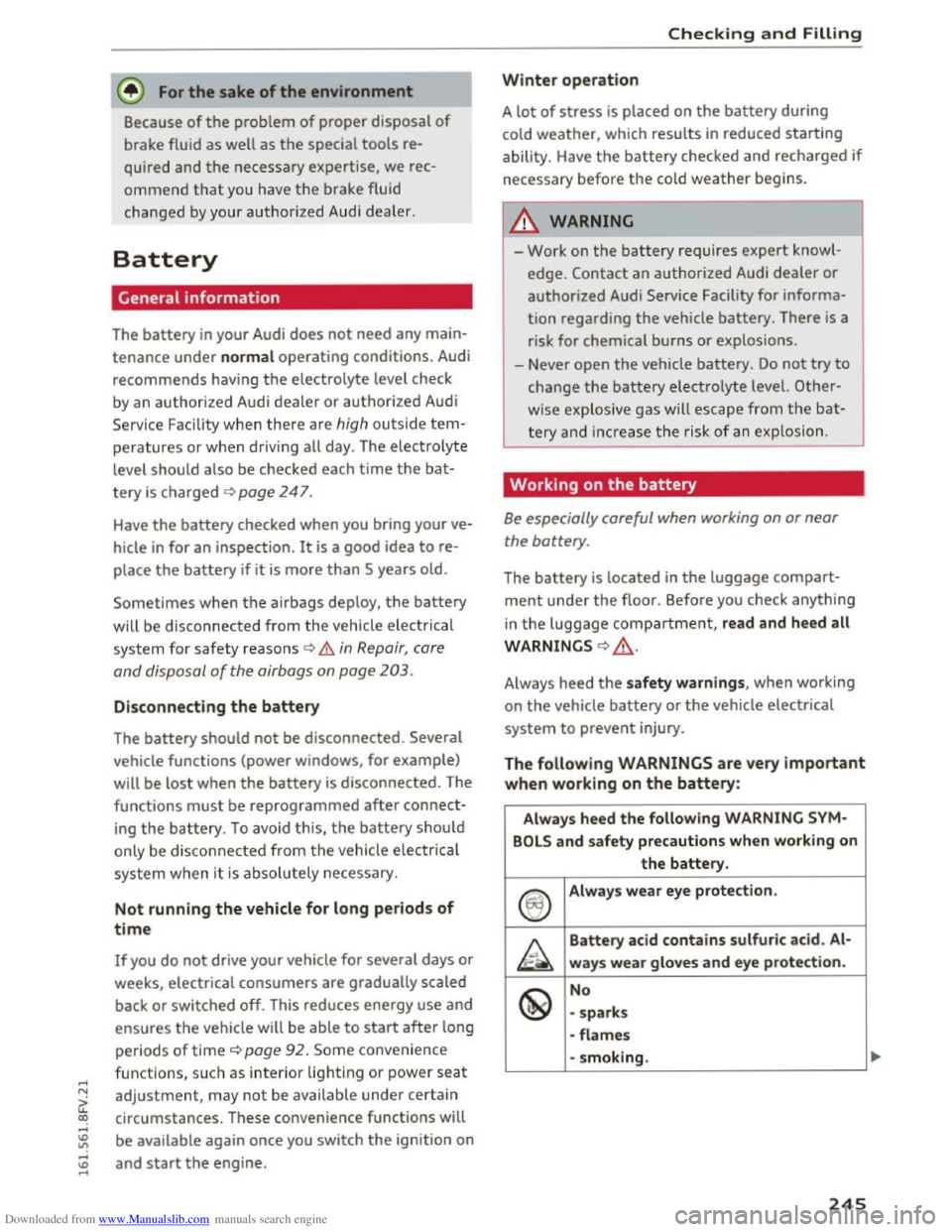
when working on the battery:
Always heed the following WARNING SYM-
BOLS and safety precautions when working on
the battery.
®
Always wear eye protection.
&
Battery acid contain s sulfuric acid. Al-
ways wear gloves and
eye protection .
@
No
- sparks
- flames
- smoking.
245
Page 248 of 322
Downloaded from www.Manualslib.com manuals search engine Checking and F illing
~
When a b attery is char ged, it pro duces
hyd rogen gas whi ch i s e xplo sive and
could
cau se pers onal injury.
®
Always kee p the battery well out of
re ach of childre n.
A WARNING
Whenever working on the ba ttery or on the
electrical system, there is the risk of injury,
accident and even fire. Read and heed the fol
lowing
WARNINGS:
- Always wear eye protection. Do not let bat
tery acid or any lead particles get on your
skin or clothing . Shield your eyes. Explosive
gases can cause blindness or other injury.
-
Battery acid contains sul furic acid. Sulfuric
acid
can cause blindness and severe burns.
- Always
wear gloves and eye protection. Do
not tilt the battery because acid could leak
out of the ventilation openi ngs.
- If you
get battery acid in your eyes or on
your skin, immediately rinse with cold wa
ter for several minutes and get medical at
tention.
-
If you should ingest any battery acid, seek
medical attention immediately.
-
Do not expose the battery to an open flame,
electric sparks or an open light.
-
Do not smoke.
-Do not interchange the positive and nega-
tive
cables.
-When working on the battery, be sure not to
short-circuit the terminals with tools or oth
er metal objects. This would cause the bat
tery to heat up very quickly, which could
lead to damage or explosion and personal
injury.
-
When a battery is charged, it produces hy
drogen gas which is explosive and could
cause personal injury .
- Always keep
the battery well out of the
reach of children.
- Before work is
done on the electrical sys
tem, disconnect the negative ground cable.
- Before
performing any work on the electri
cal
system, switch off the engi ne and igni
t i
on as well as any electrical equipment. The
246
-
negative cabl e on the battery m ust be dis
connected. If you are just going to replace a
light bulb,
then it is enough to switch off
the lights.
- Before di
sconnecting the battery, switch off
the anti-theft alarm system! Otherwise you
w ill
set off the alarm.
-
When disconnecting the battery, first dis
connect the negative cabl e and then the
positive cable.
- Before
reconnecting the battery, make sure
all electrical consumers are switched off.
Reconnect
the positive cable first and then
the negative cable. Never interchange the
cables -this could start a fire!
- Never
charge a frozen or a thawed-out bat
tery. It cou ld explode! If a battery has fro
zen,
then i t must be replaced. A discharged
b attery can freeze ove r at 32 °F (O °C).
-Make sure the vent hose is always attached
to the opening on the side of the battery .
- Never
use batteries which are damaged.
There is th e danger of an exp losion! Always
replace a da maged battery .
A WARNING
Cali fornia Proposition 65 Warning:
-
Batter y posts, ter m inals and related acces
sories contain lead a nd lead compounds,
chemicals known to the State of California
to cause cancer and reproductive problems.
Wash
hands after handling .
CD Note
-Do not disconnect the vehicle battery when
the ignition is on or when the engine is run
ning,
otherwise, you will damage electronic
components in the e lectrical system.
-If your veh icle is going to stand for a long
period of time without being driven, protect
the battery from "freezing" , otherwise it
will be damaged and will then have to be re
placed .
Page 249 of 322
Downloaded from www.Manualslib.com manuals search engine Charging the battery
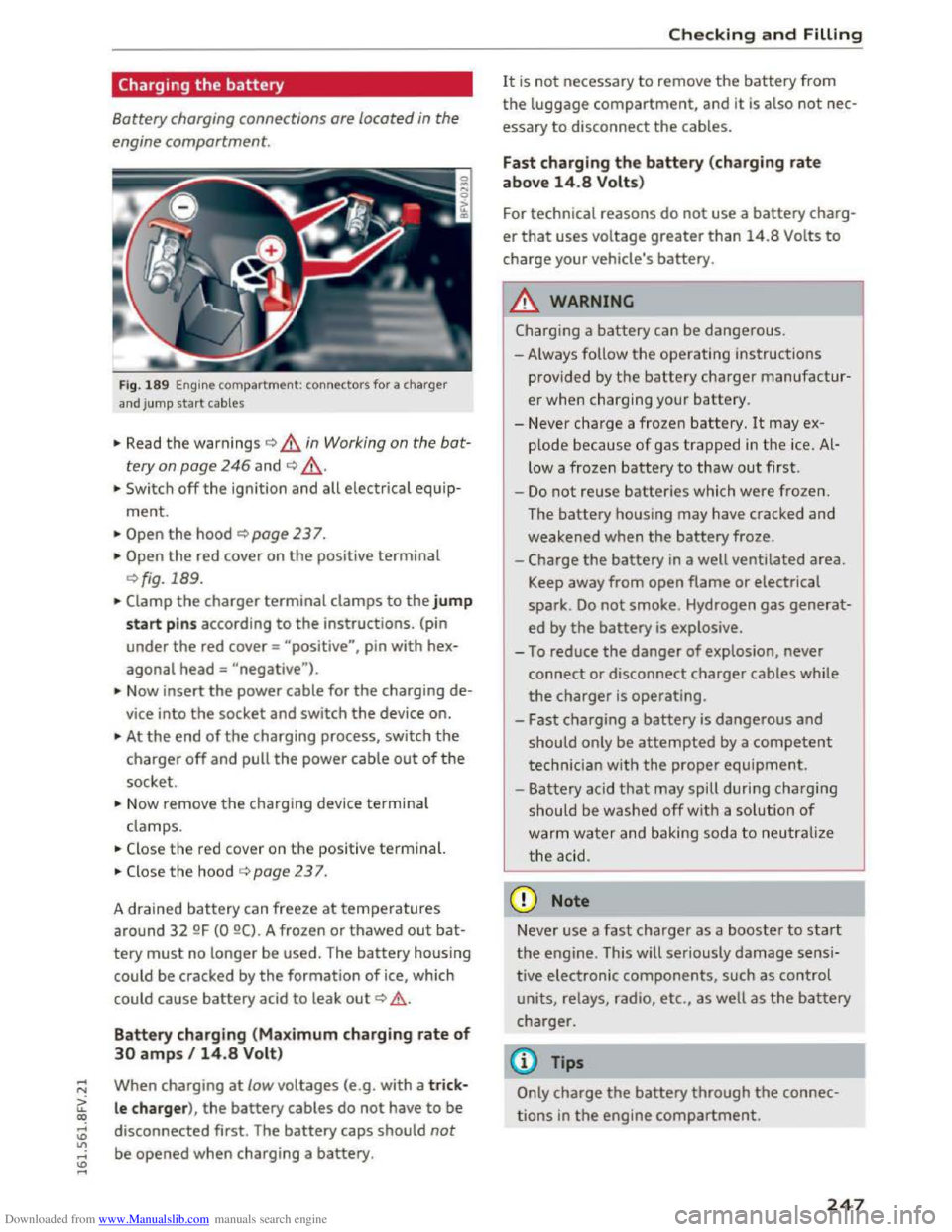
Battery charging connections are located in the
engine comportment.
Fig . 189 Engine compartment: connectors for a charger
and jump start cables
• Read the warnings ~,&.in Working on the bat
tery on page 246 and ~ ,&..
•Switch off the ignition and all electrical equip
ment.
• Open the hood ~page 23 7.
• Open the red cover on the positive terminal
~fig. 189.
•Clamp the charger terminal clamps to the jump
start pins according to the instructions. (pin
under the red cover= "positive", pin with hex
agonal head= "negative").
•
Now insert the power cable for the charging de
vice into the socket and switch the device on.
•At the end of the charging process, switch the
charger off and pull the power cable out of the
socket.
•Now remove the charging device terminal
clamps.
• Close the red cover on the positive terminal.
•Close the hood ~page 23 7.
A drained
battery can freeze at temperatures
around 32 QF (0 QC). A frozen or thawed out bat
tery must no longer be used. The battery housing
could be cracked by
the formation of ice, which
could cause
battery acid to leak out¢& .
Battery charging (Maximum charging rate of
30 amps I 14.8 Volt)
When charging at low voltages (e.g. with a trick
le charger ), the battery cables do not have to be
disconnected first. The battery caps should not
be opened when charging a battery.
Checking and Filling
It is not necessary to remove the battery from
the luggage compartment, and it is also not nec
essary to disconnect the cables.
Fast charg ing the battery ( charging rate
above
14. 8 Volts)
For technical reasons do not use a battery charg
er that uses voltage greater than 14.8 Volts to
charge your vehicle's battery.
A WARNING
!-='"
Charging a battery can be dangerous.
-Always follow the operating instructions
provided by
the battery charger manufactur
er when charging your battery.
-Never charge a froze n battery. It may ex
plode because of gas trapped in the ice. Al
low a frozen battery to thaw out first.
-
Do not reuse batteries which were frozen.
The
battery housing may have cracked and
weakened
when the battery froze.
-
Charge the battery in a well ventilated area.
Keep away
from open flame or electrical
spark.
Do not smoke. Hydrogen gas generat
ed by the battery is explosive.
-
To reduce the danger of explosion, never
connect or disconnect charger cables while
the charger is operating.
-Fast charging a battery is dangerous and
should only be attempted by a competent
technician with the proper equipment.
-Batte ry ac id that may spill during charging
should be washed
off with a so lution of
warm water and baking soda to neutralize
t
he acid.
CD Note
Never use a fast charger as a booster to start
the engine. This will seriously damage sensi
tive electronic components, such as control
units, relays, radio,
etc., as well as the battery
charger.
Tips
Only charge the battery through the connec
tions in the engine compartment.
247
Page 251 of 322
Downloaded from www.Manualslib.com manuals search engine ..... N
G: CX)
.....
"' U"I
.....
"' .....
Service interval display
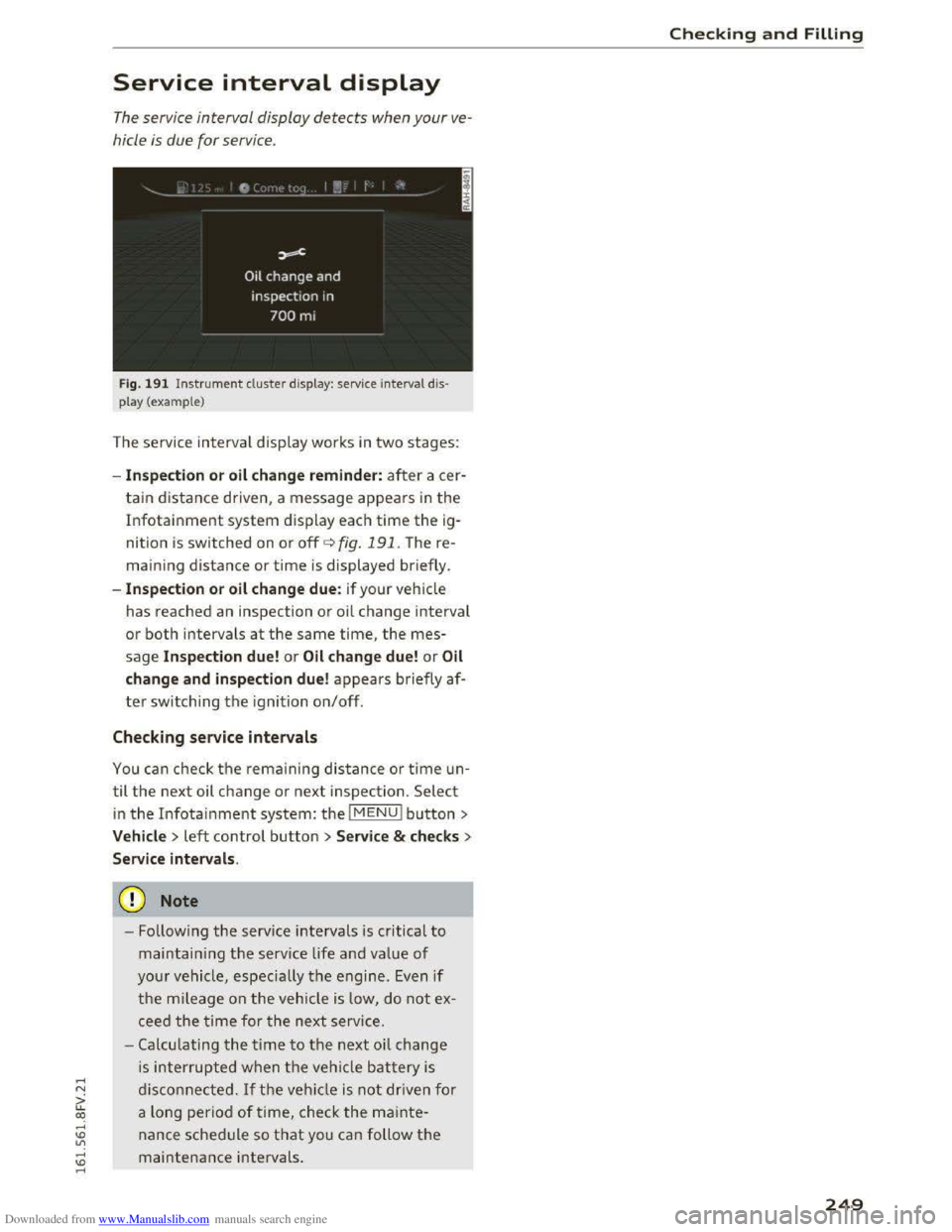
The service interval display detects when your ve
hicle
is due for service.
Fig . 191 Inst rument cluster display: serv ice in terva l d is
p lay (exa mpl
e)
The service interval display works in two stages:
-Inspection or oil change reminder: after a cer
tain distance driven, a message appears in the
Infotainment system display each time the ig
nition is switched on
or off¢ fig. 191. The re
main ing
distance or time is displayed briefly.
-Inspection or oil change due: if your vehicle
has reached an inspection or oil change interval
or both intervals at the same time, the mes
sage Inspection due! or Oil chang e due! or Oil
cha nge and inspection due! appears briefly af
ter switching the ignition on/off.
Check ing s ervice intervals
You can check the remaining distance or time un
til the next oil change or next inspection. Select
in the Infotainment system: the IMENUI button>
Vehicle > left control button > Ser vice & checks >
Service intervals .
@ Note
-Follow ing the service intervals is critical to
maintaining the service life and value of
your vehicle, especially the engine. Even if
the mileage on the vehicle is low, do not ex
ceed
the time for the next service.
- Calcu l
ating the time to the next o il change
is interrupted when the vehi cle battery is
disco n
nected. If the vehicle is not driven for
a long period
of time, check the mainte
nance schedule so that you can follow th e
maintenance intervals .
Checking and Filling
249
Page 270 of 322
Downloaded from www.Manualslib.com manuals search engine Wheels
installation of replacement or alternate tires or
wheels on the vehicle that prevent the TPM S
from functioning properly. Always check the
TPMS malfunction telltale after replacing one or
more ti
res or whee ls on your veh icle to ensure
that the replacement or alternate tires and
wheels
allow the TPMS to conti nue to functi on
p roper ly .
If the Tire Pressure Monitoring System
indicator appears
The tire pressure indicator in the instrument
cluster informs you if the tire pressure is too low
or
if there is a system malfunction.
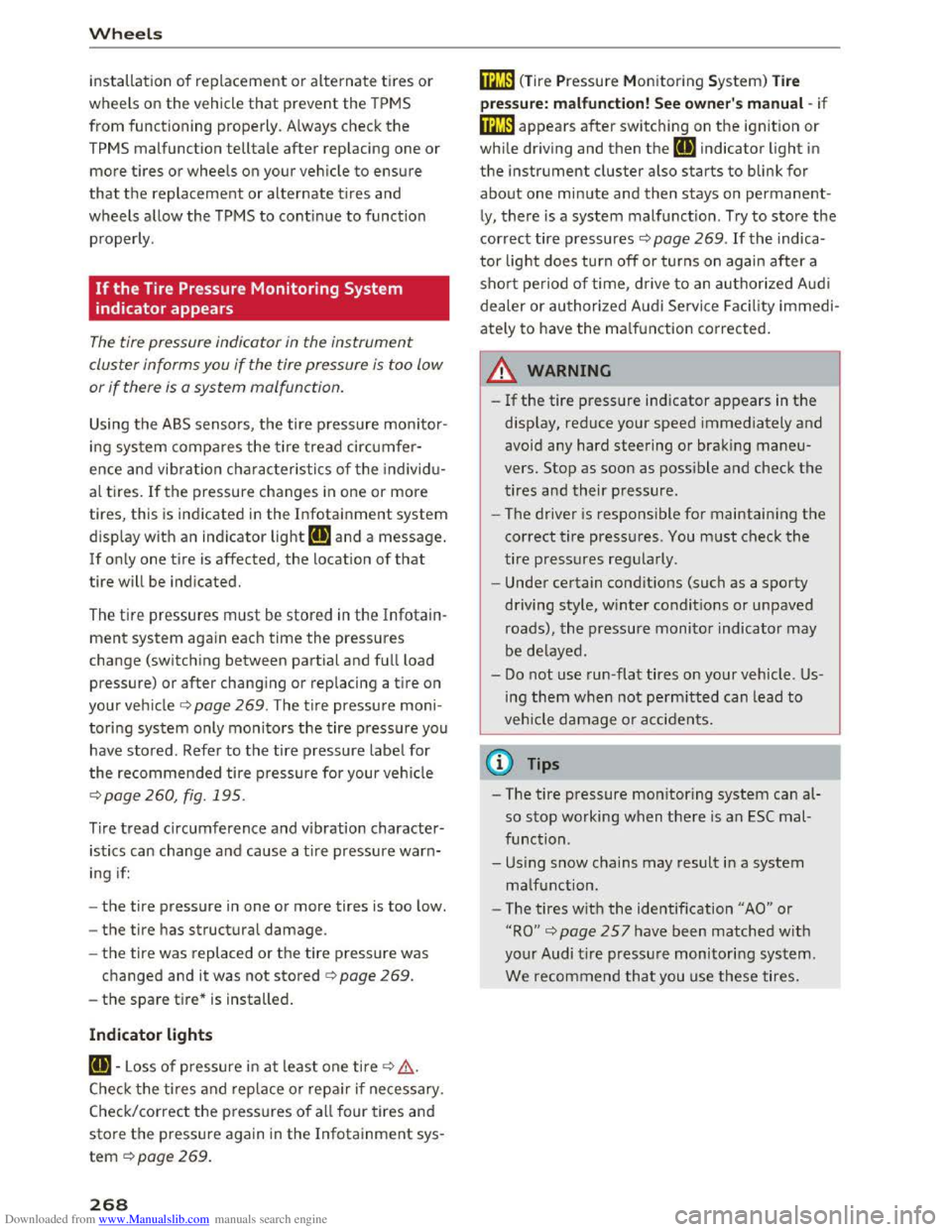
Using the ABS sensors, th e tire p ressure monitor
i n g
system compares the tire tread circumfer
ence and vibra tion char
acteristi cs of the individ u
al tires.
If the pressure changes in one or more
tires,
this i s indicated in the Infotainment system
d isp lay
with an ind icator light RI and a message .
If only one tire is affected , the location of that
tire will be ind icated.
The tire pressures must be stored in the Infotain
ment system again each time the pressu res
change (switching between partial and full load
pressure) or
after changing or replacing a tire on
your veh icle ¢ page 269. The tire pressure moni
toring system only monitors the tire pressure you
have stored. Refe r
to the tire pressure label for
the recommended tire pressure for your veh icl e
¢page260, fig.195.
Tire tread circumference and vibration character
istics
can change and cause a tire pressure warn
i n g if:
-
the tire p ressure in one or more tires is too low.
-
the tire has structural damage .
-
the tire was replaced or the tire pressure was
changed and
it was not stored¢ page 269.
-the spare tire* is installed .
Indicator lights
RI-Loss of pressure in at l east one tire ¢,&.
Check
t h e tires and rep lace or r epair if necessary.
Check/correct
the p ressures of all four tires and
store
the pressure again in the Infotainment sys
tem ¢ page 269.
268
ffim (T ire Pressure Mon itoring System) Tire
pressure: malfunction!
See owner's manual -if
m appears after switching on the ignition or
while driving and then the RI indicator light in
the instrument cluster also starts to blink for
about one minute and then stays on permanent
ly, there
is a system malfunction . T ry to store the
cor rect tire p ressures ¢ page 269. If the indica
tor light does turn off or turns on again after a
sho
rt per iod of time, d rive to an authori zed Aud i
dealer or
authorized Audi Servi ce Facility immedi
ate ly
to have the ma lfunction corrected .
.&. WARNING
-If the tire pressure indicator appears in the
display, reduce your speed immediately and
avoid any hard steering or brak ing maneu
vers.
Stop as soon as poss ible and check the
tires and
their pressure .
- The driver is responsible
for maintain ing the
correct tire pressures . You must check the
tire pressures regularly .
-
Under certain condit ions (such as a sporty
driving style, wi
nter condit ions or unpaved
roads), the pressure
monitor indica tor may
be delayed.
-
Do not use run-flat tires on your vehicle . Us
ing them when not perm itted can lead to
veh icle damage or accidents.
(D Tips
- The tire pressure monitoring system can al
so stop working when there
is an ESC mal
func tion.
-
Usi ng snow chains may result in a system
ma lfunction .
- The
tires wit h the identification "AO" or
"RO" ¢ page 2 5 7 have been matched with
your Audi tire pressu re monitor ing system .
We rec om mend that you use these tires.
Page 271 of 322
Downloaded from www.Manualslib.com manuals search engine Storing tire pressures
If the tire pressure changes or a tire is replaced,
it must be confirmed in the Infotainment sys
tem .
.,. Make sure before storing that the tire pressures
of all four tires meet the specified values and
are adapted to the load~ page 258 .
.,. Switch on the ignition .
.,. Select in the I nfo tainment system: the I MENU I
button > Vehicle > left control bu tton > Service
& checks > Tire pressure monitor.
(D Tips
Do not store the tire pressures if snow chains
are installed .
Wheels
269
Page 272 of 322
Downloaded from www.Manualslib.com manuals search engine Care and cleaning
Care and cleaning
General information
Regular, proper care helps to maintain your vehi
cle's value.
It can also be a requirement when
submitting warranty claims for corrosion damage
and
paint defects on the body .
The necessary care products
can be obtained
from your authorized Audi dealer. Read and fol
low the instructions for use on the packaging.
A WARNING
-Using cleaning and care products incorrectly
can be dangerous to your health.
-Always store cleaning and care products out
of reach of children to reduce the risk of po i
so
ning.
@ For the sake of the environment
- Preferably use environmentally-friendly
products when buying cleaning agents.
-
Do not dispose of leftover cleaning and care
products
with household trash.
Car washes
The longer that deposits remain on the vehicle,
the more the surface may be damaged. High
temperatures such
as those caused by sunlight
increase the damag ing effect.
Before washing, ri
nse off heavy deposits with
plenty of water.
Stubb orn depos its such
as bird droppings or tree
sap are best removed with plenty of water and a
microfiber cloth.
Also, wash
the underside of your vehicle once
road
salt stops being used for the season.
Pressure washers
When washing your vehicles with a pressure
washer, always
follow the operating instructions
provided
with the pressure washer. This is espe
cially
important in regard to the pressure and
spraying distance.
Do not direct the stream of
cleaning solution directly onto the side window
seals, doors, luggage
compartment lid or hood,
270
tires, rubber hoses, insulating material or sen
sors *.
Keep a distance of at least 16 in (40 cm).
Do not remove snow and ice with a pressure
washer.
Never use rotary nozzles
or high pressure noz
zles.
The
water temperature must not be above 140 °F
(60 °().
Automatic car washes
Spray off the vehicle before washing.
M a
ke su re that the windows are closed and the
windshield wipers a re off. Follow instructions
from the car was h operato r, espec ially if there
a re accessories attached
to your vehicle.
If possible, use car washes that do not have
b rushes.
Washing by hand
Clean the vehicle starting from the top and work
ing down using a soft sponge or cleaning brush.
Use solvent-free cleaning products.
Washing vehicles with matte finish paint by
hand
To avoid damaging the paint when washing, first
remove dust and large particles from your vehi
cle. Insects, grease spots and fingerprints are
bes t removed
with a special cleaner for matte
finish paint.
Apply th e p roduct using a microfiber cloth. To
avoid damagin g t he paint surface, do not use too
much pressu re.
Rinse the vehicle thorough ly with water. Then
cl e
an using a neutral shampoo and a soft micro
fiber cloth .
R i
nse the vehicle thoroughly again and let it air
dry. Remove any water residue using a shammy.
A WARNING
-Only wash the vehicle when the ignition is
off and follow the instructions from the car
wash operator
to reduce the risk of acci
dents.
Page 278 of 322
Downloaded from www.Manualslib.com manuals search engine Emergency assistance
The tire repair is only meant for temporary use.
Change the spare tire as soon as possible ¢.&..
If the tire is pierced by an object such as a nail ,
do not remove the object from the tire.
The
tire mobility kit is able to be used at temper
atures as low as - 4 °F (-20 °C).
The tire mobility kit may not be used:
-
If the t ire has cuts or punctures that are larger
than 0 .1 6 in (4 mm) CD¢ fig. 197.
-if the rim is damaged@ .
- if you drove
with very Low tire pressure or with-
out air in the tire@.
See an authorized Audi dealer or authorized Audi
Service Facility for
assistance in these situations.
& WARNING
- Please
note that the tire mobility kit cannot
be used i n all situations, and that it may on
ly be used temporarily.
- The
tire sealant must not come in contact
with skin, eyes, or clothes.
-If tire sealant gets in your eyes or on your
skin, thoroughly rinse the affected area im
mediately w ith clean water.
-Do not inhale the fumes.
-If you swallow any of the tir e sealant, thor-
oughly rinse your mouth immediately and
drink a lot of water. Do not induce vomiting.
Seek medical attention immediately.
-
Change your clothes immediately if they get
tire sealant on them.
-If an allerg ic reaction occurs, seek immedi
ate medical attention.
-Keep the tire sealant away from children .
@ Tips
-
If sealant Leak s, allow it to dry in place. You
can then peel it off like a sticker.
- Note
the expiration date on the sealant bot
tle. Replace the tire sealant at an author
ized Audi dealer or authorized Aud i Service
Facility.
- Radio reception
can be interrupted when
operating the compressor*.
-
Obey all laws.
276
Repairing tires
Applies to: vehicles with tire mobility kit
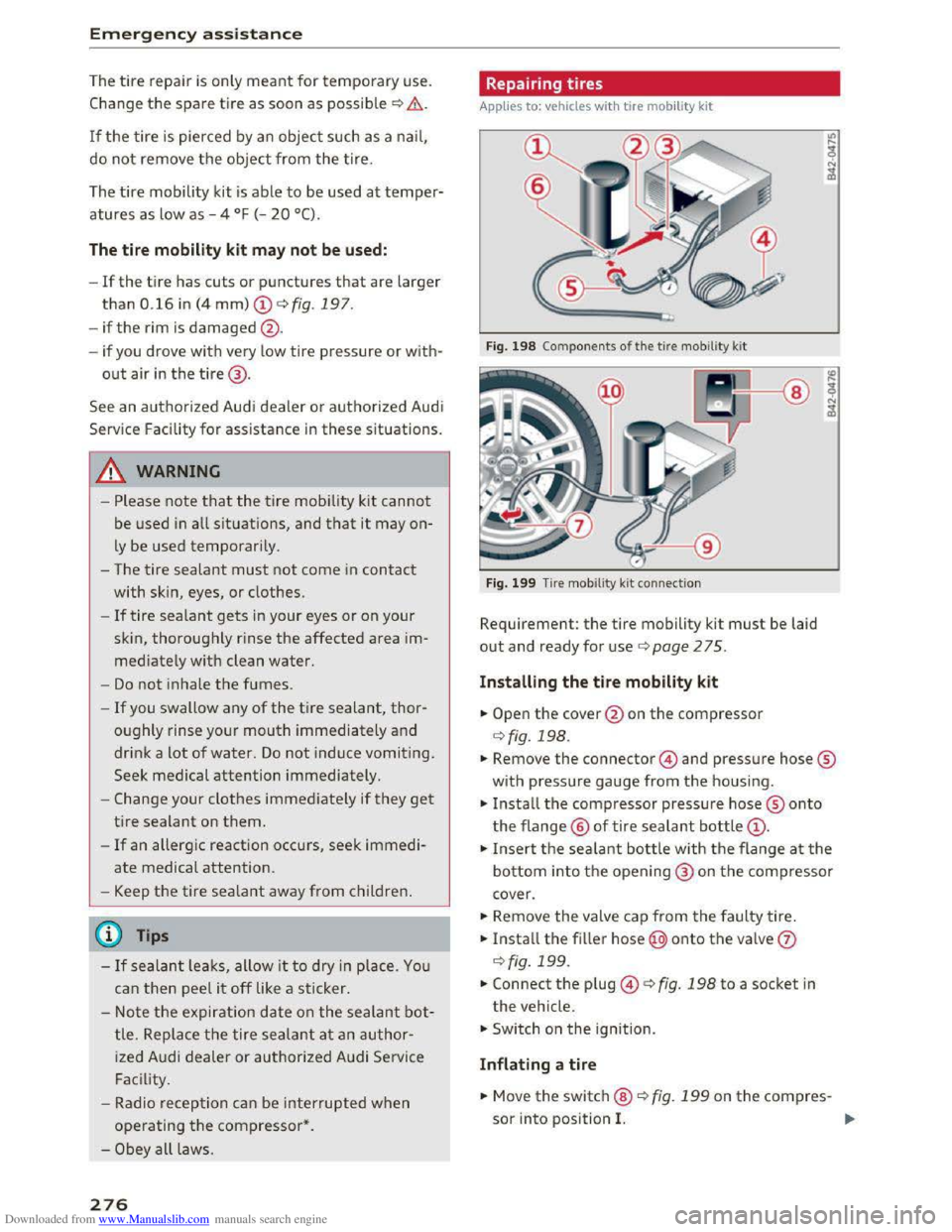
Fig. 198 Compo nents of the tire mobility kit
Fig. 199 Tire mobility ki t connection
Requirement: the tire mobility kit must be laid
out and ready for use ¢page 2 75.
Installing the tire mobility
kit
... Open the cover @ on the compressor
¢fig. 198.
... Remove the connector© and pressure hose®
with
pressure gauge from the housing.
... Install the compressor pressure hose® onto
the flange@ of tire sealant bottle@ .
.,. Insert the sealant bottle with the flange at the
bottom into the opening @ on the compressor
cover .
... Remove the valve cap from the faulty tire.
... Install th e fille r hose@onto the valve (j)
¢ fig. 199.
... Connect the plug ©<=> fig. 198 to a socket in
the vehicle .
.,. Switch on the ignition .
Inflating a tire
... Move the switch @ ¢fig. 199 on the compres-
sor into position I. ..,.
Page 287 of 322
Downloaded from www.Manualslib.com manuals search engine ...... N
~ ()()
......
"' "' ......
"' ....
Fuses and bulbs
Electrical fuses
Replacing fuses
A fuse
that has blown will have metal strips that
have burned through.
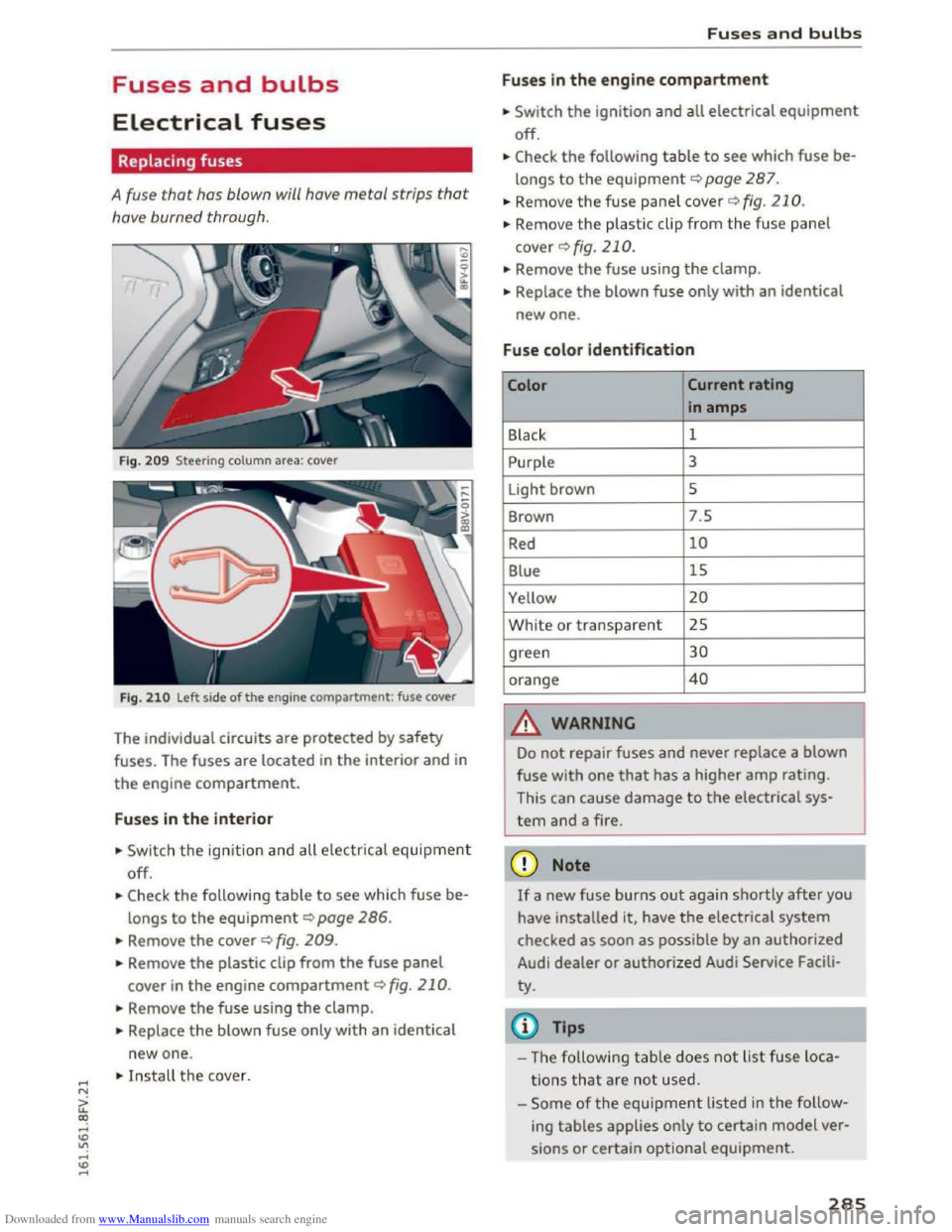
Fig. 209 Steering column area: cover
Fig.
210 Left side of the engine compartment: fuse cover
The individual circuits are protected by safety
fuses. The fuses are located in the interior and in
the engine compartment.
Fuse s in the interior
... Switch the ign ition and all electrical equipment
off .
... Check the following table to see which fuse be
longs to the equipment Q page 286.
• Remove the cover Q fig. 209.
• Remove the plastic clip from the fuse panel
cover in the engine compartment Q fig. 210.
• Remove the fuse using the clamp.
• Replace the blown fuse only with an identical
new one.
•Install the cover.
Fuses and bulbs
Fus es i n the engine compartment
... Switch the ignition and all electrical equipment
off .
... Check the following table to see which fuse be
longs to the equipment Qpage 287.
• Remove the fuse panel cover C)fig . 210.
• Remove the plastic clip from the fuse panel
coverQfig. 210.
• Remove the fuse using the clamp.
• Replace the blown fuse only with an identical
new one.
Fuse colo r identification
Color Current
rati
ng
in amps
Black 1
Purple 3
Light brown 5
Brown
7.5
Red 10
Blue 15
Yellow 20
White or transparent 25
green 30
orange 40
.&. WARNING
1-"="
Do not repair fuses and never replace a blown
fuse with one that has a higher amp rating.
This
can cause damage to the electrical sys
tem and a fire .
CD Note
If a new fuse burns out again shortly after you
have
installed it, have the electrical system
checked as soon as possible by an authorized
Audi dealer or authorized Audi Service Facili
ty.
@ Tips
-The following table does not list fuse loca
tions that are not used .
-
Some of the equipment listed in the follow
ing tables applies only to certain model ver
sions or certain optional equipment .
285
Page 289 of 322
Downloaded from www.Manualslib.com manuals search engine ..... N
G: CX)
.....
"' U"I
.....
"' .....
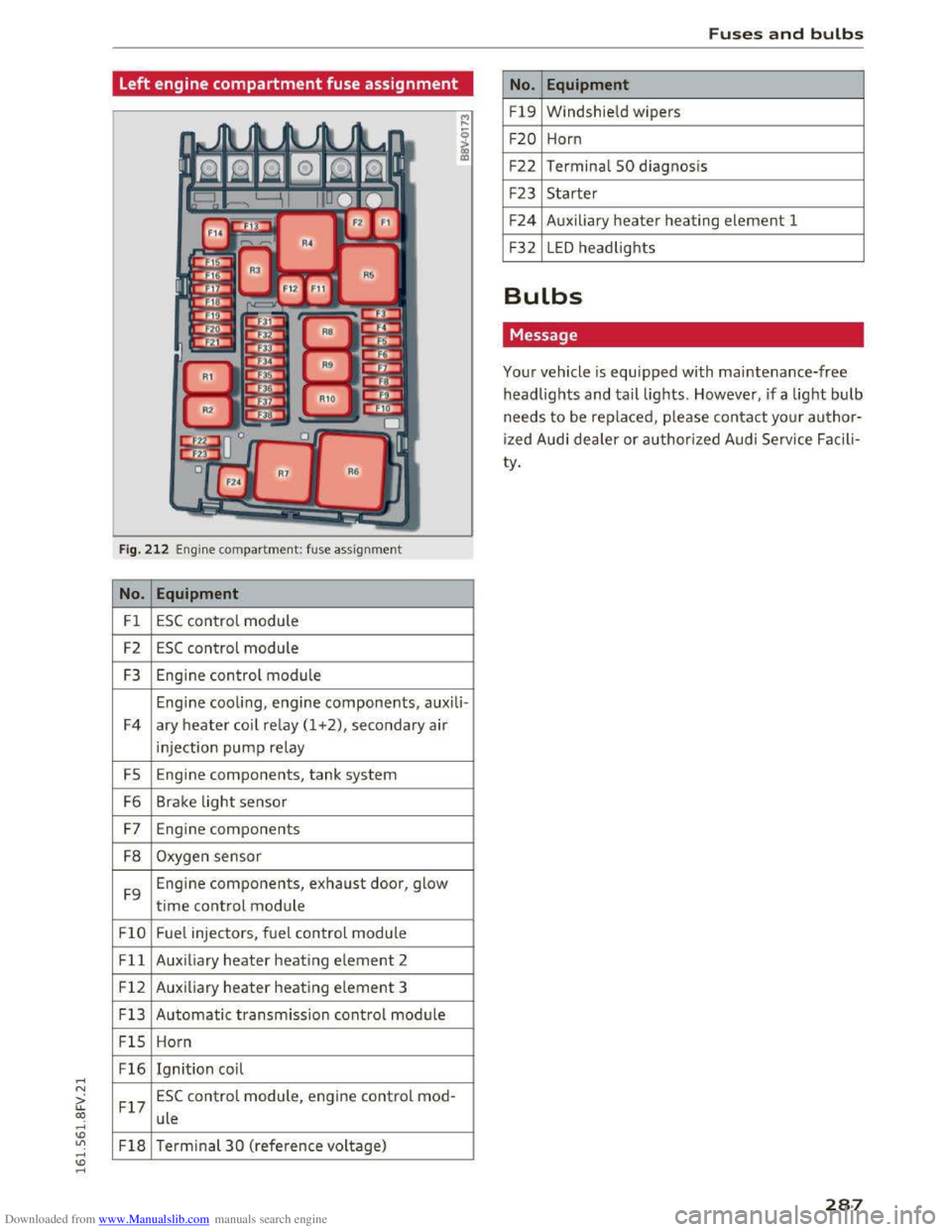
Left engine compartment fuse assignment
Fig. 212 Engine compartment: fuse assignment
No. Equipment
Fl ESC control module
F2 ESC control module
F3 Engine control module
Engine cooling, engine components, auxili-
F4 ary
heater coil relay (1 +2), secondary air
injection pump relay
FS Engine components, tank system
F6 Brake light sensor
F7 Engine components
F8 Oxygen sensor
F9 Engine
components, exhaust door, glow
time control module
FlO Fue
l injectors, fuel control module
Fll Auxiliary heater heating element 2
F 1 2 Auxiliary
heater heating e
lement 3
F13
Automatic transmission contr ol module
FlS Horn
F16 Ignition coil
F17
ESC control module, engine control mod-
ule
F18 Terminal 30 ( reference voltage)
Fuses and bulbs
No. Equipment
Fl9 Windshield wipers
F20 Horn
F22
Terminal 50 diagnosi s
F23 Starter
F24 Auxiliary heater heating element 1
F32 LED headlights
Bulbs
Message
Your vehicle is equipped with maintenance-free
headlights and tail lights. However, if a light bulb
needs to be replaced, please contact your author
ized Audi dealer or authorized Audi Service Facili
ty.
287