lock AUDI TT COUPE 2017 Service Manual
[x] Cancel search | Manufacturer: AUDI, Model Year: 2017, Model line: TT COUPE, Model: AUDI TT COUPE 2017Pages: 322, PDF Size: 79.73 MB
Page 227 of 322
co
co
.... N
" N .... 0
0
Vl c:o
@ Tips
The chi ld seats listed in categories A to C have
been statically tested by Audi only for the Ad
vanced Airbag function .
Important safety instructions for using
child safety seats
Correct use of child safety seats substantially re
duces the risk of injury in an accident!
As the driver, you are responsible for the safety
of everybody in the vehicle, especially children:
~ Always use the right child safety seat for each
child and a lways use it properly~
page 22 7.
~ Always carefully follow the child safety seat
manufacturer's instructions on how to route
the safety belt properly through the child safe
ty seat .
~ When using the vehicle safety be lt to install a
child safety seat , you must first activate the
convertible locking retractor on the safety be lt
to prevent the child safety seat from moving
~ page 232.
~ Push the child safety seat down w ith your full
weight to get the safety be lt rea lly t ight so that
the seat cannot move forward and sideways more than 1 in (2 .5 cm).
~ Secure unused safety belts on the rear seat
~ page 227.
Always remember: Even though your vehicle is
equipped with an Advanced Airbag system, all
children, especially those 12 years and younger,
should always ride in the back seat properly re
stra ined for their age and size.
_&, WARNING
Not using a ch ild safety seat , using the w rong
child sa fety seat or imp roperly installing a
child restraint increases the risk of serious
personal injury and death.
- All vehicle occupants and especia lly children
must be restrained properly whenever riding
in a vehicle . An unrestrained or improperly
restrained child could be injured by striking
the interior or by being ejected from the ve hicle during a sudden maneuver or impact.
Ch ild safety
An unrestrained or improperly restrained
child is also at greater r isk of injury or death
through contact with an inf lating airbag.
- Commercially available child safety seats
are required to comply with U.S . Federal
Motor Vehicle Safety Standard (FMVSS) 213
(in Canada CMVSS 213) .
- When buying a child restra int, select one
that fits your chi ld and the vehicle.
- Only use child restraint systems that fully
contact the flat portion of the seat cush
ion . The child restraint must not tip or
lean to either side. Audi does not recom
mend using child safety seats that rest on
legs or tube-like frames. They do not pro
vide adequate contact with the seat.
- Always heed all lega l requirements per
ta ining to the insta llation and use of child
safety seats and carefully follow the in
structions provided by the manufacturer
of the seat you are using .
- Never allow children under 4 ft
9 in (57 in/
1.45 m) to wear a normal safety belt . H ow
eve r, the rear seat in the TT Coupe is de
signed to permit children who are between
4 ft 3 in (1.3 m) and 4
ft 9 in (57 in/1.45 m)
tall to use the available three-point lap and
shoulder safety belts.
- Never let more than one child occupy a chi ld
safety seat .
- Never let babies or o lder children ride in a
veh icle while sitting on the lap of another
passenger.
- Holding a child in your arms is never a sub
stitute for a child restraint system .
- The strongest person cou ld not ho ld the
ch ild with the forces that exist in an acci
dent . The child will strike the interior of
the vehicle and can also be struck by the passenger.
- The child and the passenger can also in
jure each other in an accident.
- Never install rear-fac ing child safety seats
or infant car riers on the front passenger
seat. A child w ill be seriously injured and
can be killed when the passenger a irbag in
flates -even with an Advanced Airbag Sys
tem .
225
Page 230 of 322
Child safety
_& WARNING
Not using a child safety seat, using the wrong
child safety seat or improperly install ing a
child restra int increases the risk of serious
personal injury and death in a crash.
- Never install rear-facing child safety seats or infant carr iers on the front passenger
seat -
even with an Advanced Airbag System.
A chi ld will be seriously injured and can be
k illed when the inflating airbag hits the
child safety seat or infant carrier with great
force and smashes the child safety seat and
child against the backrest, center armrest,
door or roof
c::> page 198, Child restraints on
the front seat -some important things to
know.
- Always install rear-facing child safety seats
or infant carr iers on the rear seat.
- Never install a rear-facing child restraint in
the forward-facing direction. Such restraints
are designed for the spec ial needs of infants
and
very small children and cannot protect
them properly if the seat is forward-facing.
- If you must install a rearward fac ing ch ild
safety seat on the front passenger seat be
cause of exceptional circumstances and the
PAS SENGER AIR BAG OFF~; light does not
come on and stay on, immed iate ly install
the rear-facing child safety seat in a rear
seat ing position and have the airbag system
inspected by your Audi dealer.
- Never place or use any electrical device (such as a laptop, CD player, electronic
games device, power inverter or seat heater
for child seats) on the front passenger seat
if the device is connected to the 12-volt
socket or the cigarette lighter socket.
- If a seat heater has been retrofitted or oth
erwise added to the front passenger seat,
never install any ch ild restraint system on
th is seat.
- Make sure that there are no wet objects
(such as a wet towel) and no water or other
liquids on the front passenger seat cushion.
- Never place objects on the seat (such as a
laptop, CD player, electronic games dev ice,
power inverter or seat heater for child
228
seats). These may inf luence the electrical
capacitance measured by the capacitive pas
senger detect ion system and can also fly
around in an accident and cause serious per
sonal injury.
-Always read and heed all WARNINGS when
ever using a child restrained in a vehicle is
be ing used
c::> page 189, Safety belts,
c::>page 197, Airbag syste,n
and
c::>page 221, Important information.
Convertible child safety seats
Properly used convertible child safety seats can
help protect toddlers and children over age one who weigh between 20 and 40 lbs (9 and 18 kg)
in a crash.
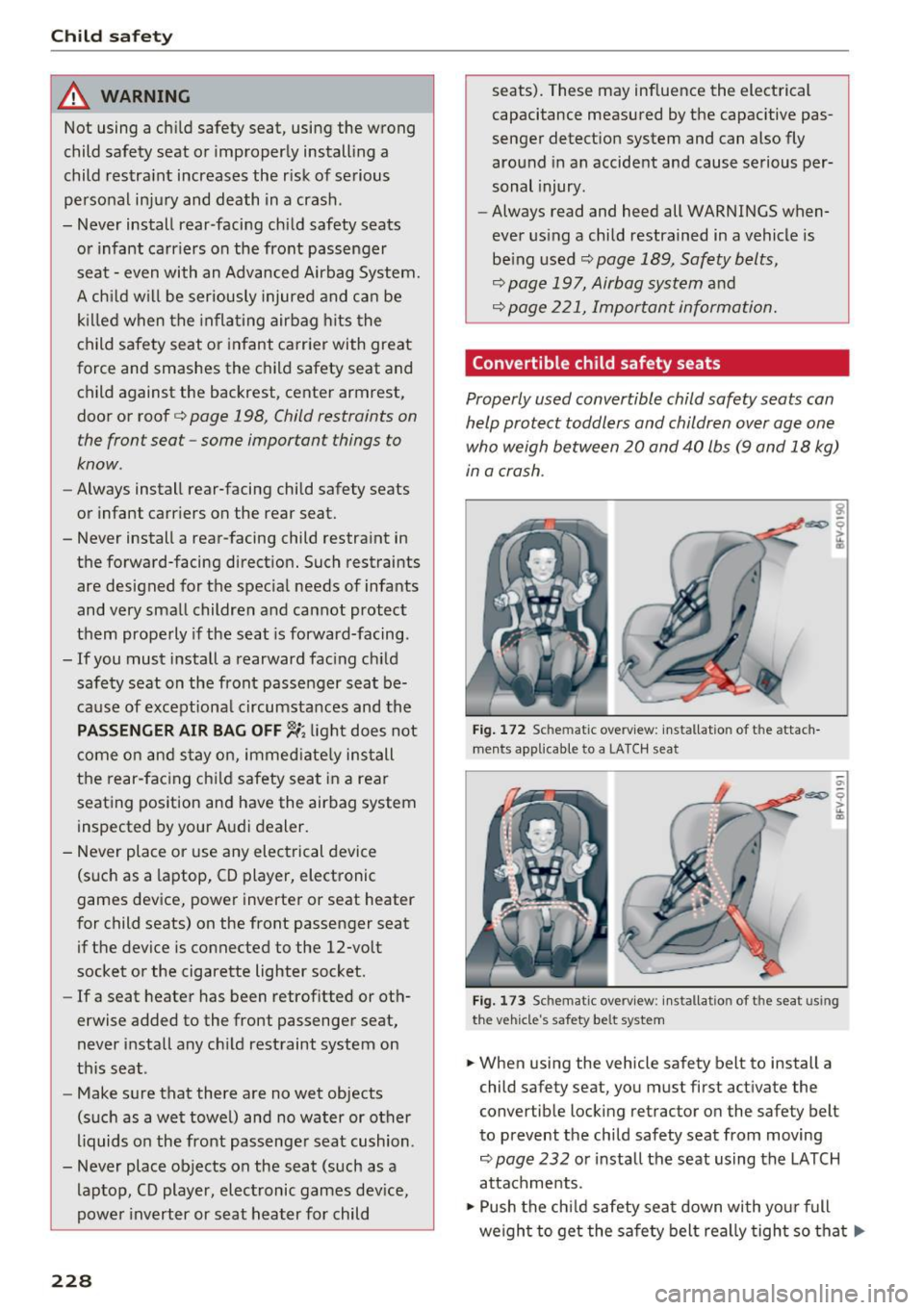
Fig . 172 Schematic overview: installat ion of the attach
me nts applicable to a LATCH seat
Fig. 173 Schemat ic overv iew: installation of the seat using
the vehicle's safety belt system
.,. When using the vehicle safety belt to install a
child safety seat, you must first activate the
convertible locking retractor on the safety belt
to prevent the child safety seat from moving
c::>page 232 or install the seat using the LATCH
attachments.
.,. Push the child safety seat down wi th yo ur full
weight to get the safety belt rea lly tight so that
Iii>
Page 232 of 322
Child safety
-If a seat heater has been retrof itted or oth
erwise added to the front passenger seat,
never install any child restraint system on
this seat .
- Make sure that there are no wet objects
(such as a wet towe l) and no water or other
liquids on the front passenger seat cushion .
- Never place objects on the seat (such as a
laptop, CD player, electronic games device,
power inverter or seat heater for child
seats) . These may influence the e lectr ica l
capacitan ce measured by the capacitive pas
senger detection system and can also fly
around in an acc ident and ca use serio us pe r
sonal injury .
- Make s ure tha t the
PASSENGER AIR BAG
OFF ~;
light comes on and stays on a ll the
time whenever the ignition is switched on.
- If the PASSENGER AIR BAG OFF 1i; light
does not come on and stay on, immediate ly
insta ll the forward-facing child seat at a
seating position on the rear seat and have
the a irbag system inspected by your author
ized Audi dealer.
- Take the ch ild restraint off the front passen
ger seat and install it properly at one of the
rear seat positions if the
PASSEN GER AIR
BAG OFF ~;
light does not stay on whenever
the ignition is switched on .
Booster seats and safety belts
Properly used booster sea ts can help protect
children weighing between about 40 lbs and
80 lbs (18 kg and 36 kg) who are less than 4 ft 9
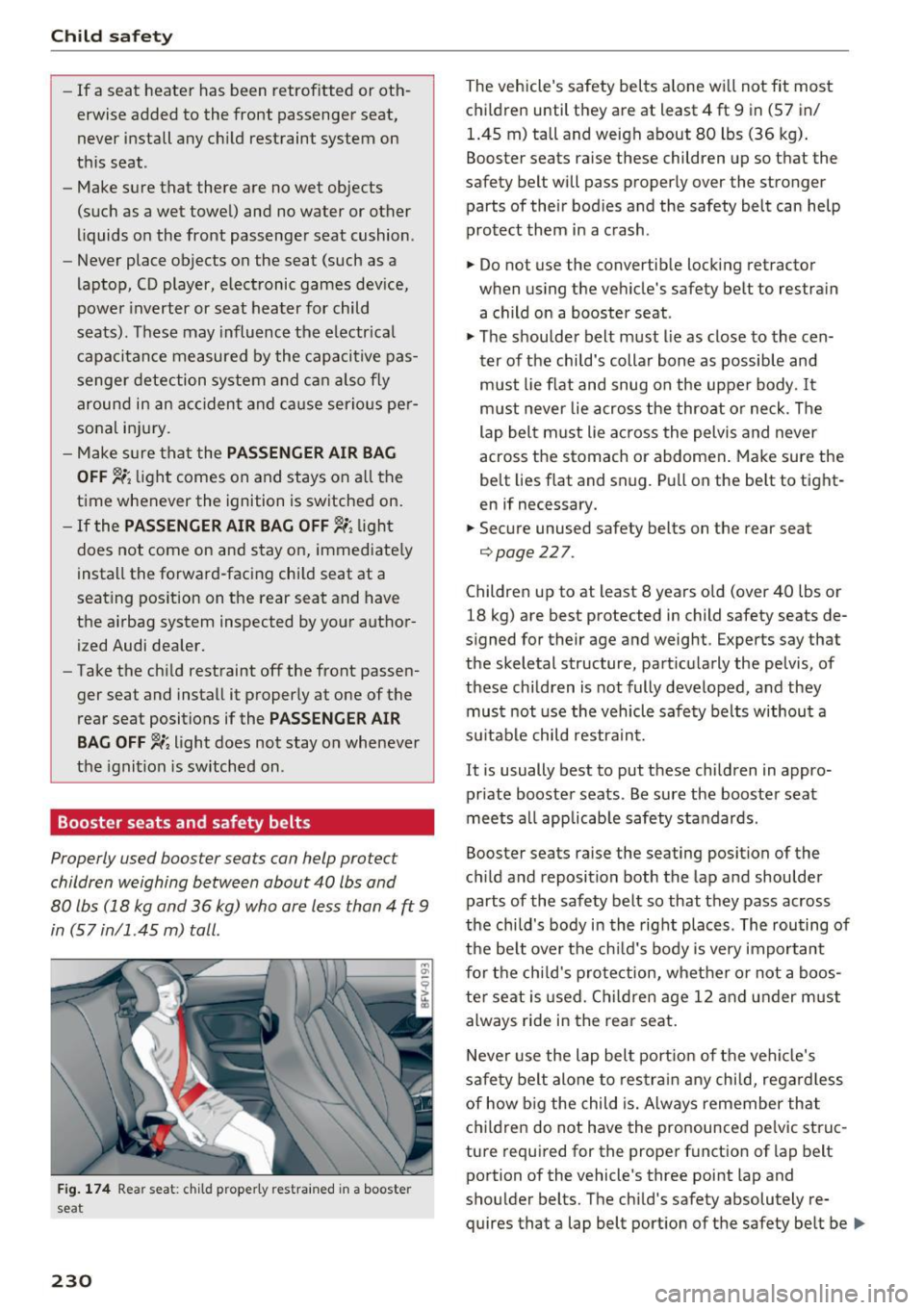
in (57 in/1 .45 m) tall.
F ig . 17 4 Rea r seat: chi ld p roper ly restra ined in a booster
seat
230
The vehicle's safety belts alone wi ll not fit most
children until they are at least 4
ft 9 in (57 in/
1.45 m) tall and weigh about 80 lbs (36 kg) .
Booster seats raise these children up so that the
safety be lt will pass properly over the stronger
parts of their bodies and the safety belt can help
protect them in a crash.
.. Do not use the convertib le locking retractor
when us ing the ve hicle's safety belt to restra in
a child on a booster seat .
.., The shoulder belt must lie as close to the cen
ter of the child's collar bon e as possib le and
must l ie flat and snug on the uppe r body.
It
must never lie across the throat or neck. The
lap belt must lie ac ross the pelvis and never
across t he stomach or abdomen . Make sure the
belt lies flat and snug. Pu ll on the belt to tight
en if necessary.
.. Secure unused safety belts on the rear seat
¢page 227.
Children up to at least 8 years o ld (over 40 lbs or
18 kg) are best protected in child safety seats de
s igned for their age and weight. Experts say that
the skeletal structure, part icu larly the pelvis, of
these children is not fully developed, and they must not use the vehicle safety belts without a
su itab le child restra int.
It is usually best to put these children in appro
pr iate booster seats . Be sure the booster seat
meets a ll applicab le safety standards .
Booster seats raise the seating position of the
c hi ld and reposition both the lap and shoulder
parts of the safety belt so that they pass across
the chi ld's body in the right places . The rou ting of
the be lt over the ch ild's body is very important
fo r the child's protection, whet he r or not a boos
ter seat is used. C hildren age 12 and under m ust
a lways ride in the rear seat.
Never use the lap belt port ion of the vehicle's
safety belt alone to restra in any child, regard less
of how b ig the child is. A lways remember that
c hi ldre n do not have the pronounced pe lvic struc
ture requ ired for the proper function of lap belt
portion of the vehicle 's three point lap and
shou lder belts. The chi ld's safety absolutely re
quires that a lap belt port ion of the safety belt be ...,
Page 234 of 322
Child safet y
use the available th ree -point lap and shoulder
safety belts .
A WARNING
-The rear seat area is too small to safe ly
transport passengers taller than 4 ft 9 in
(57 in/1.45 m).
-
- Persons taller than 4 ft 9 in (57 in/1.45 m) as well as children in booster seats who are
too close to the rear window and roof can
suffer severe head and neck injur ies when
the rear lid is closed o r in a crash.
- The m inimum clearance betwee n the pas
sengers' heads and the rear window must
never - under any circumstances - be less
than 1 in ( 2.5 cm) whe n the passenge rs s its
f ully up right .
- Always make sure tha t the rear seat passen
gers canno t be str uck when the rear lid is
cl osed.
Booster seats on the front seat
Ch ild ren aged about 7 years and older and weigh
ing more than 55 lbs (25 kg) who are between
4 ft 3 in (5 1 in/1.30 m) and 4 ft 9 in (57 in/
1.45 m) tall may in exceptional circumstances
ride on the front passenger's seat. Children less
than 4 ft 9 in (57 in/1.45 m) tall must s it on a
certified booster seat and properly wear the vehi
cle 's three-poin t lap and shoulder safety be lt .
Always securely latch the passenger seat at t he
very rear of its fore and aft adjustment range.
The bac krest must be adjusted to an upr ight po
sition .
A WARNING
If you must insta ll a booster seat ch ild re
st raint o n the fro nt passenger sea t:
- Make s ure the booster seat has been de
s igned and certified by its manufa ctu rer for
use on a front seat wit h a pas senge r fr ont
and side air bag.
- Alw ays follow the m anuf act urer's instruc
ti on s prov ided with the boos ter sea t.
232
- Always move the passenger seat to the very
rear o f its fore and aft adjustment range, as
far away from the airbag as possib le.
- Always make sure that the passenger seat is
secure ly latched in place before instal ling
the booster seat. The backrest must be ad
justed to an upr ight position .
- If the passenger seat cannot be secu rely
latched in the very rear of its fore and aft
ad justment range , then t he passenger front
airbag must be turned off with the ON / OFF
s w itch.
Securing child seats
Securing a child safety seat using a safety
belt
Safety belts for the rear seats and the front pas
senger can be locked with the convertible locking
retractor to properly secure child safety seats.
The safety belts emergency lock ing retractors for
the rear seats safety be lts and for the front pas
senger's seat safety be lt have a convert ible lock
i ng retractor for child restra ints. The safety belt
must be locked so t hat be lt webb ing ca nnot un
r eel. The retractor ca n be act ivated to lock the
safe ty belt and prevent the safety belt webbing
from loosening up dur ing no rm al driv ing. A chi ld
s a fe ty se at can on ly be prope rly insta lled when
the safety be lt is locked so that the ch ild and
c hi ld safety seat will stay in place .
Always remembe r: E ven thoug h your veh icle is
equipped wi th an Advan ced Airba g system, all
c hi ldren, especially those 12 yea rs and younger,
shou ld always ride in the back seat proper ly re
strained for their age and size .
A WARNING
Improperly installed child safety seats in
crease the r isk of serious personal injury and
death in a co llision .
-
-Always make sure that the safety be lt re
tractor is locked when installing a c hild
safety seat. An unlocked safety be lt retrac
to r cannot hold the ch ild safety seat in place
during normal d riving or in a c rash.
Page 236 of 322
Child safety
-Make sure that the PASSENGER AIR BAG
OFF 11;; light comes on and stays on all the
time whenever the ignition is switched on.
_&. WARNING
Rearward-facing child restraints:
-A child in a rearward-facing child safety seat installed on the front passenger seat will be
seriously injured and can be killed if the
front airbag inflates - even with an Ad
vanced Airbag System.
- The inflating airbag will hit the child safety
seat or infant carrier with great force and
will smash the child safety seat and child
against the backrest, center armrest, door
or roof.
-Always be especially careful if you must in
stall a rearward facing child safety seat on
the front passenger seat in exceptional cir
cumstances.
- Make sure that the
PASSENGER AIR BAG
OFF 11;; light comes on and stays on all the
time whenever the ignition is switched on.
-If the PASSENGER AIR BAG OFF~; light
does not come on and stay on, immediately
install the rear-facing child safety seat in a
rear seating position and have the airbag
system inspected by your Audi dealer.
Activating the convertible locking retractor
Use the convertible locking retractor to secure a
child restraint.
Always heed the child safety seat manufacturer's
instructions when installing a child restraint in
your vehicle. To activate the convertible locking
retractor:
.,. Place the child restraint on a seat, preferably
on the rear seat.
.,. Slowly pull the belt
all the way out.
.,. Route it around or through the child restraint
belt path
¢ _A .
.,. Push the child safety seat down with your full
weight to get the safety belt really tight .
.,. Insert the belt tongue into the buckle for that
seating position .
234
.,. Guide the safety belt back into the retractor un
til the belt lies flat and snug on the child safety
seat.
.,. You should hear a "clicking" noise as the belt
winds back into the inertia reel. Test the con
vertible locking retractor by pulling on the belt .
You should no longer be able to pull the belt
out of the retractor. The convertible locking re
tractor is now activated.
.,. Make sure that the red release button is facing
away from the child restraint so that it can be
unbuckled quickly.
.,. Pull on the belt to make sure the safety belt is
properly tight and fastened so that the seat
cannot move forward and sideways more than
1 in (2.5 cm).
_&. WARNING
Using the wrong child restraint or an improp
erly installed child restraint can cause serious
personal injury or death in a crash.
- Always make sure that the safety belt re
tractor is locked when installing a child
safety seat. An unlocked safety belt retrac
tor cannot hold the child safety seat in place
during normal driving or in a crash.
-Always buckle the child safety seat firmly in
place even if a child is not sitting in it. A
loose child safety seat can fly around during
a sudden stop or in a crash.
- Always make sure the seat backrest to which
the child restraint is installed is in an up
right position and securely latched into
place and cannot fold forward. Otherwise,
the seatback with the child safety seat at
tached to it could fly forward in the event of
an accident or other emergency situation .
- Always read and heed all WARNINGS when
ever using a child restrained in a vehicle is
being used
¢ page 221. Special precautions
apply when installing a child safety seat on
the front passenger seat
¢ page 198, Child
restraints on the front seat -some impor
tant things to know.
Page 237 of 322
co
co
.... N
" N .... 0
0
Vl c:o
Deactivating the convertible locking
retractor
The convertible locking retractor for child re
s traints will be deactiv ated automatically when
t he belt is wound all the way back into the re
tractor.
" Press the red button on the safety belt buckle.
T he belt tongue will pop o ut of the buckle .
" Guide the safety belt a ll the way back into its
stowed position.
Always let the safety belt retract complete ly into
its stowed position . T he safety belt can now be
used as an o rdinary safety be lt without the con
vertible locking retractor for child restra ints .
If the convert ible lock ing retractor should be ac
tivated inadve rten tly, the safe ty belt must be un
fastened and guided completely back into its
stowed position to deactivate this feature . If the
convertible locking retractor is not deactivated,
the safety belt w ill gradually become tighter and
uncomfortable to wear.
A WARNING
-
Improperly installed child safety seats in
crease the risk of serious personal injury and
death in a collision.
- Never unfasten the safety belt to deactivate
the convert ible locking retractor for child re
st raints while the vehicle is moving. You
would not be restrained and co uld be seri
o usly injured in an accident.
- Always read and heed all WARN INGS when
ever using a child restr ained in a veh icle is
being used
i=;, page 221. Spec ia l precaut ions
apply when installing a child safety seat on
the front passenger seat
¢ page 198, Child
restraints on the front seat -some impor
tant things to know .
Child safety
LATCH system (lower
anchorages and tethers
for children)
Child Restraint System anchors and how
are they related to child safety
To p rovide a s imp ler and more practicab le way to
attach the ch ild rest raint o n the vehicle seat,
Federal regulations require spec ial lower ancho
rages in vehicles and devices on new ch ild re
straints to attach to the vehicle anchorages.
T he combinatio n of t he tether anchorages and
t h e lowe r anchorages is now generally called the
LATCH system for " Lower Anchorages and
T ethers for C hild ren." In Canada, the terms "top
tethe r" with "lower universal anchorages" (or
"lower universa l anchorage bars") are used to de
scribe the system.
Forward-facing chi ld restrain ts manufactured af
ter September
1, 1999, are required by U.S. fed
era l reg ulations to comply with new child head
movement performance requ irements. These
new performance requ irements make a tether
necessary on most new child seats .
Installing a ch ild restraint that requires a top
tether without one can seriously impair the per
formance of the ch ild restraint and its ab ility to
protect the child in a collision . Installing a child
restra int that requires a top tether without the
top tether may be a violat ion of state law.
Child restra int manufacturers offer LATCH lower
anchorages on their child seats w ith hook -on or
push-on connecto rs attached to adjustable
straps .
In add ition to the LATCH lower anchorages, these
child restraint systems usually requ ire the use of
tethe r straps to help keep the child restra int
firmly in p lace .
A WARNING
Imp roper installation of child restra ints w ill
i nc rease the risk of injury and dea th in a
crash.
235
Page 239 of 322
co
co
.... N
" N .... 0
0
Vl c:o
Please remember that the lower anchorage
points are only intended for installation and at
tachment of child restraints specifically cert ified
for use with
LATCH lower anchorages. Child re
straints that are not equipped with the lower an
chorage attachments can still be installed in
compliance w ith the child restra int manufactur
er 's instructions on using vehicle safety belts .
.8, WARNING
Improper use of LATCH lower anchorages can
cause serious personal injury in an accident.
- Always caref ully follow the child restra ints
man ufactu rer's inst ructions for proper in
sta llation of the child restr aint and proper
u se of the lower anchorages or safety be lts
in your vehicle.
- Never secure or attach any luggage or other
items to the
LATCH lower anchorages.
- Always read and heed t he important infor
mation about child restraints in this chapter
and WARNINGS
¢ page 221, Child safety .
Installing a child restraint with LATCH
lower anchorages
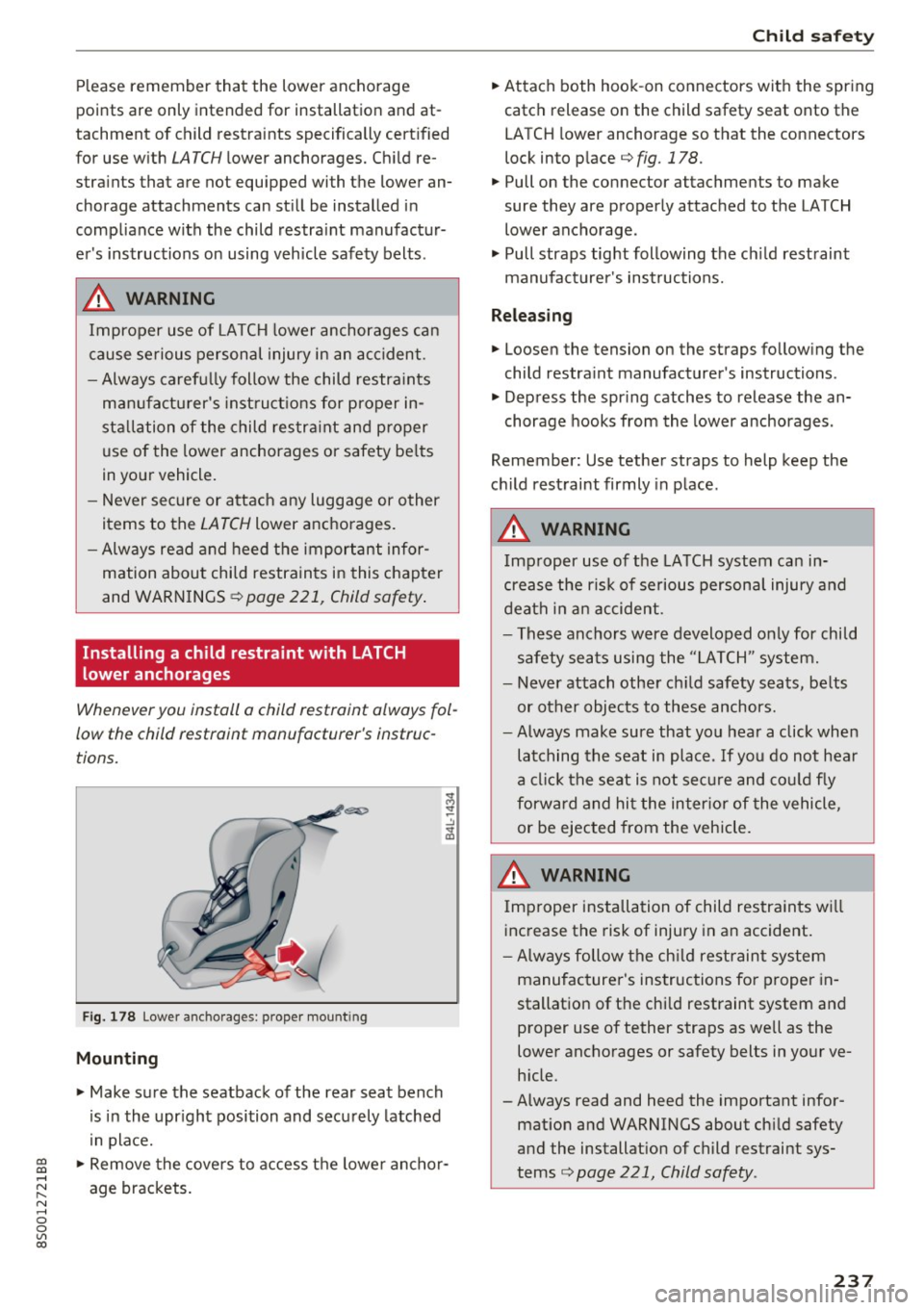
Whenever you install a child restraint always fol
low the child restraint manufacturer's instruc
tions.
F ig . 178 Lower anchorages: proper mounting
Mounting
.,. Make sure the seatback of the rear seat bench
is in the upr ight position and sec urely latched
i n place.
.,. Remove the covers to access the lowe r anchor
age brackets.
Ch ild safety
.. Attach both hook-on connectors with the spring
catch release on the child safety seat onto the
LATCH lower anchorage so that the connectors
lock into place ¢
fig. 178 .
.. Pull on the connector attachments to make
sure they are properly attached to the LATCH
lower anchorage .
.. Pull straps tight following the ch ild rest raint
manufacturer 's instructions .
Releas ing
.. Loosen the tension on the straps fo llow ing the
child restra int manufacturer's instructions.
.. Depress the spr ing catches to release the an
chorage hooks from the lower anchorages.
Remember: Use tether straps to help keep the
child restraint firmly in place .
.8, WARNING
--Improper use of the LATCH system can in
crease the risk of se rious persona l injury and
death in an accident .
-
-These anchors were developed only for chi ld
safety sea ts using the "LATCH" system.
- Never attach othe r ch ild safety seats, be lts
or other objects to these anchors.
- Always make sure that you hear a click whe n
latching the seat in place.
If you do not hear
a cl ic k the seat is not se cure and co uld fly
forward and hi t the inter ior of the vehicle,
or be ejected from the vehicle .
.8, WARNING ~ -
I mp roper insta llation of child restra ints w ill
increase the risk of injury in an accident.
- Always fo llow the ch ild restraint system
manufacturer's instructions fo r proper in
stallation of the chi ld restraint system and
proper use of tether straps as well as the
lowe r anchorages or safety belts in yo ur ve
h icle .
-Always read and heed the important infor
mat ion and WARNINGS about ch ild safety
and the installation of child restraint sys
tems¢
page 221, Child safety .
237
Page 243 of 322
co
co
.... N
" N .... 0
0
Vl c:o
-If you are unable to determine whether or
not a particular fuel blend meets the speci
ficat ions, ask your service station or its fuel
supplier.
- Do not use fuel for which the contents can
not be identified.
- Fuel system damage and performance prob
lems resulting from the use of fue ls diffe r
ent from those specified are not the respon
s ibility of Audi and are not covered under
the New Veh icle or the Emiss ion Control
System Warrant ies .
- If you experience a loss of fue l economy or
driveability and pe rformance problems due
to the use of one of these fuel blends, we r ecommend that you switch to unblended
fuel.
Gasoline additives
A ma jor concern among many auto manufactur
ers is carbon deposit build-up ca used by the type
of gasoline yo u use.
A lt hough gasoline grades d iffer from one manu
facturer to another, they have cer tain things in
common . A ll gasoline grades contain substances
that can cause deposits to collect on vita l engine
parts, such as fue l injectors and intake valves. Al
though most gasoline brands include additives to
keep engine and fuel systems clean, they are not
equally effective .
Aud i recommends using TOP TIER Detergent Gas
oline. For more informat ion on TOP TIER Dete r
gent Gasoline, please go to the official website
(www.toptiergas .com) .
After an extended period of using inadequate
fuels, carbon deposit build-ups can rob your en
g ine of peak performance.
CD Note
Damage or malfunction due to poor fuel q ual
ity is not covered by the Aud i New Vehicle
Limited Warranty.
Ch eck ing and Filling
Refueling
Fuel filler neck
The fue l filler neck is located on the rig ht rea r
s ide panel behind the fuel fille r flap .
If the power lock ing system shou ld fail, yo u can
st ill open the flap manually -fo r detailed instruc
tio ns see
9 page 243.
You can find the fuel tank capacity of your vehicle
i n
c::;, page 299.
The label on the inside of the f uel fi ller flap tells
you the correct fuel for your vehicle. For more in
f ormat ion about fuel spec ificat ions, see
9 page 240.
Your vehicle fuel tank has an onboard refue lling
vapor recovery system. This feature helps to pre
vent fuel vapors from escaping from the tank and
polluting the environme nt wh ile you refue l yo ur
vehicle . In order to fill the tank p roper ly w hile
pro tect ing t he e nvir onment, p lease follow t his
r efue ling p rocedure ca refully.
_& WARNING
Un der normal opera ting co nd it io ns, neve r car
r y additional f uel con tainers in your car. Gas
canisters and other containers used to trans
port fue l can be dange rous. Such containe rs,
f ull or empty, may leak and could cause a fire
i n a co llision. If you must transpo rt fuel to
use for your lawn mower, snow blower, etc .,
be ve ry careful and always observe local and
sta te laws rega rding the use, transportation
and storage of su ch f uel con tainers. Make cer
t ai n t he co ntain er meets industry standards
(ANSI/AS TM F8S2 -86).
CD Note
Neve r drive your veh icle until the fue l tank is
complete ly empty. The irreg ular s upply of
f u el can cause misfiring. Gasol in e c ould enter
the e xhaust sys tem an d damage the cat aly tic
conve rter.
241
Page 244 of 322
Checking and Filling
Fueling procedure
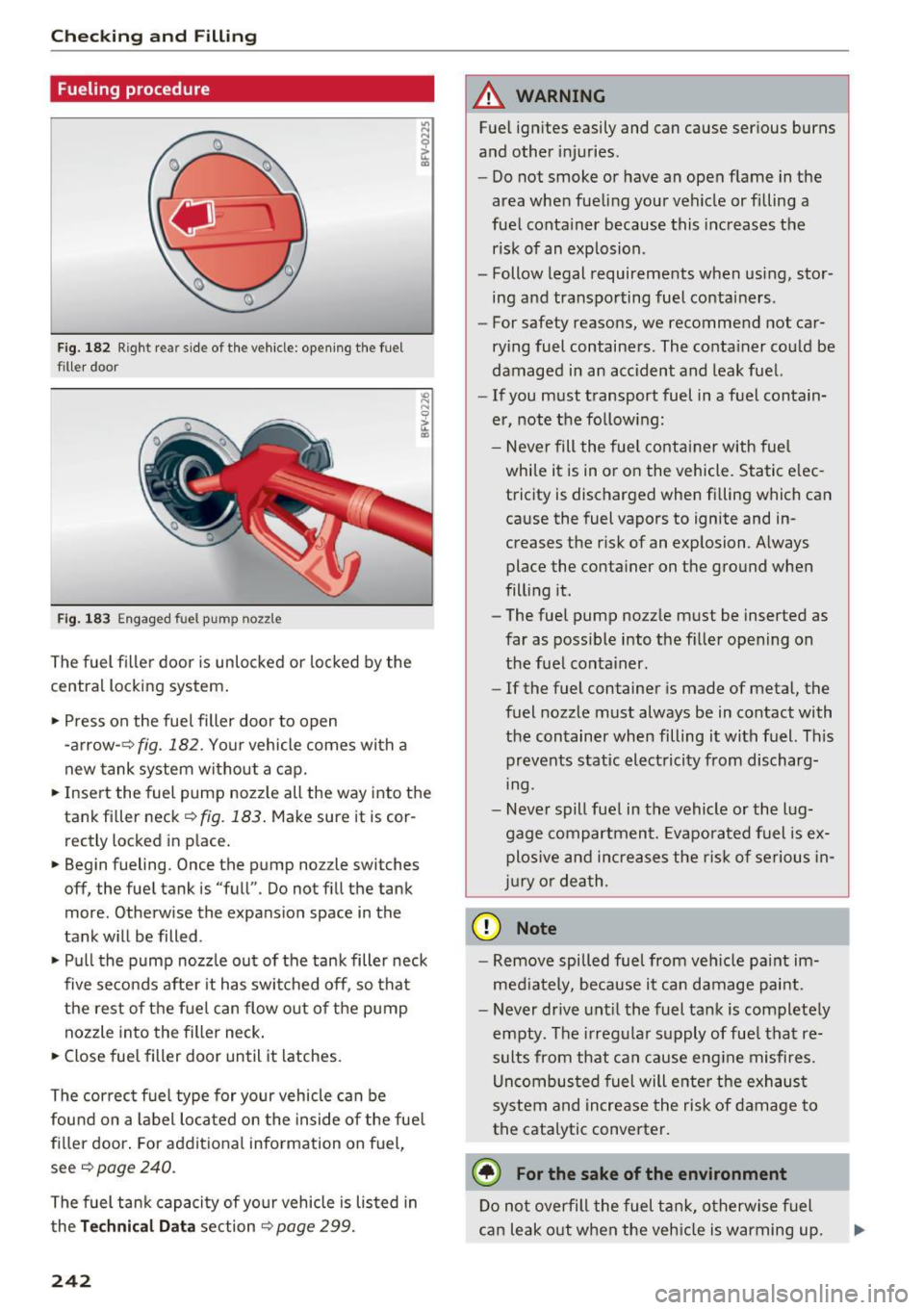
Fig. 182 Right rear side of the vehicle: opening the fue l
filler door
Fig . 183 Engaged f uel pu mp noz zle
The fuel filler door is unlocked or locked by the
central locking system .
• Press on the fue l filler door to open
-arrow- ~fig.182. Your vehicle comes with a
new tank system witho ut a cap.
• Inse rt the fuel pump nozz le all the way into the
tank fi ller neck
~ fig . 183. Make sure it is cor
rectly locked in place.
• Begin fueling. Once the pump no zzle switches
off, the fuel tank is "full" . Do no t fill the tank
more . Otherwise the expansion space in the
tank w ill be filled .
• Pu ll the pump nozz le out of the tank filler neck
five seconds after it has switched off, so that
the rest of the f uel can flow o ut of the pump
nozzle into the filler neck .
• Close fuel filler door until it latches.
The correct f uel type for your vehicle can be
found on a label located on the inside of the fue l
fi ller door. For additiona l info rmation on fuel,
see
~ page 240.
The f uel tank capacity of yo ur vehicle is listed in
the
Te chnical Data section ~ page 299.
242
A WARNING
Fuel ignites easily and can cause serious burns
and other injuries.
- Do not smoke or have an open flame in the
area whe n fueling your vehicle or filling a
fuel conta iner because this increases the
risk of an explosion .
- Follow legal requirements when using, stor
ing a nd transporting fuel containers .
- For safety reasons, we recommend not car
rying fuel containers. The conta iner could be
damaged in an accident and leak fuel.
- If you must transport fuel in a fuel contain
er, note the following:
- Never fill the fuel container with fue l
while it is in or on the vehicle. Static e lec
tricity is discharged when fi lling which can
cause the fuel vapors to ignite and in
creases the risk of an exp losion. A lways
place the conta iner on the ground when
fill ing it .
- The fuel pump nozzle must be inserted as
far as possible into the filler opening on
the fuel container .
- If the fuel container is made of metal, the
fuel nozzle must always be in contact with
the container when filling it with f uel. Th is
prevents static electricity from discharg
ing .
-Never spill fuel in the vehicle or the l ug
gage compartment. Evaporated fuel is ex
plosive and increases the ris k of se rious in
ju ry o r dea th .
(D Note
- Remove spilled fue l from veh icle pa int im
media tely, because it ca n damage paint .
- Never drive unt il the fuel tank is completely
empty . The irregular supply of fue l that re
sults from that can cause eng ine misfires.
Uncombus ted fuel will ente r the exh aus t
system and increase the risk of damage to
the cata lytic converter.
@) For the sake of the environment
Do not overfill the fuel tan k, otherwise f uel
can leak o ut when the veh icle is warming up.
Page 245 of 322
CD
CD
.... N
" N ...... 0
0
Ill co
(D Tips
If adverse weather conditions cause the fuel
filler door to freeze shut, press on the center
of the f iller door with the hee l of yo ur hand
and then try opening it again.
(D Tips
- Your vehicle is equipped with a misfueling
guard. It allows the veh icle to be fueled on
l y w ith the correct fuel pump nozzle .
- A worn or damaged nozzle or a nozz le that
i s too sma ll may not be ab le to open the
diesel misfueling guard. If this is the case,
try turning the nozzle before insert ing it in
the fue l filler neck, use a different fuel
pump, o r see an autho rized Aud i dea ler or
a uth o riz ed Aud i Serv ice F acili ty fo r ass is
tan ce.
- The misfueling g uard does not open when
adding fue l from a f ue l conta iner. When re
fueling with a reserve can iste r, you mus t
use the funne l sto red in the luggage com
partment¢
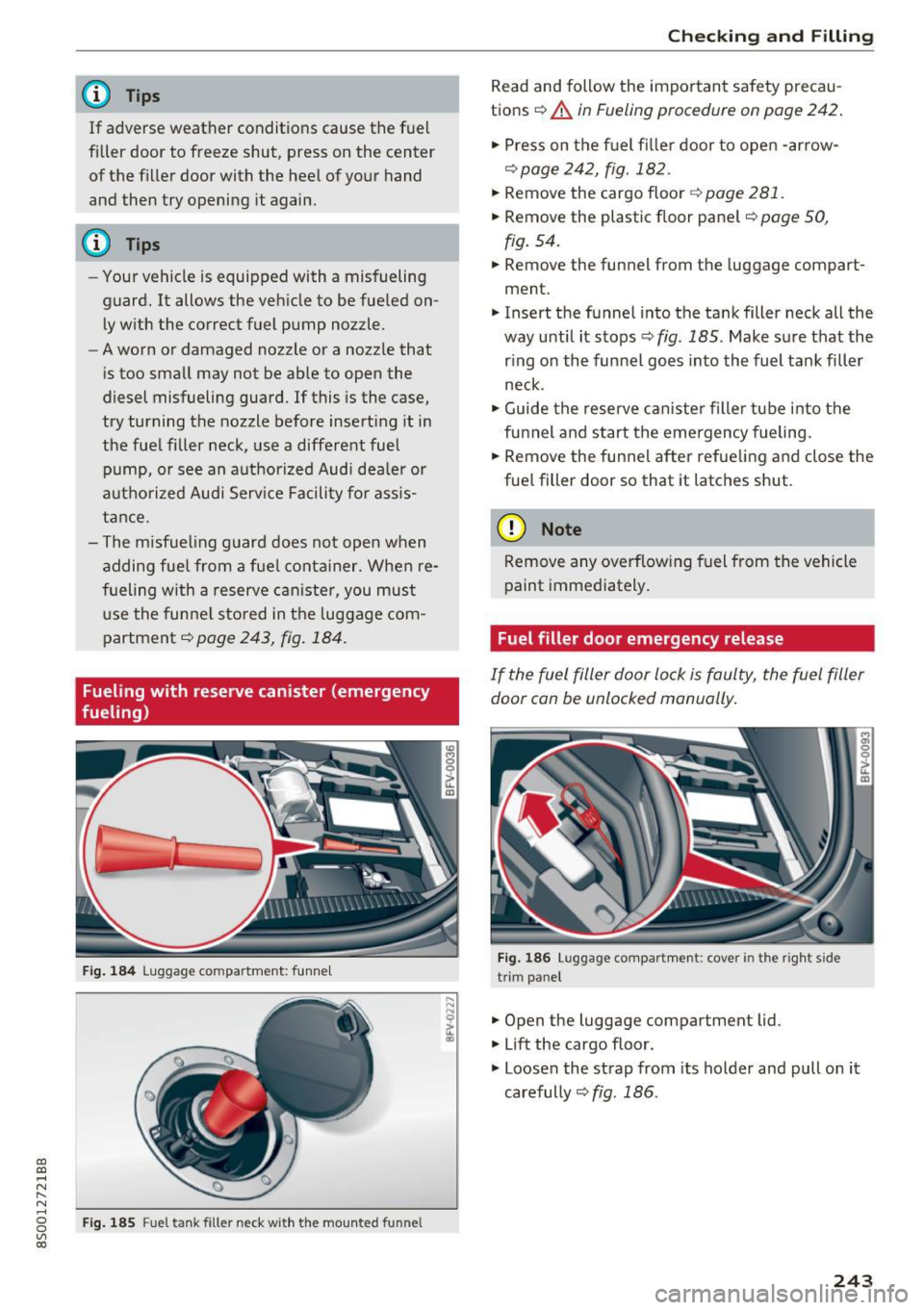
page 243, fi g. 184.
Fueling with reserve canister (emergency
fueling)
Fi g. 184 Luggage co mpa rtment: f unnel
Fig. 185 Fuel tank filler neck w it h th e mo unted fu nne l
Checking and Filling
Read and follow the impor tan t safety precau
tions¢
A in Fueling procedure on page 242 .
" Press on the f uel fi ller door to ope n -ar row-
¢ page 242, fig.182.
" Remove the cargo floor ¢ page 281.
" Remove the plastic f loor pane l¢ page 50,
fig. 5 4.
" Remove the funnel from the luggage compart
ment.
" Insert the funnel into the tank filler neck all the
way u ntil it stops
¢fig . 185. Make su re that the
r ing on the fun ne l goes into the fuel t ank filler
neck .
" Guide the reserve ca niste r filler tube into t he
fu nnel and s tart the eme rgency fueling.
" Remove the funnel afte r refueling and close the
fue l filler door so that it latches shut.
(D Note
Remove any overflow ing fuel from the vehicle
p aint immediately .
Fuel filler door emergency release
If the fuel filler door lock is faul ty, the fuel filler
door con be unlocked manually.
Fig. 1 86 Luggage co mpa rt m ent: cove r in the right sid e
trim pa nel
" Open the luggage compartment lid .
" Lift the cargo floor.
" Loose n the st rap from its ho lder and pull on it
carefully¢
fig. 186 .
243