lock AUDI TT COUPE 2017 Workshop Manual
[x] Cancel search | Manufacturer: AUDI, Model Year: 2017, Model line: TT COUPE, Model: AUDI TT COUPE 2017Pages: 322, PDF Size: 79.73 MB
Page 247 of 322

CD
CD
.... N
" N .... 0
0
Ill co
-Engine exhaust, some of its constituents,
and certain vehicle components contain or
emit chemicals known to the State of Cali
fornia to cause cancer and birth defects and
reproductive harm. In addition, certain flu
ids contained in vehicles and certain prod
ucts of component wear contain or emit
chemicals known to the State of California
to cause cancer and birth defects or other
reproductive harm.
- Battery posts , terminals and related acces
sories contain lead and lead compounds,
chemicals known to the State of California
to cause cancer and reproductive harms.
Wash hands after handling.
(D Note
When filling fluids, be sure not to mix the flu
ids up. Otherwise severe ma lfunctions and en
gine damage will occur.
@ For the sake of the environment
You shou ld regularly check the ground under
your vehicle in order to detect leaks quickly. If
there are visible spots from oil or other fluids, bring your vehicle to an authorized Audi deal
er or author ized Audi Service Facility to be
checked.
Opening/closing the hood
The hood is released from inside the vehicle.
Fig. 187 Sect ion from the driver 's side footwell: release
lever
Checking and Filling
Fig. 188 Unlocked hood : lever
Make sure the wiper arms are not raised up from
the windshield. Otherwise the paint could be
damaged .
Opening the engine compartment lid
"With the driver's doo r open, pull the lever be-
low the instrument panel in the direction of the
arrow
q fig. 187.
" Raise the hood slightly ¢.&_ .
" Press the lever
qfig. 188 in the direct ion of the
arrow. This releases the hooks .
"O pen the hood .
Closing the engine compartment lid
" Push the hood down until you override the
force of the struts.
" Let the hood fall lightly into the latch .
Do not
press it in. ¢.&_ .
A WARNING ,..___
-Never open the hood when there is steam or
coo lant escaping from the engine compart
ment, because there is a risk that you could
be burned. Wait until no steam or coolant is
escaping.
- For safety reasons, the hood must always be
closed securely while driving. Because of
this, always check the hood after closing it
to make sure it is latched correctly. The
hood is latched if the front corners cannot
be lifted.
- If you notice that the hood is not latched
while you are driving, stop immediately and
close it, because this increases the risk of an
accident .
245
Page 252 of 322
Check ing and F illing
Cooling system
Coolant
The engine coo ling system is filled with a mixture
of pur ified wate r and coolan t addit ive at the fa c
t ory . T his coo la nt must not be not changed .
The coolant leve l is monito red throug h the . in
d icator light
c::> page 12. Howeve r, we do recom
mend occasionally chec king the coo la nt level
manually.
If you must add coolant, use a m ixt ure of wa ter
a nd coo lant add it ive. Mixing the coolant additive
with d istilled water is recommended.
Coolant additive
The coolant additive is made of ant i-freezing and
corros ion protection agents. Only use the fo llow
ing coolant add it ives. These addit ives may be
m ixed w it h each other.
Coolant additive Specification
G13
TL 774 J
G12++ TL 774 G
The amount of coo lant add itive that needs to be
mixed wit h water depends on the climate where
the vehicle will be operated . If the coolant addi
tive percentage is too low, the coolant can free ze
and damage the engine.
Coolant addi- Freeze protec-
tive tion
Warm regions min . 40%, m in. -13 °F
max . 45% (
- 25 °C)
Co ld regions min. 50%, max. -40 °F
max. 55% (-40 °C)
CJ) Note
-Befo re the start of winter, have your author
i zed Audi dealer or authorized A udi Service
Fac ility check if the coolant additive in yo ur
vehicle matc hes the percentage approp riate
for the climate . Th is is especially important
whe n driving in co lde r clima tes.
- If the approp riate coolant additive is not
available in an emergency, do no t add any
other addi tive . You cou ld damage the en-
250
gine . If this h appens, on ly use wa ter and re
store the correct m ixt ure ratio with t he
specified coo lant ad ditive as soon as poss i
ble.
- Only refill w ith new coolant .
- Radiator sealant mus t not be mixed wi th
the coolant .
Adding coolant
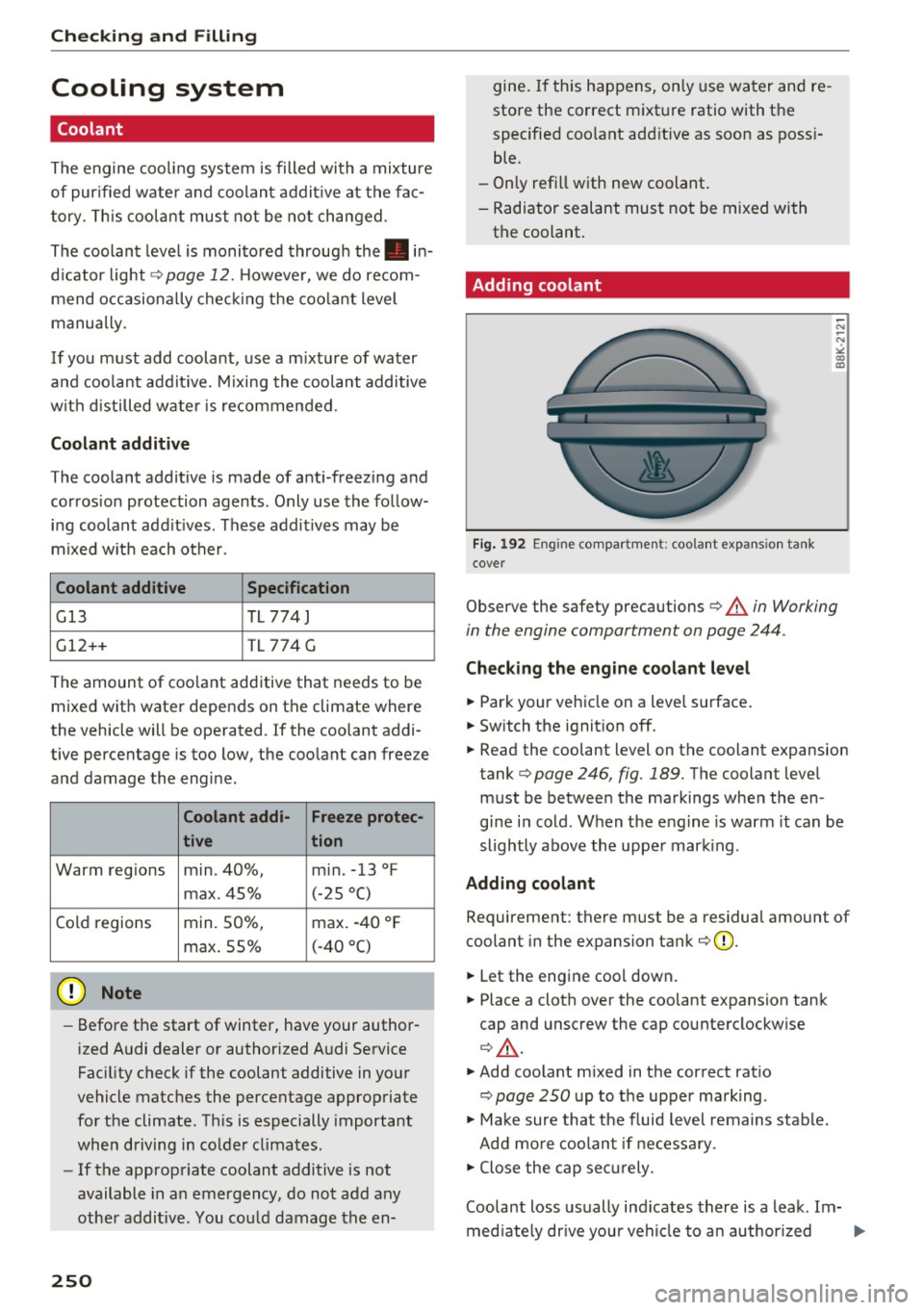
Fig. 192 En gine co mpar tm ent: coo la nt expans io n ta nk
cove r
-"' -"' •
"" co a,
Observe the safety precautions c::> A in Working
in the engine compartment on page 244 .
Checking the eng ine coolant level
.,. Park your veh icle on a level s urface .
.,. Switch the ignit ion off.
.,. Read the coolant level on the coolant expansion
tank
c::> page 246, fig. 189. The coolant leve l
must be betwee n the markings when the en
gi ne i n cold . When t he e ng ine is warm it can be
slightly above the uppe r mar king .
Adding coolant
Requirement: there must be a residual amount of
coolant in the expansion ta nk
c::> (D .
.,. Let the engine coo l down.
.,. Place a clot h over the coolant expansion tan k
cap and unscrew the cap counterclockw ise
¢ .&, .
.,. Add coo lant m ixed in the cor rect rat io
c;, page 250 up to t he up per ma rk ing .
.,. Make sure that the fluid level remains stab le.
Add mo re coolan t if necess ary.
.,. Close the cap sec urely .
Coo lant loss usually ind icates there is a lea k. Im-
med iate ly dr ive you r ve hicl e to a n author ized .,.
Page 253 of 322
CD
CD
.... N
" N .... 0
0
Ill co
Audi dealer or authorized Audi Service Facility
and have the cooling system inspected. If the
cooling system is not leaking, a loss can come
from the coolant boiling through overheating
and being pushed out of the cooling system.
A WARNING
The cooling system is pressurized and can be
come very hot . To reduce the risk of burns
from hot coolant:
- Do not open the coolant expansion tank cap when the eng ine is hot. This increases the
risk of burns.
- Stop the engine and allow it to cool.
- Protect your face, hands and arms from es-
caping coolant and steam by covering the
coolant tank cap with a large, thick cloth .
- Turn the coolant tank cap counterclockwise
slowly and keep light pressure on the cap .
- To reduce the risk of burns, do not allow any
antifreeze or coolant to drip onto the ex
haust system or hot engine components .
The ethylene g lycol in engine coolant can
catch fire under certain circumstances.
- The coolant add itive and the coolant can be
dangerous to your health. For this reason,
keep the coolant in the original container
and away from children. There is a risk of
poisoning.
- When working in the engine compartment,
remember that the radiator fan can sw itch
on even if the ignition is switched off, which
increases the risk of injury.
(D Note
Do not add coolant if the expansion tank is
empty . Air could enter the cooling system and
damage the engine. If this is the case, do not
cont inue driving. See an authorized Audi deal
er or authorized Audi Service Facility for assis
tance.
Checking and Filling
Brake fluid
Fig. 193 En gi ne compartment: cover on the b rake fluid
rese rvoir
Observe the safety precautions QA in Working
in the engine compartment on page 244 .
Checking the brake fluid level
.,. Read the brake f luid level on the brake fluid
reservoir
Q page 246, fig . 189. The brake fluid
level must be between the MIN and MAX mark
ings
Q A .
The brake fluid level is monitored automatically.
Changing the brake fluid
Have the brake fluid changed regularly by an au
thorized Audi dealer or authorized Audi Service Facility.
.&_ WARNING
- If the brake fluid level is below the MIN
marking, it can impair the brak ing effect
and driving safety, which increase the risk of
an accident. Do not continue driving. See an
authorized Audi dealer or authorized Audi
Serv ice Facility for assistance.
- If the brake fluid is old, bubbles may form
in the brake system during heavy braking.
This would impair braking performance and
driving safety, which increases the risk of an
accident .
- To ensure the brake system functions cor
rectly, only use brake fluids that comply
with VW standard 501 14 or
FMVSS-116 DOT 4.
251
Page 285 of 322
co
co
.... N
" N .... 0
0
Vl c:o
~ Install the compressor pressure hose® onto
the flange @ on the tire sea lant bottle @.
~ Insert the sealant bottle with the flange at the
bottom into the opening @ on the compressor
cover.
~ Remove the valve cap from the faulty t ire .
~ Install the filler hose @on the valve (J)
¢fig . 203 .
~ Connect the plug@¢ fig. 202 to a socket in
the vehicle.
~ Switch on the ignition.
Inflating a tire
~ Move the switch @¢ fig. 203 on the compres
sor into posit ion
I.
~ Inflate the t ire to between 29 psi (200 kPA)
and 36 psi (250 kPA) and read the p ressure on
the gauge.
~ If this tire pressure is not reached, remove the
filler hose. Drive s lowly approximately 33 ft (10
m) forward or in reverse so that the sealant can
be distributed in the tire. Pump up the tire
again¢ .&.,.
A WARNING
-Read and follow the manufacturer's safety
precautions on the compressor and in the
instructions on the bottle of sealant.
- If a tire pressure of 29 ps i (200 kPA) cannot
reached afte r inflating for 6 minutes, then
the tire is too severely damaged. Do not
contin ue driving.
- If the t ire cannot be repaired with the tire
sealan t, see an authorized A udi dealer or au
thorized Aud i Serv ice Facility for ass istance .
Do not operate the compressor for mo re than
six m inu tes continuously, or it can overheat.
Once the compressor has coo led, you can con
tinue to use it .
Completing
Appl ies to: ve hicles with tire m obility kit
~ Adhere the sticker that says "max. 50 mph
(max . 80 km/h)" that is provided with the tire
mobility kit within the driver's fie ld of vision.
Em ergenc y ass is tanc e
~ Stop the vehicle a fter driving for about 10 mi
nutes and check the tire pressure.
~ If the tire pressure is lower than 19 psi (130
kPA), then the tire is too severely damaged. Do
not continue dr iving.
A WARNING
Pay attention to the following afte r repa iring
the tire:
- Do not dr ive faster than 50 mph (80 km/h) .
- Avoid hard acceleration, braking sharply,
and fast cornering.
- The vehicle may become more difficult to
control.
- If the tire is too severe ly damaged, see an
authorized Audi dealer or authorized Audi
Serv ice Facility for assistance.
® For the sake of the environment
You can give the used tire sealant bottle to an
authorized Audi dea ler or authorized Audi
Service Fac ility for disposal.
(D Tips
Remember to obtain a new bott le of sealant
from an authorized Audi dealer or authorized
Audi Service Fac ility after repairing a tire.
Replacing wheels
Preparation
You must complete the preparation before
changing a tire.
~ Read and follow the important safety precau-
tions¢
page 281, General information.
~ Set the park ing brake.
~ Select the P selec to r lever posit ion.
~ Lay out t he vehicle too l kit¢ page 281 and the
spare tire~
page 287 .
A WARNING ~ -
If you are changing a tire on a steep hill, use a
b lock or similar object to b lock the opposite
wheel to prevent the vehicle from moving.
283
Page 286 of 322
Emergency assistance
_& WARNING
You or your passengers could be injured while
changing a wheel if you do not follow these
safety precautions :
- If you have a flat tire, move a safe distance
off the road. Turn off the engine, turn the
emergency flashers on and use other warn
ing devices to alert other motorists.
- Make sure that passengers wait in a safe
place away from the vehicle and well away
from the road and traffic.
- To help prevent the vehicle from moving
suddenly and possibly slipp ing off the jack,
always fully set the parking brake and block
the wheel diagona lly opposite the wheel be
ing changed . When one front wheel is lifted
off the ground, placing the Automatic
Transmission in P (Park) will
not prevent the
vehicle from moving.
- Before you change a wheel, be sure the
ground is level and firm. If necessary, use a
sturdy board under the jack.
- Always store the vehicle tool kit, the jack
and the replaced tire in the luggage com
partment
c:> page 185.
@ Tips
Obey all laws.
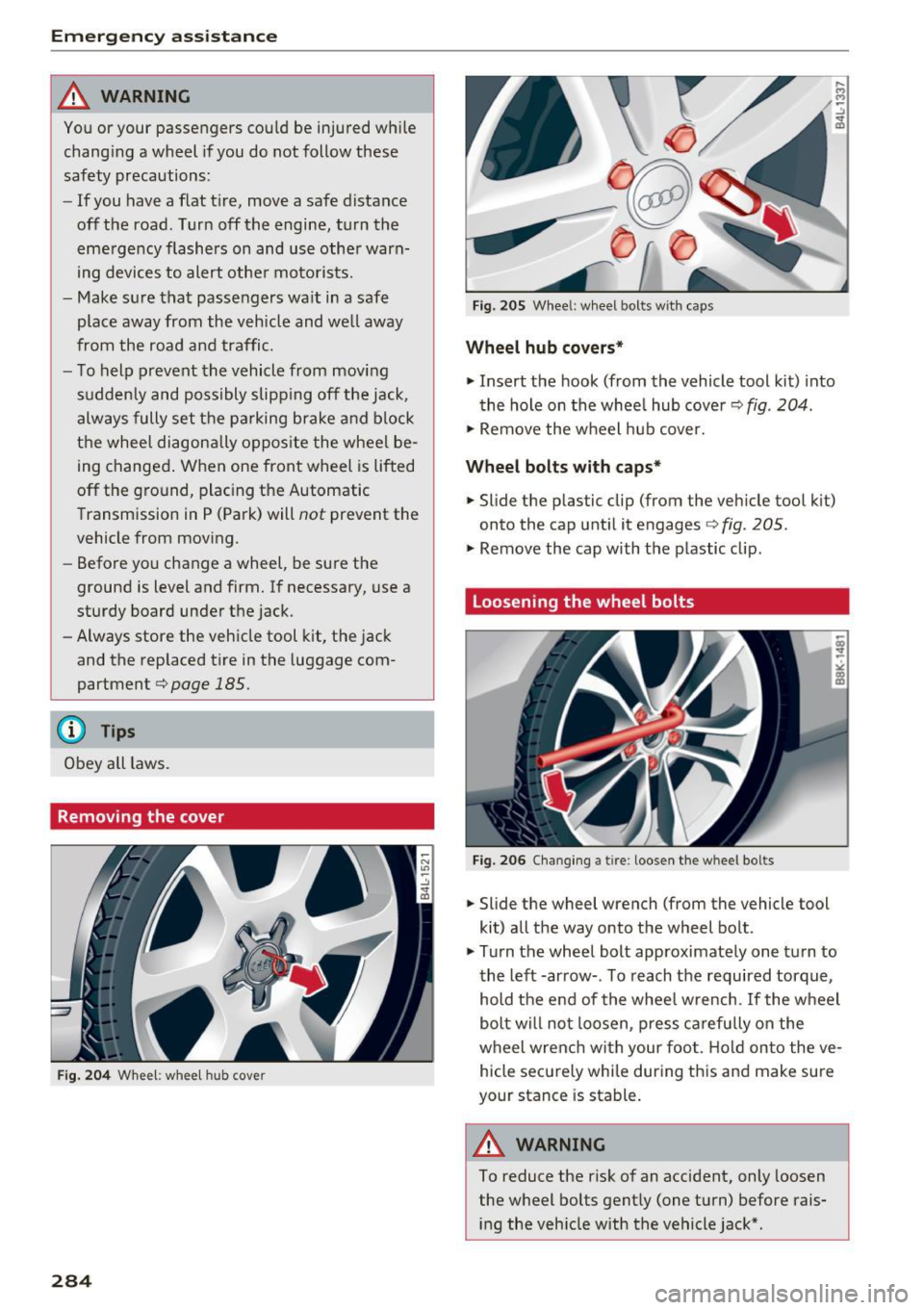
Removing the cover
Fig. 204 Whee l: wheel hub cover
284
Fig. 20S Wheel: wheel bolts with caps
Wheel hub covers*
.. Insert the hook (from the vehicle tool kit) into
the hole on the whee l hub cover
c:> fig . 204.
.. Remove the wheel hub cover.
Wheel bolts with caps*
.. Slide the plastic clip (from the vehicle tool kit)
onto the cap until it engages
c:> fig. 205.
.. Remove the cap with the plastic clip.
Loosening the wheel bolts
Fig. 206 Changing a tire: loosen the wheel bo lts
.. Slide the wheel wrench (from the vehicle tool
kit) all the way onto the wheel bolt .
.,. Turn the wheel bolt approximately one turn to
the left -arrow- . To reach the required torque,
hold the end of the wheel w rench. If the wheel
bolt will not loosen, press carefu lly on the
wheel wrenc h with your foot. Hold on to the ve
hicle securely while during this and make sure
your stance is stable.
&_ WARNING
To reduce the risk of an accident, only loosen
the wheel bolts gently (one turn) before rais
ing the vehicle with the vehicle jack* .
Page 290 of 322
Emerg enc y assis ta nc e
necessary by an authorized Audi dealer or author
ized Audi Service Facility as soon as possible.
There are some restric tions on the use of the
compact spare tire. The compact spare tire has
been designed specifically for your type of vehi
cle. Do not replace it with the spare tire from an
other type of vehicle .
Remo ving th e spar e tire
.,. Turn the handle~ fig. 211 @counter-clock-
wise.
.,. Remove the spare tire.
Remov ing th e vehicle jac k
.,. Lift up the cover on the right side of the lug
gage compartment and remove the vehicle
jack.
Snow chain s
For technical reasons, the use of snow cha ins on
the compact spare t ire is not permitted.
If you have to drive with snow chains and a front
tire fails, mount the spare wheel in place of a
rear tire. Install the snow cha ins on the rear tire
that you removed, and install that in place of the
front tire that failed .
.&, WARNING
-
-After installing a spare t ire, the tire p res
s u re must be checked as soon as poss ible.
T he tire pressure is available on
~ page 265,
fig . 199.
-If the spare tire is more than 6 years o ld,
use it only in an emergency and with ex
treme caution and carefu l driving.
- T he spare tire is intended on ly for tempora
ry and short-term use. It shou ld be replaced
as soon as possible with the norma l wheel
and tire.
- After mounting the compact spare tire, the
tire pressure must be checked as soon as
poss ible. The tire pressure of the compact
spare tire must be 61 psi (420 kPA); other
wise, you risk hav ing an accident.
- Do not drive faster than SO mph (80 km/h).
You risk hav ing an accident.
288
- Avoid full-throttle acceleration, heavy brak
ing, and fast cornering. You r isk having an
accident.
- Never drive using more than one spare
wheel and tire. You r isk having an accident.
- Normal summer or winter tires must not be
mounted on the compact spare wheel rim.
- For technical reasons, the use of tire chains
on the spare tire is not permitted. If it is
necessary to drive w ith tire chains, the spare
wheel must be mounted on the front axle in
the event of a flat in a rear t ire. The newly
ava ilable front wheel must then be installed
in place of the rear wheel with the flat tire.
Installing the tire chain before mounting
the wheel and tire is recommended.
- Loose items in the passenger compartment
can cause se rious personal injury during
ha rd bra king or in an accident. Never store
the inflatable spare tire or jack and tools in
the passenger compartment .
- Normal summer or winter tires must not be
mounted on the compact spare wheel rim .
Page 292 of 322

Fuses and bulbs
Interior fuse assignment
Fig. 215 Vehicle inter ior: fuse assignme nt
No. Equipment
Fl Power top control modu
le (Roadster)
F2 Power top control module (Roadster)
F3 ESC control module
F4 Central computer processor (MIB-2)
FS Gateway
F6 Anti-theft alarm system Climate control system, selector lever (au-
F7 tomatic transmission), parking heater,
rear window heater relay coil
Diagnos is, electrical parking brake switch,
F8 light swi tch, rain/light sensor, interior
lighting
F9 Steering column switch module
Fl0 Display
F ll Haldex clutch
F12 MMI area
F 13 Adaptive dampers control module
F14 Climate control system blower
FlS Electronic steering co lumn lock
F16 MMI components, safety be
lt microphone
(Roadster)
290
No . Equipment
F17 Instrument cluster
F18 Rearview camera
F19 Convenience key system control module
F20 Power lumbar support adjustment
F22 Front passenger's side neck heating (Road-
ster)
F23 R
ig ht exterior lighting, on-board compute r
(right)
F 25 Driver's s
ide door (for example power win-
dows)
F26 Seat heating
F28 AMI H igh med ia port
F29 On-board computer
F31 Left on-board computer
F32 Driver assistance systems
F33 Airbag
Socket relay, interior sound, back-up light
F34 switch, temperature sensor, oil level sen-
sor
Diagnosis, headlight range control system,
F35 air quality sensor, automatic dimming
rearview mirror
F36 Right cornering light/ r ight LED-h eadlight
F37 Left cornering light/ left LED-headlight
F38 E
ng ine control module, ESC control mod-
ul e
F39 Front passenger's side door (for example
power windows)
F40 Cigarette lighter, sockets
F41 SCR relay and delivery unit
F42 Central locking area
F43 On-board computer
F45 Power adjustable driver's side seat
F46 Driver's side neck heat ing (Roadster)
F49 Starter, clutch sensor
FS0 ESC valves
F53 Rear window defogger
The power seats* are protected v ia
circuit break
ers
that automatically switch on after a few sec
onds after the overload has been reduced .
Page 296 of 322
Emergency situations
(D Note
Improper hook -up of ju mper cables can r uin
the generato r.
- Always con nect P OSITIVE( +) to POS ITI VE
( + ), and NEG ATI VE( -) to NEGATIVE( -)
ground post of t he battery manage r contro l
u nit .
- Check that a ll sc rew p lugs on the battery
cells are sc rewed in firmly . If not, t ighten
plugs p rior to connect ing clamp o n negat ive
b attery t erminal.
- Please note t hat the procedure fo r con nect
i ng a jumper cable as desc rib ed above ap
plies specifica lly to the case of yo ur vehicle
being jum p starte d. When you a re giv ing a
ju mp sta rt to anothe r vehicle, do
not con
n e ct t he neg ative( -) ca b le to the neg ative
(- ) termin al o n t he dis ch arged battery @
¢
fig . 21 8. In ste ad, securely connec t the
negative (-) cab le to either a so lid metal
compo nent that is f irm ly bolted to the e n
gine block o r to the engine bloc k itself. If
the battery that is bei ng cha rged does not
vent to the outside, escap ing battery gas
could ignite an d exp lode!
Towing with a tow truck
General hints
Your Audi requires special handling for towing.
The fo llow ing informa tion is to be used by com
mercial tow truck operators who know how to op
era te the ir equipmen t sa fe ly .
- Never tow your Audi. Towing will cause dam
age to the engine and transmi ssion.
- Never wrap the safety chains or winch cables
around the brake l ines .
- To prevent unnecessary damage, your Audi
must be transported with a flat bed truck.
- To load the vehicle on to the flat bed , use the
towing loop found in the vehicle tools and at
tach to the front or rear anchorage
¢ page 294 and ¢page 295.
294
A WARNING
A veh icle being towed is not safe for passe n
ge rs . Neve r allow a nyone to ride in a vehicle
be ing towed, fo r any reason .
Front towing loop
Fig. 219 Fron t bu mpe r: cover
Fig. 2 20 Fron t bumpe r: install ing the tow ing loop
The threaded opening for the towing loop is lo
cated behind a cover on the rig ht side of the front
bumper .
.. Remove the towing loop f rom the vehicle too l
kit¢
page 281 .
.. Press inward on the upper left side of the cap
to remove i t from the bumper ¢
fig. 219 .
.,. Tighten the towing loop in the threaded o pen
ing until it s tops ¢
fig. 220 and then tig hten it
w it h a wheel w re nch.
.,. After usi ng, p lace the tow ing loop b ack in the
veh icle tool kit.
A WARNING
If t he t ow ing l oop is not tig htened unt il it
stops when installing, the threads may be pu lled out when towing the vehicle and that
could cause an accident .
-
Page 304 of 322
Consumer information
scope of maintenance and repairs which can be
carried out by vehicle owners.
Also, safety and
environmental
concerns place very strict limits
on the nature of repairs and adjustments to en
gine and transmission parts which an owner can
perform .
Maintenance, adjustments and repairs usually re
quire special tools, testing devices and other
equipment available to specially trained work
shop personnel in order to assure proper per
formance, reliability and safety of the vehicle and
its many systems .
Improper maintenance, adjustments and repairs
can impair the operation and reliability of your
vehicle and even void your vehicle warranty.
Therefore, proof of servicing in accordance with
the maintenance schedule may be a condition for
upholding a possible warranty claim made within
the warranty period.
Above all, operational safety can be adversely af
fected, creating unnecessary risks for you and
your passengers.
If in doubt about any servicing, have it done by
your authorized Audi dealer or any other properly
equ ipped and qualified workshop. We strongly
urge you to give your authorized Audi dealer the
opportunity to perform all scheduled mainte
nance and necessary repairs. Your dealer has the
facilities, original parts and trained specialists to keep your vehicle running properly.
Performing limited maintenance yourself
The following pages describe a limited number of procedures which can be performed on your vehi
cle with ordinary tools, should the need arise and
trained personnel be unavailable. Before per
forming any of these procedures, always thor
oughly read all of the applicable text and careful
ly follow the instructions given. Always rigorously
observe the
WARNINGS provided.
Before you check anything in the engine com
partment, always read and heed all WARNINGS
c> & and c> & in Working in the engine compart
ment on page 244.
302
A WARNING
-
- Serious personal injury may occur as a result
of improperly performed maintenance, ad
justments or repairs .
- Always be extremely careful when working
on the vehicle. Always follow commonly ac
cepted safety practices and general com
mon sense. Never risk personal injury.
- Do not attempt any of the maintenance,
checks or repairs described on the following pages if you are not fully familiar with these
or other procedures with respect to the ve hicle, or are uncertain how to proceed.
- Do not do any work without the proper tools
and equipment. Have the necessary work
done by your authorized Audi dealer or an
other properly equipped and qualified work
shop.
- The engine compartment of any motor vehi
cle is a potentially hazardous area. Never
reach into the area around or touch the radi
ator fan. It is temperature controlled and
can switch on suddenly - even when the en
gine is off. The radiator fan switches on au
tomatically when the coolant reaches a cer
tain temperature and will continue to run
until the coolant temperature drops.
- Always switch off the ignition before anyone
gets under the vehicle.
- Always support your vehicle with safety
stands if it is necessary to work underneath
the vehicle. The jack supplied with the vehi
cle is not adequate for this purpose and
could collapse causing serious personal in
Jury.
- If you must work underneath the vehicle
with the wheels on the ground, always make
sure the vehicle is on level ground, that the
wheels are always securely blocked and that
the engine cannot be started.
- Always make sure the transmission selector
lever (automatic transmission) is in P (Park
position) and the park brake is applied. ..,
Page 307 of 322
co
co
.... N
" N .... 0
0
Vl c:o
A
A/C (climate control system) . . . . . . . . . . . . . 52
Accessories . . . . . . . . . . . . . . . . . . . . . . . . . . 303
Active lane assist . . . . . . . . . . . . . . . . . . . . . . 72
Activating vibration warning . . . . . . . . . . . . 74
Adjusting steering time.......... ...... 74
Cleaning the camera area . . . . . . . . . . . . . 276
Indicator light . . . . . . . . . . . . . . . . . . . . . . . 73
Messages . . . . . . . . . . . . . . . . . . . . . . . . . . . 73
Switching on/off . . . . . . . . . . . . . . . . . . . . . 73
Adaptive dampers . . . . . . . . . . . . . . . . . . . . . . 79
Adaptive light . . . . . . . . . . . . . . . . . . . . . . . . . 79
Adapt ive light (indicator light) . . . . . . . . . . . 17
Additional phone ............ .. .. . 115, 175
Adjusting a ir distribution (Cl imate control sys-
tem) . . . . . . . . . . . . . . . . . . . . . . . . . . . . . . . .
52
Adjusting the air vents . . . . . . . . . . . . . . . . . . 53
Adjusting the center console lighting . . . . . . 39
Adjusting the sound . . . . . . . . . . . . . . . . . . . 178
Adjusting the temperature (climate control
system) . . . . . . . . . . . . . . . . . . . . . . . . . . . . . .
52
Advanced Airbag System
Children . . . . . . . . . . . . . . . . . . . . . . . . . . . 223
Componen ts . . . . . . . . . . . . . . . . . . . . . . . .
204
Front airbags . . . . . . . . . . . . . . . . . . . . . . . 202
How the components work together . . . . 206
Airbag . . . . . . . . . . . . . . . . . . . . . . . . . . . . . . 197
Indicator light . . . . . . . . . . . . . . . . . . . . . . . 15
Airbag system . . . . . . . . . . . . . . . . . . . . . . . . 217
Advanced Airbag-System . . . . . . . . . . . . . . 201
Care . . . . . . . . . . . . . . . . . . . . . . . . . . . . . . 212
Child restraints . . . . . . . . . . . . . . . . . . . . . 223
Components (front airbags) . . . . . . . . . . . 204
Danger of fitting a child safety seat on the
front passenger seat . . . . . . . . . . . . . . . . .
198
Disposal . . . . . . . . . . . . . . . . . . . . . . . . . . . 212
Front airbags . . . . . . . . . . . . . . . . . . . . . . . 201
H ow do the front airbags work? . . . . . . . . 207
How many airbags does my vehicle have? 204
Important information . . . . . . . . . . . . . . . 197
Important safety instructions on the knee
airbag system ................. ..... .
215
Knee airbags. ....................... 213
Monitoring . . . . . . . . . . . . . . . . . . . . . . . . . 209
PASSENGER AIR BAG light . . . . . . . . . . . . 209
Repairs ... . .. .. ............. .. .. .. . 212
Safety instructions . . . . . . . . . . . . . . . . . . . 211
Index
Side airbags . . . . . . . . . . . . . . . . . . . . . . . . 215
Side curtain airbags . . . . . . . . . . . . . . . . . . 218
Warning/Ind icator lights . . . . . . . . . . . . . 209
When must the system be inspected? . . . 209
Alarm system
refer to Anti-theft alarm system . . . . . . 25 , 30
Alignment pin (chang ing the wheel) . . . . . . 281
All season tires . . . . . . . . . . . . . . . . . . . . . . . 270
All weather lights . . . . . . . . . . . . . . . . . . . . . . 36
All wheel drive . . . . . . . . . . . . . . . . . . . . . . . . 91
Alternative routes . . . . . . . . . . . . . . . . . . . . . 142
Amb ient lighting . . . . . . . . . . . . . . . . . . . . . . 38
AMI
refer to Audi music interface . . . . . . . . . . . 161
Android Auto
refer to Audi smartphone interface 172
Announcements (sett ings)
refer to Voice guidance . . . . . . . . . . . . . . . 142
Anti -freeze
Windsh ield washer system . . . . . . . . . . . .
253
Anti-lock braking system (ABS) . . . . . . . . . . . 88
Anti-s lip regulat ion . . . . . . . . . . . . . . . . . . . . 88
Anti-theft alarm system . . . . . . . . . . . . . . . . . 30
Apple CarP lay
refer to Audi smartphone interface . . . . . 172
Arm rest.. .. .... .. .. ............... .. . 45
Ashtray . . . . . . . . . . . . . . . . . . . . . . . . . . . . . . 46
Aspect ratio (video) . . . . . . . . . . . . . . . . . . . 166
Audi connect . . . . . . . . . . . . . . . . . . . . . . . . . 126
Data connection . . . . . . . . . . . . . . . . . . . . . 131
Data protection . . . . . . . . . . . . . . . . . . . . . 133
Services (overview) . . . . . . . . . . . . . . . . . . 128
Setup . . . . . . . . . . . . . . . . . . . . . . . . . . . . . 126
Audi magnetic r ide
refer to Adaptive dampers . . . . . . . . . . . . . 79
Audi music interface . . . . . . . . . . . . . . . . . . . 161
Audi music stream
refer to Wi-Fi . . . . . . . . . . . . . . . . . . . . . . . 159
Audio files . . . . . . . . . . . . . . . . . . . . . . . . . . . 163
Audio player
Bluetooth audio player . . . . . . . . . . . . . . .
158
Wi-Fi audio player . . . . . . . . . . . . . . . . . . . 159
Audio track . . . . . . . . . . . . . . . . . . . . . . . . . . 166
Audi Service Repair Manuals and Literature 301
Audi smartphone interface . . . . . . . . . 172, 176
Audi virtual cockpit (instr ument cluster) . . . . 8
305