engine AUDI TT COUPE 2017 Workshop Manual
[x] Cancel search | Manufacturer: AUDI, Model Year: 2017, Model line: TT COUPE, Model: AUDI TT COUPE 2017Pages: 322, PDF Size: 79.73 MB
Page 251 of 322
co
co
... N
" N ... 0
0
Vl c:o
@ For the sa ke of the env ironment
- Engine oi l should never enter the sewer sys
tem or come into contact with the ground
under any circumstances.
- Pay attention to legal requirements when
disposing of empty oil containers.
The engine oil consumption may be up to 0.5 quart/600 m iles (0.5 liter/1,000 km), de
pending on driving style and operating condi
tions. Consumption may be higher during the
first 3,000 miles (5,000 km). Because of this,
the engine oil level must be checked regular ly.
It would be best to check each time you re
fue l your vehicle and before long dr ives.
Changing the engine oil
We recommend that have your oil changed by an
authorized Audi dealer or a qualified service sta
tion.
Before you check anyth ing in the eng ine compart
ment,
alw ays r ea d and heed all WARNINGS Q .&.
in Working in the engine compartment on
page 244.
The engine oil must be changed according to the
intervals specified in your Warranty
& Mainte
n ance booklet. This is very important because the
l ubri cat ing propert ies of o il diminish gradually
d ur ing normal vehicle use.
Under some c ircumstances the eng ine o il should
be changed more frequently . Change oil more of
ten if you d rive mostly short distances, ope rate
the vehicle in dusty areas or under predominant ly
stop-and -go traffic conditions, or have your vehi
cle where temperatures remain below freezing
for extended periods.
Detergent additives in the oil will make fresh oil
l ook da rk after the engine has been running for a
short time. This is normal and is not a reason to
change the oil more often than recommended.
Because of the problem of p roper disposal, along
with the special tools and necessa ry expertise re
qu ired, we strong ly recommend that you have
Ch eck ing and Filling
your oi l changed by an authorized Audi dealer or
a qualified service station .
If yo u choo se to ch ange yo ur oil your self, please
note the follow ing important info rmation:
A WARNING
=
To reduce the risk of persona l injury if you
must change the engine oil in your vehicle
yourself:
- Wear eye protect ion .
-
-To redu ce the r is k of burns from hot eng ine
oil, let the engine cool down to the touch.
- W hen remov ing the oil d rain plug w ith your
fingers, stay as far away as possib le. Always
keep your forearm parallel to the ground to
he lp prevent hot oil from running down your
arm.
- Drain the oil into a container designed for
this purpose, one la rge enough to hold at
least the tota l amount of oil in yo ur engine.
- Engine oil is poisonous. Keep it well out of
the reach of children.
- Continuous contact with used engine oil is
harmful to your skin. Always protect your
skin by washing oil off thoroughly with soap
and water.
(D Note
Never mix oil additives with your engine oil.
These additives can damage your engine and
adverse ly affect yo ur Audi Limited New Vehi
cle Warranty.
@ For the sake of the environment
- Before chang ing yo ur oi l, first make sure
you know where you can properly d ispose of
the used oil.
- Always dispose of used engine o il properly.
Do not dump it on garden soil, wooded
areas, into open streams or down sewage
drains.
- Recycle used engine o il by tak ing it to a used
eng ine oil collection fac ility in your area, or
contact a service station .
249
Page 252 of 322
Check ing and F illing
Cooling system
Coolant
The engine coo ling system is filled with a mixture
of pur ified wate r and coolan t addit ive at the fa c
t ory . T his coo la nt must not be not changed .
The coolant leve l is monito red throug h the . in
d icator light
c::> page 12. Howeve r, we do recom
mend occasionally chec king the coo la nt level
manually.
If you must add coolant, use a m ixt ure of wa ter
a nd coo lant add it ive. Mixing the coolant additive
with d istilled water is recommended.
Coolant additive
The coolant additive is made of ant i-freezing and
corros ion protection agents. Only use the fo llow
ing coolant add it ives. These addit ives may be
m ixed w it h each other.
Coolant additive Specification
G13
TL 774 J
G12++ TL 774 G
The amount of coo lant add itive that needs to be
mixed wit h water depends on the climate where
the vehicle will be operated . If the coolant addi
tive percentage is too low, the coolant can free ze
and damage the engine.
Coolant addi- Freeze protec-
tive tion
Warm regions min . 40%, m in. -13 °F
max . 45% (
- 25 °C)
Co ld regions min. 50%, max. -40 °F
max. 55% (-40 °C)
CJ) Note
-Befo re the start of winter, have your author
i zed Audi dealer or authorized A udi Service
Fac ility check if the coolant additive in yo ur
vehicle matc hes the percentage approp riate
for the climate . Th is is especially important
whe n driving in co lde r clima tes.
- If the approp riate coolant additive is not
available in an emergency, do no t add any
other addi tive . You cou ld damage the en-
250
gine . If this h appens, on ly use wa ter and re
store the correct m ixt ure ratio with t he
specified coo lant ad ditive as soon as poss i
ble.
- Only refill w ith new coolant .
- Radiator sealant mus t not be mixed wi th
the coolant .
Adding coolant
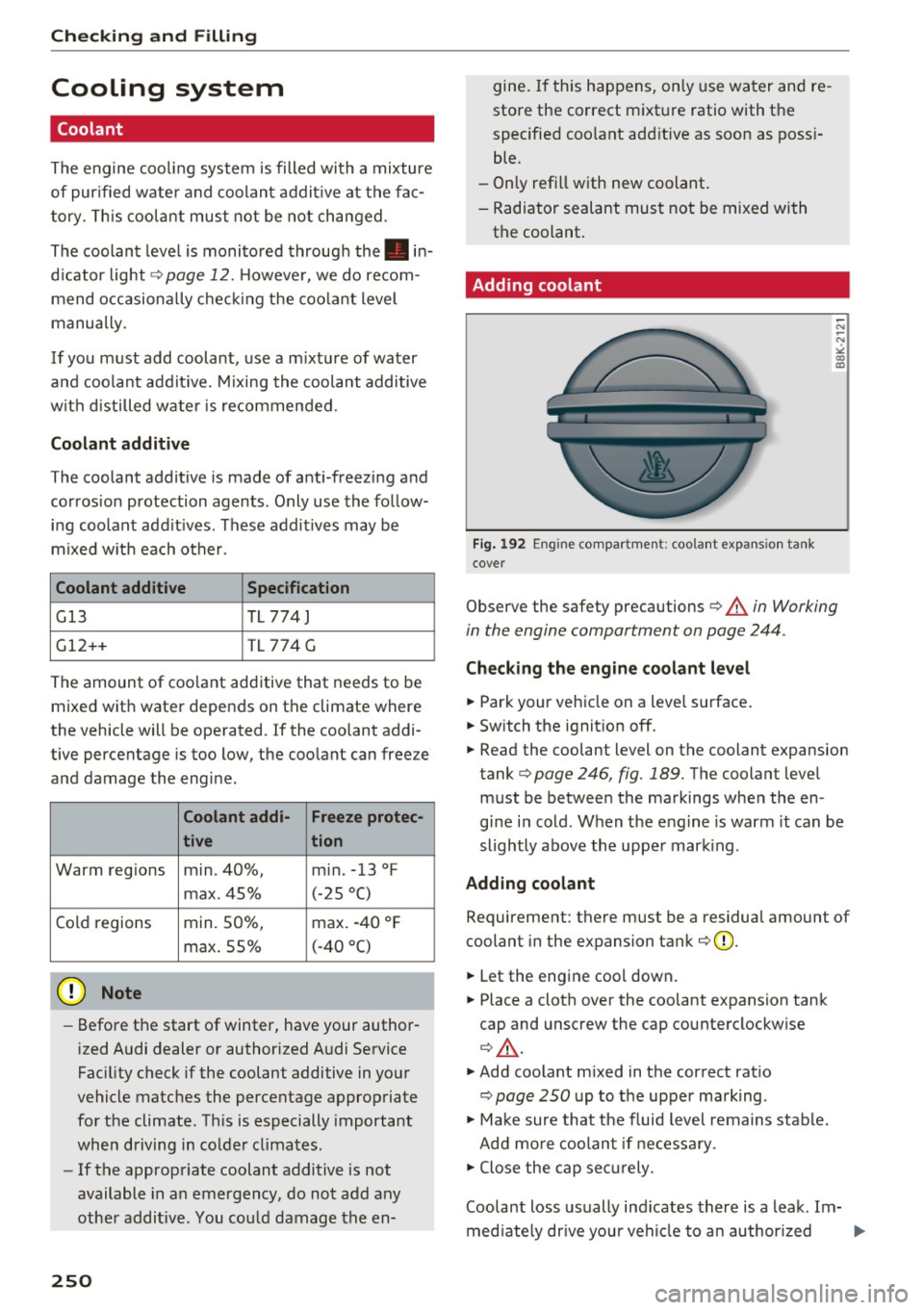
Fig. 192 En gine co mpar tm ent: coo la nt expans io n ta nk
cove r
-"' -"' •
"" co a,
Observe the safety precautions c::> A in Working
in the engine compartment on page 244 .
Checking the eng ine coolant level
.,. Park your veh icle on a level s urface .
.,. Switch the ignit ion off.
.,. Read the coolant level on the coolant expansion
tank
c::> page 246, fig. 189. The coolant leve l
must be betwee n the markings when the en
gi ne i n cold . When t he e ng ine is warm it can be
slightly above the uppe r mar king .
Adding coolant
Requirement: there must be a residual amount of
coolant in the expansion ta nk
c::> (D .
.,. Let the engine coo l down.
.,. Place a clot h over the coolant expansion tan k
cap and unscrew the cap counterclockw ise
¢ .&, .
.,. Add coo lant m ixed in the cor rect rat io
c;, page 250 up to t he up per ma rk ing .
.,. Make sure that the fluid level remains stab le.
Add mo re coolan t if necess ary.
.,. Close the cap sec urely .
Coo lant loss usually ind icates there is a lea k. Im-
med iate ly dr ive you r ve hicl e to a n author ized .,.
Page 253 of 322
CD
CD
.... N
" N .... 0
0
Ill co
Audi dealer or authorized Audi Service Facility
and have the cooling system inspected. If the
cooling system is not leaking, a loss can come
from the coolant boiling through overheating
and being pushed out of the cooling system.
A WARNING
The cooling system is pressurized and can be
come very hot . To reduce the risk of burns
from hot coolant:
- Do not open the coolant expansion tank cap when the eng ine is hot. This increases the
risk of burns.
- Stop the engine and allow it to cool.
- Protect your face, hands and arms from es-
caping coolant and steam by covering the
coolant tank cap with a large, thick cloth .
- Turn the coolant tank cap counterclockwise
slowly and keep light pressure on the cap .
- To reduce the risk of burns, do not allow any
antifreeze or coolant to drip onto the ex
haust system or hot engine components .
The ethylene g lycol in engine coolant can
catch fire under certain circumstances.
- The coolant add itive and the coolant can be
dangerous to your health. For this reason,
keep the coolant in the original container
and away from children. There is a risk of
poisoning.
- When working in the engine compartment,
remember that the radiator fan can sw itch
on even if the ignition is switched off, which
increases the risk of injury.
(D Note
Do not add coolant if the expansion tank is
empty . Air could enter the cooling system and
damage the engine. If this is the case, do not
cont inue driving. See an authorized Audi deal
er or authorized Audi Service Facility for assis
tance.
Checking and Filling
Brake fluid
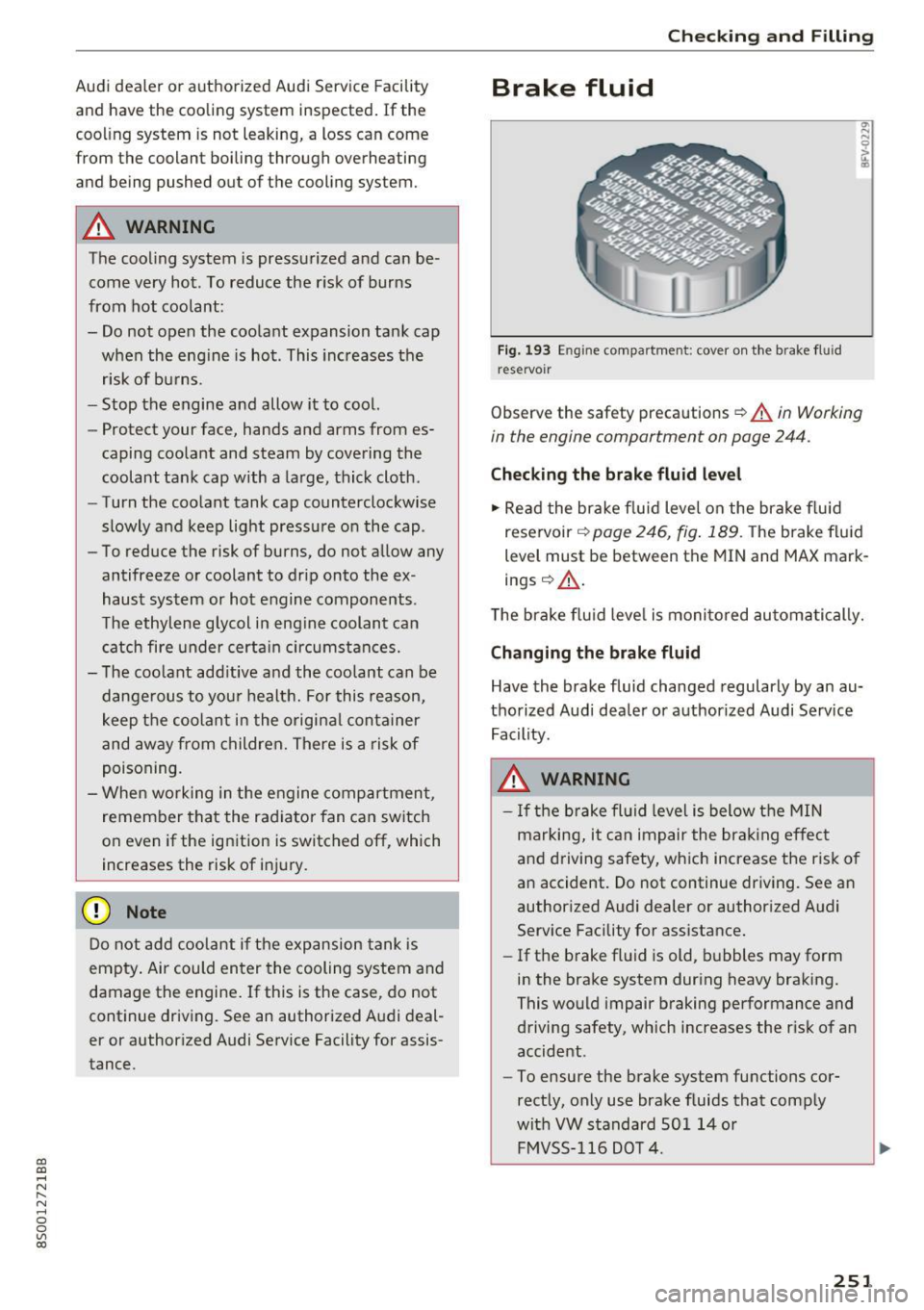
Fig. 193 En gi ne compartment: cover on the b rake fluid
rese rvoir
Observe the safety precautions QA in Working
in the engine compartment on page 244 .
Checking the brake fluid level
.,. Read the brake f luid level on the brake fluid
reservoir
Q page 246, fig . 189. The brake fluid
level must be between the MIN and MAX mark
ings
Q A .
The brake fluid level is monitored automatically.
Changing the brake fluid
Have the brake fluid changed regularly by an au
thorized Audi dealer or authorized Audi Service Facility.
.&_ WARNING
- If the brake fluid level is below the MIN
marking, it can impair the brak ing effect
and driving safety, which increase the risk of
an accident. Do not continue driving. See an
authorized Audi dealer or authorized Audi
Serv ice Facility for assistance.
- If the brake fluid is old, bubbles may form
in the brake system during heavy braking.
This would impair braking performance and
driving safety, which increases the risk of an
accident .
- To ensure the brake system functions cor
rectly, only use brake fluids that comply
with VW standard 501 14 or
FMVSS-116 DOT 4.
251
Page 255 of 322
CD
CD
.... N
" N ...... 0
0
Ill co
Charging the vehicle battery
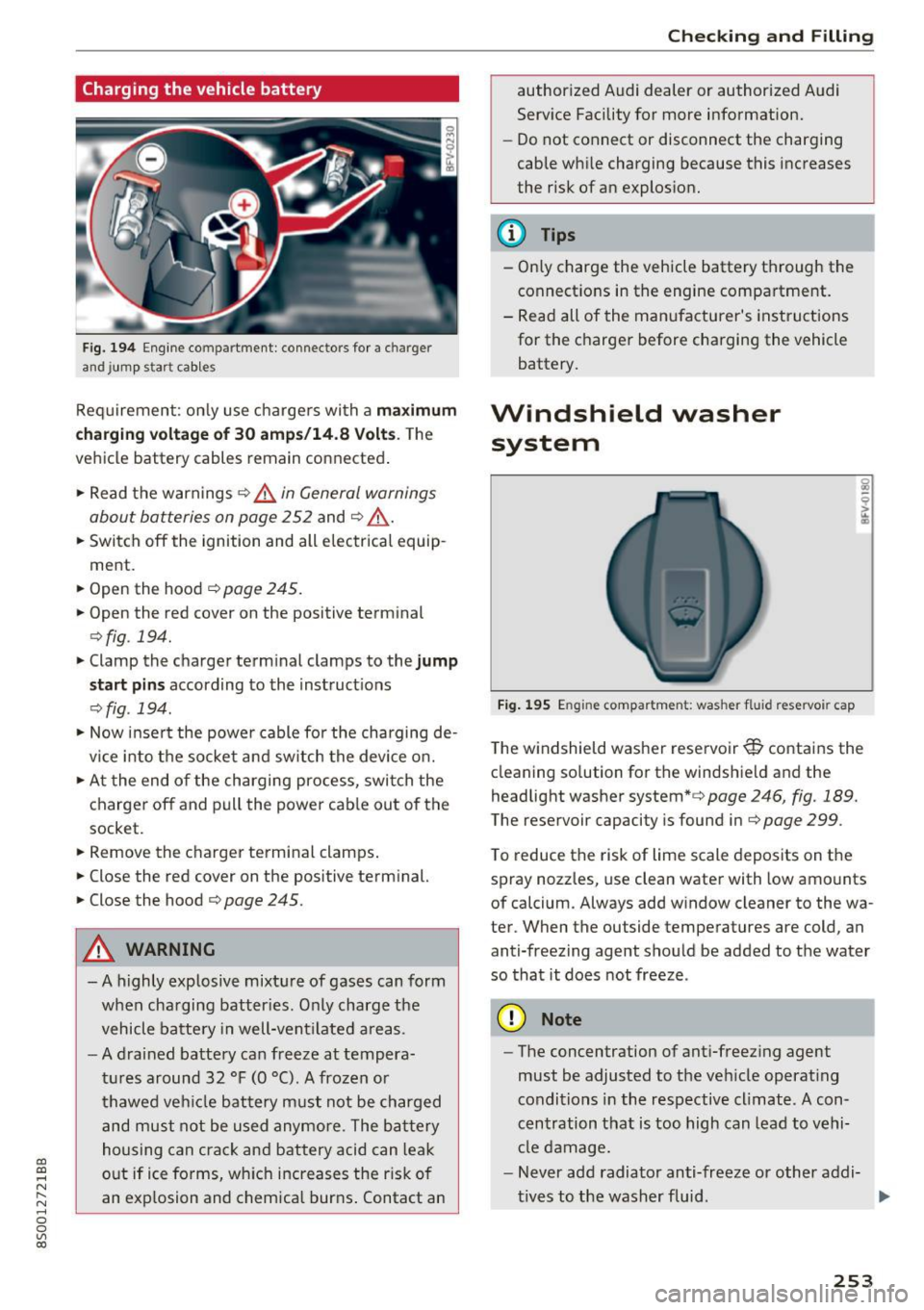
Fig. 194 Engine compartment: connectors for a charger
and jump start cables
Requirement: only use chargers with a maximum
charging voltage of 30 amps/14.8 Volts.
The
vehicle battery cables remain connected .
.,. Read the warn ings¢
& in General warnings
about batteries on page 252
and ¢ ,& .
.,. Switch off the ignition and all electrical equip
ment .
.,. Open the hood¢
page 245 .
.,. Open the red cover on the positive terminal
¢fig. 194 .
.,. Clamp the charger terminal clamps to the jump
start pins
according to the instructions
¢fig. 194 .
.,. Now insert the power cable for the charging de
vice into the socket and sw itch the device on.
.,. At the end of the charging process, switch the
charger off and pull the power cable out of the
socket .
.,. Remove the charger terminal clamps.
.,. Close the red cover on the positive terminal.
.,. Close the hood¢
page 245.
A WARNING
-A highly explosive mixture of gases can form
when charging batteries. Only charge the
vehicle battery in well-ventilated areas.
- A drained battery can freeze at tempera
tures around 32 °F (0 °C). A frozen or
thawed vehicle battery must not be charged
and must not be used anymore. The battery
housing can crack and battery acid can leak
out if ice forms, which increases the risk of
an explosion and chemical burns . Contact an
Checking and Filling
authorized Audi dealer or authorized Audi
Service Facility for more information.
- Do not connect or disconnect the charging
cable while charging because this increases
the risk of an explosion.
@ Tips
- Only charge the vehicle battery through the
connections in the engine compartment.
- Read all of the manufacturer's instructions
for the charger before charging the vehicle
battery.
Windshield washer system
Fig. 19S Engine compartment: washer fluid reservoir cap
The windshield washer reservoir{!} contains the
cleaning solution for the windshield and the
headlight washer system*¢
page 246, fig. 189.
The reservoir capacity is found in ¢ page 299.
To reduce the risk of lime scale deposits on the
spray nozzles, use clean water with low amounts
of calcium. Always add window cleaner to the wa
ter. When the outside temperatures are cold, an
ant i-freezing agent should be added to the water
so that it does not freeze.
(D Note
-The concentration of anti-freezing agent
must be adjusted to the vehicle operating
conditions in the respective cl imate. A con
centration that is too high can lead to vehi-
cle damage.
- Never add radiator anti-freeze or other addi-
tives to the washer fluid. .,.
253
Page 256 of 322
Checking and Filling
-Do not use a glass cleaner that contains
paint solvents, because this could damage
the pa int .
Service interval display
The service interval display detects when your ve
hicle is due for service.
The service interva l display works in two stages:
- Inspection or oil change reminder: after a cer-
tain distance driven, a message appears in the
Infotainment system display each time the ig
nition is switched on or off . The remaining dis
tance or time is displayed briefly.
- Inspection or oil change due: if your vehicle
has reached an inspection or oi l change interval
or both intervals at the same time, the mes
sage
Inspection due! or Oil change due! or Oil
change and inspection due!
appears briefly af
ter switching the ignition on/off .
Checking service intervals
You can check the remaining distance or time un
til the next oil change or next inspection. Select
in the Infotainment system: the !MENU ! button>
Vehicle > left control button > Service & checks >
Service intervals.
{[) Note
-Following the service intervals is critical to
maintain ing the service life and value of
your vehicle, especially the engine. Even if
the mileage on the vehicle is low, do not ex
ceed the time for the next service.
- Calculating the time to the next oi l change
i s interrupted when the vehicl e battery is
disconnected
~ page 2 79.
254
Page 269 of 322
co
co
.... N
" N .... 0
0
Vl c:o
Wheels
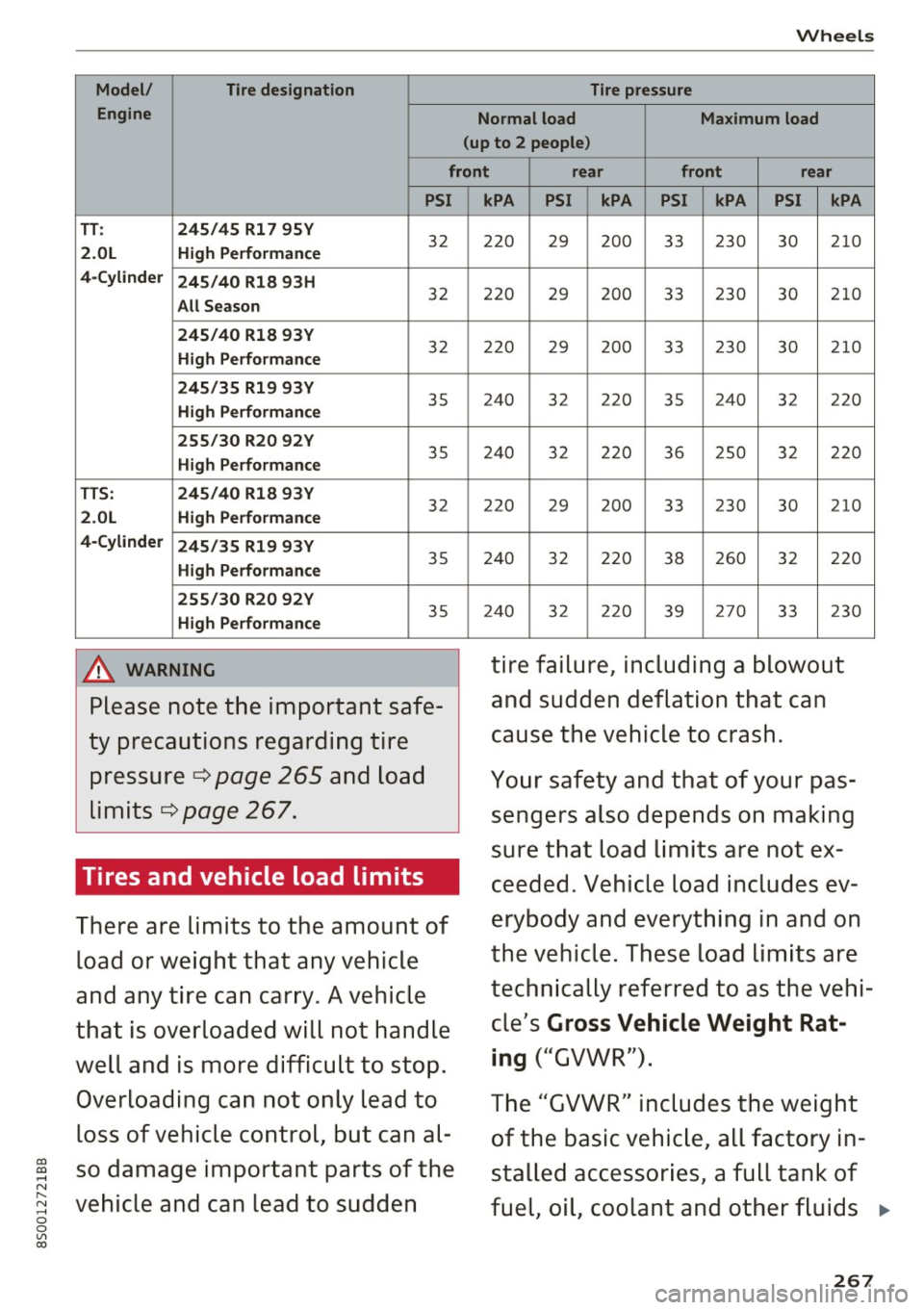
Model/ Tire designation Tire pressure
Engine Normal load Maximum load
(up to 2 people)
front rear front rear
PSI
TT: 245/45 R17 95V
32 2.0L High Performance
4-Cylinder 245/40 R18 93H
All Season
32
245/40 R18 93V 32 High Performance
245/35 R19 93V
35 High Performance
255/30 R20 92V
35 High Performance
TTS: 245/40 R18 93V
32
2.0L High Performance
4-Cylinder 245/35 R19 93V
High Performance
35
255/30 R20 92V
35 High Performance
A WARNING
Please note the important safe
ty precautions regarding tire pressure
¢ page 265 and load
limits
¢ page 267.
Tires and vehicle load limits
There are limits to the amount of
load or weight that any vehicle
and any tire can carry. A vehicle
that is overloaded will not handle
well and is more difficult to stop. Overloading can not only lead to
loss of vehicle control, but can al
so damage important parts of the
vehicle and can lead to sudden
kPA PSI kPA PSI kPA PSI kPA
220 29 200 33 230 30 210
220 29 200 33 230 30 210
220 29 200 33 230 30 210
240
32 220 35 240
32 220
240 32 220 36 250 32 220
220 29 200 33 230
30 210
240 32 220 38 260 32 220
240 32 220 39 270 33 230
tire failure, including a blowout
and sudden deflation that can
cause the vehicle to crash.
Your safety and that of your pas
sengers also depends on making
sure that load limits are not ex
ceeded. Vehicle load includes ev
erybody and everything in and on
the vehicle. These load limits are
technically referred to as the vehi cle 's
Gross Vehicle Weight Rat
ing
("GVWR").
The "GVWR" includes the weight of the basic vehicle, all factory in
stalled accessories, a full tank of
fuel, oil, coolant and other fluids ..
267
Page 283 of 322
CD co .... N
" N .... 0
0
Ill co
Emergency assistance
General information
"' Park the vehicle as far as poss ible from moving
traffic in the event of a breakdown. In the event
of a flat tire, park the vehicle on a leve l surface .
It you are on a steep h ill, be especially careful.
"' Set the parking brake.
"' Place the selector lever in the P position .
"' Switch the emergency flashers on .
"' Have the passengers exit the veh icle . They
shou ld move to a safe place, for example be
hind a guard rail.
_& WARNING
Follow the steps given above. This is for your
protection and the for the safety of other d riv
ers .
Equipment
Vehicle tool kit/tire mobility kit/
compressor
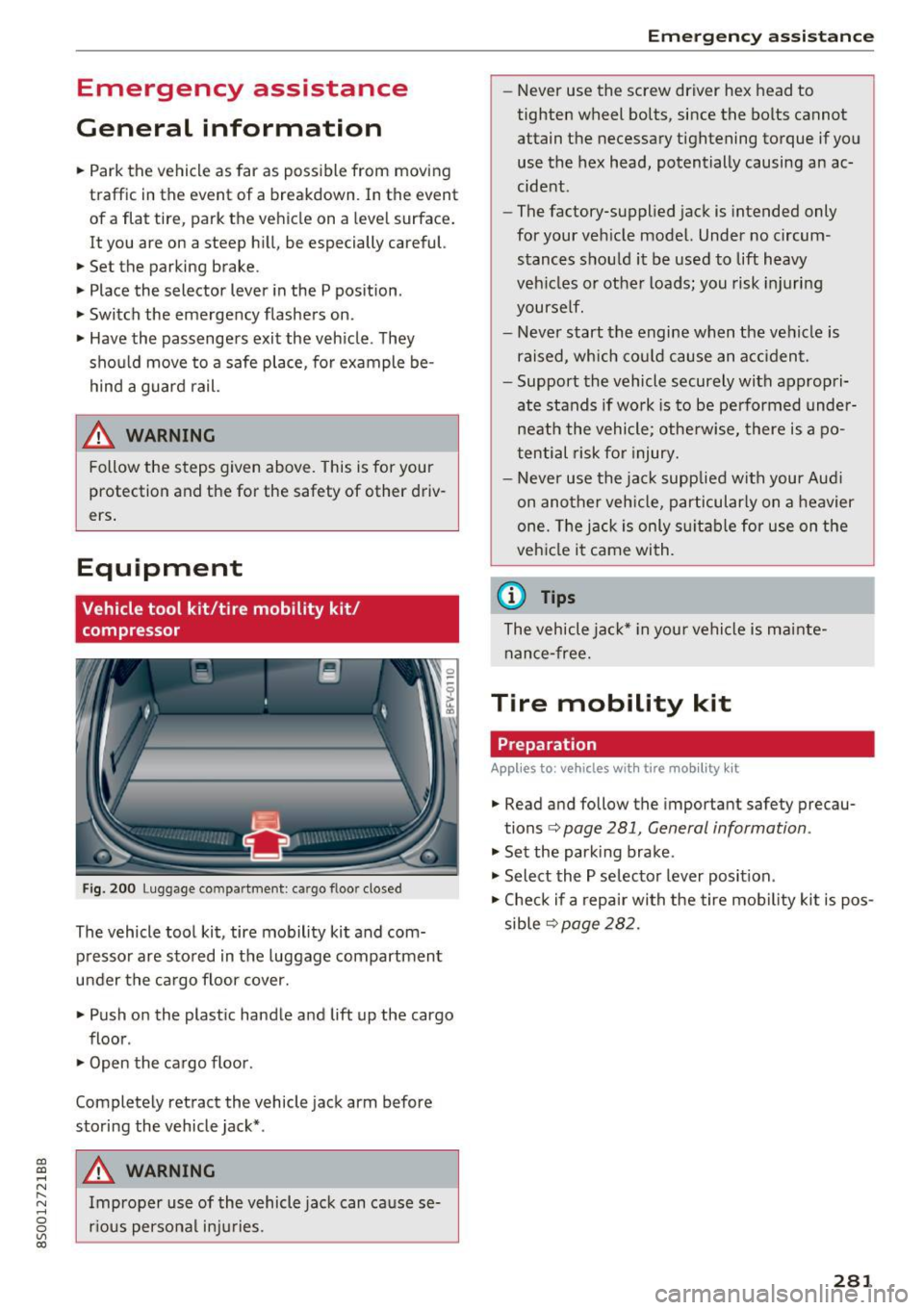
F ig . 200 Luggage co mpa rtment : ca rgo floo r closed
The vehicle tool kit, tire mobility kit and com
p ressor are sto red in the luggage compartment
u nder the ca rgo floor cover.
"' Push on the plast ic handle and lift up the cargo
floor .
"' Open the cargo floor .
Completely ret ract the vehicle jack arm before
storing the vehicle jack* .
_& WARNING
Improper use of the vehicle jac k can ca use se
r ious personal inju ries .
Em ergen cy a ssis tanc e
-Never use the screw driver hex head to
tighten wheel bolts, since the bolts cannot
attain the necessary tightening torque if you
use the hex head, potentially causing an ac
cident .
- The factory-supplied jack is intended only
for your veh icle model. Under no circum
stances shou ld it be used to lift heavy
veh icles or othe r loads; you risk injuring
yourself.
- Never start the engine when the vehicle is
raised, which co uld cause an a ccident.
- Support the vehicle securely with a ppropri
ate stands if wo rk is to be pe rformed under
nea th the vehicle; otherwise, there is a po
tential risk fo r injury.
- Never use the ja ck supp lied with your Aud i
on ano ther veh icle, p articularly on a heavier
one. The jack is only s uitab le for use on the
veh icle it came with.
(D Tips
The vehicle ja ck* in your vehicle is ma inte
nan ce-free.
Tire mobility kit
Preparation
App lies to : vehicles wi th tire mo bility kit
"' Read and follow the important safety precau-
tions <=>
page 281 , General information .
"'Set the park ing brake .
"' Select the P selector lever posit ion .
"' Check if a repair wi th the tire mob ility kit is pos
sible
<=> page 282.
281
Page 286 of 322
Emergency assistance
_& WARNING
You or your passengers could be injured while
changing a wheel if you do not follow these
safety precautions :
- If you have a flat tire, move a safe distance
off the road. Turn off the engine, turn the
emergency flashers on and use other warn
ing devices to alert other motorists.
- Make sure that passengers wait in a safe
place away from the vehicle and well away
from the road and traffic.
- To help prevent the vehicle from moving
suddenly and possibly slipp ing off the jack,
always fully set the parking brake and block
the wheel diagona lly opposite the wheel be
ing changed . When one front wheel is lifted
off the ground, placing the Automatic
Transmission in P (Park) will
not prevent the
vehicle from moving.
- Before you change a wheel, be sure the
ground is level and firm. If necessary, use a
sturdy board under the jack.
- Always store the vehicle tool kit, the jack
and the replaced tire in the luggage com
partment
c:> page 185.
@ Tips
Obey all laws.
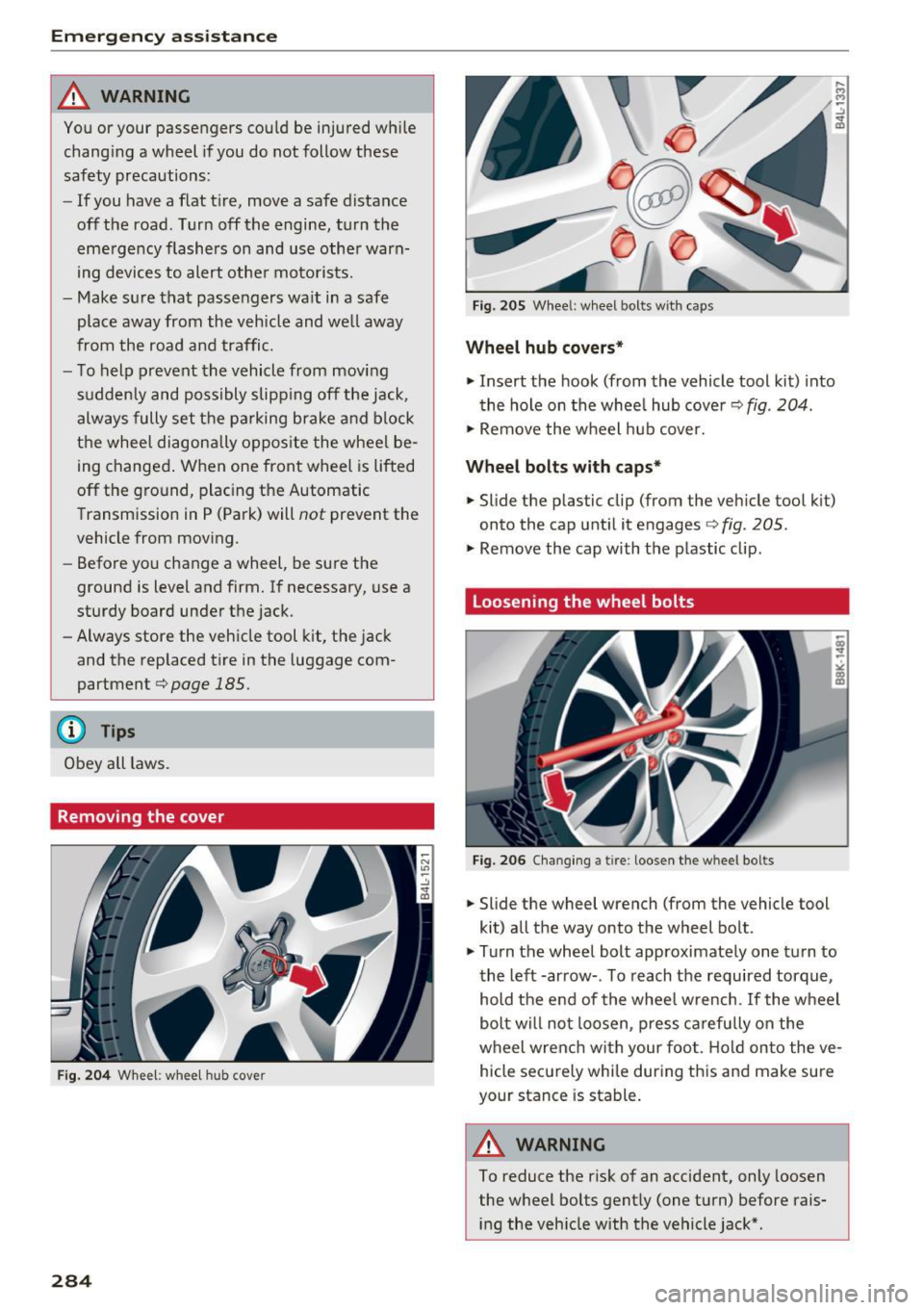
Removing the cover
Fig. 204 Whee l: wheel hub cover
284
Fig. 20S Wheel: wheel bolts with caps
Wheel hub covers*
.. Insert the hook (from the vehicle tool kit) into
the hole on the whee l hub cover
c:> fig . 204.
.. Remove the wheel hub cover.
Wheel bolts with caps*
.. Slide the plastic clip (from the vehicle tool kit)
onto the cap until it engages
c:> fig. 205.
.. Remove the cap with the plastic clip.
Loosening the wheel bolts
Fig. 206 Changing a tire: loosen the wheel bo lts
.. Slide the wheel wrench (from the vehicle tool
kit) all the way onto the wheel bolt .
.,. Turn the wheel bolt approximately one turn to
the left -arrow- . To reach the required torque,
hold the end of the wheel w rench. If the wheel
bolt will not loosen, press carefu lly on the
wheel wrenc h with your foot. Hold on to the ve
hicle securely while during this and make sure
your stance is stable.
&_ WARNING
To reduce the risk of an accident, only loosen
the wheel bolts gently (one turn) before rais
ing the vehicle with the vehicle jack* .
Page 287 of 322
CD
CD
.... N
" N .... 0
0
Ill co
Raising the vehicle
App lies to: ve hicles with veh icle jac k
- · ,tr--- """!'.
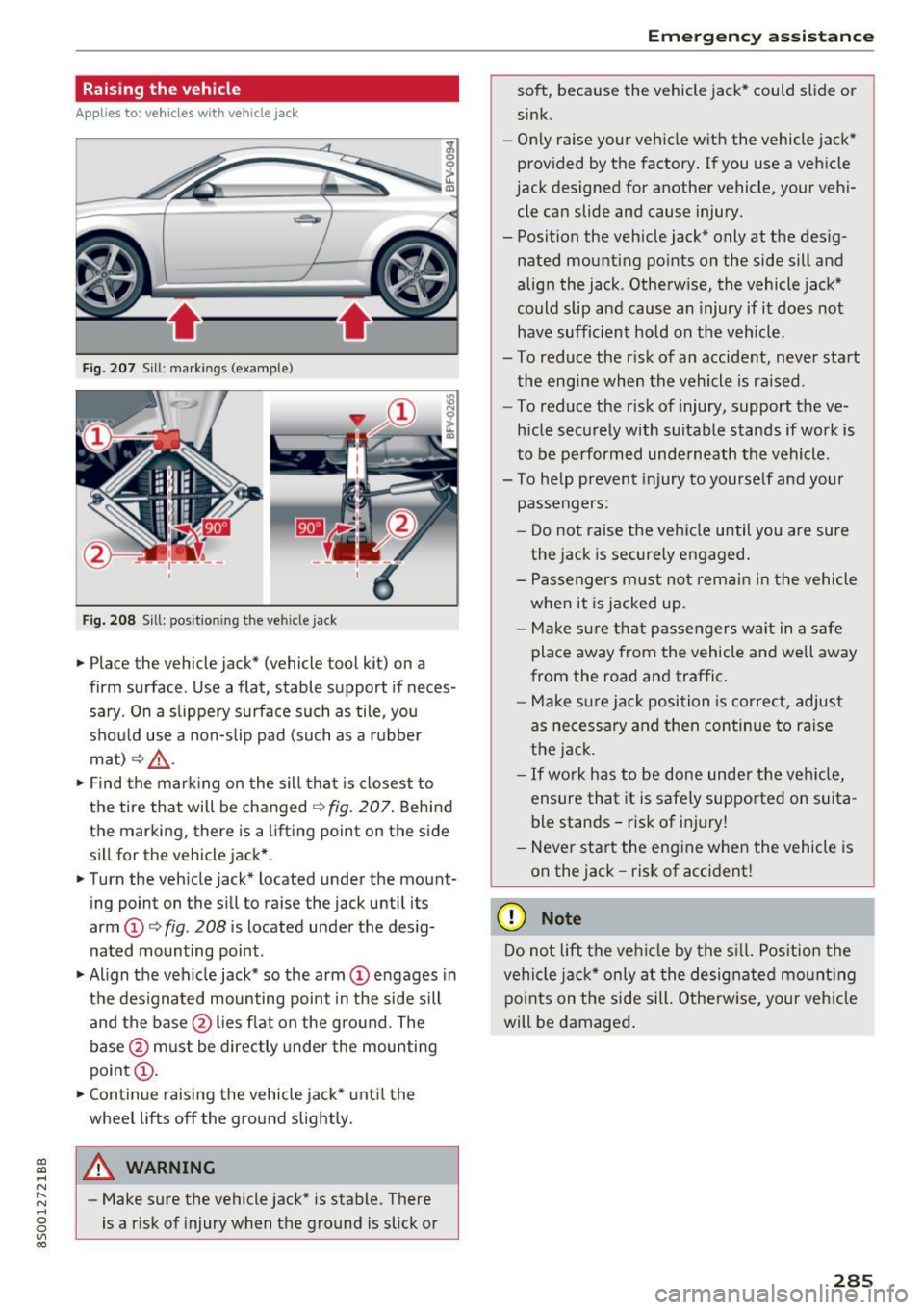
Fig. 207 Sill: ma rkings (example)
F ig. 208 S ill: posit ion ing the vehicle jack
... Place the vehicle jack* (vehicle tool kit) on a
firm surface . Use a flat, stable support if neces
sary . On a slippery surface such as tile, you
sho uld use a non-slip pad (such as a rubber
mat) ¢,&,
... Find the mar king on the sill that is closest to
the tire that will be changed¢
fig. 207. Behind
the marking, there is a lifting point on the side
sill for the vehicle jack*.
... Turn the vehicle jack* located under the mount
ing point on the s ill to raise the jack until its
arm
(D ¢ fig . 208 is located under the des ig
nated mounting point .
... Align the vehicle jack* so the arm
(D engages in
the des ignated mounting point in the side sill
and the base @lies f lat on the gro und. The
base @must be directly under the mounting
point (!) .
... Cont inue raising the vehicle jack* until the
wheel lifts off the ground slightly .
A WARNING
- Make sure the vehicle jack* is stable. There
is a r isk of injury when the ground is slick or
Em ergen cy a ssis tanc e
soft, because the vehicle jack* could slide or
sink.
- On ly raise your vehicle wit h the vehicle jack*
provided by the factory. If you use a veh icle
jack designed for another vehicle, your veh i
cle can slide and cause injury.
- Position the veh icle jack * only at the desig
nated mounting points on the side sill and
alig n the jack . Otherw ise, the vehicle jack*
could slip and cause an injury if it does not
have suffic ient hold on the veh icle.
- To reduce the r isk of an accident, never start
the engine when the vehicle is ra ised.
- To reduce the r isk of injury, support the ve
h icle securely with suitable stands if work is
to be pe rformed underneath the vehicle.
- To help prevent injury to yourse lf and your
passengers:
- Do not raise the vehi cle until you are sure
the jack is securely engaged.
- Passengers m ust not remain in the vehicle
whe n it is jacked up.
- Make s ure that p assengers wa it in a safe
place away from the vehicle and well away
from the road and traffic .
- Make s ure jack position is correct, adjust
as necessary and then continue to ra ise
the jack.
- If work has to be done under t he ve hicle,
ensure that it is safely supported on suita
ble stands -risk of in jury!
- Never sta rt the engine when the vehicle is
on the jack - risk of accident!
(D Note
Do not lift the vehi cle by the s ill. Pos it ion the
vehicle jack* only at the designate d mo unt ing
po ints on the side sill . Othe rw ise, your veh icle
will be damaged .
285
Page 291 of 322
CD
CD
.... N
" N ...... 0
0
Ill co
Fuses and bulbs
Electrical fuses
Replacing fuses
A fuse that has blown will have metal strips tha t
have burned through .
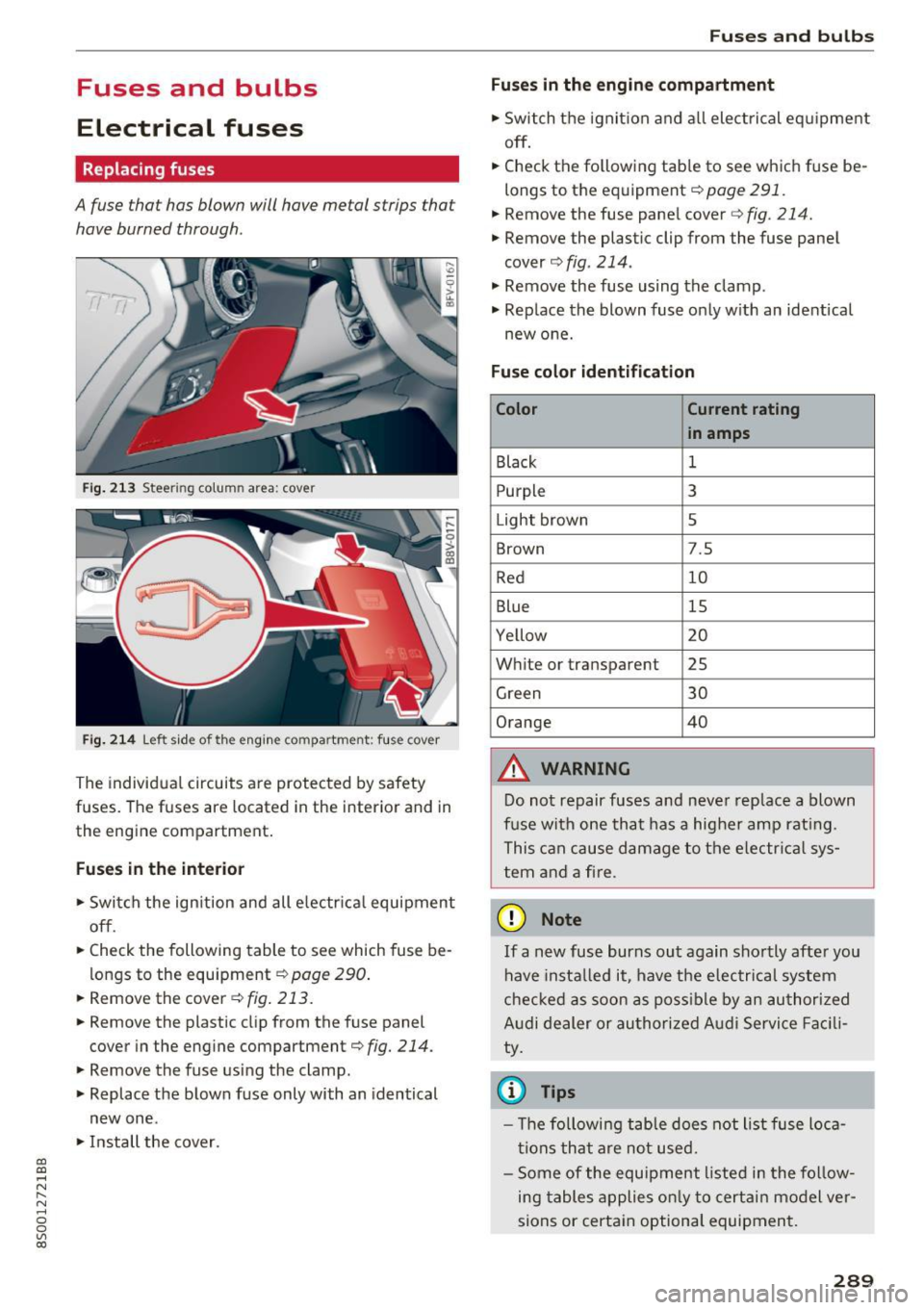
Fig. 213 Steer ing colu mn area : cove r
Fig. 214 Left side of the engin e com partment : fus e cover
The individual circuits are protected by safety
fuses. The fuses are located in the interior and in
the engine compartment.
Fuses in the interior
"S witch the ignition and all electrical equipment
off .
"C heck the following table to see which fuse be
longs to the equipment ¢
page 290.
"R emove the cover ¢
fig. 213.
"Remove the plastic clip from the fuse panel
cover in the engine compartment¢
fig. 214.
"Remove the fuse using the clamp.
" Replace the blown fuse only with an identical
new one .
"Install the cover.
Fuses and bulbs
Fuses in the engine compartment
"S witch the ignition and all electrical equipment
off .
.. Check the following table to see which fuse be
longs to the equipment¢
page 291.
.. Remove the fuse panel cover¢ fig. 214.
" Remove the plastic clip from the fuse panel
cover
¢ fig. 214 .
" Remove the fuse using the clamp .
.. Rep lace the blown fuse only with an identical
new one.
Fuse color identification
Color Current rating
in amps
Black
1
Purpl e 3
Light brown 5
Brown 7.5
Red 10
Blue 15
Ye llow 20
White or transparent 25
Green 30
Orange 40
&, WARNING
-
Do not repair fuses and never replace a blown
fuse with one that has a higher amp rating.
This can cause damage to the electrica l sys
tem and a fire .
(D Note
If a new fuse burns out again shortly after you
have instal led it, have the electrical system
checked as soon as possible by an authorized
Audi dealer or authorized Audi Service Facili
ty.
© Tips
- Th e following table does not list fuse loca
tions that are not used.
- Some of the equipment listed in the follow
ing tables applies only to certain model ver
sions or certain optional equipment.
289