service AUDI TT ROADSTER 2011 Owner's Manual
[x] Cancel search | Manufacturer: AUDI, Model Year: 2011, Model line: TT ROADSTER, Model: AUDI TT ROADSTER 2011Pages: 260, PDF Size: 64.11 MB
Page 177 of 260
-Blend must contain not more than 15%
MTBE.
Seasonally adjusted gasoline
Many gasoline grades are blended to perform
espec ially we ll for winter or summer driving.
During seasonal change-over, we suggest that
you fill up at busy gas stat ions where the sea
sonal adjustment is more likely to be made in
time .
(D Note
-Methanol fuels which do not meet these
requirements may cause corrosion and
damage to plastic and rubber compo
nents in the fuel system .
- Do not use fue ls that fail to meet the
specified criter ia in this chapter.
- If you are unable to determine whether
or not a particular fue l blend meets the
specifications, ask your service station or
its fuel supp lier.
- Do not use fuel for which the contents
cannot be identified.
- Fuel system damage and performance
problems resulting from the use of fuels
different from those specified are not
the responsibility of Audi and are not
covered under the New Vehicle or the Emission Control System Warranties.
- If you experience a loss of fuel economy
or driveability and performance prob l ems due to the use of one of these fuel
blends, we recommend that you switch
to unblended fuel.
Gasoline additives
A major concern among many auto manufac
turers is carbon deposit build- up caused by
the type of gasoline you use.
Although gasoline grades differ from one manufacturer to another , they have certain
things in common. All gasoline grades contain
substances that can cause deposits to collect
on vital engine parts, such as fuel injectors
and intake valves. Although most gasoline brands include additives to keep engine and
Fuel supply and filling your fuel tank 175
fuel systems clean, they are not equally effec
tive .
A udi recommends using TOP TIER Detergent
Gasoline. For more information on TOP TIER
Detergent Gasoline, please go to the official
website (www.toptiergas.com).
After an extended period of using inadequate
fuels, built-up carbon deposits can rob yo ur
engine of peak performance.
Q) Note
Damage or malfunction due to poor fue l
quality is not covered by the Aud i New Ve
hicle Limited Warranty.
Fuel tank
Fuel filler neck
The fuel filler neck is located on the right rear
side panel behind the fuel fille r flap.
If the unlocking system should fail, you can
still open the flap manually -for detailed in
structions see ¢
page 177.
You can find the fuel tank capacity of your ve
hicle in
Technical Data ¢ page 239.
The label on the inside of the fuel fi ller flap
tells you the correct fue l for your vehicle. For
more information about fuel specifications,
see ¢
page 174.
Your vehicle fue l tank has an on -board refue l
li ng vapor recovery system. This feature helps
to prevent fuel vapors from escaping from the
tank and polluting the environment while you refuel your vehicle . In order to fill the tank
properly while protecting the environment,
please fo llow this refueling procedure careful
ly.
_&. WARNING
Under normal operating conditions, never
carry additional fue l conta iners in yo ur car.
Gas canisters and other containers used to
transport f uel can be dangero us. Such con
tainers, full or empty, may leak and could
cause a fire in a collision. If you must
•
•
Page 186 of 260
184 Checking and filling
- If your skin has come in contact with the
engine oil, you must subsequent ly
cleanse it thoroughly.
- The oil level must not be above range
G)
-danger of converter or engine damage!
Contact an a uthorized dea lership to draw
off o il, if necessary.
- Audi does not recommend the use of o il
addit ives. They may damage the engine
and adve rsely affect you r New Vehicle
War ranty .
@i For the sake of the environment
-Under no circumstances can the oil come
i n contact with the sewage network or
the soil.
- Observe and follow lega l regu lations
when disposing of empty oil containers.
Changing the engine oil
We recommend that have your oil changed by
an authorized Audi dealer or a qualified serv
ice station .
Before you check anything in the engine com
partment,
always read and heed all WARN·
INGS
¢ .&. in Working in the engine comport·
menton page 178 .
The engine oil must be changed according to
the intervals specified in your Warranty
&
Maintenance book let . T his is very important
because the l ubricating prope rties of oil di
minish gradua lly dur ing no rmal veh icle use .
Under some circumstances the engine o il
should be changed more frequently . Change
oil more often if you drive most ly short dis
tances , ope rate the vehicle in dusty areas or
u nder predominantly stop -and-go t raffi c con
d itions, or have your veh icle w here tempe ra
tures rema in below free zin g fo r ex tended pe
riods .
D ete rge nt add it ives in the o il w ill ma ke fresh
oil look dark after the eng ine has been run
n ing fo r a shor t time. This is no rm al and is not a
reason to change t he oil more often than
recommended.
B ecau se of the p rob lem of p roper dispos al,
along wi th the specia l tools and necessa ry ex
pert ise req uired, we st rongly recommend tha t
yo u have your oil changed by an a uthorized
Audi dealer or a qualified service station.
If you choo se to change your oil your self ,
please note the fo llowing important info rma
tion:
A WARNING
-To reduce the risk of pe rsonal in jury if you
must change the eng ine oil in your vehicle
yourself:
- Wear eye protection.
- To reduce the risk of burns from hot en-
g ine oil, let the engine cool down to the
touch.
- When removing the o il dra in p lug with
your fingers, stay as far away as possib le.
Always keep your forearm parallel to the
ground to help prevent hot oil from run·
n ing down your arm.
- Dra in the oil into a container designed
for this purpose, one la rge enough to
hold a t least the tota l amount of oi l in
your e ng in e.
- Engine oil is poisonous . Keep it we ll out
of the reach of childre n.
- Continu ous contact wit h used eng ine o il
is harmful to yo ur s kin. Always protec t
your skin by washing oil off tho ro ughly
wit h soap an d wate r.
(D Note
Never mix oil additives with your engine
o il. These additives can damage your e n·
gin e and adversely affect your Audi Limit
ed New Veh icle Warranty.
@ For the sake of the environment
-Befo re changi ng your oil, first make s ure
you know where you can prope rly dispose
of t he used oil.
- Always dispose of used eng ine oi l proper -
ly. Do not dump it on garden soil,
IJJ,-
Page 187 of 260
wooded areas, into open streams or
down sewage drains.
- Recycle used engine oil by taking it to a
used engine oil collection facility in your
area, or contact a service station.
Engine cooling system
Coolant
T he engine coolan t performs two functions: it
keeps the engine from overheating and it pro
tects the engine from freezing in the winter .
The cooling system is sealed and generally re
quires little attention .
T he cooling system has been filled at the fac
tory with a permanent coolant which does not
need to be changed . The coolan t consis ts of a
mixture of water and the manufacturer 's gly
col-basedcoolant additive G12 ++ antifreeze
with anticorrosion additives (50% for USA
models; 60% for Canad ian models). This mix
ture both assures the necessary frost protec
tion and protects metal components in the
engine 's cooling system from corrosion and
scaling. It also raises th e boiling point of the
c oolant.
Do not reduce the concentration of the coo l
ant in the summer by adding plain water .
The
proportion of coolant additive must be at
least 50% but not more than 60%
to main
tain antifree ze protection and cooling efficien
cy . If the coolant frost protection is too low,
the coolant could freeze and damage the veh i
cle heating and eng ine cooling system .
For year-round driving, an tifree ze is added at
the factory for temperatures down to:
- -31 ° F ( - 3 5 °C) USA
- -40 °F ( -40 °C) Canada.
You can mix the G12 ++ coolant addit ive with
other additives (G12+ or G12) . Always check
with your authorized Audi dealer.
& WARNING
Before you check anything in the engine
compartment, always read and heed all
-
Checkin g and fillin g 185
WARNINGS c:::> .& in Working in the engine
compartment on page 178.
(D Note
- Before winter sets in, have the coolant
checked to see if the coolant additive in
your vehicle is sufficient to meet the cli
mate conditions. This is especially impor
tant if you live in a region where the win
ter is extreme ly cold . If necessary, in
crease the proportion of coo lant add itive
to 60% .
- Whe n adding coolant additive to your
cooling system, remember :
- We recommend using only coo lant ad
ditive G12++ (check the labe l) for your
vehicle . This coolant additive is avai la
ble at authorized Audi dealers. Other
types of ant ifreeze can significantly re
duce corrosion protection . The result
ing corrosion can cause a loss of cool
ant and ser ious eng ine damage.
- Do not add any type of rad iator leak seal
ant to yo ur vehicle's engine coolant .
Add ing radiator repair fluid may adverse
ly affect the function and performance of
your cooling system and could resu lt in
damage not covered by your New Vehicle
Limited Warranty .
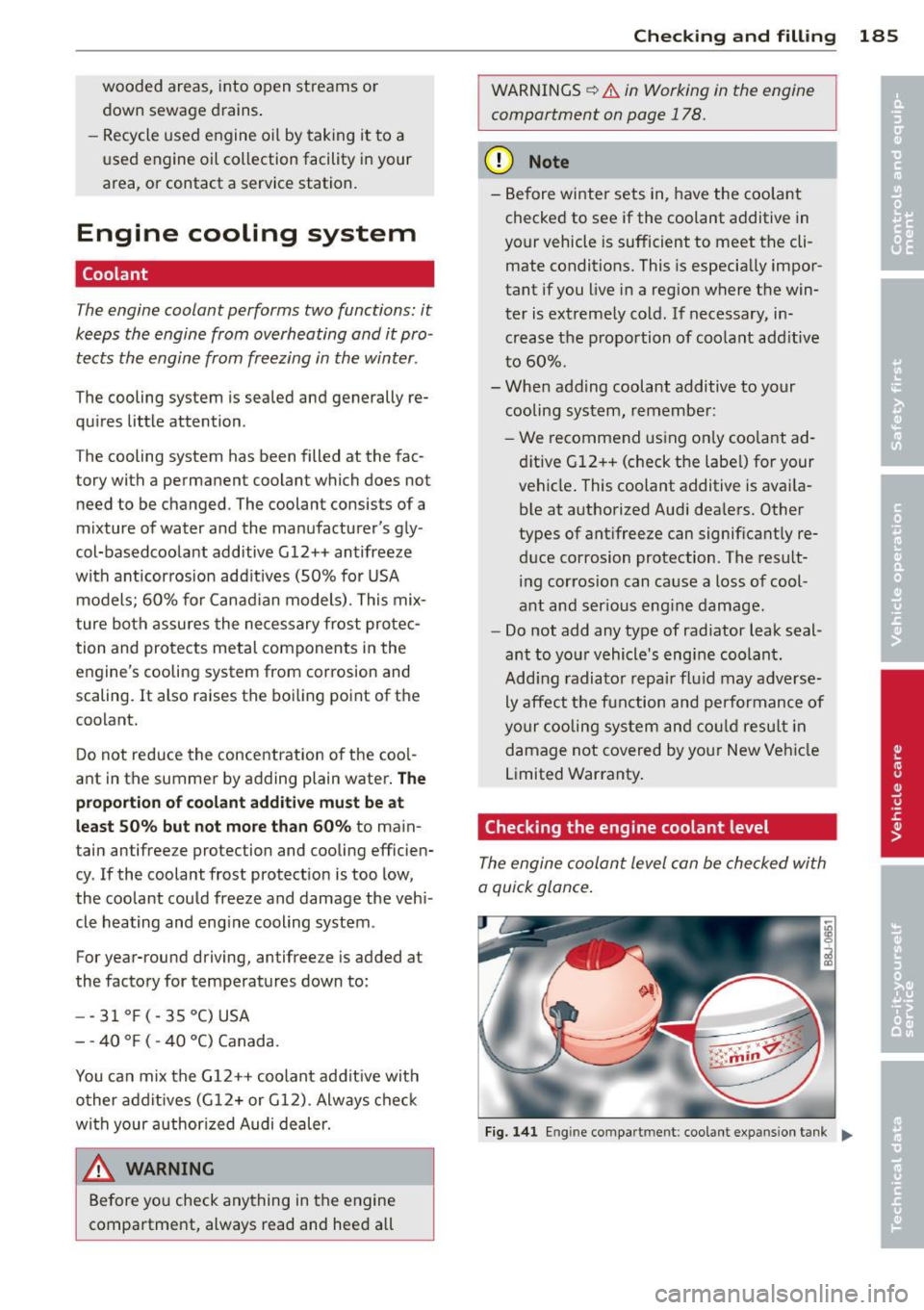
Checking the engine coolant level
The engine coolant level can be checked with
a quick glance.
Fig. 141 E ng ine compart men t: coo lant ex pansion t ank Ill>
Page 203 of 260
Never exceed the m aximum inflati on pres
s u re li sted on the ti re sidew all for any rea
son.
Remembe r that the vehicle manufacturer, not
the t ire manufacturer, determines the co rrect
tire pressure for the tires on your vehicle.
It is importan t to check the tire pressure when
t he t ires are cold .
- Read the requ ired ti re pressure from the tire
pressure label located on d river's s ide B-pi l
l ar .
- T urn the valve stem cap counter-clockwise
to remove it from the tire valve .
- Place the air pressure gauge on the valve .
- The tire pressures should only be checked
and adjusted when the tires are cold . The
s li ght ly raised p ressures of warm tires must
not be reduced.
- Adjust the t ire pressure to the load you a re
ca rrying.
- Re install the valve stem cap on the valve .
When should I ch eck the ti re pres sur e?
The correct tire pressure is especially impor
tant at high speeds. The pressure should
therefore be checked at least once a month
and a lways before start ing a journey .
When should I ad just th e tir e pre ss ures?
Ad just the tire pressure to the load you are
carrying . After changing a wheel
or replacing
wheels you have to adjust the tire pressures
on all wheels. In addition, you must then in it i
alize the new tire pressures in the tire pres
sure mon itor ing system
q page 212 .
A WARNING
Incorrect tire pressures and/or unde rinfla
tion can lead sudden tire failure, loss of cont ro l, col lision, ser ious persona l inju ry
or even death.
- When the warning symbo l
[D] appears in
the instrument cl uster, stop and inspect
the tires.
- Incor rect tire pressure and/or underinfla
tion can cause increased tire wear and
Tire s an d wheel s 201
can affect the handling of the vehicle and
stopping ability .
- Incorrect tire pressures and/or underin
flation can a lso lead to sudden t ire fail
ure, including a blowout and sudden de
flation, caus ing loss of veh icle control.
- The driver is responsible for the correct
tire pressures for all tires on the veh icle.
The applicable pressure values are locat ed on a sticker on the dr iver's s ide B-pil
lar .
- On ly when all tires on the vehicle are fil
led to the correct pressure, the t ire p res
sure mon itor ing system can work cor
rectly.
- The use of incorrect tire p ressu re va lues
can lead to acc idents or other damage.
Therefore it is essential that the drive r
observe the spec ified t ire p ress ure val ues
for the t ires and the correct pressures for
the function of the tire press ure monito r
ing system.
-A lways inflate tires to the recommended
and correct tire pressure before dr iv ing
off.
- Driving with underinf lated tires bend
mo re, letting them get too hot resulting
in tread separation, sudden tire failure
and loss of control.
- Excessive speed and/over loading can
cause heat b uild-up, sudden tire failure
and loss of control.
- If the tire pressure is too low or too high,
the t ires will wear prematurely and the
veh icle w ill not handle well.
- If the tire is not flat and you do not have
to change a wheel immediately, drive at
reduced speed to the nearest service sta
tion to check the t ire p ressu re and add
a ir as requ ired.
(D Note
Driving w it h out valve stem caps can cause
damage to the tire valves. To prevent this,
always make sure that factory installed
valve stem caps on all whee ls are secu rely
mounted o n the valve. .,.
•
•
Page 205 of 260
KG OR XXX LBS"on your vehi
cle's placard (tire inflation
pressure label)
¢ page 198 ,
fig. 146.
2. Determine the combined
weight of the driver and pas s engers that will be riding in
your vehicle .
3. Subtract the combined
weight of the driver and pas
s engers from
"XXX" kilo
grams or
"XXX " pound s
shown on the sticker
¢ page 198 , fig. 146 .
4. The resulting figure equals
the available amount of cargo and luggage load capa ci
ty . For example, if the
"XXX''
amount equals 1400 lbs.
and there will be five 150 lbs. passengers in your vehi
cle, the amount of available
cargo and luggage load ca
pacity is 650 lbs. (1400-750 (5
X 150) = 650 lbs .)
5. Determine the combined weight of luggage and cargo being loaded on the vehicle.
That weight may not safely
exceed the available cargo
and luggage load capacity
calculated in Step 4.
Tires and wheels 203
6 . If your vehicle will be towing
a trailer , load from your trail
er will be transferred to your
vehicle. Consult this manual
to determine how this re duces the available cargo
and luggage load capacity of
your vehicle.
~check the tire sidewall
(¢ page 205, fig . 150) to de
termine the designated load rating for a specific tire.
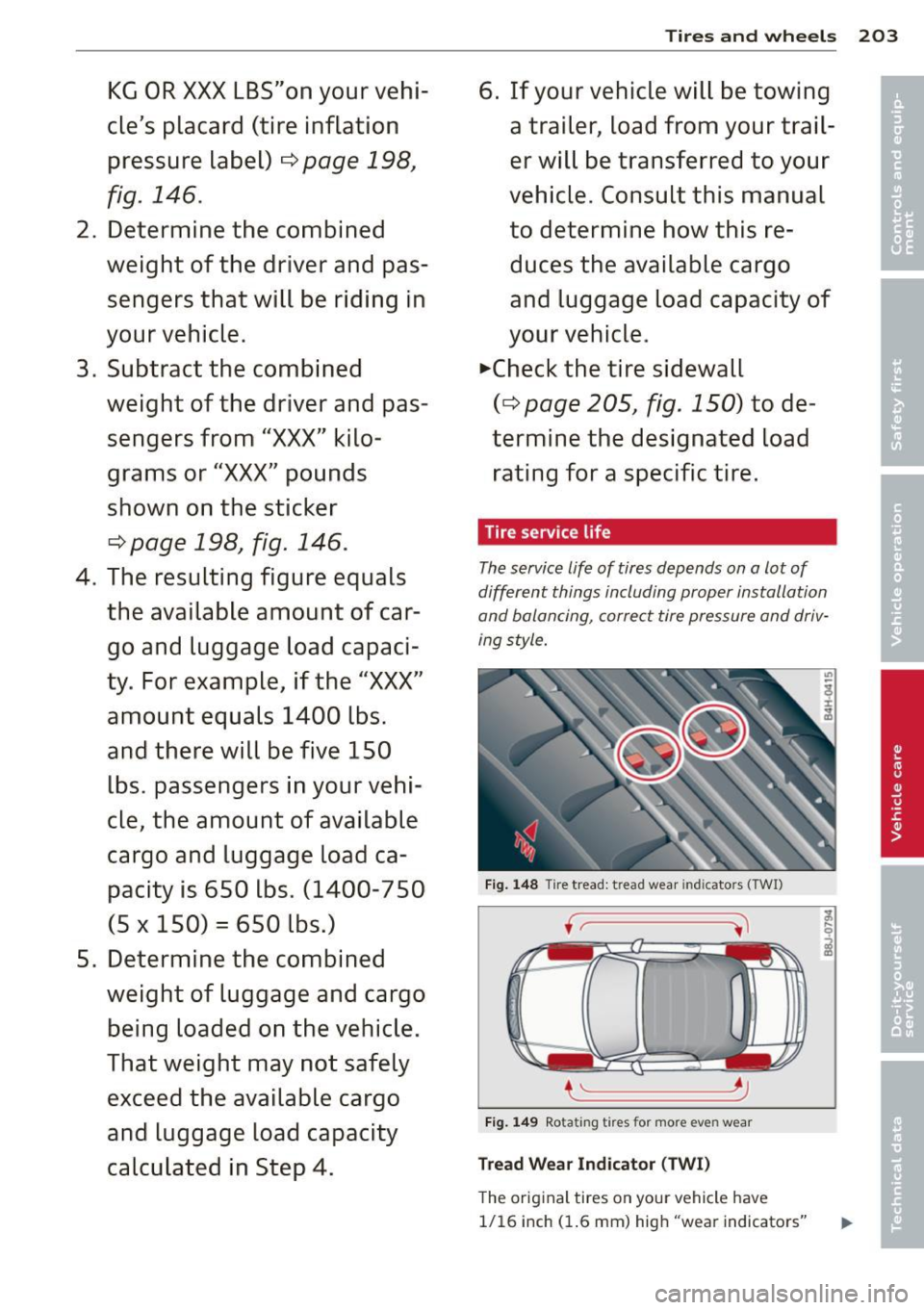
Tire service life
Th e se rvic e lif e of tir es d ep ends on a lot of
differ ent things including proper ins tall atio n
and bal ancin g, corr ect ti re press ure and dr iv
ing s tyle .
Fig. 148 Tir e t read: t read wea r in dic ato rs (TWI)
f --------
~- ---- --'
Fig. 149 Rotating tir e s for more eve n wea r
Tread Wear Indicator (TWI)
The o rig ina l tires o n yo ur vehi cle have
1/ 16 inch ( 1.6 mm) hig h "wea r in dicato rs"
Page 206 of 260
204 Tires and wheels
c::>fig . 148 running across the tread. Depend
ing on the make, there will be six to eight of
them evenly placed around the tire. Marks on
the tire sidewall (for example "TWI" or other
symbols) indicate the positions of the tread
wear ind icators . Worn tires must be replaced .
Different figures may apply in other countries
c::> ,& .
Tire pressure
Incorrect tire pressure causes premature wear
and can cause sudden tire blow-out . For this
reason, tire pressure must be checked at least
once a month
c::> page 200.
Driving style
Driving fast around curves, heavy acceleration
and hard braking increase tire wear.
Rotating tires for more even wear
For a ll four tires on your vehicle to have the
same service life, we recommend that the
front and rear tires are rotated according to
the tire manufacturer's suggested tire rota
tion intervals. Please remember the follow
ing:
- Tire rotation interva ls may differ from the
vehicle serv ice intervals outlined in your
Warranty
& Maintenance Booklet.
- The longer one tire is used in one location
on the vehicle, the more it wears at certain
points; therefore, we recommend that you
follow the tire manufacture r's suggested
t ir e rotation intervals .
- Vehicles with front-wheel drive experience
more tread wear on the front wheels com
pared to all-wheel drive (quatt ro ® ).
- Please rotate t ires as shown
c::> fig . 149.
-Extra care must be taken when rotating di-
rect ion-specific tires
c::> page 226.
Wheel balancing
The whee ls on new vehicles are balanced.
However, various situations during everyday
driving can cause them to become unbal
anced, resulting in vibrations you can usually
feel through the steering wheel. Unbalanced
wheels must be rebalanced to
avoid excessive wear on steering, suspension
and t ires . A whee l must also be reba lanced
when a new tire is installed.
Incorrect wheel alignment
Incorrect wheel alignment can cause exces
sive tire wear, impairing the safety of the vehi
cle. If tires show excessive wear, have the
whee l alignment checked by an authorized
Audi dealer or qualified workshop.
All Wheel Drive
Vehicles with quattro ® must a lways have tires
of the same size, construction and tread type .
For details see c::>page
154.
A WARNING
-Sudden tire fai lure can lead to loss of con-
trol, a crash and serious personal injury!
- Never drive a vehicle when the tread on
any tire is worn down to the wear indica
tors.
- Worn tires are a safety hazard, they do not grip well on wet roads and increase
your r isk of "hydroplaning" and loss of
control.
- Always keep chemicals that can cause
tire damage, such as grease, oil, gasoline
and brake fluid away from tires.
- Tires age even if they are not being used
and can fail suddenly, especially at high
speeds. Tires that are more than 6 years
old can only be used in an emergency
and then w ith special care and at lower
speeds.
- Never mount used tires on your vehicle if
you are not sure of their "previous histo
ry." O ld used tires may have been dam
aged even though the damage cannot be
seen that can lead to sudden tire fai lure
and loss of vehicle control.
Page 224 of 260
222 What do I do now ?
@ Tips
After a tire repair, have the sealant bottle
rep laced at a dealership . This restores full
functionality to the Tire Mob ility System.
What should I be
aware of when
changing a tire?
General information
The follow ing sections will provide you with
important information o n how to change a
tire using the vehicle tool kit.
However , we recommend that you have a
qua lified service center change the tire and
pe rform all work associated with changing it .
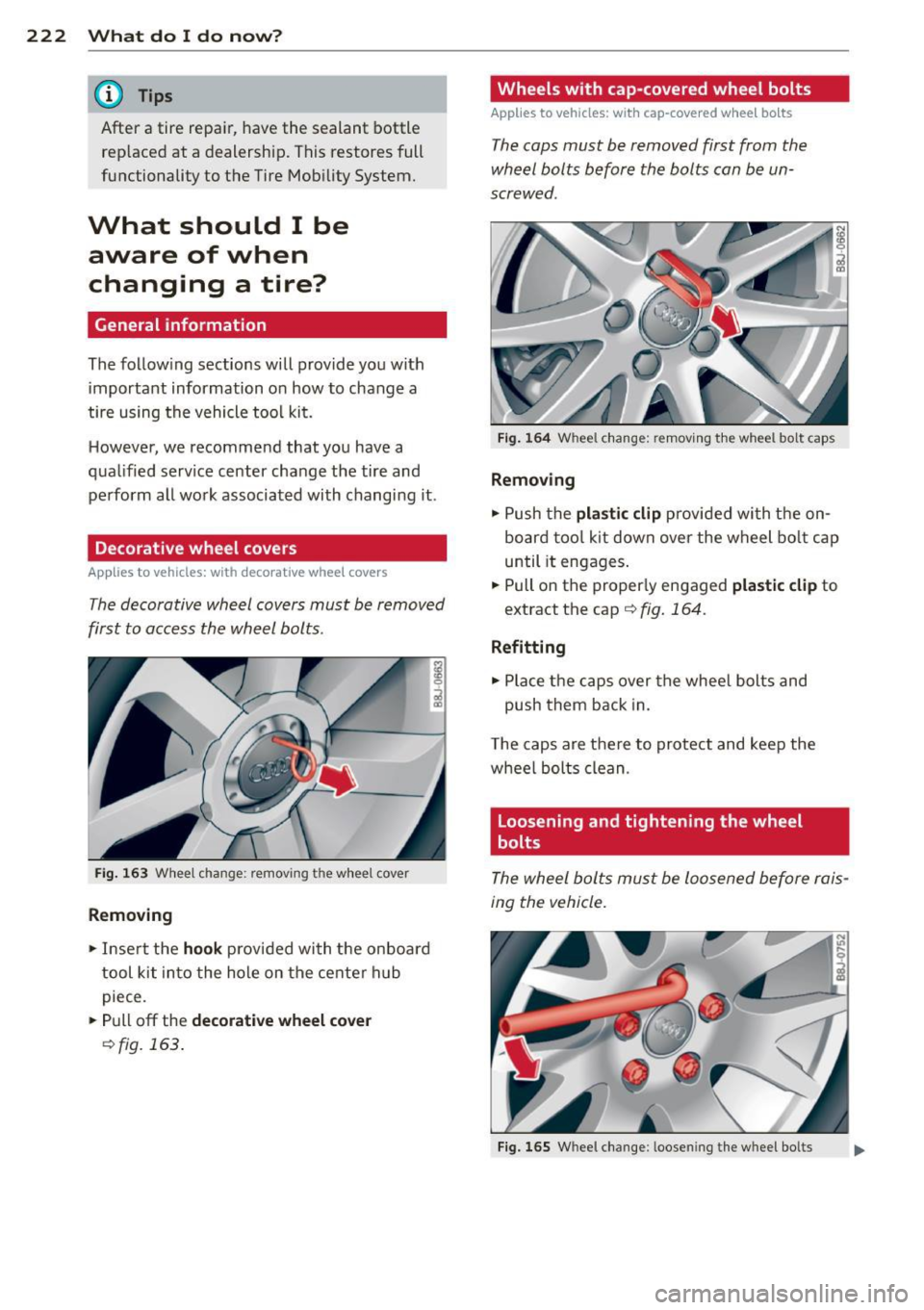
Decorative wheel covers
Applies to vehicles: with decorative wheel covers
The decorative wheel covers must be removed
first to access the wheel bolts .
Fig. 1 63 Wheel ch an ge : remo ving th e wh eel cove r
Removing
,.. In se rt the hook provided wi th t he on board
tool kit into the hole on the center h ub
piece .
,.. Pull
off the decorat ive wheel cover
Q fig . 163 .
' Wheels with cap-covered wheel bolts
Applies to vehicles: with cap-covered wheel bolts
The caps must be removed first from the
wheel bolts before the bolts can be un
screwed .
Fig . 164 W heel c hange: re moving th e wh eel bolt cap s
Removing
,.. Push the plasti c clip provided wi th the on
board too l kit down over the wheel bo lt cap
until it engages .
,.. Pull on th e properly engaged
pla stic clip to
extract the cap
Q fig. 164 .
Refitting
,.. Place the c aps over the whee l bolts and
push them back in.
T he caps are the re to protect and keep the
whee l bolts clean .
Loosening and tightening the wheel
bolts
The wheel bolts must be loosened before rais
ing the vehicle.
Fi g. 16 5 W hee l cha nge : loose ning t he wh eel bol ts
Page 227 of 260

~ Use the hexagonal socket in the screwdriver
handle to screw in and tighten all wheel
bo lts
slightly .
~ Unscrew the alignment pin and insert and
t ighten the remaining wheel bolt s light ly
like the rest.
~ T urn the jack handle counter-clockw ise to
l ower the vehicle unti l the jack is fully re
leased .
~ Use the whee l bolt w rench to t ighten al l
whee l bolts firmly <=>
page 222 . Tighten
them
crosswise, from one bolt to the (ap
proximate ly) opposite one, to keep the
whee l cente red.
Q;) Note
When removing or installing the wheel,
the rim could hit the brake rotor and dam
age the rotor. Work carefully and have a
second person help you.
(D} Tips
Never use the hexagonal socket in the han
dle of the screwdriver to loosen or t ighten
the wheel bolts .
- Pull the reversib le b lade from the screw
driver before yo u use the hexagonal
socket in the handle to t urn the whee l
bo lts .
- When mounting tires with
unid irectional
tread design
make su re the tread pat
te rn is poi nted the r ight way
<=> page 226.
- The wheel bolts should be clea n and easy
to tu rn . Check for d irt and corrosion on
the mat ing s urfaces of both the wheel
and the hub. Rem ove a ll dirt from these
su rfaces before rem ounting the wheel.
Notes on wheel change
Please read the information <=> page 205 , New
tires and replacing tires and wheels ,
if you are
going to use a spare t ire which is different
from the tires on your ve hicle.
Afte r you change a tire :
What do I do now? 225
-Check the tire pre ssure on the spare imme
diately after mounting.
- Have the whe el bolt tightening torque
checked with a torque wrench as soon a s
possible by your authorized Audi dealer or
a qualified service station.
- With steel and alloy wheel rim s, the wheel
bolt s are cor rectly tightened at a torque of
90 ft lb (120 Nm ).
- If you noti ce while changing a tire that the
wheel bolts are corroded and difficult to
turn , then they should be replaced before
you check the tightening to rque.
- Replace the flat tire w ith a new one and
have it installed on your vehicle as soon as
possible. Remount the whee l co ver.
Until then , dr ive with extra care and at re
duced speeds.
A WARNING
- If you are going to equ ip your vehicle
w it h tires o r rims which differ from those
which were factory installed, then be
sure to rea d the information
¢ page 205,
New tire s and replacing tires and
wheels.
- Always sto re the too ls secu rely in lug
gage com partmen t. Othe rwise , in a n ac
cident or s udden m aneuver they cou ld fly
forwa rd, causing inj ury to passengers in
the vehicle.
(D Note
D o not use comme rcially ava ilab le tire
se alants . Ot herwise, t he e lectr ic al c ompo
nen ts of the tire pressu re monitoring sys
tem will no lo nger work p roperly and the
sensor fo r the tire pressure mon itor ing
system will have to be rep laced by a quali
fied workshop. •
•
Page 235 of 260
instructions of the jumper cable
manufacturer. If in doubt, call for road
service.
- Jumper cables must be long enough so
that the vehicles do not touch.
- When connecting jumper cables, make
sure that they cannot get caught in any
moving parts in the engine compart
ment.
- Before you check anything in the engine
compartment, always read and heed all
WARNINGS
<=> page 172, Engine com
partment .
@ Note
Improper hook-up of jumper cables can ru
in the generator.
-Always connect POSITIVE(+) to POSI
TIVE(+), and NEGATIVE(-) to NEGATIVE
( - ) ground post of the battery manager
control unit.
- Check that all screw plugs on the battery
cells are screwed in firmly . If not, tighten
plugs prior to connecting clamp on nega
tive battery terminal.
- Please note that the procedure for con
necting a jumper cable as described
above applies spec ifically to the case of
your vehicle being jump started. When
you are giving a jump start to another ve
hicle, do
not connect the negative( -) ca
ble to the negative(- ) terminal on the
discharged battery@. Instead, securely
connect the negative (-) cable to either a
solid metal component that is firmly bolted to the engine block or to the en
gine block itself. If the battery that is be
in g charged does not vent to the outside,
escaping battery gas could ignite and ex
plode!
Emergency situations 233
Emergency towing
with commercial tow
truck
General hints
Your Audi requires special handling for tow
ing.
T he following information is to be used by
commercial tow truck operators who know
how to operate their equipment safely.
- Never tow your Audi, towing will cause
damage to the engine and transmission.
- Never wrap the safety chains or winch ca
ble s around the brake lines .
- To prevent unnecessary damage, your Audi
must be transported with a car carrier
(flatbed truck).
- To load the vehicle on to the flat bed, use
the towing loop found in the vehicle tools
and attach to the front or rear anchorage
<=> page 234 and c:> page 235.
A WARNING
A vehicle being towed is not safe for pas
sengers. Never allow anyone to ride in a
vehicle be ing towed, for any reason.
-
•
•
Page 243 of 260
Consumer Information
Warranty coverages
Your Audi is covered by the following war
ranties :
-New Vehicle Limited Warranty
- Limited Warranty Against Corrosion Perfo-
ration
- Emissions Control System Warranty
- Emissions Performance Warranty
- California Emissions Control Warranty (USA
vehicles only)
- California Emissions Performance Warranty
(USA vehicles only)
Detailed information regarding your warran
ties can be found in your
Warranty & Mainte
nance booklet .
Operating your vehicle
outside the U.S.A. or
Canada
Government regulations in the United States
and Canada require that automobiles meet
specific emission regulations and safety
standards. Therefore, veh icles built for the
U.S.A. and Canada differ from vehicles sold in
other countries .
If you p lan to take your vehicle outside the
continental limits of the United States or Can
ada, there is the possibility that
- unleaded fuels for vehicles with cata lytic
converter may not be available;
- fuel may have a considerably lower octane
rating. Improper fuel may cause engine
damage;
- service may be inadequate due to lack of
proper service facilities, tools or testing
equipment;
- replacement parts may not be readily availa
ble.
- Navigation systems for vehicles built for the
U.S.A. and Canada will not necessari ly work
in Europe, and may not work in other coun
tries outside of North America.
Consumer Information 241
@ Note
Audi cannot be responsible for mechanical
damage that could result from inadequate
fuel, service or parts availability.
Audi Service Repair Manuals and Literature
Audi Offic ial Factory Service Manuals and Lit
erature are published as soon as possible after
model introduction. Service Manuals and liter
atu re are availabl e to order from the Audi
T echnical Literature Ordering Center at:
www.audi.techliterature.com
Maintenance
' General
Your vehicle has been designed to help keep
maintenance requirements to a minimum.
However, a certain amount of regular mainte
nance is still necessary to assure your vehicle's
safety, economy and reliability. For detailed
vehicle maintenance consult your Warranty& Maintenance booklet.
Under difficult operating conditions , for ex
ample at extremely low outside temperatures,
in very dusty regions, etc., some service work
shou ld be pe rformed between the intervals
specified. This applies particularly to:
- oil changes, and
- cleaning or replacing the air fi lter.
@ For the sake of the environment
By regu larly maintaining your vehicle, you
help make sure that emission standards
are maintained, thus min imizing adverse
effects on the environment.
Important considerations for you and
your vehicle
T he increasing use of electron ics, soph isticat
ed fuel injection and emission control sys
tems, and the generally increasing technica l
complexity of today's automobiles, have ..,_
•
•