ECO mode AUDI TT ROADSTER 2011 Owner's Guide
[x] Cancel search | Manufacturer: AUDI, Model Year: 2011, Model line: TT ROADSTER, Model: AUDI TT ROADSTER 2011Pages: 260, PDF Size: 64.11 MB
Page 187 of 260
wooded areas, into open streams or
down sewage drains.
- Recycle used engine oil by taking it to a
used engine oil collection facility in your
area, or contact a service station.
Engine cooling system
Coolant
T he engine coolan t performs two functions: it
keeps the engine from overheating and it pro
tects the engine from freezing in the winter .
The cooling system is sealed and generally re
quires little attention .
T he cooling system has been filled at the fac
tory with a permanent coolant which does not
need to be changed . The coolan t consis ts of a
mixture of water and the manufacturer 's gly
col-basedcoolant additive G12 ++ antifreeze
with anticorrosion additives (50% for USA
models; 60% for Canad ian models). This mix
ture both assures the necessary frost protec
tion and protects metal components in the
engine 's cooling system from corrosion and
scaling. It also raises th e boiling point of the
c oolant.
Do not reduce the concentration of the coo l
ant in the summer by adding plain water .
The
proportion of coolant additive must be at
least 50% but not more than 60%
to main
tain antifree ze protection and cooling efficien
cy . If the coolant frost protection is too low,
the coolant could freeze and damage the veh i
cle heating and eng ine cooling system .
For year-round driving, an tifree ze is added at
the factory for temperatures down to:
- -31 ° F ( - 3 5 °C) USA
- -40 °F ( -40 °C) Canada.
You can mix the G12 ++ coolant addit ive with
other additives (G12+ or G12) . Always check
with your authorized Audi dealer.
& WARNING
Before you check anything in the engine
compartment, always read and heed all
-
Checkin g and fillin g 185
WARNINGS c:::> .& in Working in the engine
compartment on page 178.
(D Note
- Before winter sets in, have the coolant
checked to see if the coolant additive in
your vehicle is sufficient to meet the cli
mate conditions. This is especially impor
tant if you live in a region where the win
ter is extreme ly cold . If necessary, in
crease the proportion of coo lant add itive
to 60% .
- Whe n adding coolant additive to your
cooling system, remember :
- We recommend using only coo lant ad
ditive G12++ (check the labe l) for your
vehicle . This coolant additive is avai la
ble at authorized Audi dealers. Other
types of ant ifreeze can significantly re
duce corrosion protection . The result
ing corrosion can cause a loss of cool
ant and ser ious eng ine damage.
- Do not add any type of rad iator leak seal
ant to yo ur vehicle's engine coolant .
Add ing radiator repair fluid may adverse
ly affect the function and performance of
your cooling system and could resu lt in
damage not covered by your New Vehicle
Limited Warranty .
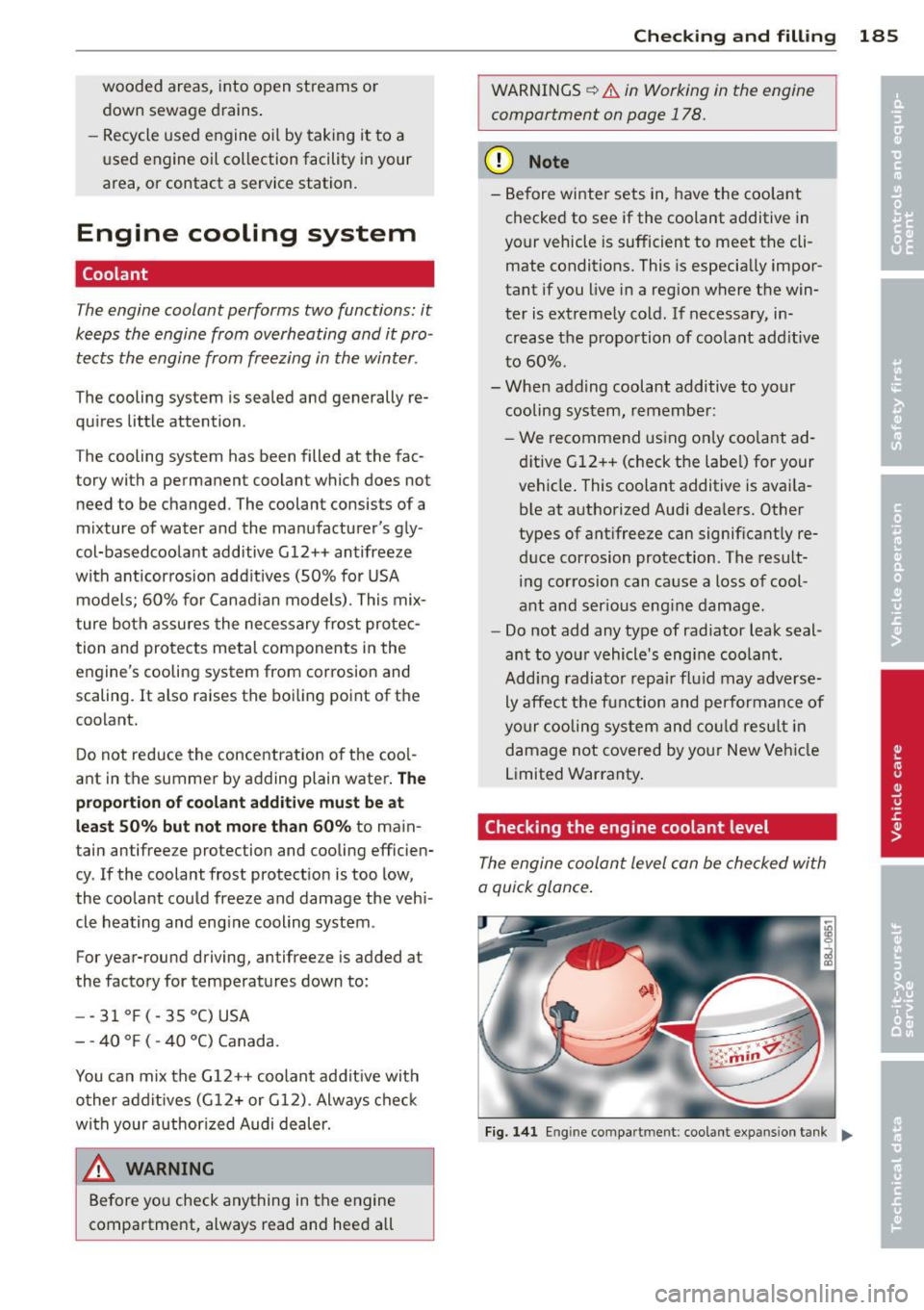
Checking the engine coolant level
The engine coolant level can be checked with
a quick glance.
Fig. 141 E ng ine compart men t: coo lant ex pansion t ank Ill>
Page 190 of 260
188 Checking and filling
If the brake fluid level falls considerably be
l ow the "MIN" mark, the brake warning/indi
cator light (U .S . mode ls: . , Canadian
models: .) will come on
¢ page 16 and
¢ page 30. Do not continue to operate the ve
h icle . The complete brake system shou ld be
thoroughly checked by an authorized A ud i
dea ler o r othe r qualified facility and t he cause
corrected. If the bra ke fluid level is too low,
the bra ke warning/ind ic a tor ligh t will illum i
nate . Contact an authorized Aud i dea ler
im
mediatel y.
Changing brake fluid
Hove the broke fluid changed by on experi
enced technician.
B rake fl uid abso rbs mois ture from the a ir. If
the water content in the b ra ke fluid i s too
h igh, corros ion in the brake sys tem may result
after a period of t ime . The boi ling point o f the
b rake fluid wi ll also decrease considerab ly and
decrease braking per formance.
T herefore, the brake flu id mus t be changed
every two year s. Always use new b rake fluid
which conforms to Fede ral Motor Vehicle
Standard "FMVSS 116 DOT 4".
T he brake flu id rese rvoi r can be difficul t to
reach, therefo re, we recommend that yo u
have the brake f luid changed by yo ur autho r
ized
Audi dealer . Your dealer has the correct
too ls, the right b rake f luid and the know-how
to do this for you.
A WARNING
- B rake fluid is poiso nous . It mus t be stor
ed only in th e closed orig inal con tainer
o ut of the reac h of children!
- Brake fa ilure can result from old o r inap
propriate b ra ke fluid. Observe these pre
c aut ions:
- Use o nly brake fluid t hat meets SAE
specif ication
J 1703 and confo rms to
Federal Motor Vehicle Standard 116.
Always check with your a uthorized Audi
dealer to make s ure you are using the
correct brake fl uid. T he correct type of brake flu
id is also ind icate d on the
brake f lu id rese rvoir.
- The brake fl uid must be new . Heavy use
of the brakes can cause a vapo r lock if
the brake fluid is left in the system too
long . This can se riously affect the effi
c iency of t he brakes as well as your
safe ty. This co uld resu lt in a n accide nt.
([) Note
Brake fluid will damage the paint of your
vehicle.
@ For the sake of the environment
Because o f the prob lem of prope r disposal
of brake fluid as well as t he spec ial too ls
required and the necessary expertise, we
recomme nd t hat yo u have th e brake flu id
cha nged by yo ur autho rize d Au di dea le r.
Battery
General information
Your ve hicl e is equipped with a specia l bat
tery, an
ACM battery. This battery is located
in t he luggage compartment and must be re
placed with an origina l equipment battery.
U nder normal opera ting condit ions, the bat
te ry is
maintenance-fr ee .
Have the battery checked when you take your
vehicle in for se rv ice . You a re well advised to
replace a battery that is o lde r th an 5 years .
Disconnecting the battery terminals
Some vehicle functions (power window reg u
lators, for example) are lost if the battery te r
mina ls are disconnected. T hese functions have
to be relearned after the battery termina ls are
connected aga in . T o prevent t his, t he battery
shou ld only b e disconne cted from the ve hicle
ele ct ric al sy stem w hen abso lutely ne cessary
f o r rep air s.
Vehicles not driven for long periods
If you are go ing to let your vehicle stand for a
long time a nd not drive it, you should remem
ber there are elect rical components which a re
Ill-
Page 201 of 260
Tires and wheels 199
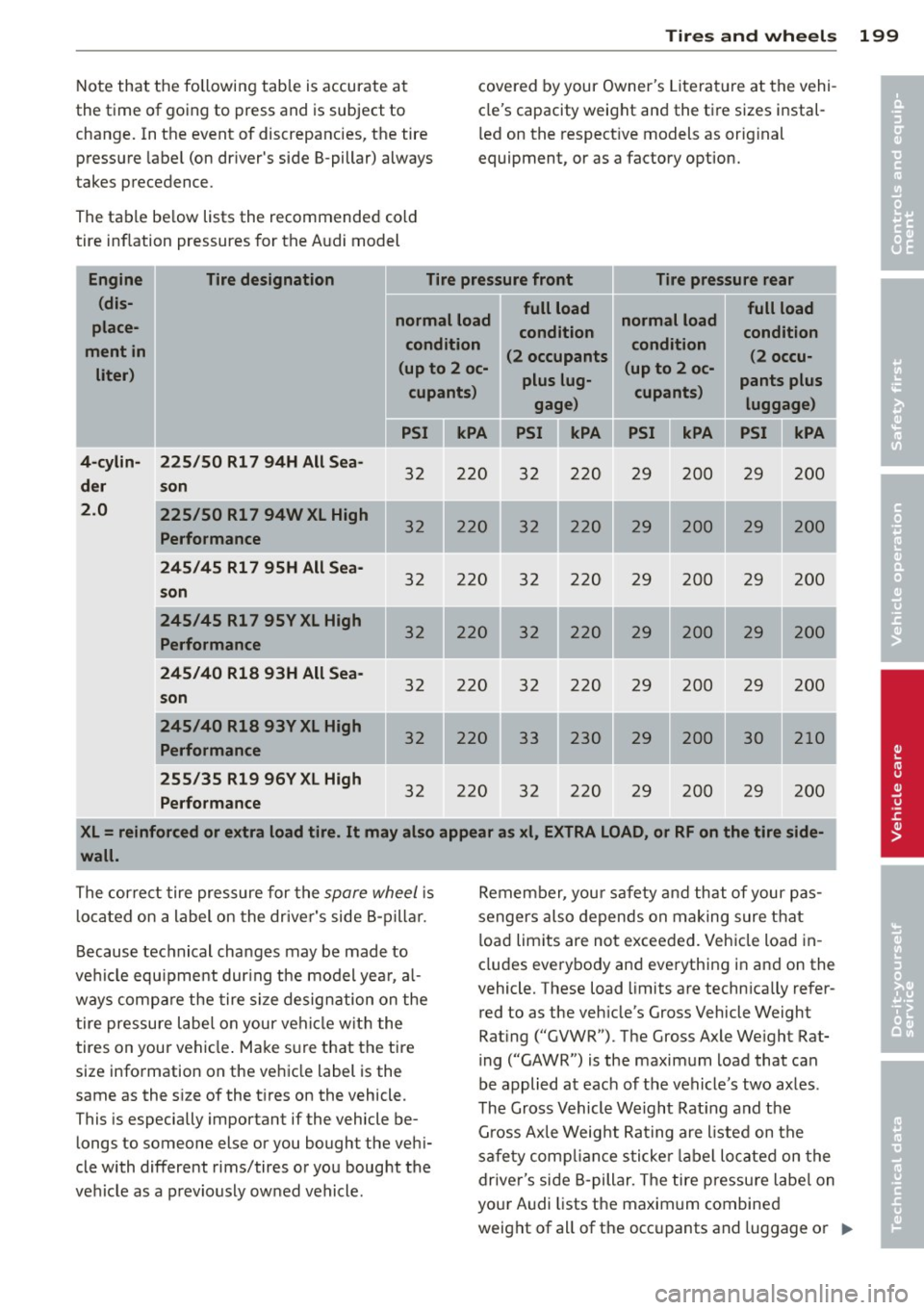
Note that the following tab le is accurate at
the time of going to press and is subject to
change. In the event of discrepanc ies, the tire
pressure label (on dr iver's side B-pillar) always
takes precedence .
The table be low lists the recommended cold
tire inf lation pressures for the Audi model covered
by your Owner 's Literature at the vehi
cle's capacity weight and the tire sizes instal
l ed on the respective models as orig inal
equipment, or as a factory option.
Engine II Tire designation Tire pressure front Tire pressure rear l
(dis-
full load full load
place- normal load
condition normal load
condition
ment in condition
(2 occupants condition
(2 occu-
liter) (up
to 2 oc-
plus lug- (up
to 2 oc-
pants plus
cupants) gage) cupants)
luggage)
PSI
ll kPA PSI kPA
PSI JI kPA PSI Jl kPA
-
4-cylin-
der
2.0 225/50
Rl 7 94H All Sea-
son
225/50 R17 94W XL High
Performance
245/45 Rl 7 95H All Sea-
son
245/45 R17 95YXL High
Performance
245/40 R18 93H All Sea
son
245/40 R18 93V XL High
Performance
255/35 Rl9 96V XL High
Performance
32 220
32 220
32 220
32 220
32 220
32 220
32 220 32
220 29 200 29 200
32 220 29 200 29 200
32 220 29 200 29 200
•
32 220 29 200 29 200
I
32 220 29 200 29 200
•
33 II 230 29
200 30 210 I
32 220 29 200 29 200
XL= reinforced or extra load tire. It may also appear as xl, EXTRA LOAD, or RF on the tire side
wall.
The correct tire pressure for the spore wheel is
l ocated on a label on the drive r's side B-pillar.
Because technical changes may be made to
ve hicl e equ ipment dur ing the model year, a l
ways compa re the tire size designation on the
tire pressure label on your vehi cle w ith t he
tires on your vehicle . Make sur e that the tire
size information on the vehicle label is the
same as the size of the tires on the vehicle.
This is especially important if the vehicle be
longs to someone else or you bought the veh i
cle with different rims/tires or you bought the
vehicle as a previously owned vehicle. Remember, you
r safety and that of your pas
sengers also depends on making sure that
load limits are not exceeded. Vehicle load in
cludes everybody and everything in and on the
vehicle. These load limits are technically refer
red to as the veh icle's Gross Vehicle Weight
Rat ing ("GVWR"). The Gross Axle We ight Rat
ing ("GAWR") is the maximum load that can
be applied at each of the vehicle's two axles .
The Gross Vehicle Weight Rating and the
Gross Axle Weight Rating are listed on the
safety comp liance sticker label lo cated on the
driver's side B-pillar. The tire pressure label on
your A udi lists the maximum combined
weight of all of the occ upants and luggage or
Ill>
•
•
Page 212 of 260
210 Tir es and whe els
Snow chains
Snow chains may be fitted only to the front
wheels, and only to certain tire sizes. Ask your
authorized Audi dealer on which tire sizes
snow chains can be used.
If you are going to use snow chains , then you
must install them on the front wheels at
least.
The snow chains must have low-profile links
and must not be thicker than 0.53 inch
(13.S mm), including the lock .
Remove wheel center covers and tr im discs
before putting snow cha ins on your vehicle
¢ Q) . For safety reasons cover caps must the n
be fitted over the whee l bolts. These are avai l
ab le from authorized Audi dea lers.
A WARNING
Using the wrong snow chains for yo ur vehi
cle or installing them incorrectly can in
crease the risk of loss of control leading to
ser ious personal inj ury.
- Snow chains are ava ilable in different
sizes. Always make sure to follow the in
struct ions provided by the snow chain
manufacturer .
- When driving w ith snow chains never
dr ive faster than the speed permitted for
your specific snow cha ins.
- Always observe local regulat ions.
([) Note
-Remove snow chains before driving on
roads not covered with snow to avoid
damaging tires and wear ing the snow
chains down unnecessar ily.
- Snow chains, which come into direct con
tact with the wheel rim, can scratch or
damage it. Therefore, make sure that the
snow chains are suitably covered. Check
the position of the snow chains after
driving a few yards and correct if neces
sa ry. Follow the i nstructions from the
snow cha in manufacture r when doing so.
(D Tips
Where snow chains are mandatory on cer
tain roads, th is normally a lso applies to ve
hicles with All Whee l Dr ive.
Wheel bolts
Wheel bolts must always be tightened to the
correct torque.
T he design of wheel bo lts is matched to the
factory installed rims. If different rims are fit
ted, the correct whee l bolts with the right
l ength and correctly shaped bolt heads must
be used. Th is ensures that wheels are fitted
securely and that the brake system functions correctly.
In certa in circumstances, you may not use
whee l bolts from a different vehicle -even if it
is the same model
¢page 243.
A WARNING
-Imp roperly t ightened or ma inta ined wheel
bo lts can become loose causing loss of
control, a coll is ion and serious pe rsonal in
jury.
- Always keep t he wheel bo lts and the
threads in the wheel hubs clean so the
wheel bo lts can turn easily and be prop
erly tightened.
- Never grease or oil the wheel bolts and
the threads in the whee l hubs . They can
become loose while driving if g reased or
oiled, even if tightened to the specified
torque.
- Onl y use whee l bolts that belong to the
rim being installed.
- Never use different wheels bo lts on yo ur
vehicle .
- Always maintain the correct tightening
torque for the whee l bolts to reduce the
risk of a whee l loss. If the tightening tor
que of the whee l bolts is too low, they
can loosen and come out when the vehi
cle is mov ing. If the tightening torque is
too high, the wheel bolts a nd threads
II>-
Page 213 of 260
can be damaged and the wheel can be
come loose.
@ Note
The specified torque fo r the wheel bo lts is
90 ft lb (120 Nm) with a tolerance of± 7,4
ft lb(± 10 Nm). Torque wheel bo lts diago
nally. After chang ing a wheel, the torque
must be checked as soon as possib le wit h a
torque wrench -preferab ly by an author
ized Aud i dealer or qualified workshop .
Low aspect ratio tires
Your Audi is factory-equipped with low aspect
ratio t ires. These t ires have been thorough ly
tes ted and been selected spec ifica lly for your
model for the ir superb pe rformance, road feel
and handling under a variety of driving condi
tions . Ask your a uthorized Audi dea le r for
more deta ils.
The low aspect ratio of these tires is indicated
by a numeral of
55 or le ss in the tire's size
designation. The numeral represents the ratio
of the tire's sidewall height in relat ion to its
tread width expressed in percentage . Conven
tional tires have a height/width ratio of 60 or more .
The perfo rmance of low -aspect -rat io ti res i s
part icularl y sensit ive to improp er i nflation
pr essu re. It i s th erefore importan t that low
aspect r atio tire s are infla ted to th e specifi ed
pr ess ure and that the inflation pressure is
regu lar ly che cked and maintained. Tir e pr es·
s ur es sh ould b e chec ked at l ea st once a
month and alw ay s before a lon g trip
<=> page 200, Checking tire pressure.
What you can do to avoid tire and rim
damag e
Low aspec t ratio t ires can be damaged more
easi ly by impact with potho les, cu rbs, gu llies
or ridges on the road, part icu larly if the tire is
underinflated .
I n o rder to m inimize the occu rrence o f impact
damage to the t ires of your vehicle, we recom -
Tires an d wheel s 211
mend that you observe the following preca u
tions:
- Always ma inta in re commended inflation
pressures . Check your tire pressu re eve ry
2,000 miles (3,000 km) and add air if neces
sary.
- Drive caref ully on roads with potholes, deep
gullies or ridges. The impact from driving
through or over such obstacles can damage
your tires. Impact with a curb may also cause damage to your tires .
- After any impact, immediate ly inspect your
tires or have them inspected by the nearest
au thor ized Audi dealer. Replace a damaged
tire as soon as possible .
- Inspect your tires every 2,000 m iles (3,000
km) for damage and wear. Damage is no t al
ways easy to see . Damage can lead to loss of
air and under inflat ion, which could eventu
ally cause tire failure .
If you believe that a
tire may have been damaged, rep lace the
tire as soon as possib le .
- These tires may wear more quickly tha n oth
ers.
- Please also remember that, while these tires
de live r responsive handling, they may ride
less comfo rtably and make more noise than
other choices .
Reduced performanc e in winter /cold
season conditions
A ll ti res are designed for certa in p urposes.
T he low aspect ratio, ult ra h igh performance
tires originally installed on your vehicle are in
tended for maxim um dry and wet road per
formance and handling. They are not suitable
for cold , snowy or icy weather condi tions. If
you drive under those circumstances, you
should equ ip your vehicle w ith all-season or
winter tires, which offer bette r traction under
those conditions. We suggest you use the rec
ommended snow o r all-season t ires specified
f o r yo ur vehicle , or thei r equivalent .
Refer to
<=> page 209 fo r more detailed infor
mation regard ing winter tires .
•
•
Page 217 of 260
Returning to the Start menu
"' Pre ss the I Reset ! button longer than 2 sec
onds to return from any menu leve l to the
Start menu .
(D Tips
Before resetting the TPMS, the current
pressures of
all four tire s must correspond
to the specified values. Adjust the tire
pressure and reset the pressure in the tire
pressure monitoring system according to
the load you are carrying
c::;, page 198.
Run-flat tires
Introduction
Applies to vehicles: with Run-flat tires
Run-flat tires help keep you moving if a tire
goes flat.
Reinforced s idewalls give the tires run-flat ca
pability if tire pressure is lost.
We recommend that run-flat tires only be
mounted on vehicles that were originally
equ ipped w ith these special tires at the facto
ry and have a Tire Pressure Monitor ing Sys
tem.
Run-flat t ires can be ident ifi ed by th e lett ers
"RSC" on the tire sidewall.
If you do change the tires on yo ur vehicle from
normal to run-flat tires, you must buy the
specia l rims required for run-flat tires, and the
Ti re Pressure Monito ring System must be re
programmed by an a uthorized Audi dea ler or
other qualified workshop.
What do run-flat tires do?
These special tires have run-flat capabilities
that help keep you moving if a tire loses pres
sure and goes flat. Under favorable cond itions
tires can be driven
at l ea st 30 mil es (SO km ),
but you must not d rive fa ste r than SO mph
(80 km /h)
c::;, page 216, Driving with run-flat
tires .
Tire s an d wheel s 215
When it is not po ssible to continue
driv ing , ev en with run-flat tire s?
- If the Electronic Stabilization Program (ESP)
is not work ing or keeps coming on.
- If the Tire Pressure Monitoring System does
not work.
- If the tire has been severely damaged, in a
crash, for example. The tread can separate
from a damaged tire as the wheel turns, and
hit parts of the vehicle, such as the fuel tank
filler neck, fuel lines or brake lines.
- Do not continue driving if severe vibration
occurs or if the t ire starts to smoke because
the tire is ru nning hot.
- Do not continue driving if damage to the
tire, such as cracks in the sidewall, appears.
A WARNING
Improper use of run-flat tires can cause
vehicle damage that can lead to loss of ve h icl e cont ro l, a c rash and serious personal
in Jury.
- Run-flat tires can only be used with spe
cial rims.
- Run-flat tires must always be monito red
with a prope rly p rogrammed Tire Pre
ssure Monito ring System.
- Always inspect a tire that has lost air to
make sure it is sa fe to dr ive with the tire
in the run-flat mode.
- Never d rive with run-f lat t ires that have
been damaged in a co llision.
- Never d rive with run-flat t ires if heat
bu ild-up causes the tire to give off
smoke.
- Never d rive with run-f lat t ires if the vehi
cle shakes or vibrates severely.
- Never d rive with a run-flat ti re that de
velops s idewa ll cracks or other damage
while in use.
- I f you sw itch between standa rd and run
f lat ti res, an aut horiz ed Aud i dealer o r
qu alified wor kshop must reprogram the
con tro l mod ule.
•
•
Page 218 of 260
216 Tires and wheels
Run-flat tires have special characteristics
and requirements, that are very different
from conventiona l tires. Run-flat tires re
quire special rims for run-flat use and can
not be used on conventional wheel rims.
(D Tips
- If you are not able to continue driving
with run-flat tires, please seek professio
nal assistance .
- Please contact your authorized Audi
dealer or Audi of America, Inc. if you
have questions about tires and r ims.
Driving with run-flat tires
App lies to vehicles: with Run -flat tires
Handling characteristics change when tire
pressure is low .
Driving on tires with low tire pressure changes
the way a vehicle handles, particularly when
cornering and braking . The handling charac
teristics of run-flat tires do not seem to
change a lot even when dr iving on low pres
sure or in the run-flat mode . Nevertheless you
must still take special precautions when oper
ating a vehicle on run-flat tires when tire pres
sure is low or the tire(s) is fla t:
"'The Electronic Stabilization Program (ESP)
must be switched on.
> Never drive faste r than 50 mph (80 km/h)
¢,& .
"'Plan ahead when driving and anticipate
what you will have to do considering traffic
and road conditions up ahead.
"' Accelerate carefully.
"' Avoid unnecessary and sudden steer ing and
braking maneuvers .
"' Reduce your speed in plenty of time before
i ntersections, curves and other places where
you may have to react quickly.
Please see:
¢ page 215, When it is not possi
ble to continue driving, even with run-flat
tires?
Handling characteristics change when
driving with low air pressure or with flat
tires even with special run-flat tires
A low pressure or flat front tire affects vehicle
handling characterist ics by pulling the vehicle
slightly to the side whe re the tire is mounted
and reduces braking performance .
A low pressure or flat
rear tire also affects
driving characteristics by pulling to the s ide
where the tire is mounted and also reduces
braking performance . The effect on vehicle
handling is most noticeable when driving
aro und curves .
A WARNING
Changed vehicle hand ling characteristics
when driving in the run-flat mode can
cause loss of vehicle control, a crash and
serious personal injury.
- Driving on special run-flat tires in the
run-flat mode will change vehicle han
dling characterist ics dur ing braking,
when cornering and under heavy acceler
ation .
- Never drive faster than the max imum
rated speed of 50 mph (80 km/h) when
driving in the run-flat mode.
- Always adjust vehicle speed to traff ic,
road and weather conditions and drive
slower than the maximum rated speed if
necessary weathe r and road cond it ion s
are taken into account.
- Always obey speed limits and other traf
f ic laws.
(D Note
We always recommend driving with even
more care when using these special tires in
the run-flat mode. Always avoid sudden
maneuve rs.
Page 230 of 260
228 Fuses and bulbs
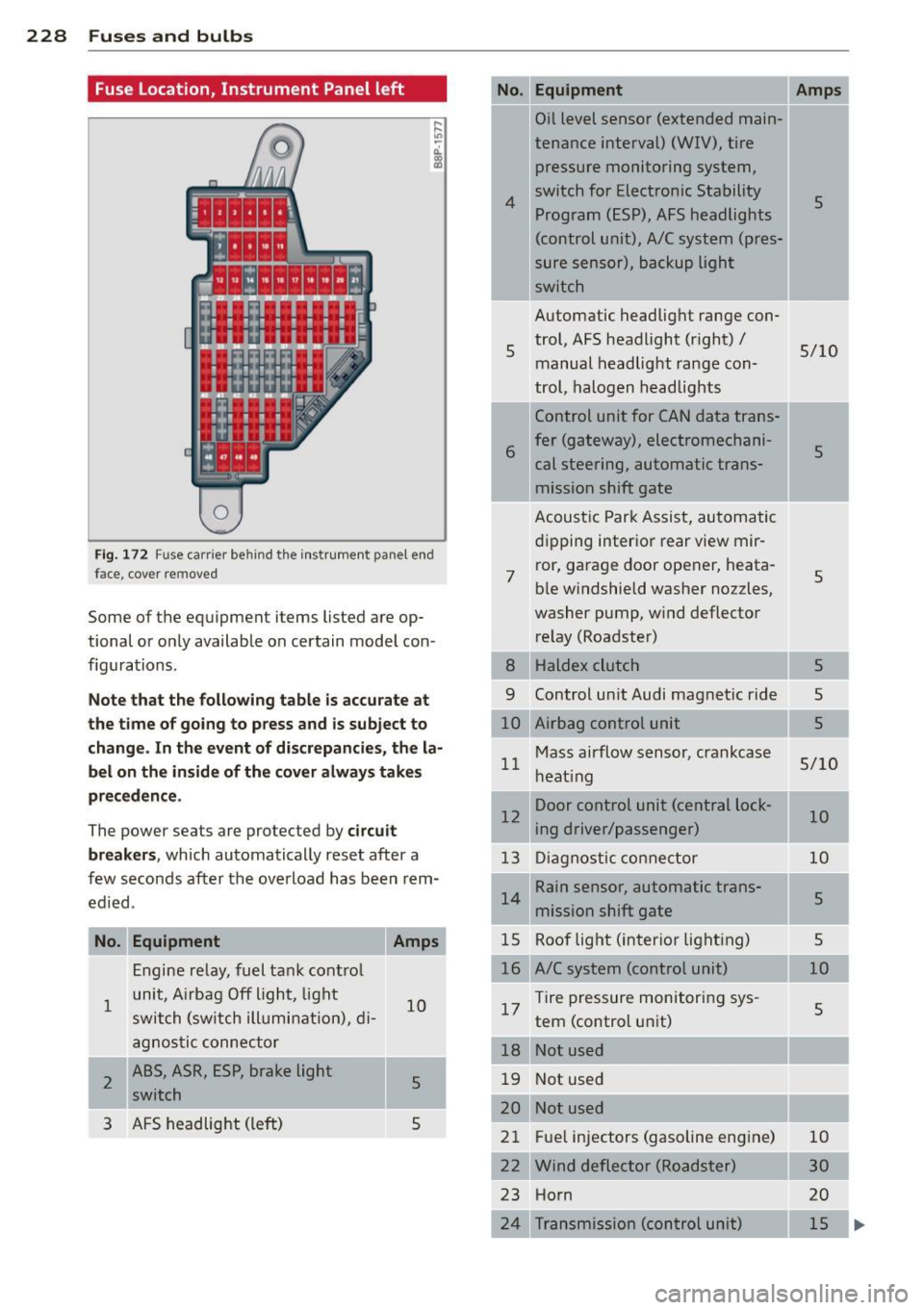
Fuse Location, Instrument Panel left
0
Fig. 172 Fuse ca rrier be hind the inst rum ent pan el end
fa ce, cover rem oved
Some of the equipment i tems lis ted are op
tional or only available on certain model con
figurations.
Note that the following table is accurate at
the time of going to press and is subject to
change. In the event of discrepancies, the la
bel on the inside of the cover always takes
precedence.
The power seats are protected by circuit
breakers,
which automatically reset after a
few seconds after the overload has been rem
edied .
No. Equipment
1
I 2
Engine relay, fuel tank control
unit , Airbag Off light, light
switch (switch illumination), di-
agnostic connector
ABS, ASR, ESP, brake light switch
3 AFS headlight (left)
Amps
10
5
s
No.
4
5
6
7
Equipment
Oil level sensor (extended main-
tenance interval)
(WIV), tire
pressure monitoring system,
switch for Electronic Stability Program (ESP), AFS headlights
(control unit), A/C system (pres-
sure sensor), backup light
switch
Automatic headlight range con
trol, AFS headlight (right)/
manual headlight range con
trol, halogen headlights
Control unit for CAN data trans
fer (gateway), electromechani
cal steering, automatic trans mission shift gate
Acoustic Park Assist, automatic
dipping interior rear
view mir-
ror, garage door opener, heata
ble windshield washer nozzles,
washer pump, wind deflector
relay (Roadster)
--r-
Amps
5
5/10
5
5
8 Haldex clutch 5
9 Control unit Audi magnetic ride 5
10 Airbag control unit 5
Mass airflow sensor, crankcase
11 5/10
heating
Door control unit (central lock-
12 10
ing driver/passenger)
--
13 Diagnostic connector 10
Rain sensor, automatic trans-
14 5
mission shift gate
15 Roof light (interior lighting) 5
16 A/C system (control unit) 10
17 Tire pressure monitoring sys-
5
tern (control unit)
l
I
18 Notused -
19 Not used
20 Not used
21 Fuel injectors (gasoline engine)
Wind deflector (Roadster)
Horn
24 Transmission (control unit) 10
30
20
15
..,.
Page 243 of 260
Consumer Information
Warranty coverages
Your Audi is covered by the following war
ranties :
-New Vehicle Limited Warranty
- Limited Warranty Against Corrosion Perfo-
ration
- Emissions Control System Warranty
- Emissions Performance Warranty
- California Emissions Control Warranty (USA
vehicles only)
- California Emissions Performance Warranty
(USA vehicles only)
Detailed information regarding your warran
ties can be found in your
Warranty & Mainte
nance booklet .
Operating your vehicle
outside the U.S.A. or
Canada
Government regulations in the United States
and Canada require that automobiles meet
specific emission regulations and safety
standards. Therefore, veh icles built for the
U.S.A. and Canada differ from vehicles sold in
other countries .
If you p lan to take your vehicle outside the
continental limits of the United States or Can
ada, there is the possibility that
- unleaded fuels for vehicles with cata lytic
converter may not be available;
- fuel may have a considerably lower octane
rating. Improper fuel may cause engine
damage;
- service may be inadequate due to lack of
proper service facilities, tools or testing
equipment;
- replacement parts may not be readily availa
ble.
- Navigation systems for vehicles built for the
U.S.A. and Canada will not necessari ly work
in Europe, and may not work in other coun
tries outside of North America.
Consumer Information 241
@ Note
Audi cannot be responsible for mechanical
damage that could result from inadequate
fuel, service or parts availability.
Audi Service Repair Manuals and Literature
Audi Offic ial Factory Service Manuals and Lit
erature are published as soon as possible after
model introduction. Service Manuals and liter
atu re are availabl e to order from the Audi
T echnical Literature Ordering Center at:
www.audi.techliterature.com
Maintenance
' General
Your vehicle has been designed to help keep
maintenance requirements to a minimum.
However, a certain amount of regular mainte
nance is still necessary to assure your vehicle's
safety, economy and reliability. For detailed
vehicle maintenance consult your Warranty& Maintenance booklet.
Under difficult operating conditions , for ex
ample at extremely low outside temperatures,
in very dusty regions, etc., some service work
shou ld be pe rformed between the intervals
specified. This applies particularly to:
- oil changes, and
- cleaning or replacing the air fi lter.
@ For the sake of the environment
By regu larly maintaining your vehicle, you
help make sure that emission standards
are maintained, thus min imizing adverse
effects on the environment.
Important considerations for you and
your vehicle
T he increasing use of electron ics, soph isticat
ed fuel injection and emission control sys
tems, and the generally increasing technica l
complexity of today's automobiles, have ..,_
•
•
Page 249 of 260
Infant seats . ............ .. .. .. ... 141
Safety instructions . . . . . . . . . . . . . . . . . 139
C igarette lig hter ........... .... .. .... 72
Cleaning Alcantara (synthet ic suede) . .. .. .. .. . 171
Eng ine compartment .......... ... .. 172
Exhaust tail pipes .............. .... 168
Fabr ics and fabric coverings .. .. .. .. . 169
Instr ument panel ......... .. .. .. .. . 169
Int erior .. .. ............. .. .. .. .. . 168
L eather . . . . . . . . . . . . . . . . . . . . . . . . . . 171
Navigation display ........ .. .. .... . 168
P lastic and vinyl ............ .. .. ... 166
Plastic parts ............. .... .. .. . 169
Radio display . ........... .. .. .. ... 168
Safety belts . . . . . . . . . . . . . . . . . . . . . . 172
Trim str ips . . . . . . . . . . . . . . . . . . 165 , 166
Cleaning and protection ........... .. . 162
Climate controls ........... .. .. .. .... 75
A/C operation . . . . . . . . . . . . . . . . . . . . . . 78
Air distribution ........... .. .. .. .... 77
Air rec irculation mode ............... 78
Automatic mode . . . . . . . . . . . . . . . . . . . 78
Controls ... ............. .... .. .... 75
Defrost .... .. ........... .. .. .. .... 78
Economical use . . . . . . . . . . . . . . . . . . . . 78
Fan ...... ... ................ .... . 76
Heated seats . . . . . . . . . . . . . . . . . . . . . . 79
H eating .. .. ............. .... .. .... 75
Po llutant filter ........... .. .. .. .... 75
Rear window defogger ....... .. .. .. .. 79
Switching on and
off . . . . . . . . . . . . . . . . 76
Temperature . ............ .. .. ...... 76
Ventilation ... ........... .. .. .. .... 75
Clock ....... ................. .. .... 11
Clutch overheating ......... .. .. .. .. .. 92
Cold tire inflation pressure ..... .. .. .. . 198
Coming home ................ .... ... 54
Compass m irror ........... .... .. .... 64
Compliance .. ............. .... .. .. . 244
Consumer Information . . . . . . . . . . 105, 241
Contacting NHTSA .................. 105
Controls and displays ......... .. .. .. .. . 8
Convenience close/open feature
Power top .. ... .. .. ...... .. .. .. .. .. 48
Windows .. ................ ... ... . 44
Convertible child safety seats . ... .. .. . 142
Index 247
Convertible locking retractor
Activating ... .. .... . ............ .. 146
Deactivating ... .. .. . .. .......... .. 147
U sing to secure a child safety seat 1.44, 146
Convertible top .. .. ................. . 46
Automat ic convertible top ......... .. . 48
Care and cleaning .... .......... .. .. 164
Emergency operation ........... .. .. . 49
General information ............. .. . 46
manua l convertible top ............. . 47
Warning/indictor lights ............ .. 14
Wind deflecto r ... .. . .. .. ...... .. .. . 49
Cooling system . . . . . . . . . . . . . . . . . . . . . 185
Expansion tank . . . . . . . . . . . . . . . . . . . . 185
Cornering light . . . . . . . . . . . . . . . . . . . . . . 54
Cruise contro l . . . . . . . . . . . . . . . . . . . . . . . 84
Changin g speed .. .. ... ....... .... .. 85
Presetting your speed . .. .... ... .. .. . 85
Switching
off .. .. ................. . 8S
Switching on . .. .. .... ........... .. . 84
Warning/indicator lights ........ .. .. . 16
Cup holder .. .. .. .. .. . .. .. ...... .. .. . 71
Current fuel mileage
20
D
Damping
refer to Audi magnetic ride ........... 86
Data ....... .. .. .. ... ............ .. 239
Data recorder . . . . . . . . . . . . . . . . . . . . . . 148
Date display . . . . . . . . . . . . . . . . . . . . . . . . 11
Daytime runn ing lights ... .. ...... .. .. . 53
Declarat ion of compliance
Cell phone package . . . . . . . . . . . . . . . . 244
E le ctronic immob ilizer .............. 244
Homelink ® un iversal remote control .. 244
Remote control key .. .. .. ...... .. .. 244
def What does this mean when it appears in
the tr ip odometer display? ...... .. .. . 12
Defective light bulb warning .......... . 33
Defrosting the windows ......... .... .. 78
Determ ining correct load limit ...... .. 202
Digital clock . . . . . . . . . . . . . . . . . . . . . . . . 11
Digital compass . . . . . . . . . . . . . . . . . . . . . 64
Dimens ions ... .... .. . .. .......... .. 238
•
•