brake AUDI TT ROADSTER 2011 Service Manual
[x] Cancel search | Manufacturer: AUDI, Model Year: 2011, Model line: TT ROADSTER, Model: AUDI TT ROADSTER 2011Pages: 260, PDF Size: 64.11 MB
Page 161 of 260
the exhaust system and this could cause
the catalytic converter to overheat.
- Do not turn off the ignition while the ve
hicle is moving .
- Do not con tinue to operate yo ur vehicle
under these conditions, as otherwise fuel
can reac h the cata lytic converter . This
could result in overheating of the con
verter, requ iring its replacement.
- To assure efficient operation of the Emis
sion Control System:
- Have your veh icle ma inta ined properly
and in acco rdance with the service rec
ommendations in your Wa rranty
&
Ma intenance booklet.
- La ck of proper maintenance as well as
improper use of the vehicle will impa ir
t he funct ion of the emission control
system and cou ld lead to damage.
@ For the sake of the environment
Even when the Emission Contro l System is
operating p roperly, t he exhaus t gas can
have a s ulfu r- like exhaust gas smell under
some operating states. This depends on
the s ulfur content o f the fue l being used.
Using a different brand of fuel may help,
or filling the tank w ith lead-free super
grade gasoline .
Operate your vehicle
economically and
minimize pollution
General
Your personal style of driving will determine
the economy of your vehicle, as well as ex
haust and noise levels .
Fuel economy, environmental impact, and
wear on your engine, brakes and t ires largely
depend on three factors :
- your persona l driving style
- operating conditions
- technical lim itations
I f you anticipate w hat you need to do nex t and
d rive economically, you can eas ily cut your
Dri vin g and en vironm ent 159
fuel consumption by 10 -15 percent. This sec
tion w ill give yo u some tips on how you can
help the env ironment and your pocketbook .
(D Tips
The cons umption estimates as publishe d
by ENVIRONME NTAL PROTEC TION AGENCY
(EPA) and Transport Canada may not corre
spond to your actual consumption on the road, which will vary depending upon vehi
cle load and speed, road and weather con
dit ions, trip length, etc.
Drive smoothly and keep a lookout
ahead
Vehicles use the most fuel when they are ac
celerating.
Avoid unnecessary accelerat ing and braking .
Vehicles use the most fuel when they are ac
ce lerat ing . If you anticipate what is going to
happe n next, you will need to brake less and,
th us, accele rate less . Let the vehicle coast
whenever possible -for examp le when you see
that the next t raff ic light is red.
Avoid full throttle
Driving at moderate speeds saves fuel and
improves your mileage.
"' Try and keep well below your car's maximum
speed.
Acce lerat ing gently reduces fue l consump
tion, eng ine wear, and does not disturb the
environment.
Fuel consumpt ion, exhaust emiss ions and en
gine noise increase disproportionately at high
speeds. If you drive at app roximately three
quarte rs of top speed, fuel consumption w ill
be reduced by one half. Nev er drive faster
t h an the posted speed limit and weathe r con
ditions perm it.
•
•
Page 164 of 260
162 Cleaning and protection
Cleaning and
protect ion
General information
Regular care preserves vehicle value .
Any automobile is exposed to industr ial
f umes, corrosive road salt, etc. A well cared
for Audi can look like new many years after pu rchase . Regula r and correct care w ill con
tr ibute to maintain ing the beauty and value of
your Aud i.
Furthermore , good care may be a condition
for substantiating a warranty claim should
corrosion damage or paint de fects occur.
Your authorized Audi dealer has a variety of
dedicated vehicl e-care products and can ad
v ise wh ich ones to use for cleaning the exter i
or and inte rior of your vehicle .
Whether you use produc ts recommended by
Aud i or other commercially ava ilable clean ing
agents, please make sure you apply t hem cor
r ectly .
A WARNING
-Cleaning agents may be poisonous. Keep
them o ut of t he rea ch of childre n.
- Heed a ll ca ution labels.
- Always read directions on th e co ntai ner
b efore using a ny product . Follow the di
rec tions caref ully.
- Most chemical cleaners a re concentrat ed
and have to be diluted.
- Use spot removing fluids only in well
ventilated areas.
- Do not use gasoline, kerosene, d iesel
fuel, nail pol is h remover or ot her volati le
fluids. They may be toxic, flammab le or
h azar dou s in other w ays. Do not was h,
w ax or dry the vehicle wi th the ig nit ion
on or the eng ine running .
- D o not cl ea n the under sides of ch assis,
f en ders, wheel cove rs , etc. without pro
tectin g your hands and a rms. You may
c u t yourself on s harp-ed ged metal parts . -
Moisture and ice on b rakes may impair
brak ing eff ic iency
c::> page 151 , General
information.
Test the brakes carefully
each time you wash t he vehicle .
@ For the sake of the environment
Select on ly environ mentally friendly clean
i ng products. Leftover cleaning products
s hou ld not d isposed of in the househo ld
waste .
Care of exterior
Washing
Frequent washing protects the vehicle .
The best p rotection against environmen tal i n
fluences is
frequent wash ing and waxing . How
often t his is requi red depends o n:
- How much t he ve hicle is used
- Whe re the veh icle is parked (garage, i n the
open under trees, etc.)
- The seasona l and weather conditions
- Environmental infl uences
T he longer b ird d roppings, inse cts, tree res in,
r oad and indus trial grime, ta r, soo t, road salt
and other mater ials remain on the vehicle
paint, the more lasting t heir destr uctive ef
f ects w ill be .
Hig h tempera tures, as from e xpos ure to in
tense sun light, intensify the co rrosive e ffect
part icu lar ly when humidity is high as well.
Un der certa in ci rcumstances,
weekly w ashing
may be ne cessary. Un der othe r cond it ions , a
mon thly washing and waxing may be a de
quate.
After the winter, the unders ide of the vehicle
sho uld be thoro ughly washe d pre ferab ly in a
pro fessional ca r wash.
A WARNING ~
A lways read and heed all WARNINGS a nd
the information
c::> page 162.
Page 169 of 260
Never dry windows with the same chamois
that you use to dry painted surfaces . Wax resi
due on the chamois can impair vision through
the windows.
_& WARNING
- The windshield must not be treated with
water-repellent materials. They can in
crease glare under poor visibility condi
tions such as wetness, darkness, or when
the sun is low on the horizon. In addi
tion, they can cause the windshield wip
ers to chatter.
- Always read and heed all WARNINGS and
other information <=;>
page 162.
([) Note
-Never use warm or hot water to remove
snow and ice from windows and mirrors.
This could cause the glass to crack.
- To prevent damage to the wires of the
rear defogger, do not place any adhesive
stickers on the inside of the rear window
over the wires.
- To help prevent dirt from scratching the
window, always scrape in a forward di
rection -pushing the scraper away from
you -never back and forth.
Weatherstrips
Complete car care includes the weatherstrips
as well.
.,. Apply a suitable rubber conditioner to the
weatherstrips from time to time.
To be able seal properly, the weatherstrips
around the hood, doors, rear lid, etc. must re main pliable . Spray the weatherstrips with sil
icone or coat them with talcum powder or
glycerine to retain the flexibility of the rubber
and to protect them against freezing in the
winter .
_& WARNING
Always read and heed all WARNINGS and
the information
¢page 162.
Cleaning and protection 167
(D Tips
Keep silicone sprays off the windshield to
avoid wiper smear in rain.
Steel wheels
App lies to vehicles : wit h stee l w hee ls
The wheels also have to be cleaned.
.,. Always include the hub caps and wheel rims
when washing your vehicle to remove road
dirt, salt sprays and brake dust.
If necessary, use a commercial wheel cleaner
to remove accumulated brake dust.
The wheel rims are easier to keep clean if they
are regularly coated with liquid wax.
Paint scratches should be touched up as soon
as possible to prevent corrosion
¢ page 166,
Touch-up paint .
_& WARNING
-Moisture and ice on brakes may affect
braking efficiency-
¢page 151, General
information. Test the brakes carefully af
ter each vehicle wash.
-Always read and heed all WARNINGS and
the information¢
page 162.
Cast (light) alloy wheels
Applies to vehicles : wi th Cas t alloy w hee ls
-
Cast (light) alloy wheels require special care .
.,. Wash the wheels with a sponge or hose
brush every other week .
.,. For deep cleaning afterwards, use only a
dedicated
acid-free cast alloy wheel cleaner .
.,. Rub a coat of
liquid wax onto the rims every
three month. Be sure to reach and treat all
parts of the rim.
To preserve the decorative appearance of the
cast alloy wheels, some special care is neces
sary. In addition to road dirt and salt, brake
dust is also corrosive. If left on for too long,
brake dust can cause pitting. .,..
•
•
Page 170 of 260
168 Cleaning and protection
Use only special acid -free cleaners form ulated
for a lloy rims. Safe products are available at
your Aud i dealer. Never leave the cleaner on
the r ims longer than spec ified on the label. If
not rinsed
off promp tly, the acid conta ined in
some cleaners can attack the threads on the
wheel bolts .
Never use abras ive or metal polishing clean
ing agents. If the protective coating has been
chipped, e .g . by k icked up road dirt, touch it
up as soon as poss ible.
A WARNING
- Moisture and ice on brakes may affect
braking efficiency ¢
page 151, General
information.
Test the brakes c aref ully
each t ime you wash the veh icle.
- Always read and heed all WARNI NGS and
other informa tion ¢
page 162.
Body cavity sealing
-
The body cavity sealing does not need to be
checked.
A ll body cavities wh ich could be affected by
corrosion have been give n thorough protec
tion at the facto ry.
T his sea ling does not require any inspection or
addit io nal treatment. If any wax should seep
out of the cav ity when the ambient tempera
ture is high, it can be removed w it h a plastic
scrape r and a su itab le so lven t.
A WARNING
So lvents can be dange rous.
- B enzine is flammable and t oxic.
If you
use benzine for removing the wax, keep
spar ks, flame and lighted c igaret tes
away. Never dump benzine on t he
ground, into open streams or down sew
age drains.
- Be sure to observe all safety and env iron
menta l regulations . Follow all instruc
t ions on the container.
- Always read and heed all WAR NIN GS and
the in format ion
¢page 162.
Chassis
Have the undercoating checked for damage
from time to time.
The lower body shell of your Aud i is also thor
oughly protected against cor ros io n.
Any damage to the unde rcoating ca used by
road ha zards should be repaired prompt ly.
A WARNING ....__
Too much undercoating in the wrong p la
ces can cause a fire.
- Do not app ly additional undercoating or
r u stp roof ing on or near the exhaust
manifold, exhaust pipes, catalytic con
ver ter or heat shields. While driving, the
substance used fo r undercoating could
overhea t and cause a fire.
- Always read and heed all WAR NINGS and
o ther info rmation
¢ page 162.
Exhaust tail pipes
Road salt and o ther co rrosive materials w ill
damage the mate ria l in the e xhaus t tail pipes
i f they are not cleaned regular ly . Do not clean
the tail pipes with w hee l cleaner, pa int polish,
c h rome polish or other ab rasive cleane rs .
Clean the tail pipes with car care products
t h at are suitable for sta inless steel.
Your a uthorized Audi dea ler can prov ide clean
ing products that have been tested and ap
proved for your vehicle .
Care of interior
Radio-/Navigation* display
.. Clea n the dis play wi th a soft clean clo th and
a n LC D cleaner.
T he disp lay can be cleaned with a profess io
nally ava ilab le " LCD clea ner". The clot h should
be s ligh tly d ampened wit h the cleaning flui d
to clean the disp lay. .,..
Page 181 of 260
-Apply the parking brake.
- Move selector lever to "P" (Park).
- Always let the engine cool down. Hot
components will burn skin on contact.
- To reduce the risk of being burned, never
open the hood if you see or hear steam
or coolant escaping from the engine
compartment. Wa it until no steam or
coolant can be seen or heard before care
fully opening the hood.
- Keep children away from the engine com
partment .
- Never spill fluids on hot engine compo
nents. They can cause a fire.
- Never touch the radiator fan. The auxili
ary electric fan is temperature controlled
and can switch on suddenly.
- Never open the coolant reservoir cap
when the engine is still warm. The cool
ant system is pressurized and hot cool
ant could spray out .
- Protect your face, hands and arm from
steam or hot engine coolant by placing a
thick rag over the cap when you open the
coolant reservoir .
- If work on the fuel system or the electri
cal system is necessary:
- Always disconnect the battery.
- Never smoke or work near heaters or
open flames. Fluids in the engine com
partment could start a fire.
- Keep an approved fire extinguisher im
mediately available.
- To avoid electrical shock and personal in
jury while the engine is running or being
started, never touch:
- Ignition cables
- Other components of the high voltage
electronic ignition system.
-If you must perform a check or repair
with the engine running:
- First, fully apply the parking brake,
move selector lever to "P" (Park).
Checking and filling 179
-Always use extreme caution to prevent
clothing, jewelry, or long hair from get
ting caught in the radiator fan, V-belts
or other moving parts, or from contact ing hot parts . Tie back hair before
starting, and wear no clothing that will
hang or droop into the engine.
- Minimize exposure to emission and
chemical hazards
9 .&, .
&_ WARNING
California Proposition 65 Warning:
- Engine exhaust, some of its constituents,
and certain vehicle components contain
or emit chemicals known to the State of
California to cause cancer and birth de
fects and reproductive harm. In addition,
certain fluids contained in vehicles and
certain products of component wear con
tain or emit chemicals known to the
State of California to cause cancer and birth defects or other reproductive harm.
- Battery posts, terminals and related ac
cessories contain lead and lead com
pounds, chemicals known to the State of
California to cause cancer and reproduc
tive harms. Wash hands after handling .
(D Note
When adding fluids, always make sure that
they are poured into the proper container
or filler opening, otherwise serious dam
age to vehicle systems will occur.
@ For the sake of the environment
To detect leaks in time, inspect the vehicle
floor pan from underneath regularly . If
you see spots from oil or other vehicle flu
ids, have your vehicle inspected by an au
thorized Audi dealer. •
•
Page 182 of 260
18 0 Che cking and filling
Engine compartment
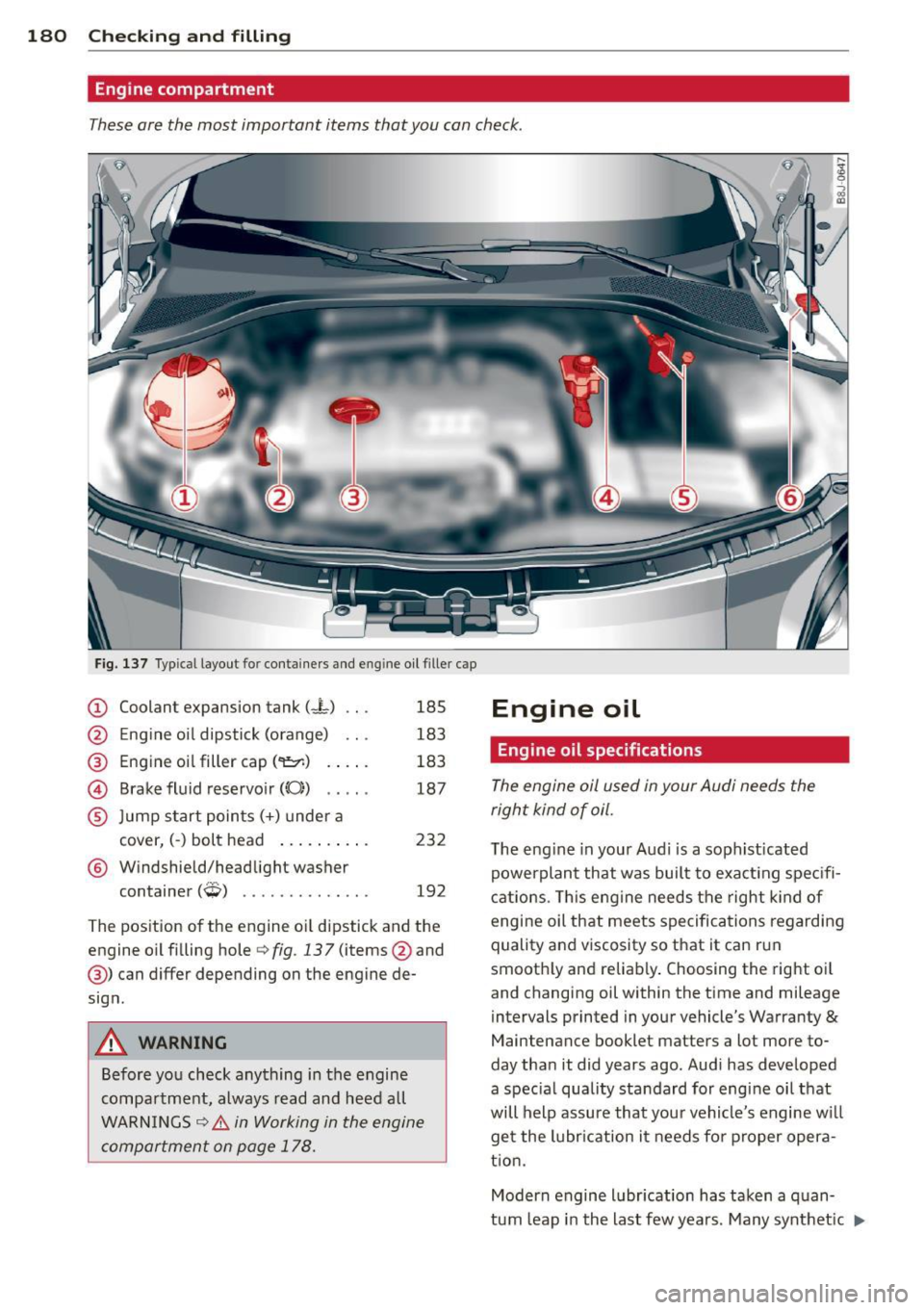
These are the most important items that you can check .
•
Fig. 137 Typ ica l layout fo r containers and eng ine oil filler cap
(D Coolant expansion tank (-L) 185
@ Eng ine o il dipstick (o range) 183
@ Engine oi l filler cap ('1:::r.) . . . . . 183
@ Brake fluid reservoir((();) . . . . . 187
® Jump start points(+) under a
cover,(-) bolt head . . . . . . . . . . 232
® Windshield/headlight washer
t . (
;;p, ) con ainer ,-!,, •••.•••. •.• •• . 192
The position of the engine o il dipstick and the
engine o il filling hole
r::> fig . 137 (items @and
@) can differ depending on the engine de
sign .
A WARNING
Before you check anything in the engine
compartment, always read and heed all
WARN INGS
c::> .& in Working in the engine
compartment on page 178.
Engine oil
Engine oil specifications
The engine oil used in your Audi needs the
right kind of oil.
T he eng ine in your Aud i is a soph ist icated
powerplant that was built to exact ing spec ifi
cat ions . T his engine needs the right kind of
engine oil that meets specifications regarding
quality and viscosity so that it can run
smooth ly and reliab ly . Choosing the right o il
and changing oil within the time and mileage
intervals printed in your vehicle's Warranty
&
Maintenance booklet matters a lot more to
day than it did years ago . Audi has developed
a spec ia l quality standard for engine oil that
will help assure that you r vehicle's engine w ill
get the lubr ication i t needs fo r proper opera
t io n.
Modern engine lubr ication has taken a quan
tum leap in the last few years. Many synthet ic
1J.
Page 189 of 260
-To avoid being burned, do not sp ill an
tifreeze or coolant on the exhaust sys tem or hot engine parts. Under certa in
conditions, the ethylene glyco l in en
g ine coolant can catc h fire.
- Antifreeze is poisonous. Always store an
t ifreeze in its or iginal co ntaine r and well
o ut of the reach of children.
- If you drain the coolant, it must be
caught and safely stored in a proper con
tainer clearly ma rked "poison".
(D Note
- Coolant pollutes the env ironment and
could cause a n engine fire. Excess cool
ant wi ll be forced out through the pres
su re re lief va lve in the cap when the en
gine becomes hot.
- If, in an emergency, only water can be
added, the cor rect ratio be tw een wate r
and antifreeze
¢page 185 must be re
store d as soon as possib le.
@ For the sake of the environment
Drained coolant s hould no t be reused. Al
ways dispose of use d coolan t w hile obse rv
ing all envir onmental reg ulations.
Radiator fan
The radiator fan switches on automatically by
i tself
The electric radiator fan is contro lled by ther
moswitches that switch on and off depend ing
on coolant and eng ine compa rtment tempera
tures.
An aux iliary electr ic radiator fa n* switches on
and off depen ding on coolant t emperature
and other ve hicl e operation conditions.
After you switch t he engine off, the a uxiliary
fan ca n cont inue runn ing fo r up to 10 minutes
- even with the ignition off .
It can even sw itch
on agai n later by i tself
c::> &., , if
- the temperature of the eng ine coolant rises
due to the heat bui ld-up from the eng ine in
t h e engine compartment, o r
Checking and fillin g 187
- the engine compartment heats up because
the vehicle is parke d in intense sunlight.
A WARNING
-To reduce the risk of persona l in ju ry nev
er touch the radiator fan .
- The a uxiliary electric fan is tempe rat ure
contro lled and can switch on suddenly
even when the engine is not running.
- The a uxiliary radiator fan sw itches on a u
tomatically when the engine coo lant
reaches a certa in temperature and w ill
continu e to run until the coo lant temper
ature drops.
Brake fluid
Checking brake fluid level
T he brake fluid level can be checked wi th a
qui ck gl ance.
Fi g. 142 Engin e compart ment : brake flu id reservoir
Before you check anyth ing in the eng ine com
partment,
alw ays read and heed all WARN
INGS c::> A in Working in the engine compart
ment on page 178 .
.,. Read the brake fluid level from the brake
fluid reservoir
c::> fig. 142. The brake fluid
level must be between the "MIN" and
"MAX" markings.
The brake fluid reservoir is located behind the
rear partition of the engine compartment on
the left side
c::> page 180.
The fluid level may drop slightly after some
time due to the automatic adjustment of the
brake pads. This is not cause for alarm.
IJ1'-
Page 190 of 260
188 Checking and filling
If the brake fluid level falls considerably be
l ow the "MIN" mark, the brake warning/indi
cator light (U .S . mode ls: . , Canadian
models: .) will come on
¢ page 16 and
¢ page 30. Do not continue to operate the ve
h icle . The complete brake system shou ld be
thoroughly checked by an authorized A ud i
dea ler o r othe r qualified facility and t he cause
corrected. If the bra ke fluid level is too low,
the bra ke warning/ind ic a tor ligh t will illum i
nate . Contact an authorized Aud i dea ler
im
mediatel y.
Changing brake fluid
Hove the broke fluid changed by on experi
enced technician.
B rake fl uid abso rbs mois ture from the a ir. If
the water content in the b ra ke fluid i s too
h igh, corros ion in the brake sys tem may result
after a period of t ime . The boi ling point o f the
b rake fluid wi ll also decrease considerab ly and
decrease braking per formance.
T herefore, the brake flu id mus t be changed
every two year s. Always use new b rake fluid
which conforms to Fede ral Motor Vehicle
Standard "FMVSS 116 DOT 4".
T he brake flu id rese rvoi r can be difficul t to
reach, therefo re, we recommend that yo u
have the brake f luid changed by yo ur autho r
ized
Audi dealer . Your dealer has the correct
too ls, the right b rake f luid and the know-how
to do this for you.
A WARNING
- B rake fluid is poiso nous . It mus t be stor
ed only in th e closed orig inal con tainer
o ut of the reac h of children!
- Brake fa ilure can result from old o r inap
propriate b ra ke fluid. Observe these pre
c aut ions:
- Use o nly brake fluid t hat meets SAE
specif ication
J 1703 and confo rms to
Federal Motor Vehicle Standard 116.
Always check with your a uthorized Audi
dealer to make s ure you are using the
correct brake fl uid. T he correct type of brake flu
id is also ind icate d on the
brake f lu id rese rvoir.
- The brake fl uid must be new . Heavy use
of the brakes can cause a vapo r lock if
the brake fluid is left in the system too
long . This can se riously affect the effi
c iency of t he brakes as well as your
safe ty. This co uld resu lt in a n accide nt.
([) Note
Brake fluid will damage the paint of your
vehicle.
@ For the sake of the environment
Because o f the prob lem of prope r disposal
of brake fluid as well as t he spec ial too ls
required and the necessary expertise, we
recomme nd t hat yo u have th e brake flu id
cha nged by yo ur autho rize d Au di dea le r.
Battery
General information
Your ve hicl e is equipped with a specia l bat
tery, an
ACM battery. This battery is located
in t he luggage compartment and must be re
placed with an origina l equipment battery.
U nder normal opera ting condit ions, the bat
te ry is
maintenance-fr ee .
Have the battery checked when you take your
vehicle in for se rv ice . You a re well advised to
replace a battery that is o lde r th an 5 years .
Disconnecting the battery terminals
Some vehicle functions (power window reg u
lators, for example) are lost if the battery te r
mina ls are disconnected. T hese functions have
to be relearned after the battery termina ls are
connected aga in . T o prevent t his, t he battery
shou ld only b e disconne cted from the ve hicle
ele ct ric al sy stem w hen abso lutely ne cessary
f o r rep air s.
Vehicles not driven for long periods
If you are go ing to let your vehicle stand for a
long time a nd not drive it, you should remem
ber there are elect rical components which a re
Ill-
Page 198 of 260
196 Tires and wheels
Maximum loaded vehicle weight
means the sum of:
(a) Curb weight
(b) Accessory weight
(c) Vehicle capacity we ight, and
(d) Production options weight
Maximum (permissible) inflation pressure
means the maximum cold inflation pressu re
to which a tire may be inflated. Also called
"maximum inflation p ressure."
Normal occupant weight
means 150 lbs. (68 kilograms) times the
number of occupants seated in the vehicle up
to the total seating capacity of your vehicle.
Occupant distribution means distribution of occupants in a vehicle .
Outer diameter means the overa ll diameter of an inf lated new
tire.
Overall width
means the linear distance between the exteri
ors of the sidewalls of an inflated tire, includ
ing e levations due to labeling, decorations, or
protective bands or ribs.
Ply
means a laye r of rubber-coated parallel cords.
Production options weight
means the comb ined we ight of those installed
regular production options weighing over 5
lbs . (2 .3 kg) in excess of those standard items
which they replace, not previously considered
in curb weight or accessory weight, including
heavy duty brakes, r ide leve lers, heavy duty
battery, and special trim.
Radial ply tire
means a pneumatic tir e in which the p ly cords
that extend to the beads are laid at substan
tially 90 degrees to the centerline of the
tread . Recommended inflation pressure
see
~
page 195, Cold tire inflation pressure.
Reinforced tire
means a t ire designed to operate at higher
loads and at higher inflation p ressures than
the corresponding standard tire. Reinforced
ti res my be ident ified as "XL" "xl" "E XTRA
, ,
LOAD", or "RF" on the sidewall.
Rim
means a metal support for a tire or a t ire and
tube assembly upon which the tire beads are seated.
Rim diameter
means nominal d iameter of the bead seat. If
you change your wheel s ize, you w ill have to
purchase new tires to match the new r im di
ameter .
Rim size designation
means rim diameter and width.
Rim width
means nominal distance between rim flanges .
Sidewall
means that portion of a tire between the
tread and bead.
Speed rating (letter code)
means the speed at which a tire is designed to
be driven for extended periods of time. The
r atings range from 93 mph (150 km/h) to
186 mph (298 km/h)
~ page 206 . You may
not find this information on all tires because
it is not requ ired by law.
T he speed rating letter code, where applica
ble, is molded on the tire sidewall and indi
cates the maximum perm iss ibl e road speeds
~ A in Winter tires on page 209 .
Tire pressure monitoring system
means a system that detects when one or
more of a veh icle's tires are underinflated and
i lluminates a low tire pressure warning tell-
tale. ..,_
Page 202 of 260
200 Tires and wheels
other cargo that the vehicle can carry. For the
location of the tire pressure label
r=:>fig. 146.
A WARNING
Overloading a vehicle can cause loss of ve
hicle control, a crash or other accident, se
rious personal injury, and even death.
- Carrying more weight than your vehicle
was designed to carry will prevent the
vehicle from handling properly and in
crease the risk of a loss of veh icle con
trol.
- The brakes on a vehicle that has been
overloaded may not be able to stop the
vehicle within a safe distance.
- Tires on a vehicle that has been overload
ed can fail suddenly causing loss of con
tro l and a crash.
A WARNING ,~ -
- Incorrect tire pressures and/or underin
flation can lead to a serious or fatal acci
dent.
- Incorrect tire pressures and/or underin
flation cause increased tire wear and can
affect the handling of the vehicle.
- Incorrect tire pressures and/or underin
flation can also lead to sudden tire fa il
ure, including a blowout and sudden de
flation, causing loss of vehicle control.
Checking tire pressure
The correct tire pressure for the tires original
ly installed on your vehicle is listed on the tire
pressure label located on driver's side 8-pil
lar.
The recommended t ire pressures are on the
tire pressure labe l and in the table
r=:> page 198, Cold tire inflation pressure . This
means that the pressure must be checked and
adjusted when the tire has not been driven for more than a couple of miles (kilometers) at
low speeds during the previous three hours.
A ir i n the tires expands when the tire heats up
as a result of interna l fr iction as it flexes in use.
The tire pressure is higher when the tire
has warmed up than when it is "co ld."
It i s the inflation pressure in a "cold" tir e that
counts. Therefore, you should never let air out
of a warm tire to match "Cold tire inflation
pressure" recommendations
r=;, page 198. The
t ir es wou ld then be underinf lated and co uld
fail suddenly .
The tire pressure label on your Audi lists the
recommended cold tire inflation pressures for
the new, original eq uipment tires that were
on your veh icle at the time it was manufac
tured. For the location of the labe l
r=:>page 198, fig . 146.
Most tires lose air natura lly over t ime. They
can a lso lose some air if you drive over a pot
hole or hit a curb while park ing. It is usually
not possible to see whether the rad ial tires
used today are underinflated just by looking
at them.
Therefore, be sure to check t ire pressures at
least once a month and a lways before going
on a long trip . Make sure to take the number
of peop le and the amount of luggage into ac
count when adjust ing tire pressu re for a trip -
even one that yo u wou ld not consider to be
" long." See
r=;, page 202, Tires and vehicle
load limits
for more important information.
Always use an accurate tire pressure gauge
when checking and adjusting inflation pres
sures. Check all of the tires and be s ure not to
forget the spare tire. If the pressure in any tire
is too high when the tire is "cold," let air out
of the tire s low ly with the edge of the tire
gauge and keep checking the pressure until
you reach the pressure that is correct for the load (passengers and luggage) and kind of
dr iv in g you plan to do.
If the pressure in any tire is too low, note the
difference between the pressure in the cold
tire and the pressure you need and add the air
that you need to reach the correct pressure for
the vehicle load (passengers and luggage) for
the tires on your vehicle as listed on the on
your vehicle and in this manual and the kind
of driving you plan to do. .,..