brake AUDI TT ROADSTER 2014 Service Manual
[x] Cancel search | Manufacturer: AUDI, Model Year: 2014, Model line: TT ROADSTER, Model: AUDI TT ROADSTER 2014Pages: 244, PDF Size: 60.87 MB
Page 183 of 244
Tires and wheels
Tires
General notes
Tires may be the least appreciated and most
abused parts of a motor vehicle .
Tires may be the least appreciated and most
abused parts of a motor vehicle . Tires are,
however, one of the most important parts of a
vehicle, particularly considering the compara
tively small patch of rubber on each tire that
assures that a ll- important contact between
you, your vehicle and the road.
Maintaining the correct tire pressure, mak ing
sure that your vehicle and its tires do not have
to carry more weight than they can safely han
d le, avoiding damage from road hazards and
r eg ularly inspect ing t ires for damage i nclud
ing cuts, slashes irregu la r wear and ove rall
condition are the most important things that
you can do to he lp avoid sudden tire failure in
cluding tread separat ion and blowouts.
A vo idin g damage
If you have to drive over a curb or similar ob
stacle, drive very slow ly and as close as possi
b le at a right angle to the curb.
A lways keep chemicals includ ing grease, o il ,
gasoline and brake fluid off the t ires .
I nspect the t ires regularly for damage (cuts,
cracks or b listers, etc.). Remove any fo reign
bod ies embedded in the treads.
Storing tires Mark tires when you remove them to indicate
the direction of rotation . Th is ensures you to
be ab le to mount them correctly when you re
i nstall them .
When removed, the wheels or t ires should be
sto red in a cool, dry and preferably dark place .
Store tires in a vertical pos ition if they are not
mounted on rims, in a horizontal pos it ion if
they are mounted on rims .
Tires an d wheel s 181
New tires
New ti res have to be broken in¢& .
The tread depth of new t ires may vary, accord
ing to the type a nd make of t ire and the tread
patte rn.
H idden damage
Damage to tires and r ims is often not readily
visible . If you notice unusual v ib rat ion or the
vehicle pulls to one s ide, th is may ind icate
that one of the t ires has been damaged . T he
ti res m ust be chec ked immed iate ly by an au
thorized Audi dea le r or q ua lified wor kshop .
Unidirectional tires
A un idirectional tire can be identified by ar
rows on the sidewa ll, that po int in the direc
tion the t ire is designed to rotate. You must
f ol low the specified di rection of rotation . T his
is necessary so that these tires can develop
their optimum characteristics regarding grip, road noise, wear and hydrop laning resistance.
For more information
¢ page 212.
A WARNING
New tires or t ires that are o ld, worn or
damaged cannot provide maximum con
trol and braking ability .
-
-New tires tend to be slippery and must
be broken in. To reduce the r isk of losing
control, a co llision and ser ious personal
in ju ries, d rive with special ca re for the
fi rst 350 m iles (560 km).
- Driving with worn or damaged tires can
lead to loss of control, sudden tire fail
ure, including a blowout and sudden de
fl ation, cras hes and se riou s personal in
juries . Have worn or damaged t ires re
placed immediate ly.
- Tires age even if they are not being used
and can fai l sudden ly, especially at hig h
speeds. Tires that are more than 6 years
old can only be used in an emergency
and then w ith special care and at low
speed.
•
•
Page 184 of 244
182 Tire s and wheel s
-Never mount used tires on yo ur vehicle if
yo u are not sure of their "previous histo
ry." Old used tires may have been dam
aged even though the damage cannot be
seen that can lead to sudden t ire failure
and loss of vehicle control.
- If you notice unusual vibration or if the
vehicle pulls to one side when driving, al
ways stop as soon as it is safe to do so
and check the wheels and tires for dam
age.
(D Note
Please note that summer and wi nte r tires
are designed for the cond itions that are
Glossary of tire and loading terminology
Accessory weight
means t he comb ined we ight (in excess of
those sta ndard items which may be rep laced)
of au toma tic tra nsmission, power s teer ing,
power brakes, power windows, power seats,
ra dio, and heater, to the extent that th ese
items are availab le as factory -installed equip
ment (whether installed or not) .
Aspect ratio
means t he ratio of the he ight to the w idth of
the tire in percent . Numbers of 55 or lower in
dicate a low sidewall for improve d steering re
sponse and better overall handling on dry pavement .
Bead
means the part of the ti re that is made of
steel wires, wrapped or reinforced by ply cords
and that is shaped to fit the rim.
Bead separation
means a b reakdown of the bond between
components in the bead.
Cord
means the strands forming the plies in the
tire . typ
ica l in those seasons . Aud i recommends
using winter tires during the winter
months . Low temperatures signif icant ly
decrease the e lasticity of summer tires,
which affects tract ion a nd brak ing ability.
If summer tires are used in very co ld tem
peratures, cracks ca n form on the tread
bars, res ulting in permanent tire damage
that can cause loud driving no ise and un
balan ced t ires. Audi i s not responsible for
th is type of damage .
Cold tire inflation pressure
means the tire p ress ure recommended by t he
vehicle manufacture r fo r a tire of a des igna ted
s iz e t hat has not bee n driven for more than a
coup le of miles (k ilometers) at low speeds in
t h e three hour period before the tire pressure
is measured or adjusted.
Curb weight
mea ns the we ight of a motor ve hicle with
standard equipment in clu din g the max imum
capacity of fuel, oil, and coolant, air condi
tioning and additional weight of optiona l
equipment.
Extra load tire
me ans a tire designed to ope rate a t higher
loads and at highe r inflation p ress ures than
the corresponding standard tire. Extra load
tires my be identified as "XL", "xl", "EXTRA
LOAD", or "RF" on the sidewall.
Gross Axle Weight Rating ("GAWR ")
me ans the lo ad -c a rry ing c apac ity of a s ingle
axle system , measured a t the tire-ground in
terfaces.
Gross Vehicle Weight Rating ("GVWR ")
mea ns the max imum total loaded we ight of
t h e ve hicl e. .,.
Page 185 of 244
Groove
means the space between two adjacent tread
ribs.
Load rating (code)
means the maximum load that a tire is rated
to carry for a given inflation pressure. You
may not find this information on all tires be
cause it is no t req uired by law.
Maximum load rating
means the load rating for a t ire at the max i
mum permissible inflation pressure for that
tire.
Maximum loaded vehicle weight
means the sum of:
(a) Curb weight
(b) Accessory weight
(c) Vehicle capacity weight, and
(d) Production options weight
Maximum (permissible) inflation pressure
means the maximum cold inflation pressure
to which a tire may be inflated. Also called "maximum inflation pressure."
Normal occupant weight
means 150 lbs. (68 kilograms) times the
number of occupants seated in the vehicle up
to the total seating capacity of your vehicle.
Occupant distribution
means distribution of occupants in a vehicle.
Outer diameter
means the overa ll diamete r of an inflated new
tire.
Overall width
means the linear distance between the exteri
ors of the sidewalls of an inflated tire, includ
in g elevations due to labeling, decorations, or
protective bands or ribs.
Ply
means a layer of rubber-coated parallel cords.
Tires and wheels 183
Production options weight
means the combined weight of those installed
regular production options we ighing over 5
lbs. (2.3 kg) in excess of those standard items
which they replace, not previously considered
in curb weight or accessory weight, including
heavy duty brakes, ride levelers, heavy duty
battery, and special trim.
Radial ply tire
means a pneumatic tire in wh ich the ply cords
that extend to the beads are laid at substan
tia lly 90 degrees to the center line of the
tread .
Recommended inflation pressure
see ¢ page 182, Cold tire inflation pressure.
Reinforced tire
means a t ire designed to operate at higher
loads and at higher inflat ion pressures than
the corresponding standard tire . Reinforced
tires my be identified as "XL", "xl", "E XTRA
LOAD", or "RF" on the sidewall.
Rim
means a metal support for a tire or a tire and
tube assembly upon which the tire beads are
seated.
Rim diameter
means nom inal d iameter of the bead seat. If
you change your wheel s ize, you will have to
purchase new tires to match the new rim di
ameter.
Rim size designation
means r im diameter and width .
Rim width
means nominal distance between rim flanges .
Sidewall
means that portion of a tire between the
tread and bead. •
•
Page 194 of 244
192 Tires and whe els
& WARNING
Sudden tire failure can lead to loss of con
trol, a crash and serious persona l injury!
- Never drive a vehicle when the tread on
any tire is worn down to the wear indica
tors .
- Worn tires are a safety hazard, they do
not grip well on wet roads and increase
yo ur risk of "hydroplan ing" and loss of
control.
- Always keep chemicals that can cause tire damage, such as grease, oil, gasoline and brake fluid away from t ires.
- Tires age even if they are not be ing used
and can fail suddenly , especially at high
speeds . T ir es that are more t han 6 years
o ld can only be used in an emergency
and then with special care and at lower
speeds.
- Never mount used ti res on yo ur vehicle if
yo u are not sure of their "previous histo
ry." Old used tires may have been dam
aged even though the damage cannot be
seen that can lead to sudden tire failure
and loss of vehicle control.
New tires and replacing tires and wheels
New tires and wheels have to be broken in .
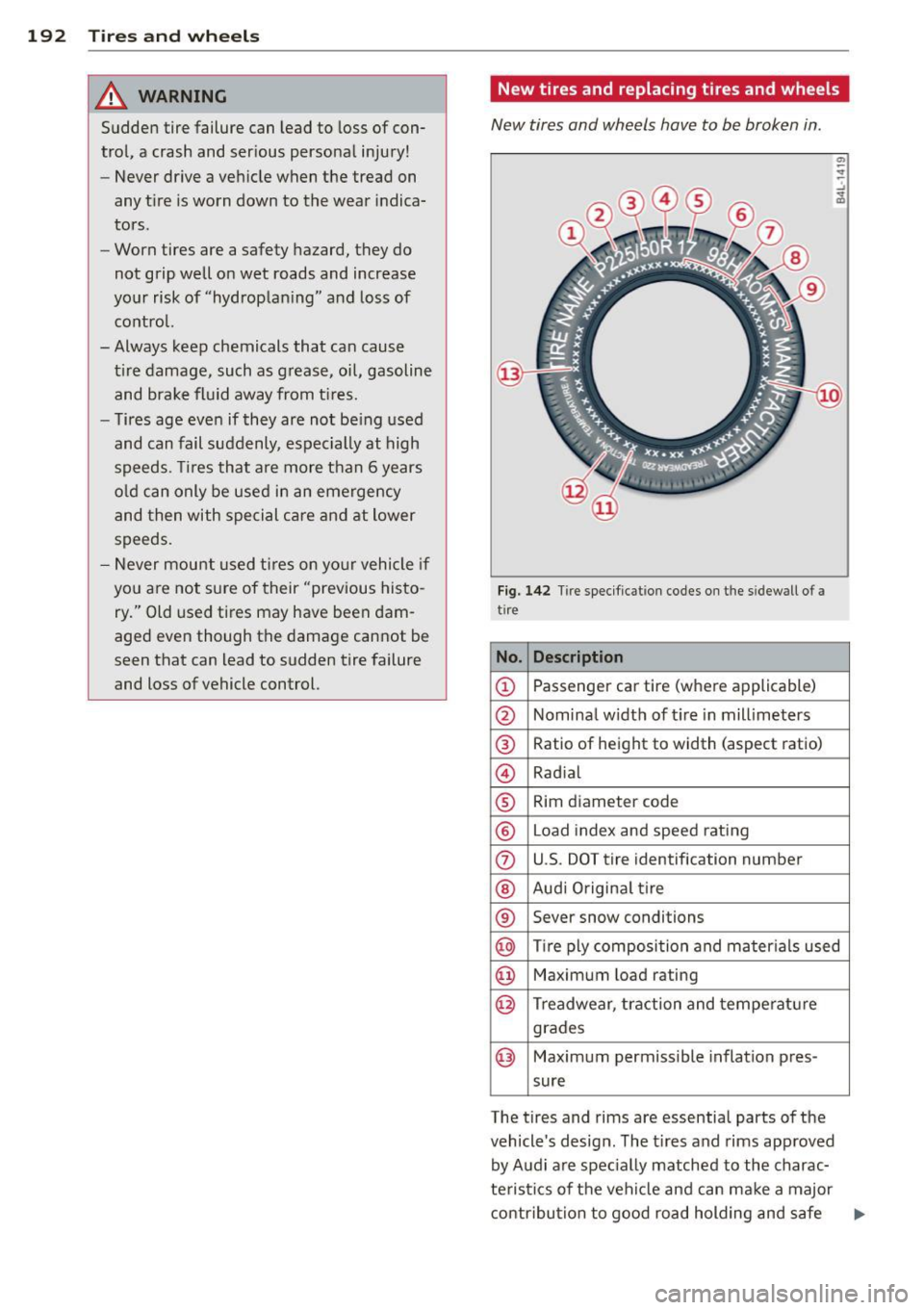
Fig. 142 Tir e specificat ion codes on t he s idew all o f a
t ire
No. De scription
® Ratio of height to width (aspect ratio)
© Rad ial
® Rim diamete r code
® Load index and speed rating
(J) U.S . DOT tire ident ification number
® Aud i Origina l t ire
® Seve r snow cond it ions
@ T ire ply composi tion and mater ials used
@ Max imum load ra ting
@ Treadwear, traction and tempe rature
grades
@ Maximum permiss ible inflation pres -
sure
The tires and rim s are essential parts of the
vehicle's design . The t ires and rims app roved
by Audi a re spec ially matched to the charac
teristics of the vehicle and can make a major contribu tion to good road holding and safe .,..
Page 197 of 244
Driving with different tires reduces vehi
cle handling and can lead to a loss of
control.
- If the spare tire is not the same as the
tires that are mounted on the vehicle -
for example with winter tires -only use
the spare tire for a short period of time
and drive with extra care. Refit the nor
mal road wheel as soon as safely possi
ble.
- Never drive faster than the maximum
speed for which the tires on your vehicle
are rated because tires that are driven
faster than their rated speed can fail
suddenly.
- Overloading tires cause heat build-up,
sudden tire failure, including a blowout
and sudden deflation and loss of control.
- Temperature grades apply to tires that
are properly inflated and not over or un
deri nflated.
- For technical reasons it is not always
possible to use wheels from other
vehicles -in some cases not even wheels
from the same vehicle model.
- If you install wheel trim discs on the ve
hicle wheels, make sure that the air flow
to the brakes is not blocked. Reduced air
flow to the brakes can them to overheat, increasing stopping distances and caus
ing a collision.
- Run flat tires may only be used on
vehicles that were equipped with them
at the factory . The vehicle must have a
chassis designed for run flat tires and a
factory-installed tire pressure monitor ing system that indicates a loss of tire
pressure. Incorrect use of run flat tires
can lead to vehicle damage or accidents.
Check with an authorized Audi dealer or
tire specialist to see if your vehicle can be
equipped with run flat tires .
If run flat
tires are used, they must be installed on
all four wheels. Mixing tire types is not
permitted .
Tires and wheels 195
@ Note
-For technical reasons, it is not generally
possible to use the wheel rims from oth
er vehicles. This can hold true for wheels
of the same vehicle type.
- If the spare tire is different from the
tires that you have mounted on your ve
hicle (for example winter tires or wide
profile tires), then use the spare tire for a
short period of time only and drive with
extra care. Replace the flat tire with the
tire matching the others on your vehicle
as soon as possible.
- Never drive without the valve stem cap .
The valves could get damaged.
(® For the sake of the environment
Dispose of old tires in accordance with the
local requirements.
Uniform tire quality grading
- Tread wear
- Traction AA A B C
- Temperature ABC
Quality grades can be found where applicable
on the tire side wall between tread shoulder
and maximum section width
¢ page 192,
fig. 142 .
For example: Tread wear 200, Traction AA,
Temperature A.
All passenger car tires must conform to Feder
al Safety Requirements in addition to these
grades.
Tread wear
The tread wear grade is a comparative rating
based on the wear rate of the tire when tested
under controlled conditions on a specified
government test course.
For example, a tire graded 1S0 would wear
one and one half (1 1/2) times as well on the
government course as a tire graded 100. •
•
Page 200 of 244
198 Tire s and wheel s
snow cha ins a re suitab ly covered. Check
the position of the snow chains after driving a few yards and correct if neces
sary. Follow the instr uctions from the
snow cha in manufacturer when doing so.
{O) Tips
Where snow cha ins are mandatory oncer
tain roads, this norma lly also applies to
veh icles with all-wheel dr ive.
Wheel bolts
Wheel bolts must always be tightened to the
correc t torque .
The design of whee l bolts is matched to the
factory installed r ims . If different rims are fit
ted, the correct wheel bolt s with the r ight
length and correctly shaped bol t heads mus t
be used . This ensures that wheel s are fitted
securely and that the brake system functions
correctly .
In certain circumstances, you may not use
wheel bolts from a d iffe rent vehicle -even if it
i s the same model
Q page 228.
A WARNING
Imprope rly tig htened o r maintained whee l
bolts can be come loose ca using loss of
cont ro l, a co llision and serious person al in
jury .
- Always keep the w heel bol ts and the
t h reads in t he wheel hubs clean so the
wheel bolts can t urn easily and be p rop
er ly t ightened .
- N ever grease or oil the wheel bo lt s an d
the threads in the wheel h ubs. They can
become loose w hile d riving if greased or
oi led, even if tightened to the specif ied
torque.
- Only use whee l bolts that be long to the
rim being installed.
- Never use different whee ls bolts on your
vehicle .
- Always mai ntai n the co rrect tighte ning
torq ue for the wheel bolts to reduce the
risk of a wheel loss. If the tightening tor- que of the whee
l bolts is too low, they
can loosen and come out when the vehi
cle is mov ing. If the tig hte ning torq ue is
too high, the w heel bolts a nd threads
can be damaged and the whee l can be
come loose.
(D Note
The specified torque for t he whee l bolts is
90 ft lb (120 Nm) with a tolerance of± 7,4
ft lb(± 10 Nm). Torque whee l bolts diago
nally . After changing a whee l, the to rq ue
must be checked as soon as possible with a
torque w rench - prefe rably by an author
iz ed A udi dealer or quali fied workshop .
Low aspect ratio tires
Your Audi is factory-eq uipped w ith low aspect
ratio tires. These tires have b een tho ro ughly
tested and been se lected specifically for your
model for their supe rb performance, road fee l
and hand ling under a variety of driving condi
t ions . Ask your author ized Audi dealer for
more de tails .
The low aspect ratio of these t ires is ind icated
by a numeral of
55 or less in the tire 's s ize
designation . The numera l rep resents the ratio
of the tire 's s idewa ll height in relation to its
t read width exp ressed in percentage. Conven
tiona l tire s have a he igh t/w idth rat io of 60 or
more.
The p erformance of low-a spect-ratio tire s is
particularly sensitiv e to improper inflation
pre ssure. It i s ther efore important that low
aspect ratio tires are inflated to the specified
pre ssure and that the inflation pre ssure i s
regularly checked and maintained. Tire pre s
sures should be checked at least once a month and always before a long trip
Q page 187, Checking tire pressure.
What you can do to avo id tire and rim
damage
Low aspect ratio tires can be damaged mo re
easily by impact w ith po tholes, curbs, gul lies ..,.
Page 205 of 244
When it i s not po ssibl e to co ntinu e
d riv ing, even with run-fl at ti res?
-If the E lectronic Stabilization Control (ESC)
is not working or keeps coming on.
- If the Tire P ressure Monitoring System does
not work .
- If the tire has been severely damaged, in a
crash, for example. The tread can separate
from a damaged tire as the whee l turns, and
hit parts of the vehicle, such as the fuel tank
filler neck, fuel lines or brake lines.
- Do not continue dr iving if severe vibration
occurs or if the tire starts to smoke because
the tire is runn ing hot .
- Do not continue driving if damage to the
tire, such as cracks in the sidewall, appears.
A WARNING
Improper use of run-flat t ires can cause
vehicle damage that can lead to loss of ve
hicle control, a crash and serious personal
injury.
- Run-flat tires can only be used with spe
c ial rims.
- Run-flat tires must always be mon itored
with a properly programmed Tire Pre
ss ure Mon itor ing System.
- Always inspect a tire that has lost air to
make su re it is safe to drive w ith the t ire
in the run-flat mode.
- Never drive with run-flat tires that have
been damaged in a collision.
- Never drive with run-flat tires if heat
build-up causes the t ire to give off
smoke.
- Never drive with run-flat tires if the vehi
cle shakes or v ibrates severely.
- Never drive with a run-flat tire that de
velops sidewall cracks or other damage
wh ile in use .
- If you switch between standard and run
flat tires, an author ized Audi dealer or
qualified wo rkshop must reprogram the
control module.
Tire s an d wheel s 203
@ Note
Run-f lat ti res have special characteristics
and requirements, that are very different
from convent ional tires. Run-flat tires re
quire special rims for run-flat use and can
not be used on conventional whee l rims .
(D Tips
- If you are not able to cont inue driving
w ith run-flat tires, please seek professio
nal ass istance.
- Please contact your authorized Audi
dealer or Aud i of America, Inc . if you
have questions about t ires and rims.
Driving with run-flat tires
Applies to veh icles: w it h Run -flat t ires
Handling characteristics change when tire
pressure is low.
Driving on tires with low tire pressure changes
the way a veh icle handles, particularly when
corner ing and braking. The handling charac
teristics of run -flat tires do not seem to
change a lot even when driving on low pres
sure or in the run-flat mode . Nevertheless you
must still take specia l precautions whe n oper
at ing a veh icle on run-flat tires when t ire pres
s u re is low o r the tire(s) is flat:
" The Electronic Stabilization Contro l (E SC)
must be switched on.
" Never drive fas ter than 50 mph (80 km/h)
q .&_ .
"Plan ahead when driving and anticipate
what you will have to do considering traffic
and road conditions up ahead.
" Accelerate carefully.
" Avo id unnecessary and sudden steering and
braking maneuvers.
" Reduce your speed in plenty of t ime before
intersections, curves and other places where
you may have to react quickly .
Please see:
q page 203, When it is not possi
ble to continue driving, even with run-flat tires?
•
•
...
Page 212 of 244
210 What do I do now?
• Close your grip around the end of the
wrench handle for maximum torque and
turn the wheel bolts
counter-clockwise
about one single turn in the direction of ar
row
¢ fig. 156.
Tightening
• Fit the wheel bolt wrench over the wheel
bolt and push it down as far as it will go .
• Close your grip around the
end of the
wrench handle for maximum torque and
turn each wheel bolt
clockwise until it sits
t ight.
A WARNING
- Us ing force without control to speed the
wheel change up can cause the veh icle to
slip off the jack and cause serious per
sonal inju ries.
-Do not loosen the wheel bolts more than
one turn
before you raise the vehicle with
the jack. -Risk of injury!
- Never t ry and use the hexagonal socket
in the handle of the screwdriver to loos
en or tighten the wheel bolts.
- If a wheel bolt sits very t ight, you may
find i t eas ier to loosen by carefully push
i ng down on the end of the whee l bolt
wrench with
one foot only. As yo u do,
hold on to the car to keep yourself stable
and take care not to slip .
Raising the vehicle
The vehicle must be lifted with the jack first
before the wheel con be removed .
a
Fig. 157 Sill pa nels : m ar kings
Fig. 158 Sill : posit ioning the vehicle jac k
• Apply the parking brake firmly to prevent
your veh icle from roll ing unintentionally.
• Move the
selector lever to position P .
• Position the jack be low the door sill under
t he
mounting point that is closest to the
wheel to be changed ¢
fig. 157.
• Extend the jack under the lifti ng point on
the door s ill until its arm is positioned di
rectly under the lifting point ¢,&. .
• Align the jack so that its arm®¢
fig. 158
engages in the designated lifting point in
the door s ill and the movable base ® lies
flat on the ground . The base @ must be
ver
tical
under the lifting point@.
• Wind the jack up further unti l the flat tire
comes off the ground ¢
.&,.
Position the vehicle jack only under the desig
nated lifting points on the sill
¢fig . 157.
T he re is exactly one locat ion for eac h wheel.
T he jack must not be positioned at any other
location ¢
.&,¢(D .
An unstable surface under the jack can cause
the vehicle to slip off the jack. Always provide
a firm
base for the jack on the ground. If nec
essary p lace a sturdy board or simi lar support
under the jack. On
hard, slippery surfaces
(such as tiles) use a rubber mat or similar to
prevent the jack from slipping ¢
.&,.
A WARNING
--You or your passengers cou ld be injured
while changing a wheel if you do not fol
low safety precautions:
- Position the vehicle jack on ly at the
designated lifting points and align the
jack. Otherwise, the vehicle jack could
Page 214 of 244
212 What do I do now?
When removing or installing the wheel,
the rim could hit the brake rotor and dam
age the rotor. Work carefully and have a
second person help you.
Never use the hexagonal socket in the han
dle of the screwdriver to loosen or t ighten
the wheel bolts.
- Pull the reversible b lade from the screw
driver before yo u use the hexagonal
socket in the handle to turn the whee l
bo lts.
- When mounting tires with
unid irectional
tread design
make sure the tread pat
tern is pointed the r ight way
~page 212.
- The wheel bolts should be clea n and easy
to tu rn . Check for d irt and corrosion on
the mat ing su rfaces of both th e whee l
and the h ub. Remove a ll dirt from these
su rfaces before remo unti ng the wheel.
Notes on wheel change
Pl ease read the informa tion ~ page 192, New
tires and replacing tires and wheels,
if you are
going to use a spare t ire which is different
from the tires on your vehicle.
After you change a tire :
-Check the tire pressure on the spare imme
diately after mounting .
- Have the wheel bolt tightening torque
che ck e d with a torqu e wrench a s soon as
possible b y your auth orized Audi dealer or
a qualified ser vice station .
- With steel and alloy wheel rims , the wheel
bolts are correctly tightened at a torque of
90 ft lb (1 20 Nm ).
- If y ou notice while changing a tire that the
wheel bolts are co rroded and difficult to
turn , then the y should be repl aced befo re
you check the t ightening torque . -
Repla ce the flat ti re with a new one and
have it installed on your veh icle a s soon as
possible. Remount the wheel cove r.
Until then , dr ive with extra care and at re
duced speed s.
_& WARNING
-
- If you are going to eq uip your vehicle
wit h tires or rims which differ from those
which were factory installed, then be
sure to read the information
9 page 192,
New tires and replacing tires and
wheels.
- Always store the tools secu rely i n lug
gage compartment. Othe rwise, in a n ac
cident or s udden maneuver they cou ld fly
forwa rd, causi ng injury to passengers in
the vehicle.
Tires with unidirectional tread design
Tires with unidirectional tread design must be
mounted with their tread pattern pointed the
right direction.
A un idirectional tire can be identified by ar
rows on the sid ewall ,
which point in the direc
tion of the rota tion. Yo u m ust follow the
specified direction of rota tion. This is ne ces sa
r y in order fo r these tires to develop t heir op
timum character istics regard ing grip, road
noise, wear, and hydrop laning.
Page 216 of 244
214 Fuses and bulbs
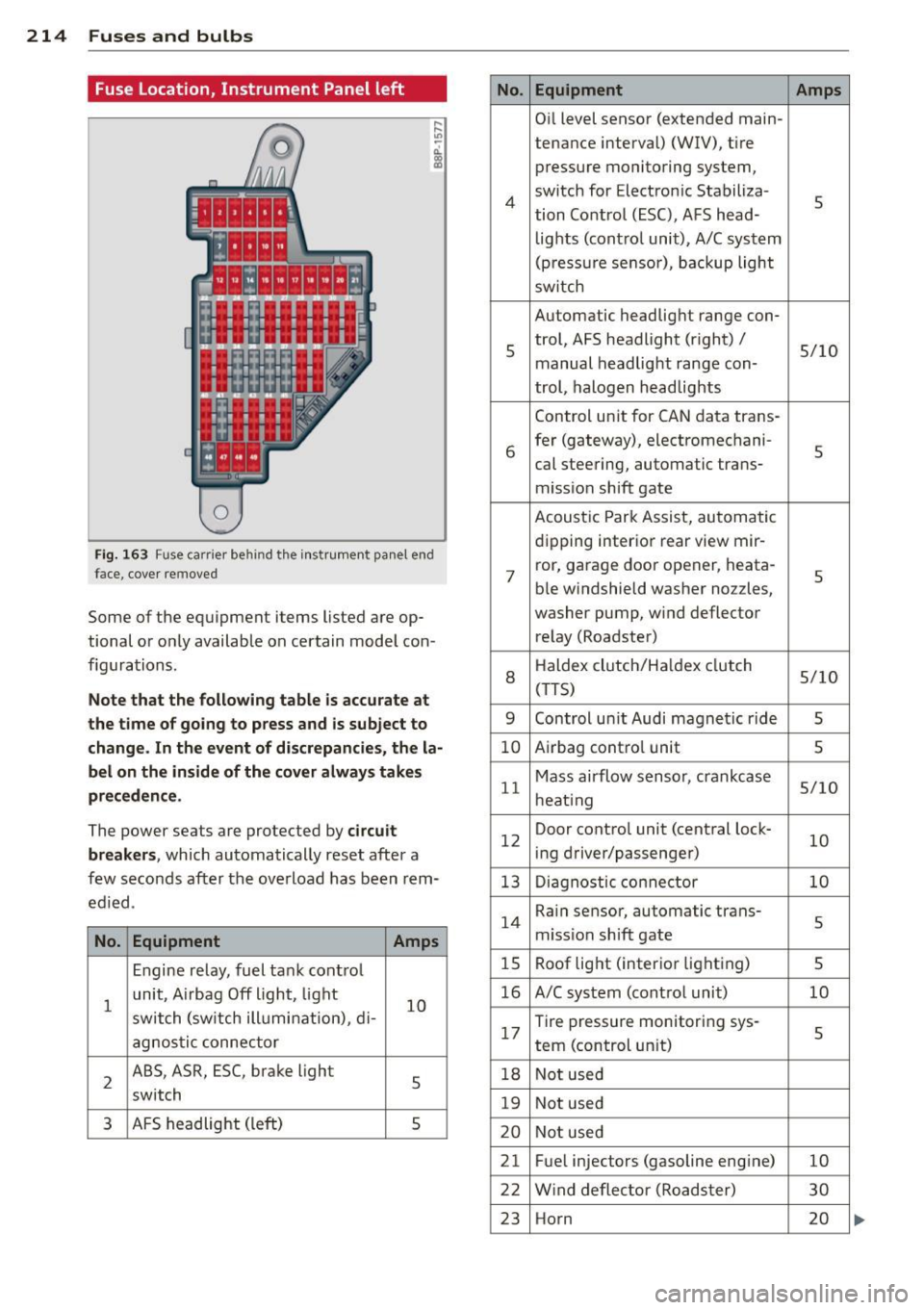
Fuse Location, Instrument Panel left
0
Fi g. 163 Fuse carrier behind the instrument panel end
face, cove r removed
Some of the equipment items listed are op
tional or only available on certain model con
figurations .
Note that the following table is accurate at
the time of going to press and is subject to
change. In the event of discrepancies, the la
bel on the inside of the cover always takes
preceden ce .
The power seats are protected by circuit
breaker s,
which automatically reset after a
few seconds after the overload has been rem
ed ied.
No . Equipment Amps
Engine relay, fuel tank control
1
unit, A irbag Off light, light
10 switch (sw itch illumination), d i-
agnos tic connector
2
ABS, ASR, ESC, brake light
5 switch
3 AFS headlight (left) s
No.
4
5
6
7
8
9
10
11
12
13
14
15
16
17
18
19
20
21
22
23
Equipment Amps
Oil level sensor (extended main-
tena nce interval) (WIV), tire
pressure monitoring system,
switch for Electronic Stabiliza-
s tion Control (ESC), AFS head-
lights (control unit), A/C system
(pressure sensor), backup light
sw itch
Automatic headlight range con-
trol, AFS headlight (right) /
5/10
manual headlight range con-
trol, halogen headlights
Control unit for CAN data trans-
fer (gateway), electromechani-
s cal steering, automatic trans-
mission shift gate
Acoustic Park Assist, automatic
dipping interior rear view mir- ror, garage door opener, heata-
s ble windshield washer nozzles,
washer pump, wind deflector
relay (Roadster)
H aldex clutch/Ha ldex clutch
5/10 (T TS)
Control un it Audi magnetic ride
s
Airbag contro l unit s
Mass airflow sensor, crankcase 5/10
heating
Door control unit (central lock-
10 ing driver/passenger)
Diagnostic connector
10
Rain sensor, automatic trans-
s miss ion shift gate
Roof light (interior lighting)
5
A/C system (control unit) 10
Tire pressure monitoring sys-
5 tern (control un it)
Not used
Not used
Not used
Fuel injectors (gasoline engine)
10
Wind deflector (Roadster) 30
Horn 20