ignition AUDI TT ROADSTER 2014 Repair Manual
[x] Cancel search | Manufacturer: AUDI, Model Year: 2014, Model line: TT ROADSTER, Model: AUDI TT ROADSTER 2014Pages: 244, PDF Size: 60.87 MB
Page 158 of 244
156 Vehicle care and cleaning
_& WARNING
- Only wash the vehicle when the ignition
is off and follow the instructions from
the car wash operator to reduce the risk
of accidents.
- To reduce the risk of cuts, protect your
self from sharp metal components when
washing the underbody or the inside of
the wheel housings.
- After washing the vehicle, the braking ef
fect may be delayed due to moisture on
the brake rotors or ice in the winter. The
brakes must be dried first with a few
careful brake applications .
@ Note
- If you wash the vehicle in an automatic
car wash, you must fold the exterior mir
rors in to reduce the risk of damage to
the mirrors. Power folding exterior mir rors* must only be folded in and out us
ing the power folding function.
- To prevent paint damage, do not wash
the vehicle in direct sunlight.
- To reduce the risk of damage, do not
wash the power top with a pressure
washer. -
To reduce the risk of damage, do not
wash decorative decals* with a pressure
washer.
- To reduc e the risk of damage to the sur
face, do not use insect removing spong
es, kitchen sponges or similar items.
- Matte finish painted vehicle compo
nents:
- To reduce the risk of damage to the
surface, do not use polishing agents or
hard wax.
- Never use car wash cycles that apply
protective wax.
It can destroy the
matte finish effect.
- Do not place any stickers or magnetic
signs on vehicle parts painted with matte finish paint. The paint could be
damaged when the stickers or magnets
are removed.
@ For the sake of the environment
Only wash the vehicle in facilities specially
designed for that purpose. This will reduce
the risk of dirty water contaminated with
oil from entering the sewer system.
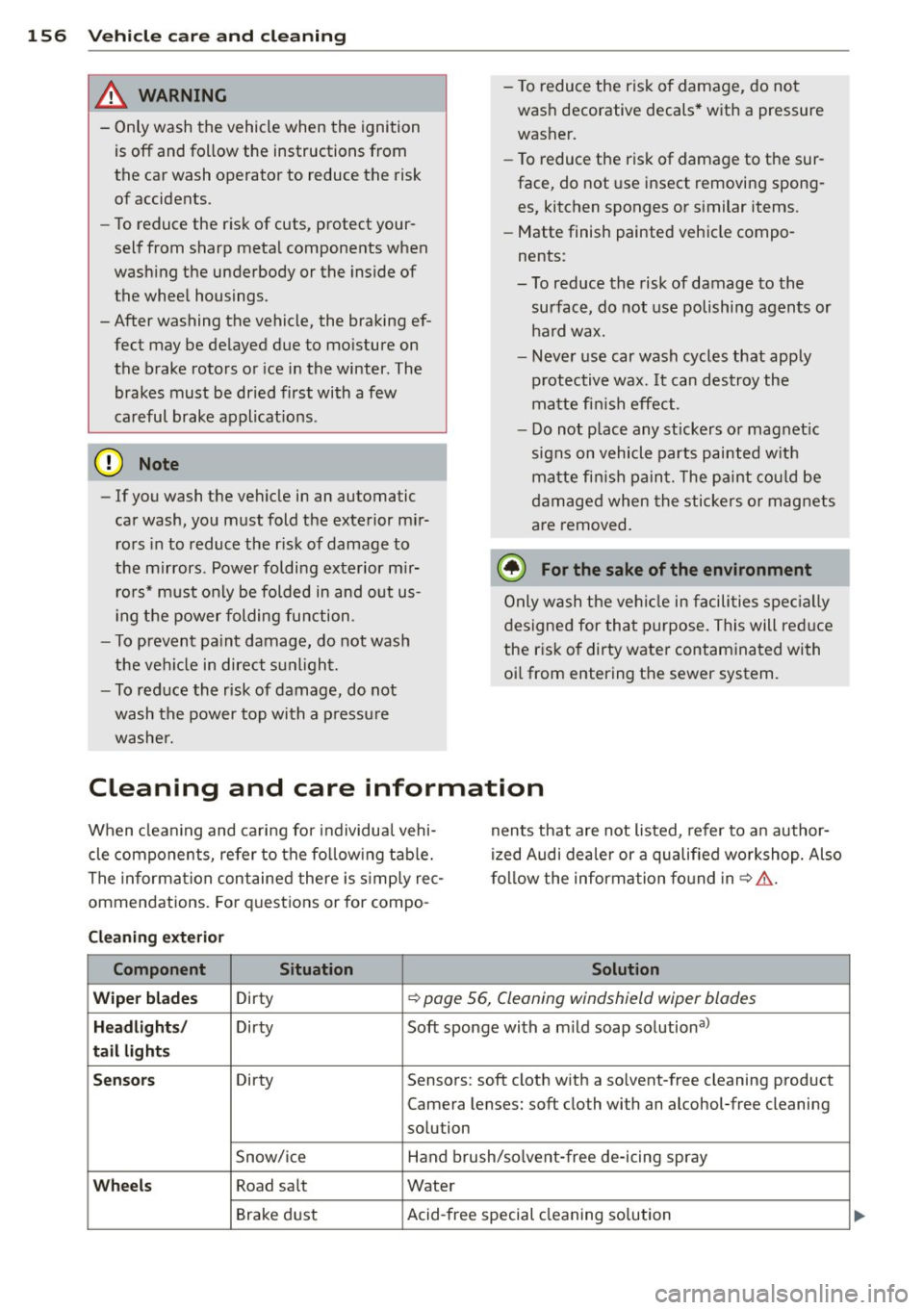
Cleaning and care information
When cleaning and caring for individual vehi
cle components, refer to the following table.
The information contained there is simply rec
ommendations. For questions or for compo- nents that are not listed,
refer to an author
ized Audi dealer or a qualified workshop. Also
follow the information found in~.&. .
Cleaning exterior Component Situation Solution
Wiper blades Dirty
~ page 56, Cleaning windshield wiper blades
Headlights/ Dirty Soft sponge with a mild soap solutional
tail lights
Sensors Dirty Sensors: soft cloth with a solvent-free cleaning product
Camera lenses: soft cloth with an alcohol-free cleaning
solution
Snow/ice Hand brush/solvent-free de-icing spray
Wheels Road salt Water
Brake dust Acid-free special
cleaning solution
Page 165 of 244
snow blower, etc., be very careful and al
ways observe local and state laws regard
ing the use, transportat ion and storage of
such fuel containers. Make certain the con t ainer meets industry standards (ANSI/
AS TM F8S2 -86).
(D Note
Never drive your vehicle unti l the fuel tank
is completely dry. The irregular supply of
fue l can cause misfir ing. Gasoline cou ld
enter into the exhaust system and damage
the cata lytic conve rter.
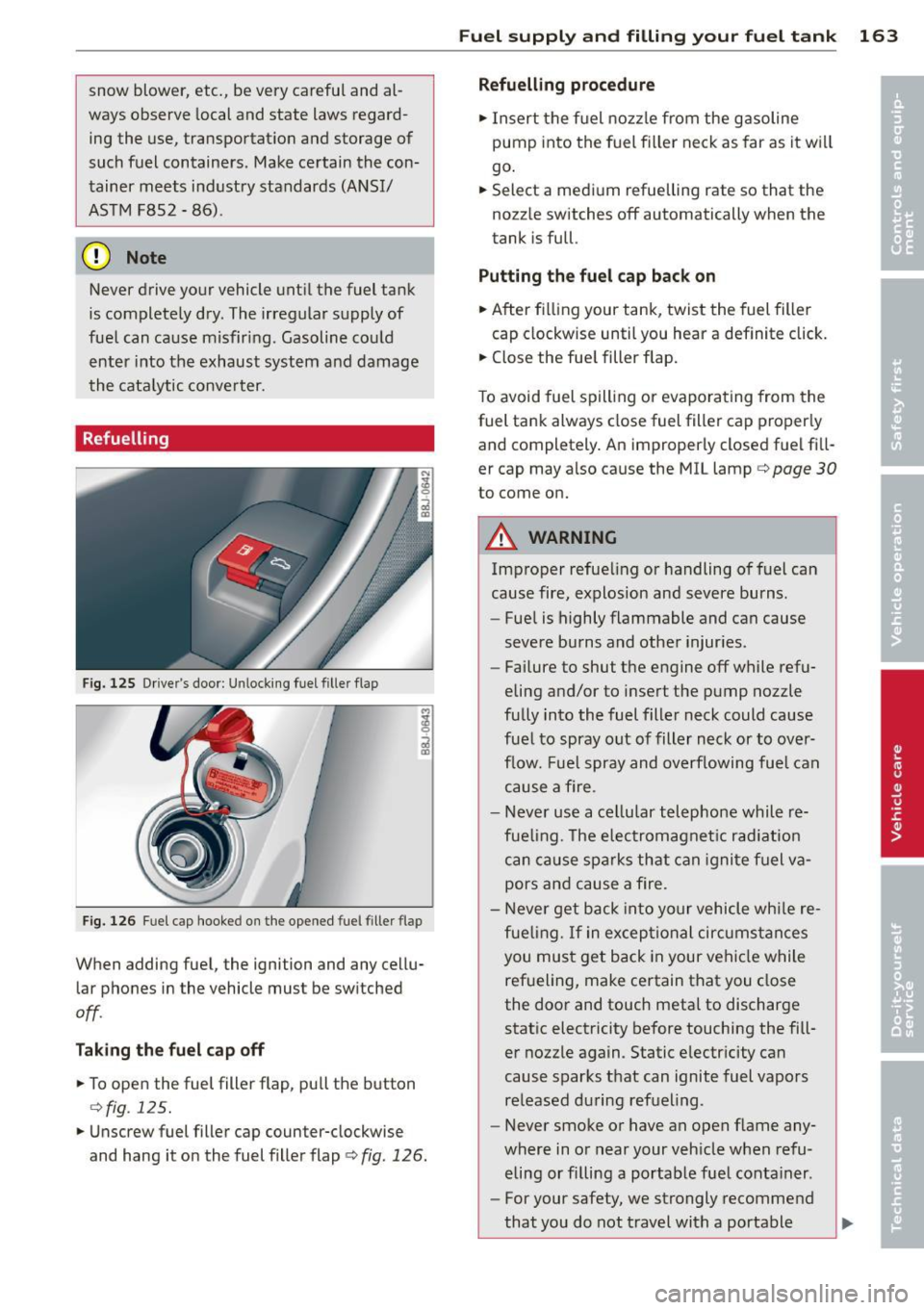
Refuelling
F ig. 125 D river's door: Un locki ng fuel filler flap
Fig. 1 26 Fuel cap hooked o n the opened fuel fi ller flap
When adding fuel, the ignition and any cellu
lar phones in the vehicle must be switched
off.
Taking the fuel cap off
.,. To open the fuel filler flap, pull the button
¢fig. 125.
.,. Unscrew fuel filler cap counter-clockwise
and hang it on the fuel filler flap ¢
fig. 126.
Fuel supply and filling your fuel t ank 163
Refuelling procedure
.,. Insert the fuel nozzle from the g asoline
pump into the fuel fi ller neck as far as it wi ll
go .
.,. Select a med ium refuelling rate so that the
nozz le switches off automatically when the
tank is full.
Putting the fuel cap bac k on
.,. After fi lling your tank, twist the fuel filler
cap clockwise until you hear a definite click.
.,. Close the fue l filler flap.
T o avoid fuel spill ing or evaporating from the
fuel tank always close fuel filler cap proper ly
and completely. An improperly closed fuel fill
er cap may also cause the MIL lamp¢
page 30
to come on.
A WARNING
Improper refue ling or handling of fuel can
cause fire, explosion and severe burns.
- Fue l is highly flammable and can cause
severe burns and other injur ies.
- Failure to shut the engine off while refu
eling and/or to insert the pump nozzle
fully into the fuel filler neck could cause
fue l to spray o ut of filler neck or to over
flow. Fue l spray and overflowing fuel can
cause a fire.
- Never use a ce llu lar telephone while re
fue ling. The electromagnet ic rad iat ion
can cause sp arks that can ignite fuel va
pors and cause a fire.
- Never get back into yo ur vehicle while re
fue ling.
If in excep tional circumstances
you must get back in your vehicle while ref ueling, make certain that you close
the door and touch metal to discharge
static electricity before touching the fill
er nozzle again. Static electr icity can
cause sparks that can ignite fuel vapors
released during refue ling.
- Never smoke or have an open flame any
where in or near your veh icle when refu
eling or filling a portab le fuel conta iner.
- For your safety, we strongly recommend
that you do not t ravel with a portable
Page 167 of 244
Checking and filling Engine hood
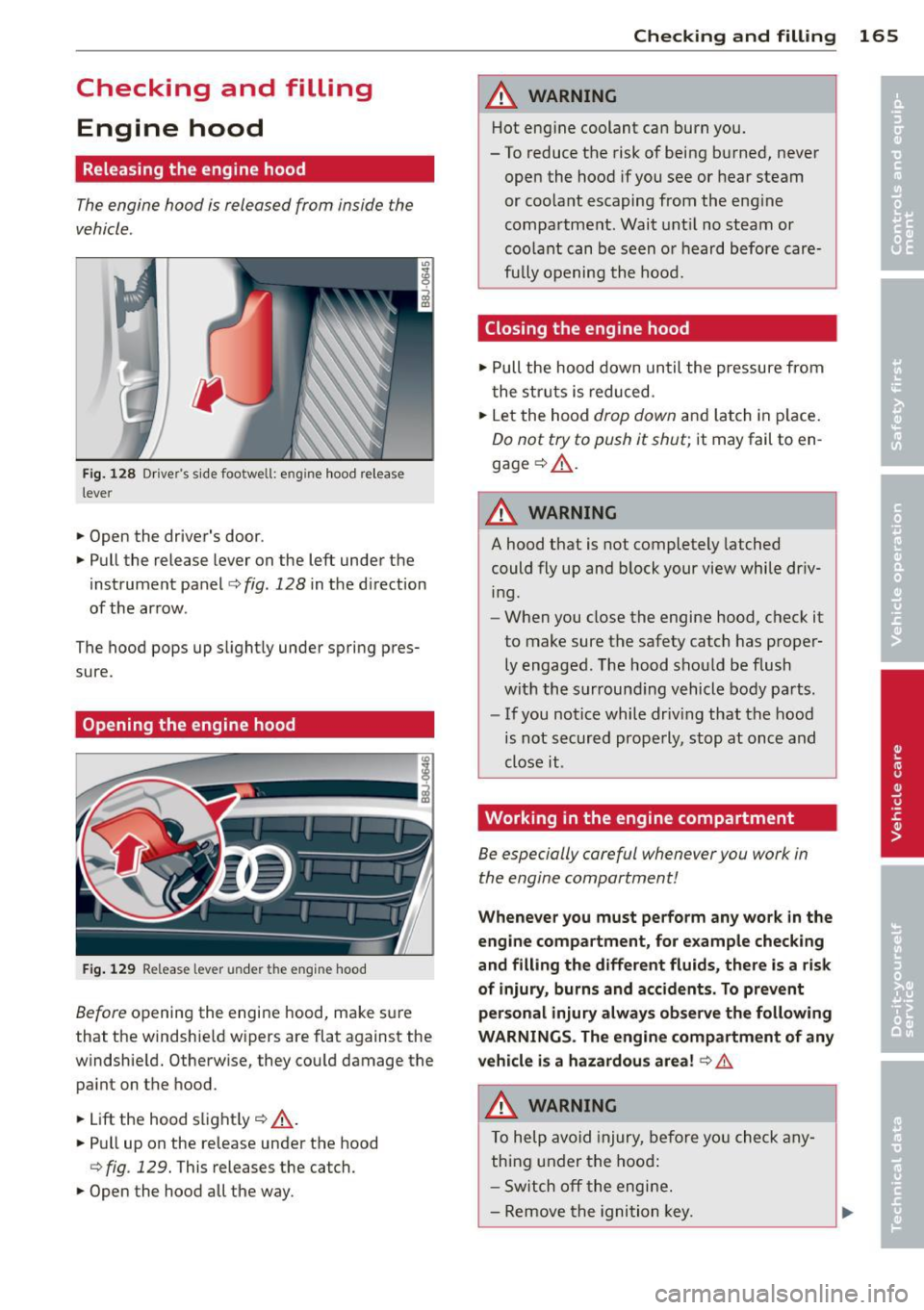
Releasing the engine hood
The engine hood is released from inside the
vehicle .
Fig. 128 Dr ive r's s ide footwe ll: e ng ine hood relea se
lever
"' Open the driver's door .
"' Pull the release lever on the left under the
instrument panel
i=> fig. 128 in the d irection
of the arrow .
The hood pops up slightly under spring pres
sure.
Opening the engine hood
F ig . 129 Release lever u nde r the engine hood
Before opening the engi ne hood, make sure
that the windshield wipers are flat against the
windshie ld. Otherwise, they could damage the
paint on the hood.
"' Lift the hood slight ly ¢
_A .
"' Pull up on the release under the hood
¢ fig . 129. This releases the catch.
"' Open the hood all the way .
Checking and fillin g 165
A WARNING
Hot engine coolant can burn you.
- To reduce the risk of being burned, never open the hood if you see or hear steam
or coolant escaping from the eng ine
compartment . Wait unt il no steam or
coolant can be seen or heard before care
fu lly opening the hood.
Closing the engine hood
"' Pull the hood down until the pressure from
the struts is reduced.
"' Let the hood
drop down and latch in p lace.
Do not try to push it shut; it may fail to en
gage ¢_& .
A WARNING
--
A hood that is not completely latched
could fly up and b lock your view while dr iv
ing.
- When you close the engine hood, check it
to make sure the safety catch has proper
ly engaged. The hood shou ld be flush
with the surround ing vehicle body parts.
- If you notice while driv ing that the hood
is not secured properly, stop at once and
close it .
Working in the engine compartment
Be especially careful whenever you work in
the engine compartment!
Whenever yo u must pe rform any wo rk in the
e n g ine compartment, for e xample ch ecki ng
and filling th e diff erent fluids, there is a risk
of injury, burn s and a ccidents. To prev ent
p ersonal injury always obse rve the foll owing
WARNINGS . The engine compa rtment of an y
vehicle i s a hazardou s area !
¢ &.
A WARNING ~
To help avoid injury, be fo re yo u check any
thing under the hood:
- Sw itch off the engi ne.
- Remove the ignition key.
Page 168 of 244
166 Checking and filling
-Apply the parking brake.
- Move selector lever to "P" (Park).
- Always let the engine cool down. Hot
components will burn skin on contact.
- To reduce the risk of being burned, never
open the hood if you see or hear steam
or coolant escaping from the engine
compartment . Wait until no steam or
coolant can be seen or heard before care
fully opening the hood.
- Keep children away from the engine com
partment .
- Never spill fluids on hot engine compo
nents. They can cause a fire.
- Never touch the radiator fan. The auxili
ary electric fan is temperature controlled
and can switch on suddenly.
- Never open the coolant reservoir cap
when the engine is still warm. The cool
ant system is pressurized and hot cool
ant could spray out .
- Protect your face, hands and arm from
steam or hot engine coolant by placing a
thick rag over the cap when you open the coolant reservoir .
- Do not remove the engine cover under
any circumstances . This increases the
risk of burns.
- If work on the fuel system or the electri
cal system is necessary:
- Always disconnect the battery .
- Never smoke or work near heaters or
open flames. Fluids in the engine com
partment could start a fire.
- Keep an approved fire extinguisher im
mediately available.
- To avoid electrical shock and personal in
jury while the engine is running or being
started, never touch:
- Ignition cables
- Other components of the high voltage
electronic ignition system.
- If you must perform a check or repair
with the engine running: -
First, fully apply the parking brake,
move selector lever to "P" (Park) .
- Always use extreme caution to prevent
clothing, jewelry, or long hair from get
ting caught in the radiator fan, V-belts
or other moving parts, or from contact ing hot parts. Tie back hair before
starting, and wear no clothing that will hang or droop into the engine.
- Minimize exposure to emission and chemical hazards~&, .
A WARNING
=
California Proposition 65 Warning:
- Engine exhaust, some of its constituents, and certain vehicle components contain
or emit chemicals known to the State of
California to cause cancer and birth de
fects and reproductive harm. In addition,
certain fluids contained in vehicles and
certain products of component wear con
tain or emit chemicals known to the
State of California to cause cancer and
birth defects or other reproductive harm.
- Battery posts, terminals and related ac
cessories contain lead and lead com
pounds, chemicals known to the State of
California to cause cancer and reproduc
tive harms. Wash hands after handling.
(D Note
When adding fluids, always make sure that
they are poured into the proper container
or filler opening, otherwise serious dam
age to vehicle systems will occur.
@) For the sake of the environment
To detect leaks in time, inspect the vehicle
floor pan from underneath regularly. If
you see spots from oil or other vehicle flu ids, have your vehicle inspected by an au
thorized Audi dealer.
Page 175 of 244
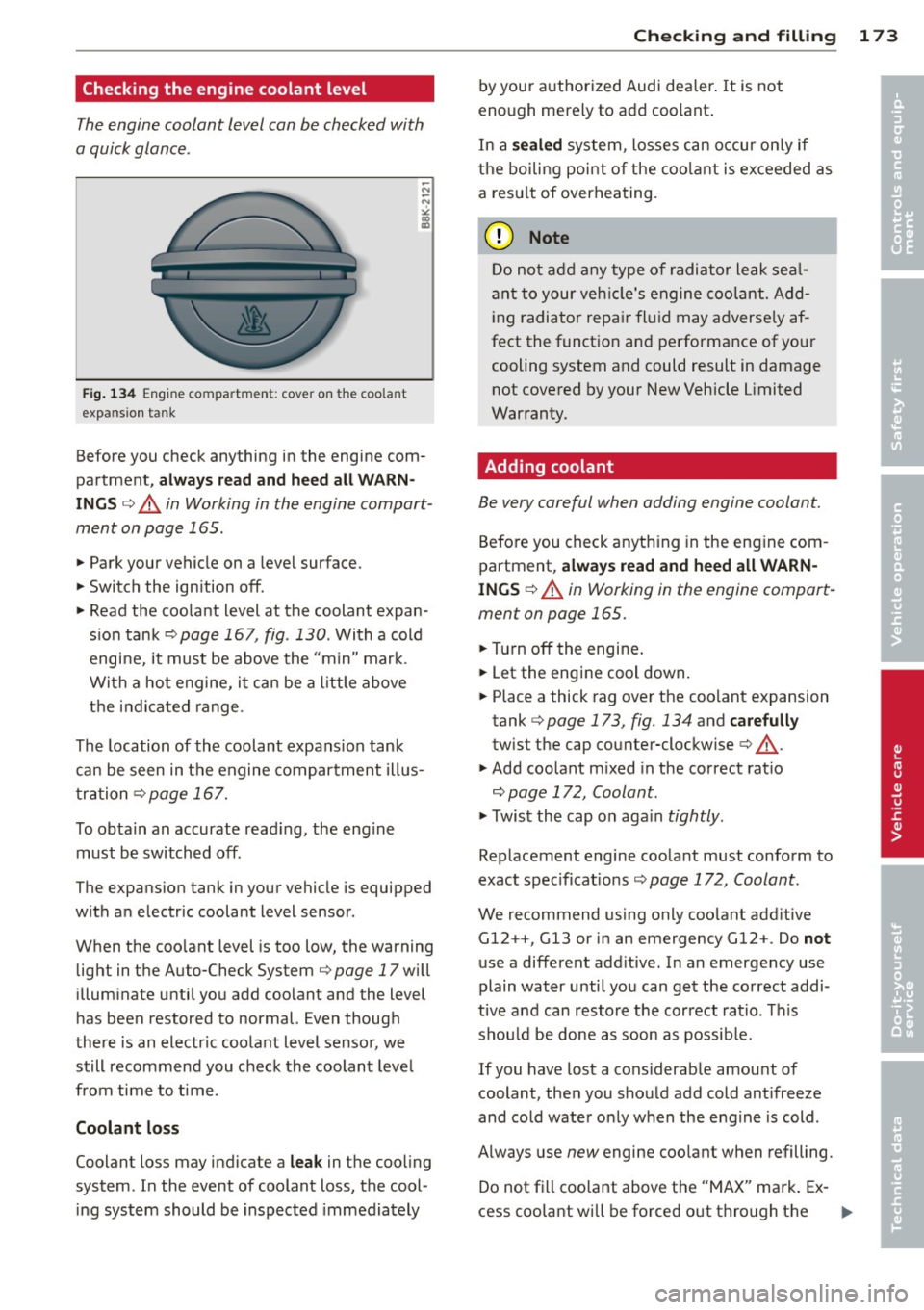
Checking the engine coolant level
The engine coolant level can be checked with
a quick glance .
Fig. 134 Eng ine compartme nt: cover o n the coolant
expansion tank
Before you check anything in the engine com
partment,
a lway s read and he ed all WARN
INGS ¢ A in Working in the engine compart
ment on page 165.
.,. Park your vehicle on a level surface.
.,. Switch the ignition
off .
.,. Read the coola nt level at the coolant expan
s ion tank
¢ page 167, fig . 130. With a cold
engine, it must be above the "min" mark.
With a hot engine, it can be a l ittle above
the indica ted range.
The location of the coolant expans ion tank
can be seen in the engine compar tment illus
tration
¢page 167.
To obtain an accurate read ing, the eng ine
must be switched
off.
The expans ion tank in your vehicle is equipped
with a n electric coolant level sensor.
When the coo lant level is too low, the warning
light in the Auto-Check System¢
page 17 will
illum inate until you add coolant and the level
has been restored to normal. Even though
there is an electric coolant level sensor, we
still recommend you check the coolant leve l
from time to time.
Coolant loss
Coolant loss may indicate a leak in the cool ing
system. In the event of coolant loss, the cool
i ng system should be inspected immediately
Checkin g and fillin g 173
by your authorized Audi dea ler . It is not
enough merely to add coo lant .
In a
s ealed system, losses can o ccu r on ly if
the boiling point o f the coo lant is exceeded as
a res ult of overheating.
(D Note
Do not ad d any type of radiator leak sea l
ant to your veh icle's engine coo lant. Add
ing radiator repa ir flui d may adverse ly af
fect the function and performance of yo ur
cooling system and could result in damage
not covered by your New Vehicle Limited
War ranty.
Adding coolant
Be very careful when adding engine coolant.
Before you check anyth ing in the engine com
partment,
alway s read and heed alt WARN
INGS ¢ A in Working in the engine compart
ment on page 165.
... Tu rn off the engine .
.,. Let the engine cool down.
.,. Place a thick rag ove r the coolant expansion
tank ¢
page 173, fig. 134 and carefully
twist the cap counter-clockwise ¢_& .
.,. Add coo lant m ixed in the correct rat io
¢ page 172, Coolant .
.,. Twist the cap on aga in tightly.
Rep lacement engine coo lant must conform to
exact specificat ions¢
page 172, Coolant.
We recommend using only coolant add itive
Gl2 ++, Gl3 or in an emergency Gl2+. Do not
use a different additive. In an emergency use
plain water until you can get the correct addi
tive and can resto re the correct ratio . Th is
shou ld be done as soon as possib le.
If you have lost a cons iderab le amount of
coolant, then you should add cold ant ifreeze
and co ld wate r on ly when the engine is cold.
Always use
new engine coolant when refilling.
Do not fill coolant above the "MAX" mark. Ex-
cess coolant will be fo rced o ut through the ..,_
•
•
Page 176 of 244
17 4 Che cking and filling
pressure relie f valve in the cap when the
engine becomes hot .
.&_ WARNING
-The coo ling system is under pressure and
can get
very hot. Reduce the risk of
sca lding from hot coolant by following
these steps .
- Turn off the eng ine and a llow it to cool
down.
- Protec t your face, hands and arms from
escap ing fl uid and steam by cover ing
the cap with a large, thick rag.
- Tu rn the cap slowly and
very ca refully
in a counter -clockwise direct ion while
applying light, downward p ress ure on
the top of the cap.
- To avo id being burned, do not sp ill an
tifreeze or coolant on the exhaust sys
tem or hot engine parts. Under certain
conditions, the ethylene glyco l in en
g ine coolant can catch fire.
- Antifreeze is poisonous. Always store an
t ifreeze in its or iginal container and we ll
out of the reach of children.
- If you drain the coolant, it must be
caught and safely stored in a proper con
ta iner clearly marked "poison".
(D Note
- Coolant po llutes the environment and
could cause an engine fire. Excess cool
ant will be forced out through the pres
sure re lief
valve in the cap when the en
gine becomes hot .
- If, in an emergency, only water can be
added, the correct ratio between wate r
and antifreeze~
page 172 must be re
stored as soon as possib le.
@) For the sake of the environment
Dra ined coolant should not be reused. Al
ways dispose of used coolant while obse rv
ing all environmental regulations .
Radiator fan
The radiator fan switches on automatically by
itself .
The electric radiator fan is controlled by ther
moswitches that switch on and off depending
on coolant and eng ine compartment tempera
tures.
An a uxiliary electric radiator fan* sw itches on
and off depending on coolant temperature
and other vehicle operat ion conditions .
After you switch the engine off, the aux iliary
fan can continue running for up to 10 minutes
-even w ith the ignition off. It can even switc h
on aga in later by itself
c> &. , if
- the temperature of the engine coo lant rises
due to the heat build-up from the engine in
the engine compartment, or
- the engine compartment heats up because
the vehicle is parked in intense sunlight.
.&_ WARNING
-
- To reduce the risk of personal inju ry nev-
er touch the radiator fan.
- The auxiliary electric fan is temperature
controlled and can sw itch on suddenly
even when the engine is not ru nning.
- The auxiliary radiator fan sw itches on au
tomatically when the engine coo lant
reac hes a certain t emperature and w ill
continue to run until the coolant temper
a ture drop s.
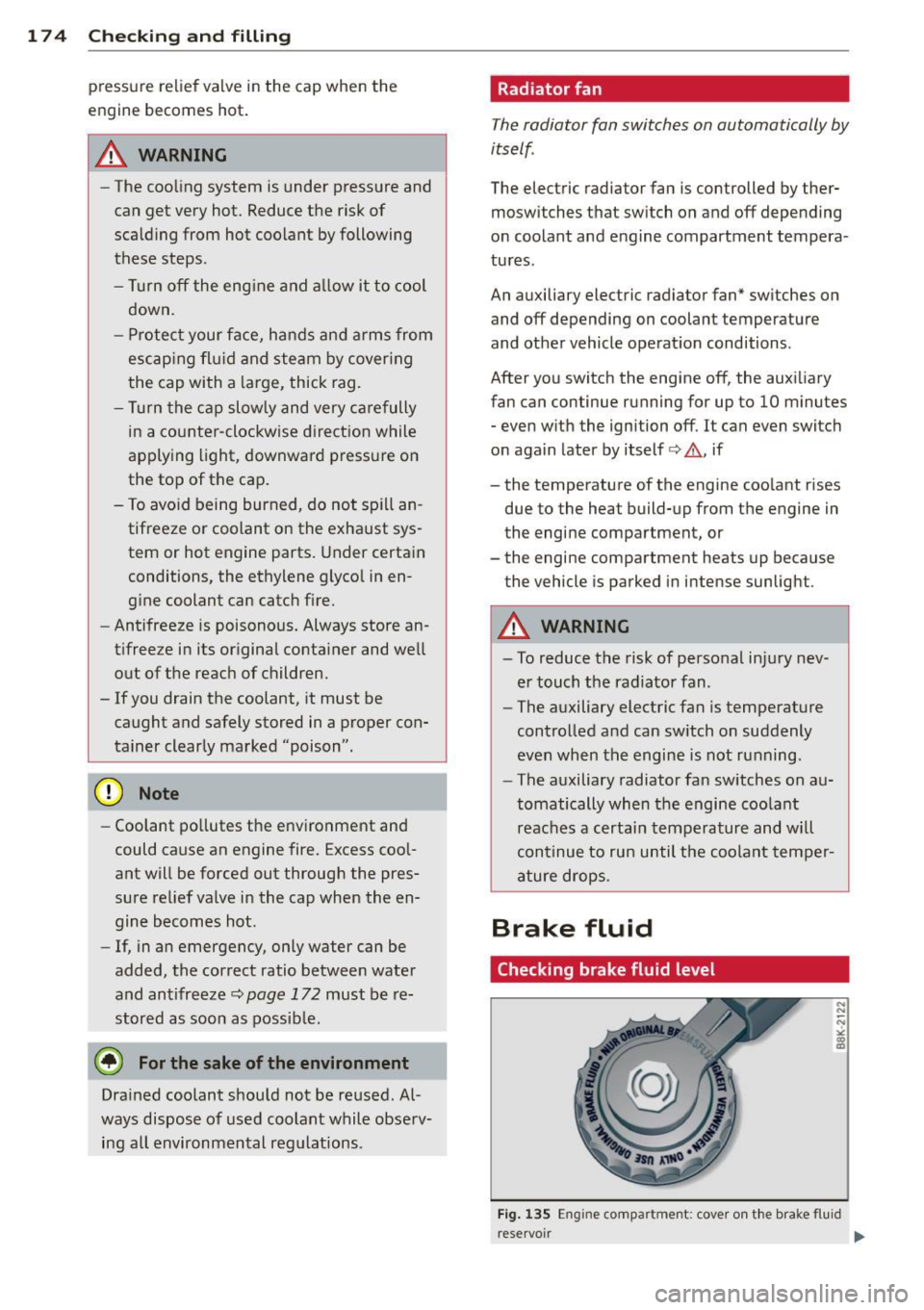
Brake fluid
' Checking brake fluid level
N
N
N
" ~
Fi g. 13S Engine compartment: cover on th e brake fluid
reservoir
Page 178 of 244
176 Check ing and filling
Have the battery checked when you take your
vehicle in for service. You are well advised to replace a battery that is older than S years .
Disconn ect ing the battery terminals
Some veh icle functions (power w indow regu
lators, for example) are lost if the battery ter
minals are disconnected . These functions have
to be re learned after the battery terminals are
connected again. To prevent this, the battery
should only be d isconnected from the vehicle
electr ical system when absolutely necessary
for repairs .
V ehicles not dri ven for l ong period s
If you do not drive your vehicle over a period
of several days or weeks, electrical compo nents are gradually cut back or switched off .
This reduces energy consumption and main tains starting capab ility over a longer period
c:::>
page 147. Some of the convenience func
tions may not operate, suc h as the inte rior
l ights or power seat adjustme nt. The conven
i ence functions wi ll be ava ilable aga in whe n
you switch on the ignition and start the en
gine.
Winter operati on
During the winter months, batte ry capacity
tends to decrease as tempe ratu res d rop . This
is because more powe r is also consumed while
start ing , and the headlights, rea r window de
fogger, etc., are used more often.
Avoid unnecessary power consumption, par
ticularly in c ity traffic or when t rave ling on ly
short distances. Let you r authorized Aud i
dea ler check the capacity of the vehicle bat
tery before winter sets inc:::>
page 179 . A we ll
charged battery w ill not only prevent starting
prob lems when the weather is cold, but will
a lso last longer .
Replacing battery
The new battery must have the same capaci
ty, vo ltage (12 volts), amperage, construction
and p lug sealing, as the origina l battery. Spec
if ications are listed on the battery housing.
Batteries specially developed by Audi fulfill the maintenance, outp
ut, and safety require
ments .
When install ing the battery, m ake su re the ig
ni tion and a ll ele ct rical consumers are switch
ed off
c:::> (i) .
We recommend that you use maintenance
free or
cy cle-re si stant /leak -proof b atter ies
accord ing to the s tanda rds TL 825 06 (from
Apri l 2008) and VW 7 SO 73 (from April
2010) .
Rep lac ing the bat tery shou ld be car ried by a
qualified wo rkshop. Please fo llow the instruc
tions on the battery cover .
(D Note
- All wo rk on the ba tte ry req uire s techn i
c al know ledge . Please con ta ct an Aud i
dealership o r another authorized faci lity
for questions abo ut the batte ry -danger
o f ac id burns and exp losion hazard!
- The battery must not be opened! Do not
try to change the battery's liquid level,
otherwise detonating gas will escape
from the battery - explosion hazard!
- The AGM battery in the l uggage com
partment cannot leak, because the elec
tro lyte for this battery is absorbed into a
special glass mat. This leak-proof battery
must not be replace with a convent ional
battery.
- Make sure the ventilation hose on the
side of the battery is connected, other
w ise fumes or battery ac id can leak out .
- Batte ry holder and termina ls always
have to be secured correctly .
- Before all work on the battery follow the
warnings be low c:::> .&. in Working on the
battery on page 177.
@ For the sake of the environment
Because of the prob lem of proper disposal
of a battery, we recommend your author
iz ed Audi dealer change the battery for
you. Batteries contain sulfur ic acid and
l ead and must a lways be disposed o f prop-
erly in compliance wi th al l envi ronmental ..,.
Page 180 of 244
1 78 Che cking and filling
must be disconnected . If you are just go
ing to rep lace a light bu lb, then it is
enough to switch off the lights.
- Before disconnecting the battery, switc h
off the anti-theft alarm system! Other
wise you will set off the alarm.
- When disconnecting the battery, first disconnect the negative cable and then
the positive cable .
- Before reconnect ing the battery, make
sure all electrical consumers are switch
ed off . Reconnect the positive cable first
and then the negative cable. Never inte r
change the cables - th is could start a fire!
- Never charge a frozen or a thawed-out battery.
It could explode! If a battery has
frozen, then it must be replaced. A dis
charged battery ca n freeze over at 32 °F
(0 oc).
- Make sure the vent hose is always attach
ed to the opening on the side of the bat
tery .
- Never use batte ries which are damaged.
Danger of explos ion! Always rep lace a
damaged battery .
8_ WARNING
California Proposition 65 Warning:
- Battery posts, te rm inals and related ac
cessories contain lead and lead com
pounds, chemicals known to the State of
California to cause cancer and reproduc
tive problems. Wash hands after han dling.
(D Note
- Do not disconnect the vehicle battery when the ignition is switched on
or when
the engine is running, otherwise, you will
damage e lectronic components in the
electrical system.
- If your vehicle is going to stand for a long period of time without being driven,
protect the battery from "freezing", oth
erwise it w ill be damaged and w ill then
have to be replaced .
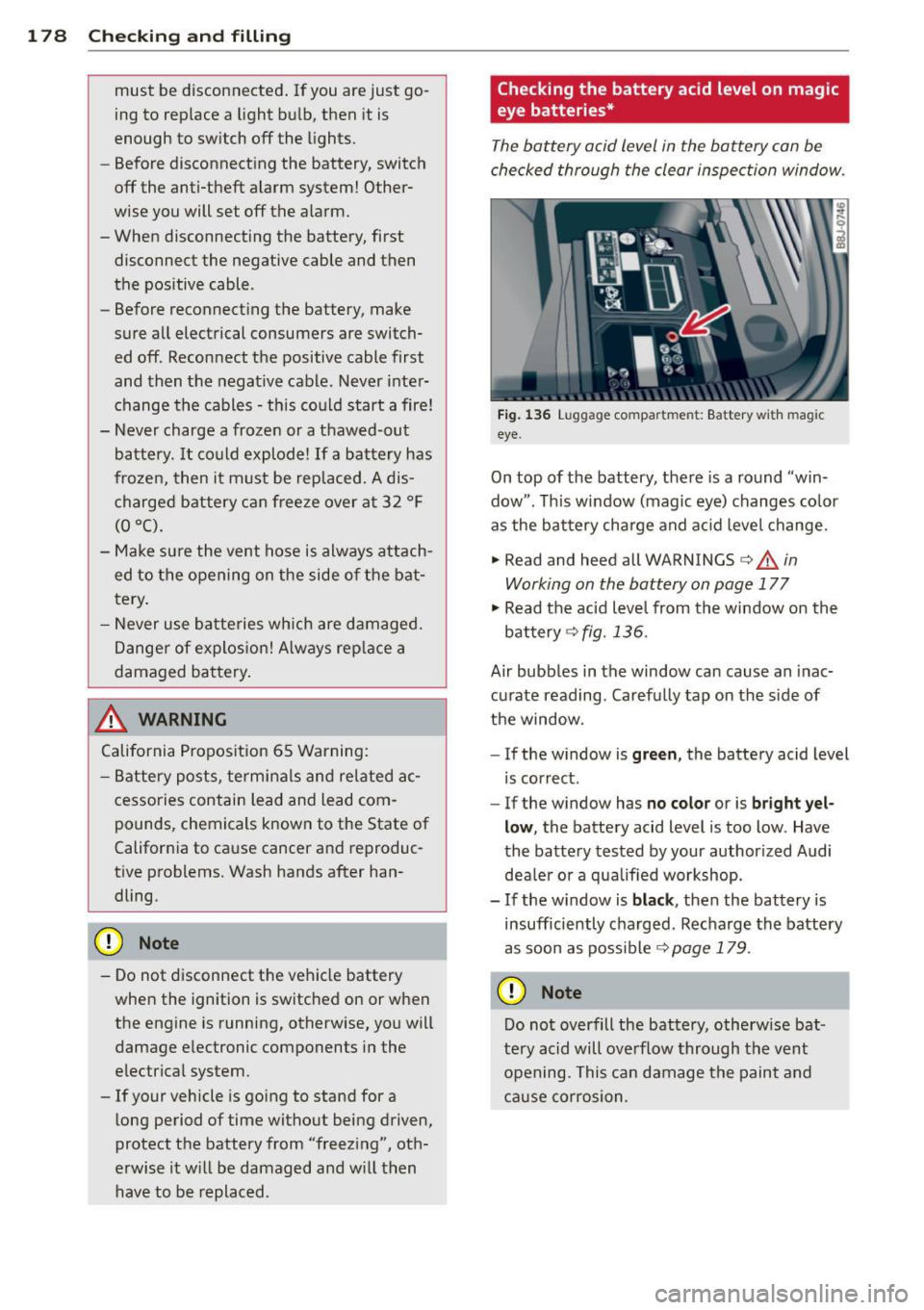
Checking the battery acid level on magic
eye batteries*
The battery acid level in the battery can be
checked through the clear inspection window .
Fig . 1 36 Lu gga ge compar tment: Battery w ith magic
eye .
On top of the battery, there is a round "win
dow". This window (magic eye) changes co lor
as the battery cha rge and ac id leve l change.
.,. Read and heed all WARNINGS
<=> .&_ in
Working on the battery on page 177
.,. Read the acid level from the window on the
battery <=>
fig. 136.
Air bubbles in the window can cause an inac
curate reading . Carefu lly tap on the s ide of
the window.
- If the window is
green , the battery acid level
is correct.
- If the window has
no colo r or is brigh t y el
lo w,
the battery acid level is too low . Have
the battery tested by your author ized Audi
dea ler or a qualified workshop.
- If the w indow is
black , then the battery is
insufficiently charged . Recharge the battery
as soon as possible¢
page 179 .
(D Note
Do not overfill the battery, otherw ise bat
tery acid will ove rflow through the vent
opening . This can damage the paint and
cause corrosion .
Page 202 of 244
200 Tires and wheels
remain continuo usly illuminated . This se
quence will continue upon subsequent vehicle
start-ups as long as the ma lfunction ex ists.
When the malfunction indicator is illuminat
ed, the system may not be able to detect or
signal low tire pressure as intended. TPMS
malfunctions may occur for a variety of rea
sons, including the installation of replace ment or alternate tires or wheels on the vehi
cle that prevent the TPMS from functioning properly . Always check the TPMS malfunction
tellta le after replacing one or more t ires or
wheels on your veh icle to ensure that the re
placement or alternate tires and wheels allow
the TPMS to continue to function properly.
Tire pressure indicator appears
Applies to vehicles: with tire pressure monitoring system
The tire pressure indicator in the instrument
cluster informs you if the tire pressure is too
low or if there is a system malfunction.
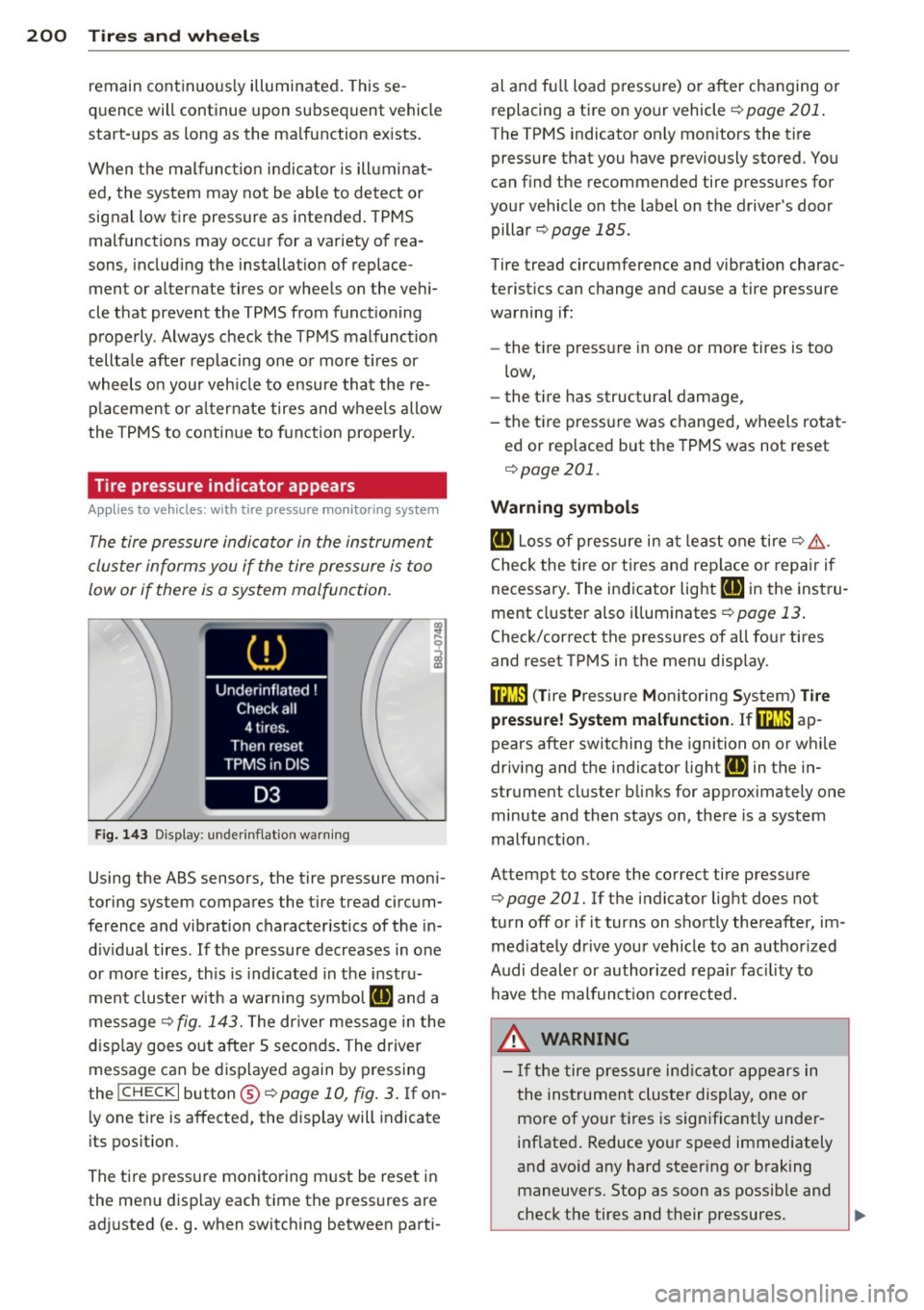
F ig. 143 Display : underi nflat io n warn ing
Using the ABS sensors, the tire pressure moni
toring sys tem compares the t ire tread circum
ference and vibration characteristics of the in
d iv idual tires . If the pressure decreases in one
or more tires, th is is indicated in the instru
ment clus ter with a warning symbo l
ail and a
message<>
fig. 143. The dr iver message in the
display goes out after 5 seconds . The driver
message can be displayed again by pressing
the
! CHECK I button @¢ page 10, fig . 3 . If on
l y one tire is affected, the display will indicate
its pos ition.
The tire press ure monitoring m ust be reset in
the menu display each time the pressures are
ad justed (e.g. when switching between parti- al and fu
ll load pressure) or after changing or
replacing a tire on your vehicle<>
page 201.
The TPMS indicator only mon itors the t ire
pressure that you have previously stored . You
can find the recommended tire pressures for
your vehicle on the label on the driver's door
pillar
¢ page 185.
Tire tread circumference and vibration charac
teristics can change and cause a tire pressure
warning if:
- the t ire pressure in one or more tires is too
low,
- the tire has structural damage,
- the tire pressure was changed, wheels rotat -
ed or replaced but the TPMS was not reset
¢ page 201.
Warning symbols
ail Loss of pressure in at least one tire¢& .
Check the tire or tires and replace or repa ir if
necessary . The indicator light
HE in the instru
ment cluster also illuminates
<>page 13.
Check/correct the pressures of all four tires
and reset TPMS in the menu display .
ffim (T ire Pressure Monitoring System) Tire
pressure! System malfunction. Ifffim
ap
pears after switching the ignition on or while
driv ing and the indicator lig ht
HE in the in
strument cluster blinks for approx ima tely one
minute and then stays on, there is a system
malfunction .
At tempt to store the correct tire pressure
¢ page 201. Ifthe indicator light does not
turn
off or if it turns on shortly thereafter, im
med iate ly drive your vehicle to an author ized
Audi dealer or author ized repair facility to
have the malfunction corrected.
_&. WARNING
-
- If the tire pressure indicat or appears in
the instrument cluster display, one or
more of your tires is significant ly under
inflated . Reduce your speed immediately
and avoid any hard steer ing or braking
maneuvers. Stop as soon as possible and
check the tires and their pressures.
IJJ,,
Page 204 of 244
202 Tires and wheels
@ Tips
-Before resetting the TPMS, the current
pressures of
all four tires must corre
spond to the specif ied values. Adjust the
tire pressure and reset the pressure in
the tire pressure mon itor ing system ac
cord ing to the load you are carry ing
¢page 185.
- Do not store the tire pressure if there are
snow chains on the tire.
Reset tire pressure monitoring system
(Step2)
Ap plies to vehicles: with tire pressure mo nit oring sys te m
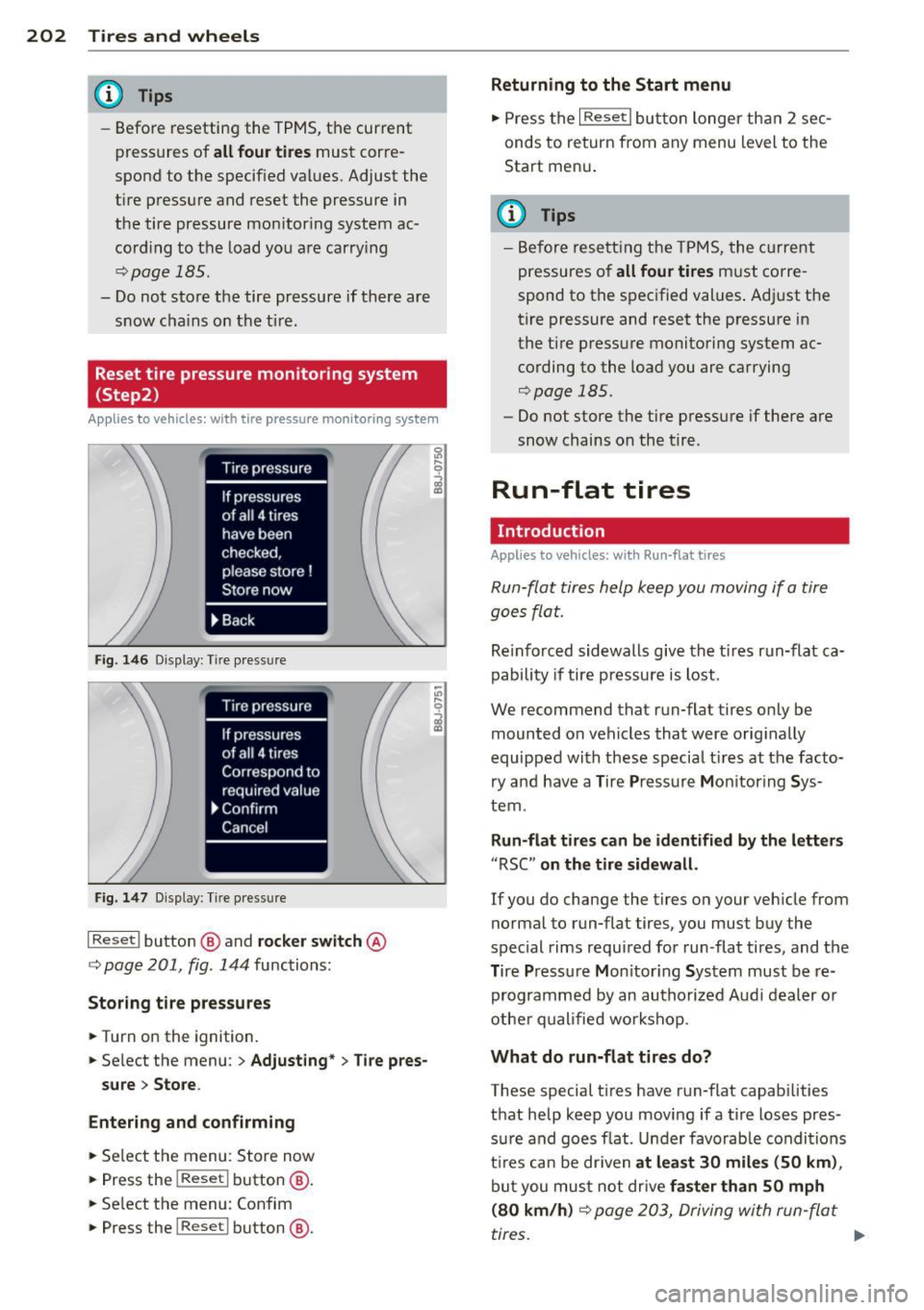
F ig. 146 Display: Tire pressure
Fig. 147 Display: Tire pres sure
I Reset I button @ and rocker switch @
c::, page 201, fig . 144 functions:
Storing tire pres sures
.. Turn on the ignition.
.. Se lect the menu :
> Adjust ing * > Tire pres
sure > Store.
Entering and confirming
.. Select the menu: Store now
.. Press the
I Reset ! button @.
.. Se lect the menu : Confim
.. Press the
I Reset ! button @.
Returning to the Start menu
.. Press the I Reset I button longer than 2 sec
onds to return from any menu level to the
Start men u.
(D Tips
-Before resetting the TPMS, the current
pressures o f
all four tires must corre
spond to the specified values . Adjust the
tire pressure and reset the pressure in
the tire pressure monitoring system ac
cording to the load you are carrying
c::, page 185.
-Do not store the tire pressure if there are
snow chains on the tire .
Run-flat tires
Introduction
Applies to vehicl es: wi th Run-fla t tires
Run-flat tires help keep you moving if a tire
goes flat.
Re inforced sidewalls give the ti res run-flat ca
pability if tire pressure is lost .
We recommend that run-flat tires only be
mounted on vehicles that were originally
equipped with these special t ires at the facto
ry and have a Tire Pressure Monitoring Sys
tem.
Run-flat tires can be identified by the letters
"RSC " on the tire sidewall.
If you do change the tires on your veh icle from
normal to run-flat tires., you must buy the
special rims required for run-flat tires, and the
T ire Pressu re M on itor ing System must be re
programmed by an authorized Audi dealer or
other qualified workshop .
What do run-flat tires do?
These special t ires have run-flat capabilities
that help keep you moving if a tire loses pres
su re and goes f lat . Under favorab le condit ions
t ir es can be dr iven
at least 30 miles (50 km) ,
but you must not drive faster than 50 mph
(80 km/h)
c::, page 203, Driving with run-flat
tires .
IJI>