belt AUDI TT ROADSTER 2016 Owner's Guide
[x] Cancel search | Manufacturer: AUDI, Model Year: 2016, Model line: TT ROADSTER, Model: AUDI TT ROADSTER 2016Pages: 306, PDF Size: 31.82 MB
Page 235 of 306
Downloaded from www.Manualslib.com manuals search engine 0
N
,.....
N
......
0
,.....
Vl
CX) A
WARNING
-Always make certain that the belt is posi
tioned properly ¢ Fig. 192 -risk of injury
¢ page
233, Adjusting the seat belts. -
- The latch plate of the belt must always be
engaged in the correct buckle for that seat.
Otherwise the belt will not be fully effective
and the danger of injury increases.
Adjusting the seat belts
Always position seat belts properly for maximum
safety.
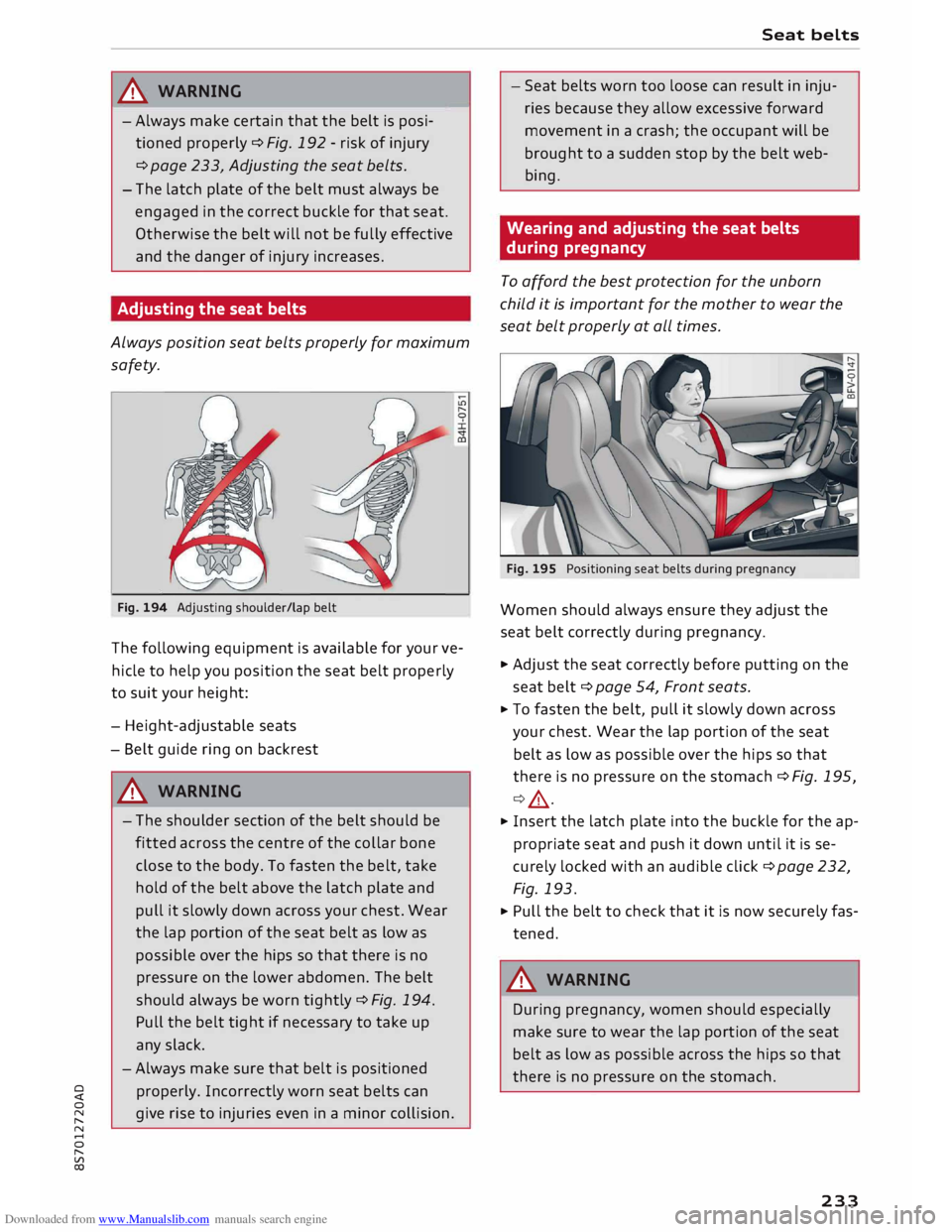
Fig. 194 Adjusting shoulder/lap belt
The following equipment is available for your ve
hicle to help you position the seat belt properly
to suit your height:
- Height-adjustable seats
- Belt guide ring on backrest
A WARNING
- The shoulder section of the belt should be
fitted across the centre of the collar bone
close to the body. To fasten the belt, take
hold of the belt above the latch plate and
pull it slowly down across your chest. Wear
the lap portion of the seat belt as low as
possible over the hips so that there is no
pressure on the lower abdomen. The belt
should always be worn tightly ¢ Fig. 194.
Pull the belt tight if necessary to take up
any slack.
- Always make sure that belt is positioned
properly. Incorrectly worn seat belts can
give rise to injuries even in a minor collision. Seat
belts
- Seat belts worn too loose can result in inju
ries because they allow excessive forward
movement in a crash; the occupant will be
brought to a sudden stop by the belt web
bing.
Wearing and adjusting the seat belts
during pregnancy
To afford the best protection for the unborn
child it is important for the mother to wear the
seat belt properly at all times.
Fig. 195 Positioning seat belts during pregnancy
Women should always ensure they adjust the
seat belt correctly during pregnancy.
.., Adjust the seat correctly before putting on the
seat belt¢ page 54, Front seats.
... To fasten the belt, pull it slowly down across
your chest. Wear the lap portion of the seat
belt as low as possible over the hips so that
there is no pressure on the stomach ¢ Fig. 195,
¢ ,& .
... Insert the latch plate into the buckle for the ap
propriate seat and push it down until it is se
curely locked with an audible click¢ page 232,
Fig. 193.
... Pull the belt to check that it is now securely fas
tened.
A WARNING
During pregnancy, women should especially
make sure to wear the lap portion of the seat
belt as low as possible across the hips so that
there is no pressure on the stomach.
233
Page 236 of 306
Downloaded from www.Manualslib.com manuals search engine Seat
belts
Taking off the seat belts
The red button releases the belt from the buckle.
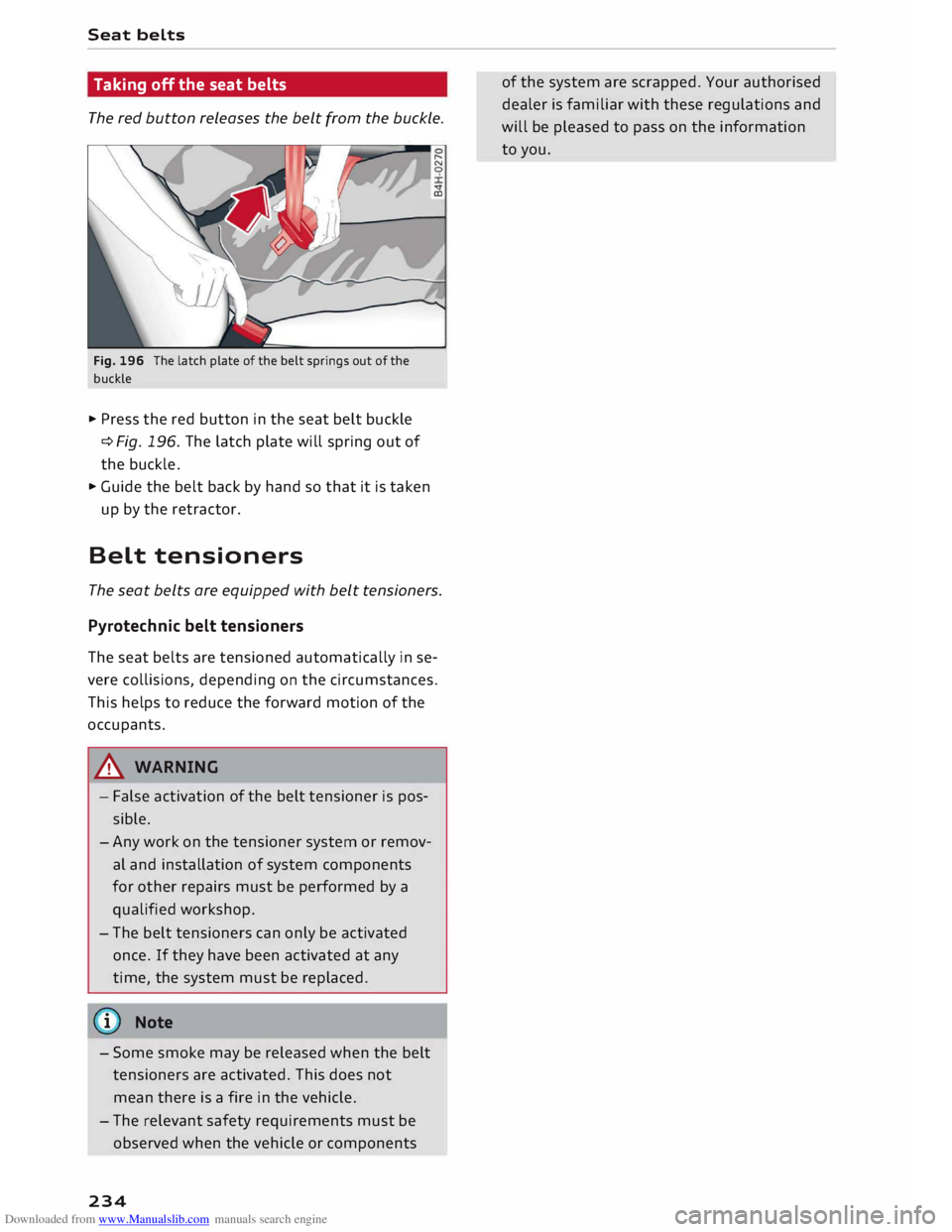
Fig. 196 The latch plate of the belt springs out of the
buckle
... Press the red button in the seat belt buckle
¢ Fig. 196. The latch plate will spring out of
the buckle .
... Guide the belt back by hand so that it is taken
up by the retractor.
Belt tensioners ....
N
0
�
ID
The seat belts are equipped with belt tensioners.
Pyrotechnic belt tensioners
The seat belts are tensioned automatically in se
vere collisions, depending on the circumstances.
This helps to reduce the forward motion of the
occupants.
A WARNING
- False activation of the belt tensioner is pos
sible.
- Any work on the tensioner system or remov
al and installation of system components
for other repairs must be performed by a
qualified workshop.
- The belt tensioners can only be activated
once. If they have been activated at any
time, the system must be replaced.
Q) Note
- Some smoke may be released when the belt
tensioners are activated. This does not
mean there is a fire in the vehicle.
- The relevant safety requirements must be
observed when the vehicle or components
234 of
the system are scrapped. Your authorised
dealer is familiar with these regulations and
will be pleased to pass on the information
to you.
Page 237 of 306
Downloaded from www.Manualslib.com manuals search engine 0
N
,.....
N
......
0
,.....
Vl
CX) Airbag
system
Description of airbag
system
General notes on airbag system
The airbag is an integral part of the car's passive
safety system.
In conjunction with the seat belts, the airbag sys
tem gives the front occupants additional protec
tion for the head and chest in the event of a se
vere frontal collision.
In a severe side collision the side airbags reduce
the risk of injury to the occupants ¢,&..
In addition to their normal function of protecting
the occupants in a collision, the seat belts also
hold them in a position where the airbags can in
flate properly and provide maximum protection.
The airbag system will only work with the igni
tion on. The airbag system is monitored electron
ically; the indicator lamp m indicates whether
the system is functioning properly.
The main parts of the airbag system are:
- The electronic monitoring system (control unit
and sensors)
- The two front airbags
- The two side airbags
- The indicator lamp El in the instrument cluster
There is a fault in the airbag system if the
warning lamp
- does not come on when the ignition is switched
on.
- does not go out about 4 seconds after the igni
tion is switched on.
- goes out and then comes on again after the ig
nition is switched on.
- comes on or flickers while the car is moving.
A WARNING
- The airbags are not a substitute for the seat
belts; they are an integral part of the car's
overall passive safety system. The airbags
can only offer effective protection if the oc
cupants are wearing their seat belts. For Airbag
system
this reason it is very important to wear the
seat belts at all times ¢ page 230, Why is it
so important to use seat belts?.
- The seat belts and airbags can only provide
maximum protection if the occupants are
seated correctly ¢ page 54, Front seats.
- If you do not wear a seat belt, if you lean
forward, or are not seated correctly while
the vehicle is in motion, you are at greater
risk of injury should the airbag system be
triggered in an accident.
- Components of the airbag system are loca
ted in various parts of the vehicle. If repairs
to other vehicle components make it neces
sary to perform work on the airbag system
or to remove or install parts of the airbag
system, this may cause damage to the air
bag system. As a result, the airbags may not
inflate correctly or may not be triggered at
all in an accident situation. For this reason,
you should always have the work carried out
by a qualified workshop.
- If a fault should occur in the airbag system,
have the system checked immediately by a
qualified workshop. Otherwise the system
may fail to trigger in an accident.
- Do not attempt to modify components of
the airbag system in any way.
- Never make any alterations to the front
bumper or the body.
- Do not remove the seats.
- The airbag system can only be activated
once; if the airbag has been triggered, the
system must be replaced. Should the airbag
system or airbag modules have to be re
placed, the qualified workshop carrying out
the replacement will document all details.
- If any repair work is required or the airbag
and restraint systems have to be replaced,
have the work carried out by your authorised
Audi dealer or a qualified workshop which
adheres to the Audi factory standards. This
will minimise the risk of injury.
- If you sell the vehicle, remember to pass on
the complete Service Wallet to the new
owner. If any of the airbags have been deac
tivated, it is important that the new owner
is also given the relevant documents.
..,.
235
Page 238 of 306
Downloaded from www.Manualslib.com manuals search engine Airbag
system
- The relevant safety requirements must be
observed when the vehicle or components
of the airbag or belt tensioner systems are
scrapped.
- For safety reasons, the alternator and the
starter are both disconnected from the bat
tery via a pyrotechnic circuit breaker in se
vere accidents.
- Any repairs to the pyrotechnic circuit
breaker must always be performed by a
qualified workshop -risk of accident!
- The relevant safety requirements must be
observed when the vehicle or the circuit
breaker are scrapped.
When are the airbags triggered?
One or more airbag systems are triggered in se
vere collisions, depending on the circumstances.
Factors determining the triggering response
It is not possible to define the exact triggering
response of the airbag system in all possible sit
uations, since the circumstances in different
types of accident will vary considerably. Impor
tant factors
include,
for example, the nature
(hard or soft) of the object which the car hits, the
angle of impact, vehicle speed and so on.
Whether the airbags are triggered depends pri
marily on the vehicle deceleration rate resulting
from the collision. By processing the signals from
the sensors located in the vehicle, the electronic
control unit is immediately able to evaluate the
severity of the collision and activate the restraint
systems accordingly. If the deceleration rate is
below the predefined reference value in the con
trol unit the airbags will not be triggered, even
though the accident may cause extensive damage
to the car. In these situations, the occupants are
protected by wearing the seat belts.
({D Note
The airbag may release a fine dust when it in
flates. This is quite normal and does not
mean there is a fire in the vehicle.
1 1
Not available in all export vehicles.
236 Front
airbags
Important notes on passenger's airbag
A AIRBAG
t '�
'\34 CII)
c:::::J
®
ClO
ClO
\t'� J�
a
-� �:&
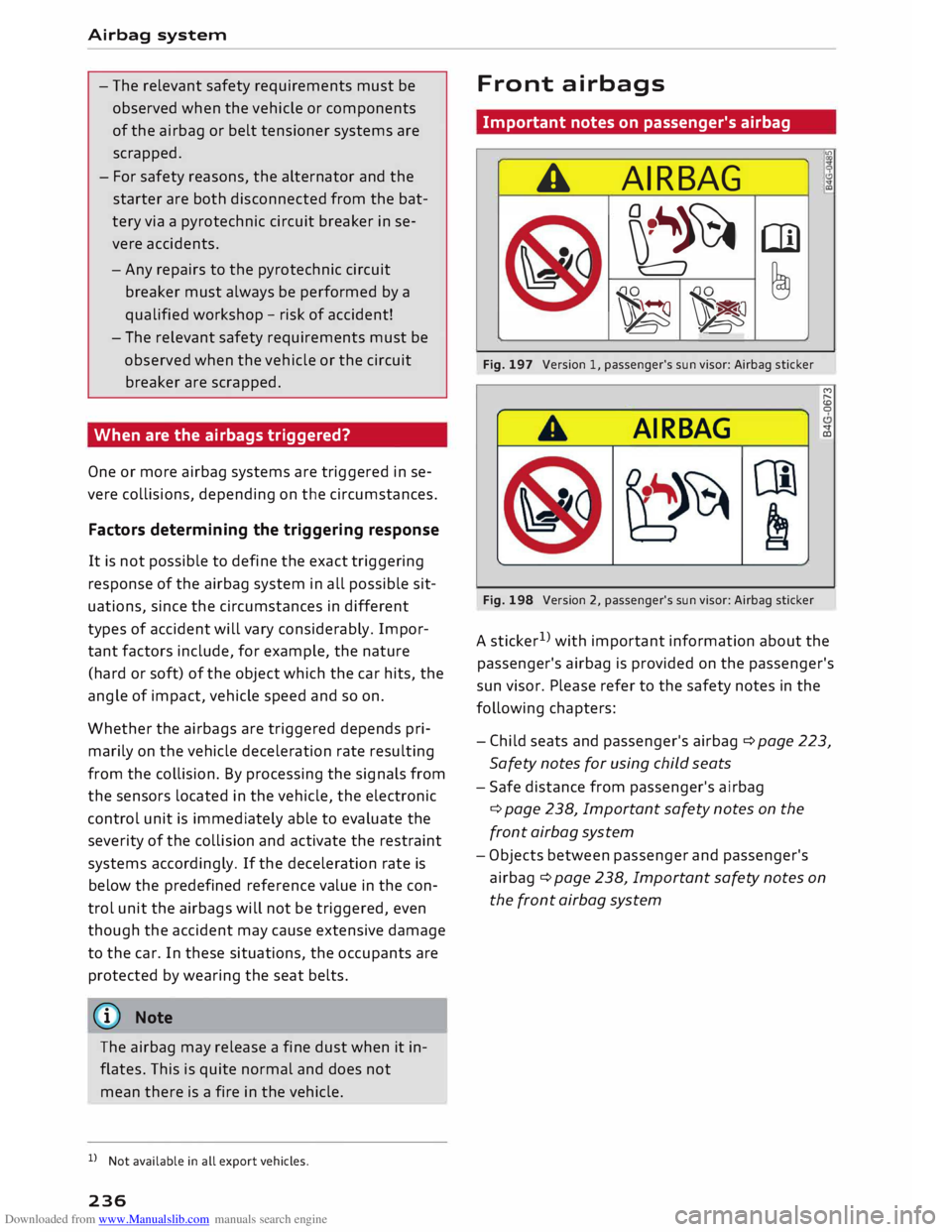
Fig. 197 Version 1, passenger's sun visor: Airbag sticker
AIRBAG
Fig. 198 Version 2, passenger's sun visor: Airbag sticker "'
M
....
c.o 0
"
A sticker 1
>
with important information about the
passenger's airbag is provided on the passenger's
sun visor. Please refer to the safety notes in the
following chapters:
- Child seats and passenger's airbag c:::> page 223,
Safety notes for using child seats
- Safe distance from passenger's airbag
c:::> page 238, Important safety notes on the
front airbag system
- Objects between passenger and passenger's
airbag c:::> page 238, Important safety notes on
the front airbag system
Page 239 of 306
Downloaded from www.Manualslib.com manuals search engine 0
N
,.....
N
....
0
,.....
Vl
CX) Deactivating
the passenger's airbag
Applies to: vehicles with key-operated switch for passenger's
airbag
If an airbag has been deactivated, it should be
reactivated as soon as possible so that it can
continue to give the required protection.
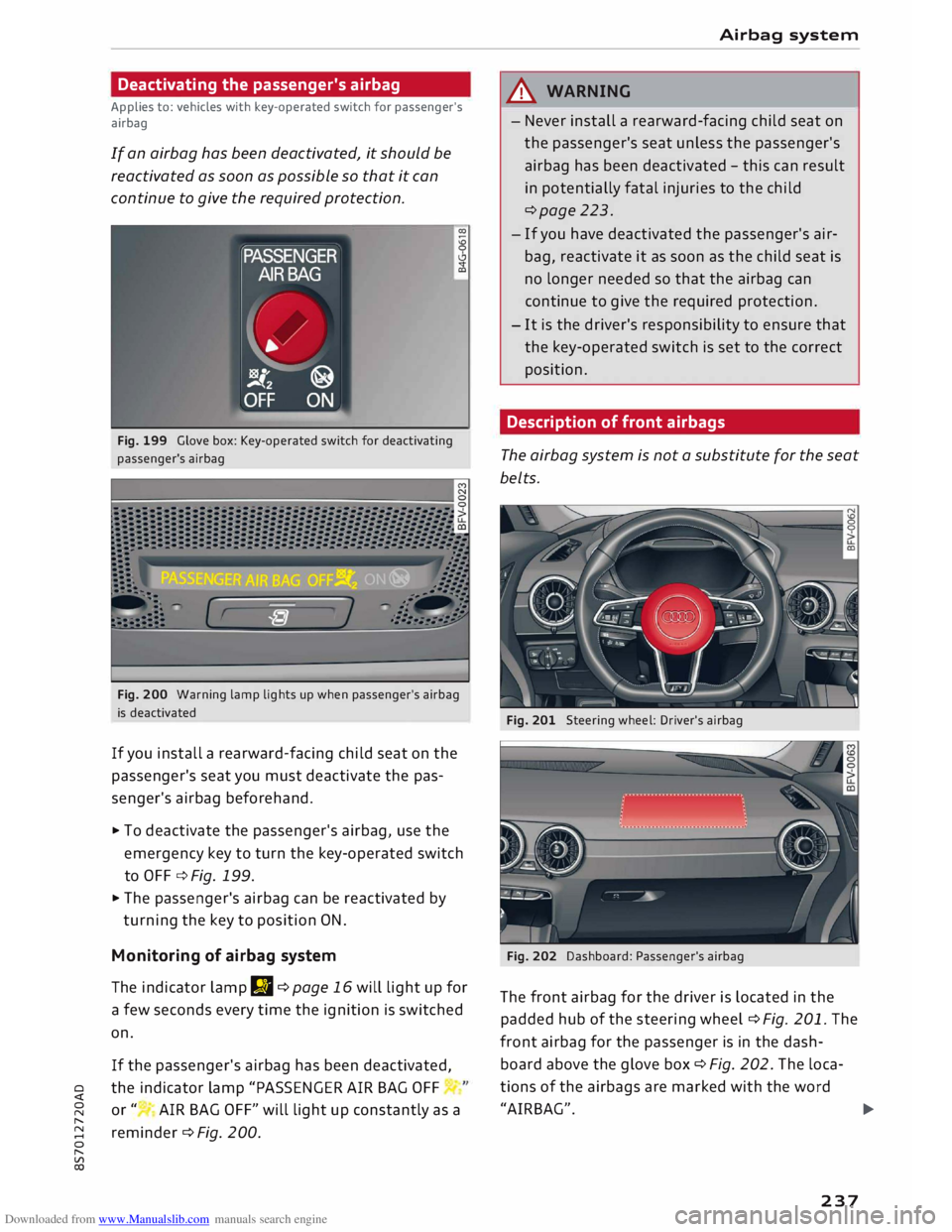
Fig. 199 Glove box: Key-operated switch for deactivating
passenger's airbag
Fig. 200 Warning lamp lights up when passenger's airbag
is deactivated
If you install a rearward-facing child seat on the
passenger's seat you must deactivate the pas
senger's airbag beforehand .
... To deactivate the passenger's airbag, use the
emergency key to turn the key-operated switch
to OFF ¢ Fig. 199 .
... The
passenger's airbag can be reactivated by
turning the key to position ON.
Monitoring of airbag system
The indicator lamp JJI ¢ page 16 will light up for
a few seconds every time the ignition is switched
on.
If the passenger's airbag has been deactivated,
the indicator lamp "PASSENGER AIR BAG OFF
or" AIR BAG OFF" will light up constantly as a
reminder¢ Fig. 200 . Airbag
system
.&_ WARNING
- Never install a rearward-facing child seat on
the passenger's seat unless the passenger's
airbag has been deactivated -this can result
in potentially fatal injuries to the child
¢page 223.
- If you have deactivated the passenger's air
bag, reactivate it as soon as the child seat is
no longer needed so that the airbag can
continue to give the required protection.
- It is the driver's responsibility to ensure that
the key-operated switch is set to the correct
position.
Description of front airbags
The airbag system is not a substitute for the seat
belts.
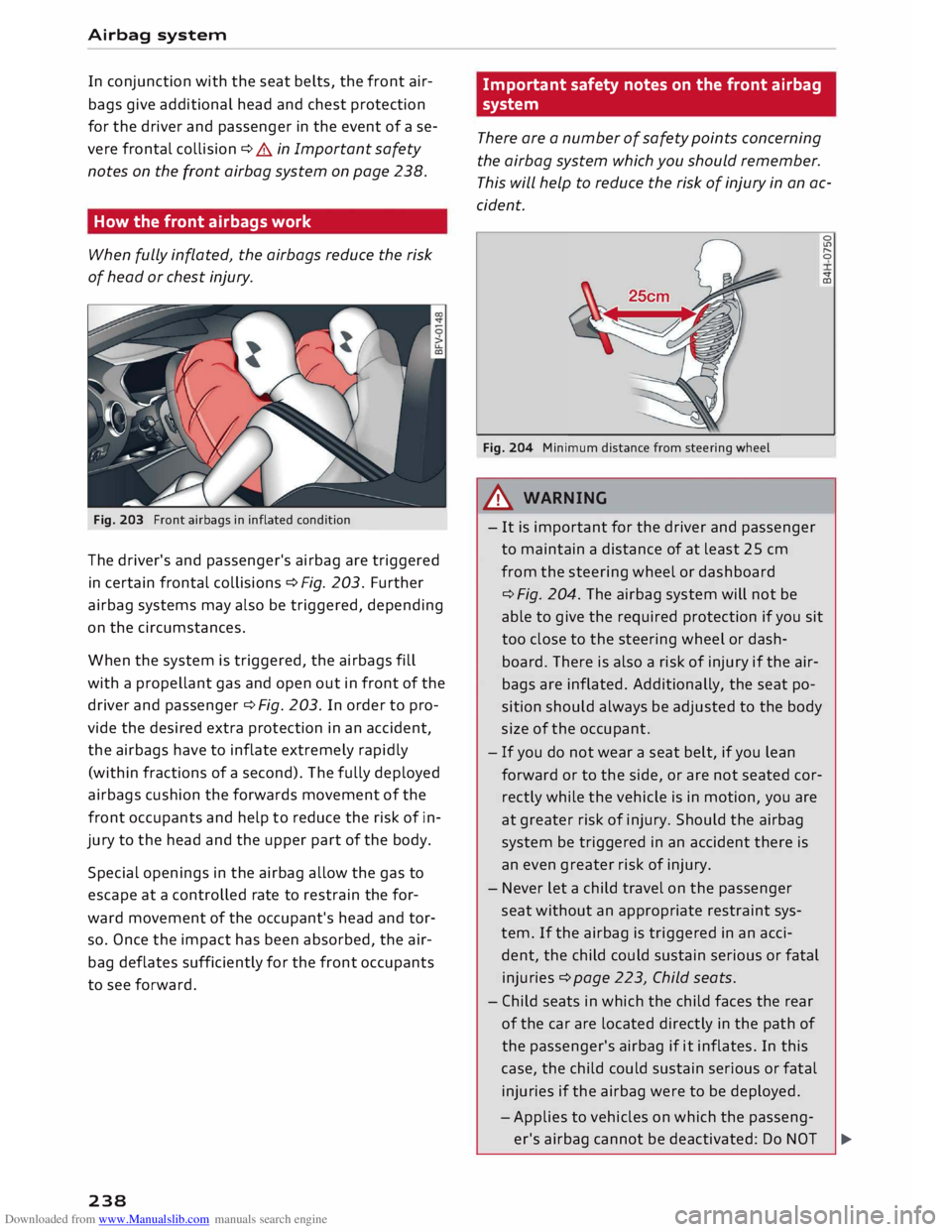
Fig. 201 Steering wheel: Driver's airbag
Fig. 202 Dashboard: Passenger's airbag
The front airbag for the driver is located in the
padded hub of the steering wheel¢ Fig. 201. The
front airbag for the passenger is in the dash
board above the glove box ¢Fig. 202. The loca
tions of the airbags are marked with the word
"AIRBAG". Ill--
237
Page 240 of 306
Downloaded from www.Manualslib.com manuals search engine Airbag
system
In conjunction with the seat belts, the front air
bags give additional head and chest protection
for the driver and passenger in the event of a se
vere frontal collision <=> A in Important safety
notes on the front airbag system on page 238.
How the front airbags work
When fully inflated, the airbags reduce the risk
of head or chest injury.
Fig. 203 Front airbags in inflated condition
The driver's and passenger's airbag are triggered
in certain frontal collisions c:> Fig. 203. Further
airbag systems may also be triggered, depending
on the circumstances.
When the system is triggered, the airbags fill
with a propellant gas and open out in front of the
driver and passenger<=> Fig. 203. In order to pro
vide the desired extra protection in an accident,
the airbags have to inflate extremely rapidly
(within fractions of a second). The fully deployed
airbags cushion the forwards movement of the
front occupants and help to reduce the risk of in
jury to the head and the upper part of the body.
Special openings in the airbag allow the gas to
escape at a controlled rate to restrain the for
ward movement of the occupant's head and tor
so. Once the impact has been absorbed, the air
bag deflates sufficiently for the front occupants
to see forward.
238 Important
safety notes on the front airbag
system
There are a number of safety points concerning
the airbag system which you should remember.
This will help to reduce the risk of injury in an ac
cident.
Fig. 204 Minimum distance from steering wheel
A WARNING 0
U'>
r--
0
�
co
- It is important for the driver and passenger
to maintain a distance of at least 25 cm
from the steering wheel or dashboard
<=> Fig. 204. The airbag system will not be
able to give the required protection if you sit
too close to the steering wheel or dash
board. There is also a risk of injury if the air
bags are inflated. Additionally, the seat po
sition should always be adjusted to the body
size of the occupant.
- If you do not wear a seat belt, if you lean
forward or to the side, or are not seated cor
rectly while the vehicle is in motion, you are
at greater risk of injury. Should the airbag
system be triggered in an accident there is
an even greater risk of injury.
- Never let a child travel on the passenger
seat without an appropriate restraint sys
tem. If the airbag is triggered in an acci
dent, the child could sustain serious or fatal
injuries c:> page 223, Child seats.
- Child seats in which the child faces the rear
of the car are located directly in the path of
the passenger's airbag if it inflates. In this
case, the child could sustain serious or fatal
injuries if the airbag were to be deployed.
- Applies to vehicles on which the passeng-
er's airbag cannot be deactivated: Do NOT
�
Page 241 of 306
Downloaded from www.Manualslib.com manuals search engine 0
N
,.....
N
......
0
,.....
Vl
CX) use
a rearward-facing child seat on the
passenger's seat.
- Applies to vehicles with key-operated
switch for deactivating the passenger's
airbag: Do NOT use a rearward-facing child
seat on the passenger's seat while the
passenger's airbag is active. If you have no
alternative but to use a rearward-facing
child seat on the passenger's seat, the
passenger's airbag must be deactivated
beforehand via the key-operated switch*
¢ page 237. Make sure that the passeng
er's airbag is reactivated by means of the
key-operated switch* as soon as the child
seat is no longer needed on the passeng
er's seat.
- Occupants must never carry any objects or
pets in the space between them and the air
bags, or allow children or other passengers
to travel in this position.
- Do not cover or stick anything on the steer
ing wheel hub or the soft plastic surface of
the airbag unit on the passenger's side of
the dashboard, and do not obstruct or modi
fy them in any way. These parts should only
be cleaned with a dry cloth (or with a cloth
moistened with plain water). It is also im
portant not to attach any objects such as
cup holders or telephone mountings to the
surfaces covering the airbag units.
- Any work on the airbag system or removal
and installation of the airbag components
for other repairs (such as repairs to the
steering wheel or removal of seats) must be
performed by a qualified workshop. Airbag
system
Side airbags
Description of side airbags
Applies to: vehicles with side airbags
The airbag system is not a substitute for the seat
belts.
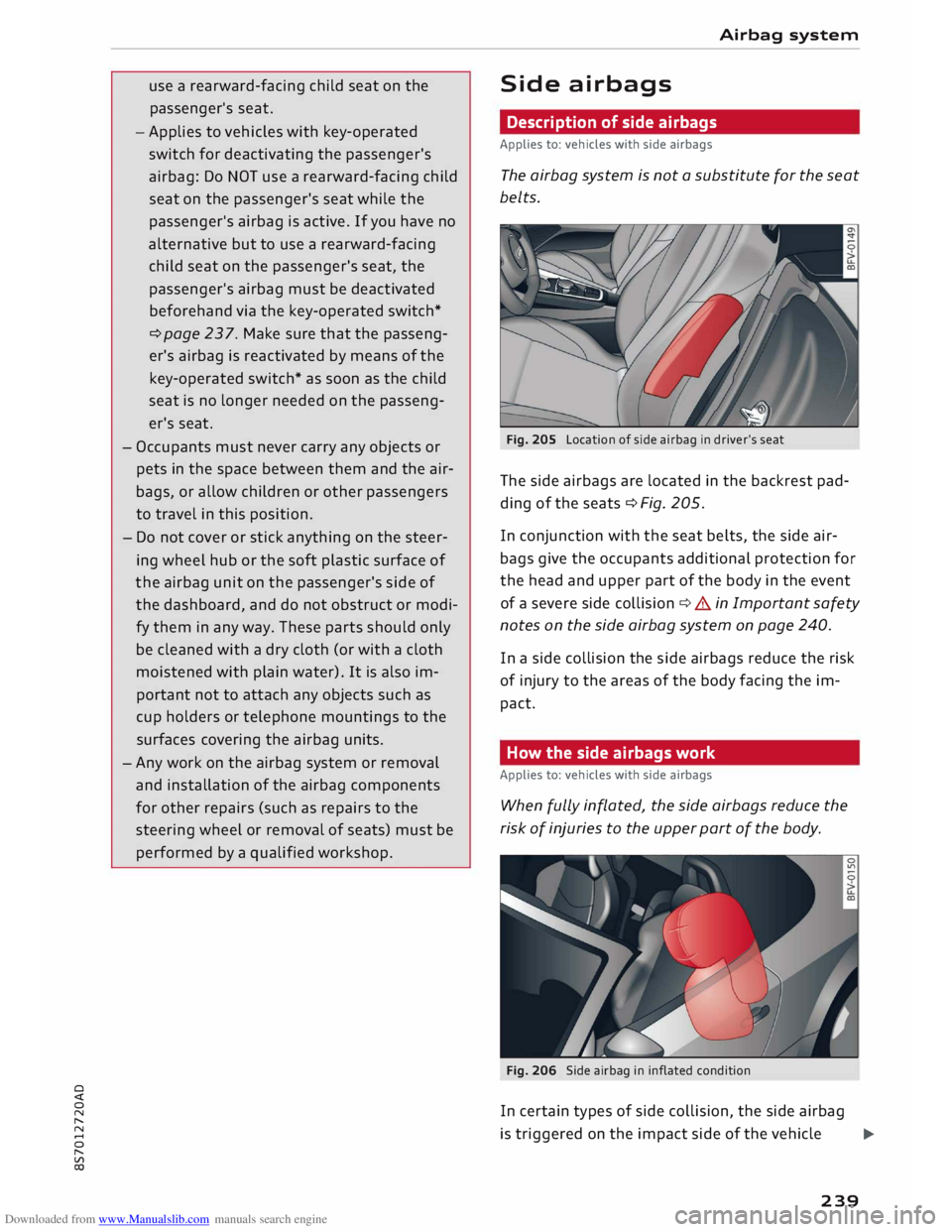
Fig. 205 Location of side airbag in driver's seat
The side airbags are located in the backrest pad
ding of the seats ¢Fig. 205.
In conjunction with the seat belts, the side air
bags give the occupants additional protection for
the head and upper part of the body in the event
of a severe side collision ¢&. in Important safety
notes on the side airbag system on page 240.
In a side collision the side airbags reduce the risk
of injury to the areas of the body facing the im
pact.
How the side airbags work
Applies to: vehicles with side airbags
When fully inflated, the side airbags reduce the
risk of injuries to the upper port of the body.
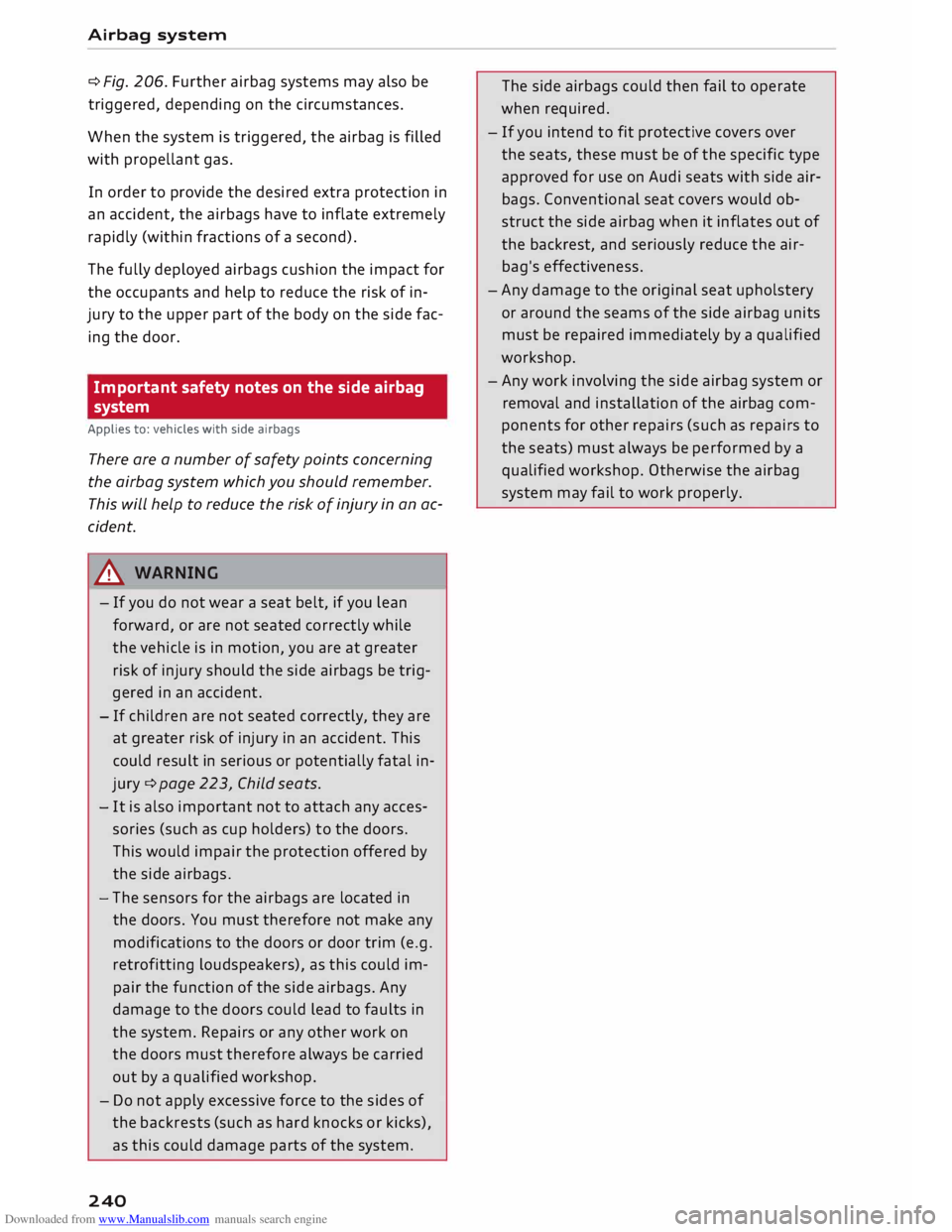
Fig. 206 Side airbag in inflated condition
In certain types of side collision, the side airbag
is triggered on the impact side of the vehicle ..,.
239
Page 242 of 306
Downloaded from www.Manualslib.com manuals search engine Airbag
system
¢ Fig. 206. Further airbag systems may also be
triggered, depending on the circumstances.
When the system is triggered, the airbag is filled
with propellant gas.
In order to provide the desired extra protection in
an accident, the airbags have to inflate extremely
rapidly (within fractions of a second).
The fully deployed airbags cushion the impact for
the occupants and help to reduce the risk of in
jury to the upper part of the body on the side fac
ing the door.
Important safety notes on the side airbag
system
Applies to: vehicles with side airbags
There are a number of safety points concerning
the airbag system which you should remember.
This will help to reduce the risk of injury in an ac
cident.
A WARNING
- If you do not wear a seat belt, if you lean
forward, or are not seated correctly while
the vehicle is in motion, you are at greater
risk of injury should the side airbags be trig
gered in an accident.
- If children are not seated correctly, they are
at greater risk of injury in an accident. This
could result in serious or potentially fatal in
jury ¢page 223, Child seats.
- It is also important not to attach any acces
sories (such as cup holders) to the doors.
This would impair the protection offered by
the side airbags.
- The sensors for the airbags are located in
the doors. You must therefore not make any
modifications to the doors or door trim (e.g.
retrofitting loudspeakers), as this could im
pair the function of the side airbags. Any
damage to the doors could lead to faults in
the system. Repairs or any other work on
the doors must therefore always be carried
out by a qualified workshop.
- Do not apply excessive force to the sides of
the backrests (such as hard knocks or kicks),
as this could damage parts of the system.
240 The
side airbags could then fail to operate
when required.
- If you intend to fit protective covers over
the seats, these must be of the specific type
approved for use on Audi seats with side air
bags. Conventional seat covers would ob
struct the side airbag when it inflates out of
the backrest, and seriously reduce the air
bag's effectiveness.
- Any damage to the original seat upholstery
or around the seams of the side airbag units
must be repaired immediately by a qualified
workshop.
- Any work involving the side airbag system or
removal and installation of the airbag com
ponents for other repairs (such as repairs to
the seats) must always be performed by a
qualified workshop. Otherwise the airbag
system may fail to work properly.
Page 247 of 306
Downloaded from www.Manualslib.com manuals search engine 0
N
,.....
N
......
0
,.....
Vl
CX) -
Never spill fluids on a hot engine. These flu
ids can cause a fire (e.g. radiator anti
freeze).
- Take care not to cause short circuits in the
electrical system, especially when working
on the battery.
- When working in the engine compartment
be aware that the radiator fan may start
running suddenly, even if the ignition is
switched off -risk of injury!
- Do not unscrew the cap on the expansion
tank when the engine is hot. The cooling
system is under pressure.
- Protect face, hands and arms by covering
the cap with a large, thick rag to protect
against escaping coolant and steam.
- Never remove the engine cover panel -risk
of burns!
- If any tests have to be performed with the
engine running, there is an extra safety risk
from the rotating parts, such as the drive
belts, alternator and radiator fan, etc., and
from the high-voltage ignition system.
- Vehicles with automatic gearbox: Never
open the throttle inadvertently (for instance
by hand from the engine compartment) if a
gear is engaged while the vehicle is station
ary with the engine running. The vehicle will
otherwise start moving immediately and
could cause an accident.
- Observe the following additional warnings if
work on the fuel system or the electrical
system is necessary:
- Do not smoke.
- Never work near naked flames.
- Always keep an approved fire extinguisher
immediately available.
- Any work on the batteries and electrical sys
tem in your vehicle entails a risk of injury
and chemical burns in addition to danger of
accident or fire. For this reason, you must
have the work carried out by a qualified
workshop.
CD CAUTION
When topping up fluids make sure the correct
fluid is put into the correct filler opening. This Checking
and topping up fluids
can otherwise cause serious malfunctions or
engine damage.
@ For the sake of the environment
Inspect the ground underneath your vehicle
regularly so that any leaks are detected at an
early stage. If you find spots of oil or other
fluids, have your vehicle inspected in the
workshop.
i Note
On right-hand drive vehicles* some of the
containers/ reservoirs mentioned below are
located on the other side of the engine com
partment.
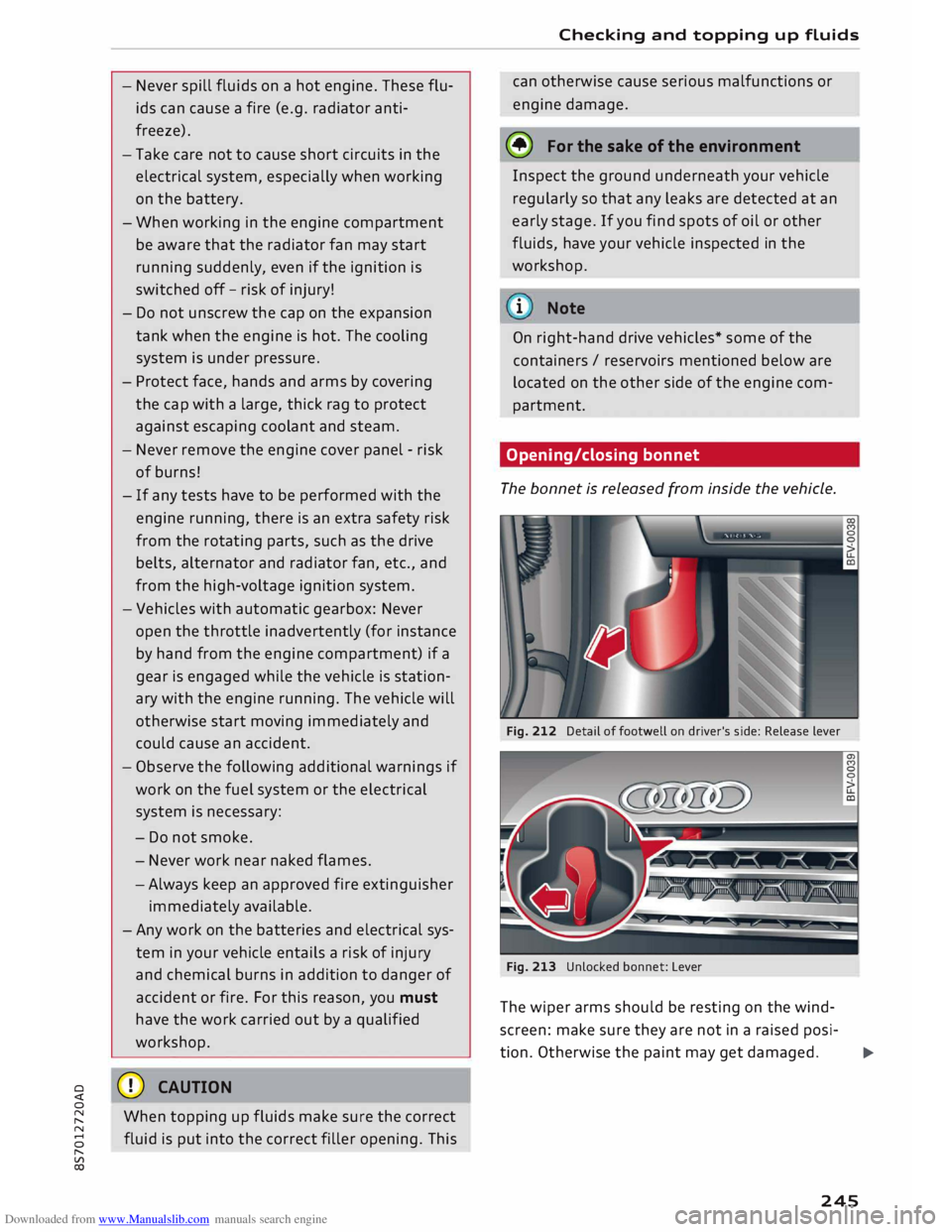
Opening/closing bonnet
The bonnet is released from inside the vehicle.
Fig. 212 Detail of footwell on driver's side: Release lever
Fig. 213 Unlocked bonnet: Lever
The wiper arms should be resting on the wind
screen: make sure they are not in a raised posi-
tion. Otherwise the paint may get damaged.
..,..
245
Page 267 of 306
Downloaded from www.Manualslib.com manuals search engine 0
N
,.....
N
....
0
,.....
Vl
CX) Care
of vehicle and cleaning
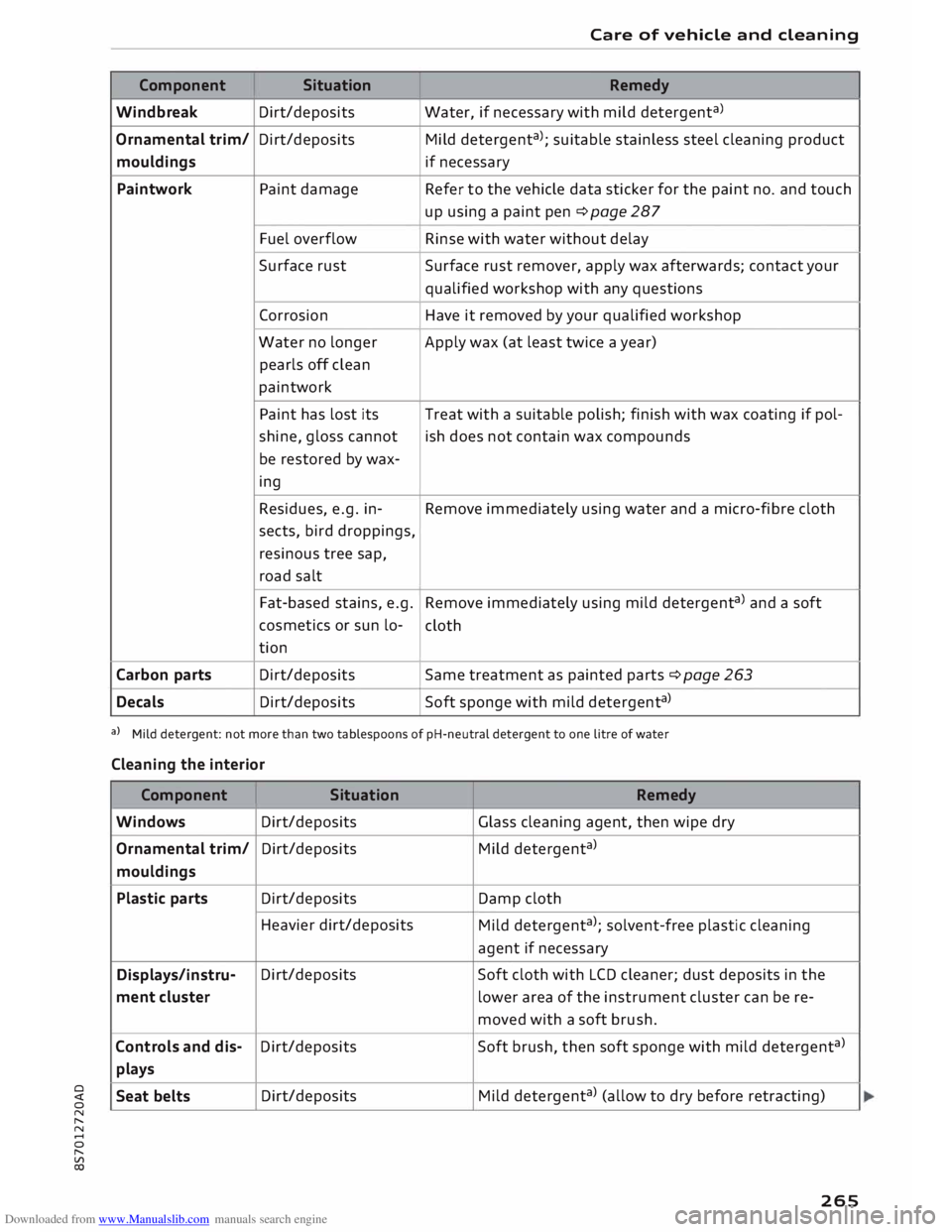
Component Situation Remedy
Windbreak Dirt/deposits Water,
if necessary with mild detergent a
>
Ornamental trim/ Dirt/deposits
Mild detergent a
>; suitable stainless steel cleaning product
mouldings if necessary
Paintwork Paint damage Refer to
the vehicle data sticker for the paint no. and touch
up using a paint pen � page 287
Fuel overflow
Rinse with water without delay
Surface rust
Surface rust remover, apply wax afterwards; contact your
qualified workshop with any questions
Corrosion Have it removed by your qualified workshop
Water no longer
Apply wax (at least twice a year)
pearls off clean
paintwork
Paint has lost its Treat
with a suitable polish; finish with wax coating if pol-
shine, gloss cannot ish does not contain wax compounds
be restored by wax-
ing
Residues, e.g. in- Remove immediately using water and a micro-fibre cloth
sects, bird droppings,
resinous tree sap,
road salt
Fat-based stains, e.g.
Remove immediately using mild detergent a
> and a soft
cosmetics or sun lo-
cloth
tion
Carbon parts Dirt/deposits
Same treatment as painted parts �page 263
Decals Dirt/deposits Soft
sponge with mild detergent a
>
al Mild detergent: not more than two tablespoons of pH-neutral detergent to one litre of water
Cleaning the interior
Component Situation Remedy
Windows Dirt/deposits Glass
cleaning agent, then wipe dry
Ornamental trim/ Dirt/deposits
Mild detergent a
>
mouldings
Plastic parts Dirt/deposits Damp
cloth
Heavier dirt/deposits
Mild detergent a
>
; solvent-free plastic cleaning
agent if necessary
Displays/instru- Dirt/deposits
Soft cloth with LCD cleaner; dust deposits in the
ment cluster lower
area of the instrument cluster can be re-
moved with a soft brush.
Controls and dis- Dirt/deposits
Soft brush, then soft sponge with mild detergent a
>
plays
Seat belts Dirt/deposits
Mild
detergent a
>
(allow to dry before retracting)
265