wheel AUDI TT ROADSTER 2018 Owner's Guide
[x] Cancel search | Manufacturer: AUDI, Model Year: 2018, Model line: TT ROADSTER, Model: AUDI TT ROADSTER 2018Pages: 310, PDF Size: 46.95 MB
Page 201 of 310
Cl 00 .-< N r-N .-< 0 r-Vl 00
seat backrests; never place them between
these areas and you or any other person in
the vehicle.
- Never attach objects to the windshield
above the passenger front airbag, such as
accessory GPS navigation units or music
players. Such objects could cause serious in
jury in a collision, especially when the air bags inflate .
A WARNING
A person on the front passenger seat, espe
cially infants and small children, will receive
serious injuries and can even be killed by be
ing too close to the airbag when it inflates.
- Although the Advanced Airbag System in
-
your vehicle is designed to turn off the front
passenger airbag if an infant or a small child
is on the front passenger seat, nobody can
absolutely guarantee that deployment un
der these special conditions is impossible in
all conceivable situations that may happen
during the useful life of your vehicle.
- The Advanced Airbag System can deploy in accordance with the "low risk" option under
the U .S . Federal Standard if a child that is
heavier than the typical one-year old child is
on the front passenger seat and the other
conditions for airbag deployment are met.
- For its own safety, a child should always ride
properly restrained for its age and size.
Advanced front airbag system
Your vehicle is equipped with a front Advanced
Airbag System in compliance with United States
Federal Motor Vehicle Safety Standard (FMVSS)
208, as well as Canada Motor Vehicle Safety
Standard (CMVSS) 208 as applicable at the time
your vehicle was manufactured.
The front Advanced Airbag System supplements
the safety belts to provide additional protection
for the driv er's and front passenger's heads and
upper bodies in frontal crashes . The airbags in
flate only in frontal impacts when the vehicle de
celeration is high enough.
Airbag system
The front Advanced Airbag System for the front
seat occupants is not a substitute for your safety
belts. Rather, it is part of the overall occupant re
straint system in your vehicle. Always remember
that the airb ag system can only help to protect
you, if you are sitting upright, wearing your safe
ty belt and wearing it properly . This is why you
and your passengers must always be properly re
strained, not just because the law requires you to
be.
The Advanced Airbag System in your vehicle has
been certified to meet the "low risk" require
ments for 3 and 6 year-old children on the pas
senger side and very small adults on the driver
side. The low risk deployment criteria are intend
ed to help reduce the risk of injury through inter
action with the front airbag that can occur, for
example, by being too close to the steering wheel
and instrument p anel when the airbag inflates.
In addition, the system has been certified to
comply with the "suppression" requirements of
the Safety Standard, to turn off the front airbag
for infants 12 months old and younger who are
res trained on the front passenger seat in child re
straints that are listed in the Standard
~page 218, Child restraints and Advanced front
airbag system .
"Suppression" requires the front airbag on the
passenger side to be turned off if:
- a child up to about one year of age is restrained
on the front passenger seat in one of the rear
facing or forward-facing infant restraints listed in Federal Motor Vehicle Safety Standard 208
with which the Advanced Airbag System in your
vehicle was certified . For a listing of the child
restraints that were used to certify your vehi
cle's compliance with the US Safety Standard
~page 218,
- When a person is detected on the front passen
ger seat that has an electrical capacitance that
is more than the total electrical capacitance of
a child that is about 1 year old restrained in one
of the rear-facing or forward-facing infant re
straints (listed in Federal Motor Vehicle Safety
Standard 208 with which the Advanced Airbag
System in your vehicle was certified), the front
.,,.
199
Page 203 of 310
Cl 00 .-< N r--N .-< 0 r--Vl 00
adjustment range, as far away from the air
bag as possib le, before insta lling the for
ward-facing child restra int.
- Always make sure that the safety belt upper
anchorage is beh ind the child restraint and
not next to or in front of the chi ld restraint
so that the safety belt will be properly pos i
t ioned.
- Always make sure that there is nothing on
the front passenger seat that w ill cause the
capacit ive passenger detection system in
the seat to signa l to the Airbag System that
the seat is occupied by a person w hen it is
not, or to sign al that it is occ upied by some
one who is heavier than t he pe rson actua lly
sitting on the seat . The presence of addi
tiona l objects could ca use the passenge r
front airbag to be turned on when it shou ld
be off, or could cause the airbag to work in a
way that is different from the way it would
have worked wi tho ut the object on t he seat .
- Make sure that the
PASSENGER AIR BAG
OFF ~; light comes on and stays on all the
t ime w henever the ignition is sw itc hed on.
Advanced Airbag System components
The front passenger seat in you r vehicle has a lot
of very impo rtant parts of the Advanced Airbag
Sys tem in it. These pa rts in cl ude the capaci tive
passenger detection system, w iring, brac kets,
and more. The control unit monitors the system
on the front passenger seat when the ignition is
switched on and turns the airbag indicator light
on when a malfunct ion in the one of the system
components is detected
¢ page 206. Because
the front passenger seat contains important
pa rts of the Advanced Airbag System, you must
take ca re to prevent it from be ing damaged .
D amage to the seat may p reve nt the Advanced
A irbag System fo r the fron t passenger seat from
doi ng its job in a crash.
The front Advanced Airbag System consists
of the following :
-Cr ash sensors in the front of the vehicle t hat
measure vehicle accelerat ion/dece lerat ion to
Airbag syste m
prov ide information to the Advanced A irbag
System about the severity of the cras h.
- An electronic contro l uni t, with integrated
cras h sensors for front and side impacts . The
control unit "decides" whether to fire the front
airbags based on the information rece ived from
the crash sensors . The control unit also "de
cides" whether the safety belt pretensioners
should be activated.
- An Advanced A irbag w it h gas generator for the
driver inside the steering wheel hub .
- An Advanced A irbag w ith gas generator inside
the instrument panel for the front passenger.
- A capacit ive passenger detection system under
neat h the front passenger seat cover. This sys
tem meas ures the e lectr ica l capacitance of the
person in the seat. The informat ion registered
is sent cont inuously to the elect ronic contro l
un it to reg ulate dep loymen t of the front Ad
vance d Airbag on the p assenger side.
- An airbag monitor ing system and ind icator
ligh t
El in the inst rument cl uste r.
- A sensor in each front seat registe rs the d is
t ance betwee n the respective seat and the
s teer ing whee l o r i nst rument p anel. The infor
mation registered is sent con tinuous ly to the
elect ronic contro l unit to regu late dep loyment
of the front Advanced Airbags .
- The
PASSENGER AIR BAG OFF ~; lig ht comes
on and stays on in the
headliner¢ page 206,
fig. 164 and tells you when the front Advanced
Airbag on the passenger side has been turned
off.
- A sensor in the safety be lt latch for the driver
and for the front seat passenger that senses
whether that safety be lt is latched or not and
transmits this information to the e lectronic
control un it .
A WARNING
-
Damage to the front passenge r seat can pre
vent the front airbag from wo rk ing prope rly.
- Imp roper repair or d isassembly of the front
passenger and driver seat will p reve nt the
Advanced A irbag Sys tem from f unct io ni ng
p roperly .
201
Page 206 of 310
Airbag syste m
Front airbag s will not d eploy:
- i f the ig nition is switched off whe n a cr ash oc-
cu rs,
- i n s ide collisions,
- in rear-end collisions,
- in rollovers,
- when the crash decelerat ion measured by the
airbag system is less than the minimum thresh
old needed for airbag deployment as registered
by the electronic contro l unit .
The front p assenger airb ag will also not
deploy:
- when the front passenger seat is not occup ied,
- whe n the electrical capac itance measured by
the capacitive passenger detect ion system for
the front passenger seat indicates that the pas
senger side frontal airbag must be switched off
by the electronic contro l unit (the
PASSENGER
A IR BAG
OFF ~; ligh t~ page 206 and how
they work comes on and stays on) .
.&_ WARNING
Sitting in the wrong position can increase the
risk of serious injury in crashes.
- To reduce the risk of injury when the airbags inflate, the driver and passengers must al
ways sit in an upright position, must not
lean against or p lace any part of their body
too close to the area where the airbags are located.
- Occupants who are unbelted, out of position
or too close to the a irbag can be seriously
injured by an airbag as it unfolds with great
force in the b link of an
eye <=;> page 195.
.&_ WARNING
A child in a rearward-facing chi ld seat insta l
led on the front passenger seat will be ser i
ously inju red and can be killed if the front air
bag inflates
-even with an Advanced Airbag
System.
- T he inflating a irbag w ill hit the child seat or
infant carrier with great force and will
smash the chi ld seat and child against the
backrest, center armrest, door or roof.
204
-
- Never install a rearward facing chi ld safety
seat on the front passenger seat unless the
PAS SEN GER AIR B AG OFF ~; light comes
on and stays on . If the
PA SSENGER AIR
BAG
OFF ~; light does not come on and stay
on, the inflat ing airbag will hit the chi ld
safety seat or infant carrie r wi th great force
and will smash the child safety seat and
child against the bac krest, door or roof .
Have the airbag system inspected immedi
ately by your authorized Audi dealer .
.&_ WARNING
Objects between you and the airbag will in
crease the r isk of injury in a crash by interfer
ing with the way the airbag unfolds or by be
ing pushed into you as the airbag inflates.
- Never hold things in your hands or on your lap when the veh icle is in use.
- Never transport items on or in the area of
the front passenger seat. Objects could
move into the area of the front airbags dur
ing braking or other sudden maneuver and
become dangerous projectiles that can
cause serious persona l injury if the airbags
inflate.
- Never place or attach accesso ries o r othe r
objects (such as cup holders, telephone brackets, large, heavy or bulky ob jects) on
the doo rs, ove r or near the area ma rked
"AIRBAG" on the steering wheel, instru
ment panel, seat backrests or between
those areas and yourself. These objects
could cause injury in a crash, especially
when the a irbags inflate.
- Never recl ine the front passenger's seat to
transport objects. Items can also move into
the area of the side a irbag or the front air
bag during brak ing or in a sudden maneu
ver. Objects near the airbags can become projecti les and cause injury, part icularly
when the seat is reclined.
- Never p lace or t ransport objects on the
-
front passenger seat. Objects on the front
passenger seat could ca use the capaci tive
sensor in the seat to signal to airbag system
that the seat is occ upied by a person when it
..,
Page 210 of 310
Airbag syste m
the system inspected immediately by your
authorized Aud i dealer. It is possible that
the a irbag will inflate when it is not sup
posed to, or will not inflate when it should.
A WARNING
If the front airbag inflates, a child without a
child restra int, or in a rearward-facing child
safety seat, or in a forward-facing child re
st raint that has not been p roperly installed
w ill be seriously injured and can be killed.
- If you must install a rearward-fac ing child
seat on the front passenger seat because of
exceptional c ircumstances and the
PA SSEN
GER AIR BAG
OFF ,;; light does not appear
and stay on, have the airbag system inspect
ed by your Audi dealer.
- If, in exceptiona l circumstances, you must
install a forward-facing chi ld restraint on
the front passenger seat, always move the
seat into its rearmost pos ition in the seat's
fore and aft adjustment range, as far away
from the airbag as possible. The backrest
must be adjusted to an upright posit ion .
Make sure that the PASSENGER AIR BAG
OFF ,;; light comes on and stays on a ll the
t ime whenever the ignition is switched on.
A WARNING
If the PASSENGER AIR BAG OFF ~; ligh t does
not go o ut when an adult is s itting on the
front passenger seat after taking the steps described above, have the airbag system in
spected by your Audi dealer before transport
ing anyone on the front passenger seat.
(D Tips
If the capacitive passenger detection system
determines that the front passenger seat is
empty, the frontal airbag on the passenger
side w ill be turned off, and the
PA SSENGER
AIR BAG
OFF ~; light will stay on.
Repair , care and disposal of the airbags
Parts of the a irbag system are installed at many
d ifferent p laces on your Aud i. Insta lling, remov-
208
ing, servicing or repair ing a part in an area of the
vehicle can damage a part of an airbag system
and prevent that system from work ing properly
i n a coll is ion.
There are some important things you have to know to make sure that the effectiveness of the
system will not be impaired and that discarded
components do not cause injury or pollute the
environment .
A WARNING
Improper care, servicing and repair proce
du res can increase the risk of personal in jury
and death by p reventing an airbag from de
p loying when needed or deploy ing an a irbag
unexpectedly:
-
- Never cover, obstruct, or change the steer
ing wheel ho rn pad or airbag cover or the in
s trumen t panel or modify them in any way.
- Never attach any objects s uch as c up ho lde rs
or telephone mountings to the surfaces cov
ering the a irbag un its.
- For cleaning the horn p ad or instr ument
panel, use only a soft, dry doth or one mois
tened w ith plain water . Solvents or cleaners
could damage the airbag cover or change
the stiffness o r strength of the material so
that the airbag cannot deploy and protect properly.
- Never repair, ad just, or change any parts o f
the airbag system.
- All work on the steering wheel, instrument
panel, front seats or e lectr ica l system ( in
cluding the installation of a udio eq uipment,
cellular te lephones and CB radios, etc.)
m ust be performed by a qualified techn ician
who has the training and spec ial equipment
necessary.
- For any work on the airbag system, we
strong ly recommend tha t you see you r au
thori zed A udi dealer or qualified wo rkshop.
- Never modify the front bumper or pa rts of
the vehicle body.
- Always make sure that the side a irbag can
inflate w ithout interfe rence:
Page 212 of 310
Airbag system
Knee airbags
Description of knee airbags
The knee airbag system can provide supplemen
tal protection to properly restrained front seat
occupants .
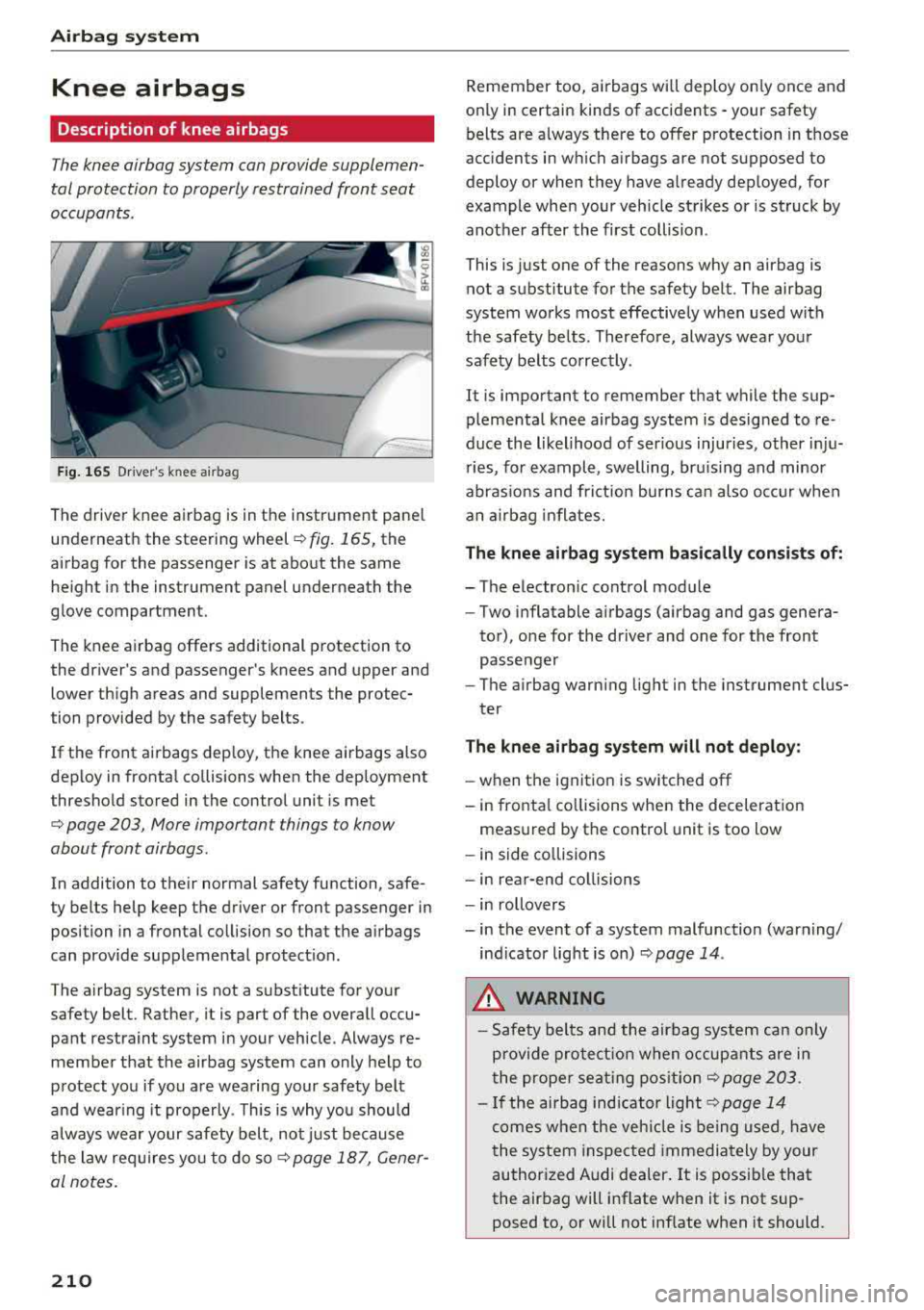
Fig. 165 Driver's k nee a irbag
The driver knee airbag is in the instrument panel
underneath the steering
wheel ¢ fig. 165, the
airbag for the passenger is at about the same
height in the instrument panel underneath the
glove compartment.
The knee airbag offers additional protection to
the driver's and passenger's knees and upper and
lower thigh areas and supplements the protec
tion provided by the safety belts.
If the front airbags deploy, the knee airbags also
deploy in frontal collisions when the deployment
threshold stored in the control unit is met
¢ page 203, More important things to know
about front airbags.
In addition to their normal safety function, safe
ty belts help keep the driver or front passenger in
posi tion in a frontal collision so that the airbags
can prov ide supplemental protection .
The airbag system is not a substitute for your safety belt. Rather, it is part of the overall occu
pant restraint system in your vehicle. Always re
member that the airbag system can only help to
protect you if you are wearing your safety belt
and wearing it properly . T his is why you should
always wear your safety belt, not just because
the law requires yo u to do so ¢
page 187, Gener
al notes.
210
Remember too, airbags will deploy only once and
on ly in certain kinds of accidents -your safety
belts are always there to offer protection in those
accidents in which airbags are not supposed to
deploy or when they have already deployed, for
example when your vehicle strikes or is struck by
another after the first collision .
This is just one of the reasons why an airbag is
not a substitute for the safety belt . The airbag
system works most effectively when used with
the safety belts. Therefore, always wear your
safety belts correctly.
It is important to remember that while the sup
plemental knee airbag system is designed to re
duce the likelihood of serious injuries, other inju
ries, for example, swelling, bruising and minor
abras ions and friction burns can also occur when
an airbag inflates.
The knee airbag system basically consists of:
-The electronic control module
-Two inflatable airbags (airbag and gas genera-
tor), one for the driver and one for the front
passenger
- The airbag warning light in the instrument clus-
ter
The knee airbag system will not deploy:
-when the ignition is switched off
- in frontal collisions when the decelerat ion
measured by the control unit is too low
-in side collisions
-in rear-end collisions
-in rollovers
-in the event of a system malfunction (warning/
ind icator light is on)
¢ page 14 .
.&, WARNING
-Safety belts and the airbag system can only
provide protection when occupants are in
the proper seating position
¢page 203 .
-If the airbag ind icator light ¢ page 14
comes when the vehicle is being used, have
the system inspected immediately by your
authorized Audi dealer.
It is possible that
the airbag will inflate when it is not sup
posed to, or will not inflate when it should.
Page 213 of 310
Cl co .... N ,....
N .... 0 ,....
Vl co
How knee airbags work
The risk of injury to the leg area can be reduced
by fully inflated knee airbags.
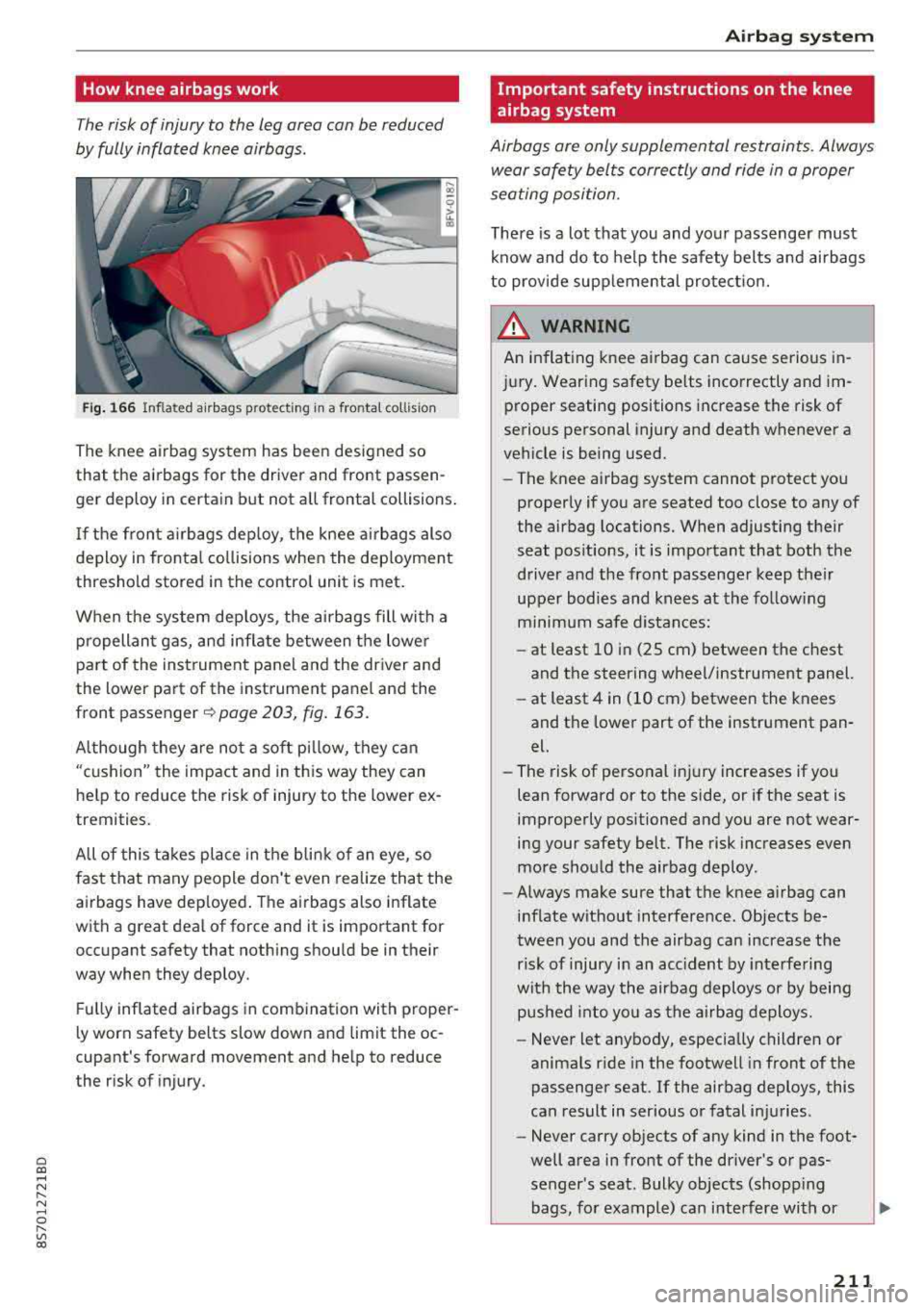
Fig. 166 Inflated airbags protecting in a frontal collision
The knee airbag system has been designed so
that the airbags for the driver and front passen
ger deploy in certain but not all frontal collisions.
If the front airbags deploy, the knee airbags also
deploy in frontal collisions when the deployment
threshold stored in the control unit is met.
When the system deploys, the airbags fill with a propellant gas, and inflate between the lower
part of the instrument panel and the driver and
the lower part of the instrument panel and the front
passenger ~ page 203, fig. 163.
Although they are not a soft pillow, they can
"cushion" the impact and in this way they can
help to reduce the risk of injury to the lower ex
tremities.
All of this takes place in the blink of an eye, so
fast that many people don't even realize that the
airbags have deployed. The airbags also inflate
with a great deal of force and it is important for
occupant safety that nothing should be in their
way when they deploy .
Fully inflated airbags in combination with proper
ly worn safety belts slow down and limit the oc
cupant 's forward movement and help to reduce
the risk of injury.
Airbag system
Important safety instructions on the knee
airbag system
Airbags are only supplemental restraints . Always
wear safety belts correctly and ride in a proper
seating position .
There is a lot that you and your passenger must
know and do to help the safety belts and airbags
to provide supplemental protection.
_& WARNING
-
An inflating knee airbag can cause serious in-
jury. Wearing safety belts incorrectly and im proper seating positions increase the risk of
serious personal injury and death whenever a
vehicle is being used.
-The knee airbag system cannot protect you properly if you are seated too close to any of
the airbag locations. When adjusting their
seat positions, it is important that both the
driver and the front passenger keep their
upper bodies and knees at the following minimum safe distances:
-at least 10 in (25 cm) between the chest
and the steering wheel/instrument panel.
-at least 4 in (10 cm) between the knees and the lower part of the instrument pan
el.
-The risk of personal injury increases if you
lean forward or to the side, or if the seat is
improperly positioned and you are not wear
ing your safety belt. The risk increases even
more should the airbag deploy .
- Always make sure that the knee airbag can
inflate without interference. Objects be
tween you and the airbag can increase the risk of injury in an accident by interfering
with the way the airbag deploys or by being pushed into you as the airbag deploys.
-Never let anybody, especially children or
animals ride in the footwell in front of the
passenger seat. If the airbag deploys, this
can result in serious or fatal injuries .
-Never carry objects of any kind in the foot
well area in front of the driver's or pas
senger's seat. Bulky objects (shopping bags, for example) can interfere with or
~
211
Page 220 of 310
Child sa fety
Advanced front airbag system and children
Your veh icle is equipped w ith a front "Advanced
A irbag System" in comp liance w it h United States
F edera l Motor Vehicle Safety Standard ( FMVSS)
208, as well as Canada Motor Vehicle Safety
Standard (CMVSS) 208 as applicable at the time
your vehicle was manufactured.
The Advanced Airbag system in your veh icle has
been certified to meet the " low-risk" require
ments for 3- and 6-year old children on the pas
senger side and small adults on the driver side.
The low risk deployment criteria are intended to
reduce the risk of injury through interaction with
the airbag that can occur, for example, by being
too close to the steering wheel and instrument
panel when the a irbag inflates. In addit ion, the
system has been certified to comply w ith the
" su ppress io n" req uirements of the Safety S tand
ard, to tu rn off the front airbag for infants up to
12 months who are restrained on the front pas
senger seat in child restraints that are listed in
the Standard.
E ven tho ugh yo ur vehicle is equipped with an
Ad a
vanced Airbag system, a chi ld should a lways ride
in the seat proper ly restrained for its age and
size. The airbag on the passenger side makes the
front seat a potentially dangerous p lace for a
child to r ide . The front seat is not the safest place
for a child in a forward-facing child safety seat .
It
can be a very dange rous place for a n infant or a
larger child in a rearward-fac ing seat.
The vehicle's Advanced Airbag System has a ca
pac itive passenger detect ion system in the front
passenger seat cush ion that ca n detect the pres
ence of a baby or a child in a ch ild restraint sys
tem on t his seat .
The capac it ive passenger detect ion system regis
ters the changes that result in an electr ical field
when a c hild, a child restra int, and a baby blanket
a re on the front passenge r seat. The change in
t he meas ured capacitance due to t he p resence o f
a child, a chi ld restraint, and a baby b lanket on
the front passenger seat is re lated to the chi ld
restraint system resting on the seat . The meas
ured capacitance of a ch ild restraint system var-
218
ies depending on the type of system and specific
make and mode l.
The elect rical capac ita nce of the va rious types,
makes, and models of child restra in ts speci fied
by the U.S . National Highway Tra ffic Safety Ad
ministration (NHTSA) in the relevant safety
standard are stored in the Advanced Airbag Sys
tem control unit together with the capacitances
typ ica l of infants and a 1-year old child. When a
c hi ld restraint is used on the front passenger
seat w it h a typical 1 year-old infant, t he Ad
vanced Airbag System compares the capacitance measured by the capacitive passenge r detect ion
system wi th the data stored in the e lec tronic co n
tro l unit .
Child restraints and Advanced front airbag
system
Regardless of the ch ild restraint that you use,
make sure that it has been certified to meet Safe
ty Standards and has been cert ified by its manu
factu rer for use w ith an airbag . If in exceptional
c ir cumstances you m ust use it on the front pas
senger seat, ca refully read all of the information
o n chi ld safety and Advanced Airbags and heed
a ll of th e app licab le WARNINGS . Make certain
that the chi ld and chi ld restraint are correctly
recognized by the capacitive passenger detection
system in the front passenger seat, that the front passenger a irbag is turned off, and that the air
bag status is always correct ly signa led by the
PASSENGER AIR BAG OFF ~; light.
Many types and models of child restra ints have
been available over the years, new models are in
troduced regularly incorporating new and im
proved designs and older models are taken out of
production . Ch ild rest rai nts are not standa rdized .
Child res tra ints of the same type typically have
d iffe rent weights and sizes and diffe re nt "foot
pr ints", the size and shape o f th e bo ttom of the
ch ild restraint that sits on the seat, w hen they
are installed on a vehicle seat . These differences
make it virtua lly impossib le to certify comp liance
with the requirements for advanced a irbags w ith
each and every child restra int that has ever been
sold in the past or will be sold over the course of
the useful life of your veh icle .
.,.
Page 246 of 310
Wheels
Wheels
Wheels and T ires
General information
~check your tires regularly for
damage (punctures, cuts, cracks
and bulges). Remove foreign ob
jects from the tire tread.
~ If driving over curbs or similar
obstacles, drive slowly and ap proach the curb at an angle.
~Have faulty tires or rims re
placed immediately.
~ Protect your tires from oil,
grease and fuel.
~ Mark tires before removing
them so that the same running
direction can be maintained if
they are reinstalled.
~Lay tires flat when storing and
store them in a cool, dry location
with as little exposure to light as
possible.
_&. WARNING -
-Never drive faster than the maximum permitted speed
for your tires. This could cause
the tires to heat up too much.
This increases the risk of an
accident because it can cause
the tire to burst .
-Always adapt your driving to the road and traffic condi-
244
tions . Drive carefully and re
duce your speed on icy or slip
pery roads . Even winter tires
can lose traction on black ice.
(@ Note
-Please note that summer and
winter tires are designed for
the conditions that are typical
i n those seasons . Aud i recom
mends using winter tires dur
ing the winter months . Low
temperatures significantly de
crease the elasticity of summ
er tires, which affects traction
and braking ability. If summer
tires are used in very cold
temperatures, cracks can form
on the tread bars, resulting in
permanent tire damage that
can cause loud driving noise
and unbalanced tires.
-Burnished, polished or chromed rims must not be used in winter driving condi
t ions. The surface of the r ims
does not have sufficient corro
sion protection for this and
could be permanently dam
aged by road salt or similar
substances.
Page 247 of 310
Cl co .... N ,....
N .... 0 ,....
Vl co
Tire designations
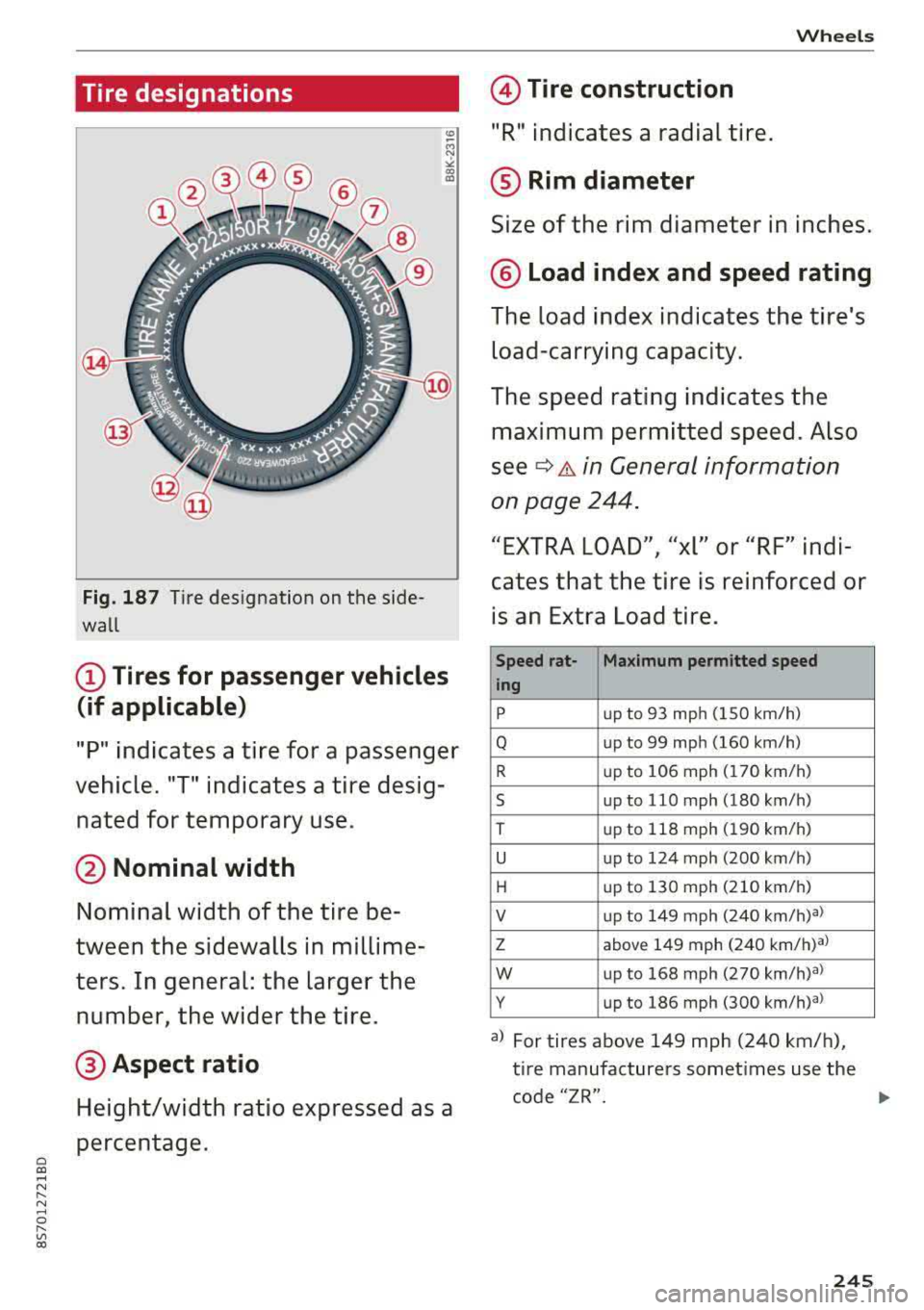
Fig. 187 Tire designation on the side
wall
(D Tires for passenger vehicles
(if applicable)
"P" indicates a tire for a passenger
vehicle . "T" indicates a tire desig
nated for temporary use.
@ Nominal width
Nominal width of the tire be
tween the sidewalls in millime
ters. In general: the larger the
number, the wider the tire .
@ Aspect ratio
Height/width ratio expressed as a
percentage .
Wheels
@Tire construction
"R" indicates a radial tire.
® Rim diameter
Size of the rim diameter in inches.
® Load index and speed rating
The load index indicates the tire's
load-carrying capacity.
The speed rating indicates the
maximum permitted speed. Also
see
¢ &. in General information
on page 244.
"EXTRA LOAD", "xl" or "RF" indi
cates that the tire is rei nforc ed or
i s an Extra Load tire .
Speed rat-
Maximum permitted speed
ing
p up to 93 mph (150 km/h)
Q up to 99 mph (160 km/h)
R up to 106 mph (170 km/h)
s up to 110 mph (180 km/h)
T up to 118 mph (190 km/h)
u up to 124 mph (200 km/h)
H up to 130 mph (210 km/h)
V up to 149 mph (240 km/h)a)
z above 149 mph (240 km/h)a)
w up to 168 mph (270 km/h)a)
y up to 186 mph (300 km/h)a)
a) For tires above 149 mph (240 km/h) ,
tire manufacturers sometimes use the
code "ZR".
245
Page 248 of 310
Wheel s
0 US DOT number (TIN) and
manufacture date
T he manufacture date is listed on
the tire sidewall (it may only ap
pear on the inner side of the tire) :
DOT ... 2217 ...
means, for example, that the tire
was produced in the 22nd week of
the year 2017.
@ Audi Original Tires
Audi Original equipment tires
with the designation
"AO" have
been specially matched to your
Audi. When used correctly, these
tires meet the highest standards
for safety and handling. An au
thorized Audi dealer or author
ized Audi Service Facility will be
able to provide you with more in
formation.
® Mud and snow capability
"M/5" or "M+S" indicates the tire
has properties ma king it suitable
to drive in mud or snow.
& indi
cates a winter t ire .
@) Compos ition of the tire cord
and materials
T he number of plies indicates the
number of rubberized fabric lay
ers in the tire . In general: the
more layers, the more weight a
246
tire can carry. Tire manufacturers
must also specify the materials
used in the tire . These include
steel , nylon, po lyester and other
materials .
@ Maximum permitted load
This number indicates the max i
mum load in kilograms and
pounds that the tire can carry.
@ Uniform tire quality grade
standards for treadwear,
tr action and temper ature
resistance
Treadwear, traction and tempera
ture
ranges ~ page 260.
@ Running direction
@Maximum permitted
inflation pressure
This number indicates the maxi
mum pressure to which a tire can
be inflated under normal operat
ing condit ions .
Glossary of tire and loading
terminology
Accessory weight
means the comb ined weight (in
excess of those standard items
which may be replaced) of auto matic transmission, power steer -
ing, power brakes, power
..