brake AUDI TT ROADSTER 2018 Service Manual
[x] Cancel search | Manufacturer: AUDI, Model Year: 2018, Model line: TT ROADSTER, Model: AUDI TT ROADSTER 2018Pages: 310, PDF Size: 46.95 MB
Page 259 of 310
0 co .... N ,.... N .... 0 ,....
"' co
passengers that the vehicle is in
tended to carry ("seating capaci
ty") with an assumed weight of
150 lbs. (68 kg) for each passen
ger at a designated seating posi
tion and the total weight of any luggage in the vehicle.
The
Gross Axle Weight Rating
("GAWR") is the maximum load
that can be applied at each of the
vehicle's two axles.
The fact that there is an upper limit to your vehicle's Gross Vehi
cle Weight Rating means that the
total weight of whatever is being
carried in the vehicle is limited.
The more passengers in the vehi
cle or passengers who are heavier
than the standard weights as sumed mean that less weight can
be carried as luggage.
The Gross Vehicle Weight Rating and the Gross Axle Weight Rating
are listed on the safety compli
ance sticker label located on the
driver's side B-pillar.
A WARNING
-
Overloading a vehicle can cause
loss of vehicle control, a crash
or other accident, serious per
sonal injury, and even death .
Wheels
-Carrying more weight than
your vehicle was designed to
carry will prevent the vehicle
from handling properly and
increase the risk of the loss of
vehicle control.
-The brakes on a vehicle that
has been overloaded may not
be able to stop the vehicle
within a safe distance.
- Tires on a vehicle that has
been overloaded can fail sud
denly, including a blowout and
sudden deflation, causing loss
of control and a crash.
-A lways make sure that the to
tal load being transported
does not make the vehicle
heavier than the vehicle's
Gross Vehicle Weight Rating.
Determining correct load
limit
Use the example below to calcu
late the total weight of the pas
sengers and luggage or other
things that you plan to transport
so that you can make sure that
your vehicle will not be overload-
ed.
~
257
Page 269 of 310
Cl 00 .-< N r--N .-< 0 r--Vl 00
wash operator to reduce the risk of acci
dents.
- To reduce the risk of cuts, protect yourself
from sharp metal components when wash ing the underbody or the inside of the wheel
hous ings.
- After wash ing the vehicle, the brak ing effect
may be delayed due to mo isture on the
brake rotors or ice in the w inter . This in
c reases the risk of an acc ident. The brakes
must be d ried fi rst w it h a few careful b rake
applications.
@ Note
- If you wash the vehicle in an automatic car
wash, you m ust retract the extendable rear
spo ile r* if necessary, and fold the exter ior
mir rors in to red uce the r isk of damage.
Power folding exte rior m irrors* must o nly
be fo lde d in a nd out u sing the power folding
f unct ion .
- To reduce the risk of p ain t d amage, do no t
wash the vehi cle i n di rect sunlig ht.
Care and cleaning
- T o red uce the risk of damage, do not was h
the power top with a pressure washer.
- T o red uce the risk of damage to the s urface,
do not use insect removing sponges, kitchen
sponges or similar items .
- Mat te finish painted veh icle components:
- To reduce the risk of damage to t he sur-
face, do not use po lish ing agents or hard
wax.
- Never use protective wax. It can destroy
the matte finish effect .
- Do not place any stickers or magnetic
signs on vehicle parts painted with matte
finish paint. The paint cou ld be damaged
when the stickers or magnets are re
moved.
@ For the sake of the environment
Only wash the vehicle in facilities spec ially de
s igned for that pu rpose . This will reduce the
r isk of di rty wate r contam inated with o il from
ente ring the sewe r sys tem.
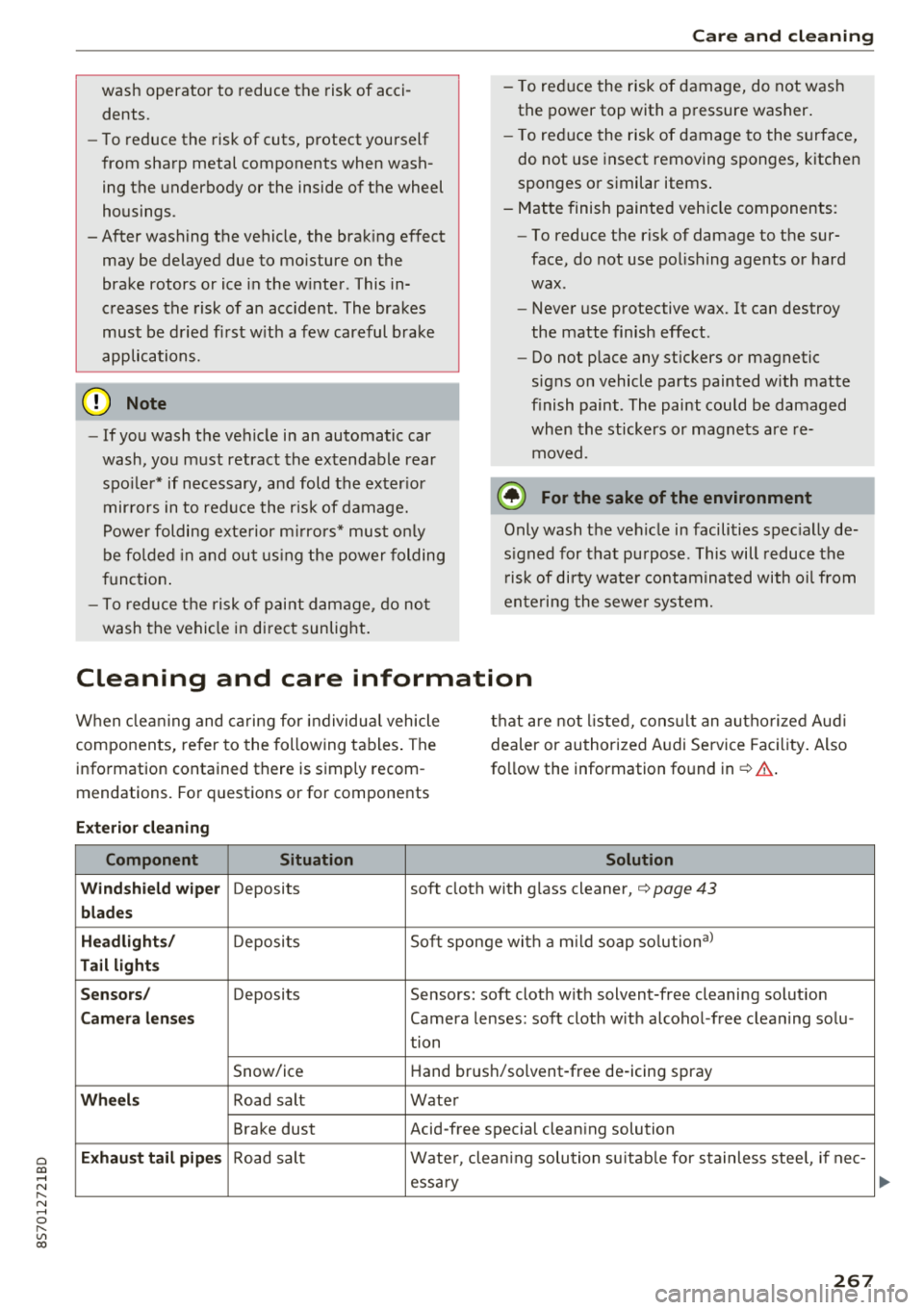
Cleaning and care information
When cleani ng and ca ring for individua l vehicle
components, refer to the following tables . The
information contained there is simp ly recom
mendations. For questions or for components t
h at are not l isted, cons ult an autho rized Aud i
dealer or authorized A udi Se rvice Fac ility . Also
fo llow the information fo und
in ¢& .
Ext erior cleaning
Component Situation Solution
Windshield wiper
Deposits soft cloth with glass cleaner, ¢ page 43
blades
Headli ghts/
Deposits Soft sponge with a m
ild soap so lutiona )
Tail light s
Se nsors /
Deposits Sensors: soft cloth with solvent-free cleaning solut ion
Cam era len ses Camera lenses: soft cloth w ith alcohol -free cleaning solu -
tion
Snow/ice Hand brush/solvent-free de-icing spray
Wheels Road salt Water
Brake dust Acid-free special clean ing solution
Exhaust tai l pipes Road salt Water, clea ning solution su itab le for stainless stee l, if nee-
essa ry
267
Page 274 of 310
Emergency assistance
Emergency assistance
Trunk escape latch
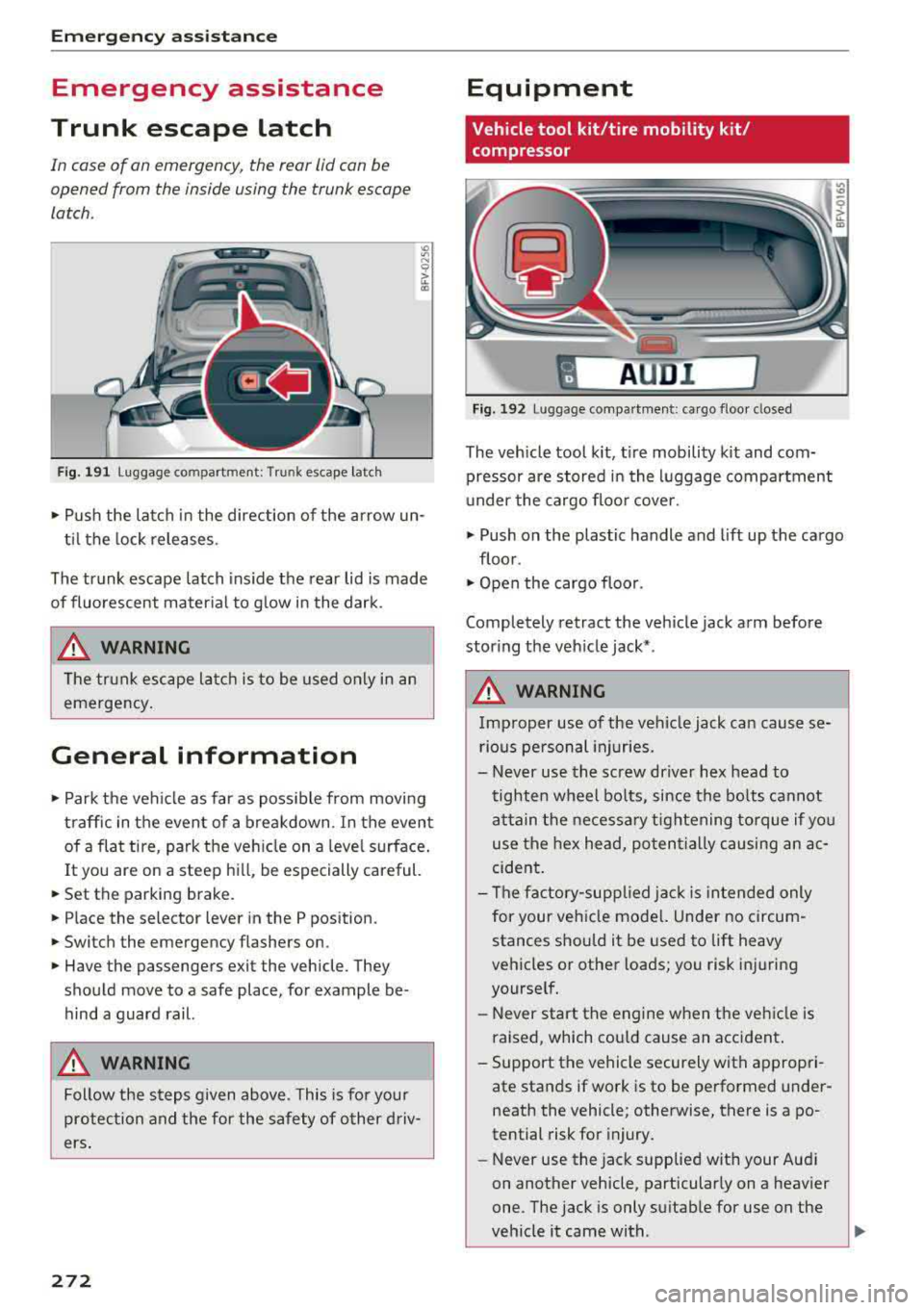
In case of an emergency , the rear lid can be
opened from the inside using the trunk escape
latch.
Fig. 191 L uggage compartment: Trunk escape latch
• Pu sh the latch in the direction of the arrow un
til the lock releases .
The trunk escape latch inside the rear lid is made
of fluorescent material to g low in the dark.
.&_ WARNING
The trunk escape latch is to be used only in an
emergency.
General information
• Park the vehicle as far as poss ible from moving
traffic in the event of a breakdown . In the event
of a flat tire , park the vehicle on a level surface .
It you are on a steep hill, be especially careful.
• Set the parking brake.
• Place the selector lever in the P position.
• Switch the emergency flashers on.
• Have the passengers exit the vehicle. They
should move to a safe place, for example be
hind a guard rail.
.&_ WARNING
Follow the steps given above . This is for your
protection and the for the safety of other driv
ers.
272
Equipment
Vehicle tool kit/tire mobility kit/
compressor
A UD i 1
Fig. 192 Lu ggage compartmen t: cargo floor closed
The vehicle tool kit, tire mobility kit and com·
pressor are stored in the luggage compartment
u nder the cargo floor cover.
• Push on the plastic handle and lift up the cargo
floor .
• Open the cargo floor.
Completely retract the vehicle jack arm before
storing the vehicle jack* .
.&_ WARNING
Improper use of the veh icle jack can cause se
rious personal injuries.
- Never use the screw driver hex head to
tighten wheel bolts, since the bolts cannot
attain the necessary tightening torque if you
use the hex head, potentially causing an ac
cident.
- The factory-supplied jack is intended only
for your vehicle mode l. Under no circum
stances should it be used to lift heavy
vehicles or other loads; you risk injuring
yourself.
- Never start the engine when the vehicle is
raised, which cou ld cause an accident .
- Support the vehicle securely with appropri
ate stands if work is to be performed under
neath the vehicle; otherwise, there is a
po
tential risk for injury.
- Never use the jack supplied with your Aud i
on another vehicle, particularly on a heavier
one. The jack is only suitable for use on the
vehicle it came with .
...
Page 277 of 310
Cl co .... N ,..._
N ...... 0 ,..._
Vl co
-If the tire is too severely damaged , see an
authorized Aud i dealer or authorized Aud i
Service Facility for assistance .
@ For the sake of the environment
You can give the used tire sealant bottle to an
author ized Audi dealer or authorized A udi
Service Facility for disposal.
@ Tips
Remember to obtain a new bottle of sea lant
from an authorized Audi dea ler or authorized
Audi Service Facility after repairing a tire.
Replacing wheels
Preparation
You must complete the preparation before
changing a tire .
"' Read and follow the important safety precau-
t ions
Q page 2 72, General information .
"' Set the parking brake .
"'Se lect the "P" selec to r l ever position.
"'Lay out the vehicle tool kit Q page 2 72 and the
spare tire
Q page 279 .
A WARNING ,-
You or your passenger could be injured while
changing a wheel if you do not follow these
safety precautions:
- If you have a flat tire, move a safe distance
off the road. Turn off the engine, turn the
emergency flashers on and use other warn
ing devices to alert other motorists.
- Make sure that passengers wait in a safe place away f rom the vehicle and well away
from the road and traffic .
- To help prevent the vehicle from moving suddenly and possibly slipping off the jack,
always fully set the parking brake and block
the front and back of the wheel diagonally
opposite the w heel be ing changed. Whe n
one front whee l is lifted off the ground,
pla cing the A utoma tic Transm ission in P
(Park) will
not prevent the ve hicle from
moving .
Emergen cy as sis tanc e
-Before you change a wheel, be sure the
ground is level and firm . If necessary, use a
sturdy board under the jack.
- Always store the vehicle too l kit, the jack
and the replaced tire in the luggage com
partment
<=) page 183.
(D Tips
Obey all laws .
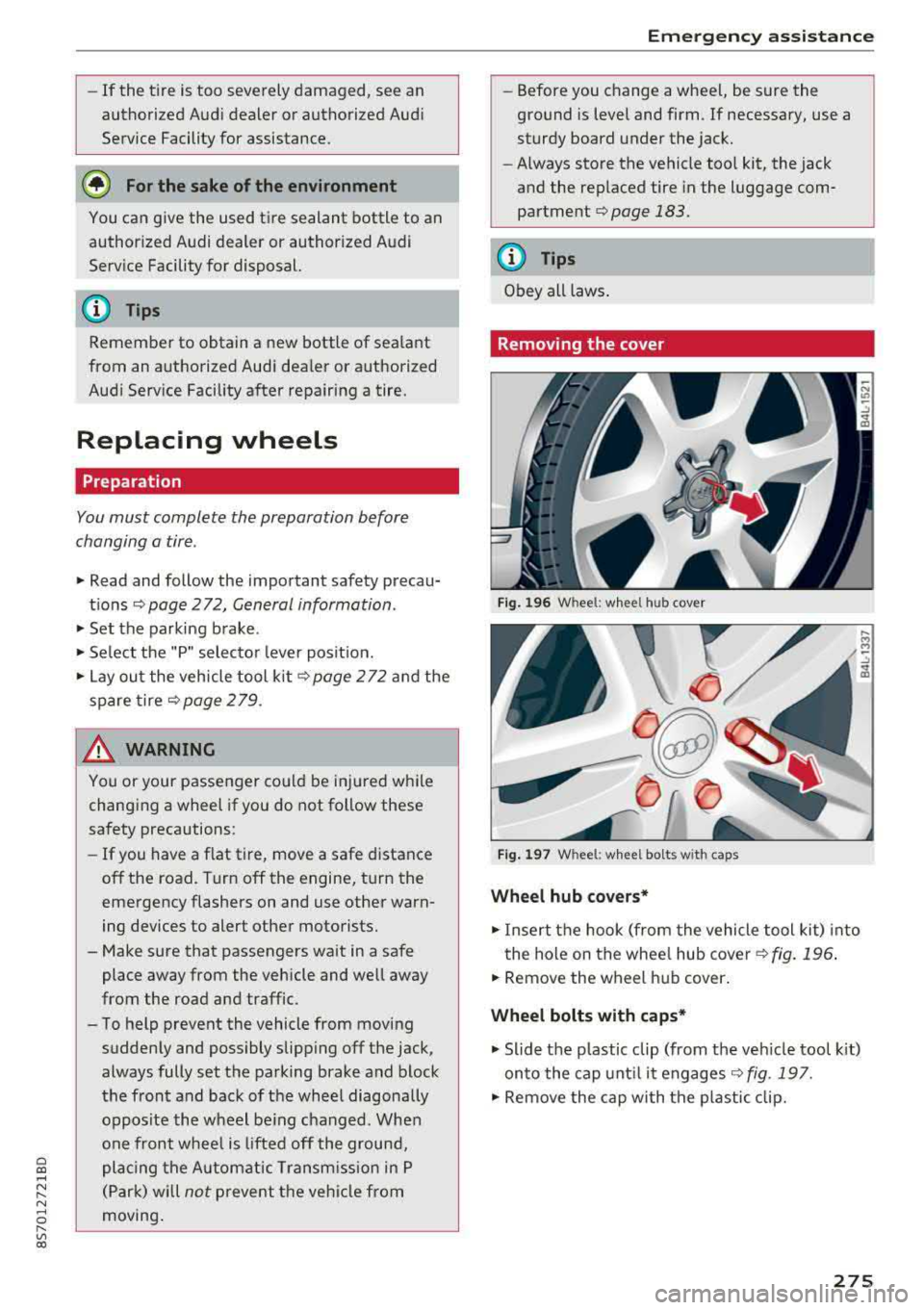
Removing the cover
Fig. 196 W heel: wh eel hu b cov er
F ig. 1 97 Wheel: wh eel bol ts with cap s
Wheel hub covers*
"'Insert the hook (from the vehicle tool kit) into
the hole on the whee l hub cover
Q fig. 196 .
"'Remove the wheel h ub cover .
Wheel bolts with caps *
"'Slide the p lastic clip (from the veh icle too l kit)
onto the cap unt il it engages
Q fig . 197.
"' Remove the cap with the p lastic clip.
275
Page 280 of 310
Emergency assistance
{QJ Note
When removing or installing the wheel, the
rim could hit the brake rotor and damage the
rotor. Work carefully and have a second per
son help you.
(D Tips
- When mounting tires with unidirectional
tread design
make sure the tread pattern is
pointed the right way
¢ page 278.
-The wheel bolts should be clean and easy to
turn. Check for dirt and corrosion on the mating surfaces of both the wheel and the
hub. Remove all dirt from these surfaces be
fore remounting the wheel.
Unidirectional tires
A unidirectional tire profile is identified by arrows
that point in the running direction on the tire
sidewall. You must always adhere to the speci
fied running direction. This is necessary ensure
the tire 's optimum performance in regard to ad
hesion, running noise, friction and hydroplaning .
To benefit fully from the advantages of the uni
directional tire design, you should replace faulty
tires as soon as possible and restore the correct
running direction on all of the tires.
Finishing
.,. Reinstall the caps on the wheel bolts if neces
sary .
.,. Store the vehicle tool kit in its designated
place .
.,. If the removed wheel does not fit in the spare
wheel well, store it securely in the luggage
compartment
¢ page 183.
.,. Check the tire pressure on the installed wheel
as soon as possible.
.,. Check the tire pressure and store it in the Info
tainment system.
.,. The wheel bol t tightening specification must be
90 ft lbs (120 Nm) . Check it as soon as possible
with a torque wrench. Drive carefully until then.
.,. Have the faulty wheel replaced as quickly as
possible.
278
(D Tips
- If you notice that the wheel bolts are cor
roded and difficult to turn while changing a
tire, they should be replaced before you check the tightening torque.
- Drive at reduced speed until you have the
tightening torques checked.
Notes on wheel changing
Please read the information ¢ page 251 if you
are going to use a spare tire which is different
from the tires on your vehicle .
After you change a tire:
- Check the tire pressure on the spare immedi
ately after installation.
- Have the wheel bolt tightening torque
checked with a torque wrench as soon as pos
sible by your authorized Audi dealer or a
qualified service station.
- With steel and alloy wheel rims, the wheel
bolts are correctly tightened at a torque of
90
ft lbs (120 Nm).
- If you notice that the wheel bolts are corroded
and difficult to turn while changing a tire,
they should be replaced before you check the
tightening torque.
- Replace the flat tire with a new one and have
it installed on your vehicle as soon as possi
ble. Remount the wheel cover .
Until then, drive with extra care and at reduced
speeds.
A WARNING
- If you are going to equip your vehicle with
tires or rims which differ from those which
were factory installed, then be sure to read
the information
¢page 251.
-Always make sure the damaged wheel or
even a flat tire and the jack and tool kit are
properly secured in the luggage compart
ment and are not loose in the passenger
compartment.
- In an accident or sudden maneuver they
could fly forward, injuring anyone in the ve
hicle.
-
Page 283 of 310
Cl co .... N ,....
N ...... 0 ,....
Vl co
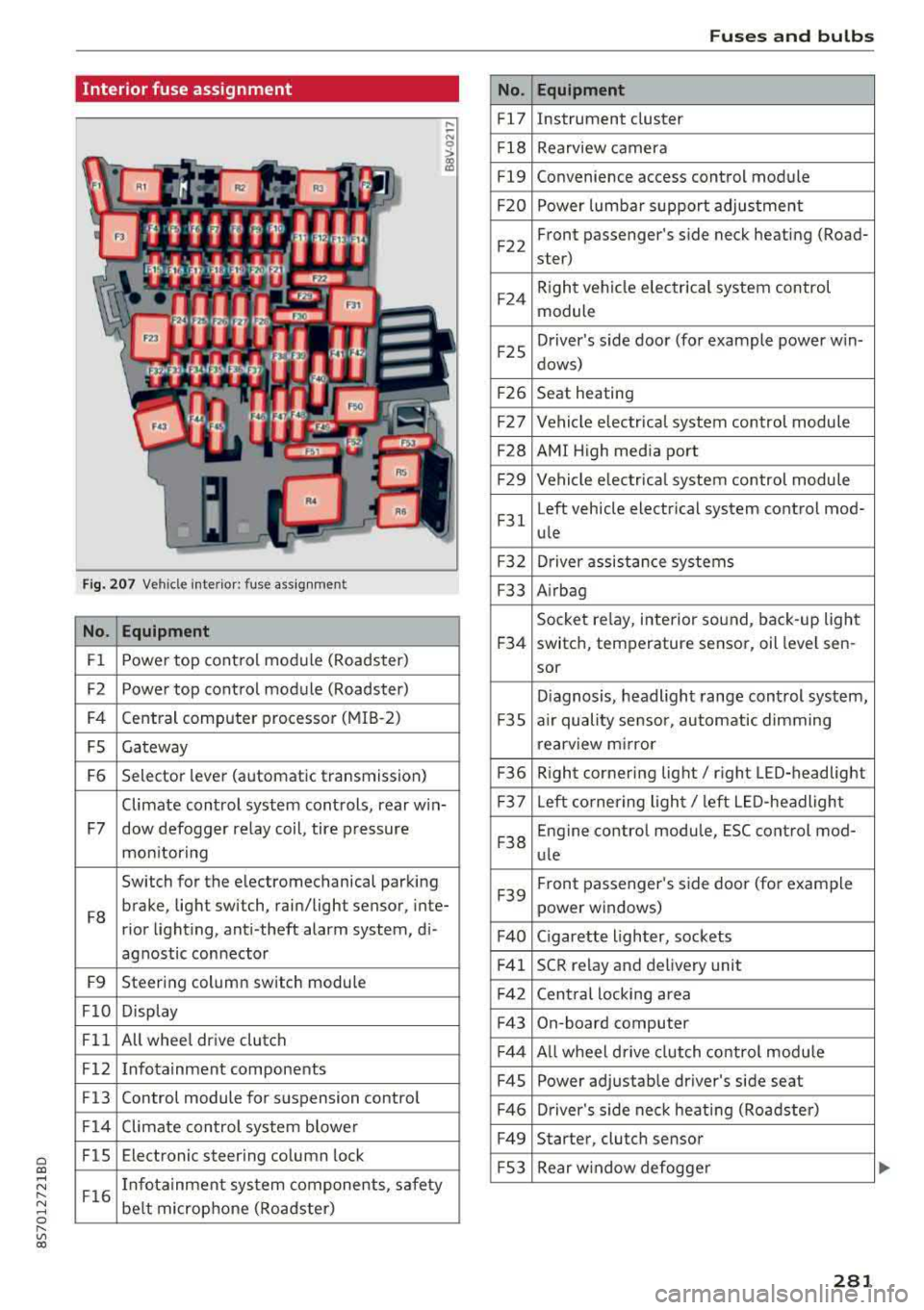
Interior fuse assignment
Fig. 207 Vehicle interior: fuse assignmen t
No. Equipment
Fl Power top cont
rol module (Roadster)
F2 Power top control module (Roadster)
F4 Central computer processor (MIB
-2)
FS Gateway
F6 Selector lever (automatic transmission)
Climate control system controls, rear w in-
F7 dow defogger relay coil, tire pressure
mon itoring
Switch for the electromechanical parking
F8 brake, light switch, rain/light sensor, inte-
rior lighting, anti -theft alarm system, di -
agnostic connector
F9 Steering column switch module
FlO Display
Fll All whee
l drive clutch
F12 Infotainment components
F13 Control module for suspension control
F14 Climate control system blowe r
FlS Electronic steering column
lock
F16 I
nfotainment system components, safety
be lt microphone (Roadster)
No.
Fl7
F1 8
Fl9
F20
F 22
F24
F 25
F 26
F 27
F28
F2 9
F 31
F3 2
F33
F 34
F 35
F36
F37
F3 8
F39
F40
F41
F 42
F43
F44
F45
F46
F49
F S3
Fuses and bulbs
Equipment
Instrument cluster
Rearview camera
Convenience access control module
Power lumbar support adjustment
Front passenger's side neck heating (Road-
ster)
R ight vehicle electrica l system control
module
Driver's s ide door (for example power w in-
dows)
Seat heating
Vehicle electrical system control module
AMI High media port
Vehicle e lectr ical system control module
Left vehicle electrical system contro l mod-
ule
Driver assistance systems
Airbag
Socket relay, inte rior sound , back-up light
switch, temperature sensor, oil leve l sen -
sor
Diagnosis, headlight range control system,
a ir quality sensor, automatic dimming
rearview mirror
R ight cornering light/ right LED-headlight
L eft cornering light/ left LED-headlight
Engine control module, ESC control mod-
ule
Front passenger's side door (for example
power windows)
C igarette lighter, sockets
SCR relay and delivery unit
Central locking area
On-board computer
A ll wheel d rive clutch control module
Power adjustable driver's side seat
Driver's side neck heating (Roadster)
Starter, clutch sensor
Rear window defogger
281
Page 284 of 310
Fuses and bulbs
The power seats* are protected via circuit break
ers
that automatically switch on after a few sec
onds after the overload has been reduced.
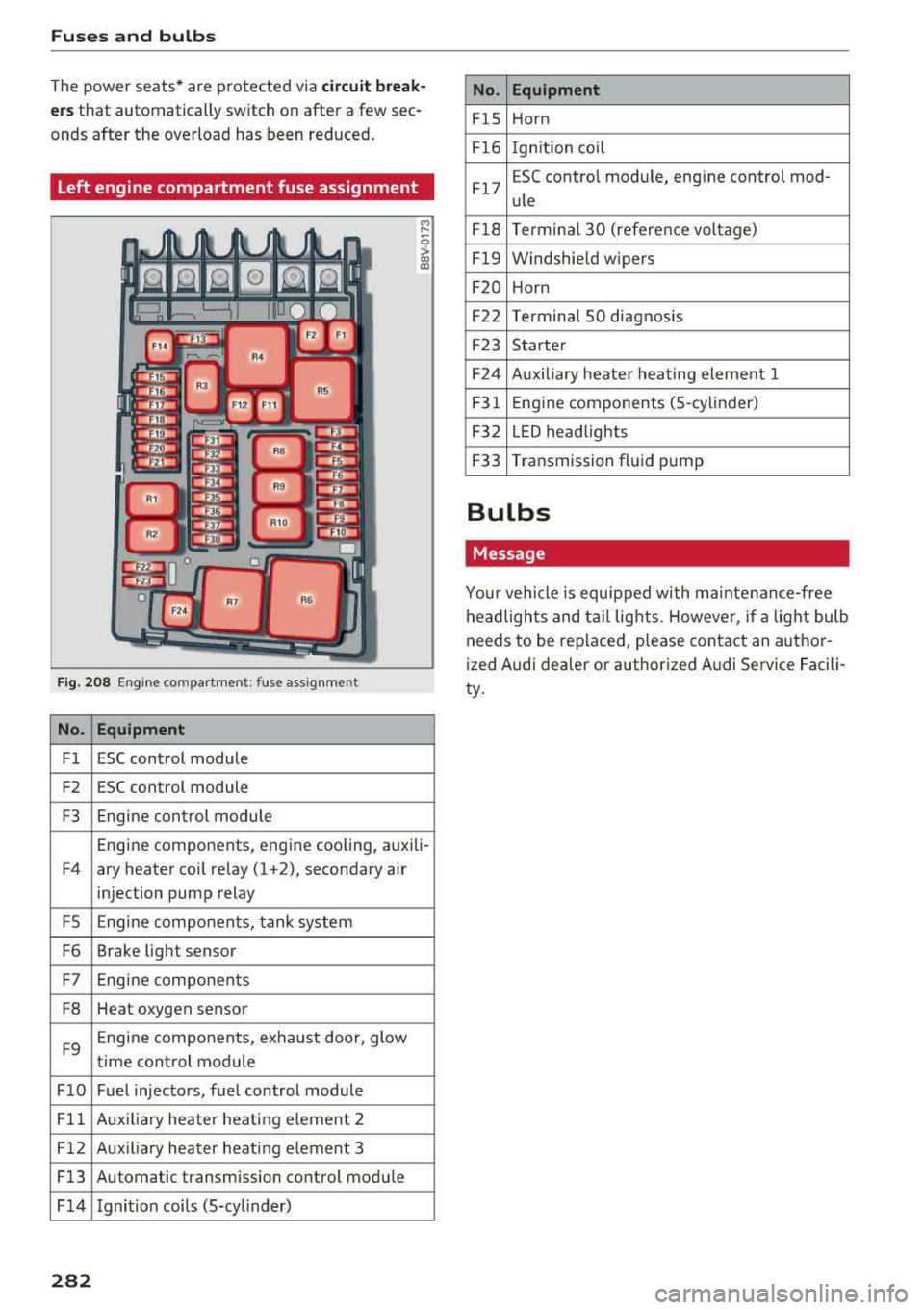
Left engine compartment fuse assignment
F ig. 208 Engine co mpartment : fuse assignment
No. Equipment
Fl ESC control module
F2 ESC control module
F3 Engine control module
M
" 0 > a, m
Engine components, engine cooling, auxili-
F4 ary heater coil relay (1 +2), secondary air
injection pump relay
FS Engine components, tank system
F6 Brake light sensor
F7 Engine components
F8 Heat oxygen sensor
F9 Engine components, exhaust door, glow
time control module
FlO Fuel injectors, fuel control module
Fll Auxiliary heater heating e lement 2
F 12 Aux iliary heater heat ing element 3
Fl3 Automatic transmission control module
F 14 Ignition coils (5-cylinder)
282
No. Equipment
FlS Horn
Fl6 Ignition coil
Fl7 E
SC contro l module, engine control mod-
ule
Fl8 Terminal
30 (reference voltage)
Fl9 Windshield wipers
F20 Horn
F22 Terminal SO diagnosis
F23 Starter
F24 Auxiliary heater heating element 1
F31 Engine
components (5 -cylinder)
F32 LED headlights
F33 Transmission fluid pump
Bulbs
Message
Your vehicle is equipped with ma intenance-free
headlights and tail lights. However, if a light bulb
needs to be replaced, please contact an author
ized Audi dealer or authorized Audi Service Facili
ty.
Page 286 of 310
Emergency situations
@ Tips
The discharged battery must be properly con·
nected to the vehicle's electrical system .
When jump starting or charging the battery,
never connect the negative ground cable to
the battery negative post because the battery
manager system must be able to detect the
battery's state of charge. Always connect the
negat ive g round cable to the negative ground
post of the battery manager control unit.
Using the jump start
cable
Both jump start cables must be connected in the
correct order!
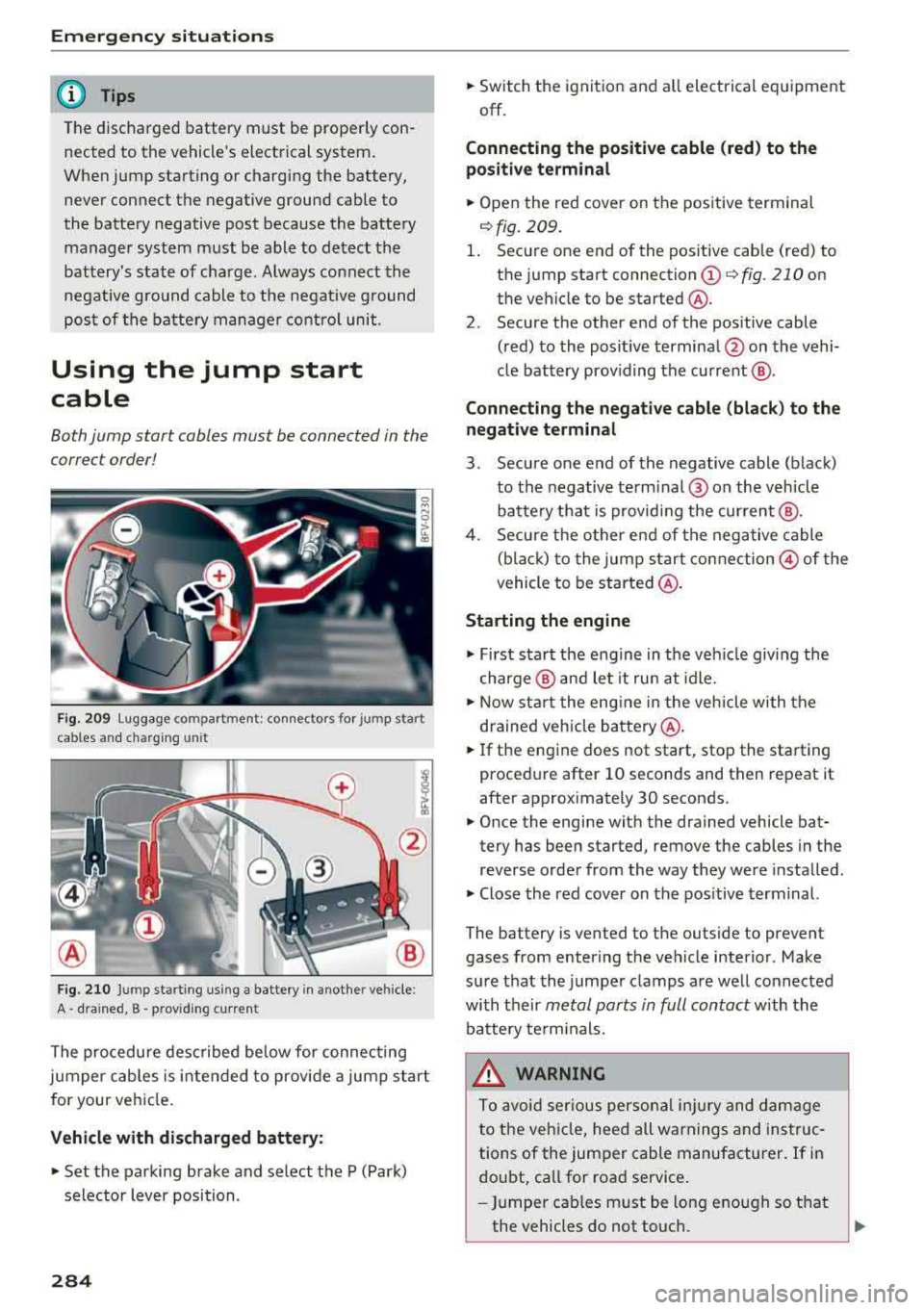
Fig. 209 luggage compartme nt: connectors for jump start
cables and charg ing unit
Fig. 210 Jump starting usi ng a battery in anot her vehicle:
A· drained, B • provid ing curren t
The procedure described below for connecting
jumper cables is intended to provide a jump start
for your vehicle.
Vehicle with discharged battery:
.. Set the parking brake and select the P (Park)
selector lever position.
284
.. Switch the ignition and all electrical equipment
off.
Connecting the positive cable (red) to the
positive terminal
.. Open the red cover on the positive terminal
<=:>fig. 209.
1. Secure one end of the positive cable (red) to
the ju mp start connection
(D c:> fig. 210 on
the vehicle to be started @.
2 . Secure the other end of the pos itive cable
(red) to the positive terminal @on the vehi·
cle battery prov iding the current @.
Connecting the negative cable (black ) to the
negative terminal
3 . Secure one end of the negative cable (black)
to the negative term inal @ on the vehicle
batte ry that is providing the current @.
4. Secure the other end of the negative cable
(black) to the jump start connection
@of the
vehicle to be started @.
Starting the engine
.,. First start the engine in the vehicle giving the
charge @ and let it run at idle .
.. Now start the engine in the vehicle with the
drained veh icle battery @.
.. If the engine does not start, stop the starting
procedure after 10 seconds and then repeat it
after approximately 30 seconds .
.. Once the engine with the drained vehicle bat·
tery has been started, remove the cables in the
reverse order from the way they were installed .
.. Close the red cover on the pos itive terminal.
The battery is vented to the outside to prevent
gases from enter ing the vehicle interior. Make
sure that the jumper clamps are well connected
with their
metal ports in full contact with the
battery termin als.
.&_ WARNING
To avoid serious personal injury and damage
to the vehicle, heed all warnings and instruc
tions of the jumper cable manufacturer. If in
doubt, call for road service .
- Jumper cables must be long enough so that
the vehicles do not touch.
Page 287 of 310
-When connecting jumper cables, make sure
that they cannot get ca ught in any mov ing
parts in the engine compartment.
- Do not bend over the batteries - danger of
chem ica l burns!
- The battery cell lock ing screws must be
t ightened sec ure ly.
- Be fore you check anything in the e ngine
compartment, a lways read and hee d all
WAR NINGS
q page 233 .
(D Note
Impro per hook -up of jum pe r cables can r uin
the gene rato r.
- Always connect POSITI VE (+ ) to POS ITIV E
( + ), and NEGATIVE( -) to NEGAT IVE( -)
g roun d post of t he battery mana ger contro l
u nit.
- Check that a ll sc rew p lugs on t he battery
cells are screwed in firmly. I f not, t ighten
plugs prior to connecting clamp on negative
batte ry terminal.
- Please note that the procedure fo r con nect
i ng a jumper cab le as desc ribed above ap
p lies specifica lly to the case of yo ur vehicle
being jump starte d. When you are giv ing a
ju mp s ta rt to anothe r vehicle, do
not con
n ect the neg ative (-) cab le to the neg ative
(-) t ermin al on the di sch arged b attery @
q fig. 210. In ste ad , securely connec t the
nega tive ( -) cab le to either a solid me tal
com ponent that is f irm ly bolted to the e n
gine block o r to the engine bloc k itself. If
the battery that is be ing cha rge d does not
vent to the outs ide, escap ing battery gas
could ignite and exp lode!
Towing with a tow truck
General hints
Your Audi requires special handling for towi ng .
The fo llow ing information is to be used by com
mercia l tow tr uck operators who know how to op-
a e rate the ir equip ment safe ly. co ....
~ - Never tow your Audi. Towing will cause dam-
"' 8 age to the engine and transmission . r--Vl co
Emergency situations
-Never wrap the safety chains or winch cables
around the brake lines .
- To prevent unnecessa ry damage , your Audi
must be transported with a flatbed truck.
- To load the vehicle on to the flatbed, use the
towing loop found in the vehicle tools and at
tach to the front or rear anchorage
¢ page 285 and ¢ page 286 .
A WARNING
-A veh icle being towed is not safe for passen-
ge rs. Neve r allow anyone to ride in a vehicle
b eing towed, fo r any r eason.
Front towing loop
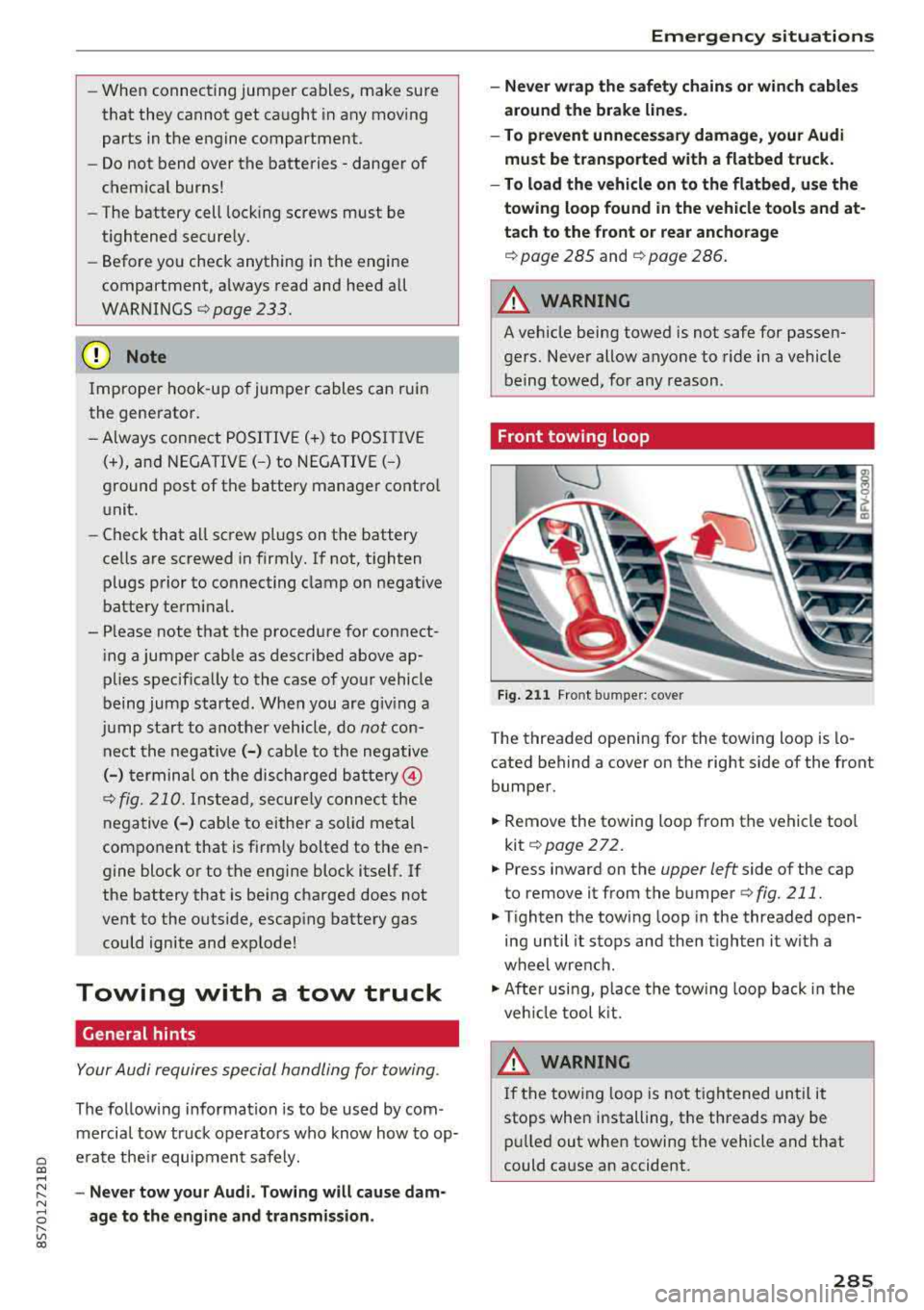
Fig. 2 11 Front bumper: cover
-
The threaded opening for the towing loop is lo
cated behind a cover on the right side of the front
bumper.
.,. Remove the towing loop from the vehicle too l
kit
¢ page 272.
.,. Press inward on the upper left side of the cap
to remove it from the bumper
¢fig. 211.
.,. Tighten the tow ing loop in the threaded open
ing until it sto ps and then tighten it w ith a
whe el wrench .
.,. After usi ng, p lace the tow ing loop b ack i n the
ve hicl e tool kit.
WARNING
If the towing loop is not ti ghtened until it
stops whe n installing, t he threads may be
pull ed out when towing the vehicle a nd that
could ca use an accident.
285
Page 293 of 310
Cl 00 .-< N r-N .-< 0 r-Vl 00
scope of maintenance and repairs which can be
carried out by vehicle owners.
Al so, sa fety a nd
en vir onment al
concerns place very strict limits
on the nature of repairs and adjustments to en
g ine and transm ission parts wh ich an owner can
perform .
Maintenance, adjustments and repairs usually re
qu ire special tools, test ing devices and other
equ ipment available to specially trained work
shop personnel in order to assure proper per
formance, rel iability and safety of the veh icle and
its many systems .
Improper maintenance, adjustments and repairs
can impair the operation and reliability of your
veh icle and even void your vehicle warranty .
Therefore, proof of servicing in accordance with
the ma intenance sc hedule may be a condition for
upho ld ing a possib le wa rranty claim made within
the warranty period.
Above all, operational safety can be adversely af
fected, creating unnecessa ry risks fo r you and
your passenger.
If i n doubt about any servicing, have it done by
your author ized Audi dealer or any other properly
equ ipped and qua lified workshop. We strongly
urge yo u to g ive your author ized Audi dealer the
opportunity to perform a ll scheduled ma inte
nance and necessary repairs. Your dealer has the
facilities, origina l parts and trained specialists to
keep your vehicle running properly .
Performing limited m aint ena nc e y our self
The follow ing pages describe a lim ited number of
p rocedures w hich can be per formed on your ve hi
cle with ordinary tools, should the need arise and
trained personnel be unavai lable . Before per
forming any of these procedures, always thor
ough ly read a ll of the app licab le text and carefu l
ly follow the instructions g iven . Always rigorously
observe the
W ARNING S provided .
Before you ch eck anything in the engine com
partment , always read a nd heed all WARNIN GS
c> & and c> & in Working in the engine compart
ment on page 233 . Con
sum er In form ation
A WARNING
--
- Ser ious personal injury may occur as a result
of improperly performed maintenance, ad
justments or repairs .
- Always be extremely careful when work ing
on the vehicle . Always follow commonly ac
cepted safety practices and general com mon sense. Never risk pe rsonal inj ury.
- Do not attempt any of the maintenance,
checks or repairs described on the following pages if you are not fu lly famil iar with these
or other proced ures with respect to the ve
h icle, or are uncerta in how to pro ceed.
- Do not do any work without the proper tools
and eq uipment. Have the necessary wo rk
done by your authorized Audi dealer or an
other proper ly equipped and qualified work
shop.
- The engine compartment of any motor vehi
cle is a potentially hazardous area . Never
reach into the area around or touch the radi
ator fan.
It is temperature controlled and
can switch on suddenly
-even when the en
g ine is off . The radiator fan switches on au
tomatically when the coolant reaches a cer
tain tempe rature and will cont inue to run
until the coolant temperature d rops.
- Always sw itch off the ignition before anyone
gets under the vehicle.
- Always support your veh icle with safety
stands if it is necessary to work underneath
the vehicle. The jack suppl ied with the veh i
cle is no t adequate for this pu rpose and
could collapse caus ing serious personal in
jury.
- I f you must wor k unde rneath the vehicle
with the wheels on the ground, always make
sure the vehicle is on level ground, that the
wheels are always securely blocked and that
the engine cannot be started.
- Always make sure the transmission se lector
lever (automatic transmiss ion) is in P (Park
position) and the park brake is applied.
II>
291