change time BUICK LACROSSE 2009 User Guide
[x] Cancel search | Manufacturer: BUICK, Model Year: 2009, Model line: LACROSSE, Model: BUICK LACROSSE 2009Pages: 428
Page 174 of 428
Oil Life
Press the gages button until OIL LIFE displays. This
mode shows an estimate of the oil’s remaining useful
life. If you see OIL LIFE 99% on the display, that means
99% of the current oil life remains. The engine oil life
system will alert you to change your oil on a schedule
consistent with your driving conditions.
When the remaining oil life is low, the CHANGE OIL
SOON message will appear on the display. You should
change your oil as soon as possible. SeeEngine Oil
on page 5-15. In addition to the engine oil life system
monitoring the oil life, additional maintenance is
recommended in the Maintenance Schedule in this
manual. SeeScheduled Maintenance on page 6-4
for more information.
Remember, you must reset the OIL LIFE yourself after
each oil change. It will not reset itself. Also, be careful not
to reset the OIL LIFE accidentally at any time other than
when the oil has just been changed. It cannot be reset
accurately until the next oil change. To reset the engine
oil life system, seeEngine Oil Life System on page 5-18.
The display will show 100% when the system is reset.
Tire Pressure
On vehicles with the Tire Pressure Monitor System
(TPMS), press the gages button until FRONT TIRE
PRESSURE displays. This mode shows the pressure
for the front tires. To view the pressure for the rear
tires, press the gages button again until REAR TIRE
PRESSURE displays. The tire pressure will be shown in
either pounds per square inch (psi) or kilopascals (kPa).
If a low tire pressure condition is detected by the
system while driving, a message advising you to check
the pressure in a specic tire will appear in the display.
SeeInflation - Tire Pressure on page 5-61andDIC
Warnings and Messages on page 3-56for more
information.
If the tire pressure display shows dashes or blanks
instead of a value, there may be a problem with
your vehicle. If this consistently occurs, see your
dealer/retailer for service.
3-52
Page 194 of 428
STABILITY CONTROL ACTIVE
If your vehicle has StabiliTrak, this message displays
when StabiliTrak is actively assisting you with directional
control of the vehicle. Slippery road conditions may exist
when this message is displayed, so adjust your driving
accordingly. SeeStabiliTrak
®System on page 4-6.
This message displays only while the ignition is in
ON/RUN. This message stays on until road conditions
change and StabiliTrak is not active.
This message cannot be acknowledged and cleared
from the screen.
STABILITY CONTROL OFF
If your vehicle has StabiliTrak, this message displays
any time the system turns off. When this message has
been displayed, StabiliTrak is no longer available to
assist you with directional control of the vehicle. Adjust
your driving accordingly. SeeStabiliTrak
®System
on page 4-6.This message displays only while the ignition is in
ON/RUN.
Any of the following conditions may cause the
StabiliTrak system to turn off:
The system is turned off by pressing and holding
the traction control button for ve seconds.
SeeStabiliTrak
®System on page 4-6.
The battery is low.
There is a StabiliTrak system failure. See your
dealer/retailer for service.
STARTING DISABLED
This message displays if the starting of the engine is
disabled due to the electronic throttle control system
or vehicle theft-deterrent system. Have your vehicle
serviced by your dealer/retailer immediately.
This message only appears while the ignition is in
ON/RUN and will not disappear until the problem is
resolved.
This message cannot be acknowledged.
3-72
Page 206 of 428
Playing the Radio
P
(Power):Press to turn the system on and off.
v(Volume):Turn to increase or to decrease the
volume.
DISP (Display):Press to switch the display between
the radio station frequency and time of day. While
the ignition is off, press this button to display the time.
If the vehicle’s radio has XM™, press the DISP
button while in XM mode to retrieve four different
categories of information related to the current song
or channel: Artist, Song Title, Category or PTY,
Channel Number/Channel Name.
To change the default on the display, press the DISP
button until the desired display appears, then hold DISP
for two seconds. The radio beeps once and the selected
display becomes the default.SCV (Speed Compensated Volume):If the vehicle’s
radio has Speed Compensated Volume (SCV), the audio
system adjusts automatically to make up for road and
wind noise while driving.
Set the volume at the desired level. Press this button
to select LOW, MEDIUM, or HIGH. Depending on the
radio, the selection may be SPEED VOL MIN (volume
minimum), SPEED VOL MED (volume medium), or
SPEED VOL MAX (volume maximum). Each higher
setting allows for more volume compensation at faster
vehicle speeds. Then while driving, SCV increases the
volume, as necessary, to overcome noise at any speed.
The volume level should always sound the same while
driving. NONE displays if the radio cannot determine the
vehicle speed. To turn SCV off, press SCV until OFF or
SPEED VOL OFF displays.
3-84
Page 213 of 428
To use repeat:
To repeat playing a track, press and release this
button. RPT # displays. Press this button again
to turn off repeat play.
To repeat playing a CD, press and hold this button
for two seconds. REPEAT CD # displays. Press
this button again to turn off repeat play.
4 RDM (Random):Depending on the radio, press
to hear the tracks in random, rather than sequential,
order. RANDOM ON displays. Press again to turn off
random play.
For the radio with a Six-Disc CD player, press to listen to
the tracks in random, on one CD or on all of the CDs.
To use random on a Six-Disc CD player:
To play the tracks on a CD in random order, press
and release the random button. RANDOM ONE
displays. Press again to turn off random play.
To play the tracks on all of the CDs that are loaded
in random order, press and hold this button for more
than two seconds. A beep sounds and RANDOM
ALL displays. Press again to turn off random play.
oSEEKp:Press the left arrow to go to the start of
the current or the previous track. Press the right arrow
to go to the start of the next track.
To scan tracks, press and hold either arrow for more
than two seconds. SCAN displays. The radio goes to the
next track, plays 10 seconds, then goes to the next track.
To scan one CD on a Six-Disc CD player, press and
hold either SEEK arrow for more than two seconds until
TRACK SCAN displays and a beep sounds. The radio
goes to the next track, plays for 10 seconds, then goes
to the next track.
Press either arrow again, to stop scanning.
To scan all loaded CDs, press and hold either arrow for
more than four seconds until ALL CD SCAN displays and
a beep sounds. Use this feature to listen to 10 seconds of
the rst track of each loaded CD.
Press either arrow again, to stop scanning.
DISP (Display):Press to see how long the current track
has been playing. The elapsed time of the track displays.
To change the default on the display, track, or elapsed
time, press until the desired display appears, then hold
the button for two seconds. The radio produces one beep
and the selected display becomes the default.
3-91
Page 220 of 428
DISP (Display):Press to change between track mode,
folder/playlist mode, and ID3 tag. The display shows
only eight characters, but there can be up to four pages
of text. If there are more than eight characters in the
song, folder, or playlist name, pressing this knob within
two seconds goes to the next page of text. If there
are no other pages to be shown, pressing this button
within two seconds goes to the next display mode.
Song name and time of day mode displays
the current song name and time of day.
Folder/playlist mode displays the current folder or
playlist number the track number and the elapsed
time of the track.
Song name and track number mode displays the
current song name and track number.
ID3 Tag and folder mode displays the ID3 tag
information and the folder number.
Song and folder mode displays the number of
songs in the folder and the folder number.
INFO (Information):INFO displays when a current
track has ID3 tag information. Press this button to
display the artist name and album contained in the tag.
BAND:Press to listen to the radio when a CD is
playing. The inactive CD remains inside the radio
for future listening.
XM Radio Messages
XL (Explicit Language Channels):These
channels, or any others, can be blocked by
calling 1-800-852-XMXM (9696).
Updating:The encryption code in the receiver is being
updated, and no action is required. This process should
take no longer than 30 seconds.
No Signal:The system is functioning correctly, but the
vehicle is in a location that is blocking the XM signal.
When the vehicle is moved into an open area, the signal
should return.
Loading XM:The audio system is acquiring and
processing audio and text data. No action is needed.
This message should disappear shortly.
CH Off Air:This channel is not currently in service.
Tune in to another channel.
CH Unauth:This channel is blocked or cannot be
received with your XM Subscription package.
CH Unavail:This previously assigned channel is no
longer assigned. Tune to another station. If this station
was one of the presets, choose another station for
that preset button.
3-98
Page 222 of 428
Audio System
When using the in-vehicle Bluetooth system, sound
comes through the vehicle’s front audio system speakers
and overrides the audio system. Use the audio system
volume knob, during a call, to change the volume level.
The adjusted volume level remains in memory for later
calls. To prevent missed calls, a minimum volume level
is used if the volume is turned down too low.
Bluetooth Controls
Use the buttons located on the steering wheel to
operate the in-vehicle Bluetooth system. SeeAudio
Steering Wheel Controls on page 3-110for more
information.
b>(Push To Talk):Press to answer incoming calls,
to conrm system information, and to start speech
recognition.
cx(Phone On Hook):Press to end a call, reject a
call, or to cancel an operation.
Pairing
A Bluetooth enabled cell phone must be paired to the
in-vehicle Bluetooth system rst and then connected to
the vehicle before it can be used. See the cell phone
manufacturers user guide for Bluetooth functions before
pairing the cell phone. If a Bluetooth phone is not
connected, calls will be made using OnStar
®Hands-Free
Calling, if available. Refer to the OnStar owner’s guide
for more information.
Pairing Information:
Up to ve cell phones can be paired to the in-vehicle
Bluetooth system.
The pairing process is disabled when the vehicle is
moving.
The in-vehicle Bluetooth system automatically links
with the rst available paired cell phone in the order
the phone was paired.
Only one paired cell phone can be connected to the
in-vehicle Bluetooth system at a time.
Pairing should only need to be completed once,
unless changes to the pairing information have
been made or the phone is deleted.
To link to a different paired phone, see Linking to a
Different Phone later in this section.
3-100
Page 241 of 428
Antilock Brake System (ABS)
This vehicle has the Antilock Brake System (ABS), an
advanced electronic braking system that will help
prevent a braking skid.
When the engine is started and the vehicle begins to
drive away, ABS checks itself. A momentary motor
or clicking noise might be heard while this test is going
on, and it might even be noticed that the brake pedal
moves a little. This is normal.
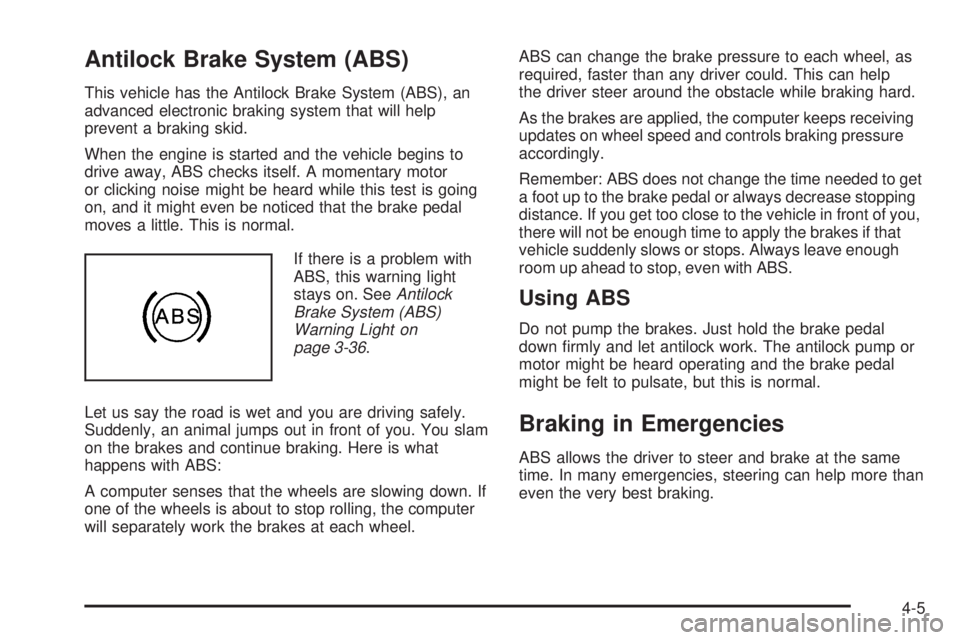
If there is a problem with
ABS, this warning light
stays on. SeeAntilock
Brake System (ABS)
Warning Light on
page 3-36.
Let us say the road is wet and you are driving safely.
Suddenly, an animal jumps out in front of you. You slam
on the brakes and continue braking. Here is what
happens with ABS:
A computer senses that the wheels are slowing down. If
one of the wheels is about to stop rolling, the computer
will separately work the brakes at each wheel.ABS can change the brake pressure to each wheel, as
required, faster than any driver could. This can help
the driver steer around the obstacle while braking hard.
As the brakes are applied, the computer keeps receiving
updates on wheel speed and controls braking pressure
accordingly.
Remember: ABS does not change the time needed to get
a foot up to the brake pedal or always decrease stopping
distance. If you get too close to the vehicle in front of you,
there will not be enough time to apply the brakes if that
vehicle suddenly slows or stops. Always leave enough
room up ahead to stop, even with ABS.
Using ABS
Do not pump the brakes. Just hold the brake pedal
down rmly and let antilock work. The antilock pump or
motor might be heard operating and the brake pedal
might be felt to pulsate, but this is normal.
Braking in Emergencies
ABS allows the driver to steer and brake at the same
time. In many emergencies, steering can help more than
even the very best braking.
4-5
Page 249 of 428
While driving on a surface with reduced traction, try
your best to avoid sudden steering, acceleration, or
braking, including reducing vehicle speed by shifting
to a lower gear. Any sudden changes could cause the
tires to slide. You may not realize the surface is slippery
until the vehicle is skidding. Learn to recognize warning
clues — such as enough water, ice, or packed snow on
the road to make a mirrored surface — and slow down
when you have any doubt.
Remember: Any Antilock Brake System (ABS) helps
avoid only the braking skid.
Driving at Night
Night driving is more dangerous than day driving
because some drivers are likely to be impaired — by
alcohol or drugs, with night vision problems, or by
fatigue.Night driving tips include:
Drive defensively.
Do not drink and drive.
Reduce headlamp glare by adjusting the inside
rearview mirror.
Slow down and keep more space between you and
other vehicles because headlamps can only light up
so much road ahead.
Watch for animals.
When tired, pull off the road.
Do not wear sunglasses.
Avoid staring directly into approaching headlamps.
Keep the windshield and all glass on your vehicle
clean — inside and out.
Keep your eyes moving, especially during turns or
curves.
No one can see as well at night as in the daytime. But,
as we get older, these differences increase. A
50-year-old driver might need at least twice as much
light to see the same thing at night as a 20-year-old.
4-13
Page 264 of 428
6. Remove the key from the ignition.
7. Secure the vehicle to the dolly following the
manufacturer’s instructions.
8. Release the parking brake only after the vehicle
being towed is rmly attached to the dolly.
Towing a Trailer
{CAUTION:
The driver can lose control when pulling a trailer if
the correct equipment is not used or the vehicle is
not driven properly. For example, if the trailer is
too heavy, the brakes may not work well — or
even at all. The driver and passengers could be
seriously injured. The vehicle may also be
damaged; the resulting repairs would not be
covered by the vehicle warranty. Pull a trailer only
if all the steps in this section have been followed.
Ask your dealer/retailer for advice and information
about towing a trailer with the vehicle.Notice:Pulling a trailer improperly can damage the
vehicle and result in costly repairs not covered
by the vehicle warranty. To pull a trailer correctly,
follow the advice in this section and see your
dealer/retailer for important information about
towing a trailer with the vehicle.
The vehicle can tow a trailer if it is equipped with the
proper trailer towing equipment. To identify the trailering
capacity of the vehicle, read the information in “Weight
of the Trailer” that appears later in this section. Trailering
is different than just driving the vehicle by itself.
Trailering means changes in handling, acceleration,
braking, durability and fuel economy. Successful, safe
trailering takes correct equipment, and it has to be used
properly.
The following information has many time-tested,
important trailering tips and safety rules. Many of these
are important for the safety of the driver and the
passengers. So please read this section carefully before
pulling a trailer.
Load-pulling components such as the engine,
transmission, axles, wheel assemblies and tires are
forced to work harder against the drag of the added
weight. The engine is required to operate at relatively
higher speeds and under greater loads, generating extra
heat. The trailer also adds considerably to wind
resistance, increasing the pulling requirements.
4-28
Page 288 of 428
Engine Oil Additives / Engine Oil
Flushes
Do not add anything to the oil. The recommended
oils with the starburst symbol that meet GM Standard
GM6094M are all that is needed for good performance
and engine protection.
Engine oil system ushes are not recommended and
could cause engine damage not covered by the vehicle
warranty.
Engine Oil Life System
When to Change Engine Oil
This vehicle has a computer system that indicates
when to change the engine oil and lter. This is based
on engine revolutions and engine temperature, and not
on mileage. Based on driving conditions, the mileage at
which an oil change is indicated can vary considerably.
For the oil life system to work properly, the system must
be reset every time the oil is changed.When the system has calculated that oil life has been
diminished, it indicates that an oil change is necessary.
A change engine oil light or, if the vehicle has the Driver
Information Center (DIC), a CHANGE OIL SOON
message comes on. SeeChange Engine Oil Light on
page 3-43orDIC Warnings and Messages on page 3-56.
Change the oil as soon as possible within the next
600 miles (1 000 km). It is possible that, if driving under
the best conditions, the oil life system might not indicate
that an oil change is necessary for over a year. However,
the engine oil and lter must be changed at least once
a year and at this time the system must be reset.
Your dealer/retailer has trained service people who
will perform this work using genuine parts and reset
the system. It is also important to check the oil regularly
and keep it at the proper level.
If the system is ever reset accidentally, the oil must be
changed at 3,000 miles (5 000 km) since the last oil
change. Remember to reset the oil life system whenever
the oil is changed.
5-18