service BUICK REGAL 1994 User Guide
[x] Cancel search | Manufacturer: BUICK, Model Year: 1994, Model line: REGAL, Model: BUICK REGAL 1994Pages: 308, PDF Size: 15.78 MB
Page 117 of 308
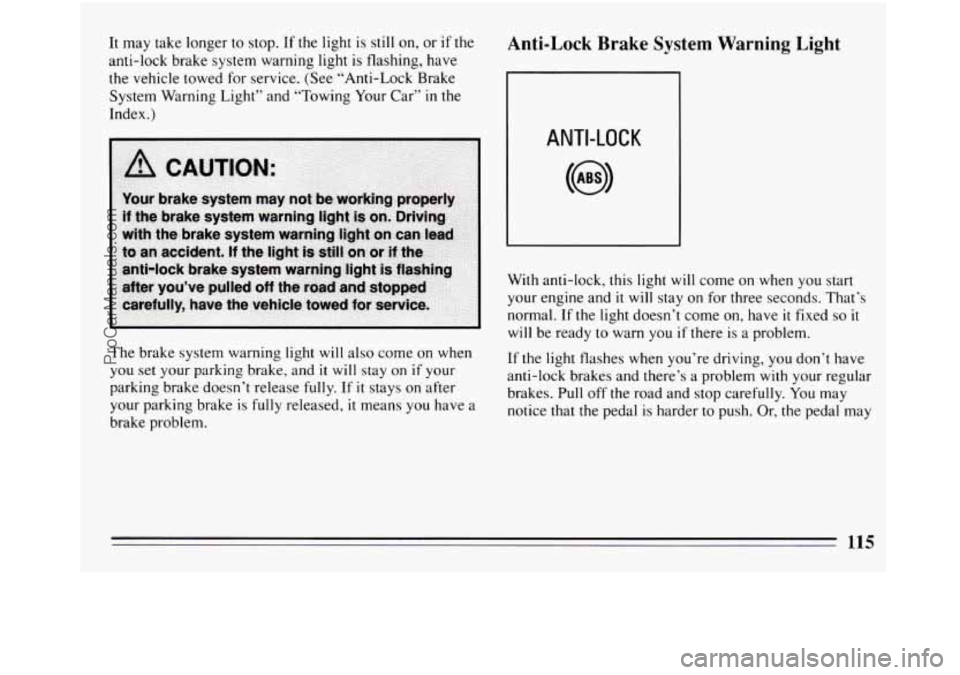
It may take longer to stop. If the light is still on, or if the
anti-lock brake system warning light is flashing, have
the vehicle towed for service. (See “Anti-Lock Brake
System Warning Light” and “Towing Your Car” in the
Index.)
The brake system warning light will also come on when
you
set your parking brake, and it will stay on if your
parking brake doesn’t release
fully. If it stays on after
your parking brake is
fully released, it means you have a
brake problem.
Anti-Lock Brake System Warning Light
ANTI-LOCK
With anti-lock, this light will come on when you start
your engine and
it will stay on for three seconds. That’s
normal. If the light doesn’t come on, have
it fixed so it
will be ready to warn you if there is a problem.
If the light flashes when you’re driving, you don’t have
anti-lock brakes and there’s a problem with your regular
brakes. Pull
off the road and stop carefully. You may
notice that the pedal is harder to push. Or, the pedal may
115
ProCarManuals.com
Page 118 of 308
go closer to the floor. It may take longer to stop. Have
the vehicle towed for service. (See “Towing Your Car”
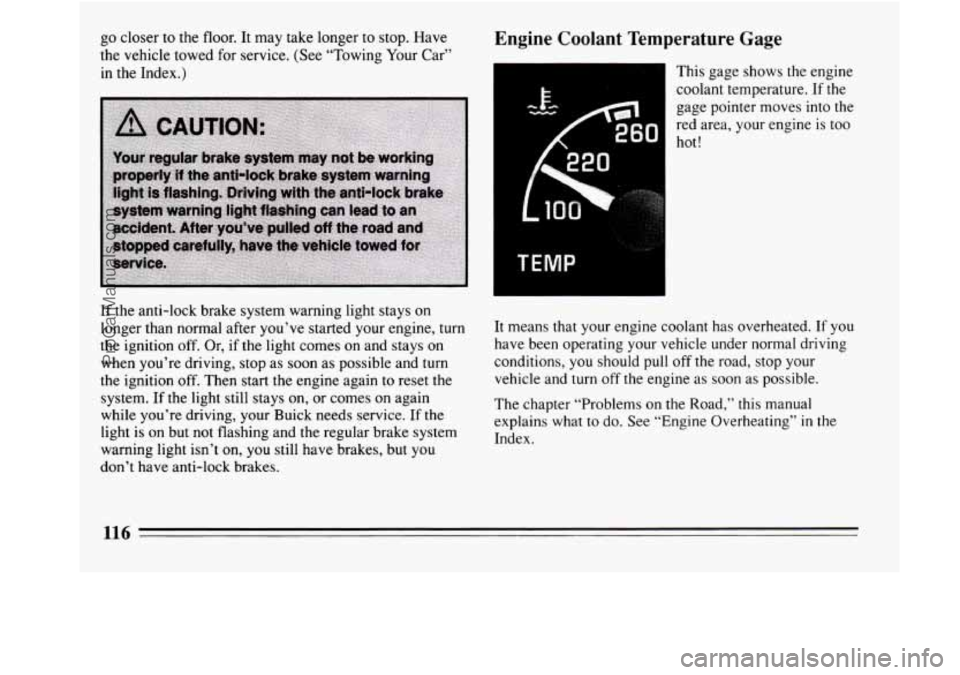
in the Index.) Engine Coolant Temperature Gage
This gage shows the engine
coolant temperature. If the
gage pointer moves into the
red area, your engine
is too
hot!
If the anti-lock brake system warning light stays on
longer than normal after you’ve started your engine, turn
the ignition off. Or,
if the light comes on and stays on
when you’re driving, stop as soon as possible and turn
the ignition off. Then start the engine again to reset the
system. If the light still stays on, or comes on again
while you’re driving, your Buick needs service. If the
light is on but not flashing and the regular brake system
warning light isn’t on,
you still have brakes, but you
don’t have anti-lock brakes. It means
that your engine coolant has overheated. If you
have been operating your vehicle under normal driving
conditions,
you should pull off the road, stop your
vehicle and turn off the engine as soon as possible.
The chapter “Problems on the Road,” this manual
explains what to do. See “Engine Overheating”
in the
Index.
116
ProCarManuals.com
Page 119 of 308
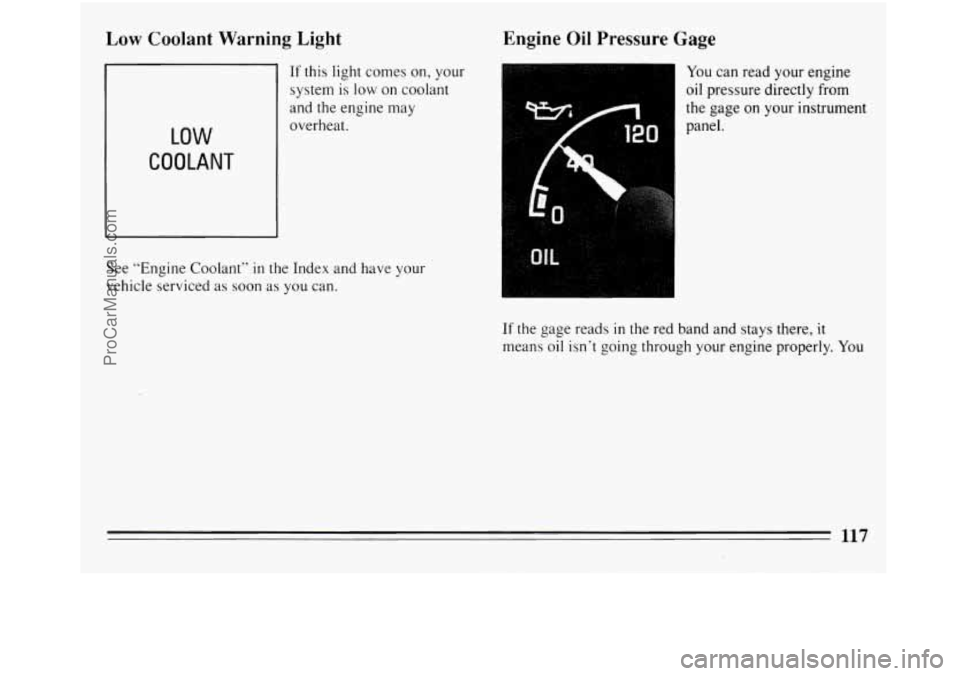
LOW Coolant Warning Light Engine Oil Pressure Gage
LOW
COOLANT
If this light comes on, your
system
is low on coolant
and the engine may
overheat.
See “Engine Coolant”
in the Index and have your
vehicle serviced as soon as you can.
1
You can read your engine
oil pressure directly from
the gage
on your instrument
panel.
If the gage reads in the red band and stays there, it
means oil isn’t going through your engine properly.
You
117
ProCarManuals.com
Page 120 of 308
could be low on oil, or you might have some other oil
problem. Have your vehicle serviced as soon
as you can.
NOTICE:
Damage to your engine from neglected oil
problems can be costly and is not covered by
your warranty.
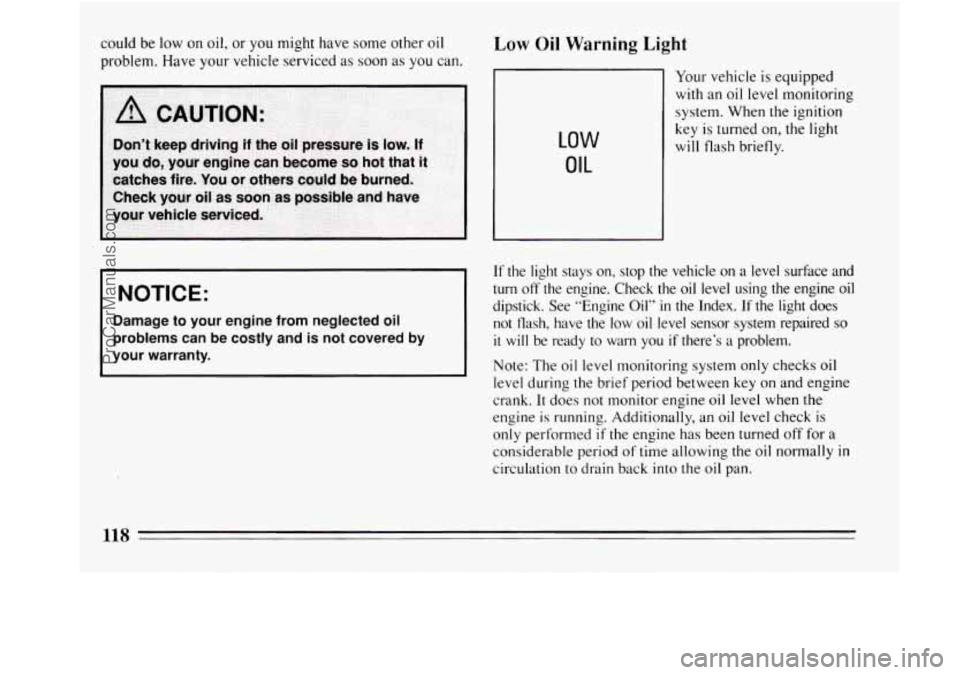
Low Oil Warning Light
LOW
OIL
Your vehicle is equipped
with an oil level monitoring
system. When the ignition
key is turned on, the light
will flash briefly.
If the light stays on, stop the vehicle on a level surface and
turn
off the engine. Check the oil level using the engine oil
dipstick. See “Engine Oil” in the Index. If the light does
not flash, have the low oil level sensor system repaired so
it will be ready to warn you if there’s a problem.
Note: The oil level monitoring system only checks oil
level during the brief period between key
on and engine
crank. It does not monitor engine oil level when the
engine
is running. Additionally, an oil level check is
only performed
if the engine has been turned off for a
considerable period of time allowing the oil normally
in
circulation to drain back into the oil pan.
118
ProCarManuals.com
Page 122 of 308
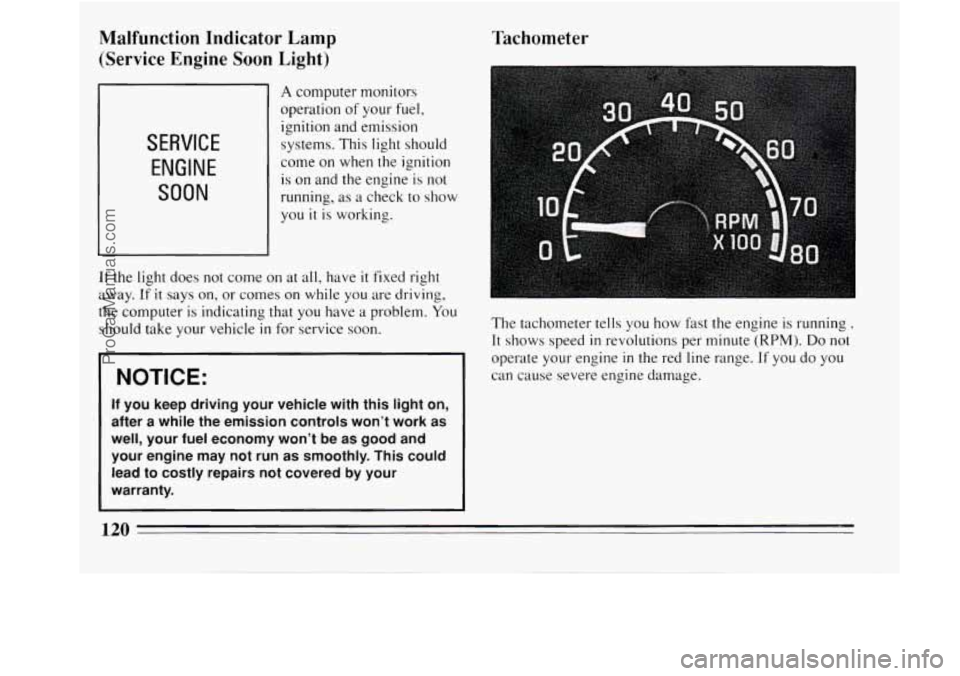
Malfunction Indicator Lamp (Service Engine
Soon Light)
SERVICE
ENGINE
SOON
A computer monitors
operation
of your fuel,
ignition and emission
systems. This light should
come on when the ignition
is on and the engine
is not
running, as a check to show
you
it is working.
If the light does not come on at all, have it fixed right
away.
If it says on, or comes on while you are driving,
the computer
is indicating that you have a problem. You
should take your vehicle in for service soon.
NOTICE:
If you keep driving your vehicle with this light on,
after a while the emission controls won’t work as
well, your fuel economy won’t be as good and
your engine may not run as smoothly. This could
lead to costly repairs not covered by your
~ warranty.
rachometer
The tachometer tells you how fast the engine is running .
It shows speed in revolutions per minute (RPM). Do not
operate your engine
in the red line range. If you do you
can cause severe engine damage.
120
ProCarManuals.com
Page 137 of 308
Care of Your Cassette Tape Player
A tape player that is not cleaned regularly can cause
reduced sound quality, ruined cassettes, or a damaged
mechanism. Cassette tapes should be stored in their
cases away from contaminants, direct sunlight, and
extreme heat. If
they aren't, they may not operate
properly or cause failure of the tape player.
Your tape player should be cleaned regularly each
month or after every
15 hours of use. If you notice a
reduction in sound quality, try
a known good cassette to
see if the tape or the tape player is at fault. If this other
cassette has no improvement in sound quality, clean the
tape player.
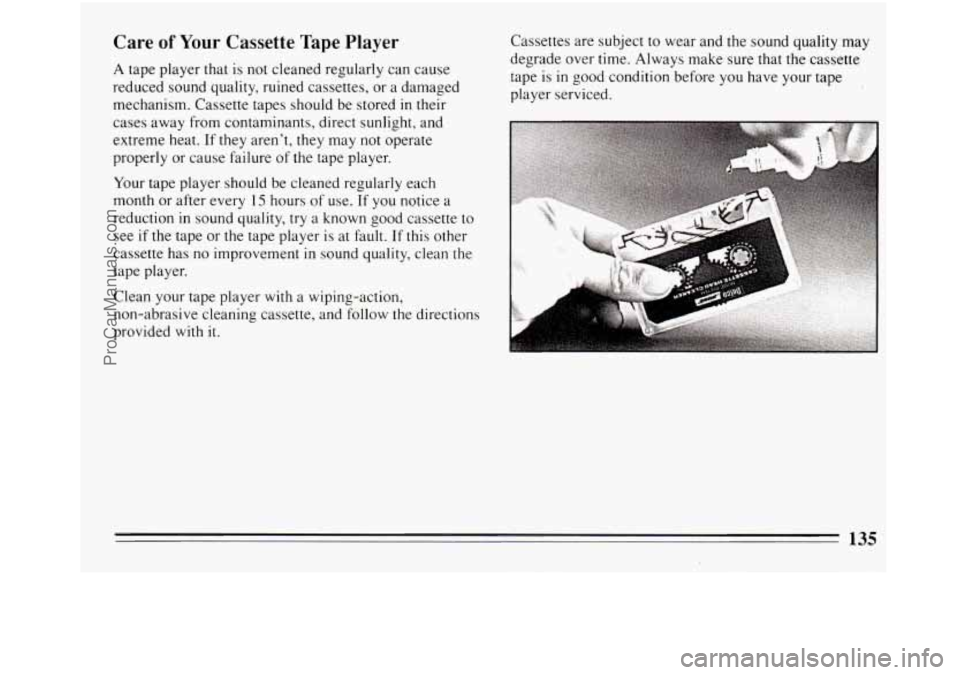
Clean your tape player
with a wiping-action,
non-abrasive cleaning cassette, and follow the directions
provided with
it.
Cassettes are subject to wear and the sound quality may
degrade over time. Always make sure that the cassette
tape is
in good condition before you have your tape
player serviced.
135
ProCarManuals.com
Page 159 of 308
At the entrance there is usually a ramp that leads to the
freeway. If you have a clear view of the freeway as you
drive along the entrance ramp, you should begin to
check traffic. Try
to determine where you expect to
blend with the flow. Try to merge into the gap at close to
the prevailing speed. Switch on your turn signal, check
your mirrors and glance over your shoulder as often as
necessary. Try to blend smoothly
with the traffic flow.
Once you are
on the freeway, adjust your speed to the
posted
limit or to the prevailing rate if it’s slower. Stay
in the right lane unless you want to pass.
Before changing lanes, check your mirrors. Then use
your turn signal.
Just before you leave the lane, glance quickly over your
shoulder to make sure there isn’t another vehicle
in your
“blind” spot.
Once you are moving
on the freeway, make certain you
allow a reasonable following distance. Expect to move
slightly slower at night.
When you want to leave the freeway, move to the proper
lane well
in advance. If you miss your exit do not, under
any circumstances, stop and back up. Drive on
to the
next exit. The exit
ramp can be curved, sometimes quite sharply.
The
exit speed is usually posted.
Reduce your speed according to your speedometer, not
to your sense
of motion. After driving for any distance
at higher speeds, you may tend to
think you are going
slower than you actually are.
Before Leaving on a Long Trip
Make sure you’re ready. Try to be well rested. If you
must start when you’re not fresh
-- such as after a day’s
work
-- don’t plan to make too many miles that first part
of the journey. Wear comfortable clothing and shoes you
can easily drive
in.
Is your vehicle ready for a long trip? If you keep it
serviced and maintained, it’s ready to go. If it needs
service, have
it done before starting out. Of course,
you’ll find experienced and able service experts
in
Buick dealerships all across North America. They’ll be
ready and willing to help if you need it.
157
ProCarManuals.com
Page 160 of 308
Here are some things you can check before a trip:
0
0
0
0
0
0
0
Windshield Washer Fluid: Is the reservoir full? Are
all windows clean inside and outside?
Wiper Blades: Are they
in good shape?
Fuel, Engine Oil, Other Fluids: Have you checked all
levels?
Lights: Are they all working? Are the lenses clean?
Tires: They are vitally important
to a safe,
trouble-free trip. Is the tread good enough for
long-distance driving? Are the tires all inflated to the
recommended pressure?
Weather Forecasts: What’s
the weather outlook along
your route? Should you delay
your trip a short time
to avoid a major storm system?
Maps:
Do you have ur>-to-date maps?
Highway Hypnosis
Is there actually such a condition as “highway hypnosis”?
Or is
it just plain falling asleep at the wheel? Call it
highway hypnosis, lack of awareness, or whatever.
There is something about an easy stretch
of road with the
same scenery, along with the hum of the tires on the road,
the drone of the engine, and the rush of the wind against
the vehicle that can make you sleepy. Don’t let
it happen
to you! If
it does, your vehicle can leave the road in
than a second, and
you could crash and be injured.
What can you do about highway hypnosis? First, be
aware that
it can happen.
Then here are some tips:
0
0
a
Make sure your vehicle is well ventilated, with a
comfortably cool interior.
Keep your eyes moving. Scan the road ahead and to
the sides. Check your rearview mirrors and your
instruments frequently.
If you get sleepy,
pull off the road into a rest, service,
or parking area and take a nap, get some exercise, or
both. For safety, treat drowsiness on the highway as
an emergency.
158
ProCarManuals.com
Page 171 of 308
Parking on Hills
You really should not park your vehicle, with a trailer
attached,
on a hill. If something goes wrong, your rig
could start to move. People can be injured, and both
your vehicle and the trailer can be damaged.
But
if you ever have to park your rig on a hill, here’s
how
to do it:
0 Shift into a gear; and
2. Have someone place chocks under the trailer wheels,
3. When the wheel chocks are in place, release the
regular brakes until the chocks absorb the load.
4. Reapply the regular brakes. Then apply your parking
brake, and
then shift to “P” (Park).
5. Release the regular brakes.
When You Are Ready to Leave After
Parking
on a Hill
0 Release the parking brake.
2. Let up on the brake pedal.
3. Drive slowly until the trailer is clear of the chocks.
4. Stop and have someone pick up and store the chocks.
Maintenance When Trailer Towing
Your vehicle will need service more often when you’re
pulling a trailer. See the Maintenance Schedule for more
on this. Things that are especially important
in trailer
operation are automatic transaxle fluid (don’t overfill),
engine oil, belt, cooling system, and brake adjustment.
Each of these is covered
in this manual, and the Index
will help you find them quickly. If you’re trailering, it’s
a good idea to review these sections before you start
your trip.
Check periodically to see that all hitch nuts and bolts are
tight.
1. Apply your regular brakes and hold the pedal down
while you:
0 Start your engine;
169
ProCarManuals.com
Page 180 of 308
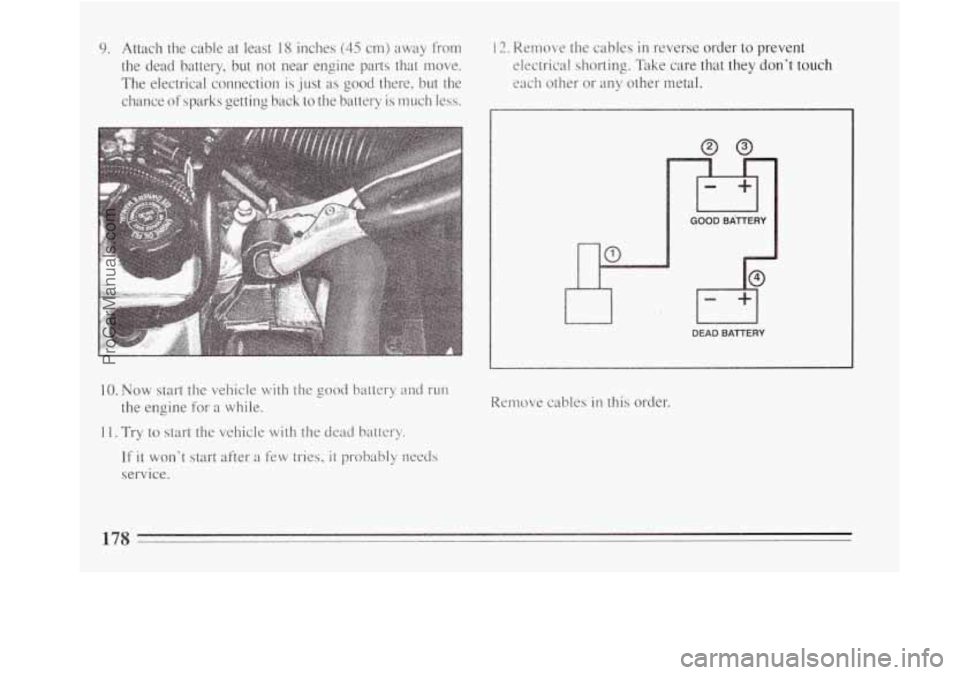
9. Attach the cable at least 18 inches (45 cm) away from
the dead battery, but not near engine parts that move.
The electrical connection is just
as good there? but the
chance
of sparks getting back to the battery is much less.
12. Remove the cables in reverse order to prevent
electrical shorting. Take care that they don’t touch
each other or any other metal.
10. Now start the vehicle with the good battery and run
the engine for a while.
11. Try to start the vehicle with the dead battery.
If it won’t start after a few tries, it probably needs
service.
GOOD BATTERY
DEAD BATTERY
Remove cables in this order.
178
ProCarManuals.com