wheel CADILLAC CT5 2023 Workshop Manual
[x] Cancel search | Manufacturer: CADILLAC, Model Year: 2023, Model line: CT5, Model: CADILLAC CT5 2023Pages: 526, PDF Size: 6.85 MB
Page 241 of 526

Cadillac CT5 Owner Manual (GMNA-Localizing-U.S./Canada-16500419) -
2023 - CRC - 5/10/22
240 Driving and Operating
Driving and
Operating
Driving Information
Driving for Better FuelEconomy . . . . . . . . . . . . . . . . . . . . 241
Distracted Driving . . . . . . . . . 242
Defensive Driving . . . . . . . . . . 242
Impaired Driving . . . . . . . . . . . 243
Control of a Vehicle . . . . . . 243
Braking . . . . . . . . . . . . . . . . . . . . . . . 243
Steering . . . . . . . . . . . . . . . . . . . . . . 244
Off-Road Recovery . . . . . . . 245
Loss of Control . . . . . . . . . . . . 245
Track Events and Competitive Driving
(V-Series and V-Series
Blackwing) . . . . . . . . . . . . . . . . . 246
Driving on Wet Roads . . . . 257
Hill and Mountain Roads . . . . . . . . . . . . . . . . . . . . . . . 258
Winter Driving . . . . . . . . . . . . . . 259
If the Vehicle Is Stuck . . . . . 261
Vehicle Load Limits . . . . . . . 261
Starting and Operating
New Vehicle Break-In . . . . 265
Composite Materials . . . . . 266
Ignition Positions . . . . . . . . . . 267 Starting the Engine . . . . . . . 269
Stop/Start System . . . . . . . . 270
Engine Heater . . . . . . . . . . . . . . 272
Retained Accessory
Power (RAP) . . . . . . . . . . . . . . . 273
Shifting Into Park . . . . . . . . . . 273
Shifting out of Park . . . . . . . 274
Parking (Manual Transmission) . . . . . . . . . . . . . 275
Parking over Things That Burn . . . . . . . . . . . . . . . . . . 275
Active Fuel Management . . . . . . . . . . . . . . 275
Extended Parking . . . . . . . . . 275
Engine Exhaust
Engine Exhaust . . . . . . . . . . . . 276
Running the Vehicle While Parked . . . . . . . . . . . . . . 276
Automatic Transmission
AutomaticTransmission . . . . . . . . . . . . . . 277
Manual Mode . . . . . . . . . . . . . . . 282
Manual Transmission
Manual Transmission . . . . . 283
Active Rev Match . . . . . . . . . 286
Drive Systems
All-Wheel Drive . . . . . . . . . . . . . 287
Brakes
Electric Brake Boost . . . . . . 287
Antilock Brake System (ABS) . . . . . . . . . . . . . 287
Electric Parking Brake . . . 288
Brake Assist . . . . . . . . . . . . . . . . 289
Hill Start Assist (HSA) . . . . 289
Automatic Vehicle Hold (AVH) . . . . . . . . . . . . . . . . . 290
Ride Control Systems
Traction Control/Electronic Stability
Control . . . . . . . . . . . . . . . . . . . . . . 291
Driver Mode Control . . . . . . 293
Competitive Driving Mode . . . . . . . . . . . . . . 299
Limited-Slip
Differential . . . . . . . . . . . . . . . . . 302
Cruise Control
Cruise Control . . . . . . . . . . . . . 302
Adaptive Cruise Control(Advanced) . . . . . . . . . . . . . . . . 305
Super Cruise . . . . . . . . . . . . . . . . 317
Driver Assistance
Systems
Driver Assistance Systems . . . . . . . . . . . . . . . . . . . . 334
Page 243 of 526
Cadillac CT5 Owner Manual (GMNA-Localizing-U.S./Canada-16500419) -
2023 - CRC - 5/10/22
242 Driving and Operating
.Keep vehicle tires properly
inflated.
.Combine several trips into a
single trip.
.Replace the vehicle's tires
with the same TPC Spec
number molded into the
tire's sidewall near the size.
.Follow recommended
scheduled maintenance.
Distracted Driving
Distraction comes in many
forms and can take your focus
from the task of driving.
Exercise good judgment and
do not let other activities
divert your attention away
from the road. Many local
governments have enacted
laws regarding driver
distraction. Become familiar
with the local laws in
your area.
To avoid distracted driving,
keep your eyes on the road,
keep your hands on the
steering wheel, and focus your
attention on driving.
.Do not use a phone in
demanding driving situations.
Use a hands-free method to
place or receive necessary
phone calls.
.Watch the road. Do not read,
take notes, or look up
information on phones or
other electronic devices.
.Designate a front seat
passenger to handle
potential distractions.
.Become familiar with vehicle
features before driving, such
as programming favorite
radio stations and adjusting
climate control and seat
settings. Program all trip
information into any
navigation device prior to
driving.
.Wait until the vehicle is
parked to retrieve items that
have fallen to the floor.
.Stop or park the vehicle to
tend to children.
.Keep pets in an appropriate
carrier or restraint.
.Avoid stressful
conversations while driving,
whether with a passenger or
on a cell phone.
{Warning
Taking your eyes off the
road too long or too often
could cause a crash
resulting in injury or death.
Focus your attention on
driving.
Refer to the infotainment
section for more information
on using that system and the
navigation system, if equipped,
including pairing and using a
cell phone.
Defensive Driving
Defensive driving means
“always expect the
unexpected.” The first step in
driving defensively is to wear
the seat belt. See Seat Belts
0 55.
Page 245 of 526

Cadillac CT5 Owner Manual (GMNA-Localizing-U.S./Canada-16500419) -
2023 - CRC - 5/10/22
244 Driving and Operating
Steering
Caution
To avoid damage to the
steering system, do not
drive over curbs, parking
barriers, or similar objects at
speeds greater than 3 km/h
(1 mph). Use care when
driving over other objects
such as lane dividers and
speed bumps. Damage
caused by misuse of the
vehicle is not covered by the
vehicle warranty.
Variable Effort Steering
The vehicle has a steering
system that varies the amount
of effort required to steer the
vehicle in relation to the speed
of the vehicle.
The amount of steering effort
required is less at slower
speeds to make the vehicle
more maneuverable and easier
to park. At faster speeds, the
steering effort increases to
provide a sport-like feel to the
steering. This provides
maximum control and stability.
Electric Power Steering
The vehicle is equipped with
an electric power steering
system, which reduces the
amount of effort needed to
steer the vehicle. It does not
have power steering fluid.
Regular maintenance is not
required.
If the vehicle experiences a
system malfunction and loses
power steering, greater
steering effort may berequired. Power steering
assist also may be reduced if
you turn the steering wheel as
far as it can turn and hold it
there with force for an
extended period of time.
See your dealer if there is a
problem.
Curve Tips
.Take curves at a reasonable
speed.
.Reduce speed before
entering a curve.
.Maintain a reasonable
steady speed through the
curve.
.Wait until the vehicle is out
of the curve before
accelerating gently into the
straightaway.
Steering in Emergencies
.There are some situations
when steering around a
problem may be more
effective than braking.
Page 246 of 526

Cadillac CT5 Owner Manual (GMNA-Localizing-U.S./Canada-16500419) -
2023 - CRC - 5/10/22
Driving and Operating 245
.Holding both sides of the
steering wheel allows you to
turn 180 degrees without
removing a hand.
.Antilock Brake System (ABS)
allows steering while
braking.
Off-Road Recovery
The vehicle's right wheels can
drop off the edge of a road
onto the shoulder while
driving. Follow these tips:1. Ease off the accelerator and then, if there is
nothing in the way, steer the vehicle so that it
straddles the edge of the
pavement.
2. Turn the steering wheel about one-eighth of a turn,
until the right front tire
contacts the
pavement edge.
3. Turn the steering wheel to go straight down the
roadway.
Loss of Control
Skidding
There are three types of skids
that correspond to the
vehicle's three control
systems:
.Braking Skid —wheels are
not rolling.
.Steering or Cornering Skid —
too much speed or steering
in a curve causes tires to slip
and lose cornering force.
.Acceleration Skid —too
much throttle causes the
driving wheels to spin. Defensive drivers avoid most
skids by taking reasonable
care suited to existing
conditions, and by not
overdriving those conditions.
But skids are always possible.
If the vehicle starts to slide,
follow these suggestions:
.Ease your foot off the
accelerator pedal and steer
the way you want the vehicle
to go. The vehicle may
straighten out. Be ready for
a second skid if it occurs.
.Slow down and adjust your
driving according to weather
conditions. Stopping
distance can be longer and
vehicle control can be
affected when traction is
reduced by water, snow, ice,
gravel, or other material on
the road. Learn to recognize
warning clues
—such as
enough water, ice, or packed
snow on the road to make a
mirrored surface —and slow
down when you have any
doubt.
Page 247 of 526
Cadillac CT5 Owner Manual (GMNA-Localizing-U.S./Canada-16500419) -
2023 - CRC - 5/10/22
246 Driving and Operating
.Try to avoid sudden
steering, acceleration,
or braking, including
reducing vehicle speed by
shifting to a lower gear. Any
sudden changes could cause
the tires to slide.
Remember: Antilock brakes
help avoid only the
braking skid.
Track Events and
Competitive Driving
(V-Series and
V-Series Blackwing)
Before any track event, there
are three features that should
be turned off:
.Automatic Emergency
Braking (AEB). See
Automatic Emergency
Braking (AEB) 0349.
.Lane Keep Assist. See Lane
Keep Assist (LKA) 0356.
.Adaptive Cruise Control. See
Adaptive Cruise Control
(Advanced) 0305.
{Danger
High-performance features
are intended for use only on
closed tracks by
experienced and qualified
drivers and should not be
used on public roads.
High-speed driving,
aggressive cornering, hard
braking, and other
high-performance driving
can be dangerous. Improper
driver inputs for the
conditions may result in loss
of control of the vehicle,
which could injure or kill you
or others. Always drive
safely.
Track events and competitive
driving may affect the vehicle
warranty. See the warranty
manual before using the
vehicle for competitive driving.
{Warning
Some of the adjustments
and procedures specified in
this section may require
specialized skill, training, and
equipment. Failure to
perform these procedures
properly could cause
malfunction, potentially
resulting in death, personal
injury, or damage to the
vehicle or property. Do not
attempt to perform these
adjustments or procedures
unless properly qualified.
{Warning
Prior to each track event
and again before returning
to public roads, tighten the
wheel nuts with a torque
wrench to the proper torque
specification. Wheel nuts
that are improperly or
incorrectly tightened can (Continued)
Page 248 of 526
Cadillac CT5 Owner Manual (GMNA-Localizing-U.S./Canada-16500419) -
2023 - CRC - 5/10/22
Driving and Operating 247
Warning (Continued)
cause the wheels to become
loose or come off, resulting
in a crash. See Capacities
and Specifications0482 for
wheel nut torque
specifications.
Caution
If the vehicle is used for
track events and
competitive driving, the
engine may use more oil
than it would with normal
use. Low oil levels can
damage the engine. Check
the oil level often and
maintain the proper level.
See Engine Oil 0383.
Competitive Driving Mode can
be selected. See Driver Mode
Control 0293.
Seat Belts
Lap-Shoulder Belt
If equipped, the driver seat
belt has an Automatic Locking
Retractor (ALR). This feature
is useful in performance
driving scenarios where the
driver wants to be held in the
seat more tightly to take
advantage of the aggressive
bolstering of the seat.
1. Move the seat 8-10 cm (3-4 in) rearward from the
normal driving position.
2. Pull the driver shoulder belt out as far as it will go,
until it stops, to set the
lock. While holding the
shoulder belt in this
position, buckle the belt.
When the shoulder belt is
released, the retractor will
make a ratchet sound
when it retracts. When the
retractor lock is set, the
belt can be tightened but
not pulled out of the
retractor. 3. Adjust the belt, and then
move the seat forward
8-10 cm (3-4 in) to the
desired driving position.
This will secure the belt.
The belt fit should be tight,
but not uncomfortable.
To unlatch the belt, press
the button on the buckle.
The belt should return to
its stowed position.
Axle Fluid
Axles must have 2 400 km
(1,500 mi) before being used in
track driving.
The front, if equipped with
AWD, and rear axle fluid
temperatures may be higher
than when driving in severe
conditions. Drain and refill with
new fluid after the first racing
or competitive driving event,
and then after every 24 hours
of racing or competitive
driving. See your dealer for
the correct fluid.
Page 254 of 526

Cadillac CT5 Owner Manual (GMNA-Localizing-U.S./Canada-16500419) -
2023 - CRC - 5/10/22
Driving and Operating 253
2. Using the G-Force Gaugein the HUD display, use
enough pedal force to
completely stop the vehicle
in four to five seconds.
(~0.7g Decel level to stop
the vehicle in a straight
line). If ABS activates,
braking is too hard.
3. Repeat the first two steps 20 consecutive times, this
should take about
five minutes.
4. After completing the 20 stops, cool the brakes by
driving for 8 km (5 mi) at
100 km/h (60 mph).
Alternative Closed Course
Brake Burnishing Procedure
This brake burnish procedure
should only be run on vehicles
with a factory equipped brake
system.
This procedure should only be
run on a track and only on dry
pavement. Brake pedal fade
will occur during this track
burnish procedure and can cause brake pedal travel and
force to increase. This could
extend stopping distance until
the brakes are fully burnished.
1. Start track lapping at lower speeds and lower
braking efforts for
three minutes of driving.
Allow for increased braking
distances due to reduced
brake output.
2. After Step 1, increase speed and braking effort
for the next six minutes of
lapping, gradually ending
up at 90% effort. Continue
to allow for increased
braking distance due to
reduced brake output.
3. Cool the brakes by lapping with minimal light braking
for six minutes.
Wheel Alignment
Wheel alignment suggested
specs for track use:
Road Course (V-Series)
.Front: -2.0 deg camber,
0.2 deg total toe
.Rear: -1.7 deg camber,
0.2 deg total toe
Road Course (V-Series
Blackwing)
.Front: -2.5 deg camber,
0.1 deg total toe
.Rear: -1.5 deg camber,
0.1 deg total toe
Tire Inflation Pressure
Guidelines
Tire inflation pressures affect
vehicle handling and tire life,
and should be adjusted for
various types of tracks/
courses.
Inspect the tires prior to every
track/course session. Track/
course driving will reduce the
tire tread life.
To maximize tire life, drive
800 km (500 mi) prior to
racetrack driving or complete
the minimum track running
that will increase the tire
pressures by 35 kPa (5 psi).
After this, immediately let the
tires cool to cold pressures.
Page 256 of 526
Cadillac CT5 Owner Manual (GMNA-Localizing-U.S./Canada-16500419) -
2023 - CRC - 5/10/22
Driving and Operating 255
.Performance Traction
Management (PTM) Mode
must be enabled. See Driver
Mode Control0293.
.The steering wheel must be
straight.
.The driver door must be
closed.
.The transmission must be in
D (Drive) or forward gear.
.The parking brake must not
be engaged.
For more information on
Competitive Driving Mode, see
Competitive Driving Mode
0 299.
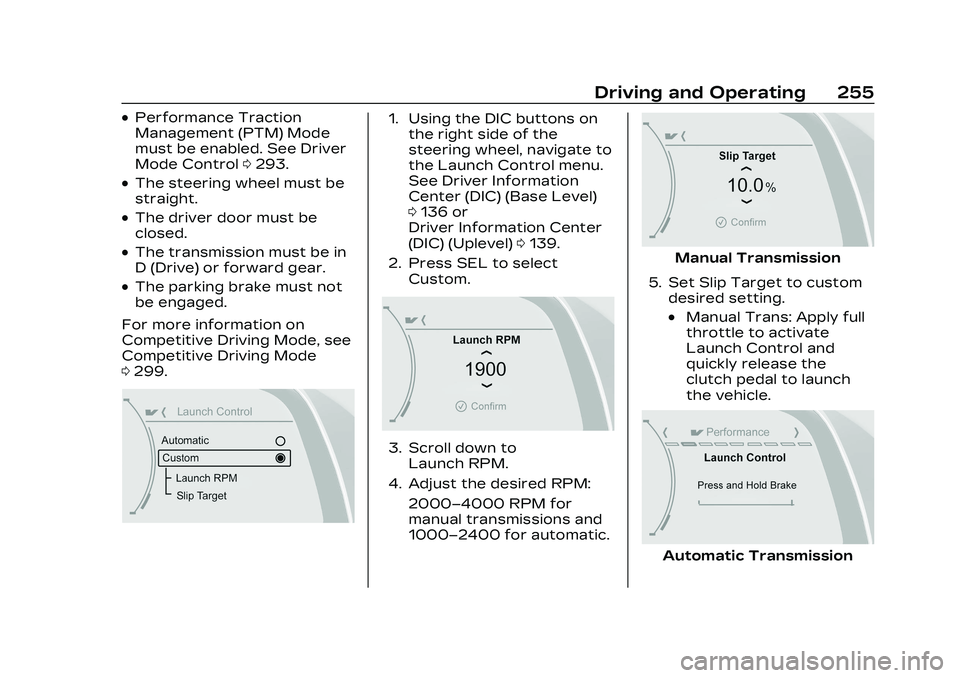
1. Using the DIC buttons on
the right side of the
steering wheel, navigate to
the Launch Control menu.
See Driver Information
Center (DIC) (Base Level)
0136 or
Driver Information Center
(DIC) (Uplevel) 0139.
2. Press SEL to select Custom.
3. Scroll down toLaunch RPM.
4. Adjust the desired RPM: 2000–4000 RPM for
manual transmissions and
1000–2400 for automatic.
Manual Transmission
5. Set Slip Target to custom desired setting.
.Manual Trans: Apply full
throttle to activate
Launch Control and
quickly release the
clutch pedal to launch
the vehicle.
Automatic Transmission
Page 257 of 526

Cadillac CT5 Owner Manual (GMNA-Localizing-U.S./Canada-16500419) -
2023 - CRC - 5/10/22
256 Driving and Operating
.Auto Trans: Firmly press
and hold the brake pedal
to activate Launch
Control.
6. Auto Trans Only - Quicklyapply full throttle. Release
the brake pedal to launch
the vehicle.
Line Lock (If Equipped)
{Warning
The vehicle may move
unexpectedly when using
Line Lock, which could cause
injury to persons or property
located nearby. Only use
Line Lock on a closed track
where there is a large clear
(Continued)
Warning (Continued)
area around all sides of the
vehicle. Be ready to apply
the brakes immediately if the
vehicle begins to move. Do
not use Line Lock in an area
that is accessible to the
public or where people or
property are located near
the vehicle.
Caution
Attempting to shift when
the drive wheels are
spinning and do not have
traction may cause damage
to the transmission. Damage
caused by misuse of the
vehicle is not covered by the
vehicle warranty. Do not
attempt to shift when the
drive wheels do not have
traction. Line Lock allows for locking
the front brakes
independently of the rear
brakes. This allows the rear
tires to spin when the throttle
is applied.
To enter Line Lock, all of
these conditions must be met:
.The vehicle must be in
Track Mode.
.Performance Traction
Management (PTM) Mode
must be enabled.
.The steering wheel must be
straight.
.The driver door must be
closed.
.The vehicle must be in D
(Drive) for an automatic
transmission or 1 (First) gear
for a manual transmission.
.The parking brake must not
be engaged.
.The vehicle must be stopped
on level ground. The
accelerator pedal must not
be applied.
Page 258 of 526
Cadillac CT5 Owner Manual (GMNA-Localizing-U.S./Canada-16500419) -
2023 - CRC - 5/10/22
Driving and Operating 257
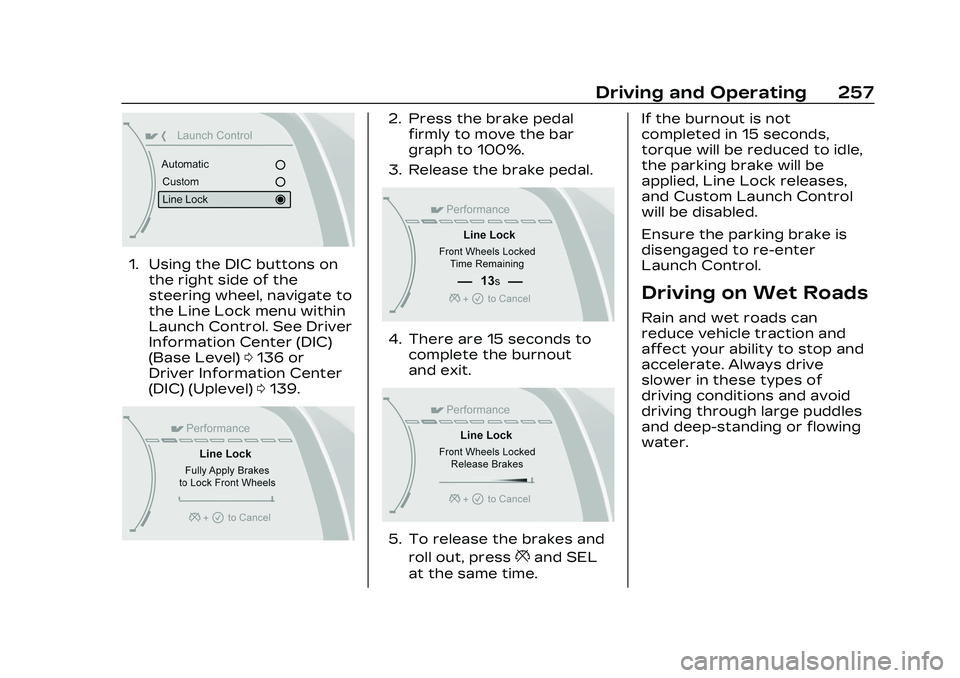
1. Using the DIC buttons onthe right side of the
steering wheel, navigate to
the Line Lock menu within
Launch Control. See Driver
Information Center (DIC)
(Base Level) 0136 or
Driver Information Center
(DIC) (Uplevel) 0139.
2. Press the brake pedal
firmly to move the bar
graph to 100%.
3. Release the brake pedal.
4. There are 15 seconds to complete the burnout
and exit.
5. To release the brakes and
roll out, press
*and SEL
at the same time. If the burnout is not
completed in 15 seconds,
torque will be reduced to idle,
the parking brake will be
applied, Line Lock releases,
and Custom Launch Control
will be disabled.
Ensure the parking brake is
disengaged to re-enter
Launch Control.
Driving on Wet Roads
Rain and wet roads can
reduce vehicle traction and
affect your ability to stop and
accelerate. Always drive
slower in these types of
driving conditions and avoid
driving through large puddles
and deep-standing or flowing
water.