service CADILLAC ESCALADE 2010 3.G Repair Manual
[x] Cancel search | Manufacturer: CADILLAC, Model Year: 2010, Model line: ESCALADE, Model: CADILLAC ESCALADE 2010 3.GPages: 616, PDF Size: 39.41 MB
Page 416 of 616

Other Rainy Weather Tips
Besides slowing down, other wet weather drivingtips include:
.Allow extra following distance.
.Pass with caution.
.Keep windshield wiping equipment in good shape.
.Keep the windshield washer fluid reservoir filled.
.Have good tires with proper tread depth.SeeTires on page 7!58.
.Turn off cruise control.
Before Leaving on a Long Trip
To prepare your vehicle for a long trip, consider havingit serviced by your dealer/retailer before departing.
Things to check on your own include:
.Windshield Washer Fluid:Reservoir full?Windows clean—inside and outside?
.Wiper Blades:In good shape?
.Fuel, Engine Oil, Other Fluids:All levels checked?
.Lamps:Do they all work and are lenses clean?
.Tires:Are treads good? Are tires inflated torecommended pressure?
.Weather and Maps:Safe to travel?Have up-to-date maps?
Highway Hypnosis
Always be alert and pay attention to your surroundingswhile driving. If you become tired or sleepy, find a safeplace to park your vehicle and rest.
Other driving tips include:
.Keep the vehicle well ventilated.
.Keep interior temperature cool.
.Keep your eyes moving—scan the roadahead and to the sides.
.Check the rearview mirror and vehicleinstruments often.
6-26
Page 417 of 616

Hill and Mountain Roads
Driving on steep hills or through mountains is differentthan driving on flat or rolling terrain. Tips for driving inthese conditions include:
.Keep the vehicle serviced and in good shape.
.Check all fluid levels and brakes, tires, coolingsystem, and transmission.
.Going down steep or long hills, shift to alower gear.
{WARNING:
If you do not shift down, the brakes could get so
hot that they would not work well. You would then
have poor braking or even none going down a hill.
You could crash. Shift down to let the engine
assist the brakes on a steep downhill slope.
{WARNING:
Coasting downhill in N (Neutral) or with the
ignition off is dangerous. The brakes will have to
do all the work of slowing down and they could
get so hot that they would not work well. You
would then have poor braking or even none going
down a hill. You could crash. Always have the
engine running and the vehicle in gear when
going downhill.
.Stay in your own lane. Do not swing wide or cutacross the center of the road. Drive at speeds thatlet you stay in your own lane.
.Top of hills: Be alert—something could be in yourlane (stalled car, accident).
.Pay attention to special road signs (falling rocksarea, winding roads, long grades, passing orno-passing zones) and take appropriate action.
SeeOff-Road Drivingon page 6!13for informationabout driving off-road.
6-27
Page 418 of 616
Winter Driving
Driving on Snow or Ice
Drive carefully when there is snow or ice between thetires and the road, creating less traction or grip. Wet icecan occur at about 0°C (32°F) when freezing rainbegins to fall, resulting in even less traction. Avoiddriving on wet ice or in freezing rain until roads can betreated with salt or sand.
Drive with caution, whatever the condition. Accelerategently so traction is not lost. Accelerating too quicklycauses the wheels to spin and makes the surface underthe tires slick, so there is even less traction.
Try not to break the fragile traction. If you accelerate toofast, the drive wheels will spin and polish the surfaceunder the tires even more.
TheStabiliTrak®Systemo n p a g e 6!6improves theability to accelerate on slippery roads, but slow downand adjust your driving to the road conditions. Whendriving through deep snow, turn off the traction controlpart of the StabiliTrak®System to help maintain vehiclemotion at lower speeds.
TheAntilock Brake System (ABS)o n p a g e 6!5improves vehicle stability during hard stops on aslippery roads, but apply the brakes sooner than whenon dry pavement.
Allow greater following distance on any slippery roadand watch for slippery spots. Icy patches can occur onotherwise clear roads in shaded areas. The surfaceof a curve or an overpass can remain icy when thesurrounding roads are clear. Avoid sudden steeringmaneuvers and braking while on ice.
Turn off cruise control, if equipped, on slippery surfaces.
Blizzard Conditions
Being stuck in snow can be in a serious situation. Staywith the vehicle unless there is help nearby. If possible,use theRoadside Serviceo n p a g e 9!8. To get helpand keep everyone in the vehicle safe:
.Turn on theHazard Warning Flashersonp a g e 4!3.
.Tie a red cloth to an outside mirror.
6-28
Page 428 of 616
The system is activated when the ignition key
is turned to RUN and will automatically adjust
vehicle height thereafter. The system may exhaust
(lower vehicle height) for up to 10 minutes after
the ignition key has been turned to LOCK. You
may hear the air compressor operating when the
height is being adjusted.
If a weight-distributing hitch is being used, it is
recommended to allow the shocks to inflate,
thereby leveling the vehicle prior to adjusting the
height. See“Weight distributing Hitches and
Weight Carrying Hitches”underTowing a Trailer
on page 6!42.
Towing
Towing Your Vehicle
To avoid damage, the disabled vehicle should betowed with all four wheels off the ground. Consult yourdealer/retailer or a professional towing service if thedisabled vehicle must be towed. SeeRoadside Serviceo n p a g e 9!8.
To tow the vehicle behind another vehicle forrecreational purposes (such as behind a motorhome),see“Recreational Vehicle Towing”following.
Recreational Vehicle Towing
If the vehicle has a two–mode hybrid engine, see theTwo–mode Hybrid manual for more information.
Recreational vehicle towing means towing the vehiclebehind another vehicle–such as behind a motorhome.The two most common types of recreational vehicletowing are known as“dinghy towing”(towing the vehiclewith all four wheels on the ground) and“dolly towing”(towing the vehicle with two wheels on the ground andtwo wheels up on a device known as a“dolly”).
Here are some important things to consider beforerecreational vehicle towing:
.What is the towing capacity of the towing vehicle?Be sure to read the tow vehicle manufacturer'srecommendations.
.What is the distance that will be travelled? Somevehicles have restrictions on how far and how longthey can tow.
.Is the proper towing equipment going to be used?See your dealer/retailer or trailering professionalfor additional advice and equipmentrecommendations.
.Is the vehicle ready to be towed? Just as preparingthe vehicle for a long trip, make sure the vehicle isprepared to be towed. SeeBefore Leaving on aLong Trip on page 6!26.
6-38
Page 443 of 616
4. Reapply the brake pedal. Then apply the parkingbrake and shift into P (Park).
5. Release the brake pedal.
{WARNING:
It can be dangerous to get out of the vehicle if the
shift lever is not fully in P (Park) with the parking
brake firmly set. The vehicle can roll.
If the engine has been left running, the vehicle
can move suddenly. You or others could be
injured. To be sure the vehicle will not move, even
when on fairly level ground, always put the shift
lever fully in P (Park) with the parking brake
firmly set.
Leaving After Parking on a Hill
1. Apply and hold the brake pedal.
2. Start the engine
3. Shift into a gear
4. Release the parking brake
5. Let up on the brake pedal.
6. Drive slowly until the trailer is clear of the chocks.
7. Stop and have someone pick up and storethe chocks.
Maintenance When Trailer Towing
The vehicle needs service more often when pulling atrailer. See this manual's Maintenance Schedule orIndex for more information. Things that are especiallyimportant in trailer operation are automatic transmissionfluid, engine oil, axle lubricant, belts, cooling systemand brake system. It is a good idea to inspect thesebefore and during the trip.
Check periodically to see that all hitch nuts and boltsare tight.
6-53
Page 444 of 616
Trailer Wiring Harness
Heavy-Duty Trailer Wiring Harness Package
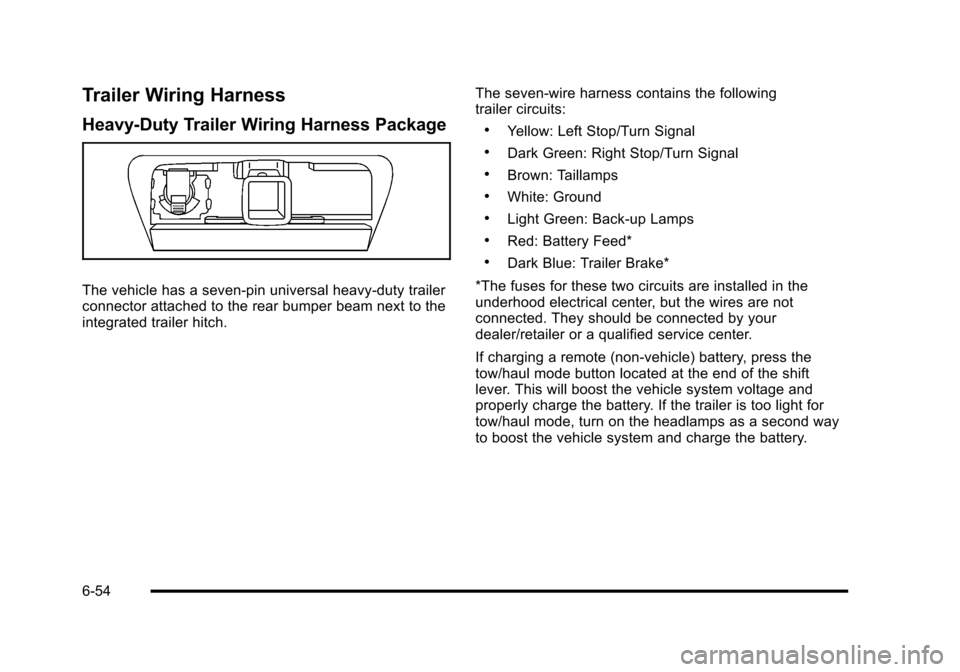
The vehicle has a seven-pin universal heavy-duty trailerconnector attached to the rear bumper beam next to theintegrated trailer hitch.
The seven-wire harness contains the followingtrailer circuits:
.Yellow: Left Stop/Turn Signal
.Dark Green: Right Stop/Turn Signal
.Brown: Taillamps
.White: Ground
.Light Green: Back-up Lamps
.Red: Battery Feed*
.Dark Blue: Trailer Brake*
*The fuses for these two circuits are installed in theunderhood electrical center, but the wires are notconnected. They should be connected by yourdealer/retailer or a qualified service center.
If charging a remote (non-vehicle) battery, press thetow/haul mode button located at the end of the shiftlever. This will boost the vehicle system voltage andproperly charge the battery. If the trailer is too light fortow/haul mode, turn on the headlamps as a second wayto boost the vehicle system and charge the battery.
6-54
Page 445 of 616
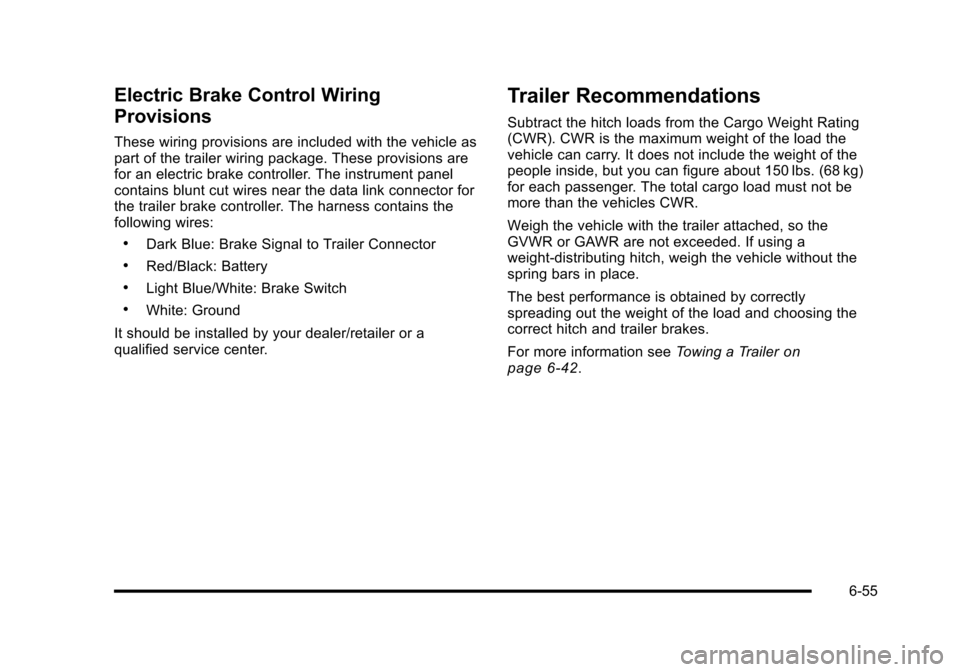
Electric Brake Control Wiring
Provisions
These wiring provisions are included with the vehicle aspart of the trailer wiring package. These provisions arefor an electric brake controller. The instrument panelcontains blunt cut wires near the data link connector forthe trailer brake controller. The harness contains thefollowing wires:
.Dark Blue: Brake Signal to Trailer Connector
.Red/Black: Battery
.Light Blue/White: Brake Switch
.White: Ground
It should be installed by your dealer/retailer or aqualified service center.
Trailer Recommendations
Subtract the hitch loads from the Cargo Weight Rating(CWR). CWR is the maximum weight of the load thevehicle can carry. It does not include the weight of thepeople inside, but you can figure about 150 lbs. (68 kg)for each passenger. The total cargo load must not bemore than the vehicles CWR.
Weigh the vehicle with the trailer attached, so theGVWR or GAWR are not exceeded. If using aweight-distributing hitch, weigh the vehicle without thespring bars in place.
The best performance is obtained by correctlyspreading out the weight of the load and choosing thecorrect hitch and trailer brakes.
For more information seeTowing a Traileronpage 6!42.
6-55
Page 447 of 616
Section 7 Service and Appearance Care
Service. . . . . . . . . . . . . . . . . . . . . . . . . . . . . . . . . . . . . . . . . . . . . 7-4Accessories and Modifications . . . . . . . . . . . . . . . . . . 7-4California Proposition 65 Warning . . . . . . . . . . . . . . . 7-5California Perchlorate MaterialsRequirements . . . . . . . . . . . . . . . . . . . . . . . . . . . . . . . . . 7-5Doing Your Own Service Work . . . . . . . . . . . . . . . . . . 7-6Adding Equipment to the Outside of theVehicle . . . . . . . . . . . . . . . . . . . . . . . . . . . . . . . . . . . . . . . . 7-6
Fuel. . . . . . . . . . . . . . . . . . . . . . . . . . . . . . . . . . . . . . . . . . . . . . . . . 7-7Gasoline Octane . . . . . . . . . . . . . . . . . . . . . . . . . . . . . . . . 7-8Gasoline Specifications . . . . . . . . . . . . . . . . . . . . . . . . . 7-8California Fuel . . . . . . . . . . . . . . . . . . . . . . . . . . . . . . . . . . 7-8Additives . . . . . . . . . . . . . . . . . . . . . . . . . . . . . . . . . . . . . . . . 7-9Fuel E85 (85% Ethanol) . . . . . . . . . . . . . . . . . . . . . . . . . 7-9Fuels in Foreign Countries . . . . . . . . . . . . . . . . . . . . . 7-10Filling the Tank . . . . . . . . . . . . . . . . . . . . . . . . . . . . . . . . . 7-11Filling a Portable Fuel Container . . . . . . . . . . . . . . . 7-13
Checking Things Under the Hood. . . . . . . . . . . . . . . 7-14Hood Release . . . . . . . . . . . . . . . . . . . . . . . . . . . . . . . . . 7-15Engine Compartment Overview . . . . . . . . . . . . . . . . 7-16Engine Oil . . . . . . . . . . . . . . . . . . . . . . . . . . . . . . . . . . . . . 7-17Engine Oil Life System . . . . . . . . . . . . . . . . . . . . . . . . 7-20Engine Air Cleaner/Filter . . . . . . . . . . . . . . . . . . . . . . . 7-22
Automatic Transmission Fluid . . . . . . . . . . . . . . . . . . 7-24Cooling System . . . . . . . . . . . . . . . . . . . . . . . . . . . . . . . . 7-28Engine Coolant . . . . . . . . . . . . . . . . . . . . . . . . . . . . . . . . 7-29Engine Overheating . . . . . . . . . . . . . . . . . . . . . . . . . . . 7-34Overheated Engine ProtectionOperating Mode . . . . . . . . . . . . . . . . . . . . . . . . . . . . . 7-37Engine Fan Noise . . . . . . . . . . . . . . . . . . . . . . . . . . . . . 7-37Power Steering Fluid . . . . . . . . . . . . . . . . . . . . . . . . . . 7-38Windshield Washer Fluid . . . . . . . . . . . . . . . . . . . . . . 7-39Brakes . . . . . . . . . . . . . . . . . . . . . . . . . . . . . . . . . . . . . . . . . 7-40Battery . . . . . . . . . . . . . . . . . . . . . . . . . . . . . . . . . . . . . . . . . 7-43Jump Starting . . . . . . . . . . . . . . . . . . . . . . . . . . . . . . . . . . 7-44
All-Wheel Drive. . . . . . . . . . . . . . . . . . . . . . . . . . . . . . . . . . . 7-49
Rear Axle. . . . . . . . . . . . . . . . . . . . . . . . . . . . . . . . . . . . . . . . . 7-50
Front Axle. . . . . . . . . . . . . . . . . . . . . . . . . . . . . . . . . . . . . . . . . 7-51
Headlamp Aiming. . . . . . . . . . . . . . . . . . . . . . . . . . . . . . . . 7-52
Bulb Replacement. . . . . . . . . . . . . . . . . . . . . . . . . . . . . . . . 7-54High Intensity Discharge (HID) Lighting . . . . . . . . 7-54LED Lighting . . . . . . . . . . . . . . . . . . . . . . . . . . . . . . . . . . . 7-55Back-Up Lamps . . . . . . . . . . . . . . . . . . . . . . . . . . . . . . . 7-55License Plate Lamp . . . . . . . . . . . . . . . . . . . . . . . . . . . . 7-56Replacement Bulbs . . . . . . . . . . . . . . . . . . . . . . . . . . . . 7-56
7-1
Page 448 of 616
Section 7 Service and Appearance Care
Windshield Wiper Blade Replacement. . . . . . . . . . . 7-57
Tires. . . . . . . . . . . . . . . . . . . . . . . . . . . . . . . . . . . . . . . . . . . . . . . 7-58Tire Sidewall Labeling . . . . . . . . . . . . . . . . . . . . . . . . . 7-60Tire Terminology and Definitions . . . . . . . . . . . . . . . 7-62Inflation - Tire Pressure . . . . . . . . . . . . . . . . . . . . . . . . 7-65High-Speed Operation . . . . . . . . . . . . . . . . . . . . . . . . . 7-66Tire Pressure Monitor System . . . . . . . . . . . . . . . . . 7-67Tire Pressure Monitor Operation . . . . . . . . . . . . . . . 7-68Tire Inspection and Rotation . . . . . . . . . . . . . . . . . . . 7-71When It Is Time for New Tires . . . . . . . . . . . . . . . . . 7-73Buying New Tires . . . . . . . . . . . . . . . . . . . . . . . . . . . . . . 7-73Different Size Tires and Wheels . . . . . . . . . . . . . . . 7-75Uniform Tire Quality Grading . . . . . . . . . . . . . . . . . . . 7-76Wheel Alignment and Tire Balance . . . . . . . . . . . . 7-77Wheel Replacement . . . . . . . . . . . . . . . . . . . . . . . . . . . 7-77Tire Chains . . . . . . . . . . . . . . . . . . . . . . . . . . . . . . . . . . . . 7-78If a Tire Goes Flat . . . . . . . . . . . . . . . . . . . . . . . . . . . . . 7-79Changing a Flat Tire . . . . . . . . . . . . . . . . . . . . . . . . . . . 7-80Removing the Spare Tire and Tools . . . . . . . . . . . . 7-81Removing the Flat Tire and Installing theSpare Tire . . . . . . . . . . . . . . . . . . . . . . . . . . . . . . . . . . . 7-86Secondary Latch System . . . . . . . . . . . . . . . . . . . . . . 7-91Storing a Flat or Spare Tire and Tools . . . . . . . . . 7-94Spare Tire . . . . . . . . . . . . . . . . . . . . . . . . . . . . . . . . . . . . . 7-98
Appearance Care. . . . . . . . . . . . . . . . . . . . . . . . . . . . . . . . . 7-98Interior Cleaning . . . . . . . . . . . . . . . . . . . . . . . . . . . . . . 7-98Fabric/Carpet . . . . . . . . . . . . . . . . . . . . . . . . . . . . . . . . . . 7-99Leather . . . . . . . . . . . . . . . . . . . . . . . . . . . . . . . . . . . . . . . 7-100Instrument Panel, Vinyl, and Other PlasticSurfaces . . . . . . . . . . . . . . . . . . . . . . . . . . . . . . . . . . . 7-101Wood Panels . . . . . . . . . . . . . . . . . . . . . . . . . . . . . . . . . 7-101Speaker Covers . . . . . . . . . . . . . . . . . . . . . . . . . . . . . . 7-101Care of Safety Belts . . . . . . . . . . . . . . . . . . . . . . . . . . 7-102Weatherstrips . . . . . . . . . . . . . . . . . . . . . . . . . . . . . . . . 7-102Washing Your Vehicle . . . . . . . . . . . . . . . . . . . . . . . . 7-102Cleaning Exterior Lamps/Lenses . . . . . . . . . . . . . 7-103Finish Care . . . . . . . . . . . . . . . . . . . . . . . . . . . . . . . . . . . 7-103Windshield, Backglass, and Wiper Blades . . . . 7-104Aluminum or Chrome-Plated Wheelsand Trim . . . . . . . . . . . . . . . . . . . . . . . . . . . . . . . . . . . 7-104Tires . . . . . . . . . . . . . . . . . . . . . . . . . . . . . . . . . . . . . . . . . . 7-105Sheet Metal Damage . . . . . . . . . . . . . . . . . . . . . . . . . 7-105Finish Damage . . . . . . . . . . . . . . . . . . . . . . . . . . . . . . . 7-106Underbody Maintenance . . . . . . . . . . . . . . . . . . . . . 7-106Chemical Paint Spotting . . . . . . . . . . . . . . . . . . . . . . 7-106
Vehicle Identification. . . . . . . . . . . . . . . . . . . . . . . . . . . . 7-107Vehicle Identification Number (VIN) . . . . . . . . . . . 7-107Service Parts Identification Label . . . . . . . . . . . . . 7-107
7-2
Page 449 of 616
Section 7 Service and Appearance Care
Electrical System. . . . . . . . . . . . . . . . . . . . . . . . . . . . . . . . 7-108Add-On Electrical Equipment . . . . . . . . . . . . . . . . . 7-108Windshield Wiper Fuses . . . . . . . . . . . . . . . . . . . . . . 7-108Power Windows and Other Power Options . . . 7-108Fuses and Circuit Breakers . . . . . . . . . . . . . . . . . . . 7-108
Instrument Panel Fuse Block . . . . . . . . . . . . . . . . . 7-109Center Instrument Panel Fuse Block . . . . . . . . . . 7-110Underhood Fuse Block . . . . . . . . . . . . . . . . . . . . . . . 7-111
Capacities and Specifications. . . . . . . . . . . . . . . . . . 7-115
7-3