tow CADILLAC ESCALADE 2010 3.G Manual PDF
[x] Cancel search | Manufacturer: CADILLAC, Model Year: 2010, Model line: ESCALADE, Model: CADILLAC ESCALADE 2010 3.GPages: 616, PDF Size: 39.41 MB
Page 470 of 616
Automatic Transmission Fluid
When to Check and Change Automatic
Transmission Fluid
It is usually not necessary to check the transmissionfluid level. The only reason for fluid loss is atransmission leak or overheating the transmission.If you suspect a small leak, then use the followingchecking procedures to check the fluid level. However,if there is a large leak, then it may be necessary to havethe vehicle towed to a dealer/retailer service departmentand have it repaired before driving the vehicle further.
Notice:Use of the incorrect automatic transmissionfluid may damage the vehicle, and the damages maynot be covered by the vehicle's warranty. Alwaysuse the automatic transmission fluid listed inRecommended Fluids and Lubricants on page 8!10.
Change the fluid and filter at the intervals listed in theMaintenance Schedule. SeeScheduled Maintenanceo n p a g e 8!3. Be sure to use the transmission fluidlisted inRecommended Fluids and Lubricantsonpage 8!10.
How to Check Automatic Transmission
Fluid
Notice:Too much or too little fluid can damage yourtransmission. Too much can mean that some of thefluid could come out and fall on hot engine parts orexhaust system parts, starting a fire. Too little fluidcould cause the transmission to overheat. Be sureto get an accurate reading if you check yourtransmission fluid.
Before checking the fluid level, prepare the vehicle asfollows:
1. Start the engine and park the vehicle on a levelsurface. Keep the engine running.
2. Apply the parking brake and place the shiftlever in P (Park).
3. With your foot on the brake pedal, move the shiftlever through each gear range, pausing for aboutthree seconds in each range. Then, move the shiftlever back to P (Park).
7-24
Page 471 of 616

4. Allow the engine to idle (500–800 rpm) for at leastone minute. Slowly release the brake pedal.
5. Keep the engine running and press the Trip/Fuelbutton or trip odometer reset stem until TRANSTEMP (Transmission Temperature) displays on theDriver Information Center (DIC).
6. Using the TRANS TEMP reading, determine andperform the appropriate check procedure. If theTRANS TEMP reading is not within the requiredtemperature ranges, allow the vehicle to cool,or operate the vehicle until the appropriatetransmission fluid temperature is reached.
Cold Check Procedure
Use this procedure only as a reference to determine ifthe transmission has enough fluid to be operated safelyuntil a hot check procedure can be made. The hotcheck procedure is the most accurate method to checkthe fluid level. Perform the hot check procedure at the
first opportunity. Use this cold check procedure to checkfluid level when the transmission temperature isbetween 80°F and 90°F (27°C and 32°C).
1. Locate thetransmission dipstick atthe rear of the enginecompartment, on thepassenger side of thevehicle.
SeeEngine Compartment Overviewon page 7!16for more information.
2. Flip the handle up and then pull out the dipstickand wipe it with a clean rag or paper towel.
3. Install the dipstick by pushing it back in all the way,wait three seconds, and then pull it back out again.
4. Check both sides of the dipstick and read the lowerlevel. Repeat the check procedure to verify thereading.
7-25
Page 472 of 616

5. If the fluid level is below the COLD check band,add only enough fluid as necessary to bring thelevel into the COLD band. It does not take muchfluid, generally less than one pint (0.5L). Do notoverfill.
6. Perform a hot check at the first opportunity afterthe transmission reaches a normal operatingtemperature between 160°F to 200°F (71°Cto 93°C).
7. If the fluid level is in the acceptable range, pushthe dipstick back in all the way, then flip the handledown to lock the dipstick in place.
Hot Check Procedure
Use this procedure to check the transmission fluid levelwhen the transmission fluid temperature is between160°F and 200°F (71°C and 93°C).
The hot check is the most accurate method to check thefluid level. The hot check should be performed at thefirst opportunity in order to verify the cold check. Thefluid level rises as fluid temperature increases, so it isimportant to ensure the transmission temperature iswithin range.
1. Locate thetransmission dipstick atthe rear of the enginecompartment, on thepassenger side of thevehicle.
SeeEngine Compartment Overviewon page 7!16for more information.
2. Flip the handle up and then pull out the dipstickand wipe it with a clean rag or paper towel.
3. Install the dipstick by pushing it back in all the way,wait three seconds, and then pull it back out again.
7-26
Page 482 of 616
If No Steam Is Coming From The
Engine Compartment
The ENGINE OVERHEATED STOP ENGINE or theENGINE OVERHEATED IDLE ENGINE message, alongwith a low coolant condition, can indicate a seriousproblem.
If you get an engine overheat warning, but see or hearno steam, the problem may not be too serious.Sometimes the engine can get a little too hot when you:
.Climb a long hill on a hot day.
.Stop after high-speed driving.
.Idle for long periods in traffic.
.Tow a trailer. SeeTowing a Trailer on page 6!42.
If you get the ENGINE OVERHEATED STOP ENGINEor the ENGINE OVERHEATED IDLE ENGINE messagewith no sign of steam, try this for a minute or so:
If the overheat warning is displayed with no sign ofsteam:
1. Turn the air conditioning off.
2. Turn the heater on to the highest temperature andto the highest fan speed. Open the windows asnecessary.
3. In heavy traffic, let the engine idle in N (Neutral)while stopped. If it is safe to do so, pull off theroad, shift to P (Park) or N (Neutral) and let theengine idle.
If the temperature overheat gage is no longer in theoverheat zone or an overheat warning no longerdisplays, the vehicle can be driven. Continue to drivethe vehicle slow for about 10 minutes. Keep a safevehicle distance from the car in front of you. If thewarning does not come back on, continue to drivenormally.
If the warning continues, pull over, stop, and park thevehicle right away.
If there is no sign of steam, idle the engine forfive minutes while parked. If the warning is stilldisplayed, turn off the engine until it cools down. Also,see“Overheated Engine Protection Operating Mode”later in this section.
7-36
Page 483 of 616
Overheated Engine Protection
Operating Mode
If an overheated engine condition exists and theENGINE POWER IS REDUCED message is displayed,an overheat protection mode which alternates firinggroups of cylinders helps prevent engine damage. Inthis mode, you will notice a loss in power and engineperformance. This operating mode allows the vehicle tobe driven to a safe place in an emergency. Drivingextended miles (km) and/or towing a trailer in theoverheat protection mode should be avoided.
Notice:After driving in the overheated engineprotection operating mode, to avoid engine damage,allow the engine to cool before attempting anyrepair. The engine oil will be severely degraded.Repair the cause of coolant loss, change the oil andreset the oil life system. SeeEngine Oilonpage 7!17.
Engine Fan Noise
The vehicle has electric cooling fans. You might hearthe fans spinning at low speed during most everydaydriving. The fans can turn off if no cooling is required.Under heavy vehicle loading, trailer towing, and/or highoutside temperatures, or if you are operating the airconditioning system, the fans can change to high speedand you might hear an increase in fan noise. This isnormal and indicates that the cooling system isfunctioning properly. The fans change to low speedwhen additional cooling is no longer required.
7-37
Page 518 of 616
Any time you notice unusual wear, rotate your
tires as soon as possible and check wheel
alignment. Also check for damaged tires or
wheels. SeeWhen It Is Time for New Tireson
page 7!73andWheel Replacementon page 7!77.
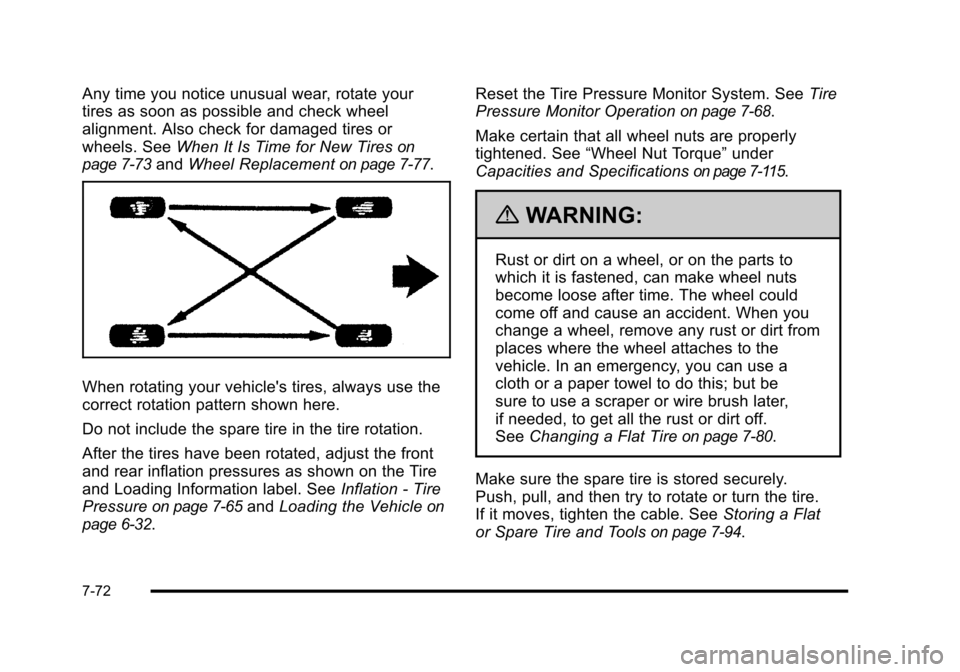
When rotating your vehicle's tires, always use the
correct rotation pattern shown here.
Do not include the spare tire in the tire rotation.
After the tires have been rotated, adjust the front
and rear inflation pressures as shown on the Tire
and Loading Information label. SeeInflation - Tire
Pressureon page 7!65andLoading the Vehicleon
page 6!32.
Reset the Tire Pressure Monitor System. SeeTire
Pressure Monitor Operationon page 7!68.
Make certain that all wheel nuts are properly
tightened. See“Wheel Nut Torque”under
Capacities and Specificationson page 7!115.
{WARNING:
Rust or dirt on a wheel, or on the parts to
which it is fastened, can make wheel nuts
become loose after time. The wheel could
come off and cause an accident. When you
change a wheel, remove any rust or dirt from
places where the wheel attaches to the
vehicle. In an emergency, you can use a
cloth or a paper towel to do this; but be
sure to use a scraper or wire brush later,
if needed, to get all the rust or dirt off.
SeeChanging a Flat Tireon page 7!80.
Make sure the spare tire is stored securely.
Push, pull, and then try to rotate or turn the tire.
If it moves, tighten the cable. SeeStoring a Flat
or Spare Tire and Toolson page 7!94.
7-72
Page 523 of 616
Temperature–A, B, C
The temperature grades are A (the highest),
B, and C, representing the tire's resistance to the
generation of heat and its ability to dissipate heat
when tested under controlled conditions on a
specified indoor laboratory test wheel. Sustained
high temperature can cause the material of the
tire to degenerate and reduce tire life, and
excessive temperature can lead to sudden tire
failure. The grade C corresponds to a level of
performance which all passenger car tires must
meet under the Federal Motor Vehicle Safety
Standard No. 109. Grades B and A represent
higher levels of performance on the laboratory test
wheel than the minimum required by law. It should
be noted that the temperature grade for this tire is
established for a tire that is properly inflated and
not overloaded. Excessive speed, underinflation,
or excessive loading, either separately or in
combination, can cause heat buildup and possible
tire failure.
Wheel Alignment and Tire Balance
The tires and wheels on your vehicle were aligned andbalanced carefully at the factory to give you the longesttire life and best overall performance. Adjustments towheel alignment and tire balancing will not benecessary on a regular basis. However, if you noticeunusual tire wear or your vehicle pulling to one side orthe other, the alignment might need to be checked.If you notice your vehicle vibrating when driving on asmooth road, the tires and wheels might need to berebalanced. See your dealer/retailer for properdiagnosis.
Wheel Replacement
Replace any wheel that is bent, cracked, or badlyrusted or corroded. If wheel nuts keep coming loose,the wheel, wheel bolts, and wheel nuts should bereplaced. If the wheel leaks air, replace it (except somealuminum wheels, which can sometimes be repaired).See your dealer/retailer if any of these conditions exist.
Your dealer/retailer will know the kind of wheelyou need.
Each new wheel should have the same load-carryingcapacity, diameter, width, offset, and be mounted thesame way as the one it replaces.
7-77
Page 525 of 616
WARNING: (Continued)
vehicle and tire size combination and road
conditions. Follow that manufacturer's
instructions. To help avoid damage to the vehicle,
drive slowly, re!adjust or remove the device if it is
contacting the vehicle, and do not spin the
wheels. If you do find traction devices that will fit,
install them on the rear tires.
If a Tire Goes Flat
It is unusual for a tire to blowout while you are driving,especially if you maintain your vehicle's tires properly.If air goes out of a tire, it is much more likely to leak outslowly. But if you should ever have a blowout, here area few tips about what to expect and what to do:
If a front tire fails, the flat tire creates a drag that pullsthe vehicle toward that side. Take your foot off theaccelerator pedal and grip the steering wheel firmly.Steer to maintain lane position, and then gently braketo a stop well out of the traffic lane.
A rear blowout, particularly on a curve, acts much like askid and may require the same correction you woulduse in a skid. In any rear blowout remove your foot fromthe accelerator pedal. Get the vehicle under control bysteering the way you want the vehicle to go. It may bevery bumpy and noisy, but you can still steer. Gentlybrake to a stop, well off the road if possible.
{WARNING:
Lifting a vehicle and getting under it to do
maintenance or repairs is dangerous without the
appropriate safety equipment and training. If a
jack is provided with the vehicle, it is designed
only for changing a flat tire. If it is used for
anything else, you or others could be badly
injured or killed if the vehicle slips off the jack.
If a jack is provided with the vehicle, only use
it for changing a flat tire.
If a tire goes flat, the next part shows how to use thejacking equipment to change a flat tire safely.
7-79
Page 529 of 616
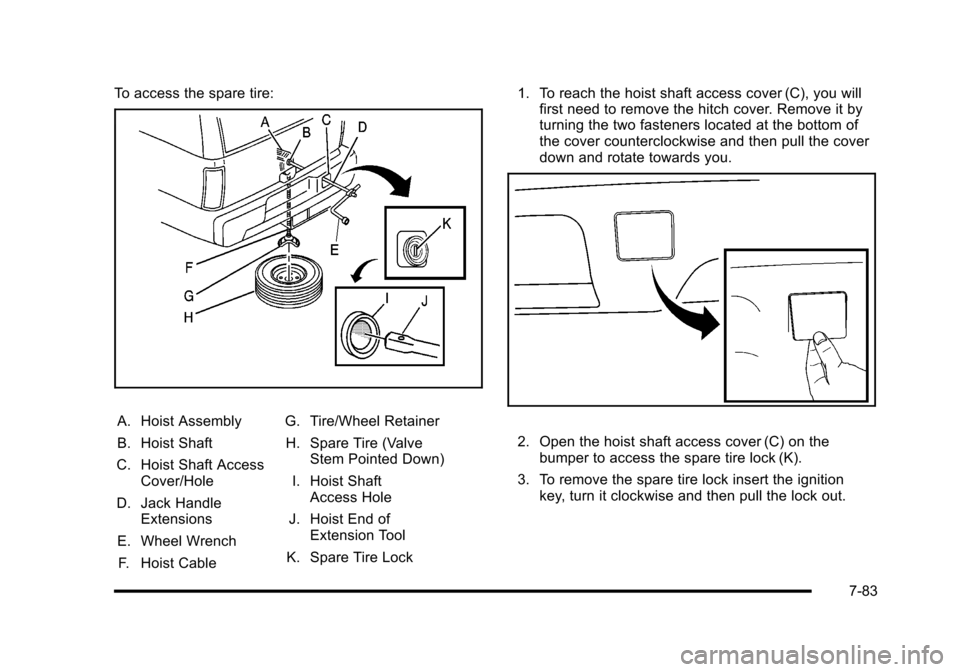
To access the spare tire:
A. Hoist Assembly
B. Hoist Shaft
C. Hoist Shaft AccessCover/Hole
D. Jack HandleExtensions
E. Wheel Wrench
F. Hoist Cable
G. Tire/Wheel Retainer
H. Spare Tire (ValveStem Pointed Down)
I. Hoist ShaftAccess Hole
J. Hoist End ofExtension Tool
K. Spare Tire Lock
1. To reach the hoist shaft access cover (C), you willfirst need to remove the hitch cover. Remove it byturning the two fasteners located at the bottom ofthe cover counterclockwise and then pull the coverdown and rotate towards you.
2. Open the hoist shaft access cover (C) on thebumper to access the spare tire lock (K).
3. To remove the spare tire lock insert the ignitionkey, turn it clockwise and then pull the lock out.
7-83
Page 530 of 616
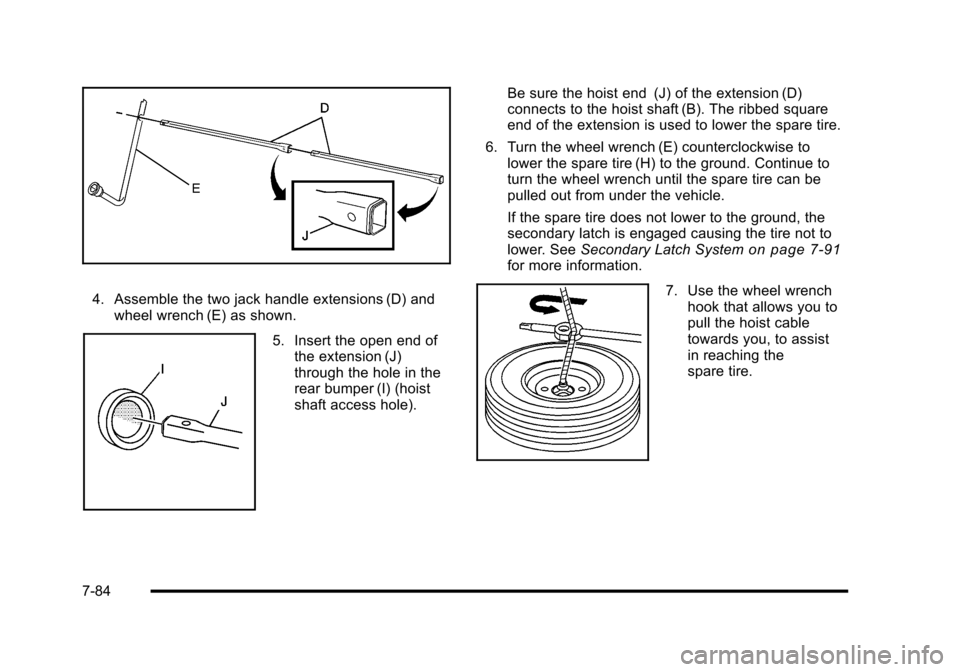
4. Assemble the two jack handle extensions (D) andwheel wrench (E) as shown.
5. Insert the open end ofthe extension (J)through the hole in therear bumper (I) (hoistshaft access hole).
Be sure the hoist end (J) of the extension (D)connects to the hoist shaft (B). The ribbed squareend of the extension is used to lower the spare tire.
6. Turn the wheel wrench (E) counterclockwise tolower the spare tire (H) to the ground. Continue toturn the wheel wrench until the spare tire can bepulled out from under the vehicle.
If the spare tire does not lower to the ground, thesecondary latch is engaged causing the tire not tolower. SeeSecondary Latch Systemon page 7!91for more information.
7. Use the wheel wrenchhook that allows you topull the hoist cabletowards you, to assistin reaching thespare tire.
7-84