tow CADILLAC ESCALADE 2010 3.G Manual Online
[x] Cancel search | Manufacturer: CADILLAC, Model Year: 2010, Model line: ESCALADE, Model: CADILLAC ESCALADE 2010 3.GPages: 616, PDF Size: 39.41 MB
Page 531 of 616

8. Tilt the tire toward the vehicle with some slack inthe cable to access the tire/wheel retainer (G).Separate the retainer from the guide pin by slidingthe retainer up the pin while pressing down on thelatch.
Once the retainer is separated from the pin, tilt theretainer and pull it through the center of the wheelalong with the cable and latch.
9. Put the spare tire near the flat tire.
7-85
Page 534 of 616
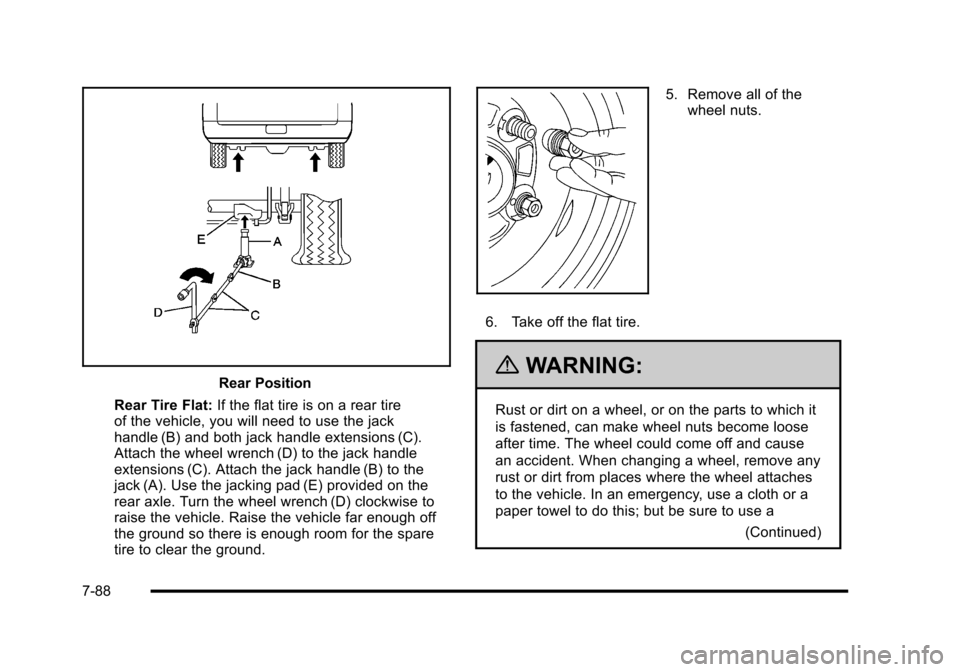
Rear Position
Rear Tire Flat:If the flat tire is on a rear tireof the vehicle, you will need to use the jackhandle (B) and both jack handle extensions (C).Attach the wheel wrench (D) to the jack handleextensions (C). Attach the jack handle (B) to thejack (A). Use the jacking pad (E) provided on therear axle. Turn the wheel wrench (D) clockwise toraise the vehicle. Raise the vehicle far enough offthe ground so there is enough room for the sparetire to clear the ground.
5. Remove all of thewheel nuts.
6. Take off the flat tire.
{WARNING:
Rust or dirt on a wheel, or on the parts to which it
is fastened, can make wheel nuts become loose
after time. The wheel could come off and cause
an accident. When changing a wheel, remove any
rust or dirt from places where the wheel attaches
to the vehicle. In an emergency, use a cloth or a
paper towel to do this; but be sure to use a
(Continued)
7-88
Page 535 of 616

WARNING: (Continued)
scraper or wire brush later, if needed, to get
all the rust or dirt off. SeeChanging a
Flat Tire on page 7!80.
7. Remove any rust or dirtfrom the wheel bolts,mounting surfaces, andspare wheel.
{WARNING:
Never use oil or grease on bolts or nuts because
the nuts might come loose. The vehicle's wheel
could fall off, causing a crash.
8. Put the wheel nuts back on with the rounded endof the nuts toward the wheel after mounting thespare tire.
9. Tighten each wheel nut by hand. Then use thewheel wrench to tighten the nuts until the wheel isheld against the hub.
7-89
Page 538 of 616

4. Repeat this procedure at least two times. If thespare tire lowers to the ground, continue withStep 5 ofRemoving the Spare Tire and Toolsonpage 7!81.
5. If the spare does not lower, turn the wrenchcounterclockwise until approximately 6 inches(15 cm) of cable is exposed.
6. Stand the wheel blocks on their shortest ends,with the backs facing each other.
7. Place the bottom edgeof the jack (A) on thewheel blocks (B),separating them so thatthe jack is balancedsecurely.
8. Attach the jack handle, extension, and wheelwrench to the jack and place it (with the wheelblocks) under the vehicle toward the front of therear bumper.
7-92
Page 540 of 616
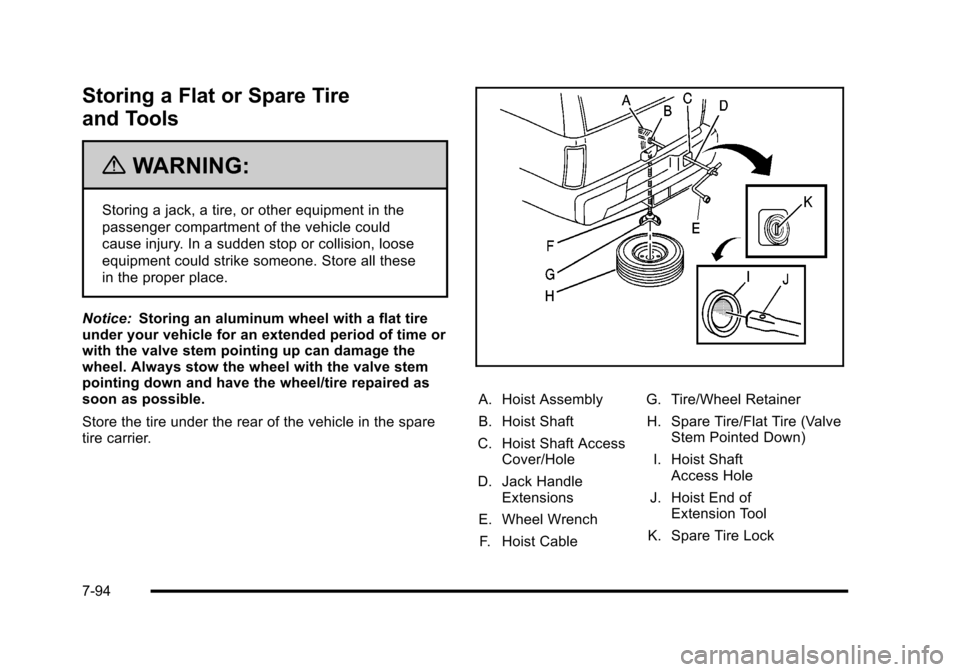
Storing a Flat or Spare Tire
and Tools
{WARNING:
Storing a jack, a tire, or other equipment in the
passenger compartment of the vehicle could
cause injury. In a sudden stop or collision, loose
equipment could strike someone. Store all these
in the proper place.
Notice:Storing an aluminum wheel with a flat tireunder your vehicle for an extended period of time orwith the valve stem pointing up can damage thewheel. Always stow the wheel with the valve stempointing down and have the wheel/tire repaired assoon as possible.
Store the tire under the rear of the vehicle in the sparetire carrier.
A. Hoist Assembly
B. Hoist Shaft
C. Hoist Shaft AccessCover/Hole
D. Jack HandleExtensions
E. Wheel Wrench
F. Hoist Cable
G. Tire/Wheel Retainer
H. Spare Tire/Flat Tire (ValveStem Pointed Down)
I. Hoist ShaftAccess Hole
J. Hoist End ofExtension Tool
K. Spare Tire Lock
7-94
Page 541 of 616

1. Put the tire (H) on the ground at the rear of thevehicle with the valve stem pointed down and tothe rear.
2. Tilt the tire toward the vehicle. Separate the tire/wheel retainer (G) from the guide pin. Pull the pinthrough the center of the wheel. Tilt the retainerdown and through the center wheel opening.
3. Assemble the two jack handle extensions (D) andwheel wrench (E) as shown.
7-95
Page 545 of 616
Notice:Using abrasive cleaners when cleaningglass surfaces on the vehicle, could scratch theglass and/or cause damage to the rear windowdefogger. When cleaning the glass on the vehicle,use only a soft cloth and glass cleaner.
Many cleaners contain solvents that may becomeconcentrated in the vehicle's breathing space. Beforeusing cleaners, read and adhere to all safetyinstructions on the label. While cleaning the vehicle'sinterior, maintain adequate ventilation by opening thevehicle's doors and windows.
Dust may be removed from small buttons and knobsusing a small brush with soft bristles.
Products that remove odors from the vehicle'supholstery and clean the vehicle's glass can beobtained from your dealer/retailer.
Do not clean the vehicle using:
.A knife or any other sharp object to remove a soilfrom any interior surface.
.A stiff brush. It can cause damage to the vehicle'sinterior surfaces.
.Heavy pressure or aggressive rubbing with acleaning cloth. Use of heavy pressure can damagethe interior and does not improve the effectivenessof soil removal.
.Laundry detergents or dishwashing soaps withdegreasers can leave residue that streaks andattracts dirt. For liquid cleaners, about 20 drops pergallon (3.78 L) of water is a good guide. Use onlymild, neutral-pH soaps.
.Too much cleaner that saturates the upholstery.
.Organic solvents such as naptha, alcohol, etc. thatcan damage the vehicle's interior.
Fabric/Carpet
Use a vacuum cleaner with a soft brush attachmentfrequently to remove dust and loose dirt. A canistervacuum with a beater bar in the nozzle may only beused on floor carpet and carpeted floor mats. For anysoil, always try to remove it first with plain water or clubsoda. Before cleaning, gently remove as much of thesoil as possible using one of the following techniques:
.For liquids: gently blot the remaining soil with apaper towel. Allow the soil to absorb into the papertowel until no more can be removed.
.For solid dry soils: remove as much as possibleand then vacuum.
7-99
Page 546 of 616
To clean:
1. Saturate a lint-free, clean white cloth with water orclub soda.
2. Wring the cloth to remove excess moisture.
3. Start on the outside edge of the soil and gently rubtoward the center. Continue cleaning, using a cleanarea of the cloth each time it becomes soiled.
4. Continue to gently rub the soiled area until thecleaning cloth remains clean.
5. If the soil is not completely removed, use a mildsoap solution and repeat the cleaning process thatwas used with plain water.
If any of the soil remains, a commercial fabric cleaner orspot lifter may be necessary. When a commercialupholstery cleaner or spot lifter is to be used, test asmall hidden area for colorfastness first. If the locallycleaned area gives any impression that a ring formationmay result, clean the entire surface.
After the cleaning process has been completed, a papertowel can be used to blot excess moisture from thefabric or carpet.
Leather
A soft cloth dampened with water can be used toremove dust. If a more thorough cleaning is necessary,a soft cloth dampened with a mild soap solution can beused. Allow the leather to dry naturally. Do not use heatto dry. Never use steam to clean leather. Never usespot lifters or spot removers on leather. Manycommercial leather cleaners and coatings that are soldto preserve and protect leather may permanentlychange the appearance and feel of the leather and arenot recommended. Do not use silicone or wax-basedproducts, or those containing organic solvents to cleanthe vehicle's interior because they can alter theappearance by increasing the gloss in a non-uniformmanner. Never use shoe polish on leather.
TEHAMA™Leather
The leather surface on the seat was not designed to beaggressively cleaned using any commercial product.Use a well wrung cloth dampened with water to removedust. Do not use a wet cloth or saturate the leathersurface with water. Allow the leather to dry naturally. If asoil occurs that cannot be completely removed, allow itto become part of the natural markings of the leather.The leather in the vehicle was designed to have anatural appearance and develop a more vintageappearance with use.
7-100
Page 548 of 616
Care of Safety Belts
Keep belts clean and dry.
{WARNING:
Do not bleach or dye safety belts. It may severely
weaken them. In a crash, they might not be able
to provide adequate protection. Clean safety belts
only with mild soap and lukewarm water.
Weatherstrips
Silicone grease on weatherstrips will make them lastlonger, seal better, and not stick or squeak. Applysilicone grease with a clean cloth. During very cold,damp weather frequent application may be required.SeeRecommended Fluids and Lubricantsonpage 8!10.
Washing Your Vehicle
The best way to preserve the vehicle's finish is to keepit clean by washing it often.
Notice:Certain cleaners contain chemicals that candamage the emblems or nameplates on the vehicle.Check the cleaning product label. If it states that itshould not be used on plastic parts, do not use it onthe vehicle or damage may occur and it would notbe covered by the warranty.
Do not wash the vehicle in direct sunlight. Use a carwashing soap. Do not use cleaning agents that arepetroleum based or that contain acid or abrasives, asthey can damage the paint, metal or plastic on thevehicle. Approved cleaning products can be obtainedfrom your dealer/retailer. Follow all manufacturers'directions regarding correct product usage, necessarysafety precautions and appropriate disposal of anyvehicle care product.
Rinse the vehicle well, before washing and after toremove all cleaning agents completely. If they areallowed to dry on the surface, they could stain.
Dry the finish with a soft, clean chamois or an all-cottontowel to avoid surface scratches and water spotting.
7-102
Page 550 of 616
Windshield, Backglass, and Wiper
Blades
Clean the outside of the windshield and backglass withglass cleaner.
Clean the rubber blades using a lint free cloth or papertowel soaked with windshield washer fluid or a milddetergent. Wash the windshield thoroughly when youclean the blades. Bugs, road grime, sap and a buildupof vehicle wash/wax treatments may cause wiperstreaking. Replace the wiper blades if they are worn ordamaged.
Wipers can be damaged by:
.Extreme dusty conditions
.Sand and salt
.Heat and sun
.Snow and ice, without proper removal
Aluminum or Chrome-Plated Wheels
and Trim
The vehicle may have either aluminum orchrome-plated wheels.
Keep the wheels clean using a soft clean cloth with mildsoap and water. Rinse with clean water. After rinsingthoroughly, dry with a soft clean towel. A wax may thenbe applied.
Notice:Chrome wheels and other chrome trim maybe damaged if the vehicle is not washed afterdriving on roads that have been sprayed withmagnesium, calcium or sodium chloride. Thesechlorides are used on roads for conditions such asice and dust. Always wash the vehicle's chromewith soap and water after exposure.
Notice:Using strong soaps, chemicals, abrasivepolishes, cleaners, brushes, or cleaners that containacid on aluminum or chrome-plated wheels, coulddamage the surface of the wheel(s). The repairswould not be covered by the vehicle warranty. Useonly approved cleaners on aluminum orchrome-plated wheels.
7-104