ignition CADILLAC ESCALADE ESV 2010 Owner's Manual
[x] Cancel search | Manufacturer: CADILLAC, Model Year: 2010, Model line: ESCALADE ESV, Model: CADILLAC ESCALADE ESV 2010Pages: 620, PDF Size: 7.4 MB
Page 152 of 620

Black plate (28,1)Cadillac Escalade/Escalade ESV Owner Manual - 2010
The steering may bind with the wheels turned off center.
If this happens, move the steering wheel from right to
left while turning the key to ACC/ACCESSORY. If this
doesn't work, then the vehicle needs service.
Notice: Using a tool to force the key to turn in the
ignition could cause damage to the switch or break
the key. Use the correct key, make sure it is all the
way in, and turn it only with your hand. If the key
cannot be turned by hand, see your dealer.
B (ACC/ACCESSORY): This position lets things like
the radio and the windshield wipers operate while the
engine is off. Use this position if the vehicle must be
pushed or towed.
C (ON/RUN): This position can be used to operate the
electrical accessories and to display some instrument
panel cluster warning and indicator lights. The switch
stays in this position when the engine is running. The
transmission is also unlocked in this position on
automatic transmission vehicles.
If you leave the key in the ACC/ACCESSORY or
ON/RUN position with the engine off, the battery could
be drained. You may not be able to start the vehicle if
the battery is allowed to drain for an extended period
of time. D (START): This is the position that starts the engine.
When the engine starts, release the key. The ignition
switch returns to ON/RUN for driving.
A warning tone will sound when the driver door is
opened, the ignition is in ACC/ACCESSORY or
LOCK/OFF and the key is in the ignition.
Retained Accessory Power (RAP) The following vehicle accessories can be used for up to
10 minutes after the engine is turned off: .
Audio System .
Power Windows .
OnStar ®
System (if equipped) .
Sunroof (if equipped)
These features work when the key is in ON/RUN or
ACC/ACCESSORY. Once the key is turned from
ON/RUN to LOCK/OFF, the windows and sunroof
continue to work up to 10 minutes until any door is
opened. The radio continues to work for up to
10 minutes or until the driver door is opened.
3-28
Page 153 of 620
Black plate (29,1)Cadillac Escalade/Escalade ESV Owner Manual - 2010
Starting the Engine If the vehicle is a Two-mode Hybrid, see the Two-mode
Hybrid manual for more information.
Move the shift lever to P (Park) or N (Neutral). The
engine will not start in any other position. To restart
the engine when the vehicle is are already moving, use
N (Neutral) only.
Notice: Do not try to shift to P (Park) if the vehicle
is moving. If you do, you could damage the
transmission. Shift to P (Park) only when the vehicle
is stopped.
Starting Procedure 1. With your foot off the accelerator pedal, turn the
ignition key to START. When the engine starts, let
go of the key. The idle speed will go down as the
engine gets warm. Do not race the engine
immediately after starting it. Operate the engine
and transmission gently to allow the oil to warm up
and lubricate all moving parts. The vehicle has a Computer-Controlled Cranking
System. This feature assists in starting the engine
and protects components. If the ignition key is
turned to the START position, and then released
when the engine begins cranking, the engine will
continue cranking for a few seconds or until the
vehicle starts. If the engine does not start and the
key is held in START for many seconds, cranking
will be stopped after 15 seconds to prevent
cranking motor damage. To prevent gear damage,
this system also prevents cranking if the engine
is already running. Engine cranking can be
stopped by turning the ignition switch to the
ACC/ACCESSORY or LOCK/OFF position.
Notice: Cranking the engine for long periods of
time, by returning the key to the START position
immediately after cranking has ended, can overheat
and damage the cranking motor, and drain the
battery. Wait at least 15 seconds between each try,
to let the cranking motor cool down.
3-29
Page 162 of 620

Black plate (38,1)Cadillac Escalade/Escalade ESV Owner Manual - 2010
Parking Brake
Set the parking brake by holding the regular brake
pedal down, then pushing down the parking brake
pedal.
If the ignition is on, the brake system warning light will
come on. See Brake System Warning Light
on
page 4 ‑ 33 . Notice: Driving with the parking brake on can
overheat the brake system and cause premature
wear or damage to brake system parts. Make sure
that the parking brake is fully released and the
brake warning light is off before driving.
To release the parking brake, hold the regular brake
pedal down, then push down momentarily on the
parking brake pedal until you feel the pedal release.
Slowly pull your foot up off the park brake pedal. If the
parking brake is not released when you begin to drive,
the brake system warning light will flash and a chime
will sound warning you that the parking brake is still on.
If you are towing a trailer and are parking on a hill, see
Towing a Trailer on page 6 ‑ 42 .
3-38
Page 163 of 620

Black plate (39,1)Cadillac Escalade/Escalade ESV Owner Manual - 2010
Shifting Into Park
{ WARNING: It can be dangerous to get out of the vehicle if the
shift lever is not fully in P (Park) with the parking
brake firmly set. The vehicle can roll. If you have
left the engine running, the vehicle can move
suddenly. You or others could be injured. To be
sure the vehicle will not move, even when you are
on fairly level ground, use the steps that follow.
If you are pulling a trailer, see Towing a Trailer
on
page 6 ‑ 42
.
1. Hold the brake pedal down, then set the parking
brake.
2. Move the shift lever into the P (Park) position by
pulling the shift lever toward you and moving it up
as far as it will go.
3. Turn the ignition key to LOCK/OFF.
4. Remove the key and take it with you. If you can
leave the vehicle with the ignition key in your hand,
the vehicle is in P (Park). Leaving the Vehicle With the Engine
Running
{ WARNING: It can be dangerous to leave the vehicle with the
engine running. The vehicle could move suddenly
if the shift lever is not fully in P (Park) with the
parking brake firmly set. And, if you leave the
vehicle with the engine running, it could overheat
and even catch fire. You or others could be
injured. Do not leave the vehicle with the engine
running.
If you have to leave the vehicle with the engine running,
be sure the vehicle is in P (Park) and the parking brake
is firmly set. After the shift lever is moved into P (Park),
hold the regular brake pedal down. Then, see if you can
move the shift lever away from P (Park) without first
pulling it toward you. If you can, it means that the shift
lever was not fully locked into P (Park).
3-39
Page 164 of 620

Black plate (40,1)Cadillac Escalade/Escalade ESV Owner Manual - 2010
Torque Lock If you are parking on a hill and you do not shift the
transmission into P (Park) properly, the weight of the
vehicle can put too much force on the parking pawl in
the transmission. It might be difficult to pull the shift
lever out of P (Park). This is called torque lock. To
prevent torque lock, set the parking brake and then shift
into P (Park) properly before you leave the driver seat.
To find out how, see Shifting Into Park on page 3 ‑ 39 .
When you are ready to drive, move the shift lever out of
P (Park) before releasing the parking brake.
If torque lock does occur, you might need to have
another vehicle push yours a little uphill to take some of
the pressure from the parking pawl in the transmission.
Then you should be able to pull the shift lever out of
P (Park).
Shifting Out of Park This vehicle is equipped with an electronic shift lock
release system. The shift lock release is designed to: .
Prevent ignition key removal unless the shift lever
is in P (Park) with the shift lever button fully
released, and .
Prevent movement of the shift lever out of
P (Park), unless the ignition is in ON/RUN or
ACC/ACCESSORY and the regular brake pedal
is applied. The shift lock release is always functional except in the
case of an uncharged or low voltage (less than 9 volt)
battery.
If the vehicle has an uncharged battery or a battery with
low voltage, try charging or jump starting the battery.
See Jump Starting on page 7 ‑ 44 for more information.
To shift out of P (Park) use the following:
1. Apply the brake pedal.
2. Move the shift lever to the desired position.
If you still are unable to shift out of P (Park):
1. Ease the pressure on the shift lever.
2. While holding down the brake pedal, press the shift
lever all the way into P (Park).
3. Move the shift lever to the desired position.
If you are still having a problem shifting, then have the
vehicle serviced soon.
3-40
Page 168 of 620

Black plate (44,1)Cadillac Escalade/Escalade ESV Owner Manual - 2010
Resetting the Power Foldaway Mirrors Reset the power foldaway mirrors if: .
The mirrors are accidentally obstructed while
folding. .
They are accidentally manually folded/unfolded. .
The mirrors will not stay in the unfolded position. .
The mirrors vibrate at normal driving speeds.
Fold and unfold the mirrors one time using the mirror
controls to reset them to their normal position.
A popping noise may be heard during the resetting of
the power foldaway mirrors. This sound is normal after
a manual folding operation.
Automatic Dimming Adjust the driver outside mirror for the glare of the
headlamps behind your vehicle. See Automatic
Dimming Rearview Mirror
on page 3 ‑ 43 for more
information.
Turn Signal Indicator The vehicle has a turn signal indicator on the mirror. An
arrow on the mirror flashes in the direction of the turn or
lane change. Ground Illumination Lamps The mirrors may also include ground illumination lamps
in the base of the mirror. These lamps help to see the
area near the base of the front doors when it is
dark out.
Park Tilt Mirrors If the vehicle has the memory package, the passenger
and/or driver mirror tilts to a preselected position when
the vehicle is in R (Reverse). This feature lets the driver
view the curb when parallel parking. The mirror(s) return
to the original position when the vehicle is shifted out of
R (Reverse), or the ignition is turned off or to
OFF/LOCK.
Turn this feature on or off through the Driver Information
Center (DIC). See DIC Vehicle Customization
on
page 4 ‑ 58
for more information.
3-44
Page 190 of 620
Black plate (66,1)Cadillac Escalade/Escalade ESV Owner Manual - 2010
Rear Storage Area For vehicles with a rear storage area, it is located in the
rear cargo area of the vehicle on the driver's side trim
panel.
Turn the knobs and swing the storage door to access
the storage compartment. The door can be removed.
Rear Seat Armrest For vehicle with an armrest/storage compartment
located by the second row seat, pull the loop at the top
of the armrest out to lower the armrest.
Push the button on the front of the armrest and pull
the top up to open the compartment.
Sunroof Your vehicle may be equipped with a power sliding
sunroof. To open or close the sunroof, the ignition
needs to be turned to ON/RUN, or Retained Accessory
Power (RAP) must be active. When RAP is active, the
sunroof will work for 10 minutes after the ignition is
turned off, or until a front door is opened. See Retained
Accessory Power (RAP)
on page 3 ‑ 28 for more
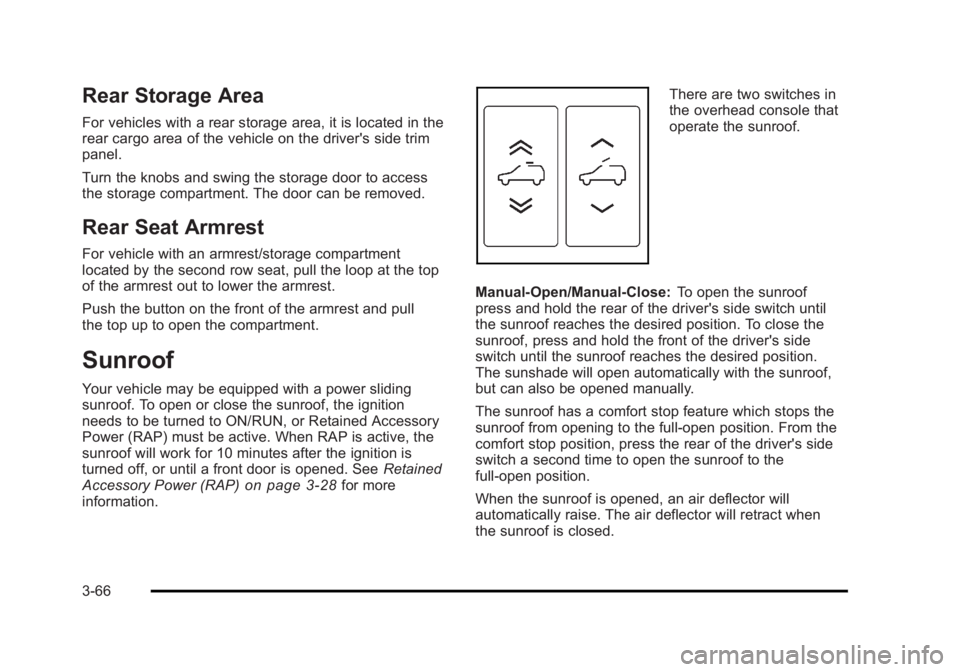
information. There are two switches in
the overhead console that
operate the sunroof.
Manual-Open/Manual-Close: To open the sunroof
press and hold the rear of the driver's side switch until
the sunroof reaches the desired position. To close the
sunroof, press and hold the front of the driver's side
switch until the sunroof reaches the desired position.
The sunshade will open automatically with the sunroof,
but can also be opened manually.
The sunroof has a comfort stop feature which stops the
sunroof from opening to the full-open position. From the
comfort stop position, press the rear of the driver's side
switch a second time to open the sunroof to the
full-open position.
When the sunroof is opened, an air deflector will
automatically raise. The air deflector will retract when
the sunroof is closed.
3-66
Page 202 of 620
Black plate (10,1)Cadillac Escalade/Escalade ESV Owner Manual - 2010
Increasing Speed While Using Cruise
Control To increase the cruise speed while using cruise control: .
Press and hold the +RES button on the steering
wheel until the desired speed is reached, then
release it. .
To increase vehicle speed in small increments,
press the +RES button. Each time this is done, the
vehicle goes about 1.6 km/h (1 mph) faster.
Reducing Speed While Using Cruise
Control To reduce the vehicle speed while using cruise control: .
Press and hold the SET – button on the steering
wheel until the desired lower speed is reached,
then release it. .
To slow down in very small amounts, press the
SET – button on the steering wheel briefly. Each
time this is done, the vehicle goes about 1.6 km/h
(1 mph) slower.
Passing Another Vehicle While Using
Cruise Control Use the accelerator pedal to increase the vehicle
speed. When you take your foot off the pedal, the
vehicle will slow down to the previous set cruise speed. Using Cruise Control on Hills How well the cruise control will work on hills depends
upon the vehicle speed, load, and the steepness of the
hills. When going up steep hills, you might have to step
on the accelerator pedal to maintain the vehicle's
speed. When going downhill, you might have to brake
or shift to a lower gear to keep the vehicle's speed
down. When the brakes are applied the cruise control
turns off.
Ending Cruise Control There are three ways to end cruise control: .
Step lightly on the brake pedal. .
Press the
[ button on the steering wheel. .
Press the
I button on the steering wheel.
Erasing Speed Memory The cruise control set speed memory is erased when
the cruise control or the ignition is turned off.
4-10
Page 203 of 620

Black plate (11,1)Cadillac Escalade/Escalade ESV Owner Manual - 2010
Exterior Lamps The exterior lamps
control is located on
the instrument panel to
the left of the steering
wheel.
It controls the following systems: .
Headlamps .
Taillamps .
Parking Lamps .
License Plate Lamps .
Instrument Panel Lights
The exterior lamps control has four positions:
9 (Off): Turns off the automatic headlamps and
daytime running lamps (DRL). Turning the headlamp
control to the off position again will turn the automatic
headlamps or DRL back on.
For vehicles first sold in Canada, the off position only
works when the vehicle is shifted into the P (Park)
position. AUTO (Automatic): Automatically turns on the
headlamps at normal brightness, together with
the following: .
Parking Lamps .
Instrument Panel Lights .
Taillamps .
License Plate Lamps
; (Parking Lamps): Turns on the parking lamps
together with the following: .
Instrument Panel Lights .
Taillamps .
License Plate Lamps
2 (Headlamps): Turns on the headlamps together with
the following lamps listed below. .
Parking Lamps .
Instrument Panel Lights .
Taillamps .
License Plate Lamps
When the headlamps are turned on while the vehicle is
on, the headlamps will turn off automatically 10 minutes
after the ignition is turned off. When the headlamps are
turned on while the vehicle is off, the headlamps will
stay on for 10 minutes before automatically turning off
to prevent the battery from being drained.
4-11
Page 206 of 620

Black plate (14,1)Cadillac Escalade/Escalade ESV Owner Manual - 2010
Disabling and Resetting IntelliBeam ®
at
the Rearview Mirror IntelliBeam ®
can be disabled by using the controls on
the inside rearview mirror.
AUTO
3 (On/Off): To disable the system, press this
button on the inside rearview mirror. The IntelliBeam ®
indicator will turn off and will not come back on until the
IntelliBeam ®
button is pressed again.
(Stalk Disable): When IntelliBeam ®
has turned on the
high-beams, pull or push the high-beam stalk. This will
disable IntelliBeam ®
. The IntelliBeam ®
indicator on the
mirror will turn off. To re-enable IntelliBeam ®
, press the
IntelliBeam ®
button on the mirror.
A different sensitivity setting is available for dealer
diagnostics. This is done by pushing and holding this
button for 20 seconds until the IntelliBeam ®
indicator
light flashes three times. If you accidentally activate
this, the vehicle's setting will automatically be reset
each time the ignition is turned off and then on again. Cleaning the IntelliBeam ®
Light Sensor The light sensor is located
on the inside of the
vehicle in front of the
inside rearview mirror.
Clean the light sensor window, periodically, using glass
cleaner on a soft cloth. Gently wipe the sensor window.
Do not spray glass cleaner directly on the surface of the
sensor window.
4-14