wheel CADILLAC SRX 2004 1.G Workshop Manual
[x] Cancel search | Manufacturer: CADILLAC, Model Year: 2004, Model line: SRX, Model: CADILLAC SRX 2004 1.GPages: 468, PDF Size: 2.92 MB
Page 296 of 468
Here are some important things to consider before you
do recreational vehicle towing:
What’s the towing capacity of the towing vehicle?
Be sure you read the tow vehicle manufacturer’s
recommendations.
How far will you tow? Some vehicles have
restrictions on how far and how long they can tow.
Do you have the proper towing equipment?
See your dealer or trailering professional for
additional advice and equipment recommendations.
Is your vehicle ready to be towed? Just as you
would prepare your vehicle for a long trip, you’ll
want to make sure your vehicle is prepared to be
towed. SeeBefore Leaving on a Long Trip on
page 4-37.
Dinghy Towing
Notice:If you tow your vehicle with all four wheels
on the ground, the drivetrain components could
be damaged. The repairs would not be covered by
your warranty. Do not tow your vehicle with all
four wheels on the ground.
Your vehicle was not designed to be towed with all four
wheels on the ground. If your vehicle must be towed,
see “Dolly Towing” following for more information.
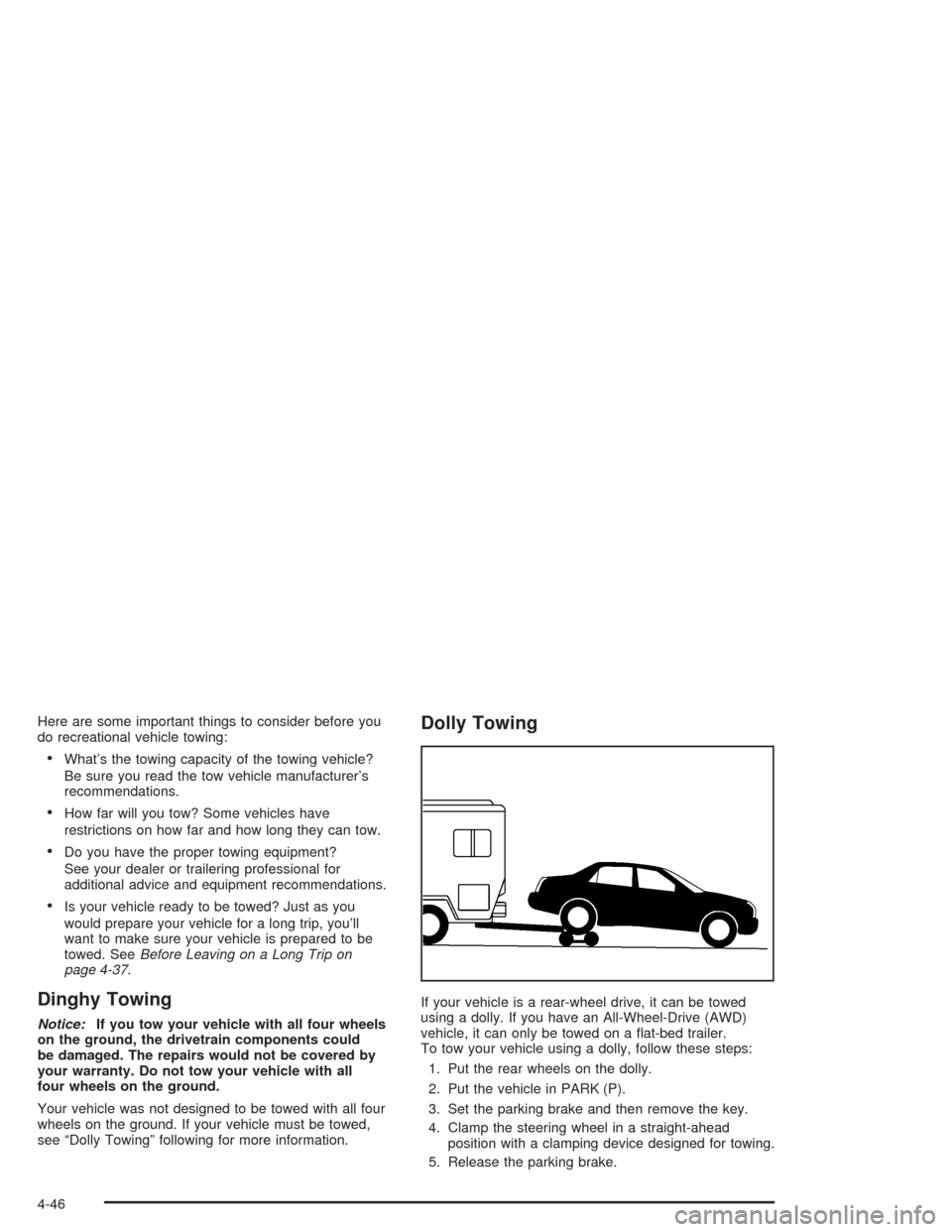
Dolly Towing
If your vehicle is a rear-wheel drive, it can be towed
using a dolly. If you have an All-Wheel-Drive (AWD)
vehicle, it can only be towed on a at-bed trailer.
To tow your vehicle using a dolly, follow these steps:
1. Put the rear wheels on the dolly.
2. Put the vehicle in PARK (P).
3. Set the parking brake and then remove the key.
4. Clamp the steering wheel in a straight-ahead
position with a clamping device designed for towing.
5. Release the parking brake.
4-46
Page 302 of 468
Level Control
This feature keeps the rear of your vehicle level as the
load changes. It’s automatic — you don’t need to
adjust anything.
Towing a Trailer
{CAUTION:
If you do not use the correct equipment and
drive properly, you can lose control when you
pull a trailer. For example, if the trailer is too
heavy, the brakes may not work well — or even
at all. You and your passengers could be
seriously injured. You may also damage your
vehicle; the resulting repairs would not be
covered by your warranty. Pull a trailer only if
you have followed all the steps in this section.
Ask your dealer for advice and information
about towing a trailer with your vehicle.Your vehicle can tow a trailer if it is equipped with the
proper trailer towing equipment. To identify what
the vehicle trailering capacity is for your vehicle, you
should read the information in “Weight of the Trailer” that
appears later in this section. But trailering is different
than just driving your vehicle by itself. Trailering means
changes in handling, acceleration, braking, durability
and fuel economy. Successful, safe trailering takes
correct equipment, and it has to be used properly.
That’s the reason for this part. In it are many time-tested,
important trailering tips and safety rules. Many of
these are important for your safety and that of your
passengers. So please read this section carefully before
you pull a trailer.
Load-pulling components such as the engine,
transmission, rear axle, wheel assemblies and tires are
forced to work harder against the drag of the added
weight. The engine is required to operate at relatively
higher speeds and under greater loads, generating extra
heat. What’s more, the trailer adds considerably to
wind resistance, increasing the pulling requirements.
4-52
Page 306 of 468
Driving with a Trailer
Towing a trailer requires a certain amount of experience.
Before setting out for the open road, you’ll want to get
to know your rig. Acquaint yourself with the feel of
handling and braking with the added weight of the trailer.
And always keep in mind that the vehicle you are
driving is now a good deal longer and not nearly as
responsive as your vehicle is by itself.
Before you start, check all trailer hitch parts and
attachments, safety chains, electrical connector, lamps,
tires and mirror adjustment. If the trailer has electric
brakes, start your vehicle and trailer moving and then
apply the trailer brake controller by hand to be sure
the brakes are working. This lets you check your
electrical connection at the same time.
During your trip, check occasionally to be sure that the
load is secure, and that the lamps and any trailer
brakes are still working.
Following Distance
Stay at least twice as far behind the vehicle ahead as
you would when driving your vehicle without a trailer.
This can help you avoid situations that require
heavy braking and sudden turns.
Passing
You’ll need more passing distance up ahead when
you’re towing a trailer. And, because you’re a good deal
longer, you’ll need to go much farther beyond the
passed vehicle before you can return to your lane.
Backing Up
Hold the bottom of the steering wheel with one hand.
Then, to move the trailer to the left, just move that hand
to the left. To move the trailer to the right, move your
hand to the right. Always back up slowly and, if possible,
have someone guide you.
Making Turns
Notice:Making very sharp turns while trailering
could cause the trailer to come in contact with the
vehicle. Your vehicle could be damaged. Avoid
making very sharp turns while trailering.
When you’re turning with a trailer, make wider turns than
normal. Do this so your trailer won’t strike soft shoulders,
curbs, road signs, trees or other objects. Avoid jerky or
sudden maneuvers. Signal well in advance.
4-56
Page 307 of 468

Turn Signals When Towing a Trailer
When you tow a trailer, your vehicle may need a
different turn signal asher and/or extra wiring.
Check with your dealer. The arrows on your instrument
panel will ash whenever you signal a turn or lane
change. Properly hooked up, the trailer lamps will also
ash, telling other drivers you’re about to turn,
change lanes or stop.
When towing a trailer, the arrows on your instrument
panel will ash for turns even if the bulbs on the trailer
are burned out. Thus, you may think drivers behind
you are seeing your signal when they are not.
It’s important to check occasionally to be sure the trailer
bulbs are still working.
Driving on Grades
Reduce speed and shift to a lower gear before you start
down a long or steep downgrade. If you don’t shift
down, you might have to use your brakes so much that
they would get hot and no longer work well.
On a long uphill grade, shift down and reduce your
speed to around 45 mph (70 km/h) to reduce the
possibility of the engine and the transmission
overheating.
Parking on Hills
{CAUTION:
You really should not park your vehicle, with a
trailer attached, on a hill. If something goes
wrong, your rig could start to move. People
can be injured, and both your vehicle and the
trailer can be damaged.
But if you ever have to park your rig on a hill, here’s
how to do it:
1. Apply your regular brakes, but don’t shift into
PARK (P).
When parking uphill, turn your wheels away from
the curb. When parking downhill, turn your wheels
into the curb.
2. Have someone place chocks behind the trailer
wheels.
3. When the chocks are in place, release the regular
brakes until the chocks absorb the load.
4. Reapply the regular brakes. Then apply your
parking brake and shift into PARK (P).
5. Release the regular brakes.
4-57
Page 309 of 468

Service............................................................5-3
Doing Your Own Service Work.........................5-4
Adding Equipment to the Outside of Your
Vehicle......................................................5-5
Fuel................................................................5-5
Gasoline Octane............................................5-5
Gasoline Specications....................................5-6
California Fuel...............................................5-6
Additives.......................................................5-7
Fuels in Foreign Countries...............................5-7
Filling Your Tank............................................5-8
Filling a Portable Fuel Container.....................5-10
Checking Things Under the Hood....................5-10
Hood Release..............................................5-11
Engine Compartment Overview.......................5-12
Engine Oil...................................................5-15
Engine Air Cleaner/Filter................................5-22
Automatic Transmission Fluid.........................5-24
Engine Coolant.............................................5-25
Coolant Surge Tank Pressure Cap..................5-28
Engine Overheating.......................................5-28
Cooling System............................................5-31
Power Steering Fluid.....................................5-37
Windshield Washer Fluid................................5-38Brakes........................................................5-40
Battery........................................................5-43
Jump Starting...............................................5-44
All-Wheel Drive..............................................5-51
Rear Axle.......................................................5-52
Front Axle......................................................5-53
Bulb Replacement..........................................5-54
High Intensity Discharge (HID) Lighting............5-54
Halogen Bulbs..............................................5-54
Headlamps, Sidemarker, and Parking Lamps......5-55
Front Turn Signal and Fog Lamps...................5-56
Sidemarker Lamps........................................5-57
Center High-Mounted Stoplamp (CHMSL).........5-57
Taillamps, Turn Signal, Stoplamps and
Sidemarker Lamps.....................................5-57
Back-Up and License Plate Lamps..................5-57
Replacement Bulbs.......................................5-58
Windshield Wiper Blade Replacement..............5-59
Tires..............................................................5-61
Ination - Tire Pressure.................................5-68
Tire Pressure Monitor System.........................5-69
Tire Inspection and Rotation...........................5-71
When It Is Time for New Tires.......................5-72
Section 5 Service and Appearance Care
5-1
Page 310 of 468
Buying New Tires.........................................5-72
Uniform Tire Quality Grading..........................5-74
Wheel Alignment and Tire Balance..................5-75
Wheel Replacement......................................5-76
Tire Chains..................................................5-77
If a Tire Goes Flat........................................5-78
Changing a Flat Tire.....................................5-79
Compact Spare Tire......................................5-93
Appearance Care............................................5-94
Cleaning the Inside of Your Vehicle.................5-94
Care of Safety Belts......................................5-96
Weatherstrips...............................................5-96
Cleaning the Outside of Your Vehicle..............5-97
Sheet Metal Damage.....................................5-99Finish Damage.............................................5-99
Underbody Maintenance................................5-99
Chemical Paint Spotting.................................5-99
Vehicle Care/Appearance Materials................5-100
Vehicle Identication.....................................5-101
Vehicle Identication Number (VIN)................5-101
Service Parts Identication Label...................5-101
Electrical System..........................................5-102
Add-On Electrical Equipment.........................5-102
Windshield Wiper Fuses...............................5-102
Power Windows and Other Power Options........5-102
Fuses and Circuit Breakers..........................5-103
Capacities and Specications........................5-111
Section 5 Service and Appearance Care
5-2
Page 350 of 468
Notice:
Using the wrong uid can badly damage brake
system parts. For example, just a few drops of
mineral-based oil, such as engine oil, in your
brake system can damage brake system
parts so badly that they will have to be replaced.
Do not let someone put in the wrong kind
of uid.
If you spill brake uid on your vehicle’s painted
surfaces, the paint nish can be damaged. Be
careful not to spill brake uid on your vehicle. If
you do, wash it off immediately. SeeAppearance
Care on page 5-94.
Brake Wear
Your vehicle has four-wheel disc brakes.
Disc brake pads have built-in wear indicators that make
a high-pitched warning sound when the brake pads
are worn and new pads are needed. The sound
may come and go or be heard all the time your vehicle
is moving (except when you are pushing on the
brake pedal rmly).
{CAUTION:
The brake wear warning sound means that
soon your brakes will not work well. That
could lead to an accident. When you hear the
brake wear warning sound, have your vehicle
serviced.
Notice:Continuing to drive with worn-out brake
pads could result in costly brake repair.
Some driving conditions or climates may cause a brake
squeal when the brakes are rst applied or lightly
applied. This does not mean something is wrong with
your brakes.
Properly torqued wheel nuts are necessary to help
prevent brake pulsation. When tires are rotated, inspect
brake pads for wear and evenly tighten wheel nuts in
the proper sequence to GM torque specications.
Brake linings should always be replaced as complete
axle sets.
5-42
Page 359 of 468
All-Wheel Drive
All of the lubricant checks in this section apply to your
vehicle. If you have an all-wheel-drive vehicle, there
is an additional system that need lubrication.
Transfer Case
When to Check Lubricant
It is not necessary to regularly check the transfer case
uid unless you suspect there is a leak or you hear
an unusual noise. A uid loss could indicate a problem.
Have it inspected and repaired.
How to Check Lubricant
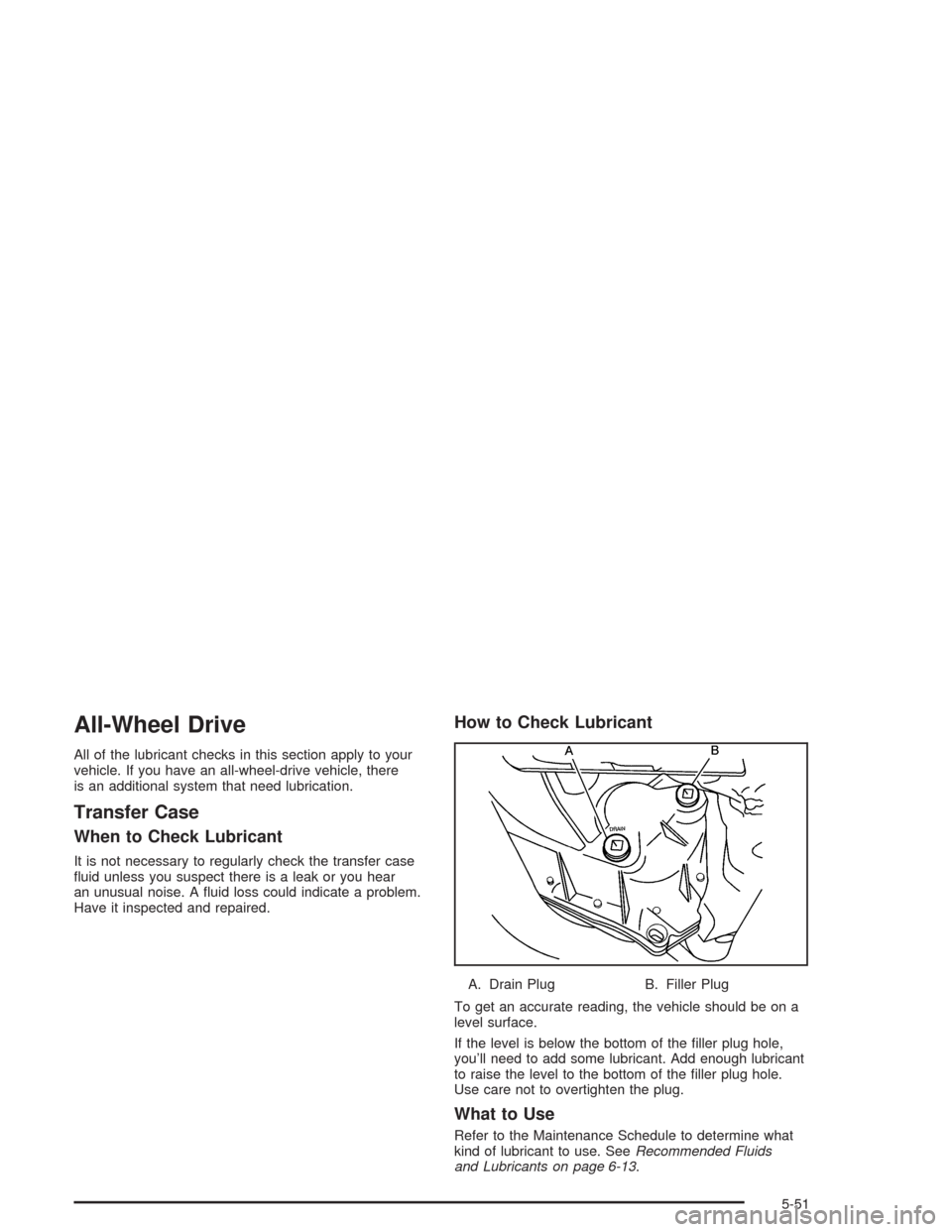
A. Drain Plug B. Filler Plug
To get an accurate reading, the vehicle should be on a
level surface.
If the level is below the bottom of the ller plug hole,
you’ll need to add some lubricant. Add enough lubricant
to raise the level to the bottom of the ller plug hole.
Use care not to overtighten the plug.
What to Use
Refer to the Maintenance Schedule to determine what
kind of lubricant to use. SeeRecommended Fluids
and Lubricants on page 6-13.
5-51
Page 364 of 468
5. Replace the lower outboard plastic snap-in retainer
in the fender bracket, if needed.
6. Reconnect the electrical harness at the back side of
the headlamp assembly.
7. Push the headlamp assembly straight into the
vehicle engaging the headlamp pin into the
snap-in retainer and adjusting the lamp inboard side
to clear past the front fascia.
8. Reinstall the two fasteners on top of the headlamp
assembly.
9. Reinstall the screw at the lower inboard side of the
headlamp assembly through the hole in the bracket
into the headlamp.
10. Reinstall the fasteners along the top surface of the
front fascia.
To replace the sidemarker and/or parking lamp bulb(s),
do the following:
1. Turn the bulb socket counterclockwise to remove it
from the assembly.
2. Replace the bulb. SeeReplacement Bulbs on
page 5-58for the proper bulb number.
3. To reinstall the headlamp assembly, reverse
Steps 5 through 10 of the procedure listed
previously.Front Turn Signal and Fog Lamps
To replace the front turn signal and/or fog lamp bulb(s),
do the following:
1. Remove the protection shield located on the
underside of the front of the vehicle by pulling
out the push-pins located on the underside of the
shield. If you are replacing a bulb on the
passenger’s side, also use a tool to remove the
fasteners that attach the front fascia extension panel
in the wheelhouse.
2. Remove the two screws located on the inboard side
and bottom of the lamp assembly that attach the
lamp assembly to the front fascia.
3. Remove the lamp assembly from the front fascia by
rotating the lamp assembly rearward to disengage
the outboard hooks of the lamp from the slots
in the front fascia.
4. Disconnect the electrical harness connector from
the back side of the lamp assembly.
5. Remove the six Torx
®screws located on the
access cap.
6. If you are replacing the fog lamp bulb, disconnect
the electrical connector from the back of the bulb
socket.
5-56
Page 365 of 468
7. Turn the bulb socket one-quarter turn
counterclockwise to remove it from the assembly.
8. Replace the bulb. SeeReplacement Bulbs on
page 5-58for the proper bulb number.
9. Reverse Steps 1 through 7 to reinstall the bulb
socket and access cap.
Sidemarker Lamps
This procedure is for replacing the sidemarker bulb only.
If you need to replace the parking lamp bulb or
halogen headlamp as well, seeHeadlamps, Sidemarker,
and Parking Lamps on page 5-55.
1. Use a tool to remove the fasteners that attach the
front fascia extension panel in the wheelhouse.
2. Reach forward past the wheelhouse to the front
sidemarker socket in the outboard side of the
headlamp assembly.
3. Rotate the front sidemarker socket one-eighth turn
counterclockwise to remove it.
4. Replace the bulb. SeeReplacement Bulbs on
page 5-58for the proper bulb number.
5. Reinstall the socket to the headlamp assembly.
6. Replace the fasteners that attach the front fascia
extension panel in the wheelhouse.
Center High-Mounted Stoplamp
(CHMSL)
It is recommended that this component be replaced as
a unit. See your dealer.
Taillamps, Turn Signal, Stoplamps
and Sidemarker Lamps
It is recommended that this component be replaced as
a unit. See your dealer.
Back-Up and License Plate Lamps
To replace the back-up and/or license plate lamps, use
the following procedure:
1. Open the liftgate.
2. Remove the liftgate trim panel on the interior of the
liftgate by pulling the trim panel snap-in fasteners
out of the retainers and also by using a tool to
remove the screw on the bottom right side of the
trim panel.
3. Disconnect the courtesy lamp electrical connector
on the trim panel.
4. Use a tool to remove the ve nuts on the back of
the license plate applique assembly.
5-57