Tire CADILLAC STS 2007 1.G Service Manual
[x] Cancel search | Manufacturer: CADILLAC, Model Year: 2007, Model line: STS, Model: CADILLAC STS 2007 1.GPages: 560, PDF Size: 2.92 MB
Page 353 of 560
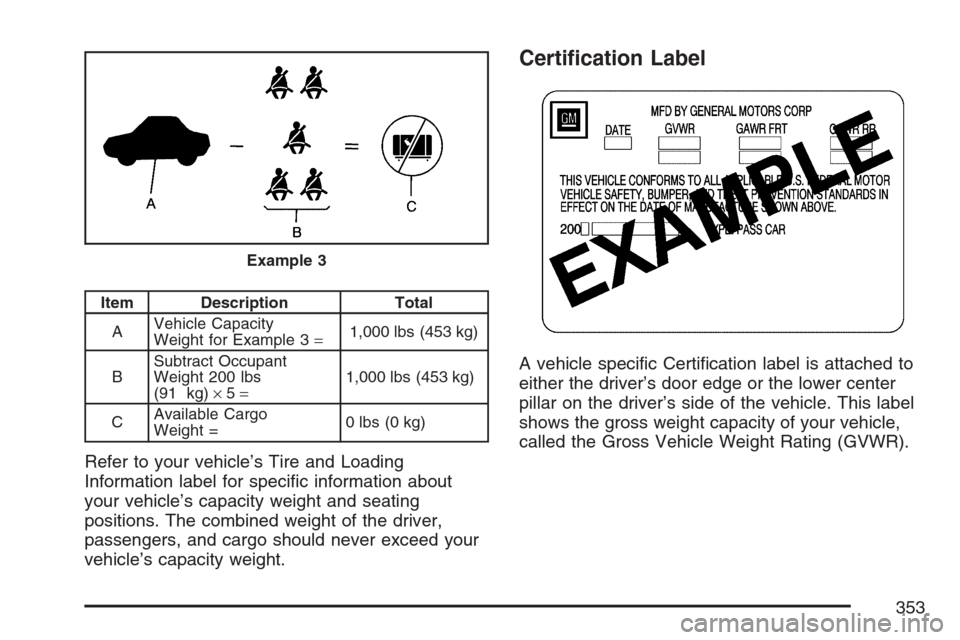
Item Description Total
AVehicle Capacity
Weight for Example 3=1,000 lbs (453 kg)
BSubtract Occupant
Weight 200 lbs
(91 kg)×5=1,000 lbs (453 kg)
CAvailable Cargo
Weight =0 lbs (0 kg)
Refer to your vehicle’s Tire and Loading
Information label for specic information about
your vehicle’s capacity weight and seating
positions. The combined weight of the driver,
passengers, and cargo should never exceed your
vehicle’s capacity weight.
Certication Label
A vehicle specic Certication label is attached to
either the driver’s door edge or the lower center
pillar on the driver’s side of the vehicle. This label
shows the gross weight capacity of your vehicle,
called the Gross Vehicle Weight Rating (GVWR).
Example 3
353
Page 360 of 560

Tires............................................................ 421
Winter Tires.............................................. 422
Tire Sidewall Labeling............................... 423
Tire Terminology and Denitions............... 426
Run-Flat Tires (STS-V).............................. 429
Ination - Tire Pressure............................. 431
High-Speed Operation............................... 432
Tire Pressure Monitor System................... 433
Tire Inspection and Rotation...................... 438
When It Is Time for New Tires.................. 440
Buying New Tires...................................... 441
Different Size Tires and Wheels................ 443
Uniform Tire Quality Grading..................... 444
Wheel Alignment and Tire Balance............ 445
Wheel Replacement.................................. 445
Tire Chains............................................... 447
Lifting Your Vehicle (STS-V)...................... 448
If a Tire Goes Flat.................................... 451
Tire Inator Kit.......................................... 452
Changing a Flat Tire................................. 464
Removing the Spare Tire and Tools.......... 465
Removing the Flat Tire and Installing
the Spare Tire....................................... 466Storing a Flat or Spare Tire and Tools...... 473
Compact Spare Tire.................................. 475
Appearance Care........................................ 476
Cleaning the Inside of Your Vehicle.......... 476
Fabric/Carpet............................................. 477
Leather...................................................... 478
Instrument Panel, Vinyl, and Other
Plastic Surfaces..................................... 479
Wood Panels............................................. 479
Speaker Covers........................................ 479
Care of Safety Belts.................................. 479
Weatherstrips............................................ 480
Washing Your Vehicle............................... 480
Cleaning Exterior Lamps/Lenses................ 480
Finish Care............................................... 481
Windshield and Wiper Blades.................... 481
Aluminum or Chrome-Plated Wheels......... 482
Tires......................................................... 483
Sheet Metal Damage................................. 483
Finish Damage.......................................... 483
Underbody Maintenance............................ 483
Chemical Paint Spotting............................ 484
Vehicle Care/Appearance Materials............ 484
Section 5 Service and Appearance Care
360
Page 407 of 560
{CAUTION:
The brake wear warning sound means that
soon the brakes will not work well. That
could lead to an accident. When you hear
the brake wear warning sound, have your
vehicle serviced.
Notice:Continuing to drive with worn-out
brake pads could result in costly brake repair.
Some driving conditions or climates may cause
a brake squeal when the brakes are rst applied or
lightly applied. This does not mean something is
wrong with your brakes.
Properly torqued wheel nuts are necessary to help
prevent brake pulsation. When tires are rotated,
inspect brake pads for wear and evenly tighten
wheel nuts in the proper sequence to GM torque
specications.
Brake linings should always be replaced as
complete axle sets.
Brake Pedal Travel
See your dealer if the brake pedal does not return
to normal height, or if there is a rapid increase in
pedal travel. This could be a sign of brake trouble.
Brake Adjustment
Every time you apply the brakes, with or without
the vehicle moving, your brakes adjust for wear.
Replacing Brake System Parts
The braking system on a vehicle is complex. Its
many parts have to be of top quality and work well
together if the vehicle is to have really good
braking. Your vehicle was designed and tested with
top-quality GM brake parts. When you replace parts
of your braking system — for example, when your
brake linings wear down and you need new ones
put in — be sure you get new approved
replacement parts. If you do not, your brakes may
no longer work properly. For example, if someone
puts in brake linings that are wrong for your vehicle,
the balance between your front and rear brakes can
change — for the worse. The braking performance
you have come to expect can change in many other
ways if someone puts in the wrong replacement
brake parts.
407
Page 421 of 560

Tires
Your new vehicle comes with high-quality tires
made by a leading tire manufacturer. If you ever
have questions about your tire warranty and where
to obtain service, see your GM Warranty booklet for
details. For additional information refer to the tire
manufacturer’s booklet included with your vehicle.
{CAUTION:
Poorly maintained and improperly
used tires are dangerous.
Overloading your tires can cause
overheating as a result of too much
friction. You could have an air-out and
a serious accident. SeeLoading Your
Vehicle on page 349.
CAUTION: (Continued)
CAUTION: (Continued)
Underinated tires pose the same
danger as overloaded tires. The
resulting accident could cause serious
injury. Check all tires frequently to
maintain the recommended pressure.
Tire pressure should be checked when
your tires are cold. SeeInflation - Tire
Pressure on page 431.
Overinated tires are more likely to be
cut, punctured, or broken by a sudden
impact — such as when you hit a
pothole. Keep tires at the
recommended pressure.
Worn, old tires can cause accidents. If
your tread is badly worn, or if your tires
have been damaged, replace them.
SeeHigh-Speed Operation on page 432for
ination pressure adjustment for high
speed driving.
421
Page 422 of 560

Low-Prole Performance Tires
If your vehicle has 255/45ZR18, P255/45R18 or
P275/40R19 100Y size tires, they are classied as
low-prole performance tires. These tires are
designed for very responsive driving on wet or dry
pavement. You may also notice more road noise
with low-prole performance tires and that they tend
to wear faster. These performance tires are not
rated as all-season tires. Winter tires are
recommended for snow or ice covered roads.
Notice:If your vehicle has low-prole tires,
they are more susceptible to damage from road
hazards or curb impact than standard prole
tires. Tire and/or wheel assembly damage
can occur when coming into contact with road
hazards like, potholes, or sharp edged
objects, or when sliding into a curb. Your GM
warranty does not cover this type of damage.
Keep tires set to the correct ination pressure
and, when possible avoid contact with
curbs, potholes, and other road hazards.
Winter Tires
If you expect to drive on snow or ice covered
roads often, you may want to get winter tires for
your vehicle. All season tires provide good overallperformance on most surfaces but they may not
offer the traction you would like or the same
level of performance as winter tires on snow or ice
covered roads.
Winter tires, in general, are designed for increased
traction on snow and ice covered roads. With
winter tires, there may be decreased dry
road traction, increased road noise, and shorter
tread life. After switching to winter tires, be alert for
changes in vehicle handling and braking.
See your dealer for details regarding winter tire
availability and proper tire selection. Also,
seeBuying New Tires on page 441.
If you choose to use winter tires:
Use tires of the same brand and tread type on
all four wheel positions.
Use only radial ply tires of the same size, load
range, and speed rating as the original
equipment tires.
Winter tires with the same speed rating as your
original equipment tires may not be available for H,
V, W, Y, and ZR speed rated tires. If you choose
winter tires with a lower speed rating, never
exceed the tire’s maximum speed capability.
422
Page 423 of 560

Tire Sidewall Labeling
Useful information about a tire is molded into its
sidewall. The examples below show a typical
passenger vehicle tire and a compact spare tire
sidewall.(A) Tire Size:The tire size is a combination of
letters and numbers used to dene a particular
tire’s width, height, aspect ratio, construction type,
and service description. See the “Tire Size”
illustration later in this section for more detail.
(B) TPC Spec (Tire Performance Criteria
Specication):Original equipment tires designed
to GM’s specic tire performance criteria have
a TPC specication code molded onto the sidewall.
GM’s TPC specications meet or exceed all
federal safety guidelines.
(C) DOT (Department of Transportation):The
Department of Transportation (DOT) code
indicates that the tire is in compliance with the
U.S. Department of Transportation Motor Vehicle
Safety Standards.
(D) Tire Identication Number (TIN):The letters
and numbers following DOT (Department of
Transportation) code is the Tire Identication
Number (TIN). The TIN shows the manufacturer
and plant code, tire size, and date the tire
was manufactured. The TIN is molded onto both
sides of the tire, although only one side may have
the date of manufacture.
Passenger (P-Metric) Tire Example
423
Page 424 of 560

(E) Tire Ply Material:The type of cord and
number of plies in the sidewall and under the tread.
(F) Uniform Tire Quality Grading (UTQG):Tire
manufacturers are required to grade tires
based on three performance factors: treadwear,
traction, and temperature resistance. For more
information seeUniform Tire Quality Grading on
page 444.
(G) Maximum Cold Ination Load Limit:
Maximum load that can be carried and the
maximum pressure needed to support that load.
(A) Temporary Use Only:The compact spare
tire or temporary use tire has a tread life of
approximately 3,000 miles (5 000 km) and should
not be driven at speeds over 65 mph (105 km/h).
The compact spare tire is for emergency use when
a regular road tire has lost air and gone at. If
your vehicle has a compact spare tire, see
Compact Spare Tire on page 475andIf a Tire
Goes Flat on page 451.
Compact Spare Tire Example
424
Page 425 of 560

(B) Tire Ply Material:The type of cord and
number of plies in the sidewall and under the tread.
(C) Tire Identication Number (TIN):The letters
and numbers following the DOT (Department of
Transportation) code is the Tire Identication
Number (TIN). The TIN shows the manufacturer
and plant code, tire size, and date the tire
was manufactured. The TIN is molded onto both
sides of the tire, although only one side may have
the date of manufacture.
(D) Maximum Cold Ination Load
Limit:Maximum load that can be carried and the
maximum pressure needed to support that load.
(E) Tire Ination:The temporary use tire or
compact spare tire should be inated to 60 psi
(420 kPa). For more information on tire pressure
and ination seeInation - Tire Pressure on
page 431.
(F) Tire Size:A combination of letters and
numbers dene a tire’s width, height, aspect ratio,
construction type, and service description. The
letter T as the rst character in the tire size means
the tire is for temporary use only.(G) TPC Spec (Tire Performance Criteria
Specication):Original equipment tires designed
to GM’s specic tire performance criteria have
a TPC specication code molded onto the sidewall.
GM’s TPC specications meet or exceed all
federal safety guidelines.
Tire Size
The following illustration shows an example of a
typical passenger vehicle tire size.
(A) Passenger (P-Metric) Tire:The United States
version of a metric tire sizing system. The letter P
as the rst character in the tire size means a
passenger vehicle tire engineered to standards set
by the U.S. Tire and Rim Association.
(B) Tire Width:The three-digit number indicates
the tire section width in millimeters from sidewall
to sidewall.
425
Page 426 of 560
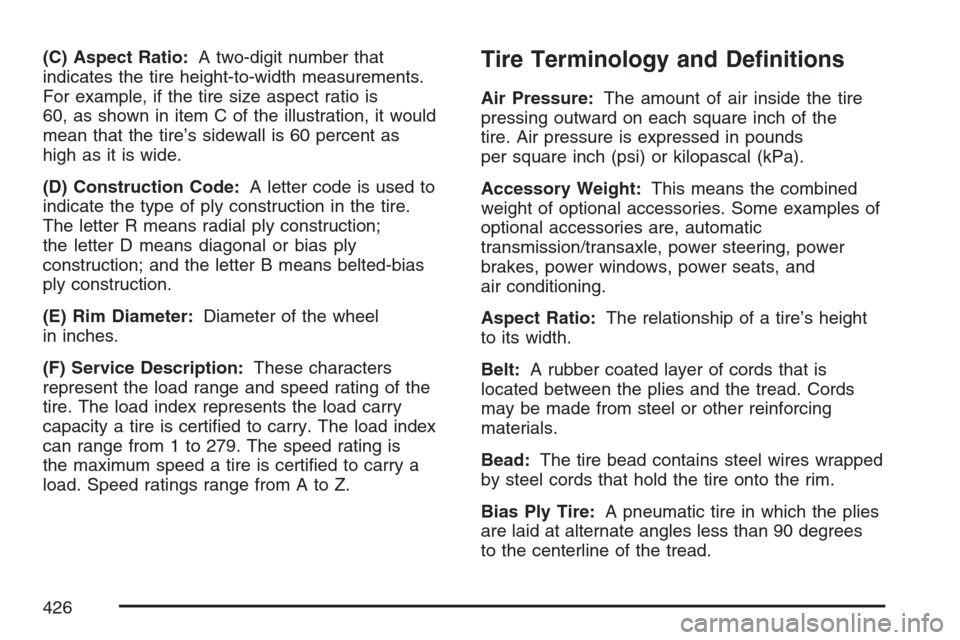
(C) Aspect Ratio:A two-digit number that
indicates the tire height-to-width measurements.
For example, if the tire size aspect ratio is
60, as shown in item C of the illustration, it would
mean that the tire’s sidewall is 60 percent as
high as it is wide.
(D) Construction Code:A letter code is used to
indicate the type of ply construction in the tire.
The letter R means radial ply construction;
the letter D means diagonal or bias ply
construction; and the letter B means belted-bias
ply construction.
(E) Rim Diameter:Diameter of the wheel
in inches.
(F) Service Description:These characters
represent the load range and speed rating of the
tire. The load index represents the load carry
capacity a tire is certied to carry. The load index
can range from 1 to 279. The speed rating is
the maximum speed a tire is certied to carry a
load. Speed ratings range from A to Z.Tire Terminology and Denitions
Air Pressure:The amount of air inside the tire
pressing outward on each square inch of the
tire. Air pressure is expressed in pounds
per square inch (psi) or kilopascal (kPa).
Accessory Weight:This means the combined
weight of optional accessories. Some examples of
optional accessories are, automatic
transmission/transaxle, power steering, power
brakes, power windows, power seats, and
air conditioning.
Aspect Ratio:The relationship of a tire’s height
to its width.
Belt:A rubber coated layer of cords that is
located between the plies and the tread. Cords
may be made from steel or other reinforcing
materials.
Bead:The tire bead contains steel wires wrapped
by steel cords that hold the tire onto the rim.
Bias Ply Tire:A pneumatic tire in which the plies
are laid at alternate angles less than 90 degrees
to the centerline of the tread.
426
Page 427 of 560
Cold Tire Pressure:The amount of air pressure
in a tire, measured in pounds per square inch
(psi) or kilopascals (kPa) before a tire has built up
heat from driving. SeeInation - Tire Pressure
on page 431.
Curb Weight:This means the weight of a motor
vehicle with standard and optional equipment
including the maximum capacity of fuel, oil, and
coolant, but without passengers and cargo.
DOT Markings:A code molded into the sidewall
of a tire signifying that the tire is in compliance
with the U.S. Department of Transportation (DOT)
motor vehicle safety standards. The DOT code
includes the Tire Identication Number (TIN),
an alphanumeric designator which can also identify
the tire manufacturer, production plant, brand,
and date of production.
GVWR:Gross Vehicle Weight Rating. See
Loading Your Vehicle on page 349.
GAWR FRT:Gross Axle Weight Rating for the
front axle. SeeLoading Your Vehicle on page 349.GAWR RR:Gross Axle Weight Rating for the rear
axle. SeeLoading Your Vehicle on page 349.
Intended Outboard Sidewall:The side of
an asymmetrical tire, that must always face
outward when mounted on a vehicle.
Kilopascal (kPa):The metric unit for air pressure.
Light Truck (LT-Metric) Tire:A tire used on
light duty trucks and some multipurpose passenger
vehicles.
Load Index:An assigned number ranging from
1 to 279 that corresponds to the load carrying
capacity of a tire.
Maximum Ination Pressure:The maximum air
pressure to which a cold tire may be inated.
The maximum air pressure is molded onto
the sidewall.
Maximum Load Rating:The load rating for a tire
at the maximum permissible ination pressure
for that tire.
427