overheating CADILLAC XLR 2005 1.G Owners Manual
[x] Cancel search | Manufacturer: CADILLAC, Model Year: 2005, Model line: XLR, Model: CADILLAC XLR 2005 1.GPages: 438, PDF Size: 3.69 MB
Page 151 of 438
Notice:When using an accessory power outlet,
maximum electrical load must not exceed 20 amps.
Always turn off any electrical equipment when
not in use. Leaving electrical equipment on for
extended periods will drain your vehicle’s battery.
Certain electrical accessories may not be compatible
with the accessory power outlet and could result
in blown vehicle or adapter fuses. If you experience a
problem, see your dealer for additional information
on accessory power outlets.
Notice:Adding any electrical equipment to your
vehicle may damage it or keep other components
from working as they should. The repairs would not
be covered by your warranty. Check with your
dealer before adding electrical equipment.
When adding electrical equipment, be sure to follow the
installation instructions included with the equipment.
We recommend that you see a qualied technician or
your dealer for the proper installation of your equipment.
Notice:Improper use of the power outlet can
cause damage not covered by your warranty. Do not
hang any type of accessory or accessory bracket
from the plug because the power outlets are
designed for accessory power plugs only.Ashtrays and Cigarette Lighter
The ashtray and cigarette lighter are located under a lid in
the front console to the right of the shift lever. Press the
left side of the lid and it will open automatically.
Notice:If you put papers or other ammable items
in the ashtray, hot cigarettes or other smoking
materials could ignite them and possibly damage
your vehicle. Never put ammable items in the
ashtray.
Loose objects, such as paper clips, can lodge behind
and beneath the ashtray lid and prevent movement
of the lid. You should avoid putting small, loose objects
near the ashtray.
To use the cigarette lighter, push it in all the way and let
go. When it is ready, it will pop back out by itself.
Notice:Holding a cigarette lighter in while it is
heating will not allow the lighter to back away from
the heating element when it is hot. Damage from
overheating may occur to the lighter or heating
element, or a fuse could be blown. Do not hold a
cigarette lighter in while it is heating. Do not
use anything other than the cigarette lighter in the
heating element.
3-39
Page 166 of 438
You can acknowledge this message by pressing the
RESET button. When the SERVICE STABILITRAK
message is displayed, the StabiliTrak
®system will not
assist you in controlling the vehicle. You should have the
system serviced as soon as possible. Adjust your
driving accordingly.
When the system is working, you will see the
STABILITRAK ACTIVE message displayed in the DIC.
You may also feel of hear the system working. This
is normal.
If you turn off the StabiliTrak
®system, by pressing the
front part of the button on the console for ve seconds,
the traction control system light will come on, a
chime will sound and the TRAC/STABILITRAK OFF
message will be displayed in the DIC. The Traction
Control System will also be turned off. SeeDIC
Warnings and Messages on page 3-64for more
information.
If the StabiliTrak
®system and Traction Control System
are turned off, pressing the console button momentarily
will turn both systems on. The DIC will display the
TRAC/STABILITRAK ON message, the instrument
cluster light will be off and a chime will sound. SeeDIC
Warnings and Messages on page 3-64for more
information.
Engine Coolant Temperature Gage
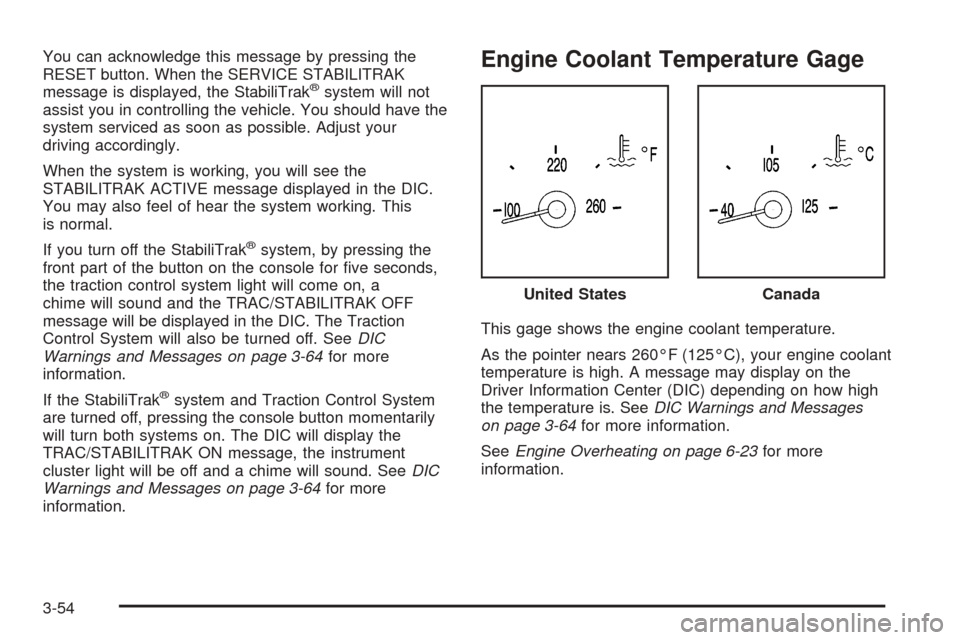
This gage shows the engine coolant temperature.
As the pointer nears 260°F (125°C), your engine coolant
temperature is high. A message may display on the
Driver Information Center (DIC) depending on how high
the temperature is. SeeDIC Warnings and Messages
on page 3-64for more information.
SeeEngine Overheating on page 6-23for more
information.United States
Canada
3-54
Page 177 of 438
COOLANT OVER TEMP:This message will appear
when the engine coolant temperature is too hot.
Stop and allow your vehicle to idle in PARK (P) until it
cools down and the message is removed. Do not
increase engine speed above a normal idle. If it does
not cool down, turn off the engine and have it serviced
by your GM dealer before driving it again. Severe
engine damage can result from an overheated engine.
SeeEngine Overheating on page 6-23.
CRUISE NOT READY:This message indicates that
ACC will not activate due to a temporary condition. Your
vehicle does not require service. If this message
appears when you attempt to activate the system,
continue driving for several minutes then try again to
activate the system.
DRIVER NO. X (1 OR 2):This message will be
displayed when the vehicle is started or when there is a
change of driver. The message will show which driver
is activating the personalization feature. It will only
stay on for ve seconds.
ENGINE HOT, STOP ENGINE:This message will
appear when the engine has overheated. Stop and turn
the engine off immediately to avoid severe engine
damage. SeeEngine Overheating on page 6-23.A
multiple chime will also sound when this message
is displayed.ENGINE PROTECTION REDUCE ENGINE RPM:
If this message appears, the control system has
determined that continued operation at the existing
engine speed may lead to engine overheating.
Therefore, you should lower the engine speed by
upshifting the transmission or drive at a lower speed.
HEADLAMPS SUGGESTED:If it is dark enough
outside and the headlamps and Twilight Sentinel
®
controls are off, this message will display on the DIC.
This message informs the driver that turning on the
exterior lamps is recommended. It has become
dark enough outside to require the headlamps and/or
other exterior lamps. This message will also appear
if the optional Rainsense™ wiping feature is on and the
Twilight Sentinel
®is off.
HIGH TRANS TEMP:This message indicates that the
transaxle uid in your vehicle is too hot. Stop and
allow your vehicle to idle until it cools down or until this
message is removed.
3-65
Page 309 of 438
Service............................................................6-3
Doing Your Own Service Work.........................6-4
Adding Equipment to the Outside of Your
Vehicle......................................................6-5
Fuel................................................................6-5
Gasoline Octane............................................6-5
Gasoline Specications....................................6-5
California Fuel...............................................6-5
Additives.......................................................6-6
Fuels in Foreign Countries...............................6-6
Filling Your Tank............................................6-7
Filling a Portable Fuel Container.....................6-10
Checking Things Under the Hood....................6-10
Hood Release..............................................6-11
Engine Compartment Overview.......................6-12
Engine Oil...................................................6-13
Engine Oil Life System..................................6-16
Engine Air Cleaner/Filter................................6-18
Automatic Transmission Fluid.........................6-20
Engine Coolant.............................................6-20
Coolant Surge Tank Pressure Cap..................6-23
Engine Overheating.......................................6-23
Overheated Engine Protection
Operating Mode........................................6-25
Cooling System............................................6-26
Power Steering Fluid.....................................6-31Windshield Washer Fluid................................6-32
Brakes........................................................6-33
Battery........................................................6-36
Jump Starting...............................................6-37
Rear Axle.......................................................6-41
Headlamp Aiming...........................................6-42
Headlamp Vertical Aiming..............................6-43
Bulb Replacement..........................................6-44
Windshield Wiper Blade Replacement..............6-45
Tires..............................................................6-46
Tire Sidewall Labelling...................................6-47
Tire Terminology and Denitions.....................6-49
Run-Flat Tires..............................................6-52
Ination - Tire Pressure.................................6-53
Tire Pressure Monitor System.........................6-55
Tire Inspection and Rotation...........................6-57
When It Is Time for New Tires.......................6-58
Buying New Tires.........................................6-58
Uniform Tire Quality Grading..........................6-59
Wheel Alignment and Tire Balance..................6-61
Wheel Replacement......................................6-61
Tire Chains..................................................6-63
Lifting Your Vehicle.......................................6-64
If a Tire Goes Flat........................................6-68
Section 6 Service and Appearance Care
6-1
Page 328 of 438
Automatic Transmission Fluid
How to Check
It is not necessary to check the transmission uid level.
A transmission uid leak is the only reason for uid
loss. If a leak occurs, take the vehicle to your dealer
service department and have it repaired as soon
as possible.
There is a special procedure for checking and changing
the transmission uid. Because this procedure is difficult,
you should have this done at your dealer service
department. Contact your dealer for additional
information or the procedure can be found in the service
manual. To purchase a service manual, seeService
Publications Ordering Information on page 8-12.
Notice:Use of automatic transmission uid labeled
other than DEXRON
®-III, Approved for the
H-Specication, may damage your vehicle, and the
damages may not be covered by your warranty.
Always use automatic transmission uid labeled
DEXRON
®-III, Approved for the H-Specication.Change both the uid and lter every 50,000 miles
(80 000 km) if the vehicle is mainly driven under one of
these conditions:
In heavy city traffic where the outside temperature
regularly reaches 90°F (32°C) or higher.
In hilly or mountainous terrain.
High performance operation.
If you do not use your vehicle under one of these
conditions, change the uid and lter every
100,000 miles (166 000 km).
SeeScheduled Maintenance on page 7-4for the proper
service intervals for the transmission uid and lter.
Engine Coolant
The cooling system in your vehicle is lled with
DEX-COOL®engine coolant. This coolant is designed
to remain in your vehicle for ve years or 150,000 miles
(240 000 km), whichever occurs rst, if you add only
DEX-COOL
®extended life coolant.
The following explains your cooling system and how
to add coolant when it is low. If you have a problem
with engine overheating, seeEngine Overheating
on page 6-23.
6-20
Page 331 of 438
Adding Coolant
If you need more coolant, add the proper DEX-COOL®
coolant mixtureat the surge tank,but only when the
engine is cool.
{CAUTION:
You can be burned if you spill coolant on hot
engine parts. Coolant contains ethylene glycol,
and it will burn if the engine parts are hot
enough. Do not spill coolant on a hot engine.
When replacing the pressure cap, press down and turn
it clockwise (right) until you hear a clicking sound.
Make sure you fully install the cap.
Coolant Surge Tank Pressure Cap
Notice:If the pressure cap is not tightly installed,
coolant loss and possible engine damage may
occur. Be sure the cap is properly and tightly
secured.
SeeEngine Compartment Overview on page 6-12for
information on location.
Engine Overheating
You will nd a COOLANT OVER TEMP message or an
ENGINE HOT, STOP ENGINE message displayed in the
Driver Information Center (DIC). SeeDIC Warnings and
Messages on page 3-64. You will also hear a chime.
There is also an engine coolant temperature gage on the
instrument panel cluster. SeeEngine Coolant
Temperature Gage on page 3-54.
6-23
Page 335 of 438
{CAUTION:
Heater and radiator hoses, and other engine
parts, can be very hot. Do not touch them. If
you do, you can be burned.
Do not run the engine if there is a leak. If you
run the engine, it could lose all coolant. That
could cause an engine re, and you could be
burned. Get any leak xed before you drive the
vehicle.
If there seems to be no leak, with the engine on, check
to see if the electric engine cooling fan is running. If
the engine is overheating, the fan should be running. If
it is not, your vehicle needs service.Notice:Engine damage from running your engine
without coolant is not covered by your warranty. See
Overheated Engine Protection Operating Mode on
page 6-25for information on driving to a safe place
in an emergency.
Notice:Using coolant other than DEX-COOL®may
cause premature engine, heater core or radiator
corrosion. In addition, the engine coolant may
require changing sooner, at 30,000 miles (50 000 km)
or 24 months, whichever occurs rst. Any repairs
would not be covered by your warranty. Always use
DEX-COOL
®(silicate-free) coolant in your vehicle.
6-27
Page 354 of 438
Tires
Your new vehicle comes with high-quality tires made by
a leading tire manufacturer. If you ever have questions
about your tire warranty and where to obtain service,
see your GM Warranty booklet for details. For additional
information refer to the tire manufacturer’s booklet
included with your vehicle’s Owner’s Manual.{CAUTION:
Poorly maintained and improperly used tires
are dangerous.
Overloading your tires can cause
overheating as a result of too much
friction. You could have an air-out and a
serious accident. SeeLoading Your
Vehicle on page 5-30.
Underinated tires pose the same danger
as overloaded tires. The resulting accident
could cause serious injury. Check all tires
frequently to maintain the recommended
pressure. Tire pressure should be checked
when your tires are cold. SeeInflation - Tire
Pressure on page 6-53.
Overinated tires are more likely to be
cut, punctured or broken by a sudden
impact — such as when you hit a pothole.
Keep tires at the recommended pressure.
Worn, old tires can cause accidents. If your
tread is badly worn, or if your tires have
been damaged, replace them.
6-46
Page 428 of 438
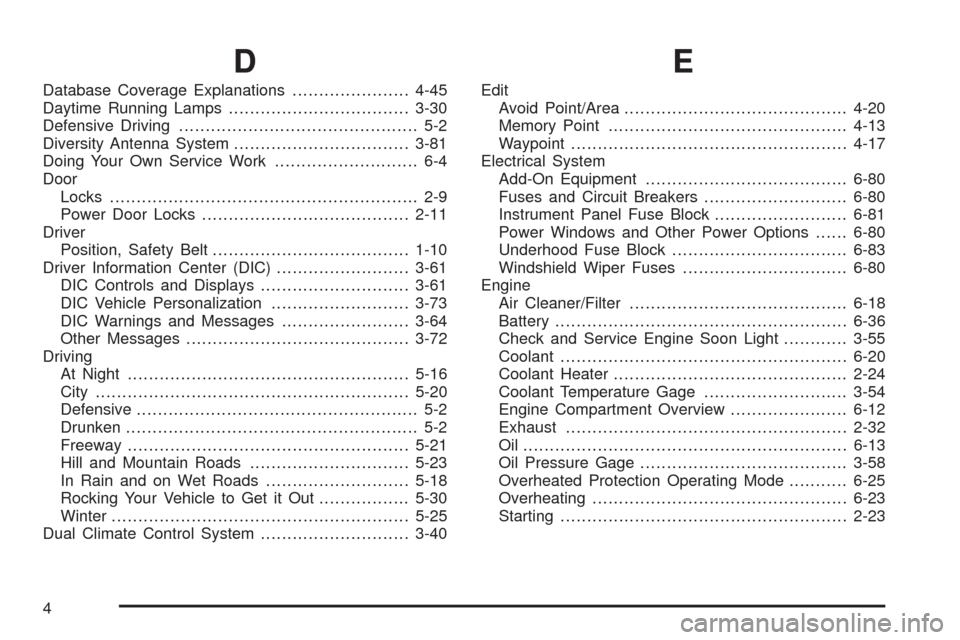
D
Database Coverage Explanations......................4-45
Daytime Running Lamps..................................3-30
Defensive Driving............................................. 5-2
Diversity Antenna System.................................3-81
Doing Your Own Service Work........................... 6-4
Door
Locks.......................................................... 2-9
Power Door Locks.......................................2-11
Driver
Position, Safety Belt.....................................1-10
Driver Information Center (DIC).........................3-61
DIC Controls and Displays............................3-61
DIC Vehicle Personalization..........................3-73
DIC Warnings and Messages........................3-64
Other Messages..........................................3-72
Driving
At Night.....................................................5-16
City...........................................................5-20
Defensive..................................................... 5-2
Drunken....................................................... 5-2
Freeway.....................................................5-21
Hill and Mountain Roads..............................5-23
In Rain and on Wet Roads...........................5-18
Rocking Your Vehicle to Get it Out.................5-30
Winter........................................................5-25
Dual Climate Control System............................3-40
E
Edit
Avoid Point/Area..........................................4-20
Memory Point.............................................4-13
Waypoint....................................................4-17
Electrical System
Add-On Equipment......................................6-80
Fuses and Circuit Breakers...........................6-80
Instrument Panel Fuse Block.........................6-81
Power Windows and Other Power Options......6-80
Underhood Fuse Block.................................6-83
Windshield Wiper Fuses...............................6-80
Engine
Air Cleaner/Filter.........................................6-18
Battery.......................................................6-36
Check and Service Engine Soon Light............3-55
Coolant......................................................6-20
Coolant Heater............................................2-24
Coolant Temperature Gage...........................3-54
Engine Compartment Overview......................6-12
Exhaust.....................................................2-32
Oil .............................................................6-13
Oil Pressure Gage.......................................3-58
Overheated Protection Operating Mode...........6-25
Overheating................................................6-23
Starting......................................................2-23
4