air filter CHERY TIGGO 2009 Service User Guide
[x] Cancel search | Manufacturer: CHERY, Model Year: 2009, Model line: TIGGO, Model: CHERY TIGGO 2009Pages: 1903, PDF Size: 33.38 MB
Page 178 of 1903
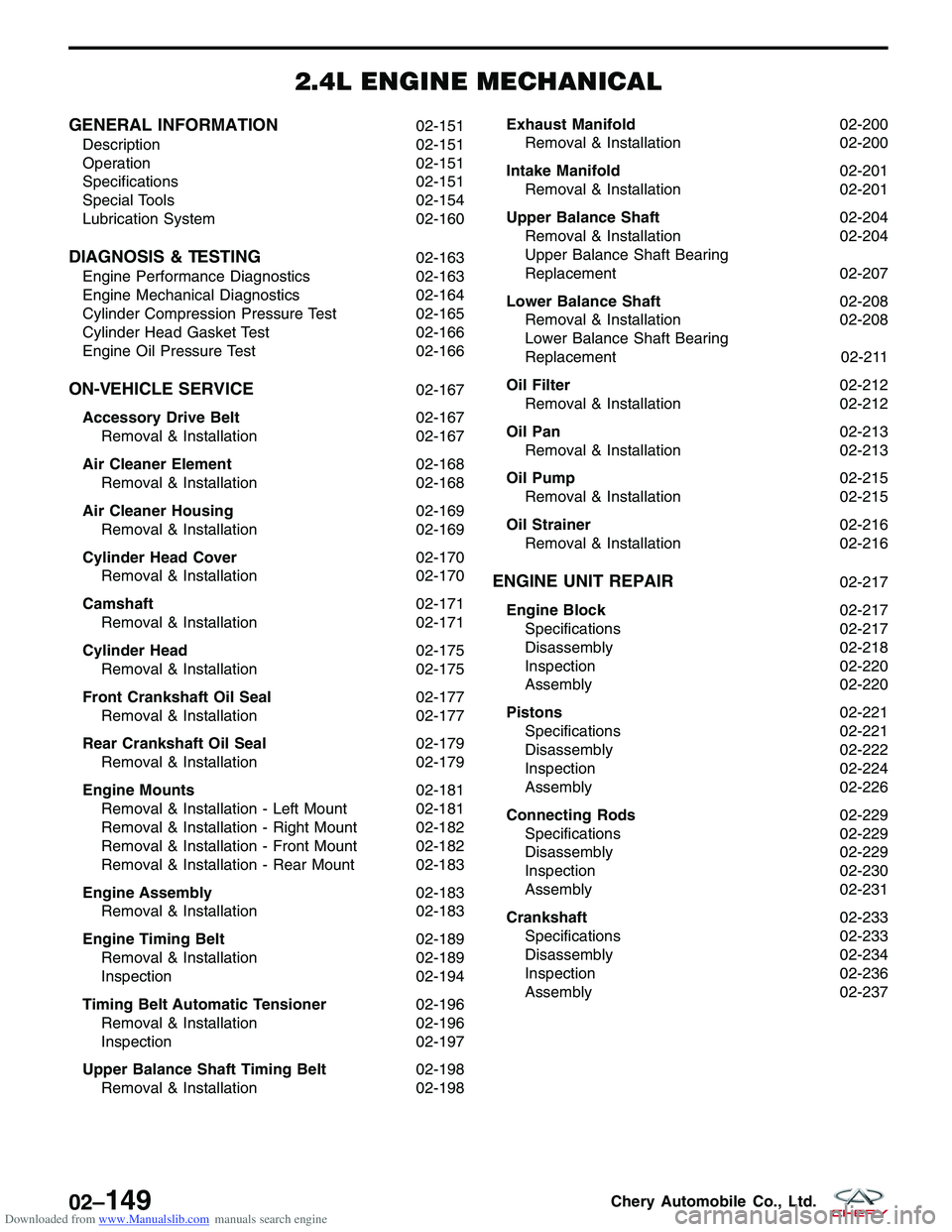
Downloaded from www.Manualslib.com manuals search engine 2.4L ENGINE MECHANICAL
GENERAL INFORMATION02-151
Description 02-151
Operation 02-151
Specifications 02-151
Special Tools 02-154
Lubrication System 02-160
DIAGNOSIS & TESTING02-163
Engine Performance Diagnostics 02-163
Engine Mechanical Diagnostics 02-164
Cylinder Compression Pressure Test 02-165
Cylinder Head Gasket Test 02-166
Engine Oil Pressure Test 02-166
ON-VEHICLE SERVICE02-167
Accessory Drive Belt 02-167
Removal & Installation 02-167
Air Cleaner Element 02-168
Removal & Installation 02-168
Air Cleaner Housing 02-169
Removal & Installation 02-169
Cylinder Head Cover 02-170
Removal & Installation 02-170
Camshaft 02-171
Removal & Installation 02-171
Cylinder Head 02-175
Removal & Installation 02-175
Front Crankshaft Oil Seal 02-177
Removal & Installation 02-177
Rear Crankshaft Oil Seal 02-179
Removal & Installation 02-179
Engine Mounts 02-181
Removal & Installation - Left Mount 02-181
Removal & Installation - Right Mount 02-182
Removal & Installation - Front Mount 02-182
Removal & Installation - Rear Mount 02-183
Engine Assembly 02-183
Removal & Installation 02-183
Engine Timing Belt 02-189
Removal & Installation 02-189
Inspection 02-194
Timing Belt Automatic Tensioner 02-196
Removal & Installation 02-196
Inspection 02-197
Upper Balance Shaft Timing Belt 02-198
Removal & Installation 02-198Exhaust Manifold
02-200
Removal & Installation 02-200
Intake Manifold 02-201
Removal & Installation 02-201
Upper Balance Shaft 02-204
Removal & Installation 02-204
Upper Balance Shaft Bearing
Replacement 02-207
Lower Balance Shaft 02-208
Removal & Installation 02-208
Lower Balance Shaft Bearing
Replacement 02-211
Oil Filter 02-212
Removal & Installation 02-212
Oil Pan 02-213
Removal & Installation 02-213
Oil Pump 02-215
Removal & Installation 02-215
Oil Strainer 02-216
Removal & Installation 02-216
ENGINE UNIT REPAIR02-217
Engine Block 02-217
Specifications 02-217
Disassembly 02-218
Inspection 02-220
Assembly 02-220
Pistons 02-221
Specifications 02-221
Disassembly 02-222
Inspection 02-224
Assembly 02-226
Connecting Rods 02-229
Specifications 02-229
Disassembly 02-229
Inspection 02-230
Assembly 02-231
Crankshaft 02-233
Specifications 02-233
Disassembly 02-234
Inspection 02-236
Assembly 02-237
02–149Chery Automobile Co., Ltd.
Page 192 of 1903
Downloaded from www.Manualslib.com manuals search engine DIAGNOSIS & TESTING
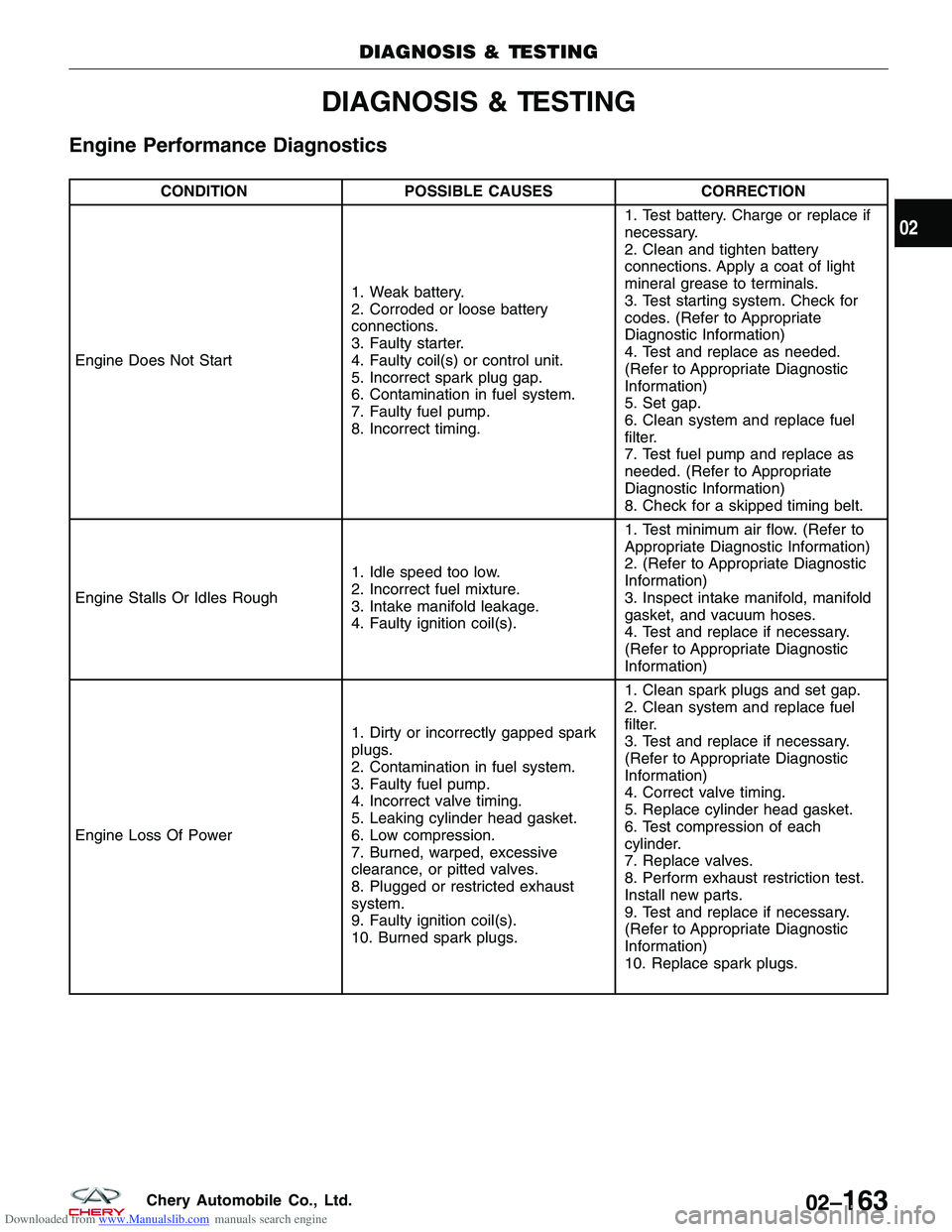
Engine Performance Diagnostics
CONDITIONPOSSIBLE CAUSES CORRECTION
Engine Does Not Start 1. Weak battery.
2. Corroded or loose battery
connections.
3. Faulty starter.
4. Faulty coil(s) or control unit.
5. Incorrect spark plug gap.
6. Contamination in fuel system.
7. Faulty fuel pump.
8. Incorrect timing.1. Test battery. Charge or replace if
necessary.
2. Clean and tighten battery
connections. Apply a coat of light
mineral grease to terminals.
3. Test starting system. Check for
codes. (Refer to Appropriate
Diagnostic Information)
4. Test and replace as needed.
(Refer to Appropriate Diagnostic
Information)
5. Set gap.
6. Clean system and replace fuel
filter.
7. Test fuel pump and replace as
needed. (Refer to Appropriate
Diagnostic Information)
8. Check for a skipped timing belt.
Engine Stalls Or Idles Rough 1. Idle speed too low.
2. Incorrect fuel mixture.
3. Intake manifold leakage.
4. Faulty ignition coil(s).1. Test minimum air flow. (Refer to
Appropriate Diagnostic Information)
2. (Refer to Appropriate Diagnostic
Information)
3. Inspect intake manifold, manifold
gasket, and vacuum hoses.
4. Test and replace if necessary.
(Refer to Appropriate Diagnostic
Information)
Engine Loss Of Power 1. Dirty or incorrectly gapped spark
plugs.
2. Contamination in fuel system.
3. Faulty fuel pump.
4. Incorrect valve timing.
5. Leaking cylinder head gasket.
6. Low compression.
7. Burned, warped, excessive
clearance, or pitted valves.
8. Plugged or restricted exhaust
system.
9. Faulty ignition coil(s).
10. Burned spark plugs.1. Clean spark plugs and set gap.
2. Clean system and replace fuel
filter.
3. Test and replace if necessary.
(Refer to Appropriate Diagnostic
Information)
4. Correct valve timing.
5. Replace cylinder head gasket.
6. Test compression of each
cylinder.
7. Replace valves.
8. Perform exhaust restriction test.
Install new parts.
9. Test and replace if necessary.
(Refer to Appropriate Diagnostic
Information)
10. Replace spark plugs.
DIAGNOSIS & TESTING
02
02–163Chery Automobile Co., Ltd.
Page 193 of 1903
Downloaded from www.Manualslib.com manuals search engine CONDITIONPOSSIBLE CAUSES CORRECTION
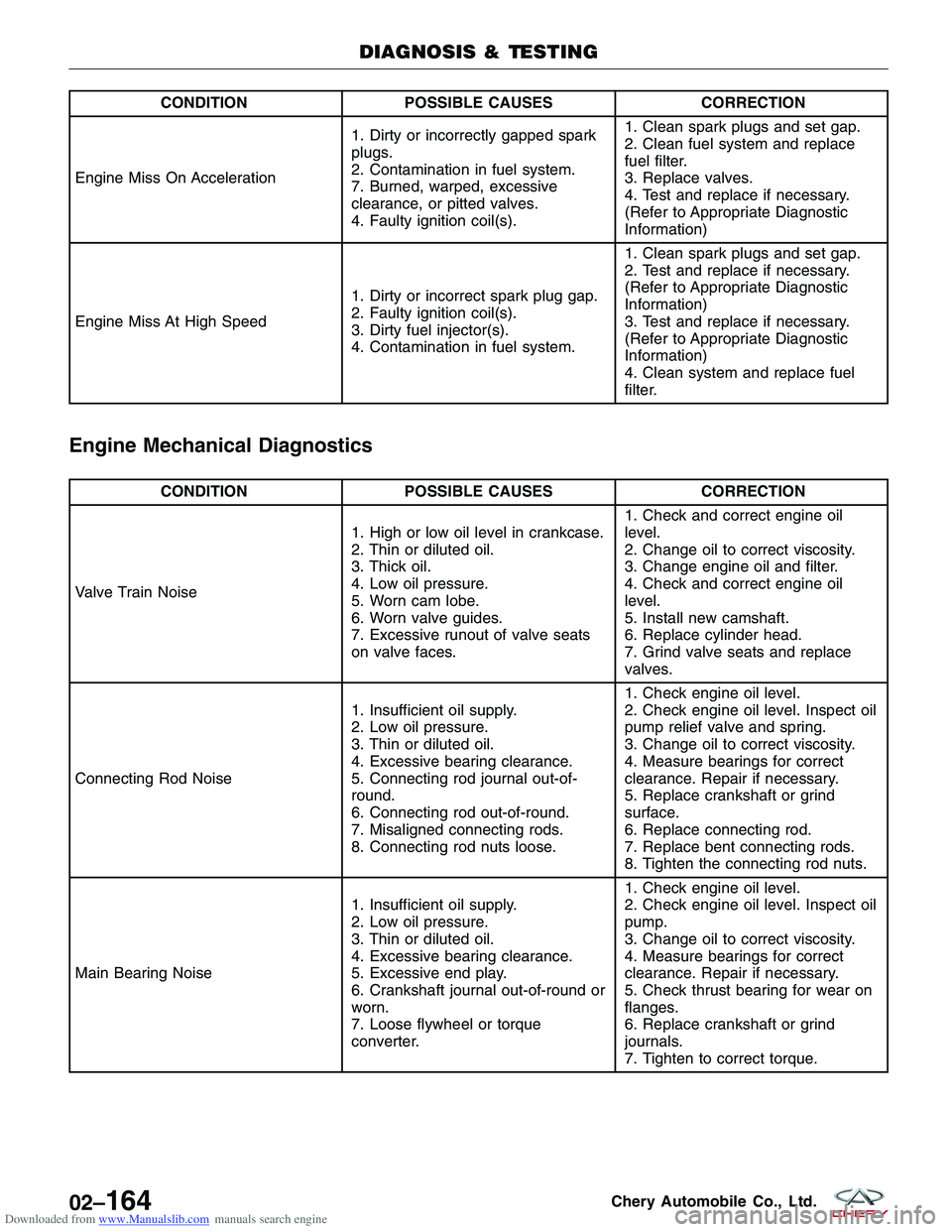
Engine Miss On Acceleration 1. Dirty or incorrectly gapped spark
plugs.
2. Contamination in fuel system.
7. Burned, warped, excessive
clearance, or pitted valves.
4. Faulty ignition coil(s).1. Clean spark plugs and set gap.
2. Clean fuel system and replace
fuel filter.
3. Replace valves.
4. Test and replace if necessary.
(Refer to Appropriate Diagnostic
Information)
Engine Miss At High Speed 1. Dirty or incorrect spark plug gap.
2. Faulty ignition coil(s).
3. Dirty fuel injector(s).
4. Contamination in fuel system.1. Clean spark plugs and set gap.
2. Test and replace if necessary.
(Refer to Appropriate Diagnostic
Information)
3. Test and replace if necessary.
(Refer to Appropriate Diagnostic
Information)
4. Clean system and replace fuel
filter.
Engine Mechanical Diagnostics
CONDITION
POSSIBLE CAUSES CORRECTION
Valve Train Noise 1. High or low oil level in crankcase.
2. Thin or diluted oil.
3. Thick oil.
4. Low oil pressure.
5. Worn cam lobe.
6. Worn valve guides.
7. Excessive runout of valve seats
on valve faces.1. Check and correct engine oil
level.
2. Change oil to correct viscosity.
3. Change engine oil and filter.
4. Check and correct engine oil
level.
5. Install new camshaft.
6. Replace cylinder head.
7. Grind valve seats and replace
valves.
Connecting Rod Noise 1. Insufficient oil supply.
2. Low oil pressure.
3. Thin or diluted oil.
4. Excessive bearing clearance.
5. Connecting rod journal out-of-
round.
6. Connecting rod out-of-round.
7. Misaligned connecting rods.
8. Connecting rod nuts loose.1. Check engine oil level.
2. Check engine oil level. Inspect oil
pump relief valve and spring.
3. Change oil to correct viscosity.
4. Measure bearings for correct
clearance. Repair if necessary.
5. Replace crankshaft or grind
surface.
6. Replace connecting rod.
7. Replace bent connecting rods.
8. Tighten the connecting rod nuts.
Main Bearing Noise 1. Insufficient oil supply.
2. Low oil pressure.
3. Thin or diluted oil.
4. Excessive bearing clearance.
5. Excessive end play.
6. Crankshaft journal out-of-round or
worn.
7. Loose flywheel or torque
converter.1. Check engine oil level.
2. Check engine oil level. Inspect oil
pump.
3. Change oil to correct viscosity.
4. Measure bearings for correct
clearance. Repair if necessary.
5. Check thrust bearing for wear on
flanges.
6. Replace crankshaft or grind
journals.
7. Tighten to correct torque.
DIAGNOSIS & TESTING
02–164Chery Automobile Co., Ltd.
Page 194 of 1903
Downloaded from www.Manualslib.com manuals search engine CONDITIONPOSSIBLE CAUSES CORRECTION
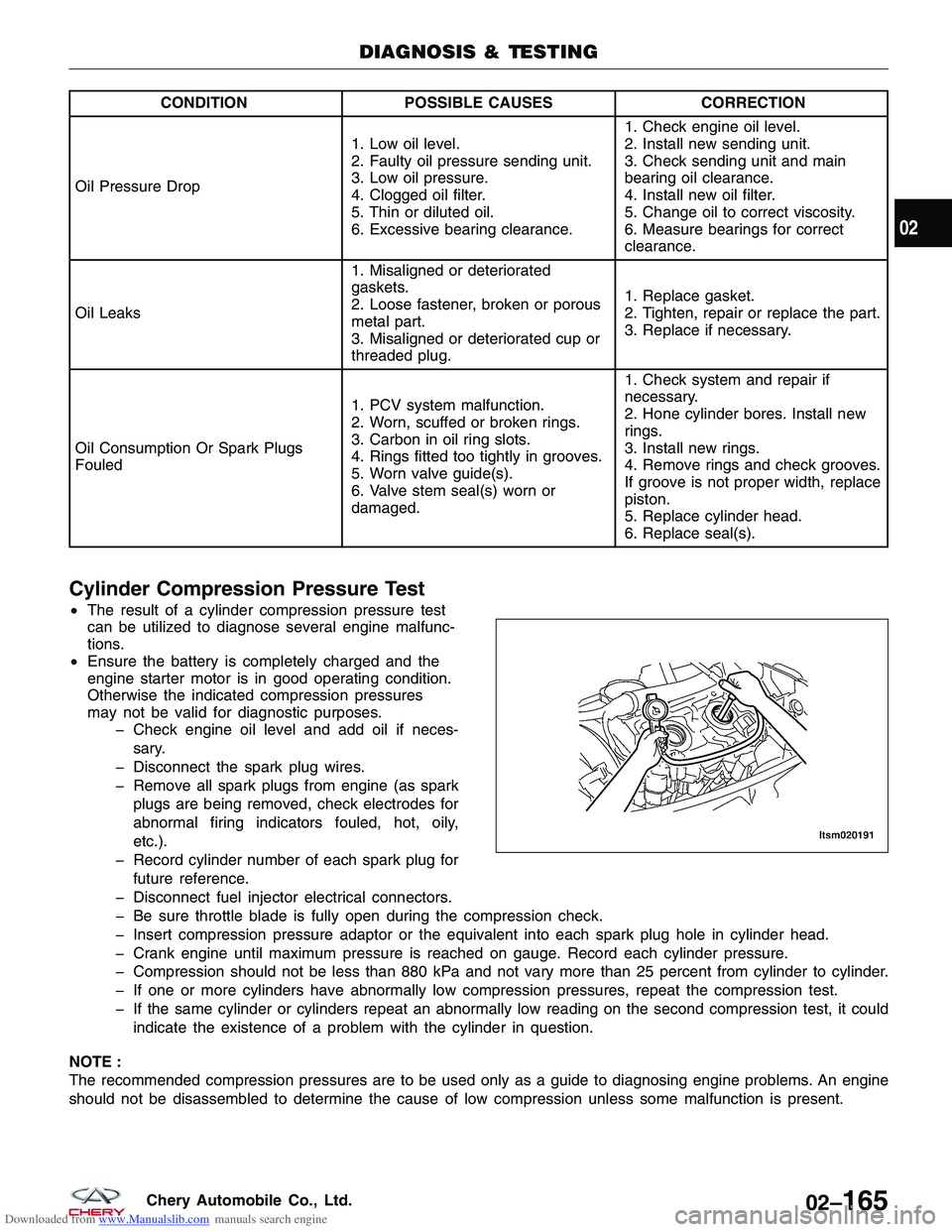
Oil Pressure Drop 1. Low oil level.
2. Faulty oil pressure sending unit.
3. Low oil pressure.
4. Clogged oil filter.
5. Thin or diluted oil.
6. Excessive bearing clearance.1. Check engine oil level.
2. Install new sending unit.
3. Check sending unit and main
bearing oil clearance.
4. Install new oil filter.
5. Change oil to correct viscosity.
6. Measure bearings for correct
clearance.
Oil Leaks 1. Misaligned or deteriorated
gaskets.
2. Loose fastener, broken or porous
metal part.
3. Misaligned or deteriorated cup or
threaded plug.1. Replace gasket.
2. Tighten, repair or replace the part.
3. Replace if necessary.
Oil Consumption Or Spark Plugs
Fouled 1. PCV system malfunction.
2. Worn, scuffed or broken rings.
3. Carbon in oil ring slots.
4. Rings fitted too tightly in grooves.
5. Worn valve guide(s).
6. Valve stem seal(s) worn or
damaged.1. Check system and repair if
necessary.
2. Hone cylinder bores. Install new
rings.
3. Install new rings.
4. Remove rings and check grooves.
If groove is not proper width, replace
piston.
5. Replace cylinder head.
6. Replace seal(s).
Cylinder Compression Pressure Test
•
The result of a cylinder compression pressure test
can be utilized to diagnose several engine malfunc-
tions.
• Ensure the battery is completely charged and the
engine starter motor is in good operating condition.
Otherwise the indicated compression pressures
may not be valid for diagnostic purposes.
Check engine oil level and add oil if neces-
sary.
Disconnect the spark plug wires.
Remove all spark plugs from engine (as spark plugs are being removed, check electrodes for
abnormal firing indicators fouled, hot, oily,
etc.).
Record cylinder number of each spark plug for future reference.
Disconnect fuel injector electrical connectors.
Be sure throttle blade is fully open during the compression check.
Insert compression pressure adaptor or the equivalent into each spark plug hole in cylinder head.
Crank engine until maximum pressure is reached on gauge. Record each cylinder pressure.
Compression should not be less than 880 kPa and not vary more than 25 percent from cylinder to cylinder.
If one or more cylinders have abnormally low compression pressures, repeat the compression test.
If the same cylinder or cylinders repeat an abnormally low reading on the second compression test, it could indicate the existence of a problem with the cylinder in question.
NOTE :
The recommended compression pressures are to be used only as a guide to diagnosing engine problems. An engine
should not be disassembled to determine the cause of low compression unless some malfunction is present.
DIAGNOSIS & TESTING
LTSM020191
02
02–165Chery Automobile Co., Ltd.
Page 234 of 1903
Downloaded from www.Manualslib.com manuals search engine NOTE :
The following special tools are required to perform the repair procedure:
•MB-991603 - Balance Shaft Bearing Puller Limiter
• MD-998162 - Plug Spanner
• MD-998371 - Balance Shaft Bearing Puller
• MD-998372 - Balance Shaft Bearing Puller
• MD-998375 - Crankshaft Front Oil Seal Installer
• MD-998705 - Balance Shaft Bearing Installer
• MD-998727 - Oil Pan Remover
• MD-998783 - Plug Spanner Fixer
• MB-991828 - Oil Filter Wrench
• MB-991396 - Oil Filter Wrench
1. Remove the engine timing belt (See Engine Timing Belt Removal & Installation in Section 02 Engine).
2. Remove the upper balance shaft timing belt (See Upper Balance Shaft Timing Belt Removal & Installation in Section 02 Engine).
3. Raise and support the vehicle.
4. Loosen the oil drain plug and drain the oil.
5. Remove the oil pan retaining bolts. (Tighten: Oil pan bolts to 18 N·m)
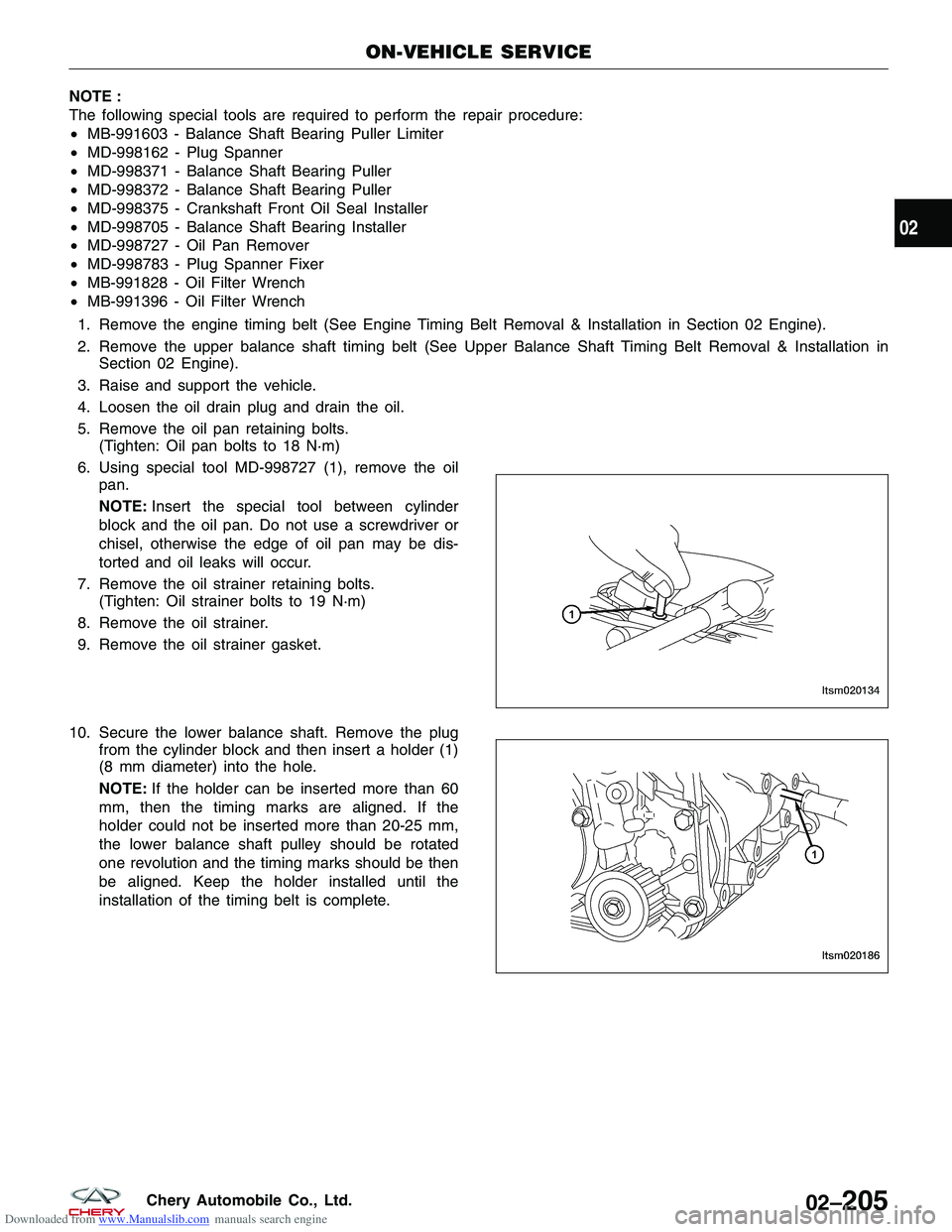
6. Using special tool MD-998727 (1), remove the oil pan.
NOTE: Insert the special tool between cylinder
block and the oil pan. Do not use a screwdriver or
chisel, otherwise the edge of oil pan may be dis-
torted and oil leaks will occur.
7. Remove the oil strainer retaining bolts. (Tighten: Oil strainer bolts to 19 N·m)
8. Remove the oil strainer.
9. Remove the oil strainer gasket.
10. Secure the lower balance shaft. Remove the plug from the cylinder block and then insert a holder (1)
(8 mm diameter) into the hole.
NOTE: If the holder can be inserted more than 60
mm, then the timing marks are aligned. If the
holder could not be inserted more than 20-25 mm,
the lower balance shaft pulley should be rotated
one revolution and the timing marks should be then
be aligned. Keep the holder installed until the
installation of the timing belt is complete.
ON-VEHICLE SERVICE
LTSM020134
LTSM020186
02
02–205Chery Automobile Co., Ltd.
Page 238 of 1903
Downloaded from www.Manualslib.com manuals search engine NOTE :
The following special tools are required to perform the repair procedure:
•MD-991603 - Balance Shaft Bearing Puller Limiter
• MD-998162 - Plug Spanner
• MD-998371 - Balance Shaft Bearing Puller
• MD-998372 - Balance Shaft Bearing Puller
• MD-998375 - Crankshaft Front Oil Seal Installer
• MD-998705 - Balance Shaft Bearing Installer
• MD-998727 - Oil Pan Remover
• MD-998783 - Plug Spanner Fixer
• MD-991828 - Oil Filter Wrench
• MD-991396 - Oil Filter Wrench
1. Raise and support the vehicle.
2. Loosen the oil drain plug and drain the oil.
3. Remove the engine timing belt (See Engine Timing Belt Removal & Installation in Section 02 Engine).
4. Remove the upper balance shaft timing belt (See Upper Balance Shaft Timing Belt Removal & Installation in Section 02 Engine).
5. Remove the oil pan retaining bolts. (Tighten: Oil pan bolts to 18 N·m)
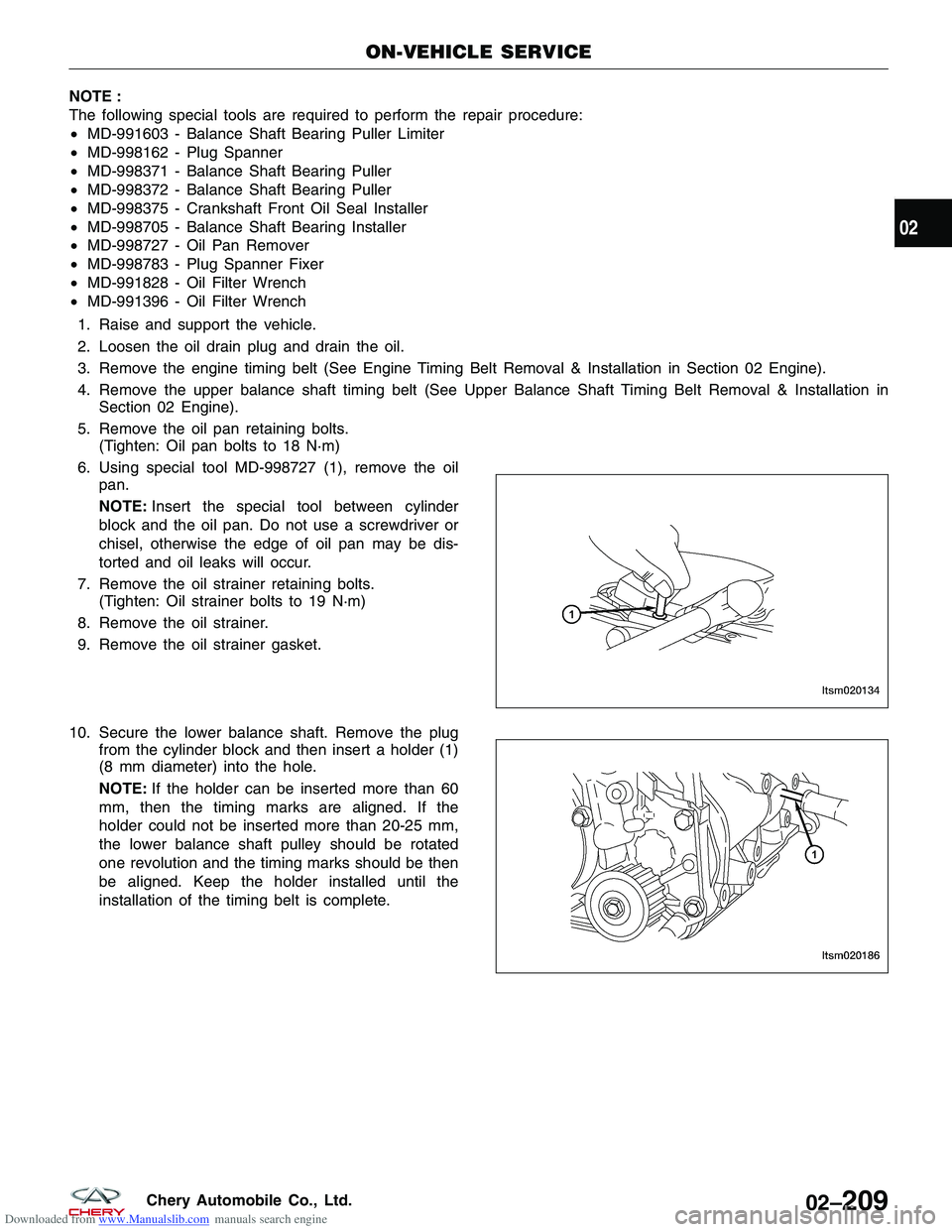
6. Using special tool MD-998727 (1), remove the oil pan.
NOTE: Insert the special tool between cylinder
block and the oil pan. Do not use a screwdriver or
chisel, otherwise the edge of oil pan may be dis-
torted and oil leaks will occur.
7. Remove the oil strainer retaining bolts. (Tighten: Oil strainer bolts to 19 N·m)
8. Remove the oil strainer.
9. Remove the oil strainer gasket.
10. Secure the lower balance shaft. Remove the plug from the cylinder block and then insert a holder (1)
(8 mm diameter) into the hole.
NOTE: If the holder can be inserted more than 60
mm, then the timing marks are aligned. If the
holder could not be inserted more than 20-25 mm,
the lower balance shaft pulley should be rotated
one revolution and the timing marks should be then
be aligned. Keep the holder installed until the
installation of the timing belt is complete.
ON-VEHICLE SERVICE
LTSM020134
LTSM020186
02
02–209Chery Automobile Co., Ltd.
Page 241 of 1903
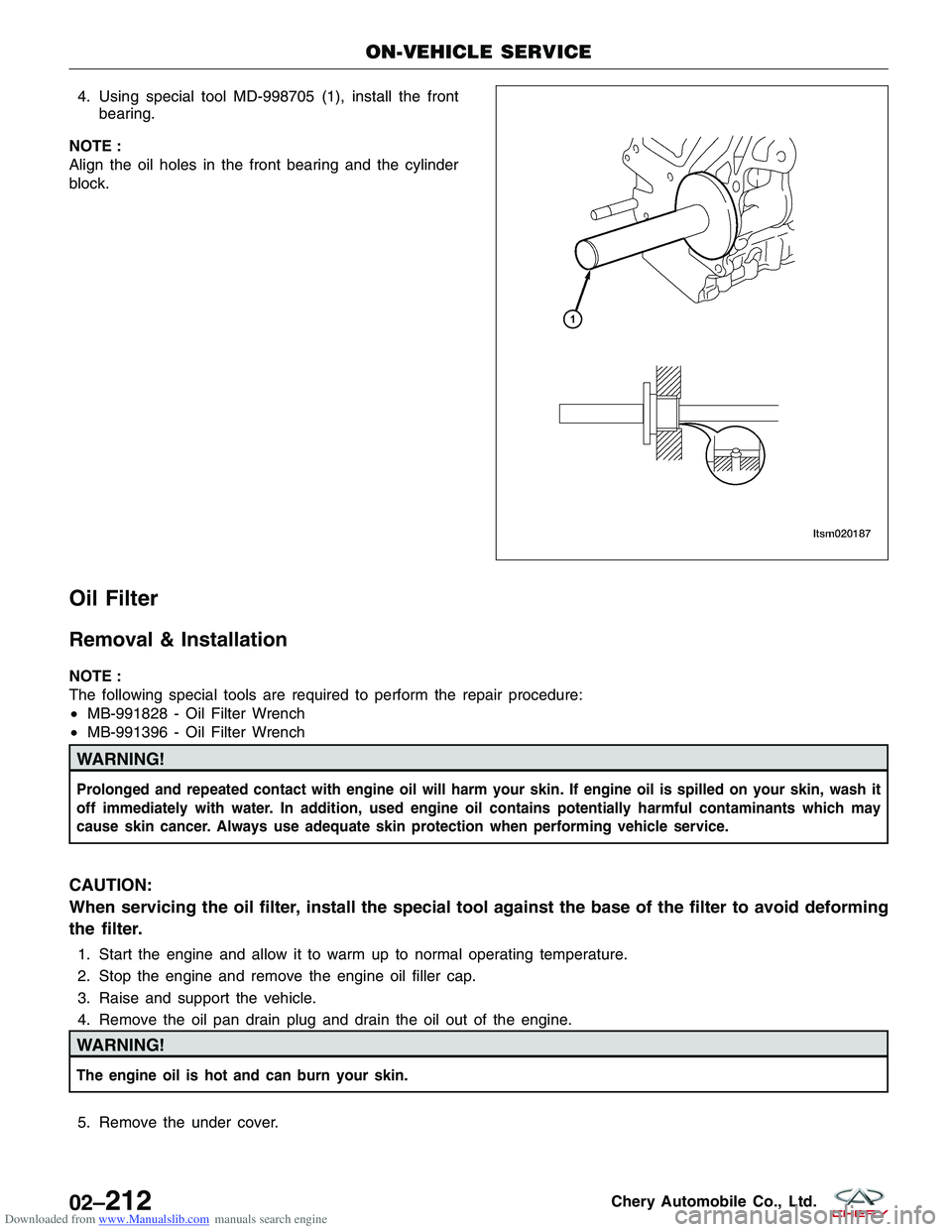
Downloaded from www.Manualslib.com manuals search engine 4. Using special tool MD-998705 (1), install the frontbearing.
NOTE :
Align the oil holes in the front bearing and the cylinder
block.
Oil Filter
Removal & Installation
NOTE :
The following special tools are required to perform the repair procedure:
• MB-991828 - Oil Filter Wrench
• MB-991396 - Oil Filter Wrench
WARNING!
Prolonged and repeated contact with engine oil will harm your skin. If engine oil is spilled on your skin, wash it
off immediately with water. In addition, used engine oil contains potentially harmful contaminants which may
cause skin cancer. Always use adequate skin protection when performing vehicle service.
CAUTION:
When servicing the oil filter, install the special tool against the base of the filter to avoid deforming
the filter.
1. Start the engine and allow it to warm up to normal operating temperature.
2. Stop the engine and remove the engine oil filler cap.
3. Raise and support the vehicle.
4. Remove the oil pan drain plug and drain the oil out of the engine.
WARNING!
The engine oil is hot and can burn your skin.
5. Remove the under cover.
ON-VEHICLE SERVICE
LTSM020187
02–212Chery Automobile Co., Ltd.
Page 242 of 1903
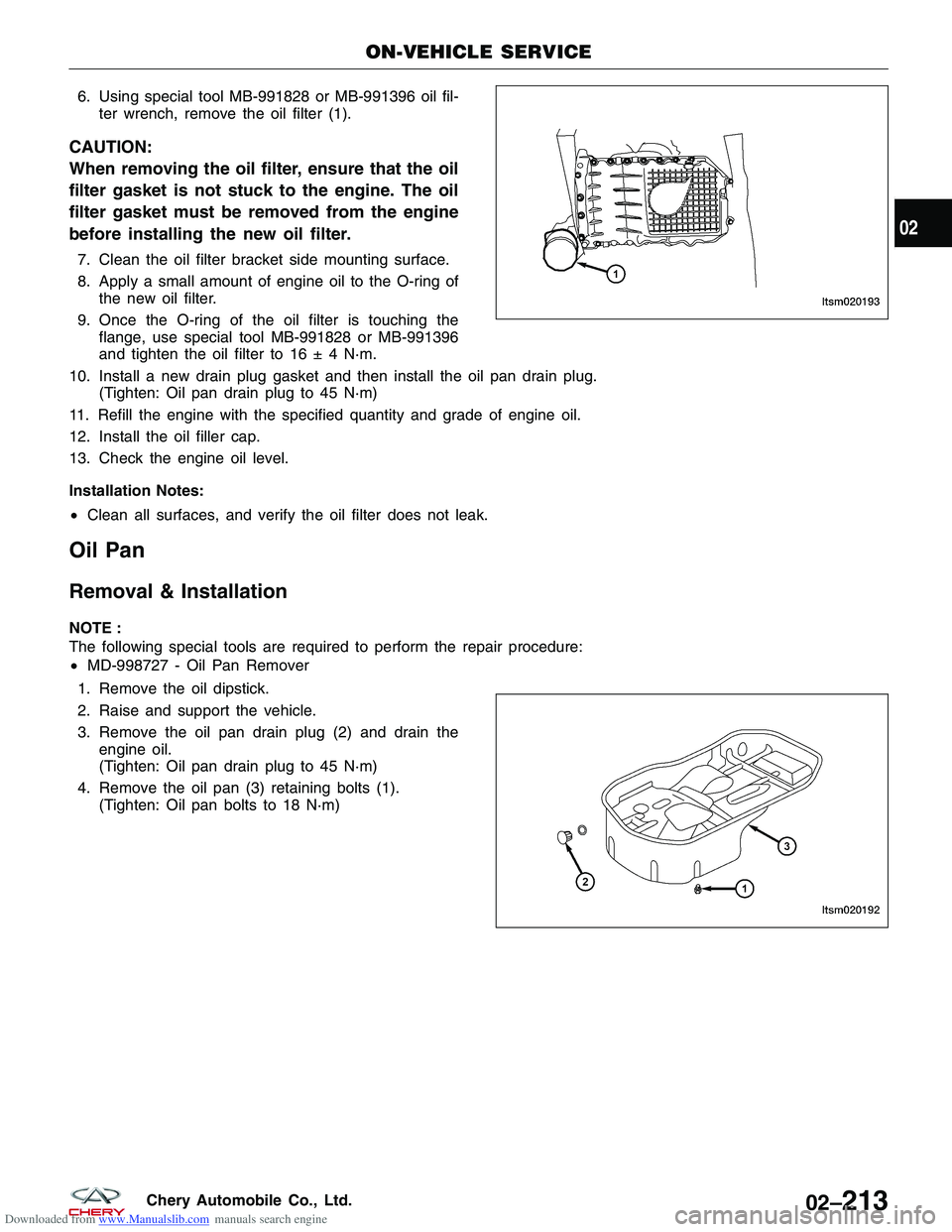
Downloaded from www.Manualslib.com manuals search engine 6. Using special tool MB-991828 or MB-991396 oil fil-ter wrench, remove the oil filter (1).
CAUTION:
When removing the oil filter, ensure that the oil
filter gasket is not stuck to the engine. The oil
filter gasket must be removed from the engine
before installing the new oil filter.
7. Clean the oil filter bracket side mounting surface.
8. Apply a small amount of engine oil to the O-ring ofthe new oil filter.
9. Once the O-ring of the oil filter is touching the flange, use special tool MB-991828 or MB-991396
and tighten the oil filter to 16 ± 4 N·m.
10. Install a new drain plug gasket and then install the oil pan drain plug. (Tighten: Oil pan drain plug to 45 N·m)
11. Refill the engine with the specified quantity and grade of engine oil.
12. Install the oil filler cap.
13. Check the engine oil level.
Installation Notes:
• Clean all surfaces, and verify the oil filter does not leak.
Oil Pan
Removal & Installation
NOTE :
The following special tools are required to perform the repair procedure:
•MD-998727 - Oil Pan Remover
1. Remove the oil dipstick.
2. Raise and support the vehicle.
3. Remove the oil pan drain plug (2) and drain the engine oil.
(Tighten: Oil pan drain plug to 45 N·m)
4. Remove the oil pan (3) retaining bolts (1). (Tighten: Oil pan bolts to 18 N·m)
ON-VEHICLE SERVICE
LTSM020193
LTSM020192
02
02–213Chery Automobile Co., Ltd.
Page 410 of 1903
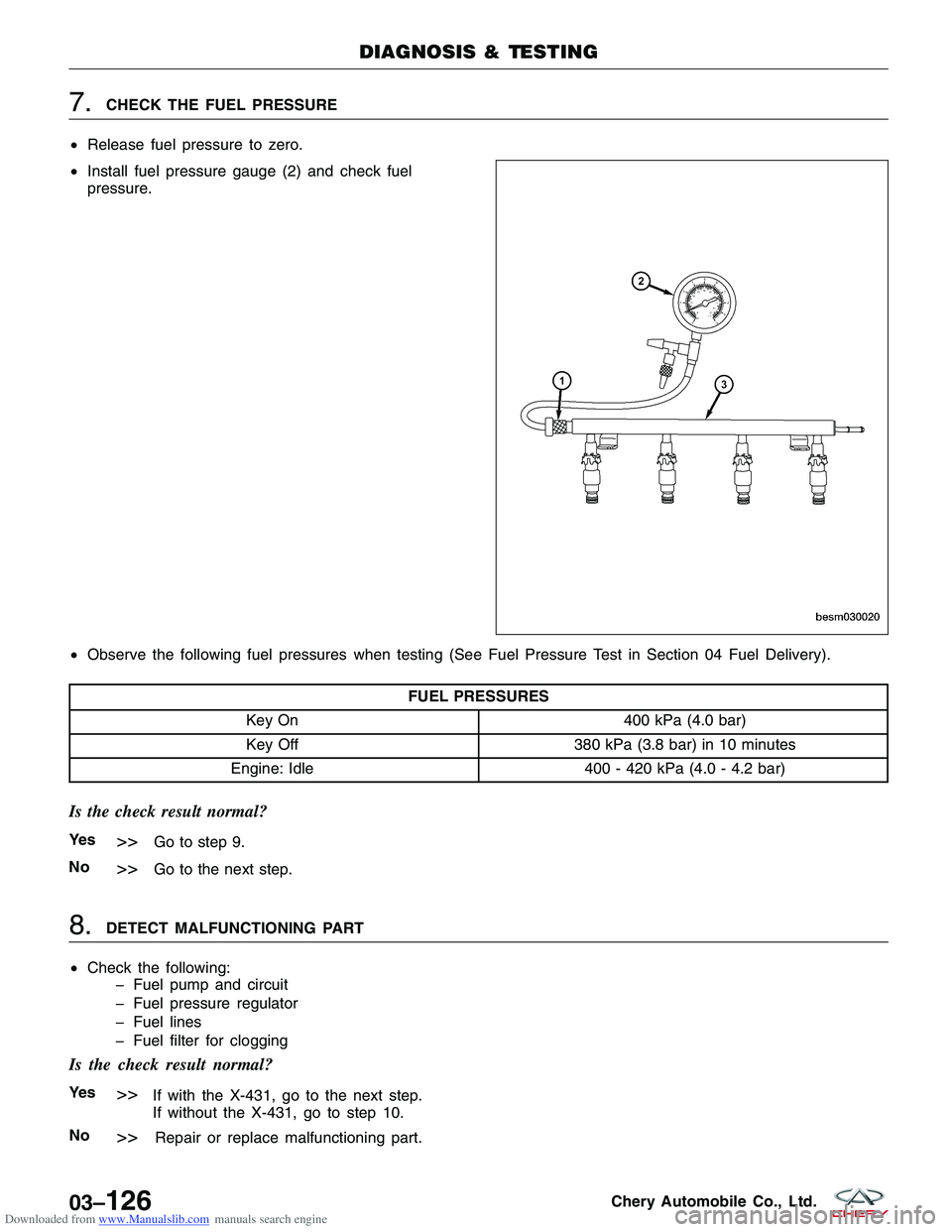
Downloaded from www.Manualslib.com manuals search engine 7.CHECK THE FUEL PRESSURE
• Release fuel pressure to zero.
• Install fuel pressure gauge (2) and check fuel
pressure.
• Observe the following fuel pressures when testing (See Fuel Pressure Test in Section 04 Fuel Delivery).
FUEL PRESSURES
Key On 400 kPa (4.0 bar)
Key Off 380 kPa (3.8 bar) in 10 minutes
Engine: Idle 400 - 420 kPa (4.0 - 4.2 bar)
Is the check result normal?
Ye s>>Go to step 9.
No
>>Go to the next step.
8.DETECT MALFUNCTIONING PART
• Check the following:
Fuel pump and circuit
Fuel pressure regulator
Fuel lines
Fuel filter for clogging
Is the check result normal?
Ye s>>If with the X-431, go to the next step.
If without the X-431, go to step 10.
No
>>Repair or replace malfunctioning part.
DIAGNOSIS & TESTING
BESM030020
03–126Chery Automobile Co., Ltd.
Page 509 of 1903

Downloaded from www.Manualslib.com manuals search engine 3. Disconnect the APP sensor electrical connector (2).
4. Remove the three APP sensor mounting bolts (1).(Tighten: APP sensor mounting bolts to 11 N·m)
5. Remove the APP sensor with the pedal.
6. Installation is in the reverse order of removal.
Electronic Throttle Control Actuator
Description
The throttle body is located on the intake manifold. It controls air into the intake manifold. The electronic throttle
control actuator consists of throttle control motor, throttle position sensor, etc. The throttle control motor is operated
by the Engine Control Module (ECM) and it opens and closes the throttle valve. The throttle position sensor detects
the throttle valve position.
Operation
Filtered air from the air cleaner enters the intake manifold through the throttle body. A throttle valve (plate) is used to
supply air for idle and driving conditions. The throttle position sensor is part the throttle body. The throttle position
sensor signal is used by the ECM to determine throttle position. The ECM controls the electronic throttle control to
meter air into the engine. This regulates engine power. The vehicle is in sense a “Drive by Wire” system.
Removal & Installation
1. Remove the engine cover.
2. Disconnect the negative battery cable.
ON-VEHICLE SERVICE
LTSM030038
03
03–225Chery Automobile Co., Ltd.