power steering fluid CHERY TIGGO 2009 Service User Guide
[x] Cancel search | Manufacturer: CHERY, Model Year: 2009, Model line: TIGGO, Model: CHERY TIGGO 2009Pages: 1903, PDF Size: 33.38 MB
Page 1360 of 1903
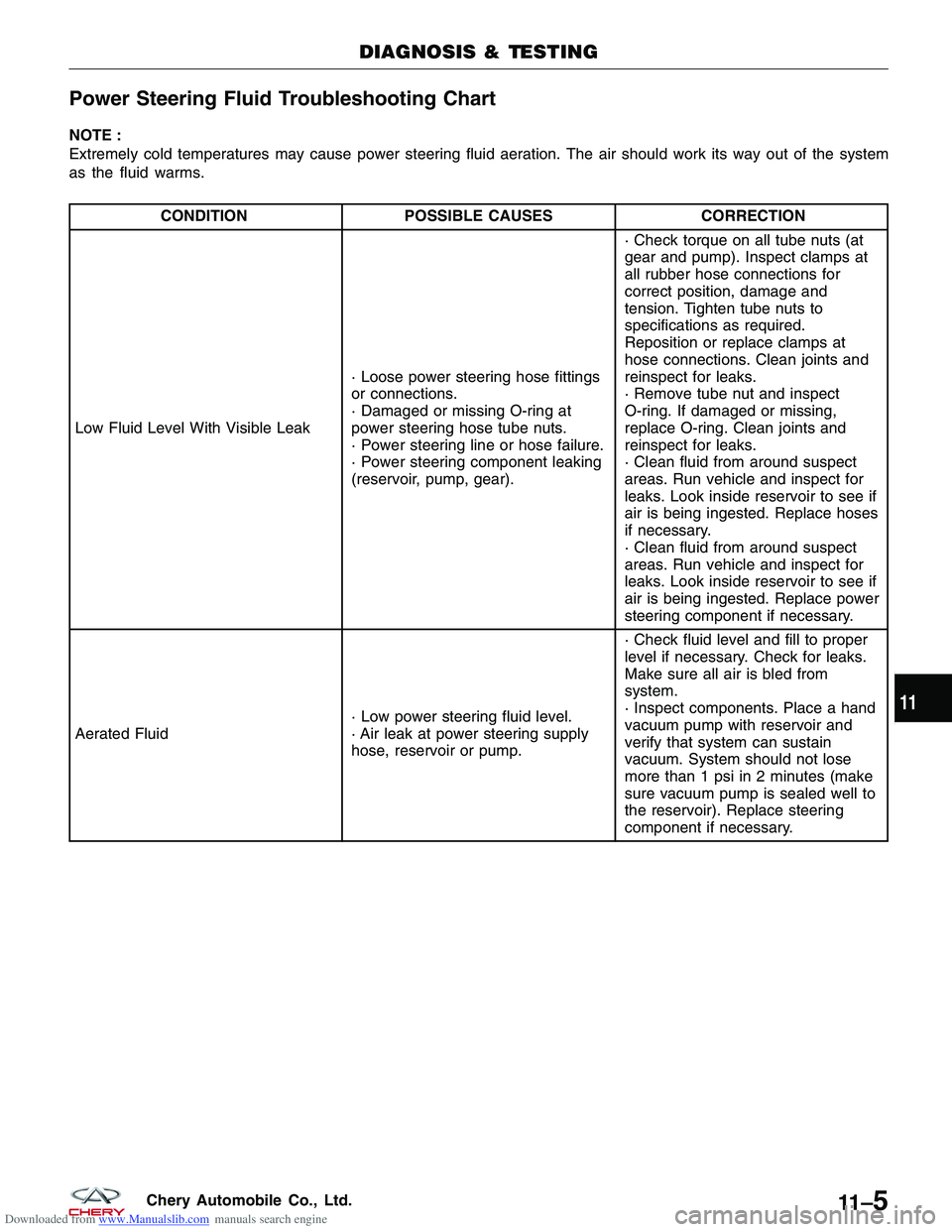
Downloaded from www.Manualslib.com manuals search engine Power Steering Fluid Troubleshooting Chart
NOTE :
Extremely cold temperatures may cause power steering fluid aeration. The air should work its way out of the system
as the fluid warms.
CONDITIONPOSSIBLE CAUSES CORRECTION
Low Fluid Level With Visible Leak · Loose power steering hose fittings
or connections.
· Damaged or missing O-ring at
power steering hose tube nuts.
· Power steering line or hose failure.
· Power steering component leaking
(reservoir, pump, gear).· Check torque on all tube nuts (at
gear and pump). Inspect clamps at
all rubber hose connections for
correct position, damage and
tension. Tighten tube nuts to
specifications as required.
Reposition or replace clamps at
hose connections. Clean joints and
reinspect for leaks.
· Remove tube nut and inspect
O-ring. If damaged or missing,
replace O-ring. Clean joints and
reinspect for leaks.
· Clean fluid from around suspect
areas. Run vehicle and inspect for
leaks. Look inside reservoir to see if
air is being ingested. Replace hoses
if necessary.
· Clean fluid from around suspect
areas. Run vehicle and inspect for
leaks. Look inside reservoir to see if
air is being ingested. Replace power
steering component if necessary.
Aerated Fluid · Low power steering fluid level.
· Air leak at power steering supply
hose, reservoir or pump.· Check fluid level and fill to proper
level if necessary. Check for leaks.
Make sure all air is bled from
system.
· Inspect components. Place a hand
vacuum pump with reservoir and
verify that system can sustain
vacuum. System should not lose
more than 1 psi in 2 minutes (make
sure vacuum pump is sealed well to
the reservoir). Replace steering
component if necessary.
DIAGNOSIS & TESTING
11
11 –5Chery Automobile Co., Ltd.
Page 1361 of 1903
Downloaded from www.Manualslib.com manuals search engine ON-VEHICLE SERVICE
Power Steering Filling and Flushing
Filling
1. Fill the power steering fluid reservoir to the proper level and let the fluid settle for at least two minutes.
2. Start the engine and let run for a few seconds, then turn the engine off.
3. Add fluid if necessary.
4. Repeat the above procedure until the fluid level remains constant after running the engine.
5. When the steering fluid temperature is relatively high, the steering fluid level will approach to the “MAX” level.
6. When the steering fluid cools down, the steering fluid level may approach to the “MIN” level.
NOTE :
If the steering fluid is extremely foamy or milky looking, allow the vehicle to stand a few minutes and repeat the
procedure.
Flushing
1. Raise and support the vehicle.
2. Remove the steering fluid reservoir release cap.
3. Siphon out the contaminated power steering fluid from the power steering liquid reservoir.
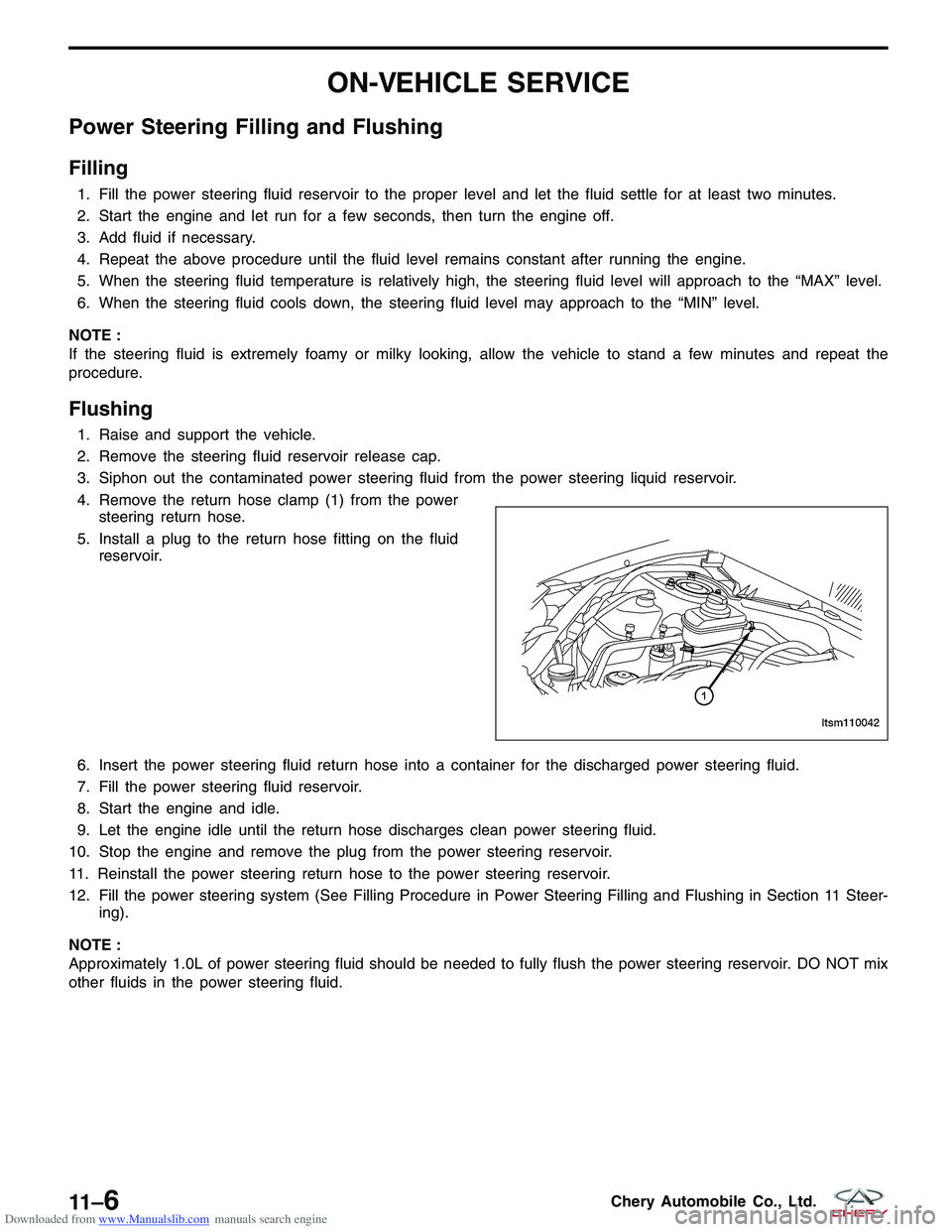
4. Remove the return hose clamp (1) from the power steering return hose.
5. Install a plug to the return hose fitting on the fluid reservoir.
6. Insert the power steering fluid return hose into a container for the discharged power steering fluid.
7. Fill the power steering fluid reservoir.
8. Start the engine and idle.
9. Let the engine idle until the return hose discharges clean power steering fluid.
10. Stop the engine and remove the plug from the power steering reservoir.
11. Reinstall the power steering return hose to the power steering reservoir.
12. Fill the power steering system (See Filling Procedure in Power Steering Filling and Flushing in Section 11 Steer- ing).
NOTE :
Approximately 1.0L of power steering fluid should be needed to fully flush the power steering reservoir. DO NOT mix
other fluids in the power steering fluid.
LTSM110042
11 –6Chery Automobile Co., Ltd.
Page 1362 of 1903
Downloaded from www.Manualslib.com manuals search engine Inspection
1. If the power steering fluid level is low, inspect the entire power steering system for potential leaks.
CAUTION:
DO NOT operate the vehicle with foamy steering fluid for an extended period. This may cause
pump damage.
2. Perform the following to inspect the power steering fluid reservoir level:•Park the vehicle on a level surface.
• Start the engine.
• Turn the steering wheel several times to heat the power steering fluid to 50°- 60°C.
• With the engine running, turn the steering wheel left and right to the wheel stops and repeat this several
times.
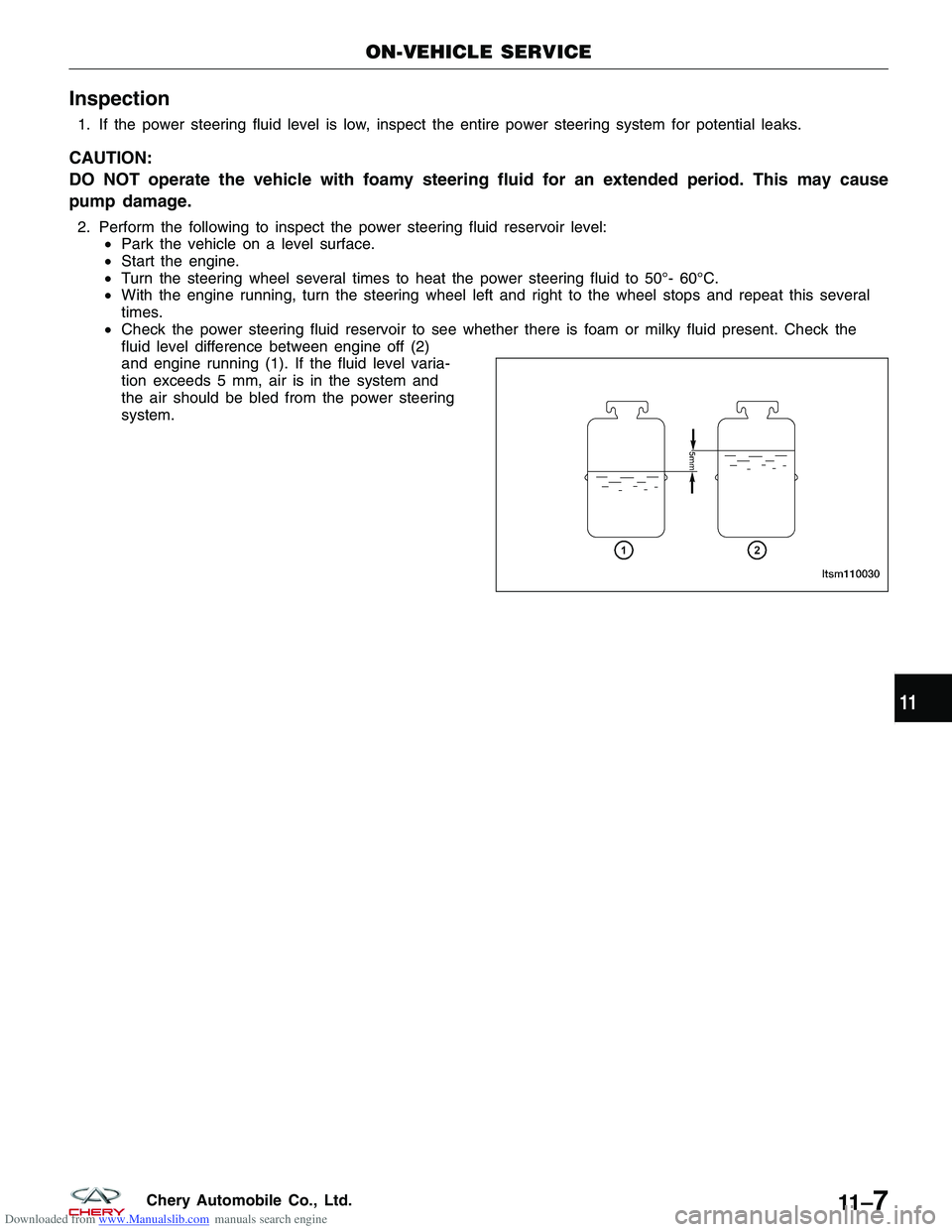
• Check the power steering fluid reservoir to see whether there is foam or milky fluid present. Check the
fluid level difference between engine off (2)
and engine running (1). If the fluid level varia-
tion exceeds 5 mm, air is in the system and
the air should be bled from the power steering
system.
ON-VEHICLE SERVICE
LTSM110030
11
11 –7Chery Automobile Co., Ltd.
Page 1366 of 1903
Downloaded from www.Manualslib.com manuals search engine DIAGNOSIS & TESTING
Vehicle Inspection
There is some noise in all power steering systems. One of the most common is a hissing sound. Hiss is a high
frequency noise similar to that of a water tap being closed slowly. The noise is present in all valves that have a high
velocity steering fluid passing through an orifice. There is no relationship between this noise and steering perfor-
mance. The hissing sound is commonly heard during the following operations:
•Evident at a standstill
• At park with the engine running
• When the steering wheel is at the end of its travel
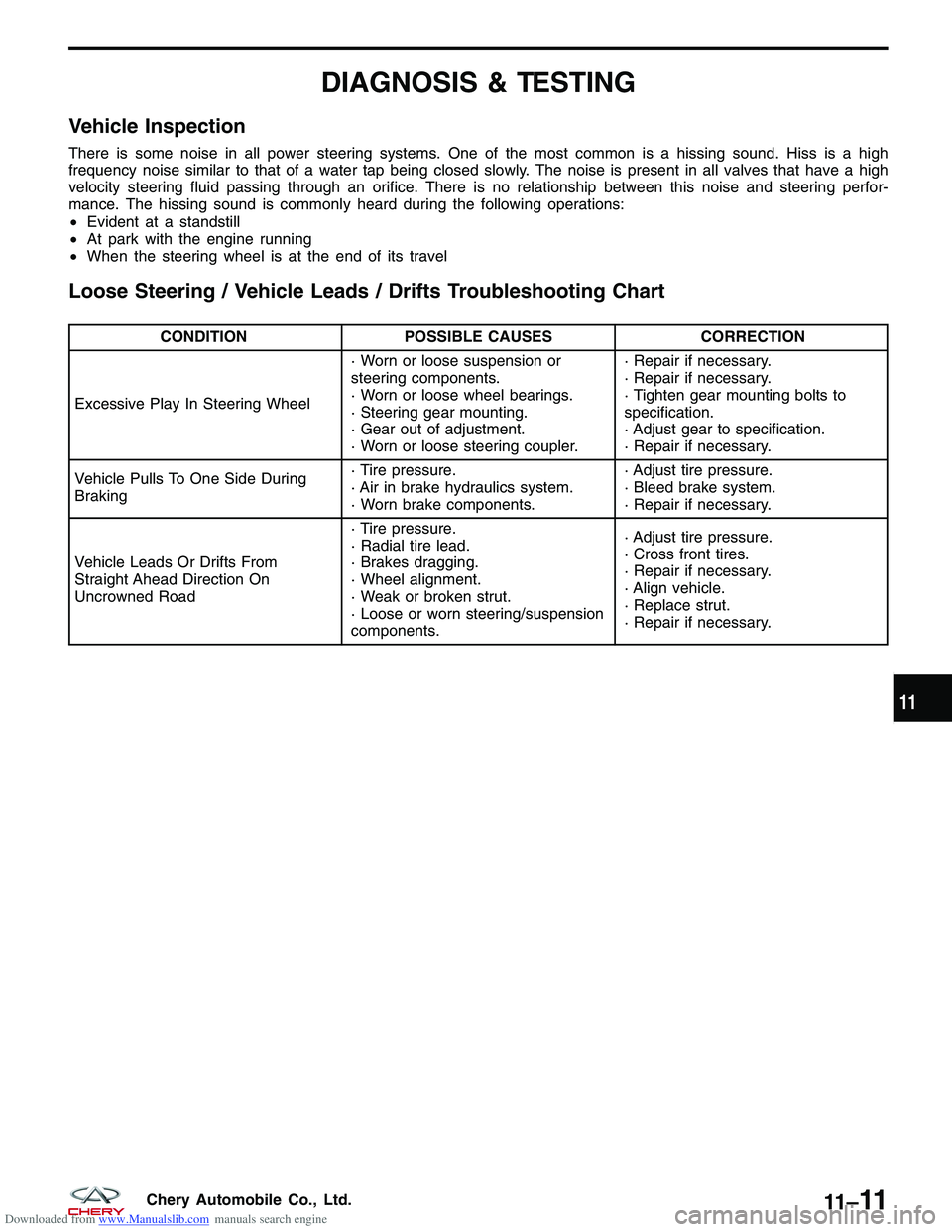
Loose Steering / Vehicle Leads / Drifts Troubleshooting Chart
CONDITION POSSIBLE CAUSES CORRECTION
Excessive Play In Steering Wheel · Worn or loose suspension or
steering components.
· Worn or loose wheel bearings.
· Steering gear mounting.
· Gear out of adjustment.
· Worn or loose steering coupler.· Repair if necessary.
· Repair if necessary.
· Tighten gear mounting bolts to
specification.
· Adjust gear to specification.
· Repair if necessary.
Vehicle Pulls To One Side During
Braking · Tire pressure.
· Air in brake hydraulics system.
· Worn brake components.· Adjust tire pressure.
· Bleed brake system.
· Repair if necessary.
Vehicle Leads Or Drifts From
Straight Ahead Direction On
Uncrowned Road · Tire pressure.
· Radial tire lead.
· Brakes dragging.
· Wheel alignment.
· Weak or broken strut.
· Loose or worn steering/suspension
components.· Adjust tire pressure.
· Cross front tires.
· Repair if necessary.
· Align vehicle.
· Replace strut.
· Repair if necessary.
11
11 –11Chery Automobile Co., Ltd.
Page 1374 of 1903
Downloaded from www.Manualslib.com manuals search engine GENERAL INFORMATION
Description
The steering gear used is the rack-and-pinion type with power assist. It is mounted on the front suspension sub-
frame. The outer ends of the outer tie rods attach to the front knuckles.
NOTE :
The power steering gear should not be serviced or adjusted. If a malfunction or steering fluid leak occurs with the
steering gear, the complete steering gear needs to be replaced.
Operation
The steering wheel turns the pinion. The rack is a long flat bar with geared teeth on one side. The rack teeth mesh
with the teeth on the pinion gear. Rotation of the pinion moves the rack from left to right and right to left. The tie rod
then causes the wheels to turn to the left or right.
Specifications
Torque Specifications
DESCRIPTIONTORQUE (N·m)
Inlet / Outlet Pipe Nut 25 - 30
Intermediate Shaft Bolt 25 - 30
Steering Gear to Sub-Frame Bolts 70 - 80
Sub-Frame Assembly Bolts 180 ± 15
Tie Rod End Nut 32 - 38
Tie Rod Jam Nut 15
Wheel Mounting Nuts 110
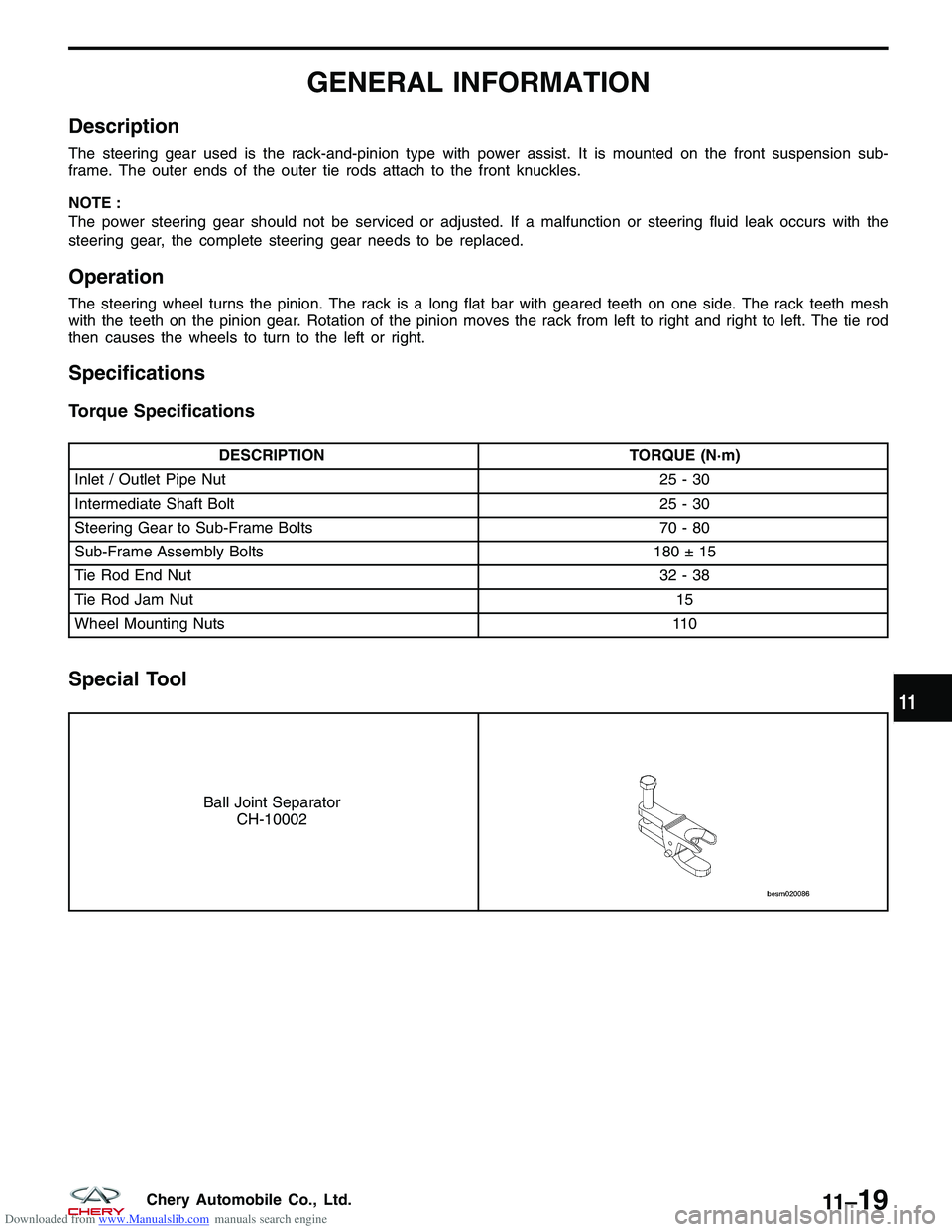
Special Tool
Ball Joint Separator
CH-10002
11
11 –19Chery Automobile Co., Ltd.
Page 1376 of 1903
Downloaded from www.Manualslib.com manuals search engine ON-VEHICLE SERVICE
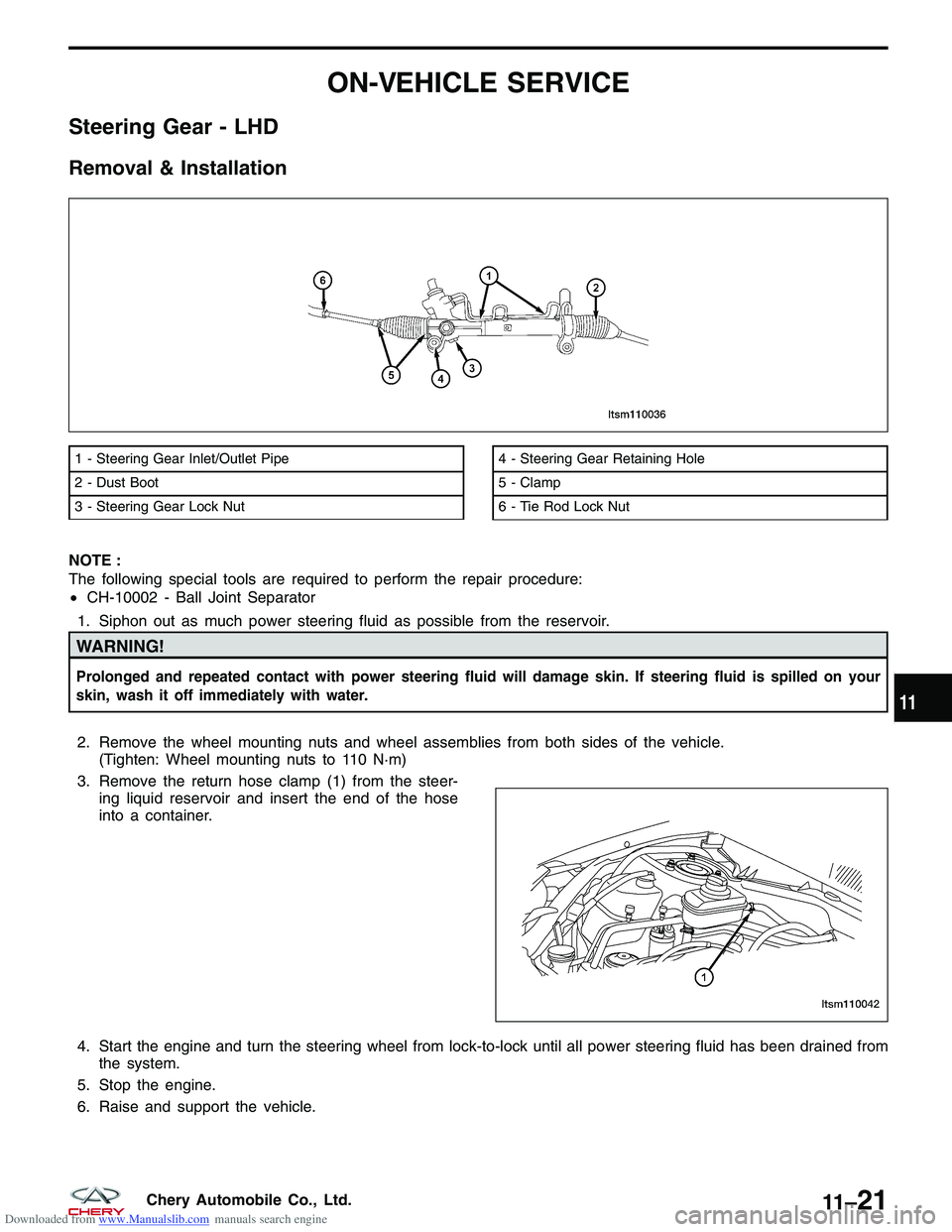
Steering Gear - LHD
Removal & Installation
NOTE :
The following special tools are required to perform the repair procedure:
•CH-10002 - Ball Joint Separator
1. Siphon out as much power steering fluid as possible from the reservoir.
WARNING!
Prolonged and repeated contact with power steering fluid will damage skin. If steering fluid is spilled on your
skin, wash it off immediately with water.
2. Remove the wheel mounting nuts and wheel assemblies from both sides of the vehicle. (Tighten: Wheel mounting nuts to 110 N·m)
3. Remove the return hose clamp (1) from the steer- ing liquid reservoir and insert the end of the hose
into a container.
4. Start the engine and turn the steering wheel from lock-to-lock until all power steering fluid has been drained from the system.
5. Stop the engine.
6. Raise and support the vehicle.
1 - Steering Gear Inlet/Outlet Pipe
2 - Dust Boot
3 - Steering Gear Lock Nut4 - Steering Gear Retaining Hole
5 - Clamp
6 - Tie Rod Lock Nut
LTSM110036
LTSM110042
11
11 –21Chery Automobile Co., Ltd.
Page 1380 of 1903
Downloaded from www.Manualslib.com manuals search engine Steering Gear - RHD
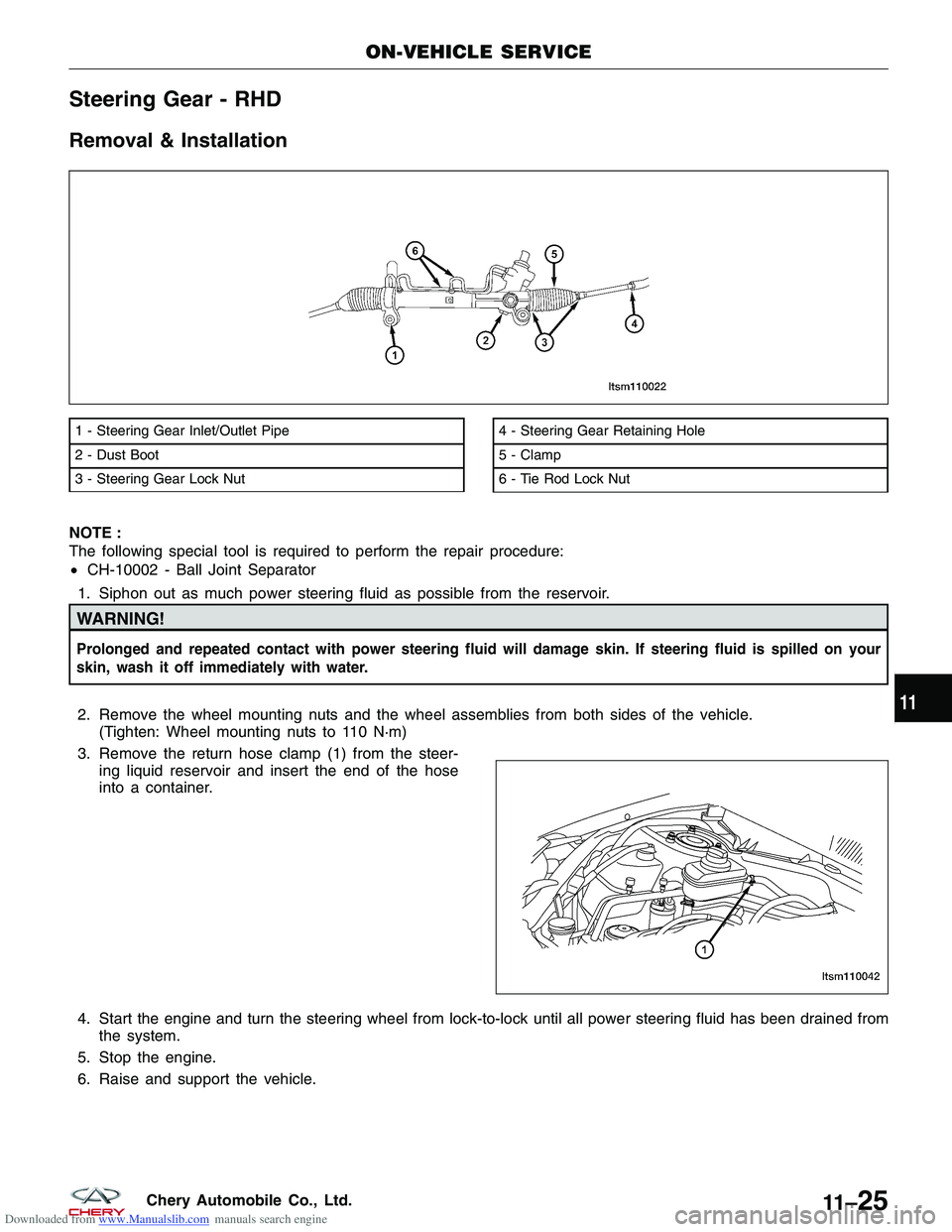
Removal & Installation
NOTE :
The following special tool is required to perform the repair procedure:
•CH-10002 - Ball Joint Separator
1. Siphon out as much power steering fluid as possible from the reservoir.
WARNING!
Prolonged and repeated contact with power steering fluid will damage skin. If steering fluid is spilled on your
skin, wash it off immediately with water.
2. Remove the wheel mounting nuts and the wheel assemblies from both sides of the vehicle. (Tighten: Wheel mounting nuts to 110 N·m)
3. Remove the return hose clamp (1) from the steer- ing liquid reservoir and insert the end of the hose
into a container.
4. Start the engine and turn the steering wheel from lock-to-lock until all power steering fluid has been drained from the system.
5. Stop the engine.
6. Raise and support the vehicle.
1 - Steering Gear Inlet/Outlet Pipe
2 - Dust Boot
3 - Steering Gear Lock Nut4 - Steering Gear Retaining Hole
5 - Clamp
6 - Tie Rod Lock Nut
ON-VEHICLE SERVICE
LTSM110022
LTSM110042
11
11 –25Chery Automobile Co., Ltd.
Page 1386 of 1903
Downloaded from www.Manualslib.com manuals search engine POWER STEERING PUMP
GENERAL INFORMATION11-32
Description 11-32
Operation 11-32
Specifications 11-32
DIAGNOSIS & TESTING11-33
Steering System Noise Troubleshooting
Chart 11-33
Insufficient Assist / Poor Return To Center
Troubleshooting Chart 11-33
ON-VEHICLE SERVICE11-34
Power Steering Pump - 1.6L & 1.8L &
2.0L 11-34
Removal & Installation 11-34 Power Steering Pump - 2.4L
11-35
Removal & Installation 11-35
Power Steering Fluid Reservoir 11-36
Removal & Installation 11-36
Power Steering Pressure and Return
Lines - 1.6L & 1.8L & 2.0L 11-37
Removal & Installation 11-37
Power Steering Pressure and Return
Lines - 2.4L 11-39
Removal & Installation 11-39
11
11 –31Chery Automobile Co., Ltd.
Page 1387 of 1903
Downloaded from www.Manualslib.com manuals search engine GENERAL INFORMATION
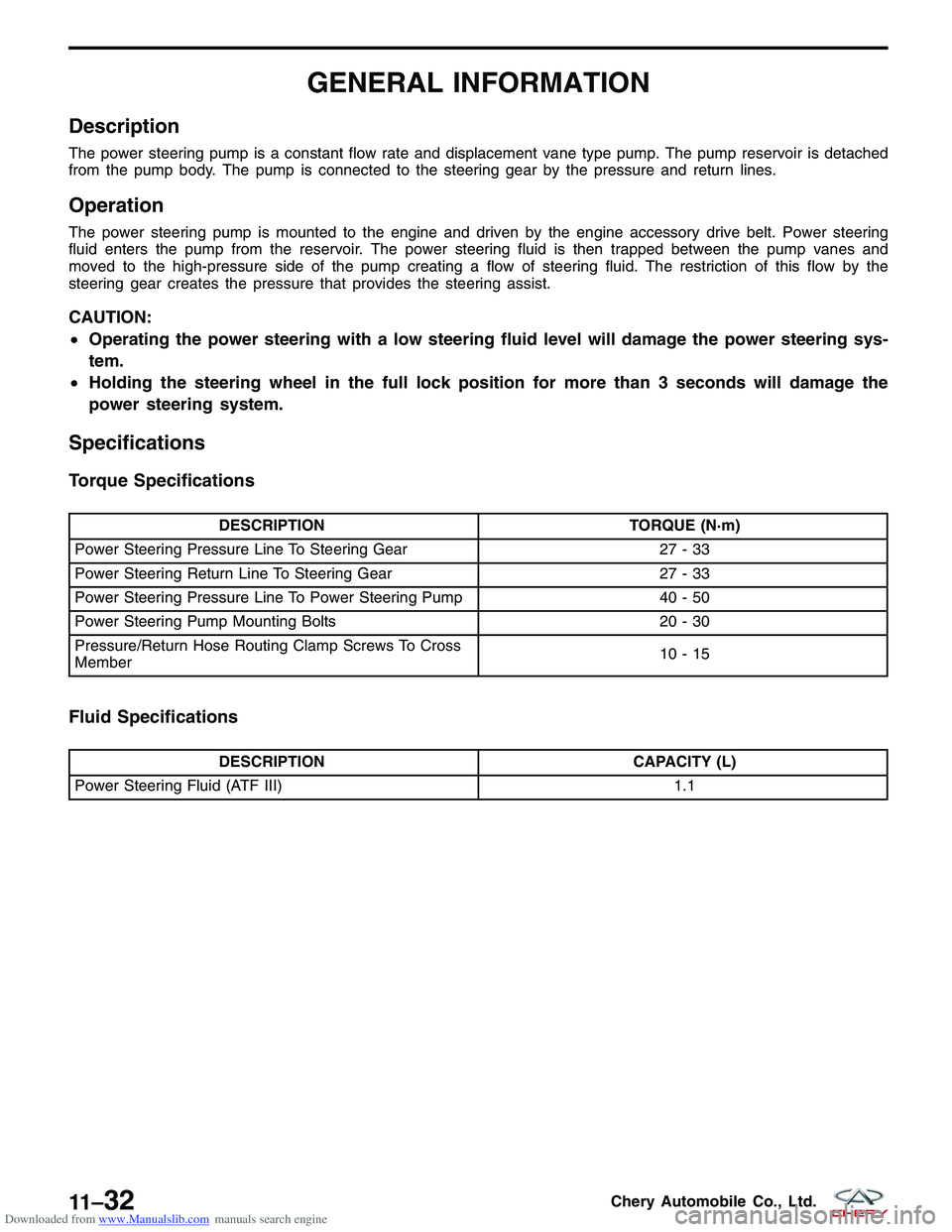
Description
The power steering pump is a constant flow rate and displacement vane type pump. The pump reservoir is detached
from the pump body. The pump is connected to the steering gear by the pressure and return lines.
Operation
The power steering pump is mounted to the engine and driven by the engine accessory drive belt. Power steering
fluid enters the pump from the reservoir. The power steering fluid is then trapped between the pump vanes and
moved to the high-pressure side of the pump creating a flow of steering fluid. The restriction of this flow by the
steering gear creates the pressure that provides the steering assist.
CAUTION:
•Operating the power steering with a low steering fluid level will damage the power steering sys-
tem.
• Holding the steering wheel in the full lock position for more than 3 seconds will damage the
power steering system.
Specifications
Torque Specifications
DESCRIPTION TORQUE (N·m)
Power Steering Pressure Line To Steering Gear 27 - 33
Power Steering Return Line To Steering Gear 27 - 33
Power Steering Pressure Line To Power Steering Pump 40 - 50
Power Steering Pump Mounting Bolts 20 - 30
Pressure/Return Hose Routing Clamp Screws To Cross
Member 10-15
Fluid Specifications
DESCRIPTION
CAPACITY (L)
Power Steering Fluid (ATF III) 1.1
11 –32Chery Automobile Co., Ltd.
Page 1388 of 1903
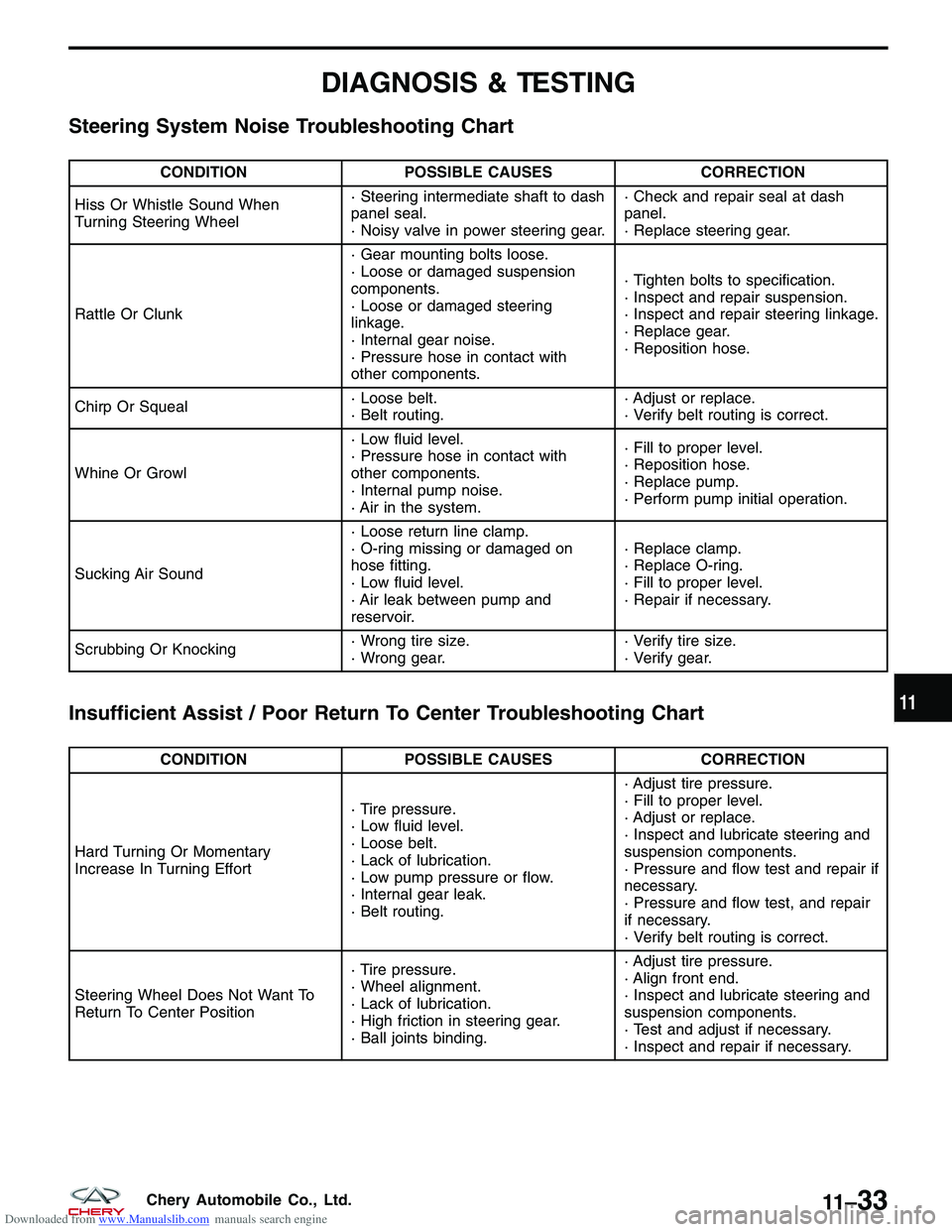
Downloaded from www.Manualslib.com manuals search engine DIAGNOSIS & TESTING
Steering System Noise Troubleshooting Chart
CONDITIONPOSSIBLE CAUSES CORRECTION
Hiss Or Whistle Sound When
Turning Steering Wheel · Steering intermediate shaft to dash
panel seal.
· Noisy valve in power steering gear.· Check and repair seal at dash
panel.
· Replace steering gear.
Rattle Or Clunk · Gear mounting bolts loose.
· Loose or damaged suspension
components.
· Loose or damaged steering
linkage.
· Internal gear noise.
· Pressure hose in contact with
other components.· Tighten bolts to specification.
· Inspect and repair suspension.
· Inspect and repair steering linkage.
· Replace gear.
· Reposition hose.
Chirp Or Squeal · Loose belt.
· Belt routing.· Adjust or replace.
· Verify belt routing is correct.
Whine Or Growl · Low fluid level.
· Pressure hose in contact with
other components.
· Internal pump noise.
· Air in the system.· Fill to proper level.
· Reposition hose.
· Replace pump.
· Perform pump initial operation.
Sucking Air Sound · Loose return line clamp.
· O-ring missing or damaged on
hose fitting.
· Low fluid level.
· Air leak between pump and
reservoir.· Replace clamp.
· Replace O-ring.
· Fill to proper level.
· Repair if necessary.
Scrubbing Or Knocking · Wrong tire size.
· Wrong gear.· Verify tire size.
· Verify gear.
Insufficient Assist / Poor Return To Center Troubleshooting Chart
CONDITION
POSSIBLE CAUSES CORRECTION
Hard Turning Or Momentary
Increase In Turning Effort · Tire pressure.
· Low fluid level.
· Loose belt.
· Lack of lubrication.
· Low pump pressure or flow.
· Internal gear leak.
· Belt routing.· Adjust tire pressure.
· Fill to proper level.
· Adjust or replace.
· Inspect and lubricate steering and
suspension components.
· Pressure and flow test and repair if
necessary.
· Pressure and flow test, and repair
if necessary.
· Verify belt routing is correct.
Steering Wheel Does Not Want To
Return To Center Position · Tire pressure.
· Wheel alignment.
· Lack of lubrication.
· High friction in steering gear.
· Ball joints binding.· Adjust tire pressure.
· Align front end.
· Inspect and lubricate steering and
suspension components.
· Test and adjust if necessary.
· Inspect and repair if necessary.
11
11 –33Chery Automobile Co., Ltd.