service CHERY TIGGO 2009 Service Repair Manual
[x] Cancel search | Manufacturer: CHERY, Model Year: 2009, Model line: TIGGO, Model: CHERY TIGGO 2009Pages: 1903, PDF Size: 33.38 MB
Page 1352 of 1903
Downloaded from www.Manualslib.com manuals search engine ON-VEHICLE SERVICE
Tire Repair
Description
Tires are designed and engineered for each specific vehicle. They provide the best overall performance for normal
operation. The ride and handling characteristics match the vehicle’s requirements. With proper care they will give
excellent reliability, traction, skid resistance, and tread life.
WARNING!
Failure to equip the vehicle with tires having adequate speed capability can result in sudden tire failure.
In order to maintain the speed capability of the vehicle, replacement tires must have speed ratings equal to or
higher than those fitted to the vehicle as original equipment. If tires with lower speed ratings are fitted, the vehi-
cle’s handling may be affected and the speed capability of the vehicle may be lowered to the maximum speed
capability of the replacement tires. To avoid an accident resulting in severe or fatal injury, consult the tire man-
ufacturer in regards to maximum speed ratings.
Replacement Procedure
Note the following guidelines when replacing a tire:
•It is recommended that tires equivalent to the original equipment tires be used when replacement is needed.
• Failure to use equivalent replacement tires may adversely affect the safety and handling of the vehicle.
• The use of tires smaller than the minimum tire size approved for the vehicle can result in tire overloading and
failure.
• Use tires that have the approved load rating for the vehicle and never overload them.
• Failure to equip the vehicle with tires having adequate speed capability can result in sudden tire failure and
loss of vehicle control.
• The use of oversize tires may cause interference with vehicle components. Under extremes of suspension and
steering travel, interference with vehicle components may cause tire damage.
Perform the following when replacing a tire: 1. Raise and support the vehicle.
2. Remove the wheel mounting nuts and the wheel assembly.
3. Deflate the tire completely before removing the tire from the wheel.
4. Use lubrication such as a mild soap solution when dismounting or mounting tire.
5. Replace the tire with a tire approved for the vehicle.
6. Use tools free of burrs or sharp edges which could damage the tire or wheel rim.
7. Before mounting tire on wheel, make sure all rust is removed from the rim bead and repaint if necessary.
8. Balance the wheel assembly.
9. Install the wheel assembly and install the wheel mounting nuts. (Tighten: Wheel mounting nuts to 110 N·m)
Repair Procedure
Note the following guidelines when performing a tire repair:
•For proper repairing, a radial tire must be removed from the wheel.
• Repairs should only be made if the defect, or puncture, is in the tread area.
• The tire should be replaced if the puncture is located in the sidewall.
Perform the following when repairing a tire: 1. Raise and support the vehicle.
2. Remove the wheel mounting nuts and the wheel assembly.
3. Deflate the tire completely before removing the tire from the wheel.
4. Use lubrication such as a mild soap solution when dismounting or mounting tire.
5. Repair the tire only if the defect, or puncture, is in the tread area.
6. Use tools free of burrs or sharp edges which could damage the tire or wheel rim.
7. Before mounting tire on wheel, make sure all rust is removed from the rim bead and repaint if necessary.
10–51Chery Automobile Co., Ltd.
Page 1353 of 1903
Downloaded from www.Manualslib.com manuals search engine 8. Install the wheel assembly and install the wheel mounting nuts.(Tighten: Wheel mounting nuts to 110 N·m)
Wheel Assembly
Description
Original equipment wheels are designed for operation up to the specified maximum vehicle capacity.
Inspect wheels for the following:
•Dents or cracks
• Damaged wheel bolt holes
• Air leaks from any area or surface of the rim
• Excessive run out
NOTE :
Do not attempt to repair a wheel by hammering, heating or welding.
NOTE :
The wheel nuts are designed for specific applications. Do not use replacement bolts with a different design or lesser
quality.
Removal & Installation
1. Raise and support the vehicle.
2. If the vehicle is equipped with wheel center caps that cover the wheel nuts, remove the cap with an appropriate removal tool utilizing the notch located between the wheel and the outer edge of the cap.
NOTE: Use care not to damage the finish on the wheel.
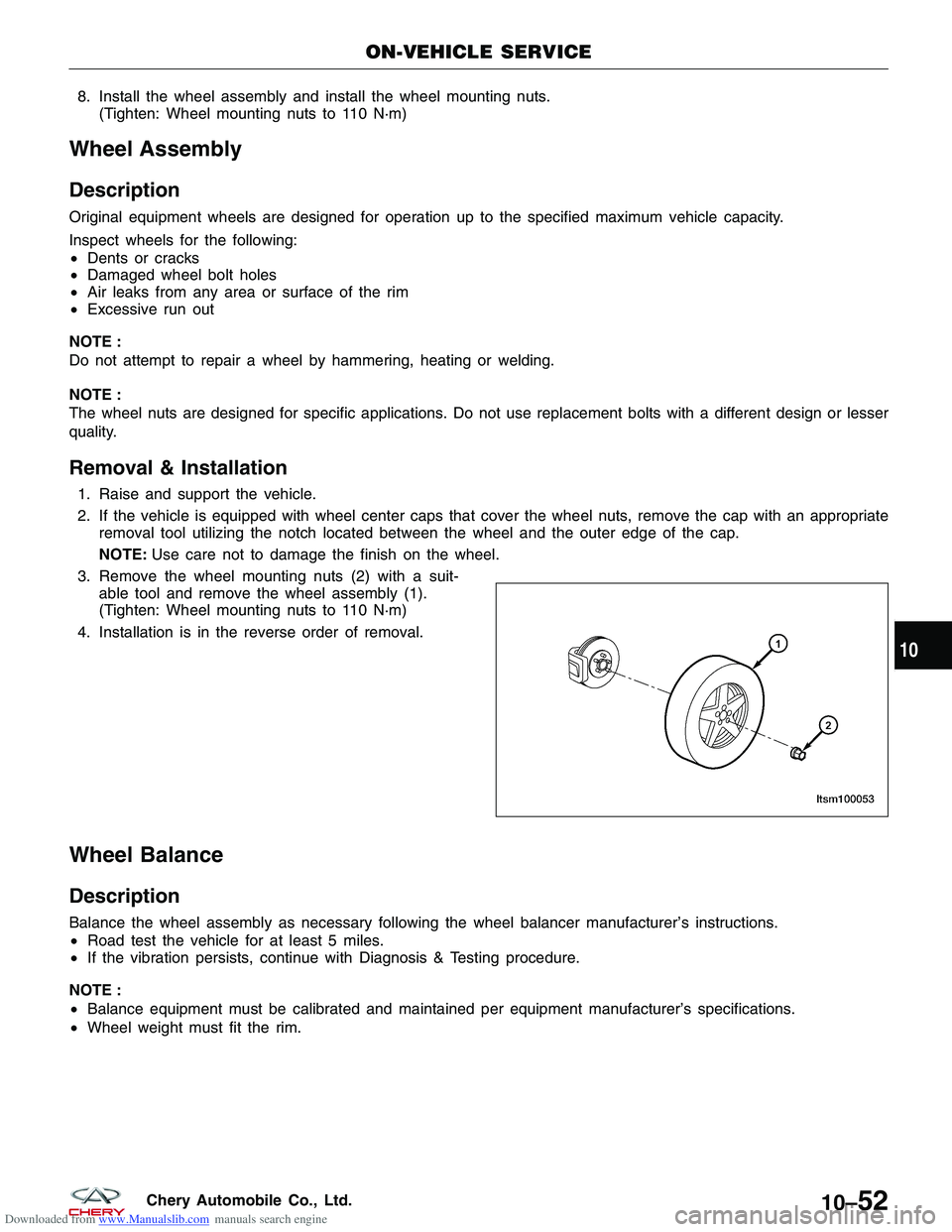
3. Remove the wheel mounting nuts (2) with a suit- able tool and remove the wheel assembly (1).
(Tighten: Wheel mounting nuts to 110 N·m)
4. Installation is in the reverse order of removal.
Wheel Balance
Description
Balance the wheel assembly as necessary following the wheel balancer manufacturer’s instructions.
• Road test the vehicle for at least 5 miles.
• If the vibration persists, continue with Diagnosis & Testing procedure.
NOTE :
• Balance equipment must be calibrated and maintained per equipment manufacturer’s specifications.
• Wheel weight must fit the rim.
ON-VEHICLE SERVICE
LTSM100053
10
10–52Chery Automobile Co., Ltd.
Page 1354 of 1903
Downloaded from www.Manualslib.com manuals search engine Wheel Balance Procedure
1. Raise and support the vehicle.
2. Remove the wheel mounting nuts and the wheelassembly.
3. Perform a dynamic balance test.
NOTE :
A wheel requiring 5g or less of weight per side is con-
sidered to be within the proper specifications for a
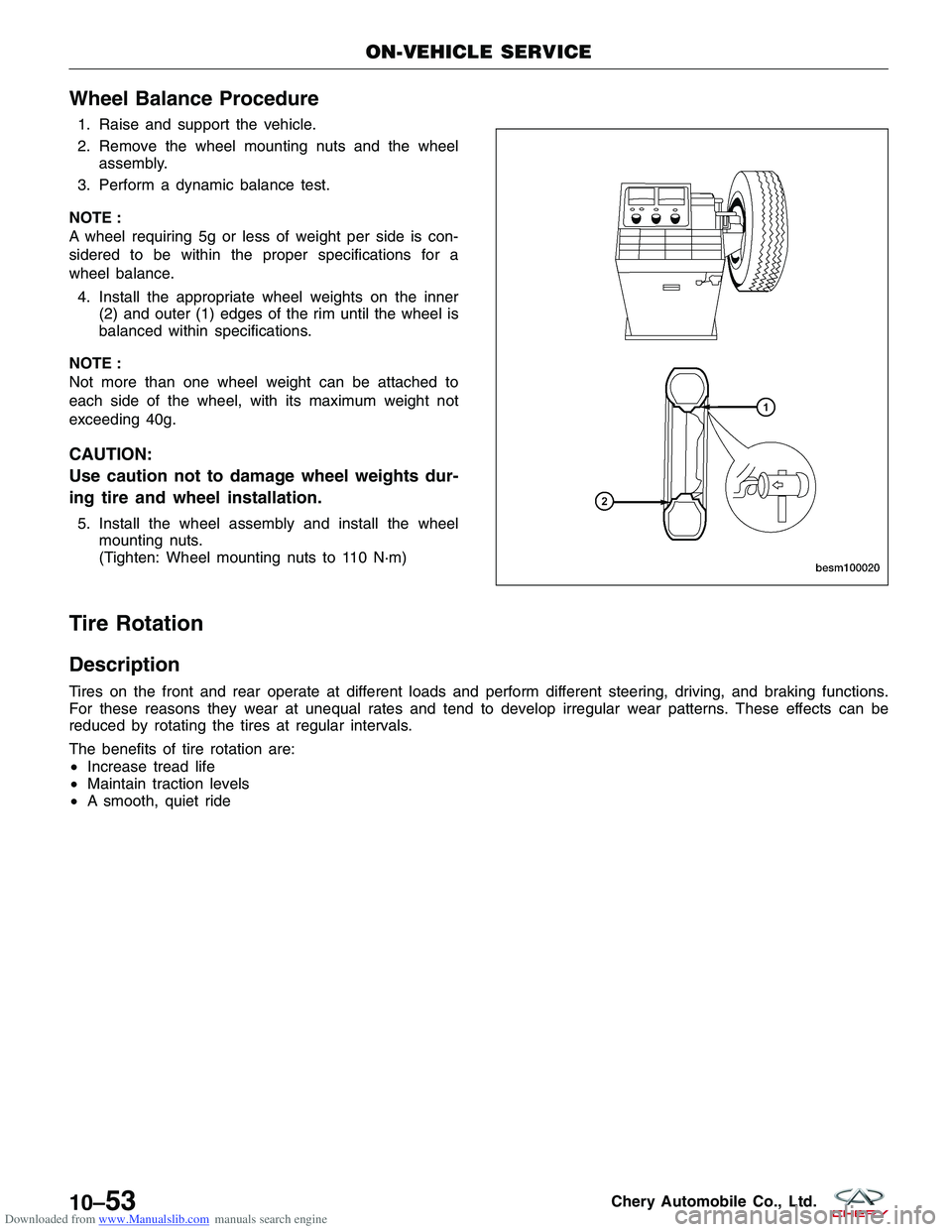
wheel balance. 4. Install the appropriate wheel weights on the inner (2) and outer (1) edges of the rim until the wheel is
balanced within specifications.
NOTE :
Not more than one wheel weight can be attached to
each side of the wheel, with its maximum weight not
exceeding 40g.
CAUTION:
Use caution not to damage wheel weights dur-
ing tire and wheel installation.
5. Install the wheel assembly and install the wheel mounting nuts.
(Tighten: Wheel mounting nuts to 110 N·m)
Tire Rotation
Description
Tires on the front and rear operate at different loads and perform different steering, driving, and braking functions.
For these reasons they wear at unequal rates and tend to develop irregular wear patterns. These effects can be
reduced by rotating the tires at regular intervals.
The benefits of tire rotation are:
•Increase tread life
• Maintain traction levels
• A smooth, quiet ride
ON-VEHICLE SERVICE
BESM100020
10–53Chery Automobile Co., Ltd.
Page 1355 of 1903
Downloaded from www.Manualslib.com manuals search engine Non-Directional Tires
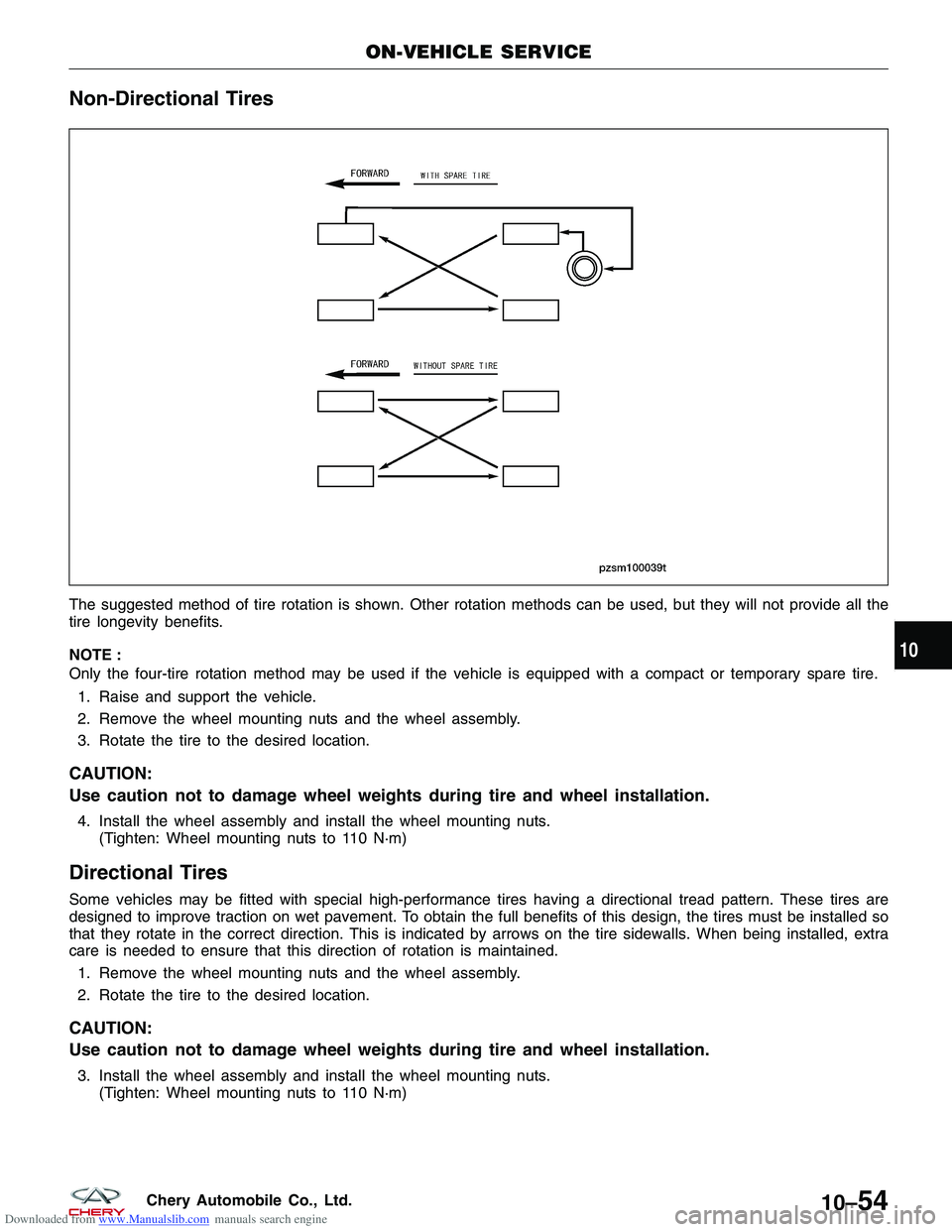
The suggested method of tire rotation is shown. Other rotation methods can be used, but they will not provide all the
tire longevity benefits.
NOTE :
Only the four-tire rotation method may be used if the vehicle is equipped with a compact or temporary spare tire.1. Raise and support the vehicle.
2. Remove the wheel mounting nuts and the wheel assembly.
3. Rotate the tire to the desired location.
CAUTION:
Use caution not to damage wheel weights during tire and wheel installation.
4. Install the wheel assembly and install the wheel mounting nuts. (Tighten: Wheel mounting nuts to 110 N·m)
Directional Tires
Some vehicles may be fitted with special high-performance tires having a directional tread pattern. These tires are
designed to improve traction on wet pavement. To obtain the full benefits of this design, the tires must be installed so
that they rotate in the correct direction. This is indicated by arrows on the tire sidewalls. When being installed, extra
care is needed to ensure that this direction of rotation is maintained.
1. Remove the wheel mounting nuts and the wheel assembly.
2. Rotate the tire to the desired location.
CAUTION:
Use caution not to damage wheel weights during tire and wheel installation.
3. Install the wheel assembly and install the wheel mounting nuts. (Tighten: Wheel mounting nuts to 110 N·m)
ON-VEHICLE SERVICE
PZSM100039T
10
10–54Chery Automobile Co., Ltd.
Page 1356 of 1903
Downloaded from www.Manualslib.com manuals search engine STEERING
11
CONTENTSpage
Steering System ..................................................................... 11-1
Steering Column ..................................................................... 11-8
Steering Gear ...................................................................... 11-18
Power Steering Pump ................................................................ 11-31
STEERING SYSTEM
GENERAL INFORMATION11-2
Description 11-2
Operation 11-2
Specifications 11-3
Special Tools 11-3
DIAGNOSIS & TESTING11-4
Power Steering Troubleshooting Chart 11-4
Power Steering Fluid Troubleshooting
Chart 11-5
ON-VEHICLE SERVICE11-6
Power Steering Filling and Flushing 11-6
Filling 11-6
Flushing 11-6
Inspection 11-7
11
11 –1Chery Automobile Co., Ltd.
Page 1361 of 1903
Downloaded from www.Manualslib.com manuals search engine ON-VEHICLE SERVICE
Power Steering Filling and Flushing
Filling
1. Fill the power steering fluid reservoir to the proper level and let the fluid settle for at least two minutes.
2. Start the engine and let run for a few seconds, then turn the engine off.
3. Add fluid if necessary.
4. Repeat the above procedure until the fluid level remains constant after running the engine.
5. When the steering fluid temperature is relatively high, the steering fluid level will approach to the “MAX” level.
6. When the steering fluid cools down, the steering fluid level may approach to the “MIN” level.
NOTE :
If the steering fluid is extremely foamy or milky looking, allow the vehicle to stand a few minutes and repeat the
procedure.
Flushing
1. Raise and support the vehicle.
2. Remove the steering fluid reservoir release cap.
3. Siphon out the contaminated power steering fluid from the power steering liquid reservoir.
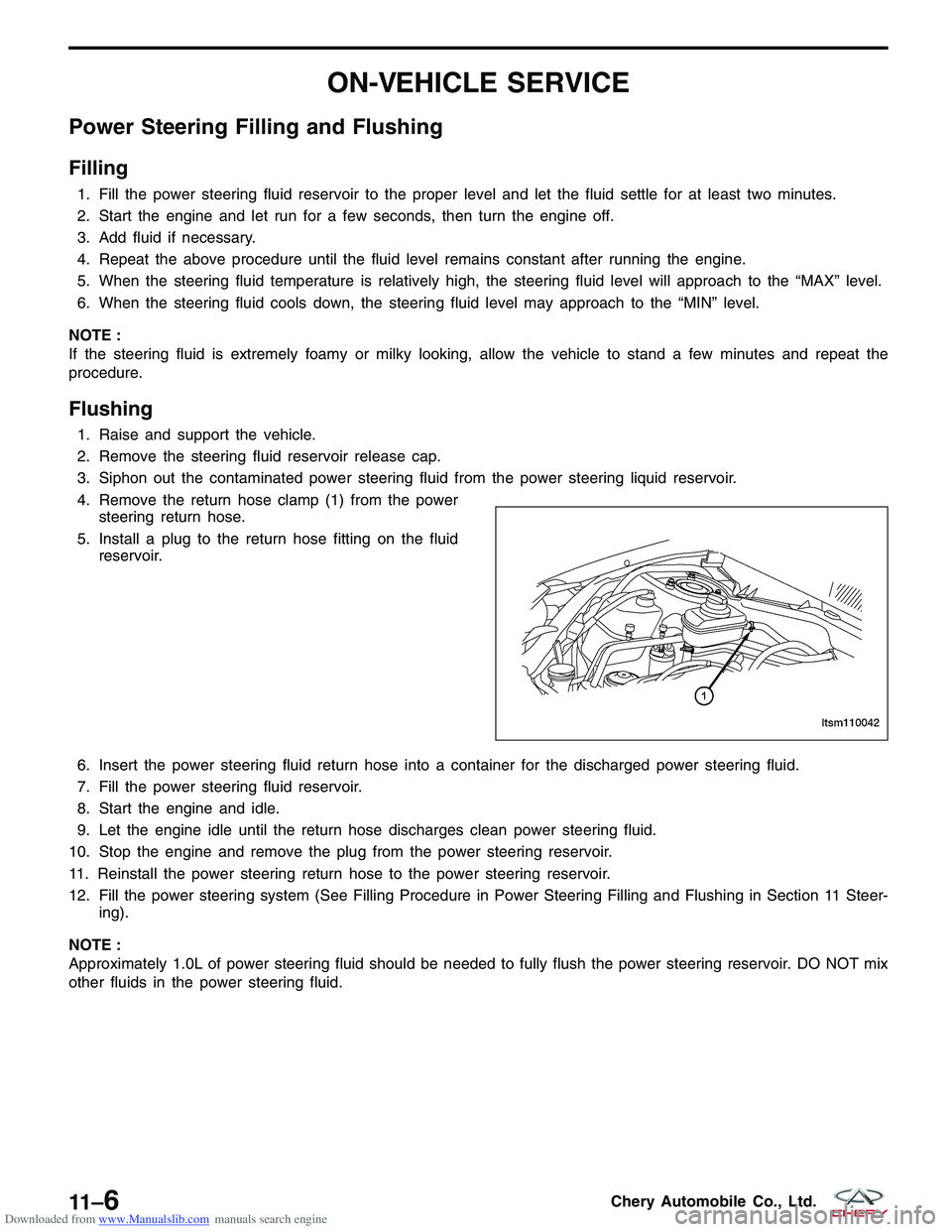
4. Remove the return hose clamp (1) from the power steering return hose.
5. Install a plug to the return hose fitting on the fluid reservoir.
6. Insert the power steering fluid return hose into a container for the discharged power steering fluid.
7. Fill the power steering fluid reservoir.
8. Start the engine and idle.
9. Let the engine idle until the return hose discharges clean power steering fluid.
10. Stop the engine and remove the plug from the power steering reservoir.
11. Reinstall the power steering return hose to the power steering reservoir.
12. Fill the power steering system (See Filling Procedure in Power Steering Filling and Flushing in Section 11 Steer- ing).
NOTE :
Approximately 1.0L of power steering fluid should be needed to fully flush the power steering reservoir. DO NOT mix
other fluids in the power steering fluid.
LTSM110042
11 –6Chery Automobile Co., Ltd.
Page 1362 of 1903
Downloaded from www.Manualslib.com manuals search engine Inspection
1. If the power steering fluid level is low, inspect the entire power steering system for potential leaks.
CAUTION:
DO NOT operate the vehicle with foamy steering fluid for an extended period. This may cause
pump damage.
2. Perform the following to inspect the power steering fluid reservoir level:•Park the vehicle on a level surface.
• Start the engine.
• Turn the steering wheel several times to heat the power steering fluid to 50°- 60°C.
• With the engine running, turn the steering wheel left and right to the wheel stops and repeat this several
times.
• Check the power steering fluid reservoir to see whether there is foam or milky fluid present. Check the
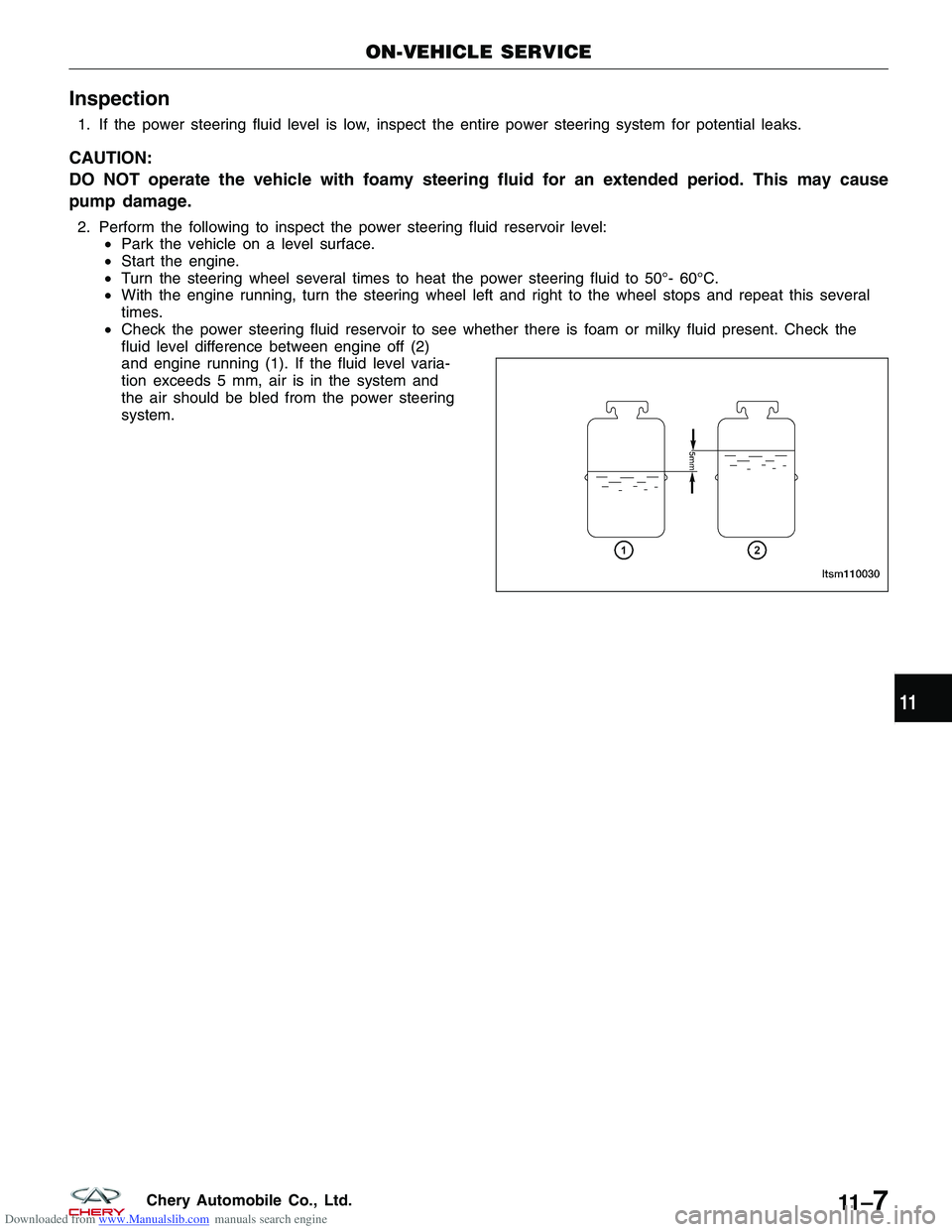
fluid level difference between engine off (2)
and engine running (1). If the fluid level varia-
tion exceeds 5 mm, air is in the system and
the air should be bled from the power steering
system.
ON-VEHICLE SERVICE
LTSM110030
11
11 –7Chery Automobile Co., Ltd.
Page 1363 of 1903
Downloaded from www.Manualslib.com manuals search engine STEERING COLUMN
GENERAL INFORMATION11-9
Description 11-9
Operation 11-10
Specifications 11-10
Special Tool 11-10
DIAGNOSIS & TESTING11-11
Vehicle Inspection 11-11
Loose Steering / Vehicle Leads / Drifts
Troubleshooting Chart 11-11
ON-VEHICLE SERVICE11-12
Steering Wheel 11-12
Removal & Installation 11-12
Inspection - Steering System 11-13
Steering Column Shroud 11-14
Removal & Installation 11-14
Steering Column Shaft 11-15
Removal & Installation 11-15
11 –8Chery Automobile Co., Ltd.
Page 1364 of 1903
Downloaded from www.Manualslib.com manuals search engine GENERAL INFORMATION
Description
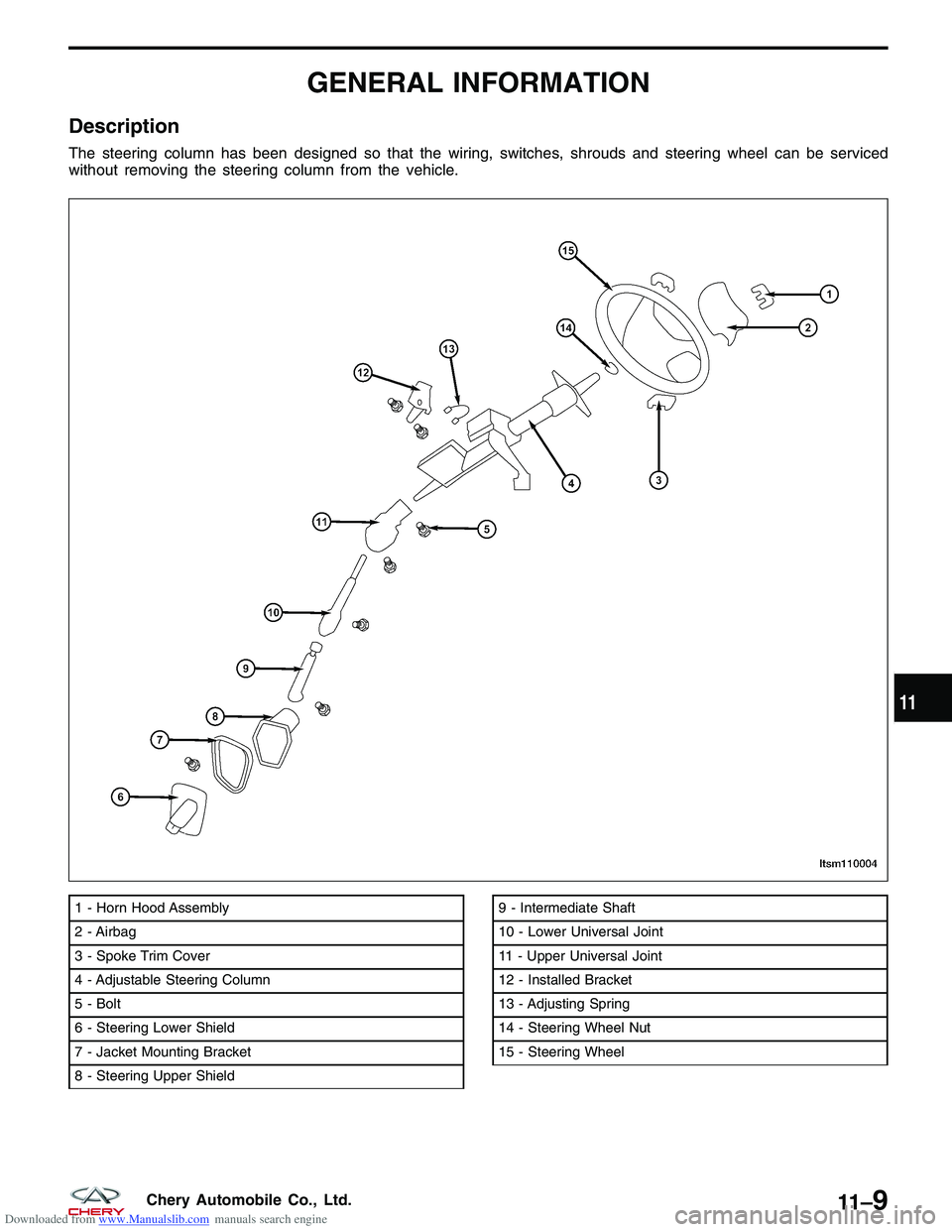
The steering column has been designed so that the wiring, switches, shrouds and steering wheel can be serviced
without removing the steering column from the vehicle.
1 - Horn Hood Assembly
2 - Airbag
3 - Spoke Trim Cover
4 - Adjustable Steering Column
5 - Bolt
6 - Steering Lower Shield
7 - Jacket Mounting Bracket
8 - Steering Upper Shield9 - Intermediate Shaft
10 - Lower Universal Joint
11 - Upper Universal Joint
12 - Installed Bracket
13 - Adjusting Spring
14 - Steering Wheel Nut
15 - Steering Wheel
LTSM110004
11
11 –9Chery Automobile Co., Ltd.
Page 1367 of 1903
Downloaded from www.Manualslib.com manuals search engine ON-VEHICLE SERVICE
Steering Wheel
Removal & Installation
WARNING!
Before servicing the steering column, the airbag system must be disarmed. Failure to do so may result in acci-
dental deployment of the airbag and possible personal injury (See Airbag System Disarming Procedure in Sec-
tion 14 Restraints).
NOTE :
To help maintain alignment of the spiral cable connector during reassembly, apply a small piece of tape to the spiral
cable and the steering column to keep them in alignment.1. Set the front wheels to the straight-ahead position.
2. Disconnect the negative battery cable.
3. Remove the driver airbag (See Driver Airbag Removal & Installation in Section 14 Restraints).
4. Disconnect the spiral cable electrical connector.
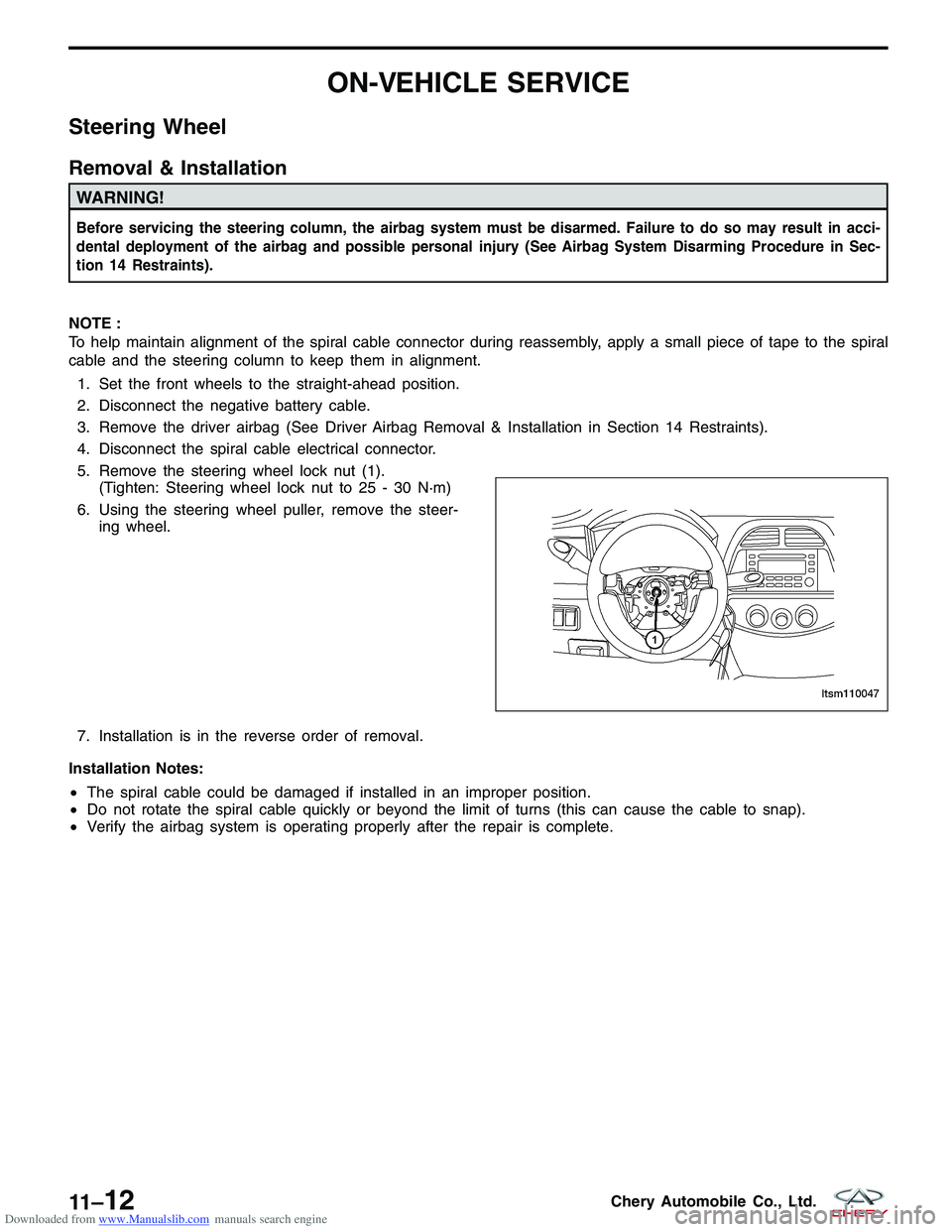
5. Remove the steering wheel lock nut (1). (Tighten: Steering wheel lock nut to 25 - 30 N·m)
6. Using the steering wheel puller, remove the steer- ing wheel.
7. Installation is in the reverse order of removal.
Installation Notes:
• The spiral cable could be damaged if installed in an improper position.
• Do not rotate the spiral cable quickly or beyond the limit of turns (this can cause the cable to snap).
• Verify the airbag system is operating properly after the repair is complete.
LTSM110047
11 –12Chery Automobile Co., Ltd.