towing CHEVROLET BLAZER 1998 2.G Owners Manual
[x] Cancel search | Manufacturer: CHEVROLET, Model Year: 1998, Model line: BLAZER, Model: CHEVROLET BLAZER 1998 2.GPages: 416, PDF Size: 22.4 MB
Page 87 of 416
Downloaded from www.Manualslib.com manuals search engine If the engine stalls and the SECURITY light flashes,
wait about
10 minutes until the light stops flashing
before trying to restart the engine. Remember to release
the
key from the START position as soon as the
engine starts.
If the engine does not start after three (3) tries, the
vehicle needs service.
If you are driving and the SECURITY light comes on,
you will be able to restart the engine if you turn the
engine
off. However, your Passlock system is not
working properly and must be serviced by your dealer.
Your vehicle is not protected by Passlock at this time.
You may also want to check the fuse (see “Fuses and
Circuit Breakers” in the Index). See your dealer
for service.
If the
SECURITY light flashes, wait until the light stops
flashing before starting the engine.
If the
SECURITY light comes on while the engine is
running, a problem has been detected and the system
may need service. See your dealer for service.
In an emergency, call the
GM Roadside Assistance
Center. See “Roadside Assistance” in the Index.
New Vehicle “Break-In”
NOTICE:
Your vehicle doesn’t need an elaborate
“break-in.” But
it will perform better in the long
run if
you follow these guidelines:
a
0
0
0
Keep your speed at 55 mph (88 km/h) or
less for the
first 500 miles (805 km).
Don’t drive at any one speed
-- fast or
slow -- for the first 500 miles (805 km).
Don’t make full-throttle starts.
Avoid making hard stops for the first
200 miles (322 km) or so. During this time
your new brake linings aren’t yet broken
in. Hard stops with new linings can mean
premature wear and earlier replacement.
Follow this breaking-in guideline every
time
you get new brake linings.
Don’t tow
a trailer during break-in.
See “Towing a Trailer’’ in the Index for
more information.
2-13
Page 91 of 416
Downloaded from www.Manualslib.com manuals search engine 3. If your engine still won’t start (or starts but then
stops), wait
15 seconds and start over.
When the engine starts, let go of the key and
the
accelerator pedal.
NOTICE:
Your engine is designed to work with the
electronics in your vehicle.
If you add electrical
parts or accessories, you could change the way
the engine operates. Before adding electrical
equipment, check with your dealer.
If you don’t,
your engine might not perform properly.
If you ever have to have your vehicle towed, see,
the part
of this manual that tells how to do it
without damaging your vehicle. See “Towing
Your Vehicle” in the Index.
Engine Coolant Heater (If Equipped)
In very cold weather, 0°F (- 1 SOC) or colder, the engine
coolant heater can help. You’ll get easier starting and
better fuel economy during engine warm-up. Usually,
the coolant heater should be plugged in a minimum of
four hours prior to starting your vehicle.
To Use the Engine Coolant Heater
1. Turn off the engine.
2. Open the hood and unwrap the electrical cord. The
cord is located
on the driver’s side of the engine
compartment, behind the underhood fuse block.
3. Plug it into a normal, grounded 1 10-volt AC outlet.
Plugging the cord into an ungrounded outlet
could cause an electrical shock. Also, the wrong
kind
of extension cord could overheat and cause
a fire.
You could be seriously injured. Plug the
cord into
a properly grounded three-prong
110-volt
AC outlet. If the cord won’t reach, use a
heavy-duty three-prong extension cord rated for
at least
15 amps.
4. Before starting the engine, be sure to unplug and store
the cord as it was before to keep it away from moving
engine parts. If you don’t,
it could be damaged.
2-17
Page 92 of 416
Downloaded from www.Manualslib.com manuals search engine How long should you keep the coolant heater plugged
in? The answer depends on the outside temperature, the
kind
of oil you have, and some other things. Instead of
trying to list everything here,
we ask that you contact
your dealer in the area where you’ll be parking your
vehicle. The dealer can give you the best advice for that
particular area.
Automatic Transmission Operation
Your automatic transmission may have a shift lever
located on the console between the seats
or on the
steering column.
There
are several different positions for your shift lever.
If your vehicle is equipped with a column shift lever, it
features an electronic shift position indicator within the
instrument cluster. This display must be powered
anytime the shift lever is capable
of being moved out of
PARK (P). This means that if your key is in OFF, but
not locked, there will be
a small current drain on your
battery which could discharge your battery over a period
of time. If you need to leave your key in the ignition in
OFF for an extended period, it is recommended that you
disconnect the battery cable from the battery to prevent
discharging your battery. PARK
(P): This
locks your rear wheels. It’s the best
position to use when you start your engine because your
vehicle can’t move easily.
It is dangerous to get out of your vehicle if the
shift lever is
not fully in PARK (P) with the
parking brake firmly set. Your vehicle can roll.
Don’t leave your vehicle when the engine is
running unless you have to. If you have left the
engine running, the vehicle can move suddenly.
You
or others could be injured. To be sure your
vehicle won’t move, even when you’re on
fairly
level ground, always set your parking brake and
move the shift lever to PARK
(P).
See “Shifting Into PARK (P)” in the Index. If
you’re pulling a trailer, see “Towing a nailer’’ in
the Index.
2-18
Page 94 of 416
Downloaded from www.Manualslib.com manuals search engine DRIVE (D): This position is for normal driving. If you
need more power for passing, and you’re:
@ Going less than about 35 mph (55 km/h), push your
Going about 35 mph (55 km/h) or more, push the
accelerator
pedal about halfway down.
accelerator all the way down.
You’ll shift down to the next gear and have more power.
DRTVE @) should not be used when towing a trailer,
carrying a heavy load, driving on steep hills, or for
off-road driving. Select
THIRD (3) when operating the
vehicle under
any of these conditions.
THIRD (3): This position is also used for normal
driving, however it offers more power and lower fuel
economy than DRIVE (D). You should use THIRD
(3)
when towing a trailer, carrying a heavy load, driving on
steep hills or winding roads or for off-road driving.
SECOND (2): This position gives you more power but
lower fuel economy
than THIRD (3). You can use
SECOND
(2) on hills. It can help control your speed as
you go down steep mountain roads, but then you would
also want to
use your brakes off and on.
You
can alS0 use SECOND (2) for starting your vehicle
from a stop on slippery road surfaces.
FIRST (1): This position gives you even more power
(but lower fuel economy) than SECOND
(2). You can
use it on very steep hills, or in deep snow or mud. If the
selector lever is put in FIRST
(1) while the vehicle is
moving forward, the transmission won’t shift into
FIRST
(1) until the vehicle is going slowly enough.
NOTICE:
If your rear wheels can’t rotate, don’t try to
drive. This might happen if you were stuck in
very deep sand or
mud or were up against a solid
object.
You could damage your transmission.
Also, if you stop when going uphill, don’t hold your
vehicle there with only the accelerator
pedal. This
could overheat and damage the transmission. Use
your brakes or shift into PARK (P) to hold your
vehicle in position on
a hill.
2-20
Page 97 of 416
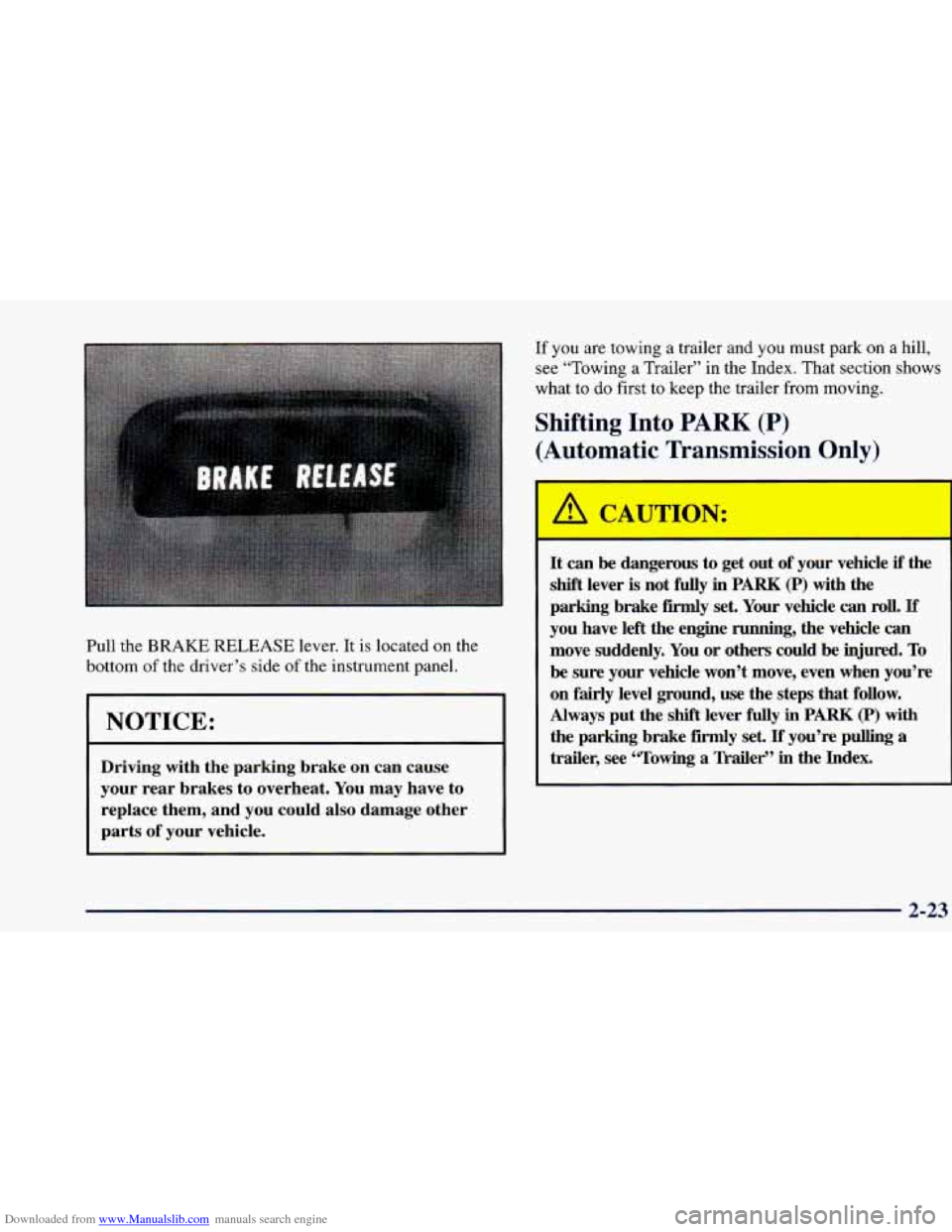
Downloaded from www.Manualslib.com manuals search engine Pull the BRAKE RELEASE lever. It is located on the
bottom of the driver’s side
of the instrument panel.
NOTICE:
Driving with the parking brake on can cause
your rear brakes to overheat. You may have to
replace them, and you could also damage other
parts
of your vehicle.
If you are towing a trailer and you must park on a hill,
see “Towing a Trailer” in the Index. That section shows
what to do first to keep the trailer from moving.
Shifting Into PARK (P)
(Automatic Transmission Only)
It can be dangerous to get out of your vehicle if the
shift lever is not fully in PARK (P) with the
parking brake
firmly set. Your vehicle can roll. If
you have left the engine running, the vehicle can
move suddenly. You or others could be injured. To
be sure your vehicle won’t move, even when you’re
on fairly level ground, use the steps that follow.
Always put the shift lever
fully in PARK (P) with
the parking brake
firmly set. If you’re pulling a
trailer, see “Towing a Tkailer” in the Index.
2-23
Page 100 of 416
Downloaded from www.Manualslib.com manuals search engine Torque Lock (Automatic Transmission)
If you are parking on a hill and you don’t shift your
transmission into PARK (P) properly, the weight of the
vehicle may put too much force
on the parking pawl in
the transmission. You may find it difficult to pull the
shift lever out
of PARK (P). This is called “torque lock.”
To prevent torque lock, set the parking brake and then
shift into PARK (P) properly before you leave the
driver’s seat. To find
out how, see “Shifting Into
PARK
(P)” in the Index.
When
you are ready to drive, move the shift lever out of
PARK (P)
before you release the parking brake.
If torque lock does occur, you may need to have another
vehicle push yours a little uphill
to take some of the
pressure from the parking pawl in the transmission,
so
you can pull the shift lever out of PARK (P).
Shifting Out of Park (P)
(Automatic Transmission)
Your vehicle has a Brake-Transmission Shift Interlock
(BTSI). You have
to fully apply your regular brake
before you can shift from PARK
(P) when the ignition is
in
RUN. See “Automatic Transmission Operation” in
the Index.
If you cannot shift out of PARK (P), ease pressure on
the shift lever
-- push the shift lever all the way into
PARK
(P) as you maintain brake application. Then move
the shift lever into the gear you want (you must press the
shift lever button if you have the console shift lever.)
If you ever hold the brake pedal down but still can’t
shift out of PARK
(P), try this:
1. Turn the key to OFF.
2. Apply and hold the brake until the end of Step 4.
3. Shift to NEUTRAL (N).
4. Start the vehicle and then shift to the drive gear
5. Have the vehicle fixed as soon as you can.
you want.
Parking
Your Vehicle (Manual
Transmission Models Only)
Before you get out of your vehicle, turn off your engine,
put your manual transmission in
REVERSE (R) and
firmly apply the parking brake.
If
you are parking on a hill, or if your vehicle is pulling
a trailer, see “Towing
a Trailer” in the Index.
2-26
Page 102 of 416
Downloaded from www.Manualslib.com manuals search engine Running Your Engine While You’re
Parked (Automatic Transmission)
It’s better not to park with the engine running. But if
ever you
have to, here are some things to know.
Idling the engine with the
air system control off
could allow dangerous exhaust into your vehicle
(see the earlier Caution under “Engine Exhaust”).
Also, idling in a closed-in place can let deadly
carbon monoxide
(CO) into your vehicle even if
the fan switch is at the highest setting. One place
this can happen is a garage. Exhaust
-- with
CO -- can come in easily. NEVER park in a
garage with the engine running.
Another closed-in place can be a blizzard. (See
“Blizzard” in the Index.) It can be dangerous to
get out of your vehicle if
the shift lever is not fully in
PARK (P) with the
parking brake firmly set. Your vehicle can roll.
Don’t leave your vehicle when the engine is
running unless you have to.
If you’ve left the
engine running, the vehicle can move suddenly.
You or others could be injured.
To be sure your
vehicle won’t move, even when you’re
on fairly
level ground, always set your parking brake and
move the shift lever to
PARK (P).
Follow the proper steps to be sure your vehicle won’t
move. See “Shifting Into
PARK (P)” in the Index.
If you’re pulling a trailer, see “Towing a Trailer” in
the Index.
2-28
Page 109 of 416
Downloaded from www.Manualslib.com manuals search engine If a bulb is burned out, replace it to help avoid an
accident. If the arrows don’t
go on at all when you
signal a turn, check the fuse (see “Fuses and Circuit
Breakers” in the Index) and for burned-out bulbs.
If
you have a trailer towing option with added wiring for
the trailer lamps, a different turn signal flasher is used.
With this flasher installed, the signal indicator will flash
even
if a turn signal bulb is burned out. Check the front
and rear turn signal lamps regularly to make sure they
are working.
-7 Signal On Chime
lr your turn signal is left on ror more than 3/4 of a mile
(1.2 km), a chime will sound at each flash of the turn
signal.
To turn off the chime, move the turn signal lever
to the off position.
Headlamp High/Low Beam Changer
To change the headlamps from low beam to high or high
to low, pull the multifunction lever all the way toward
you. Then release it.
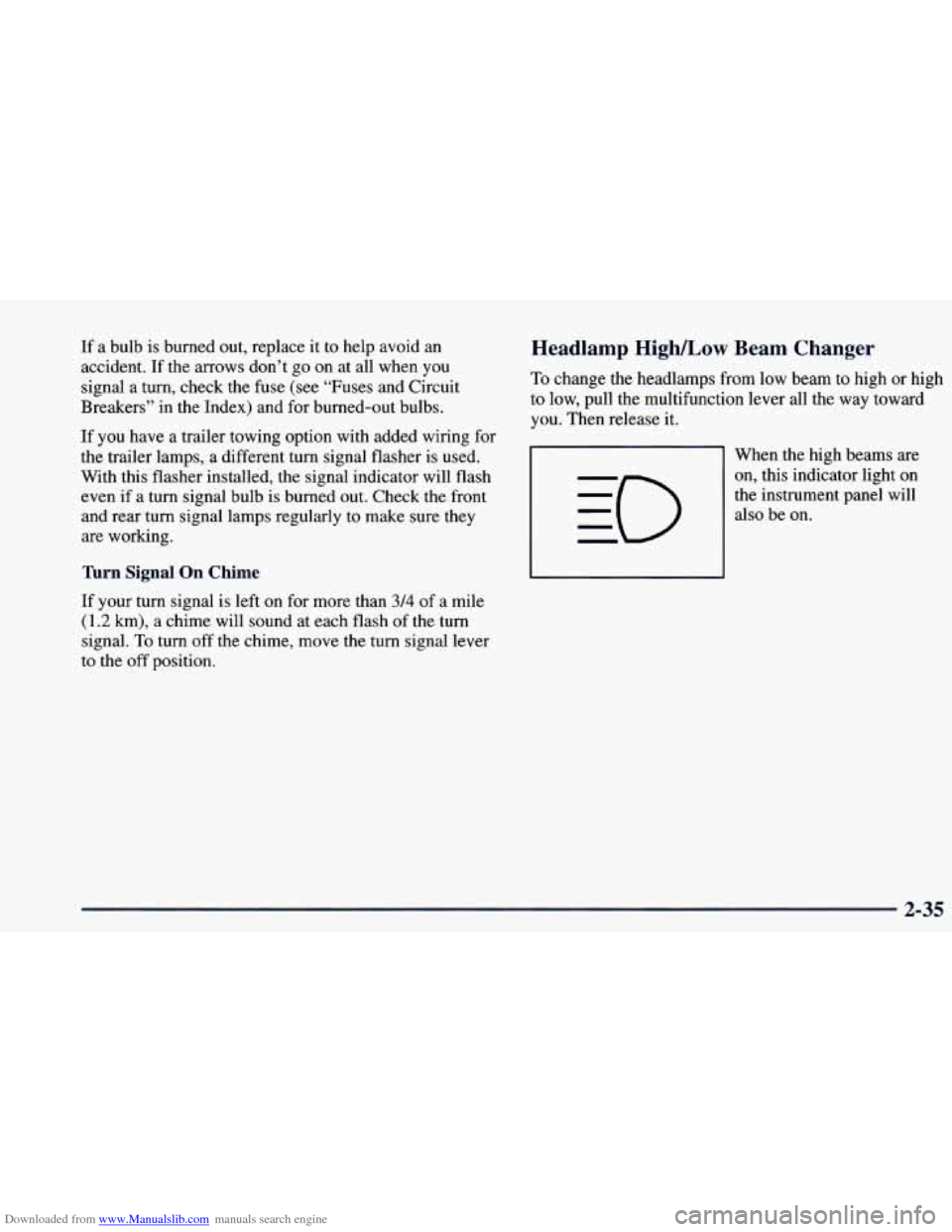
When the high beams are on, this indicator light on
the instrument panel will
also be on.
2-35
Page 145 of 416
Downloaded from www.Manualslib.com manuals search engine Brake System Warning Light
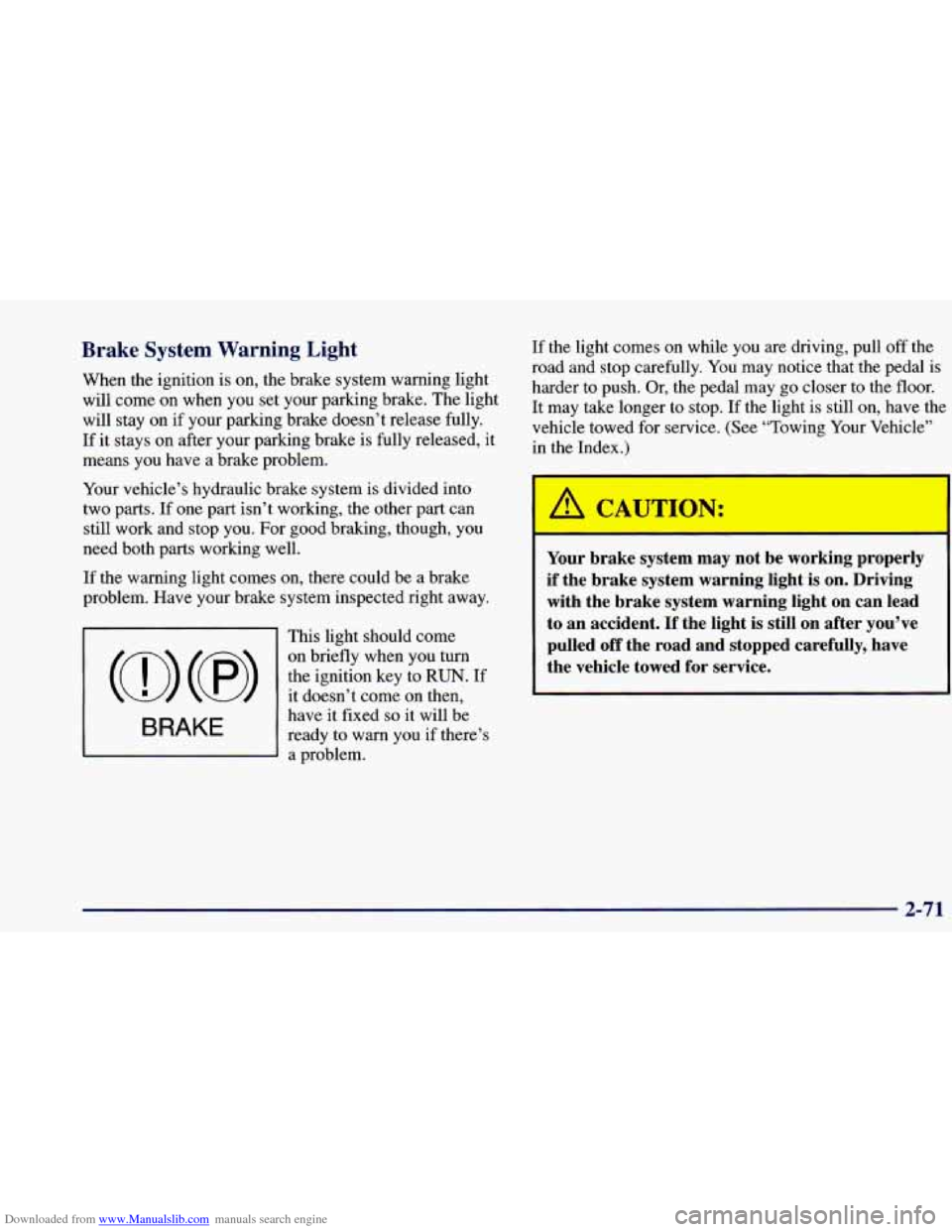
When the ignition is on, the brake system warning light
will come on when you set your parlung brake. The light
will stay on if your parking brake doesn’t release fully.
If it stays on after your parking brake is fully released, it
means you have a brake problem.
Your vehicle’s hydraulic brake system is divided into
two parts.
If one part isn’t working, the other part can
still
work and stop you. For good braking, though, you
need both parts working well.
If the warning light comes on, there could be a brake
problem. Have your brake system inspected right away.
This light should come
(0) (8>
the ignition key to RUN. If
on briefly when you turn
it
doesn’t come on then,
have it fixed
so it will be
ready to warn you if there’s
a problem.
BRAKE
If the light comes on while you are driving, pull off the
road and stop carefully. You may notice that the pedal is
harder to push. Or, the pedal may go closer to the floor.
It may take longer to stop. If the light is still on, have the
vehicle towed for service.
(See “Towing Your Vehicle”
in the Index.)
’ A CAUTl IN:
F--
Your brake system may not be working properly
if the brake system warning light is on. Driving
with the brake system warning light on can lead
to an accident.
If the light is still on after you’ve
pulled
off the road and stopped carefully, have
the vehicle towed for service.
2-71
Page 148 of 416
Downloaded from www.Manualslib.com manuals search engine If the Light Is Flashing If the Light Is On Steady
The following may prevent more serious damage to
your vehicle:
Reducing vehicle speed.
0 Avoiding hard accelerations.
Avoiding steep uphill grades.
If you are towing a trailer, reduce the amount of
cargo being hauled as soon as it is possible.
If the light stops flashing and remains on steady, see
“If
the Light Is On Steady” following.
If the light continues to flash, when it is safe to do
so,
stop the vehicle. Find a safe place to park your vehicle.
Turn the key
off, wait at least 10 seconds and restart the
engine.
If the light remains on steady, see “If the Light
Is On Steady” following. If the light is still flashing,
follow the previous steps, and drive the vehicle to your
dealer or qualified service center for service. You may be
able to correct the emission system
malfunction by considering the following:
Did you recently
put fuel into your vehicle?
If
so, reinstall the fuel cap, making sure to fully install
the cap. The diagnostic system can determine
if the fuel
cap has been left
off or improperly installed. A loose or
missing fuel cap will allow fuel to evaporate into the
atmosphere.
A few driving trips with the cap properly
installed should turn the light
off.
Did you just drive through a deep puddle of water?
If
so, your electrical system may be wet. The condition
will usually be corrected when
the electrical system
dries out. A few driving trips should
turn the light off.
2-74