turn CHEVROLET CAMARO 1967 1.G Chassis User Guide
[x] Cancel search | Manufacturer: CHEVROLET, Model Year: 1967, Model line: CAMARO, Model: CHEVROLET CAMARO 1967 1.GPages: 659, PDF Size: 114.24 MB
Page 51 of 659
HEATER AND AIR CONDITIONING 1A-28
providing a protective film to reduce the possibility
of infection.
3.
As soon as possible, call or consult an eye specialist
for immediate and future treatment.
REMEMBER -
pound of cure."
"An ounce of prevention is worth a
PRECAUTIONS IN HANDLING REFRIGERANT LINES
• All metal tubing lines should be free of kinks, be-
cause of the restriction that kinks will offer to the
flow of refrigerant. The refrigeration capacity of the
entire system can be greatly reduced by a single
kink.
• The flexible hose lines should never be bent to a
radius of less than 10 times the diameter of the hose.
• The flexible hose lines should never be allowed to
come within a distance of 2-1/2" of the exhaust
manifold.
• Flexible hose lines should be inspected at least once
a year for leaks or brittleness. If found brittle or
leaking they should be replaced with new lines.
• Use only sealed lines from parts stock.
• When disconnecting any fitting in the refrigeration
system, the system must first be discharged of all
refrigerant. However, proceed very cautiously re-
gardless of gauge readings. Open very slowly, keep-
ing face and hands away so that no injury can occur
if there happens to be liquid refrigerant in the line.
If pressure is noticed when fitting is loosened, allow
it to bleed off very slowly.
CAUTION: Always wear safety goggles when
opening refrigerant lines.
• In the event any line is opened to atmosphere, it
should be immediately capped to prevent entrance
of moisture and dirt.
• The use of the proper wrenches when making con-
nections on "O" ring fittings is important. The use
of improper wrenches may damage the connection.
The opposing fitting should always be backed up with
a wrench to prevent distortion of connecting lines or
components. When connecting the flexible hose con-
nections it is important that the swagged fitting and
the flare nut, as well as the coupling to which it is
attached, be held at the same time using three dif-
ferent wrenches to prevent turning the fitting and
damaging the ground seat.
• "O" rings and seats must be in perfect condition.
The slightest burr or piece of dirt may cause a leak.
• Sealing beads on hose clamp connections must be
free of nicks and scratches to assure a perfect seal.
MAINTAINING CHEMICAL STABILITY IN THE
REFRIGERATION SYSTEM
The metal internal parts of the Chevrolet refrigeration
system and the refrigerant and oil contained in the sys-
tem are designed to remain in a state of chemical
stability as long as pure R-12 and uncontaminated re-
frigeration oil is used in the system.
However, when abnormal amounts of foreign materials,
such as dirt, air or moisture are allowed to enter the
system, the chemical stability may be upset. When ac-
celerated by heat, these contaminates may form acids
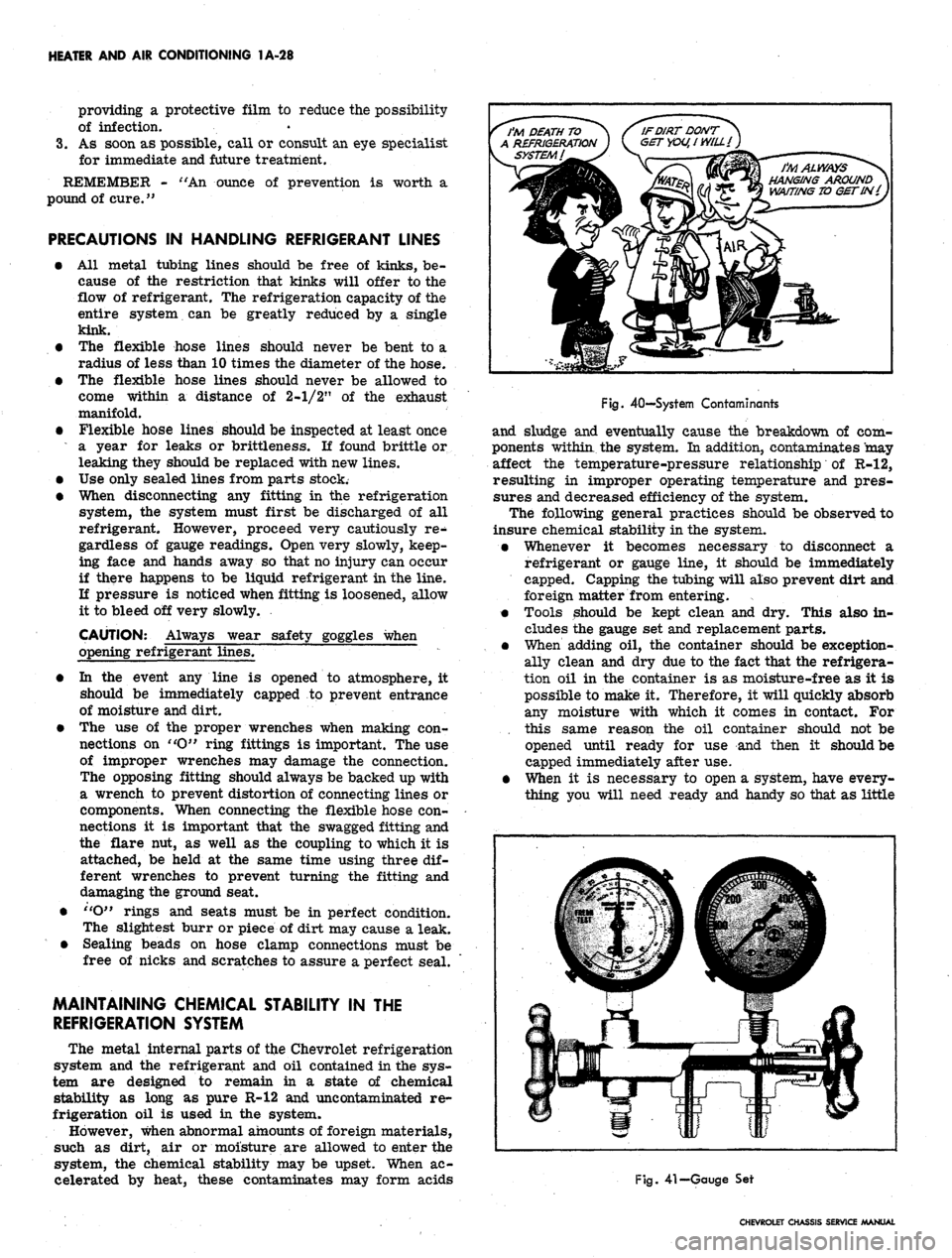
Fig.
40-^-System Contaminants
and sludge and eventually cause the breakdown of com-
ponents within, the system. In addition, contaminates may
affect the temperature-pressure relationship of R-12,
resulting in improper operating temperature and pres-
sures and decreased efficiency of the system.
The following general practices should be observed to
insure chemical stability in the system.
• Whenever it becomes necessary to disconnect a
refrigerant or gauge line, it should be immediately
capped. Capping the tubing will also prevent dirt and
foreign matter from entering.
• Tools should be kept clean and dry. This also in-
cludes the gauge set and replacement parts.
• When adding oil, the container should be exception-
ally clean and dry due to the fact that the refrigera-
tion oil in the container is as moisture-free as it is
possible to make it. Therefore, it will quickly absorb
any moisture with which it comes in contact. For
. this same reason the oil container should not be
opened until ready for use and then it should be
capped immediately after use.
• When it is necessary to open a system, have every-
thing you will need ready and handy so that as little
Fig.
41—Gauge Set
CHEVROLET CHASSIS SERVICE MANUAL
Page 54 of 659
HEATER
AND AIR
CONDITIONING
1A-31
FIVE
AMP
TIME DELAY
FUSE
CORD
TO
110
AC
SOURCE
PUMP
INLET
PUMP DISCHARGE
OUTLET
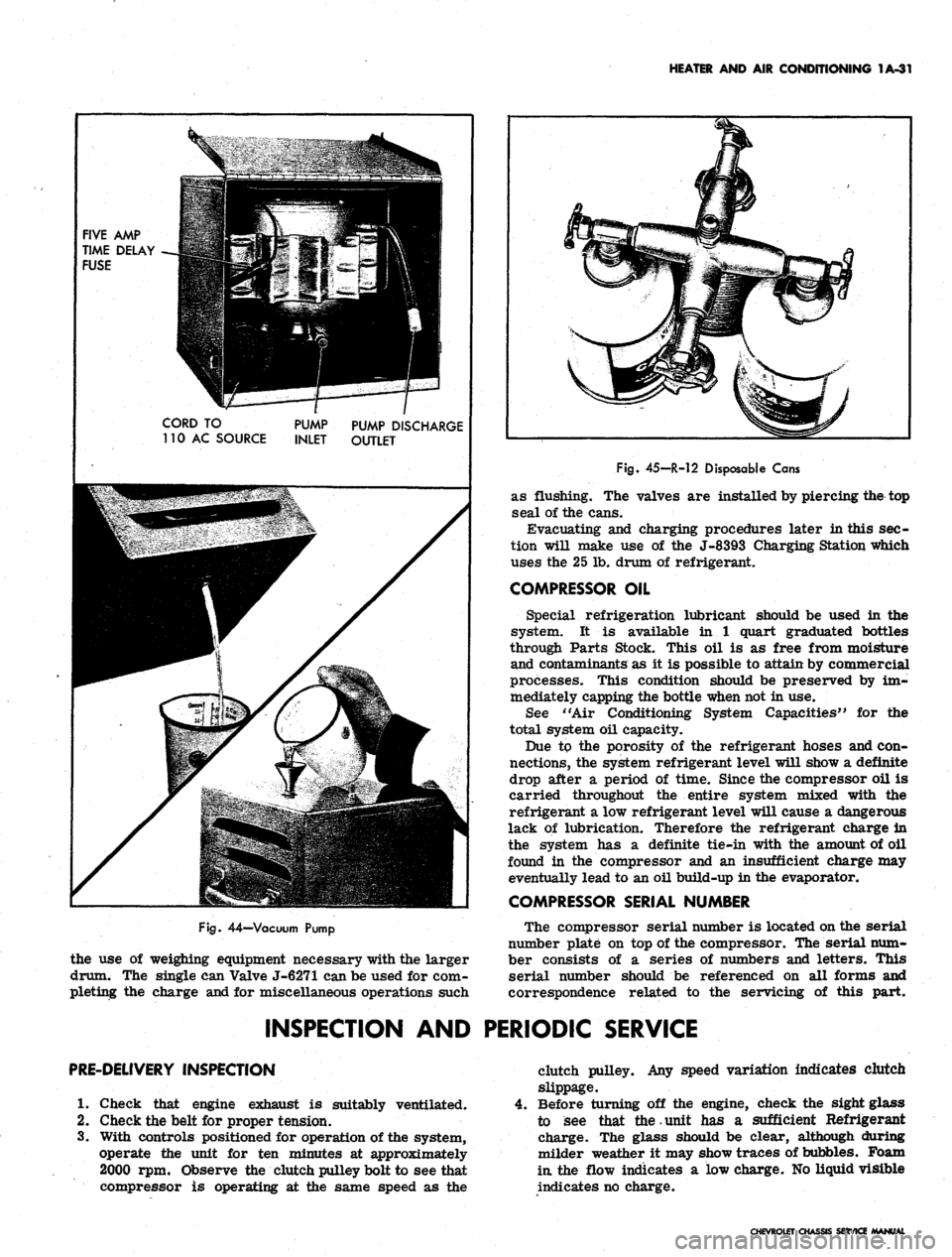
Fig.
44—Vacuum Pump
the use of weighing equipment necessary with the larger
drum. The single can Valve J-6271 can be used for com-
pleting the charge and for miscellaneous operations such
Fig.
45-R-12 Disposable Cans
as flushing. The valves are installed by piercing the top
seal of the cans.
Evacuating and charging procedures later in this sec-
tion will make use of the J-8393 Charging Station which
uses the 25 lb. drum of refrigerant.
COMPRESSOR OIL
Special refrigeration lubricant should be used in the
system. It is available in 1 quart graduated bottles
through Parts Stock. This oil is as free from moisture
and contaminants as it is possible to attain by commercial
processes. This condition should be preserved by im-
mediately capping the bottle when not in use.
See "Air Conditioning System Capacities" for the
total system oil capacity.
Due to the porosity of the refrigerant hoses and con-
nections, the system refrigerant level will show a definite
drop after a period of time. Since the compressor oil is
carried throughout the entire system mixed with the
refrigerant a low refrigerant level will cause a dangerous
lack of lubrication. Therefore the refrigerant charge in
the system has a definite tie-in with the amount of oil
found in the compressor and an insufficient charge may
eventually lead to an oil build-up in the evaporator.
COMPRESSOR SERIAL NUMBER
The compressor serial number is located on the serial
number plate on top of the compressor. The serial num-
ber consists of a series of numbers and letters. This
serial number should be referenced on all forms and
correspondence related to the servicing of this part.
INSPECTION AND PERIODIC SERVICE
PRE-DELIVERY INSPECTION
1.
Check that engine exhaust is suitably ventilated.
2.
Check the belt for proper tension.
3.
With controls positioned for operation of the system,
operate the unit for ten minutes at approximately
2000 rpm. Observe the clutch pulley bolt to see that
compressor is operating at the same speed as the
clutch pulley. Any speed variation indicates clutch
slippage.
Before turning off the engine, check the sight glass
to see that the.unit has a sufficient Refrigerant
charge. The glass should be clear, although during
milder weather it may show traces of bubbles. Foam
in.
the flow indicates a low charge. No liquid visible
indicates no charge.
CHEVROLET CHASSIS SERVICE MANUAL
Page 56 of 659
HEATER AND AIR CONDITIONING 1A-33
within the system. The following fixed conditions must be
adhered to in order to make it possible to compare the
performance of the system being tested with the stan-
dards below:
1.
Doors and windows closed. (Car inside or in shade.)
2.
Hood up and engine exhaust suitably ventilated.
3.
Vehicle in NEUTRAL with engine running at 2000
rpm.
4.
Air Conditioning controls set for -
• Maximum cooling.
• High blower speed.
5.
TEMP knob and AIR knob set for full recirculating
air. On Comfortron systems* move the control lever
to REAR and pull the white vacuum hose from the
transducer. Plug the hose. An alternate method is to
install the J-22368 Tester (described later in this
section) and operate it on MANUAL control to main-
tain maximum cooling and blower speed.
6. Gauge set installed.
7.
System settled out (run-in approximately
10
minutes).
8. A thermometer placed in front of vehicle grille and
another in the right hand diffuser outlet.
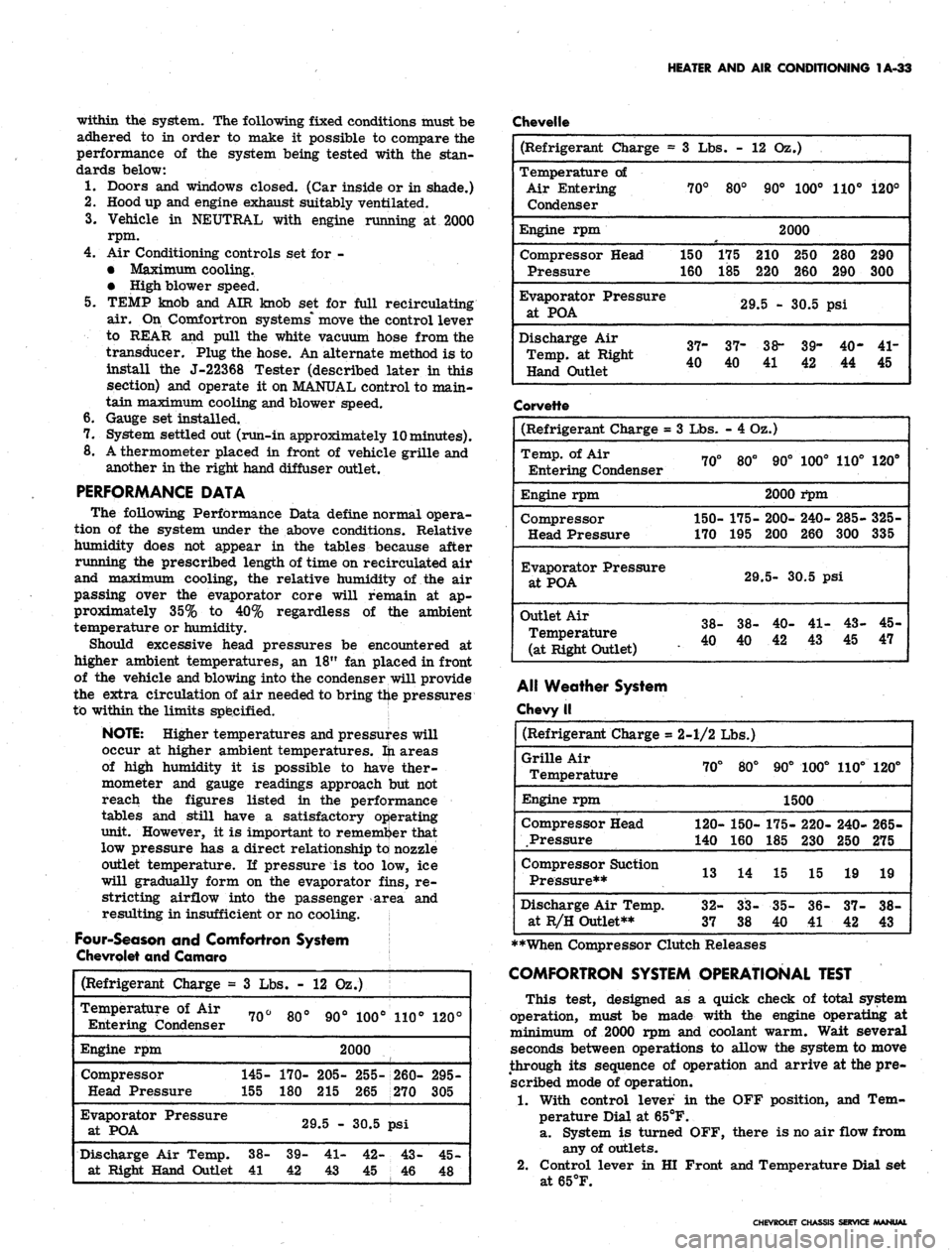
PERFORMANCE DATA
The following Performance Data define normal opera-
tion of the system under the above conditions. Relative
humidity does not appear in the tables because after
running the prescribed length of time on recirculated air
and maximum cooling, the relative humidity of the air
passing over the evaporator core will remain at ap-
proximately 35% to 40% regardless of the ambient
temperature or humidity.
Should excessive head pressures be encountered at
higher ambient temperatures, an 18" fan placed in front
of the vehicle and blowing into the condenser will provide
the extra circulation of air needed to bring the pressures
to within the limits specified.
NOTE: Higher temperatures and pressures will
occur at higher ambient temperatures, fti areas
of high humidity it is possible to have ther-
mometer and gauge readings approach but not
reach the figures listed in the performance
tables and still have a satisfactory operating
unit. However, it is important to remember that
low pressure has a direct relationship to nozzle
outlet temperature. If pressure is too low, ice
will gradually form on the evaporator fins, re-
stricting airflow into the passenger area and
resulting in insufficient or no cooling.
Four-Season and Comfortron System
Chevrolet and Camaro
Chevelle
(Refrigerant
Charge
=
Temperature
of Air
Entering Condenser
Engine rpm
Compressor
Head Pressure
Evaporator Pressure
at POA
Discharge Air Temp,
at Right Hand Outlet
3
Lbs. -
70°
145-
155
38-
41
80°
170-
180
12 02
90°
.)
100°
2000
205-
215
29.5 -
39-
42
41-
43
255-
265
30.5
42-
45
110°
260-
270
psi
43-
46
120°
295-
305
45-
48
(Refrigerant Charge =
Temperature of
Air Entering
Condenser
Engine rpm
Compressor Head
Pressure
Evaporator
Pressure
at
POA
Discharge Air
Temp, at Right
Hand Outlet
3 Lbs. -
70°
150
160
37-
40
80°
175
185
12 Oz.)
90° 100°
2000
210 250
220 260
29.5 - 30.5
37-
40
38-
39-
41 42
110°
280
290
psi
40-
44
120°
290
300
41-
45
Corvette
(Refrigerant Charge =
Temp, of Air
Entering Condenser
Engine rpm
Compressor
Head Pressure
Evaporator
Pressure
at
POA
Outlet
Air
Temperature
(at Right
Outlet)
3
Lbs.
70°
150-
170
38-
40
- 4 Oz.)
80°
175-
195
29
38-
40
90°
2000
200-
200
100°
i*pm
240-
260
110°
285-
300
5-
30.5 psi
40-
42
41-
43
43-
45
120°
325-
335
45-
47
Alt Weather System
Chevy II
(Refrigerant
Charge
=
Grille Air
Temperature
Engine rpm
Compressor Head
Pressure
Compressor Suction
Pressure**
Discharge Air Temp,
at R/H Outlet**
2-1/2 Lbs.)
70°
120-
140
13
32-
37
80°
150-
160
14
CO
OO
CO
CO
90°
100°
1500
175-
185
15
35-
40
220-
230
15
36-
41
110°
240-
250
19
37-
42
120°
265-
275
19
38-
43
**When Compressor Clutch Releases
COMFORTRON SYSTEM OPERATIONAL TEST
This test, designed as a quick check of total system
operation, must be made with the engine operating at
minimum of 2000 rpm and coolant warm. Wait several
seconds between operations to allow the system to move
through its sequence of operation and arrive at the pre-
scribed mode of operation.
1.
With control lever in the OFF position, and Tem-
perature Dial at 65°F.
a. System is turned OFF, there is no air flow from
any of outlets.
2.
Control lever in HI Front and Temperature Dial set
at65°F.
CHEVROLET CHASSIS SERVICE MANUAL
Page 63 of 659
HEATER AND AIR CONDITIONING 1A-40
THERAAAL VACUUM
VALVE
TO ENGINE
VACUUM
SOURCE
VACUUM STORAGE
TANK
OUTSIDE AIR
DIAPHRAGM
MODE
DIAPHRAGM
VACUUM
RELAY
BLACK
DEFOG-DEICE
DIAPHRAGM
GREEN
BLACKj ||
|
BROWN
CONTROL
VALVE
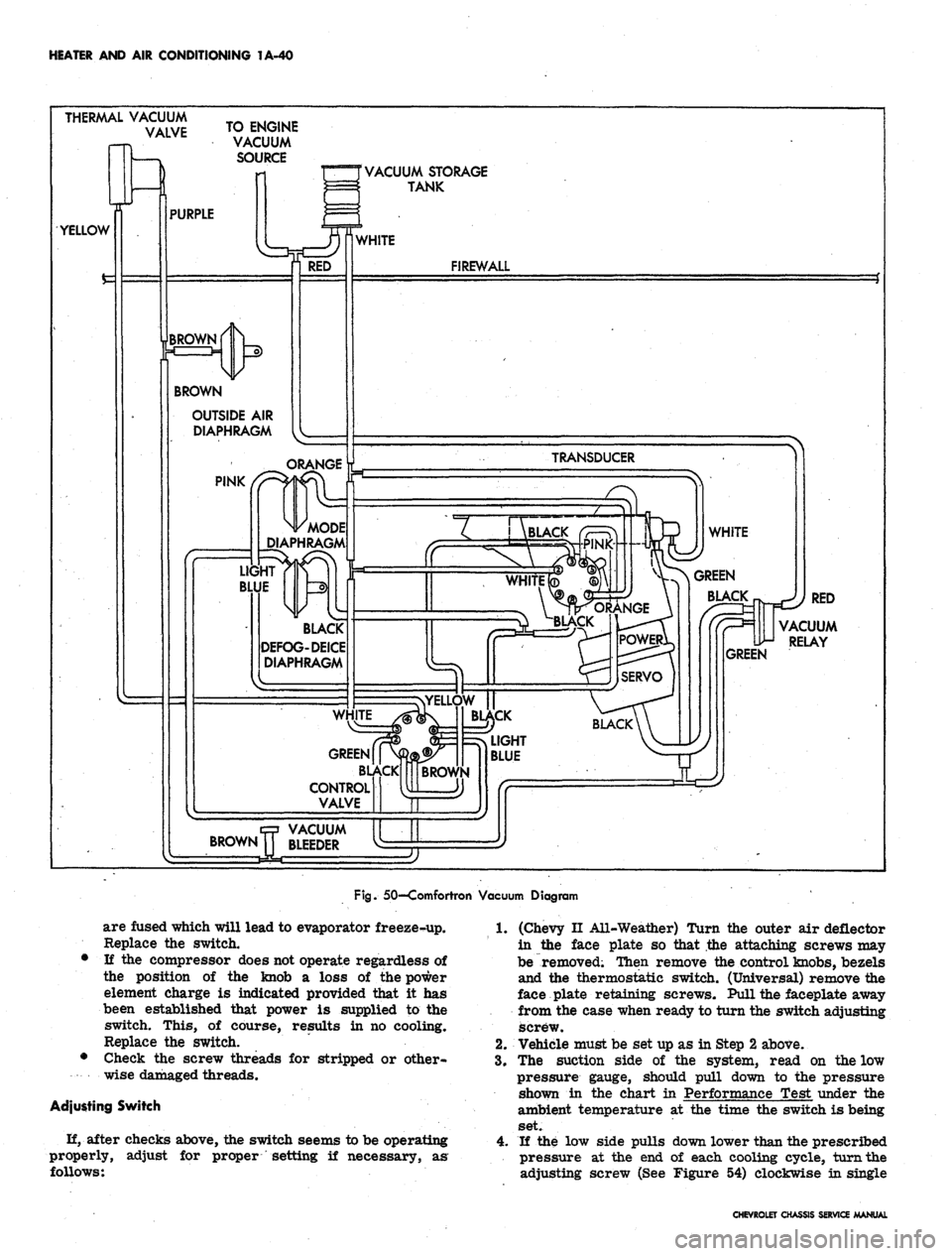
Fig.
50—Comfortron Vacuum Diagram
are fused which will lead to evaporator freeze-up.
Replace the switch.
• If the compressor does not operate regardless of
the position of the knob a loss of the power
element charge is indicated provided that it has
been established that power is supplied to the
switch. This, of course, results in no cooling.
Replace the switch.
• Check the screw threads for stripped or other-
wise damaged threads.
Adjusting Switch
H, after checks above, the switch seems to be operating
properly,
follows:
adjust for proper setting if necessary, as
1.
(Chevy II All-Weather) Turn the outer air deflector
in the face plate so that the attaching screws may
be removed; Then remove the control knobs, bezels
and the thermostatic switch. (Universal) remove the
face plate retaining screws. Pull the faceplate away
from the case when ready to turn the switch adjusting
screw.
2.
Vehicle must be set up as in Step 2 above.
3.
The suction side of the system, read on the low
pressure gauge, should pull down to the pressure
shown in the chart in Performance Test under the
ambient temperature at the time the switch is being
set.
4.
If the low side pulls down lower than the prescribed
pressure at the end of each cooling cycle, turn the
adjusting screw (See Figure 54) clockwise in single
CHEVROLET CHASSIS SERVICE MANUAL
Page 64 of 659
HEATER
AND AIR
CONDITIONING
1A-41
OUTLET
1
TO EXPANSION
^
VALVE
TO
OIL
BLEED LINE
^ INLET
Fig.
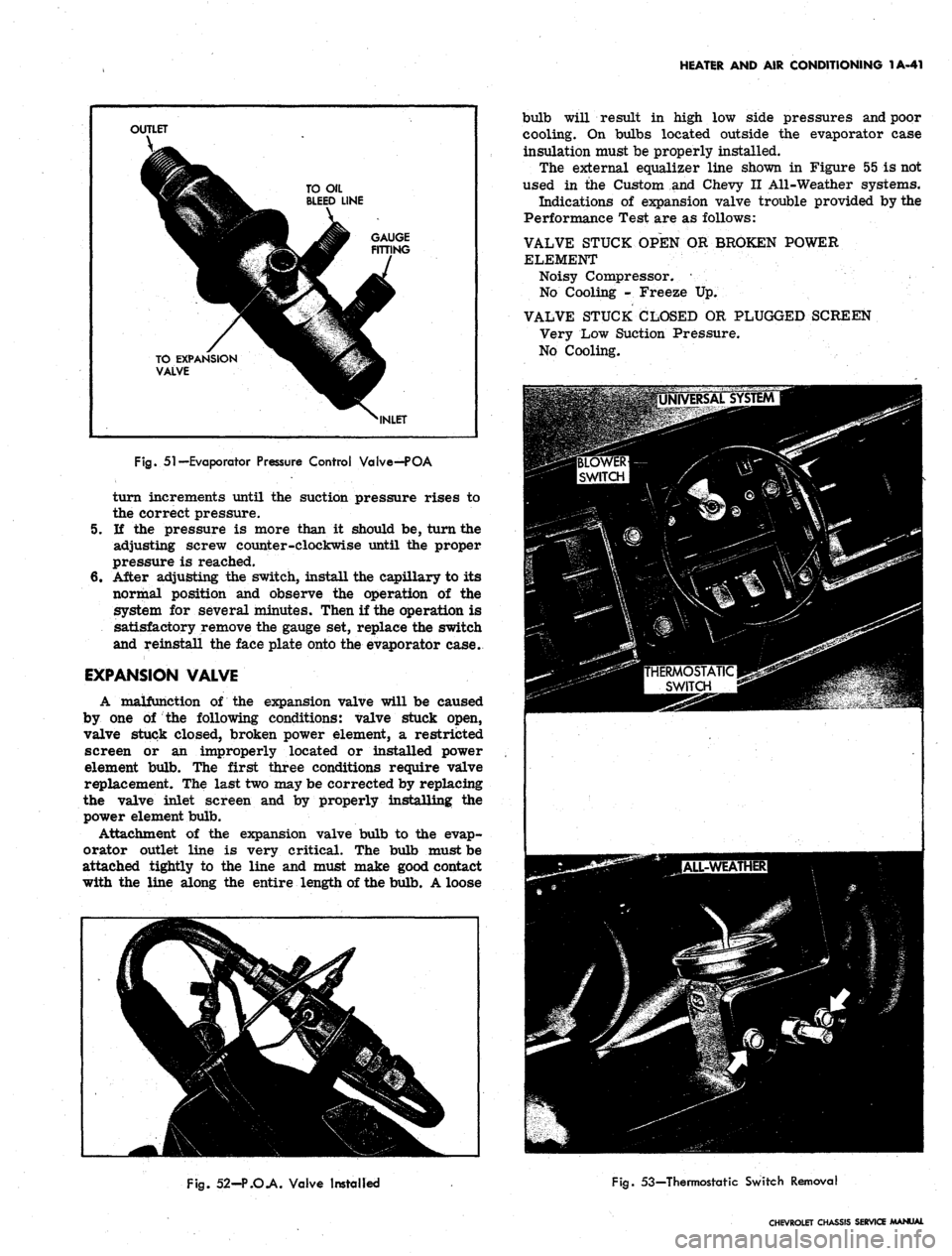
51—Evaporator Pressure Control Valve—POA
turn increments until
the
suction pressure rises
to
the correct pressure.
5.
If the
pressure
is
more than
it
should
be,
turn the
adjusting screw counter-clockwise until
the
proper
pressure
is
reached.
6. After adjusting
the
switch, install the capillary to
its
normal position
and
observe
the
operation
of the
system
for
several minutes. Then
if
the operation
is
satisfactory remove the gauge
set,
replace the switch
and reinstall the face plate onto the evaporator case.
EXPANSION VALVE
A malfunction
of the
expansion valve will
be
caused
by
one of the
following conditions: valve stuck open,
valve stuck closed, broken power element,
a
restricted
screen
or an
improperly located
or
installed power
element bulb.
The
first three conditions require valve
replacement.
The
last two may be corrected by replacing
the valve inlet screen
and by
properly installing
the
power element bulb.
Attachment
of the
expansion valve bulb
to the
evap-
orator outlet line
is
very critical.
The
bulb must be
attached tightly
to the
line
and
must make good contact
with
the
line along
the
entire length
of
the bulb. A loose
bulb will result
in
high
low
side pressures and poor
cooling.
On
bulbs located outside
the
evaporator case
insulation must be properly installed.
The external equalizer line shown
in
Figure
55 is
not
used
in the
Custom
and
Chevy
II
All-Weather systems.
Indications
of
expansion valve trouble provided by the
Performance Test are
as
follows:
VALVE STUCK OPEN
OR
BROKEN POWER
ELEMENT
Noisy Compressor.
•
No Cooling
-
Freeze
Up.
VALVE STUCK CLOSED
OR
PLUGGED SCREEN
Very Low Suction Pressure.
No Cooling.
Fig.
52-P.O.A. Valve Installed
Fig.
53—Thermostatic Switch Removal
CHEVROLET CHASSIS SERVICE MANUAL
Page 66 of 659
HEATER AND AIR CONDITIONING 1A-43
LOW PRESSURE
CONTROL
HIGH PRESSURE
CONTROL
3
VACUUM
CONTROL
4
FREON
CONTROL
Fig,
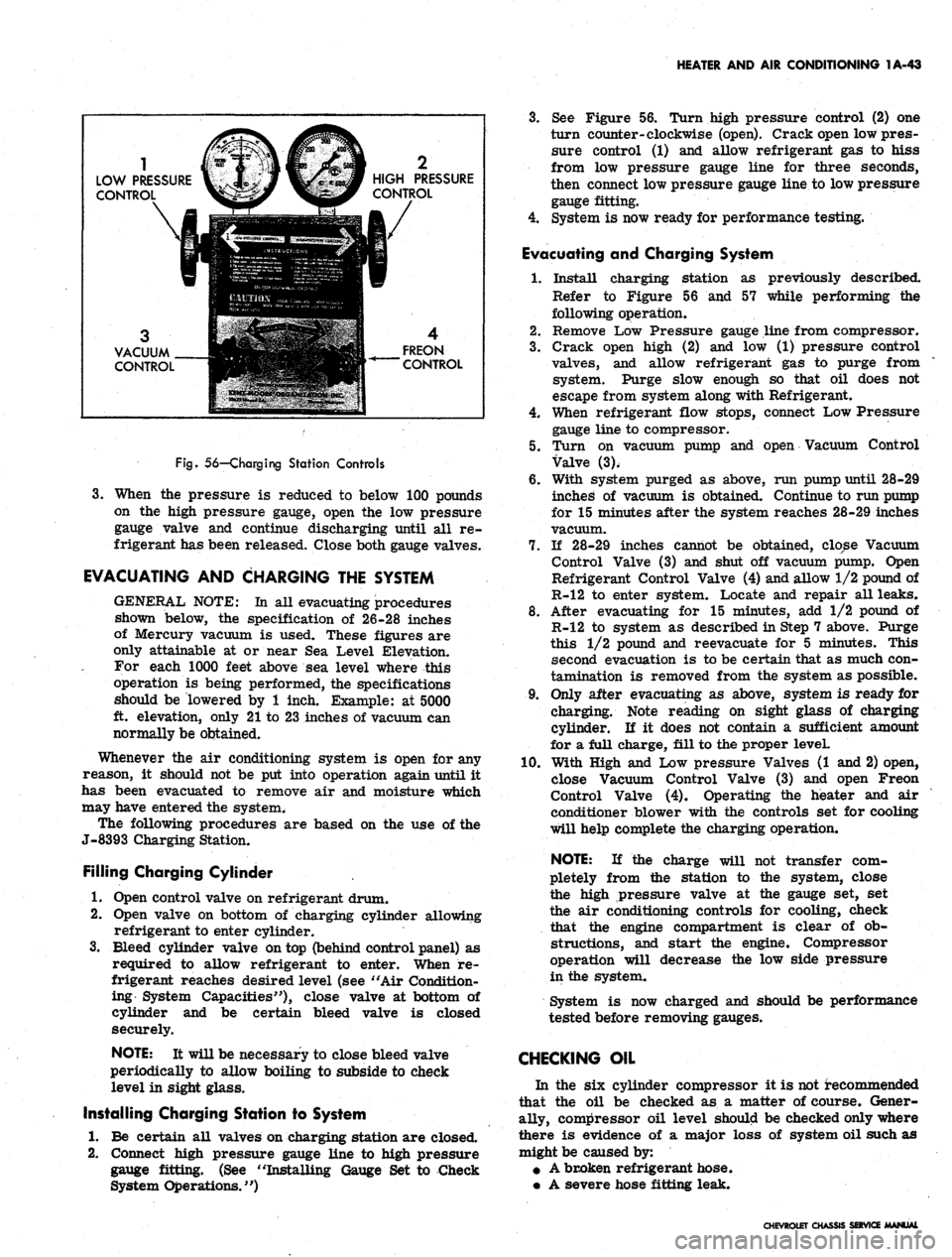
56—Charging Station Controls
3.
When the pressure is reduced to below 100 pounds
on the high pressure gauge, open the low pressure
gauge valve and continue discharging until all re-
frigerant has been released. Close both gauge valves.
EVACUATING AND CHARGING THE SYSTEM
GENERAL NOTE: La all evacuating procedures
shown below, the specification of 26-28 inches
of Mercury vacuum is used. These figures are
only attainable at or near Sea Level Elevation.
For each 1000 feet above sea level where this
operation is being performed, the specifications
should be lowered by 1 inch. Example: at 5000
ft. elevation, only 21 to 23 inches of vacuum can
normally be obtained.
Whenever the air conditioning system is open for any
reason, it should not be put into operation again until it
has been evacuated to remove air and moisture which
may have entered the system.
The following procedures are based on the use of the
J-8393 Charging Station.
Filling Charging Cylinder
1.
Open control valve on refrigerant drum.
2.
Open valve on bottom of charging cylinder allowing
refrigerant to enter cylinder.
3.
Bleed cylinder valve on top (behind control panel) as
required to allow refrigerant to enter. When re-
frigerant reaches desired level (see "Air Condition-
ing System Capacities"), close valve at bottom of
cylinder and be certain bleed valve is closed
securely.
NOTE: It will be necessary to close bleed valve
periodically to allow boiling to subside to check
level in sight glass.
Installing Charging Station to System
1.
Be certain all valves on charging station are closed.
2.
Connect high pressure gauge line to high pressure
gauge fitting. (See "Installing Gauge Set to Check
System Operations.")
3.
See Figure 56. Turn high pressure control (2) one
turn counter-clockwise (open). Crack open low pres-
sure control (1) and allow refrigerant gas to hiss
from low pressure gauge line for three seconds,
then connect low pressure gauge line to low pressure
gauge fitting.
4.
System is now ready for performance testing.
Evacuating and Charging System
1.
Install charging station as previously described.
Refer to Figure 56 and 57 while performing the
following operation.
2.
Remove Low Pressure gauge line from compressor.
3.
Crack open high (2) and low (1) pressure control
valves, and allow refrigerant gas to purge from
system. Purge slow enough so that oil does not
escape from system along with Refrigerant.
4.
When refrigerant flow stops, connect Low Pressure
gauge line to compressor.
5.
Turn on vacuum pump and open Vacuum Control
Valve (3).
6. With system purged as above, run pump until 28-29
inched of vacuum is obtained. Continue to run pump
for 15 minutes after the system reaches 28-29 inches
vacuum.
7.
If 28-29 inches cannot be obtained, close Vacuum
Control Valve (3) and shut off vacuum pump. Open
Refrigerant Control Valve (4) and allow 1/2 pound of
R-12 to enter system. Locate and repair all leaks.
8. After evacuating for 15 minutes, add 1/2 pound of
R-12 to system as described in Step 7 above. Purge
this 1/2 pound and reevacuate for 5 minutes. This
second evacuation is to be certain that as much con-
tamination is removed from the system as possible.
9. Only after evacuating as above, system is ready for
charging. Note reading on sight glass of charging
cylinder. If it does not contain a sufficient amount
for a full charge, fill to the proper leveL
10.
With High and Low pressure Valves (1 and 2) open,
close Vacuum Control Valve (3) and open Freon
Control Valve (4). Operating the heater and air
conditioner blower with the controls set for cooling
will help complete the charging operation.
NOTE: If the charge will not transfer com-
pletely from the station to the system, close
the high pressure valve at the gauge set, set
the air conditioning controls for cooling, check
that the engine compartment is clear of ob-
structions, and start the engine. Compressor
operation will decrease the low side pressure
in the system.
System is now charged and should be performance
tested before removing gauges.
CHECKING OIL
In the six cylinder compressor it is not recommended
that the oil be checked as a matter of course. Gener-
ally, compressor oil level should be checked only where
there is evidence of a major loss of system oil such as
might be caused by:
• A broken refrigerant hose.
• A severe hose fitting leak.
CHEVROLET CHASSIS SERVICE MANUAL
Page 68 of 659
HEATER AND AIR CONDITIONING 1A-45
• A very badly leaking compressor seal.
• Collision damage to the system components.
As a quick check on compressor oil charge, with the
engine off, carefully crack open the oil drain plug on the
bottom of the compressor. If oil comes out, the com-
pressor has the required amount of oil To further check
the compressor oil charge, should the above test show
insufficient oil, it is necessary to remove the compressor
from the vehicle, drain and measure the oil.
Checking Compressor Oil Charge
1.
Run the system for 10 minutes at 500-600 engine
rpm with controls set for maximum cooling and
high blower speed.
2.
Turn off engine, discharge the system, remove
compressor from vehicle, place it in a horizontal
position with the drain plug downward. Remove the
drain plug and, tipping the compressor back and
forth and rotating the compressor shaft, drain the
oil into a clean container, measure and discard the
oiL
3.
a. If the quantity drained was 4 fluid oz. or more,
add the same amount of new refrigerant oil to
the replacement compressor.
b.
If the quantity drained was less than 4 fluid oz.,
add 6 fluid oz. of new refrigeration oil to the
replacement compressor.
c. If a new service compressor is being installed,
drain all oil from it and replace only the amount
specified in Steps 3a and 3b above.
d. If a field repaired compressor is being installed,
add an additional 1 fluid oz. to the compressor.
4.
In the event that it is not possible to idle the com-
pressor as outlined in Step 1 to effect oil return to
it, proceed as follows:
a. Remove the compressor, drain, measure and
discard the oil.
b.
If the amount drained is more than 1-1/2 fluid
oz.
and the system shows no signs of a major
leak, add the same amount to the replacement
compressor.
c. If the amount drained is less than 1-1/2 fluid oz.
and the system appears to have lost an excessive
amount of oil add 6 fluid oz. of clean refrigeration
oil to replacement compressor, 7 fluid oz. to a
repaired compressor.
If the oil contains chips or other foreign ma-
terial, replace the receiver-dehydrator and flush
or replace all component parts as necessary. Add
the full specified volume of new refrigeration oil
to the system.
5.
Add additional oil in the following amounts for any
system components being replaced.
Evaporator 3 fluid oz.
Condenser . . . . ... . . . . . . 1 fluid oz.
Receiver-Dehydrator ....... 1 fluid oz.
NOTE: When adding oil to the compressor, it
will be necessary to tilt the rear end of the
compressor up so that the oil will not run out
of the suction and discharge ports. Do not set
the compressor on the shaft end.
Adding Oil to the System
The system should be completely assembled and un-
charged before adding oil. Use only uncontaminated
refrigerant oil (525 viscosity) and add as follows:
1.
Connect the low pressure line from the gauge set
to the low pressure gauge fitting on the P.O.A.
valve (Four-Season) or low pressure fitting on the
compressor connector Mock (Universal System).
2.
Connect the high pressure line from the charging
station gauge set to the compressor muffler or high
pressure side of the connector block.
3.
Disconnect the high pressure line from the gauge set,
make certain that the line is clean, and place the
end in a graduated container.
4.
Pour enough refrigerant oil into the container so
that the required volume may be drawn into the
system by the high pressure hose.
5.
Close the high pressure valve at the gauge set,
and open the low pressure valve.
6. Operate the vacuum pump to drop the pressure within
the system and cause atmospheric pressure to force
oil through the high pressure line into the system.
When the oil level has dropped the required volume,
pull the line out of the oil container and continue
vacuum pump operation to force the oil contained
in the line into the system.
7.
Shut off the vacuum pump and connect ttye high
pressure line to the gauge set. Open the high
pressure valve and evacuate the system through
the high and low pressure sides of the system.
Complete the charging operation as outlined in Step
10 under "Evacuating and Charging System".
COMPONENT REPLACEMENT AND MINOR REPAIRS
REFRIGERANT LINE CONNECTIONS
"O"
Rings
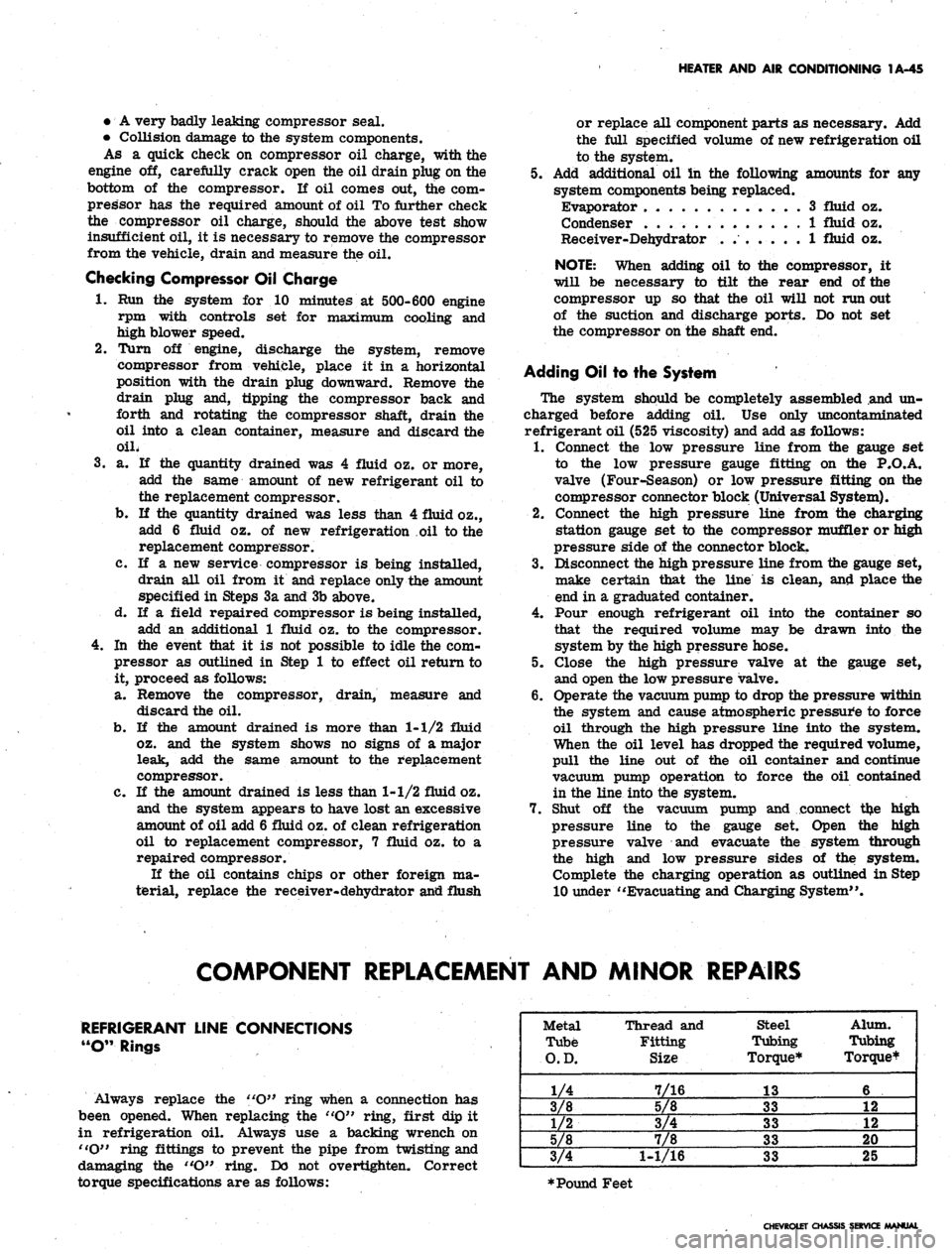
Always replace the "O" ring when a connection has
been opened. When replacing the "O" ring, first dip it
in refrigeration oil. Always use a backing wrench on
"O"
ring fittings to prevent the pipe from twisting and
damaging the "O" ring. Do not overtighten. Correct
torque specifications are as follows:
Metal
Tube
O.D.
1/4
3/8
1/2
5/8
3/4
Thread and
Fitting
Size
7/16
5/8
3/4
7/8
1-1/16
Steel
Tubing
Torque*
13
33
33
33
33
Alum.
Tubing
Torque*
6
12
12
20
25
* Pound Feet
CHEVROLET CHASSIS SERVICE
Page 72 of 659
HEATER AND AIR CONDITIONING 1A-49
CHEVROLET
CHEVELLE
CHEVY II
CAMARO
the last possible moment. Be certain that the
direction of flow is correct before connecting
the pipes.
Chevrolet, Chevelle, Chevy II, and Camaro
Replacement
1.
Remove the receiver inlet and outlet connections and
the two receiver to fender skirt attaching screws.
2.
Carefully remove the receiver-dehydrator from the
vehicle.
3.
Replace the new receiver~dehydrator assembly in
the vehicle and install all attaching screws and re-
frigerant lines.
4.
Add one fluid oz. refrigerant oil, evacuate and charge
the system.
Corvette
Replacement
1.
Purge the system of refrigerant.
2.
Disconnect the "O" ring inlet
hose clamp outlet connection
openings.
3.
Remove the receiver-dehydrator to radiator support
bracket screws (production engine) or receiver-
dehydrator to condenser bracket screws (optional
engine) and remove the unit from the car.
4.
Install the new receiver-dehydrator applying 30 in.
lbs.
torque to the attaching screws.
connection and the
and tape the hose
NOTE:
Do not uncap the new receiver-
dehydrator until the last instant before
installation.
5.
2.
3.
Fig.
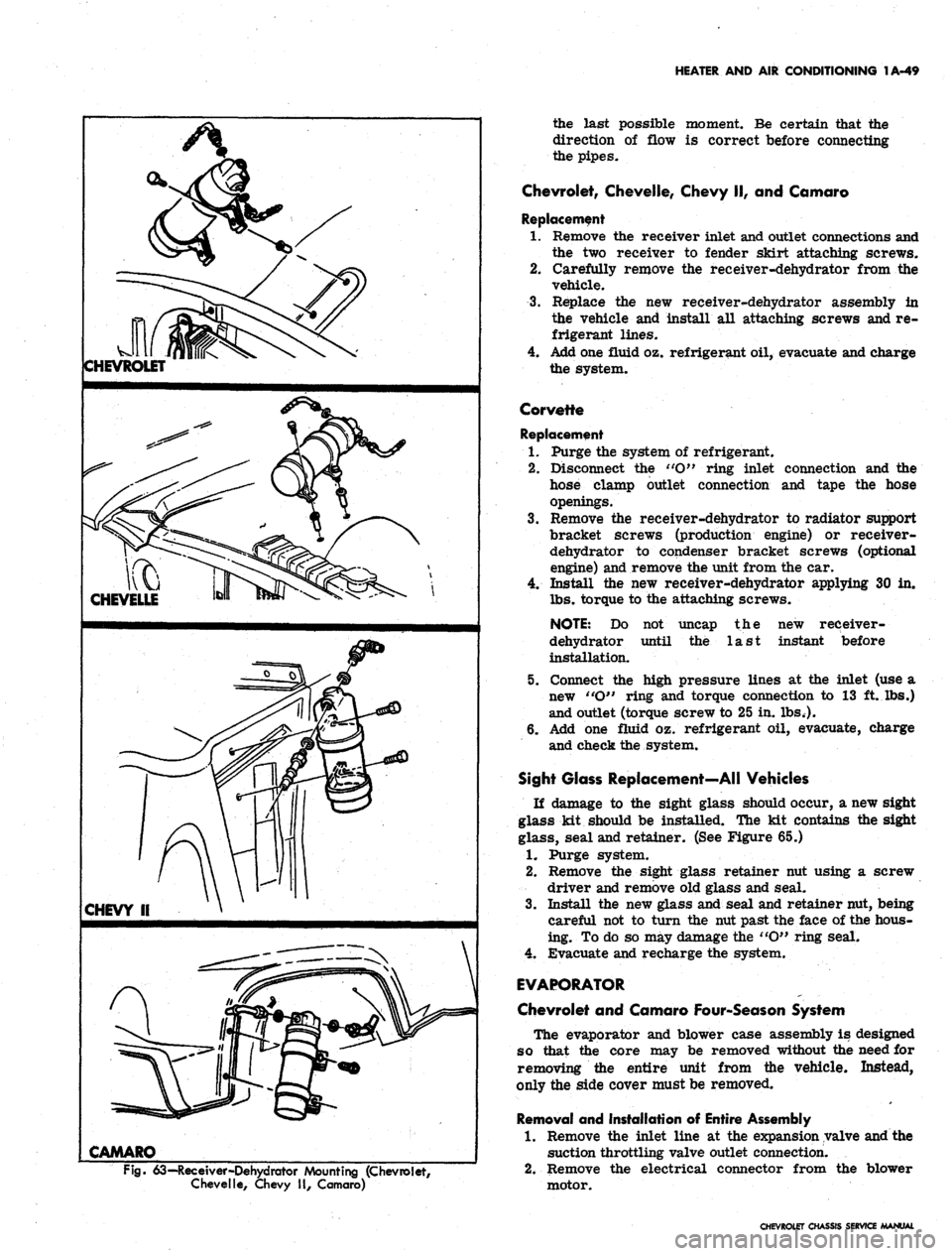
63—
Receiver-Dehydrator Mounting (Chevrolet,
Chevelle/ Chevy II, Camaro)
Connect the high pressure lines at the inlet (use a
new "O" ring and torque connection to 13 ft. lbs.)
and outlet (torque screw to 25 in. lbs.).
6. Add one fluid oz. refrigerant oil, evacuate, charge
and check the system.
Sight Glass Replacement-All Vehicles
If damage to the sight glass should occur, a new sight
glass kit should be installed. The kit contains the sight
glass,
seal and retainer. (See Figure 65.)
1.
Purge system.
Remove the sight glass retainer nut using a screw
driver and remove old glass and seal.
Install the new glass and seal and retainer nut, being
careful not to turn the nut past the face of the hous-
ing. To do so may damage the "O" ring seal.
4.
Evacuate and recharge the system.
EVAPORATOR
Chevrolet and Camaro Four-Season System
The evaporator and blower case assembly is designed
so that the core may be removed without the need for
removing the entire unit from the vehicle. Instead,
only the side cover must be removed.
Removal and Installation of Entire Assembly
1.
Remove the inlet line at the expansion valve and the
suction throttling valve outlet connection.
2.
Remove the electrical connector from the blower
motor.
CHEVROLET CHASSIS SERVICE MANUAL
Page 77 of 659
HEATER AND AIR CONDITIONING 1A-54
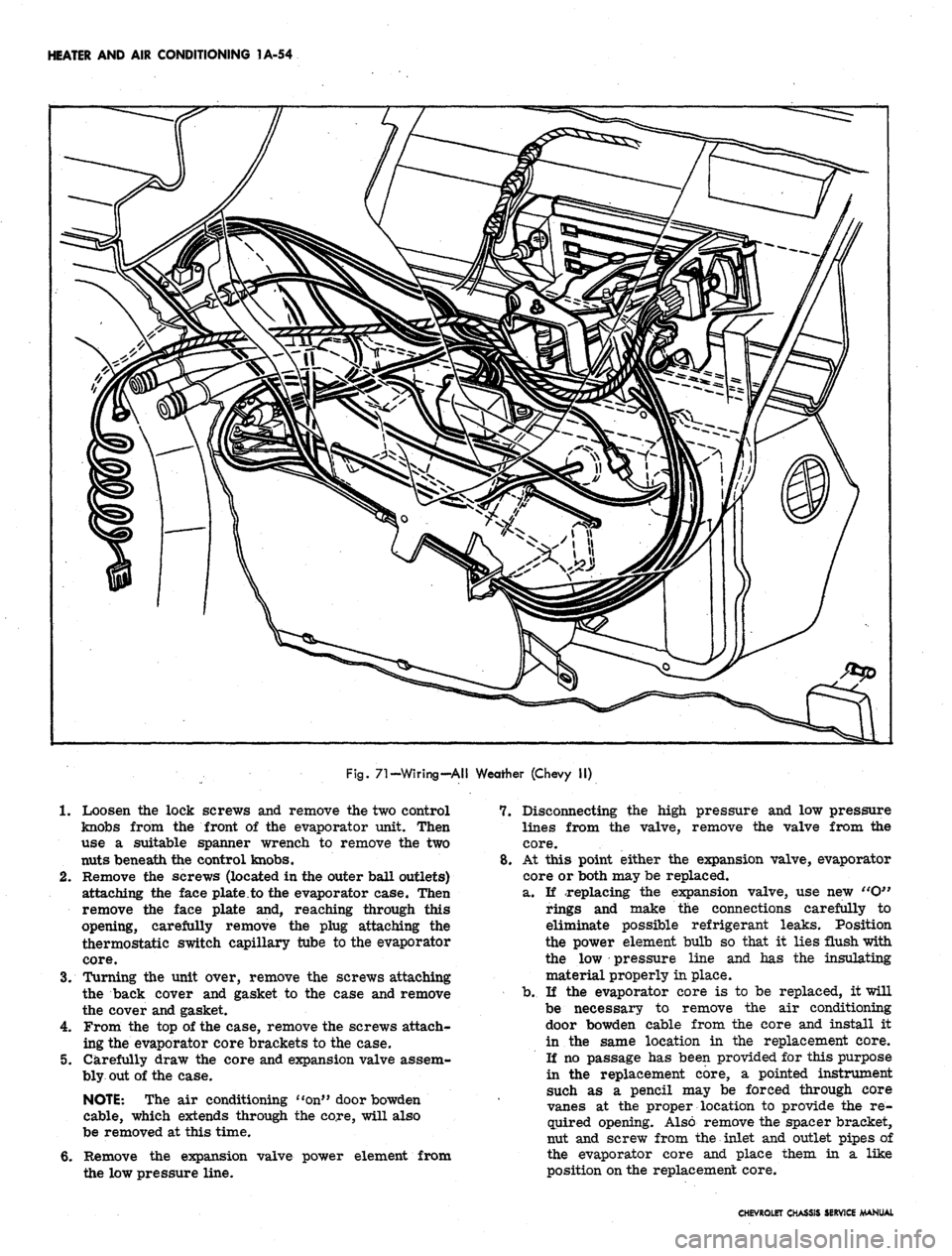
Fig.
71-Wiring-AH Weather (Chevy II)
1.
Loosen the lock screws and remove the two control
knobs from the front of the evaporator unit. Then
use a suitable spanner wrench to remove the two
nuts beneath the control knobs.
2.
Remove the screws (located in the outer ball outlets)
attaching the face plate.to the evaporator case. Then
remove the face plate and, reaching through this
opening, carefully remove the plug attaching the
thermostatic switch capillary tube to the evaporator
core.
3.
Turning the unit over, remove the screws attaching
the back cover and gasket to the case and remove
the cover and gasket.
4.
From the top of the case, remove the screws attach-
ing the evaporator core brackets to the case.
5.
Carefully draw the core and expansion valve assem-
bly out of the case.
NOTE: The air conditioning "on" door bowden
cable, which extends through the core, will also
be removed at this time.
6. Remove the expansion valve power element from
the low pressure line.
7.
Disconnecting the high pressure and low pressure
lines from the valve, remove the valve from the
core.
8. At this point either the expansion valve, evaporator
core or both may be replaced.
a. If replacing the expansion valve, use new etO"
rings and make the connections carefully to
eliminate possible refrigerant leaks. Position
the power element bulb so that it lies flush with
the low pressure line and has the insulating
material properly in place.
b.
If the evaporator core is to be replaced, it will
be necessary to remove the air conditioning
door bowden cable from the core and install it
in the same location in the replacement core.
If no passage has been provided for this purpose
in the replacement core, a pointed instrument
such as a pencil may be forced through core
vanes at the proper location to provide the re-
quired opening. Also remove the spacer bracket,
nut and screw from the inlet and outlet pipes of
the evaporator core and place them in a like
position on the replacement core.
CHEVROLET CHASSIS SERVICE MANUAL
Page 94 of 659
HEATER AND AIR CONDITIONING 1A-71
SUN-AMBIENT
SENSOR AND COMPRESSOR
CLUTCH SWITCH
HIGH BLOWER
DELAY RELAY
THERMAL
VACUUM
VALVE
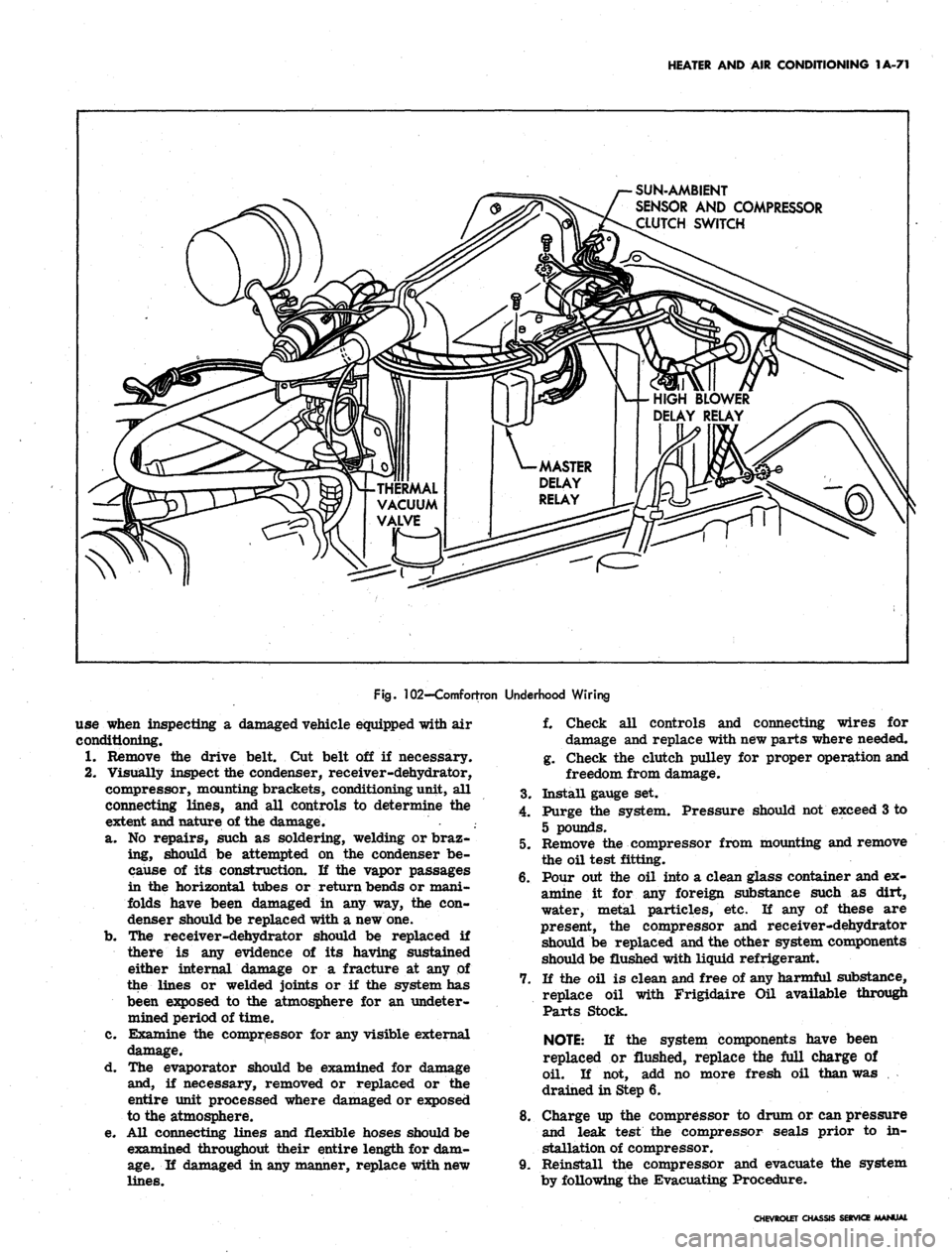
Fig.
102-Comfortron Underhood Wiring
use when inspecting a damaged vehicle equipped with air
conditioning.
1.
Remove the drive belt. Cut belt off if necessary.
2.
Visually inspect the condenser, receiver-dehydrator,
compressor, mounting brackets, conditioning unit, all
connecting lines, and all controls to determine the
extent and nature of the damage.
a. No repairs, such as soldering, welding or braz-
ing, should be attempted on the condenser be-
cause of its construction. If the vapor passages
in the horizontal tubes or return bends or mani-
folds have been damaged in any way, the con-
denser should be replaced with a new one.
b.
The receiver-dehydrator should be replaced if
there is any evidence of its having sustained
either internal damage or a fracture at any of
the lines or welded joints or if the system has
been exposed to the atmosphere for an undeter-
mined period of time.
c. Examine the compressor for any visible external
damage.
d. The evaporator should be examined for damage
and, if necessary, removed or replaced or the
entire unit processed where damaged or exposed
to the atmosphere.
e. All connecting lines and flexible hoses should be
examined throughout their entire length for dam-
age.
If damaged in any manner, replace with new
lines.
f. Check all controls and connecting wires for
damage and replace with new parts where needed.
g. Check the clutch pulley for proper operation and
freedom from damage.
3.
Install gauge set.
4.
Purge the system. Pressure should not exceed 3 to
5 pounds.
5. Remove the compressor from mounting and remove
the oil test fitting.
6. Pour out the oil into a clean glass container and ex-
amine it for any foreign substance such as dirt,
water, metal particles, etc. If any of these are
present, the compressor and receiver-dehydrator
should be replaced and the other system components
should be flushed with liquid refrigerant.
7. If the oil is clean and free of any harmful substance,
replace oil with Frigidaire Oil available through
Parts Stock.
NOTE:
If the system components have been
replaced or flushed, replace the full charge of
oil. If not, add no more fresh oil than was
drained in Step 6.
8. Charge up the compressor to drum or can pressure
and leak test the compressor seals prior to in-
stallation of compressor.
9. Reinstall the compressor and evacuate the system
by following the Evacuating Procedure.
CHEVROLET CHASSIS SERVICE MANUAL