turn CHEVROLET CAMARO 1967 1.G Chassis Owner's Guide
[x] Cancel search | Manufacturer: CHEVROLET, Model Year: 1967, Model line: CAMARO, Model: CHEVROLET CAMARO 1967 1.GPages: 659, PDF Size: 114.24 MB
Page 180 of 659
FRONT SUSPENSION 3-16
available the following procedure may also be
used (fig. 22-Alternate Method).
1.
Support car on suitable hoist or jack (so control
arms may swing free) and remove the wheel and
tire assembly, shock absorber, and stabilizer link
at control arm.
2.
Place suitable jack stand under the lower control
arm cross shaft.
3.
Follow Steps 2-5 as outlined on previous page.
4.
Turn head of tool screw to partially compress
spring.
5. Remove the three control arm cross shaft attaching
bolts,
washers and nuts.
6. Carefully lower jack stand and if necessary increase
compression on spring and when coil spring is out of
its upper seat, relax tension on spring (fig. 22).
7. By using a pry bar to assist, if necessary, remove
the coil spring from the lower control arm.
8. Installation is the reverse of the above procedure.
Carefully follow instructions for installing spring
tool.
LOWER CONTROL ARM SPHERICAL JOINT
Chevrolet, Chevelle, Comoro and Corvette
Inspection
The lower control arm spherical joint should be re-
placed whenever wear is indicated in the upper joint
inspection.
NOTE: The lower control arm spherical joint
is a loose fit in the assembly when not connected
to the steering knuckle.
Only if inspection of each upper joint indicates them
both to be within limits, inspect each lower joint for ex-
cessive wear as follows:
1.
After reconnecting upper joints to steering knuckles,
support vehicle weight on wheels or wheel hubs.
2.
With outside micrometer or caliper, measure dis-
tance from top of lubrication fitting to bottom of ball
stud, and record the dimensions for each side.
3.
Then support vehicle weight at outer end of each
lower control arm, so that wheels or wheel hubs are
free,
then repeat Step 2.
4.
If the difference in dimensions on either side is
greater than 1/16" (.0625"), the joint is excessively
worn and both lower joints should be replaced.
If inspection of lower spherical joints does not indicate
excessive wear, inspect further as follows:
5.
On Chevrolet Only--Examine lubrication hole in each
joint assembly after cleaning out hole. Look for evi-
dence of the liner partially or fully blocking lubrica-
tion opening. Such evidence indicates that liner is
disintegrating and that both lower spherical joints
should be replaced.
Another indication of lower spherical joint excessive
wear is indicated when difficulty is experienced when
lubricating the joint. If the liner has worn to the point
where the lubrication grooves in the liner have worn
away, then abnormal pressure is required to force lubri-
cant through the joint. This is another reason to recom-
mend replacement of both lower joints.
If the above inspections do not indicate any reason for
spherical joint replacements, test the torque tightness of
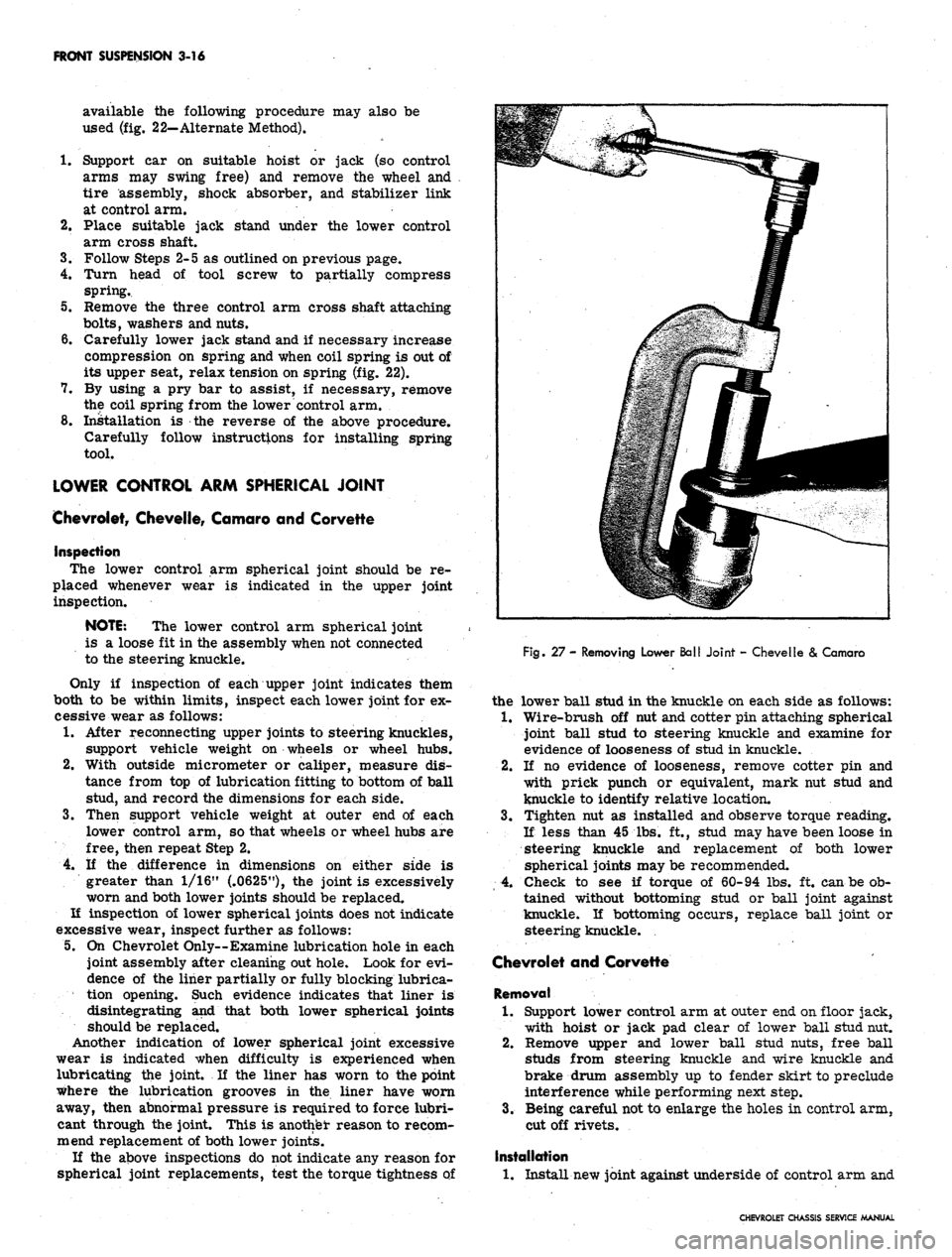
Fig. 27 - Removing Lower Ball Joint - Chevelle
&
Camaro
the lower ball stud in the knuckle on each side as follows:
1.
Wire-brush off nut and cotter pin attaching spherical
joint ball stud to steering knuckle and examine for
evidence of looseness of stud in knuckle.
2.
If no evidence of looseness, remove cotter pin and
with prick punch or equivalent, mark nut stud and
knuckle to identify relative location.
3.
Tighten nut as installed and observe torque reading.
If less than 45 lbs. ft., stud may have been loose in
steering knuckle and replacement of both lower
spherical joints may be recommended.
4.
Check to see if torque of 60-94 lbs. ft. can be ob-
tained without bottoming stud or ball joint against
knuckle. If bottoming occurs, replace ball joint or
steering knuckle.
Chevrolet and Corvette
Removal
1.
Support lower control arm at outer end on floor jack,
with hoist or jack pad clear of lower ball stud nut.
2.
Remove upper and lower ball stud nuts, free ball
studs from steering knuckle and wire knuckle and
brake drum assembly up to fender skirt to preclude
interference while performing next step.
3.
Being careful not to enlarge the holes in control arm,
cut off rivets.
Installation
1.
Install new joint against underside of control arm and
CHEVROLET CHASSIS SERVICE MANUAL
Page 181 of 659
FRONT SUSPENSION 3-17
4.
Replace the wheel and tire.
5.
Lower the vehicle.
Chevy II
inspection
Fig.
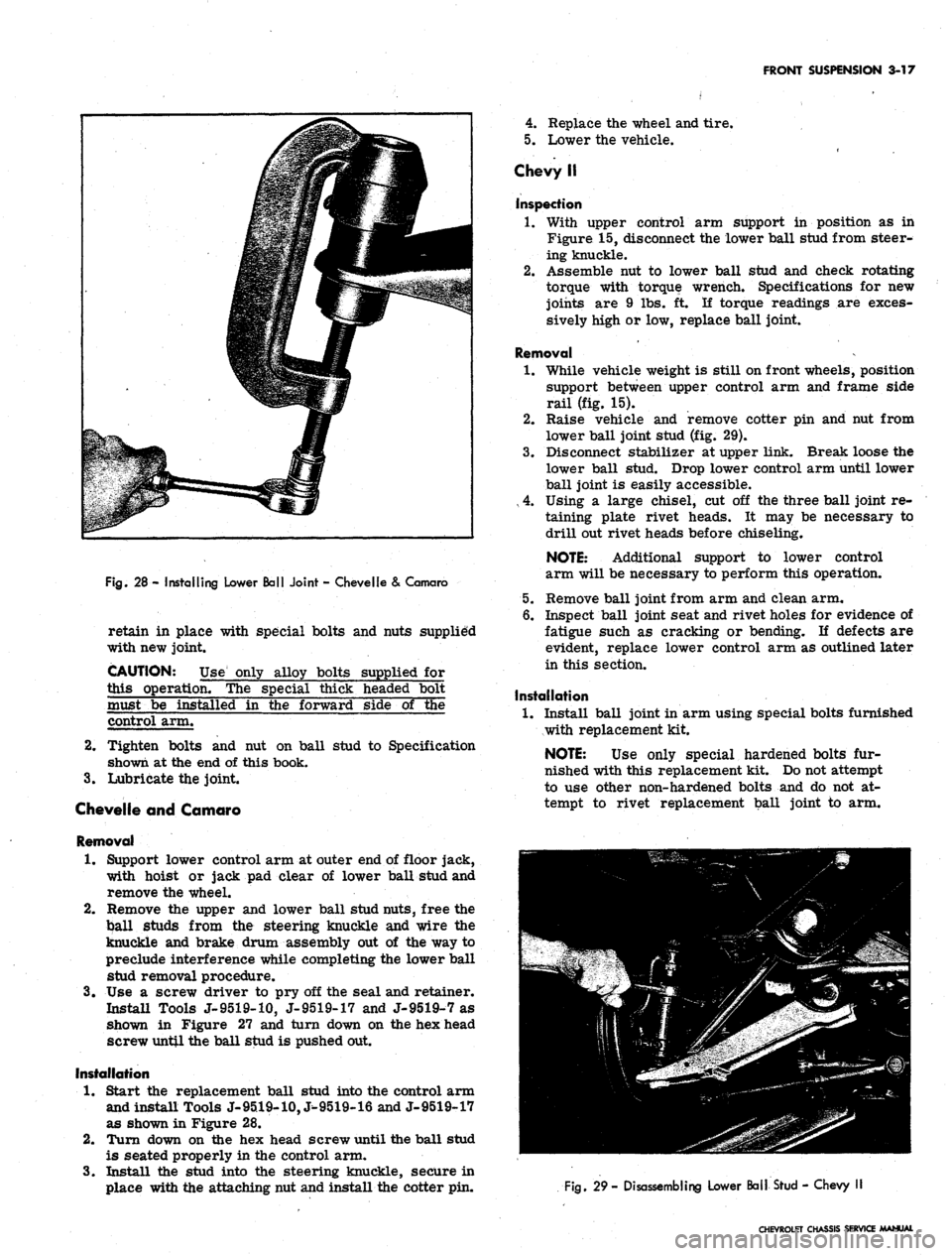
28 - Installing Lower Ball Joint - Chevelle & Camaro
retain in place with special bolts and nuts supplied
with new joint.
CAUTION: Use only alloy bolts supplied for
this operation. The special thick headed bolt
must be installed in the forward side of the
control arm.
2.
Tighten bolts and nut on ball stud to Specification
shown at the end of this book.
3.
Lubricate the joint.
Chevelle and Camaro
Removal
1.
Support lower control arm at outer end of floor jack,
with hoist or jack pad clear of lower ball stud and
remove the wheel.
2.
Remove the upper and lower ball stud nuts, free the
ball studs from the steering knuckle and wire the
knuckle and brake drum assembly out of the way to
preclude interference while completing the lower ball
stud removal procedure.
3.
Use a screw driver to pry off the seal and retainer.
Install Tools J-9519-10, J-9519-17 and J-9519-7 as
shown in Figure 27 and turn down on the hex head
screw until the ball stud is pushed out.
Installation
1.
Start the replacement ball stud into the control arm
and install Tools J-9519-10, J^9519-16 and J-9519-17
as shown in Figure 28.
2.
Turn down on the hex head screw until the ball stud
is seated properly in the control arm.
3.
Install the stud into the steering knuckle, secure in
place with the attacking nut and install the cotter pin.
1.
With upper control arm support in position as in
Figure 15, disconnect the lower ball stud from steer-
ing knuckle.
2.
Assemble nut to lower ball stud and check rotating
torque with torque wrench. Specifications for new
joints are 9 lbs. ft. If torque readings are exces-
sively high or low, replace ball joint.
Removal
1.
While vehicle weight is still on front wheels, position
support between upper control arm and frame side
rail (fig. 15).
2.
Raise vehicle and remove cotter pin and nut from
lower ball joint stud (fig. 29).
3.
Disconnect stabilizer at upper link. Break loose the
lower ball stud. Drop lower control arm until lower
ball joint is easily accessible.
, 4. Using a large chisel, cut off the three ball joint re-
taining plate rivet heads. It may be necessary to
drill out rivet heads before chiseling.
NOTE: Additional support to lower control
arm will be necessary to perform this operation.
5.
Remove ball joint from arm and clean arm.
6. Inspect ball joint seat and rivet holes for evidence of
fatigue such as cracking or bending. If defects are
evident, replace lower control arm as outlined later
in this section.
Installation
1.
Install ball joint in arm using special bolts furnished
with replacement kit.
NOTE: Use only special hardened bolts fur-
nished with this replacement kit. Do not attempt
to use other non-hardened bolts and do not at-
tempt to rivet replacement ball joint to arm.
Fig.
29- Disassembling Lower Ball Stud - Chevy
CHEVROLET CHASSIS SERVICE MANUAL
Page 184 of 659
FRONT SUSPENSION 3-20
Fig.
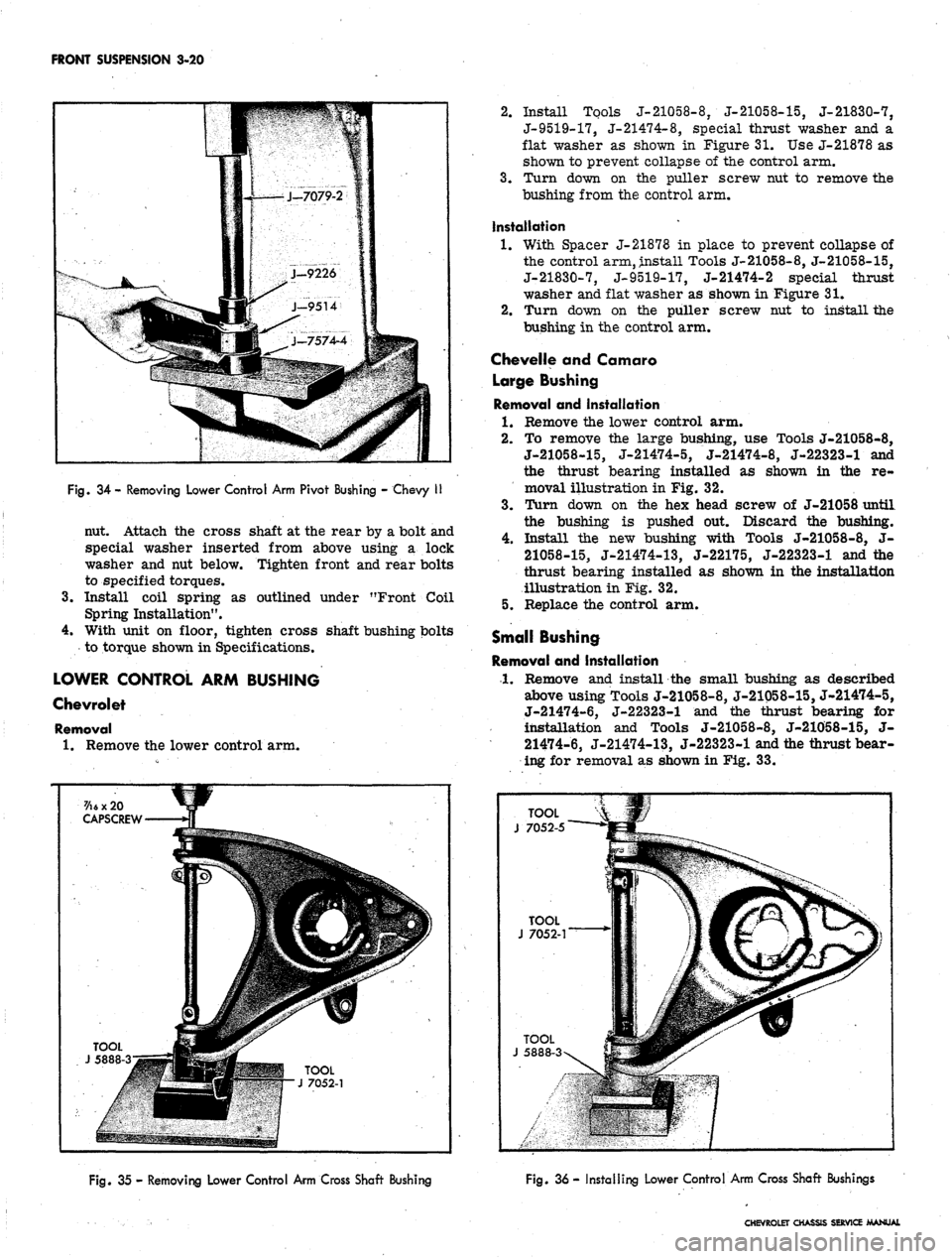
34 - Removing Lower Control Arm Pivot Bushing - Chevy II
nut. Attach the cross shaft at the rear by a bolt and
special washer inserted from above using a lock
washer and nut below. Tighten front and rear bolts
to specified torques.
3.
Install coil spring as outlined under "Front Coil
Spring Installation".
4.
With unit on floor, tighten cross shaft bushing bolts
to torque shown in Specifications.
LOWER CONTROL ARM BUSHING
Chevrolet
Removal
1.
Remove the lower control arm.
2.
Install Tools J-21058-8, J-21058-15, J-21830-7,
J-9519-17, J-21474-8, special thrust washer and a
flat washer as shown in Figure
31.
Use J-21878 as
shown to prevent collapse of the control arm.
3.
Turn down on the puller screw nut to remove the
bushing from the control arm.
Installation
1.
With Spacer J-21878 in place to prevent collapse of
the control arm, install Tools J-21058-8, J-21058-15,
J-21830-7, J-9519-17, J-21474-2 special thrust
washer and flat washer as shown in Figure 31,
2.
Turn down on the puller screw nut to install the
bushing in the control arm.
Chevelle and Camaro
Large Bushing
Removal and Installation
1.
Remove the lower control arm.
2.
To remove the large bushing, use Tools J-21058-8,
J-21058-15, J-21474-5, J-21474-8, J-22323-1 and
the thrust bearing installed as shown in the re-
moval illustration in Fig. 32.
3.
Turn down on the hex head screw of J-21058 until
the bushing is pushed out. Discard the bushing.
4.
Install the new bushing with Tools J-21058-8, J-
21058-15,
J-21474-13, J-22175, J-22323-1 and the
thrust bearing installed as shown in the installation
illustration in Fig. 32.
5.
Replace the control arm.
Small Bushing
Removal and Installation
1.
Remove and install the small bushing as described
above using Tools J-21058-8, J-21058-15, J-21474-5,
J-21474-6, J-22323-1 and the thrust bearing for
installation and Tools J-21058-8, J-21058-15, J-
21474-6, J-21474-13, J-22323-1 and tiie thrust bear-
ing for removal as shown in Fig. 33.
7/\6 x 20
CAPSCREW
TOOL
J 5888-3
TOOL
J 7052-5
TOOL
J 7052-1
TOOL
J 5888-3-
Fig.
35 - Removing Lower Control Arm Cross Shaft Bushing
Fig.
36 - Installing Lower Control Arm Cross Shaft Bushings
CHEVROLET CHASSIS SERVICE MANUAL
Page 185 of 659
FRONT SUSPENSION 3-21
Chevy II
Removal
1.
Support control arm on Tool J-7 574-4 and insert
Spacer J-9514 (fig. 34).
2,
Press bushing out with Tool J-9226 and Handle
J-7079-2 (fig. 34).
Installation
With Spacer J-9514 still in control arm, invert control
arm and press in new bushing with Tool, J-7474-2 and
Handle J-7079-2 until bushing is fully seated.
CAUTION: It should be noted that control arm
bushing diameters are unequal and bushing must
be pressed into position through larger diameter
only.
CROSS SHAFT AND/ON BUSHINGS
Corvette
Removal
1.
Remove bolt, lock washer and collar from each end
of cross shaft.
2.
Thread a 7/16 x 20 capscrew (furnished with Tool
J-5888) to the bottom of the threads in one end of the
cross shaft.
3.
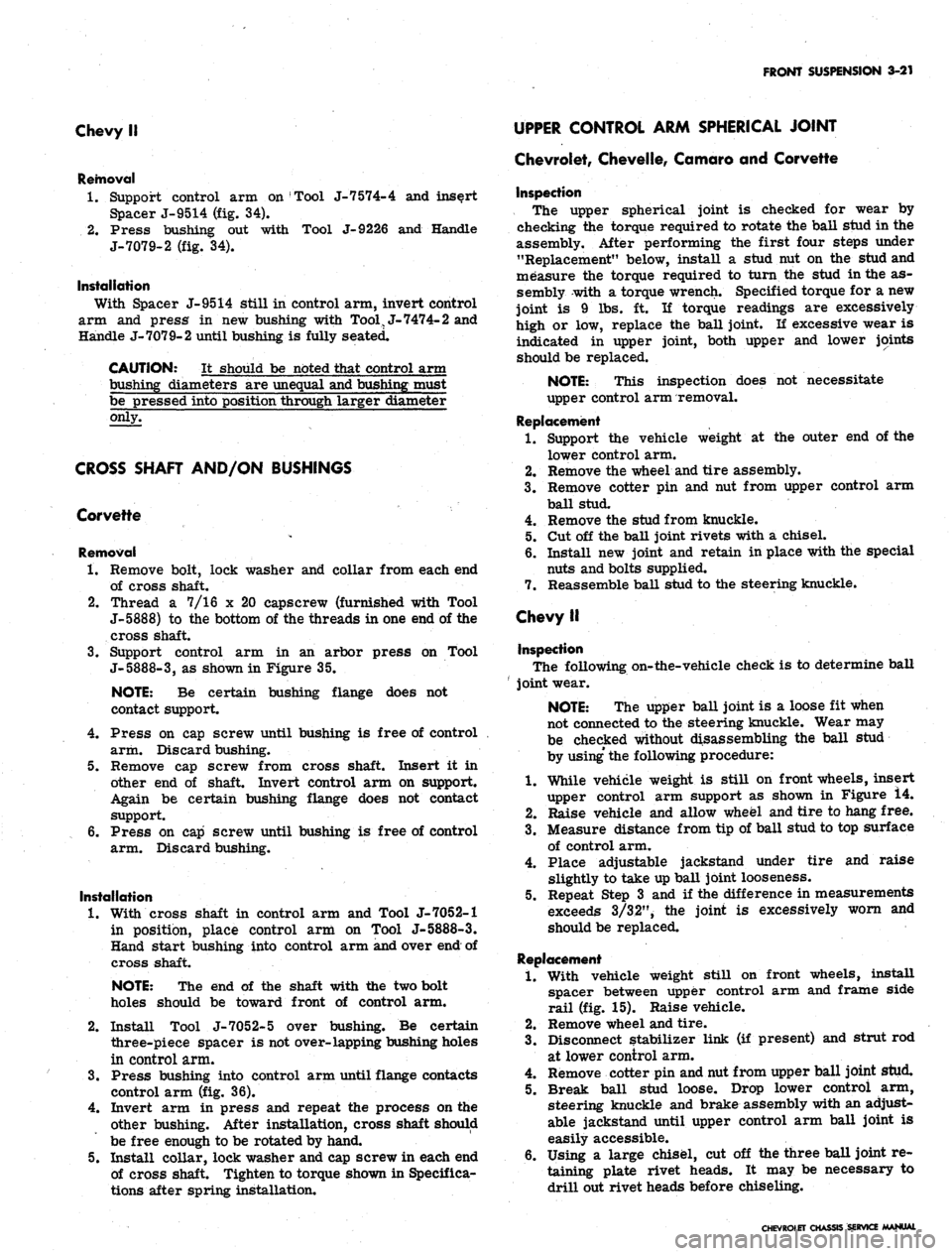
Support control arm in an arbor press on Tool
J-5888-3,
as shown in Figure 35.
NOTE:
Be certain bushing flange does not
contact support.
4.
Press on cap screw until bushing is free of control
arm. Discard bushing.
5. Remove cap screw from cross shaft. Insert it in
other end of shaft. Invert control arm on support.
Again be certain bushing flange does not contact
support.
6. Press on cap screw until bushing is free of control
arm. Discard bushing.
Installation
1.
With cross shaft in control arm and Tool J-7052-1
in position, place control arm on Tool J-5888-3.
Hand start bushing into control arm and over end of
cross shaft.
NOTE:
The end of the shaft with the two bolt
holes should be toward front of control arm.
2.
Install Tool J-7052-5 over bushing. Be certain
three-piece spacer is not over-lapping bushing holes
in control arm.
3.
Press bushing into control arm until flange contacts
control arm (fig. 36).
4.
Invert arm in press and repeat the process on the
other bushing. After installation, cross shaft should
be free enough to be rotated by hand.
5. Install collar, lock washer and cap screw in each end
of cross shaft. Tighten to torque shown in Specifica-
tions after spring installation.
UPPER CONTROL ARM SPHERICAL JOINT
Chevrolet, Chevelle, Comoro and Corvette
Inspection
The upper spherical joint is checked for wear by
checking the torque required to rotate the ball stud in the
assembly. After performing the first four steps under
"Replacement" below, install a stud nut on the stud and
measure the torque required to turn the stud in the as-
sembly with a torque wrench. Specified torque for a new
joint is 9 lbs. ft. If torque readings are excessively
high or low, replace the ball joint. If excessive wear is
indicated in upper joint, both upper and lower joints
should be replaced.
NOTE:
This inspection does not necessitate
upper control arm removal.
Replacement
1.
Support the vehicle weight at the outer end of the
lower control arm.
2.
Remove the wheel and tire assembly.
3.
Remove cotter pin and nut from upper control arm
ball stud.
4.
Remove the stud from knuckle.
5. Cut off the ball joint rivets with a chisel.
6. Install new joint and retain in place with the special
nuts and bolts supplied.
7. Reassemble ball stud to the steering knuckle.
Chevy II
Inspection
The following on-the-vehicle check is to determine ball
joint wear.
NOTE:
The upper ball joint is a loose fit when
not connected to the steering knuckle. Wear may
be checked without disassembling the ball stud
by
using'
the following procedure:
1.
While vehicle weight is still on front wheels, insert
upper control arm support as shown in Figure 14.
2.
Raise vehicle and allow wheel and tire to hang free.
3.
Measure distance from tip of ball stud to top surface
of control arm.
4.
Place adjustable jackstand under tire and raise
slightly to take up ball joint looseness.
5. Repeat Step 3 and if the difference in measurements
exceeds 3/32", the joint is excessively worn and
should be replaced.
Replacement
1.
With vehicle weight still on front wheels, install
spacer between upper control arm and frame side
rail (fig. 15). Raise vehicle.
2.
Remove wheel and tire.
3.
Disconnect stabilizer link (if present) and strut rod
at lower control arm.
4.
Remove cotter pin and nut from upper ball joint stud.
5. Break ball stud loose. Drop lower control arm,
steering knuckle and brake assembly with an adjust-
able jackstand until upper control arm ball joint is
easily accessible.
6. Using a large chisel, cut off the three ball joint re-
taining plate rivet heads. It may be necessary to
drill out rivet heads before chiseling.
CHEVROLET CHASSIS SERVICE MANUAL
Page 187 of 659
FRONT SUSPENSION 3-23
CHEVROLET
J-7052-2
CAMARO
& CHEVELLE
J-21482
CHEVROLET
J-7052-2
CAMARO
& CHEVELLE
J-21482
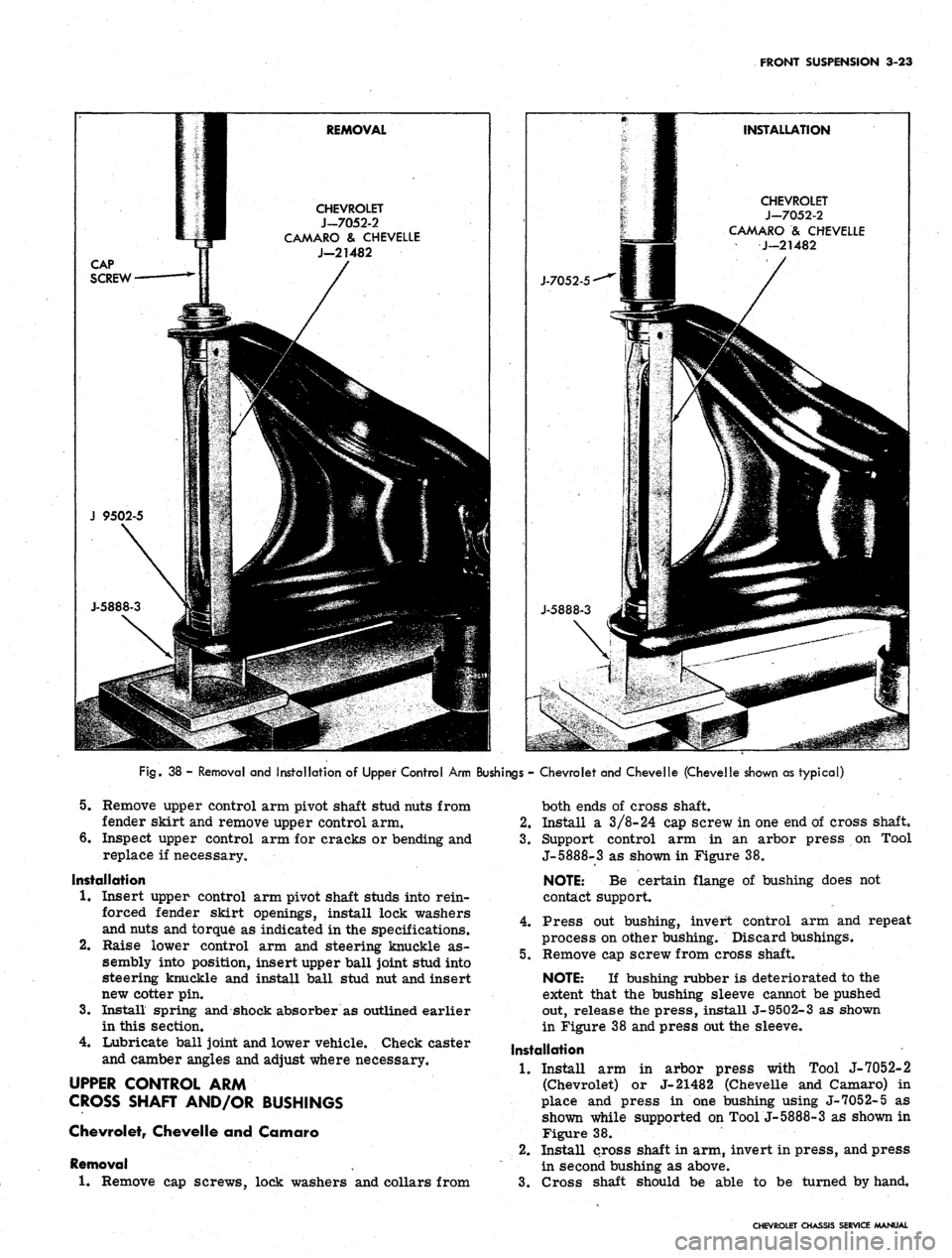
Fig.
38 - Removal and Installation of Upper Control Arm Bushings - Chevrolet and Chevelle (Chevelle shown as typical)
5.
Remove upper control arm pivot shaft stud nuts from
fender skirt and remove upper control arm.
6. Inspect upper control arm for cracks or bending and
replace if necessary.
Installation
1.
Insert upper control arm pivot shaft studs into rein-
forced fender skirt openings, install lock washers
and nuts and torque as indicated in the specifications.
Raise lower control arm and steering knuckle as-
sembly into position, insert upper ball joint stud into
steering knuckle and install ball stud nut and insert
new cotter pin.
Install spring and shock absorber as outlined earlier
in this section.
Lubricate ball joint and lower vehicle. Check caster
and camber angles and adjust where necessary.
UPPER CONTROL ARM
CROSS SHAFT AND/OR BUSHINGS
Chevrolet, Chevelle and Camaro
Removal
1.
Remove cap screws, lock washers and collars from
2.
3.
4.
both ends of cross shaft.
2.
Install a 3/8-24 cap screw in one end of cross shaft,
3.
Support control arm in an arbor press on Tool
J-5888-3 as shown in Figure 38.
NOTE: Be certain flange of bushing does not
contact support.
4.
Press out bushing, invert control arm and repeat
process on other bushing. Discard bushings.
5.
Remove cap screw from cross shaft.
NOTE: If bushing rubber is deteriorated to the
extent that the bushing sleeve cannot be pushed
out, release the press, install J-9502-3 as shown
in Figure 38 and press out the sleeve.
Installation
1.
Install arm in arbor press with Tool J-7052-2
(Chevrolet) or J-21482 (Chevelle and Camaro) in
place and press in one bushing using J-7052-5 as
shown while supported on Tool j-5888-3 as shown in
Figure 38.
2.
Install cross shaft in arm, invert in press, and press
in second bushing as above.
3.
Cross shaft should be able to be turned by hand.
CHEVROLET CHASSIS SERVICE MANUAL
Page 189 of 659
FRONT SUSPENSION 3-25
Installation
1.
Insert new bushing in control arm and over pivot
shaft.
2.
Support arm on J-5888-3 and insert Spacer J-
8345-1.
5.
Press bushing into place with Installer J-9513-3
(fig. 40).
Invert arm and press remaining bushing in place with
J-9513-3.
Install bushing spacers, lock washers and nuts
to pivot shaft ends. Torque as indicated in
Specifications.
NOTE:
Pivot shaft bolts must be in horizontal
position (toward center line of vehicle) before
torquing nuts.
Corvette
Removal
1.
Remove cap screws, lock washers and collars from
both ends of cross shaft.
2.
Install a 3/8-24 cap screw (furnished with Tool
J- 5888) in one end of cross shaft.
3.
Support control arm in an arbor press on Tool
J-5888-3 as shown in Figure 41.
NOTE:
Be certain flange of bushing does not
contact support.
4.
Press out bushing, invert control arm and repeat
process on other bushing. Discard bushings.
5. Remove cap screw from cross shaft.
Installation
1.
Install arm in arbor press with Tool J-7052-2 in
place and press in one bushing while supported on
Tool J-5888-3 as shown in Figure 42.
2.
Install cross shaft in arm, invert in press, and press
in second bushing as above.
3.
Cross shaft should be able to be turned by hand.
4.
Install collar, lock washer and cap screw in ends of
cross shaft. Do not tighten.
CHEVROLET CHASSIS SERVICE MANUAL
Page 196 of 659
REAR SUSPENSION AND DRIVE LINE 4-6
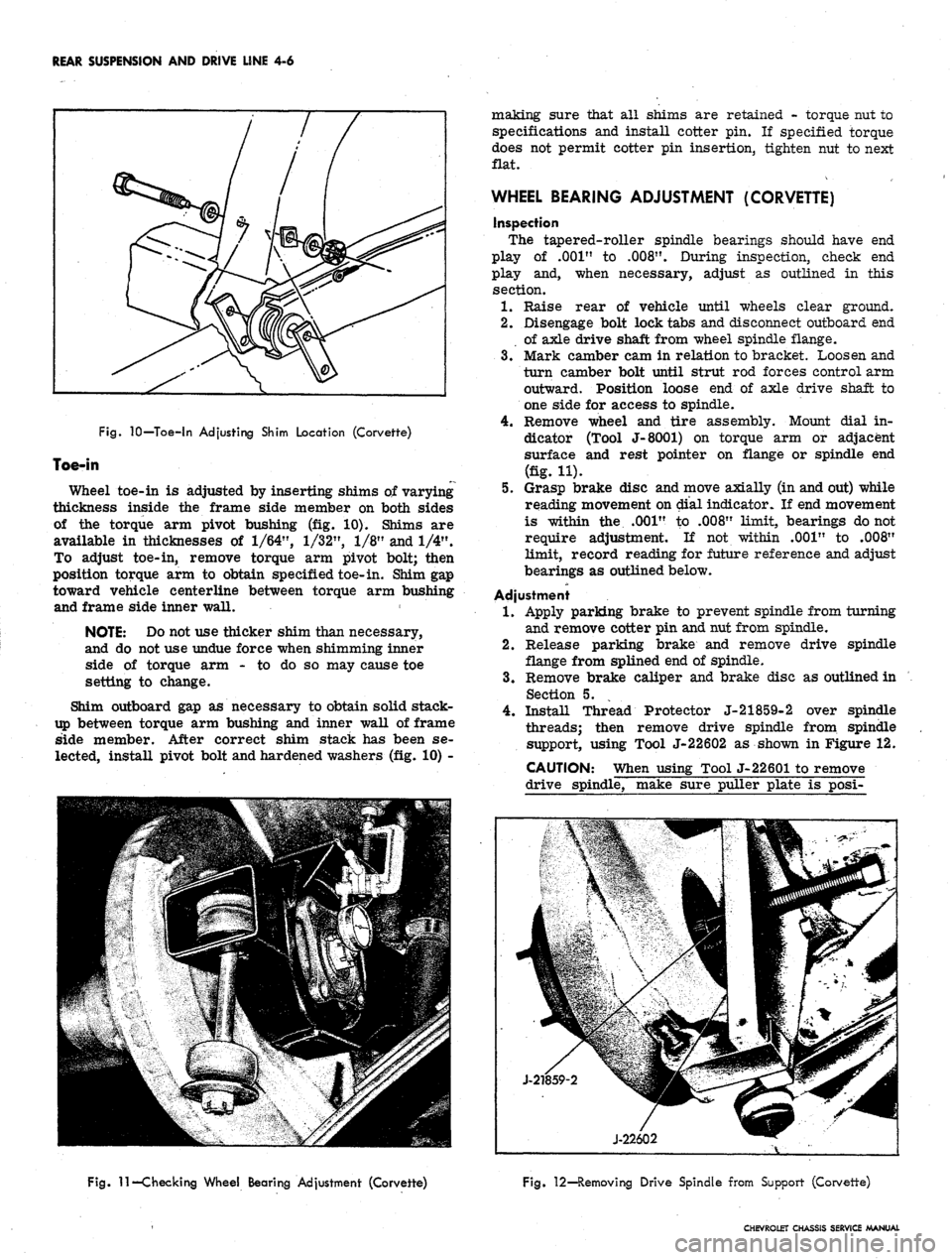
Fig.
10—Toe-in Adjusting Shim Location (Corvette)
Toe-in
Wheel toe-in is adjusted by inserting shims of varying
thickness inside the frame side member on both sides
of the torque arm pivot bushing (fig. 10). Shims are
available in thicknesses of
1/64",
1/32",
1/8" and 1/4".
To adjust toe-in, remove torque arm pivot bolt; then
position torque arm to obtain specified toe-in. Shim gap
toward vehicle centerline between torque arm bushing
and frame side inner wall.
NOTE: Do not use thicker shim than necessary,
and do not use undue force when shimming inner
side of torque arm - to do so may cause toe
setting to change.
Shim outboard gap as necessary to obtain solid stack-
up between torque arm bushing and inner wall of frame
side member. After correct shim stack has been se-
lected, install pivot bolt and hardened washers (fig. 10) -
making sure that all shims are retained - torque nut to
specifications and install cotter pin. If specified torque
does not permit cotter pin insertion, tighten nut to next
flat.
WHEEL BEARING ADJUSTMENT (CORVETTE)
inspection
The tapered-roller spindle bearings should have end
play of .001" to
.008".
During inspection, check end
play and, when necessary, adjust as outlined in this
section.
1.
Raise rear of vehicle until wheels clear ground.
2.
Disengage bolt lock tabs and disconnect outboard end
of axle drive shaft from wheel spindle flange.
3.
Mark camber cam in relation to bracket. Loosen and
turn camber bolt until strut rod forces control arm
outward. Position loose end of axle drive shaft to
one side for access to spindle.
4.
Remove wheel and tire assembly. Mount dial in-
dicator (Tool J-8001) on torque arm or adjacent
surface and rest pointer on flange or spindle end
(fig. H).
5.
Grasp brake disc and move axially (in and out) while
reading movement on dial indicator. If end movement
is within the .001" to .008" limit, bearings do not
require adjustment. If not within .001" to .008"
limit, record reading for future reference and adjust
bearings as outlined below.
Adjustment
1.
Apply parking brake to prevent spindle from turning
and remove cotter pin and nut from spindle.
2.
Release parking brake and remove drive spindle
flange from splined end of spindle.
3.
Remove brake caliper and brake disc as outlined in
Section 5.
4.
Install Thread Protector J-21859-2 over spindle
threads; then remove drive spindle from spindle
support, using Tool J-22602 as shown in Figure 12.
CAUTION: When using Tool J-22601 to remove
drive spindle, make sure puller plate is posi-
Fig.
11—Checking Wheel Bearing Adjustment (Corvette)
Fig. 12—Removing Drive Spindle from Support (Corvette)
CHEVROLET CHASSIS SERVICE MANUAL
Page 201 of 659
REAR SUSPENSION AND DRIVE LINE 4-11
lower cushion
correct.
will be aligned if installation is
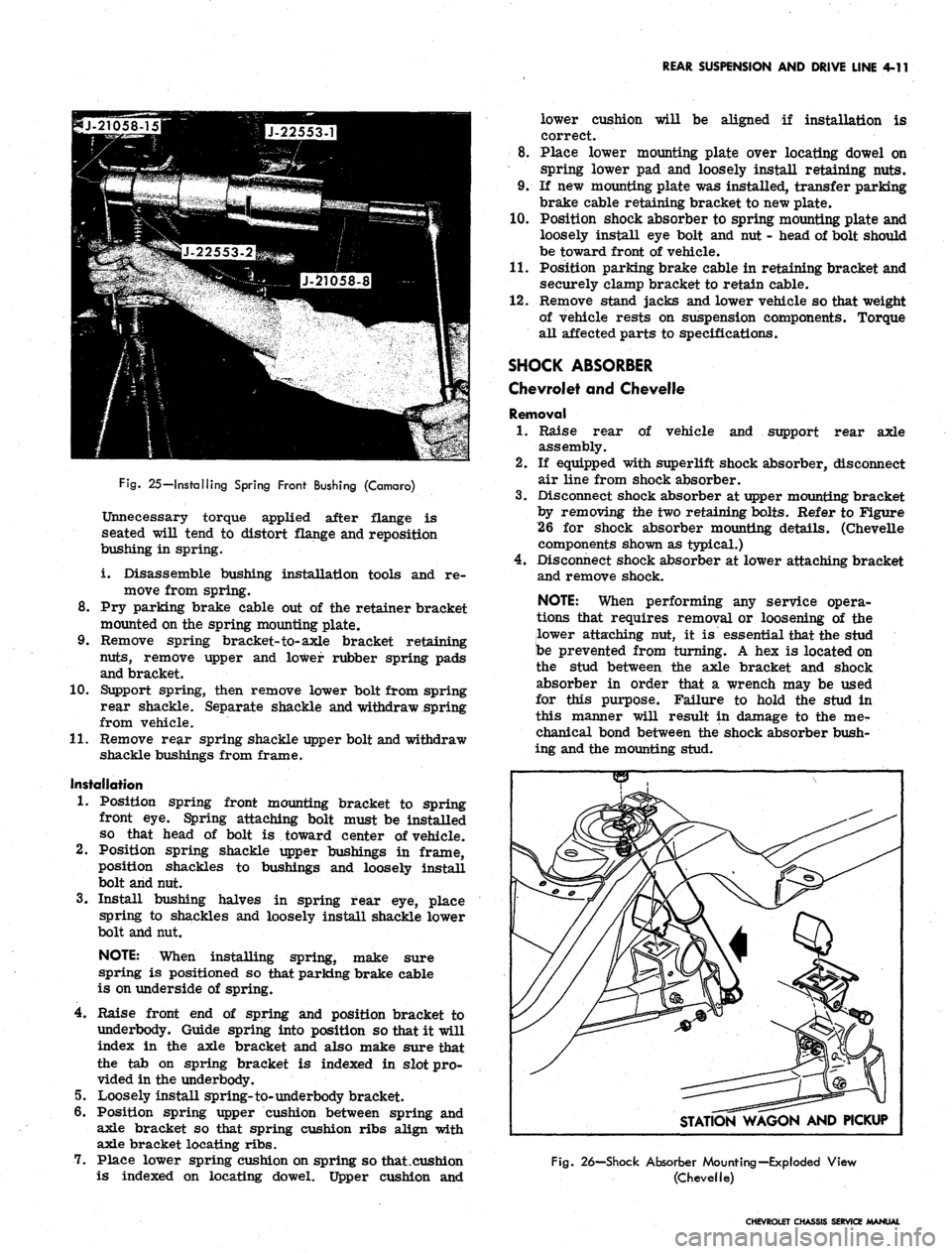
Fig.
25—Installing Spring Front Bushing (Camaro)
Unnecessary torque applied after flange is
seated will tend to distort flange and reposition
bushing in spring.
i. Disassemble bushing installation tools and re-
move from spring.
8. Pry parking brake cable out of the retainer bracket
mounted on the spring mounting plate.
9. Remove spring bracket-to-axle bracket retaining
nuts,
remove upper and lower rubber spring pads
and bracket.
10.
Support spring, then remove lower bolt from spring
rear shackle. Separate shackle and withdraw spring
from vehicle.
11.
Remove rear spring shackle upper bolt and withdraw
shackle bushings from frame.
Installation
1.
Position spring front mounting bracket to spring
front eye. Spring attaching bolt must be installed
so that head of bolt is toward center of vehicle.
2.
Position spring shackle upper bushings in frame,
position shackles to bushings and loosely install
bolt and nut.
3.
Install bushing halves in spring rear eye, place
spring to shackles and loosely install shackle lower
bolt and nut.
NOTE: When installing spring, make sure
spring is positioned so that parking brake cable
is on underside of spring.
4.
Raise front end of spring and position bracket to
underbody. Guide spring into position so that it will
index in the axle bracket and also make sure that
the tab on spring bracket is indexed in slot pro-
vided in the underbody.
5.
Loosely install spring-to-underbody bracket.
6. Position spring upper cushion between spring and
axle bracket so that spring cushion ribs align with
axle bracket locating ribs.
7.
Place lower spring cushion on spring so that .cushion
is indexed on locating dowel. Upper cushion and
8. Place lower mounting plate over locating dowel on
spring lower pad and loosely install retaining nuts.
9. If new mounting plate was installed, transfer parking
brake cable retaining bracket to new plate.
10.
Position shock absorber to spring mounting plate and
loosely install eye bolt and nut - head of bolt should
be toward front of vehicle.
11.
Position parking brake cable in retaining bracket and
securely clamp bracket to retain cable.
12.
Remove stand jacks and lower vehicle so that weight
of vehicle rests on suspension components. Torque
all affected parts to specifications.
SHOCK ABSORBER
Chevrolet and Chevelle
Removal
1.
Raise rear of vehicle and support rear axle
assembly.
If equipped with superlift shock absorber, disconnect
air line from shock absorber.
Disconnect shock absorber at upper mounting bracket
by removing the two retaining bolts. Refer to Figure
26 for shock absorber mounting details. (Chevelle
components shown as typical.)
Disconnect shock absorber at lower attaching bracket
and remove shock.
NOTE: When performing any service opera-
tions that requires removal or loosening of the
lower attaching nut, it is essential that the stud
be prevented from turning. A hex is located on
the stud between the axle bracket and shock
absorber in order that a wrench may be used
for this purpose. Failure to hold the stud in
this manner will result in damage to the mer
chanical bond between the shock absorber bush-
ing and the mounting stud.
2.
3.
STATION WAGON AND PICKUP
Fig.
26—Shock Absorber Mounting—Exploded View
(Chevelle)
CHEVROLET CHASSIS SERVICE MANUAL
Page 203 of 659
REAR SUSPENSION AND DRIVE LINE 4-13
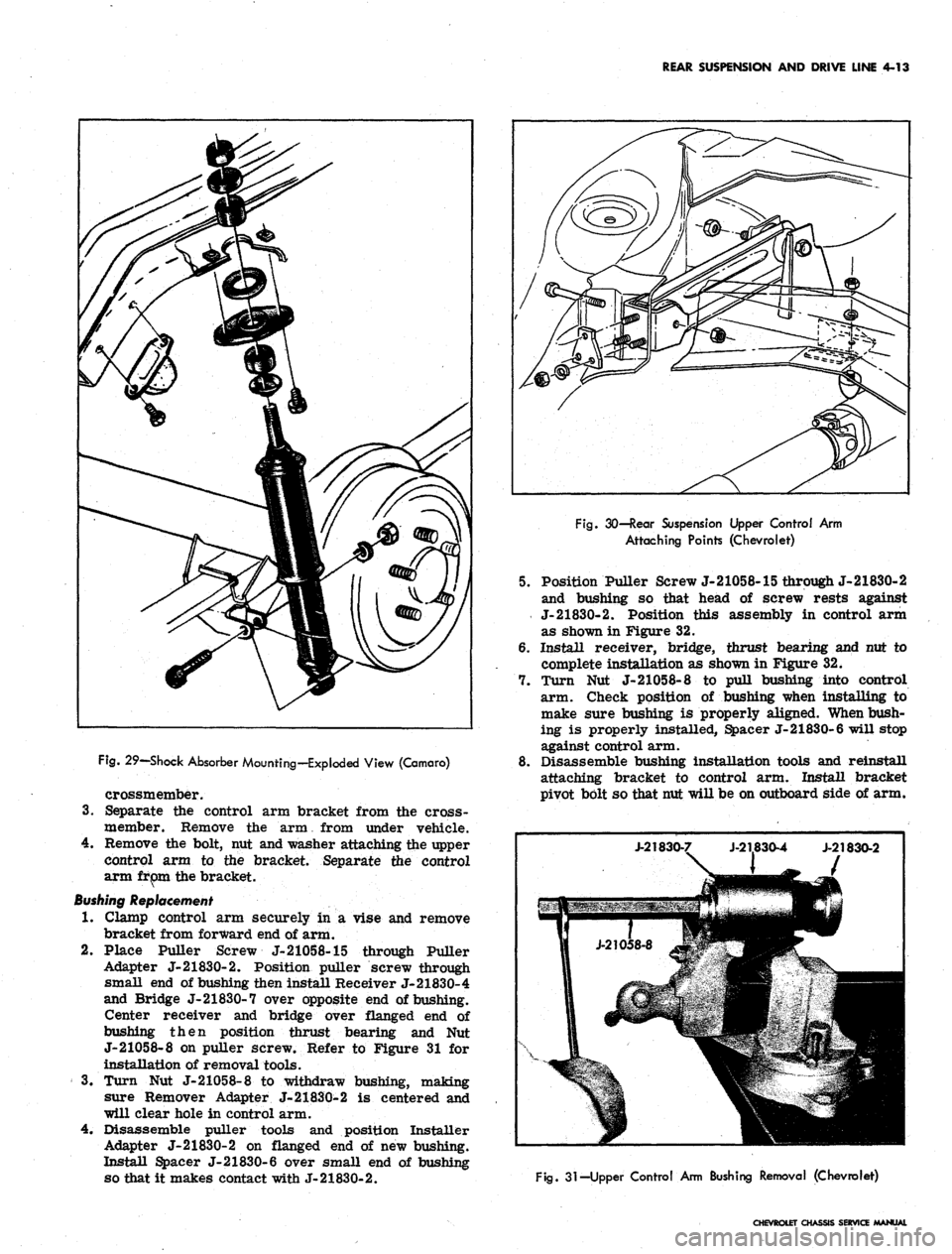
Fig.
29—Shock Absorber Mounting—Exploded View (Comoro)
crossmember.
3.
Separate the control arm bracket from the cross-
member. Remove the arm from under vehicle.
4.
Remove the bolt, nut and washer attaching the upper
control arm to the bracket. Separate the control
arm from the bracket.
Bushing Replacement
1.
Clamp control arm securely in a vise and remove
bracket from forward end of arm.
2.
Place Puller Screw J-21058-15 through Puller
Adapter J-21830-2. Position puller screw through
small end of bushing then install Receiver J-21830-4
and Bridge J-21830-7 over opposite end of bushing.
Center receiver and bridge over flanged end of
bushing then position thrust bearing and Nut
J-21058-8 on puller screw. Refer to Figure 31 for
installation of removal tools.
3.
Turn Nut J-21058-8 to withdraw bushing, making
sure Remover Adapter J-21830-2 is centered and
will clear hole in control arm.
4.
Disassemble puller tools and position Installer
Adapter J-21830-2 on flanged end of new bushing.
Install Spacer J-21830-6 over small end of bushing
so that it makes contact with J-21830-2.
Fig.
30—Rear Suspension Upper Control Arm
Attaching Points (Chevrolet)
Position Puller Screw J-21058-15 through J-21830-2
and bushing so that head of screw rests against
J-21830-2. Position this assembly in control arm
as shown in Figure 32.
Install receiver, bridge, thrust bearing and nut to
complete installation as shown in Figure 32.
Turn Nut J-21058-8 to pull bushing into control
arm. Check position of bushing when installing to
make sure bushing is properly aligned. When bush-
ing is properly installed, Spacer J-21830-6 will stop
against control arm.
Disassemble bushing installation tools and reinstall
attaching bracket to control arm. Install bracket
pivot bolt so that nut will be on outboard side of arm.
Fig.
31—Upper Control Arm Bushing Removal (Chevrolet)
CHEVROLET CHASSIS SERVICE MANUAL
Page 206 of 659
REAR SUSPENSION AND DRIVE LINE 4-16
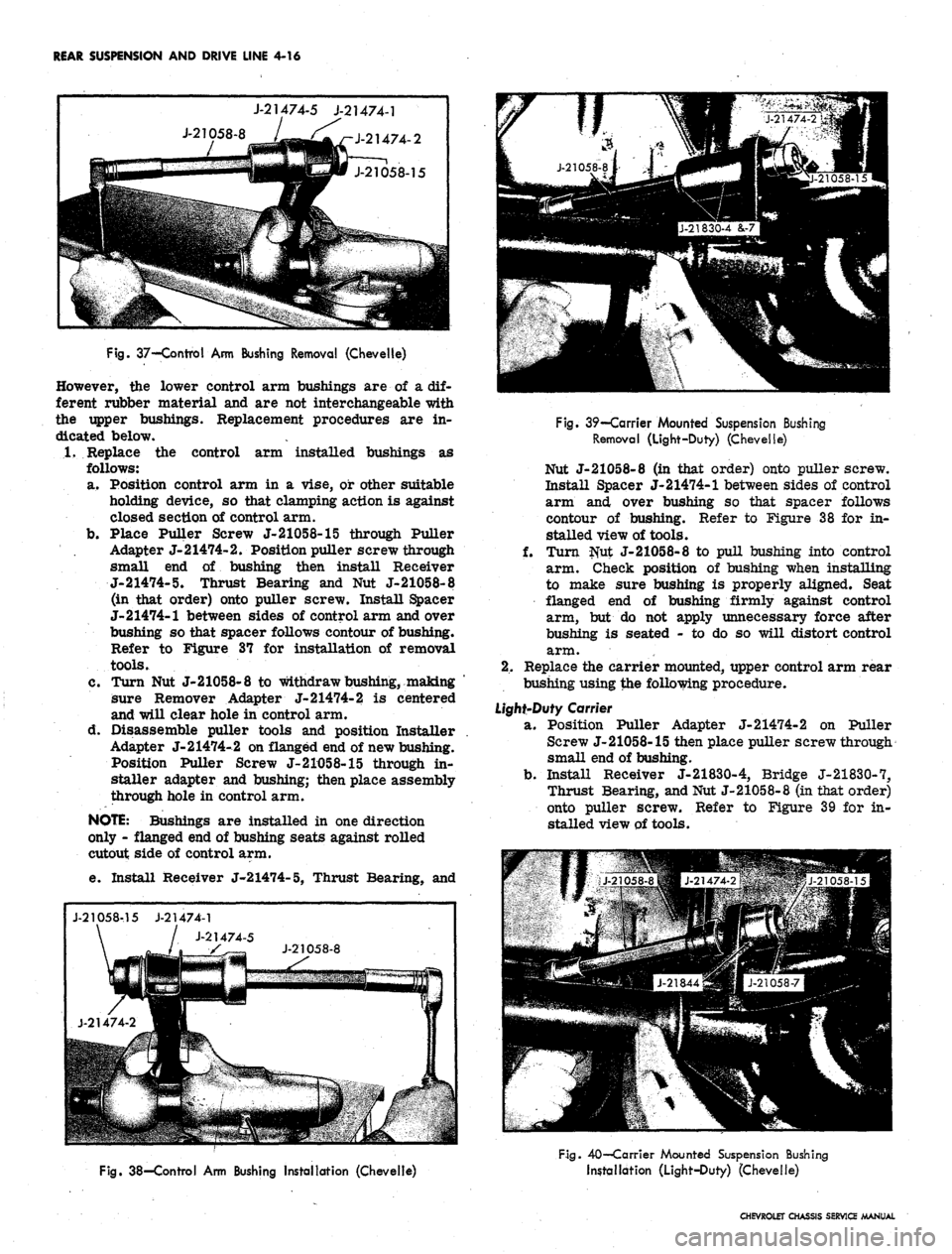
J-21474-5 J-21474-1
J-21058-8 /__* A r-j-21474-2
Fig.
37-Control Arm Bushing Removal (Chevelle)
However, the lower control arm bushings are of a dif-
ferent rubber material and are not interchangeable with
the upper bushings. Replacement procedures are in-
dicated below.
1,
Replace the control arm installed bushings as
follows:
a. Position control arm in a vise, or other suitable
holding device, so that clamping action is against
closed section of control arm.
b.
Place Puller Screw J-21058-15 through Puller
Adapter J-21474-2. Position puller screw through
small end of bushing then install Receiver
J-21474-5. Thrust Bearing and Nut J-21058-8
(in that order) onto puller screw. Install Spacer
J-21474-1 between sides of control arm and over
bushing so that spacer follows contour of bushing.
Refer to Figure 37 for installation of removal
tools.
c. Turn Nut J-21058-8 to withdraw bushing, making
sure Remover Adapter J-21474-2 is centered
and will clear hole in control arm.
d. Disassemble puller tools and position Installer
Adapter J-21474-2 on flanged end of new bushing.
Position Puller Screw J-21058-15 through in-
staller adapter and bushing; then place assembly
through hole in control arm.
NOTE:
Bushings are installed in one direction
only - flanged end of bushing seats against rolled
cutout side of control arm.
e. Install Receiver J-21474-5, Thrust Bearing, and
J-21058-15 J-21474-1
Fig.
39—Carrier Mounted Suspension Bushing
Removal (Light-Duty) (Chevelle)
Nut J-21058-8 (in that order) onto puller screw.
Install Spacer J-21474-1 between sides of control
arm and, over bushing so that spacer follows
contour of bushing. Refer to Figure 38 for in-
stalled view of tools.
f. Turn Iftit J-21058-8 to pull bushing into control
arm. Check position of bushing when installing
to make sure bushing is properly aligned. Seat
flanged end of bushing firmly against control
arm, but do not apply unnecessary force after
bushing is seated - to do so will distort control
arm.
2.
Replace the carrier mounted, upper control arm rear
bushing using the following procedure.
Light-Duty Carrier
a. Position Puller Adapter J-21474-2 on Puller
Screw J-21058-15 then place puller screw through
small end of bushing.
b.
Install Receiver J-21830-4, Bridge J-21830-7,
Thrust Bearing, and Nut J-21058-8 (in that order)
onto puller screw. Refer to Figure 39 for in-
stalled view of tools.
Fig.
38—Control Arm Bushing Installation (Chevelle)
Fag.
40—Carrier Mounted Suspension Bushing
Installation (Light-Duty) (Chevelle)
CHEVROLET CHASSIS SERVICE MANUAL