turn CHEVROLET CAMARO 1967 1.G Chassis Owner's Manual
[x] Cancel search | Manufacturer: CHEVROLET, Model Year: 1967, Model line: CAMARO, Model: CHEVROLET CAMARO 1967 1.GPages: 659, PDF Size: 114.24 MB
Page 111 of 659
CORVETTE BODY 1B-4
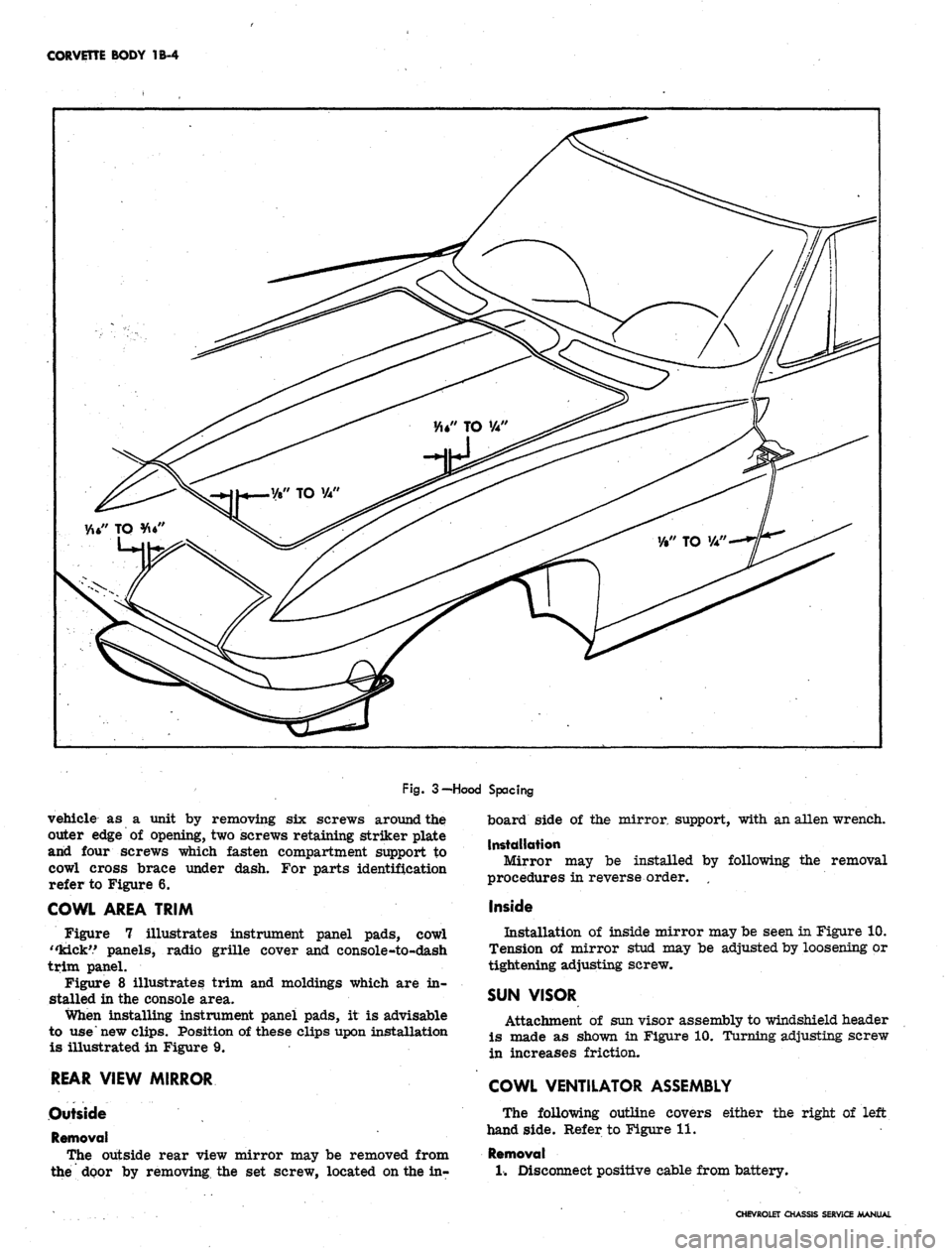
Fig.
3-Hood Spacing
vehicle as a unit by removing six screws around the
outer edge of opening, two screws retaining striker plate
and four screws which fasten compartment support to
cowl cross brace under dash. For parts identification
refer to Figure 6.
COWL AREA TRIM
Figure 7 illustrates instrument panel pads, cowl
"kick'.' panels, radio grille cover and console-to-dash
trim panel.
Figure 8 illustrates trim and moldings which are in-
stalled in the console area.
When installing instrument panel pads, it is advisable
to use new clips. Position of these clips upon installation
is illustrated in Figure 9.
REAR VIEW MIRROR
Outside
Removal
The outside rear view mirror may be removed from
the'
door by removing the set screw, located on the in-
board side of the mirror support, with an alien wrench.
Installation
Mirror may be installed by following the removal
procedures in reverse order. ,
Inside
Installation of inside mirror may be seen in Figure 10.
Tension of mirror stud may be adjusted by loosening or
tightening adjusting screw.
SUN VISOR
Attachment of sun visor assembly to windshield header
is made as shown in Figure 10. Turning adjusting screw
in increases friction.
COWL VENTILATOR ASSEMBLY
The following outline covers either the right of left
hand side. Refer to Figure 11.
Removal
1.
Disconnect positive cable from battery.
CHEVROLET CHASSIS SERVICE MANUAL
Page 118 of 659

CORVETTE BODY 1B-11
CLAYOfc
CAULKING
COMPOUND
Fig. 26-Window Rear Stop - Typical
Fig. 24—Checking Adjustment of Striker
3.
Adjust door as required. Location of hinge retaining
bolts may be seen in Figure 25 at "A". Do not allow
doors to hang on one hinge without support.
4.
Install trim pad and lubricate door "hold opens" and
hinges with Lubriplate or its equivalent.
NOTE:
After performing any door adjustment,
the window and door post should be checked for
alignment and adjusted as necessary. In addi-
tion,
never slam the door after adjustment with-
out first checking the door lock and striker plate
engagement. An adjustment may be necessary.
TRIM PANEL, AND INSIDE HANDLES
Figure 29 is an exploded view of integral arm rest,
inside handles, and trim panel fastenings.
Removal of trim panel may be accomplished as
follows:
1.
Remove two screws under arm rest.
2.
Using Tool J-7797, remove clips retaining window
crank and lock remote control as shown in Figure 28.
3.
Remove knob from door lock control by turning
counter-clockwise.
4.
Remove 2 screws retaining inside pull handle.
5. Remove sheet metal screws and special washers
retaining trim panel to door assembly.
6. Pull trim panel out. at bottom, tap bottom edge of
trim panel with hand to disengage from top of door.
Remove trim panel from vehicle.
WEATHERSTRIP
Figure
30
illustrates both 19437 and 19467 model door
COWL
Fig.
25-Door Adjustment Points
Fig.
27-Door Hinge
CHEVROLET CHASSIS SERVICE MANUAL
Page 130 of 659
CORVETTE BODY 1B-23
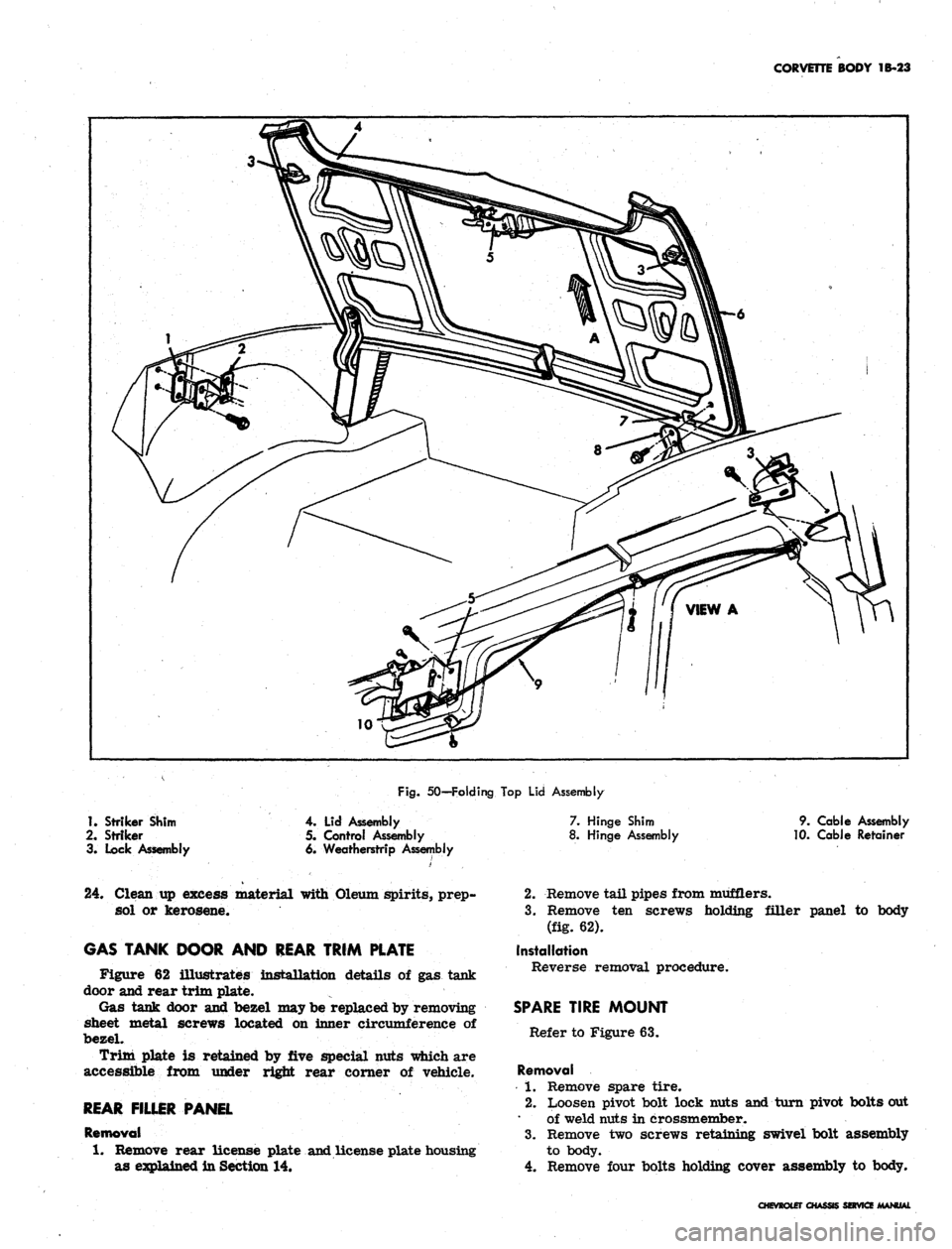
Fig.
50—Folding Top Lid Assembly
1.
Striker Shim
2.
Striker
3. Lock Assembly
4. Lid Assembly
5. Control Assembly
6. Weatherstrip Assembly
7. Hinge Shim
8. Hinge Assembly
9. Cable Assembly
10.
Cable Retainer
24.
Clean up excess material with Oleum spirits, prep-
sol or kerosene.
GAS TANK DOOR AND REAR TRIM PLATE
Figure 62 illustrates installation details of gas tank
door and rear trim plate.
Gas tank door and bezel may be replaced by removing
sheet metal screws located on inner circumference of
bezel.
Trim plate is retained by five special nuts which are
accessible from under right rear corner of vehicle.
REAR FILLER PANEL
Removal
1.
Remove rear license plate and license plate housing
as explained in Section 14.
2.
Remove tail pipes from mufflers.
3.
Remove ten screws holding filler panel to body
(fig. 62).
Installation
Reverse removal procedure.
SPARE TIRE MOUNT
Refer to Figure 63.
Removal
1.
Remove spare tire.
2.
Loosen pivot bolt lock nuts and turn pivot bolts out
of weld nuts in crossmember.
3.
Remove two screws retaining swivel bolt assembly
to body.
4.
Remove four bolts holding cover assembly to body.
CHEVROLET CHASSIS SERVICE
Page 159 of 659
CORVETTE BODY 1B-52
and pull weatherstrip and trim from rear bow.
Section A-A shows installed position of these com-
ponents. Refer also to figure 105.
installation
1.
Find and mark center of header, #3 bow, rear bow
and leading and trailing edges of top trim. Align
these marks during installation and recheck their
alignment from time to time while installation is in
progress, especially during tacking or stapling.
2.
Assemble top trim and weatherstrip to rear bow,
referring to Section A-A and Figure 105. Note that
filler strip locks this assembly together and goes
in last. Align center marks.
3.
If new pads are required, install at this time, align-
ing with marks made when old pads were removed.
Figure 106 shows pad construction; Figure 107 shows
pad installed.
4.
Install top trim-rear bow assembly on top frame
with four screws removed at disassembly.
5.
Lock down rear bow in desired "top up" position.
Pull up stay straps and staple or tack to #3 bow
(fig. 108).
6. Pull leading edge of trim iip to header and align
center marks. Smooth out fabric and clamp, tack
or staple temporarily to header.
7.
Draw window extension up to #3 bow, aligning cen-
tering marks. Turn an ample amount of fabric under
and tack to #3 bow. Apply neoprene trim cement,
GM Part #3695016 or equivalent, to area shown in
View D of Figure 102. Follow directions on package.
8. Draw roof portion of trim over #3 bow, align marks
and tack on staple.
9. Trim off excess material and install wire-on binding
as shown in Figure 109 and View D of Figure 102.
Install binding caps.
10.
Remove temporary clamps or fastenings holding trim
to header.
11.
With header locked down, pull trim assembly up tight
and mark for final installation.
12.
Apply trim cement to header and rear side rail.
13.
Release header from windshield. Tack or staple trim
to header (fig. 103).
14.
Apply trim to rear side frame, previously cemented.
15.
Install weatherstrips which were removed at dis-
assembly and install retaining screws in header
weatherstrip.
16.
Make any adjustments necessary, following instruc-
tions listed under Folding Top—Adjustments.
FRAME AND LINKAGE
Figure 110 illustrates construction features of the
folding top frame and linkage. Various cross sections in
Figure 110 show the pivoting joints and their assembly.
If an operation is being performed which requires
removal of folding top trim, follow directions in this
section. The entire frame assembly may be removed and
replaced as a unit. Follow instructions for Folding Top
Trim and Rear Window Assembly and Top Assembly—
Removal and Installation.
The pivoting joints should be lubricated with light
machine oil once a year. Apply oil sparingly so as not
to stain top trim.
WEATHERSTRIP
Side Rail Weatherstrip
Figure 111 illustrates installation of side rail weather-
strip which acts to seal window opening. The weather-
strip is held in place by studs which are part of the
weatherstrip assembly, and by neoprene base cement
which is applied between weatherstrip and side rail
surface.
When replacing weatherstrip remove all rust, old
cement and foreign material from the surfaces to be
cemented, to assure successful bonding. Use only good
quality neoprene cement suitable for weatherstrip
application.
Header Weatherstrip
Weatherstrip assembly is retained to the header panel
by a combination of studs, sheet metal screws and special
fasteners as shown in Figure 112, along with neoprene
base weatherstrip cement.
Figure 99 shows' a cross section of weatherstrip taken
through a special fastener. To replace fastener, rotate
ninety degrees to align fastener head with slot. Follow
directions for cementing in the Side Rail Weatherstrip
instructions preceding this write up.
ADDING HARDTOP (ROOF PANEL ASSEMBLY)
An available roof panel assembly (hardtop) complete
can be added to convertible model Corvettes. The hard-
ware is included with the panel assembly.
Reworking of a plastic part (one for each side of the
roof panel) can be used as a marker for drilling of two
required holes in the folding top compartment lid* Hard-
ware is attached at four locations — two on the lid and
two (one each side) at the lock pillar area as follows:
1.
Rework two plastic retainers (#6280765) (used on
Chevrolet and Corvair door inner panels for trim
retention) as shown by Figure 113.
2.
Slide the reworked plastic retainers into the bolt re-
tainer slots on each side of the hardtop rear bow
(position plastic tip inboard).
3.
Mark the hardtop reveal molding at the approximate
location of the two plastic retainers,
4.
Mark the tips of the two plastic retainers with a
china marker pencil.
5.
Close the soft top compartment lid.
6. With aid of an ^assistant, position front of hardtop
onto header and lower onto vehicle. Do not fasten
latches at windshield header.
7.
Apply hand pressure at reveal molding marks.
8. Mark roof panel attachment hole location at each
lock pillar area (fig. 114).
9. With aid of an assistant, lift roof panel straight up
off body and set roof panel aside.
10.
Mark the drill position at the four china marks with
a center punch.
11.
Place a 2" x 4" board under the top compartment lid
to prevent drill damage to folding top material. Make
certain the compartment lid is securely locked
before drilling.
12.
Drill 1/8" pilot hole at the 4 marked locations.
CHEVROLET CHASSIS SERVICE MANUAL
Page 169 of 659
FRONT SUSPENSION 3-5
FRONT END ALIGNMENT
Front end alignment, that is alignment of the inter-
related steering components of the front suspension sys-
tem, must be correctly maintained to assure ease and
stability of steering and satisfactory tire life.
Alignment Preliminary Steps
Several different types of machines are available for
checking all the factors of front end alignment. The in-
structions furnished with each particular machine should
be followed. In all cases, however, checks should be
made with the vehicle level and at curb weight.
Since steering complaints are not always the result of
improper alignment a check should be made to see if any
of the following conditions exist. Any such conditions
should be corrected before proceeding further.
1.
Steering gear loose or improperly adjusted.
2.
Steering gear housing loose at frame.
3.
Excessive wear or play in spherical joints or steer-
ing shaft coupling.
4.
Tie rod or steering connections loose.
5.
Improper front spring heights.
6. Unbalanced or underinflated tires.
7.
Improperly adjusted wheel bearings.
8. Shock absorbers not operating properly.
Wheel alignment should always be made with the vehi-
cle rolled forward taking out any slack in the same man-
ner as when the vehicle is traveling forward.
Caster and Camber Adjustment
NOTE: Before adjusting caster and camber
angles, the front bumper should be raised and
quickly released to allow car to return to its
normal height.
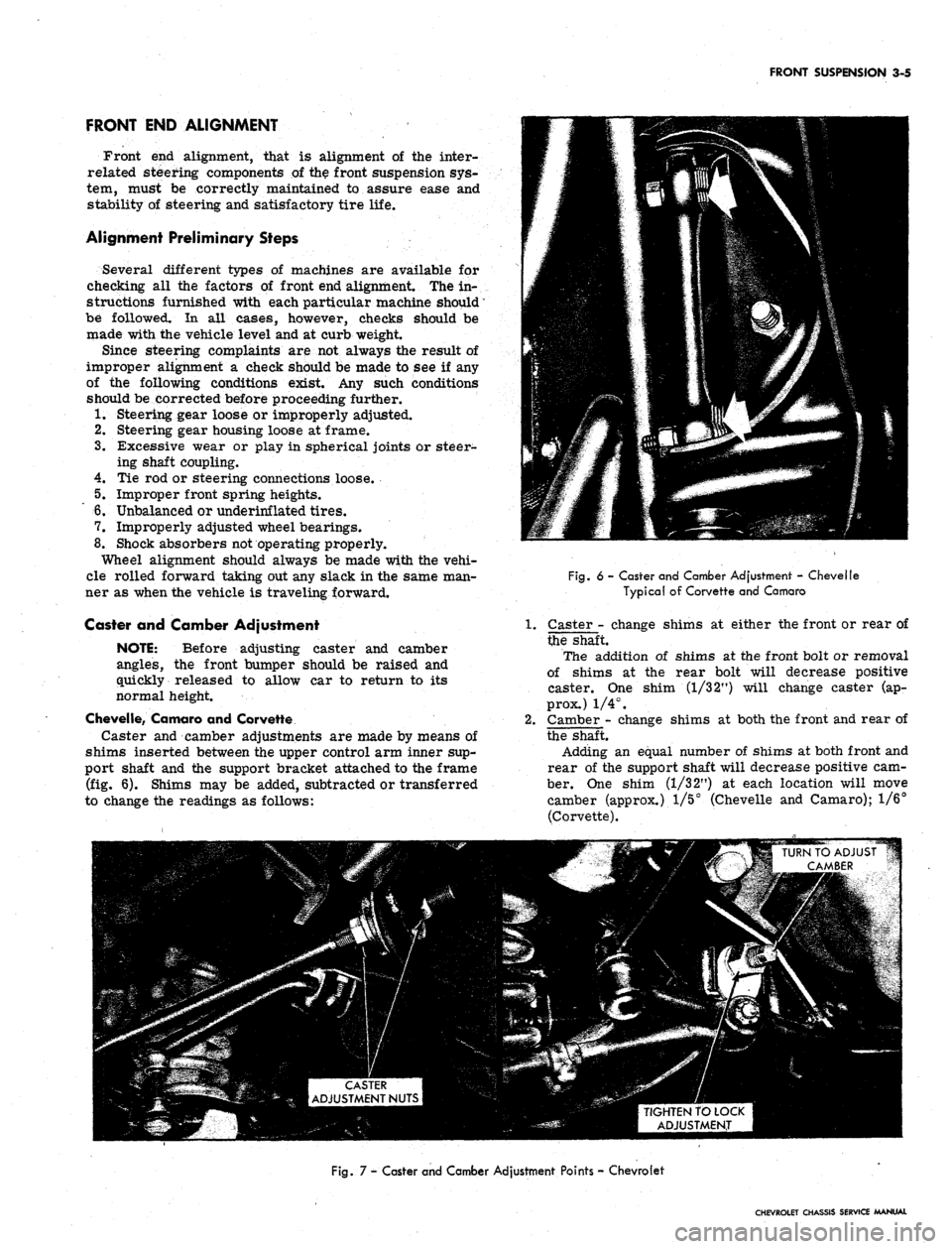
Chevelle, Camaro and Corvette
Caster and camber adjustments are made by means of
shims inserted between the upper control arm inner sup-
port shaft and the support bracket attached to the frame
(fig. 6). Shims may be added, subtracted or transferred
to change the readings as follows:
Fig.
6 - Caster and Camber Adjustment - Chevelle
Typical of Corvette and Camaro
Caster - change shims at either the front or rear of
the shaft.
The addition of shims at the front bolt or removal
of shims at the rear bolt will decrease positive
caster. One shim (1/3 2") will change caster (ap-
prox.) 1/4°.
Camber - change shims at both the front and rear of
the shaft.
Adding an equal number of shims at both front and
rear of the support shaft will decrease positive cam-
ber. One shim (1/32") at each location will move
camber (approx.) 1/5° (Chevelle and Camaro); 1/6°
(Corvette).
TIGHTEN TO LOCK
ADJUSTMENT
Fig.
7 - Caster and Camber Adjustment Points - Chevrolet
CHEVROLET CHASSIS SERVICE MANUAL
Page 170 of 659
FRONT SUSPENSION 3-6
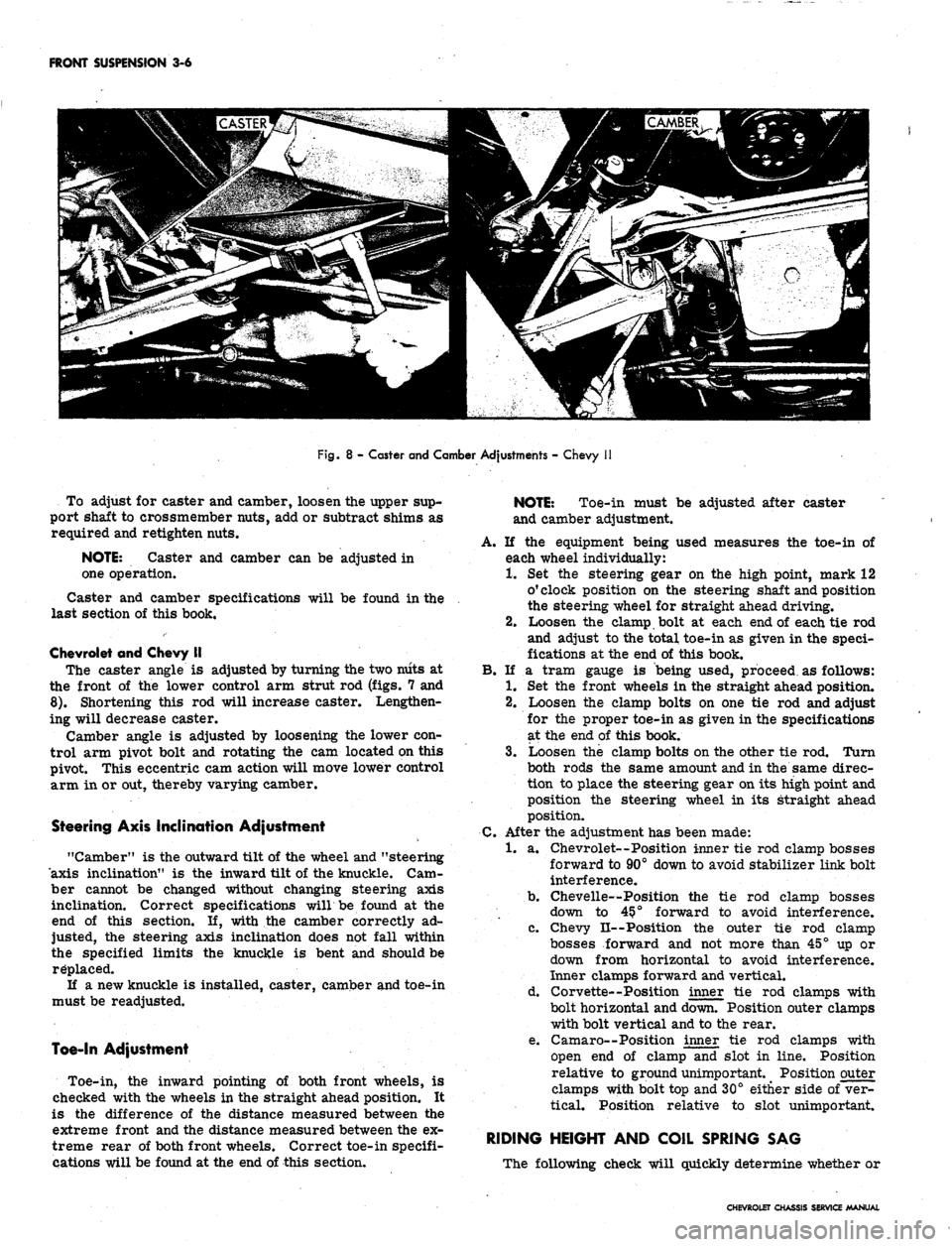
Fig.
8 - Caster and Camber Adjustments - Chevy
To adjust for caster and camber, loosen the upper sup-
port shaft to crossmember nuts, add or subtract shims as
required and retighten nuts.
NOTE:
Caster and camber can be adjusted in
one operation.
Caster and camber specifications will be found in the
last section of this book.
Chevrolet and Chevy II
The caster angle is adjusted by turning the two niits at
the front of the lower control arm strut rod (figs. 7 and
8).
Shortening this rod will increase caster. Lengthen-
ing will decrease caster.
Camber angle is adjusted by loosening the lower con-
trol arm pivot bolt and rotating the cam located on this
pivot. This eccentric cam action will move lower control
arm in or out, thereby varying camber.
Steering Axis Inclination Adjustment
"Camber" is the outward tilt of the wheel and "steering
axis inclination" is the inward tilt of the knuckle. Cam-
ber cannot be changed without changing steering axis
inclination. Correct specifications willbe found at the
end of this section. If, with the camber correctly ad-
justed, the steering axis inclination does not fall within
the specified limits the knuckle is bent and should be
replaced.
If a new knuckle is installed, caster, camber and toe-in
must be readjusted.
Toe-In Adjustment
Toe-in, the inward pointing of both front wheels, is
checked with the wheels in the straight ahead position. It
is the difference of the distance measured between the
extreme front and the distance measured between the ex-
treme rear of both front wheels. Correct toe-in specifi-
cations will be found at the end of this section.
NOTE:
Toe-in must be adjusted after caster
and camber adjustment.
A. If the equipment being used measures the toe-in of
each wheel individually:
1.
Set the steering gear on the high point, mark 12
o'clock position on the steering shaft and position
the steering wheel for straight ahead driving.
2.
Loosen the clamp bolt at each end of each tie rod
and adjust to the total toe-in as given in the speci-
fications at the end of this book.
B.
If a tram gauge is being used, proceed as follows:
1.
Set the front wheels in the straight ahead position.
2.
Loosen the clamp bolts on one tie rod and adjust
for the proper toe-in as given in the specifications
at the end of this book.
3.
Loosen the clamp bolts on the other tie rod. Turn
both rods the same amount and in the same direc-
tion to place the steering gear on its high point and
position the steering wheel in its straight ahead
position.
C.
After the adjustment has been made:
1.
a. Chevrolet—Position inner tie rod clamp bosses
forward to 90° down to avoid stabilizer link bolt
interference.
b.
Chevelle—Position the tie rod clamp bosses
down to 45?° forward to avoid interference.
c. Chevy II--Position the outer tie rod clamp
bosses forward and not more than 45° up or
down from horizontal to avoid interference.
Inner clamps forward and vertical.
d. Corvette--Position inner tie rod clamps with
bolt horizontal and down. Position outer clamps
with bolt vertical and to the rear.
e. Camaro—Position inner tie rod clamps with
open end of clamp and slot in line. Position
relative to ground unimportant. Position outer
clamps with bolt top and 30° either side of ver-
tical. Position relative to slot unimportant.
RIDING HEIGHT AND COIL SPRING SAG
The following check will quickly determine whether or
CHEVROLET CHASSIS SERVICE MANUAL
Page 174 of 659
FRONT SUSPENSION 3-10
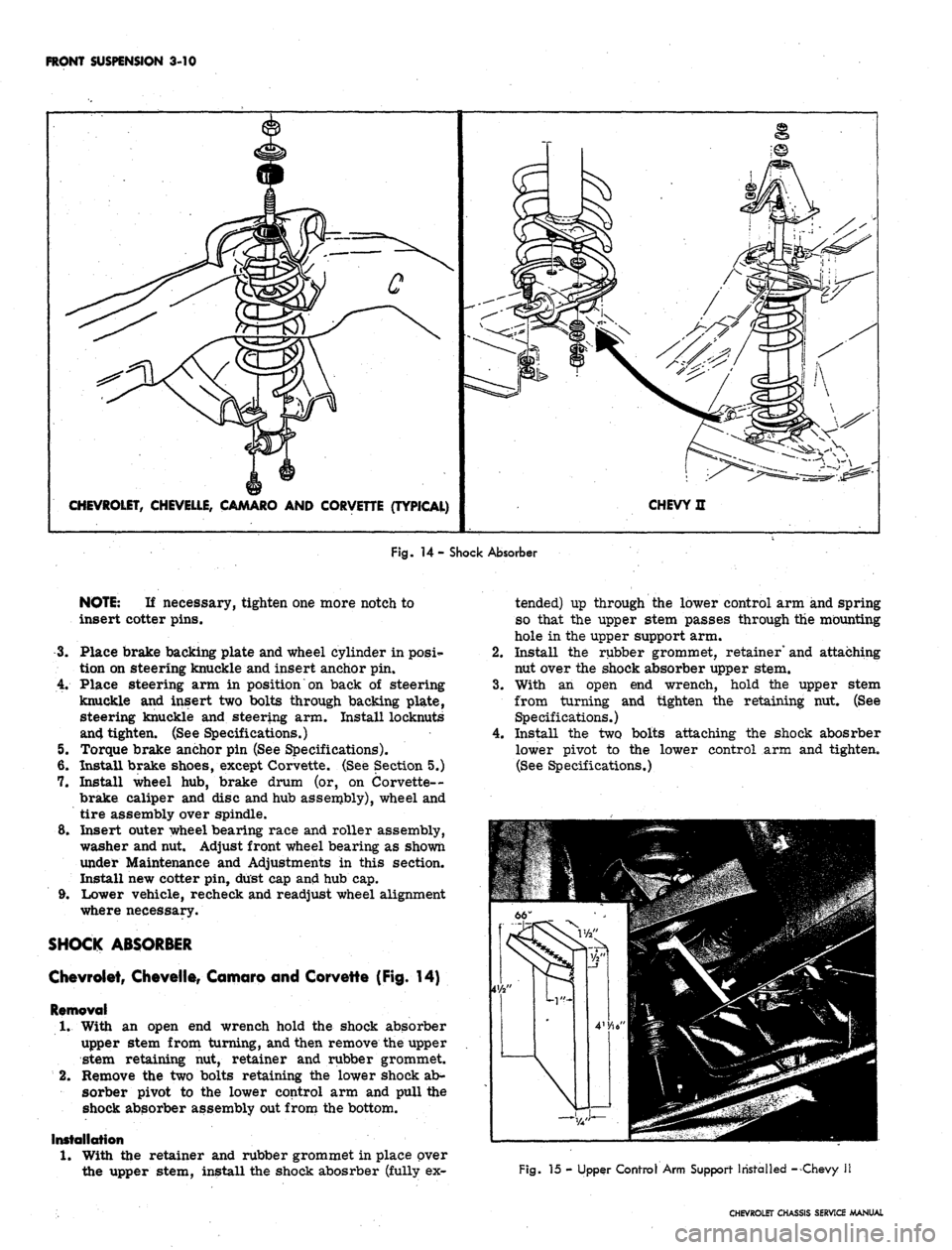
CHEVROLET, CHEVELLE, CAMARO AND CORVETTE (TYPICAL)
CHEVY H
Fig.
14- Shock Absorber
NOTE:
If necessary, tighten one more notch to
insert cotter pins.
3.
Place brake backing plate and wheel cylinder in posi*-
tion on steering knuckle and insert anchor pin.
4.
Place steering arm in position on back of steering
knuckle and insert two bolts through backing plate,
steering knuckle and steering arm. Install locknuts
and tighten. (See Specifications.)
5. Torque brake anchor pin (See Specifications).
6. Install brake shoes, except Corvette. (See Section 5.)
7. Install wheel hub, brake drum (or, on Corvette--
brake caliper and disc and hub assembly), wheel and
tire assembly over spindle.
8. Insert outer wheel bearing race and roller assembly,
washer and nut. Adjust front wheel bearing as shown
under Maintenance and Adjustments in this section.
Install new cotter pin, dust cap and hub cap.
9. Lower vehicle, recheck and readjust wheel alignment
where necessary.
SHOCK ABSORBER
Chevrolet, Chevelle, Comoro and Corvette (Fig. 14)
Removal
1.
With an open end wrench hold the shock absorber
upper stem from turning, and then remove the upper
stem retaining nut, retainer and rubber grommet.
2.
Remove the two bolts retaining the lower shock ab-
sorber pivot to the lower control arm and pull the
shock absorber assembly out from the bottom.
Installation
1.
With the retainer and rubber grommet in place over
the upper stem, install the shock abosrber (fully ex-
tended) up through the lower control arm and spring
so that the upper stem passes through the mounting
hole in the upper support arm.
2.
Install the rubber grommet, retainer' and attaching
nut over the shock absorber upper stem.
3.
With an open end wrench, hold the upper stem
from turning and tighten the retaining nut. (See
Specifications.)
4.
Install the two bolts attaching the shock abosrber
lower pivot to the lower control arm and tighten.
(See Specifications.)
Fig.
15 - Upper Control Arm Support Installed - Chevy II
CHEVROLET CHASSIS SERVICE MANUAL
Page 176 of 659
FRONT SUSPENSION 3-12
2.
Remove forward nut, retainer and rubber bushing
from front end of strut rod.
3.
Remove two nuts from strut rod to lower control arm
bolts and remove bolts and washers.
4.
Withdraw strut rod from bracket.
5. Remove remaining rubber bushing, retainer, sleeve
and nut from strut rod.
6. Inspect rubber bushings for aging and replace if
necessary. *•
Installation
1.
Screw rear nu$ on forward end of rod and position it
approximately 3/4" from end of threads. Install
rear retainer, sleeve and bushing on rod so raised
pilot diameter faces forward.
2.
Insert strut rod in bracket so pilot diameter on bush-
ing pilots in hole in bracket. Install forward bushing
on sleeve so raised pilot diameter faces rear to
enter hole in bracket, then install forward retainer
and nut on rod.
3.
Attach strut rod to top of lower control arm with two
bolts,
washers and nuts.
4.
Lower vehicle to floor, check caster and camber
angles and adjust where necessary. Torque nuts as
shown in Specifications.
FRONT SPRING
Chevrolet
Removal
1.
With an open end wrench hold the shock absorber
upper stem from turning, and then remove the upper
stem retaining nut, retainer and rubber grommet.
I IVi" rVi"i
\>. j ii
>
I
5'4
s
WOOD
BLOCK
USED
WITH
CHEVROLET
ONLY
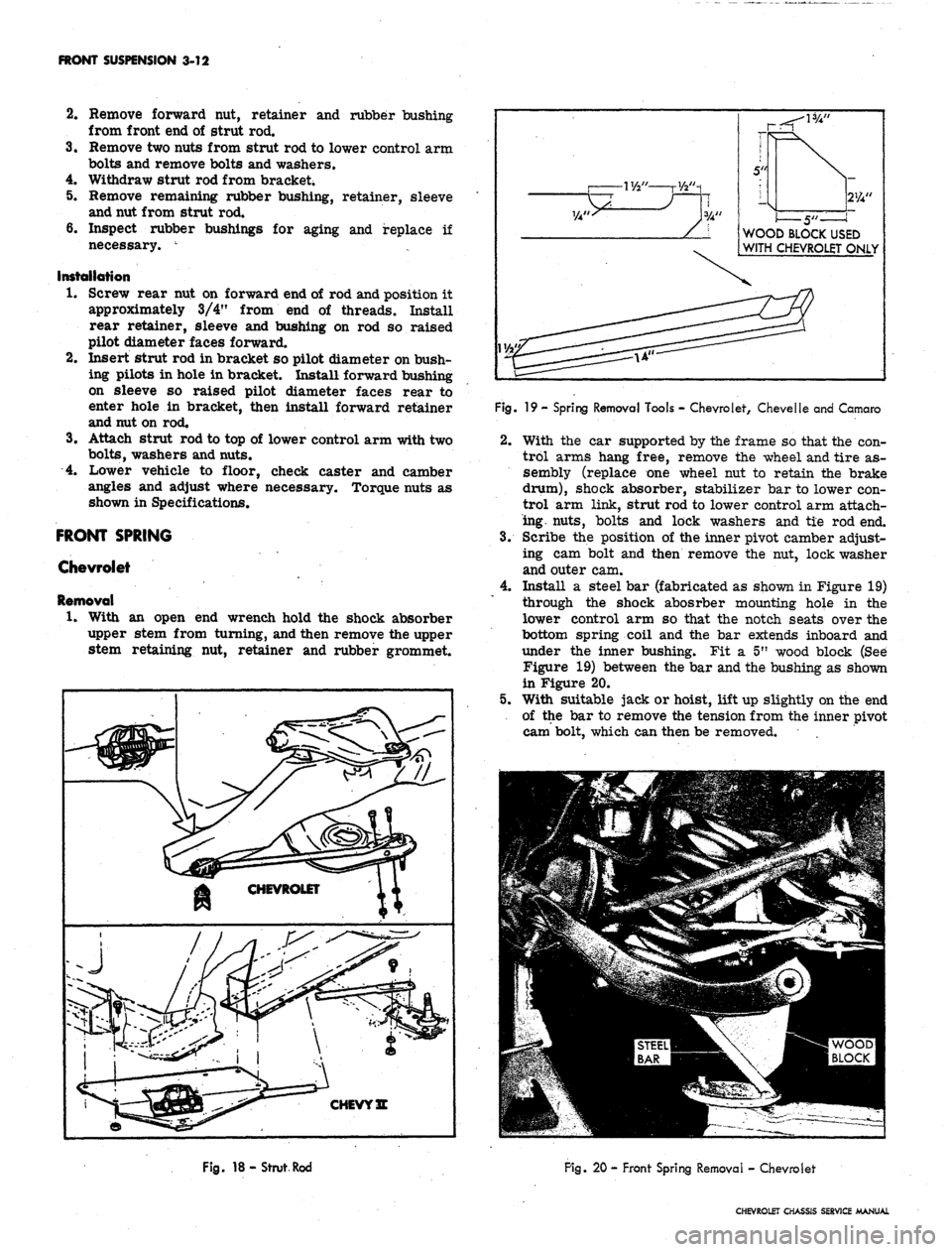
Fig.
19
- Spring Removal Tools - Chevrolet, Chevelle and Comoro
2.
With the car supported by the frame so that the con-
trol arms hang free, remove the wheel and tire as-
sembly (replace one wheel nut to retain the brake
drum),
shock absorber, stabilizer bar to lower con-
trol arm link, strut rod to lower control arm attach-
ing, nuts, bolts and lock washers and tie rod end.
3.
Scribe the position of the inner pivot camber adjust-
ing cam bolt and then remove the nut, lock washer
and outer cam.
4.
Install a steel bar (fabricated as shown in Figure 19)
through the shock abosrber mounting hole in the
lower control arm so that the notch seats over the
bottom spring coil and the bar extends inboard and
under the inner bushing. Fit a 5" wood block (See
Figure 19) between the bar and the bushing as shown
in Figure 20.
5.
With suitable jack or hoist, lift up slightly on the end
of the bar to remove the tension from the inner pivot
cam bolt, which can then be removed.
Fig.
18-Strut Rod
Pig. 20 - Front Spring Removal - Chevrolet
CHEVROLET CHASSIS SERVICE MANUAL
Page 177 of 659
FRONT SUSPENSION ,3-13
6. Carefully lower the inner end of the control arm.
Tension on the spring will be removed before the
spring can be removed from the vehicle.
7.
Remove the spring.
Installation
1.
With the suspension set up as in Step 2 of the disas-
sembly procedure, insert a block of wood between the
upper control arm and the spring tower to keep the
arm up out of the way.
2.
Set the spring in place on the crossmember after
checking on proper positioning necessary.
3.
Install the steel bar and wood block as shown in Fig-
ure 20 and lift the control arm up until the inner
pivot cam bolt can be installed. ,
4.
Install the outer cam and loosely install the lock
washer and nut
5.
Set the cam bolt on the mark scribed during the re-
moval procedure and hold in this position while tight-
ening the nut (See specifications at the end of this
book).
6. Replace the strut rod to lower control arm nuts,
bolts and lock washers, the stabilizer bar link, the
shock absorber, the tie rod end, and the wheel and
tire.
7.
Lower vehicle to floor and install the shock absorber
upper stem retaining nut retainer and grommet.
8. Check the camber adjustment.
Chevelle and Camaro
Removal
1.
With an open end wrench hold the shock absorber up-
per stem from turning, and then, remove the upper
stem retaining nut, retainer and rubber grommet.
2.
With the car supported by the frame so that the con-
trol arms hang free, remove the wheel and tire as-
sembly (replace one wheel nut to retain the brake
drum),
shock absorber, and stabilizer bar to lower
control arm link.
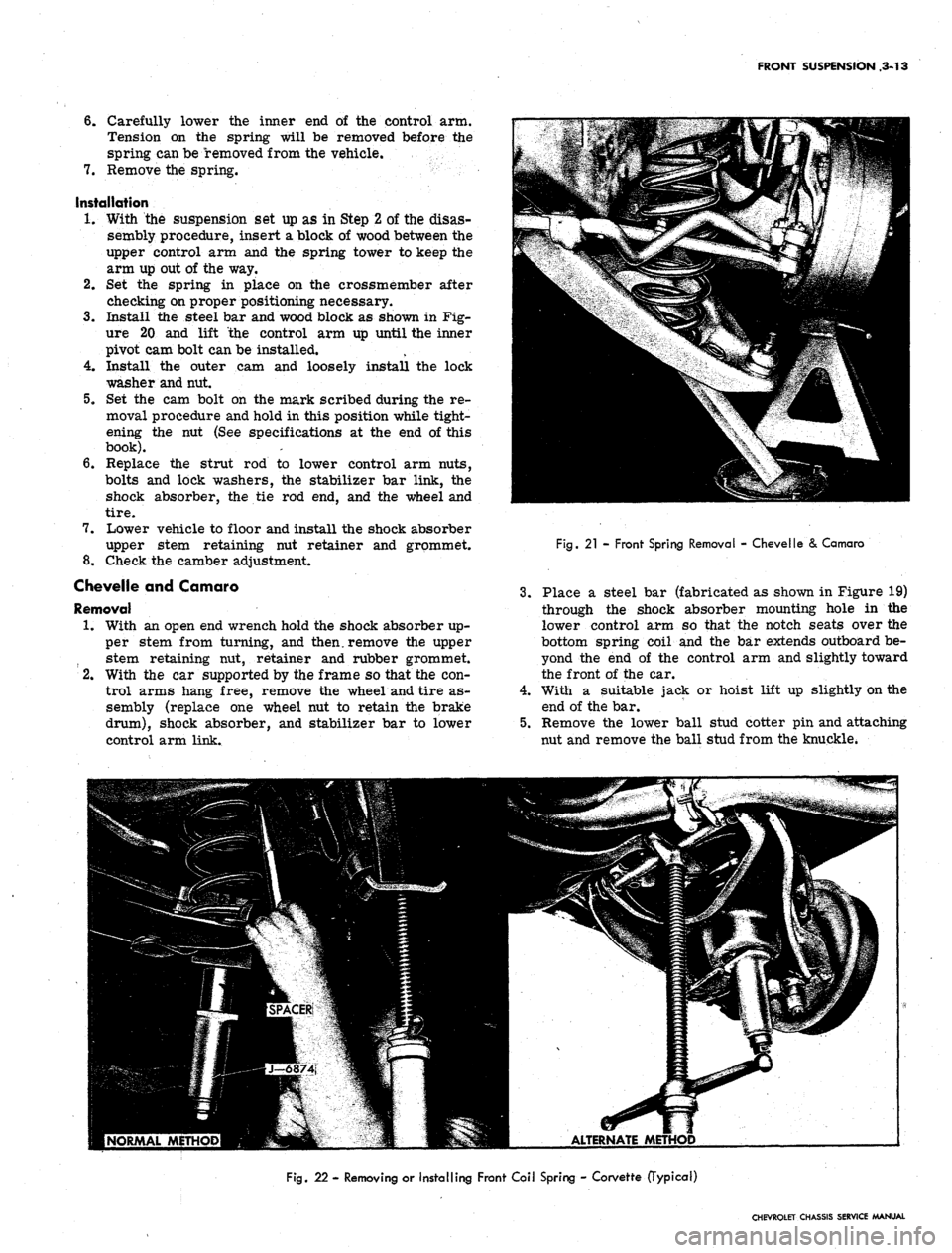
4.
5.
Fig.
21 - Front Spring Removal - Chevelle & Camaro
Place a steel bar (fabricated as shown in Figure 19)
through the shock absorber mounting hole in the
lower control arm so that the notch seats over the
bottom spring coil and the bar extends outboard be-
yond the end of the control arm and slightly toward
the front of the car.
With a suitable jack or hoist lift up slightly on the
end of the bar.
Remove the lower ball stud cotter pin and attaching
nut and remove the ball stud from the knuckle.
ALTERNATE METHOD
Fig.
22 - Removing or Installing Front Coil Spring - Corvette (Typical)
CHEVROLET CHASSIS SERVICE MANUAL
Page 179 of 659
FRONT SUSPENSION 3-15
4.
Insert Spring Compressor J-
6874-
4-
5 with Adapters
J-6874-8-9 into upp^r spring tower so that lower
MU"
bolt fits into shock absorber mounting holes in
spring seat (fig. 23). Secure the two lower studs to
the spring seat with nuts.
5.
Fit the tool upper pilot to top of spring and compress
spring by tightening upper nut (fig. 24). Compress
spring until screw is bottomed out.
6. Remove lower spring seat retaining nuts, lift spring
and seat assembly from control arm and guide it
down and out through fender skirt (fig. 25).
Spring Seat Replacement (Fig. 26)
1.
Release spring tension and disconnect spring com-
pressor from spring seat.
2.
Install new spring seat to spring compressor.
Installation
1.
If spring is to be replaced, install new spring into
tool and compress spring until screw is bottomed
out.
NOTE: Spring coil ends must be against spring
stops in upper and lower seats.
2.
Lift spring and tool assembly into place and position
so that the upper spring stop is inboard.
NOTE: Locating tab on upper spring seat may
be flattened before reinstalling spring.
3.
Install lower spring seat to control arm and torque
nuts as shown in the Specifications.
4.
Loosen spring compressor until spring is properly
seated in upper spring tower and remove.
5.
Install shock abosrber as outlined under Shock Ab-
sorber—Installation in this section.
Corvette
Removal
1.
With car on suitable hoist or jack, (support vehicle
by frame so control arms may swing free) remove
wheel and tire assembly, stabilizer bar and shock
absorber. Loosen the lower ball joint to steering
knuckle nut, and the' two lower control arm cross
shaft bushing bolts.
2.
Place Tool J-6874-1 across top of sixth coil (ap-
prox.),
then loosely secure Tool J-6874-2 to the up-
per shoe, with attaching capscrews and lock washers.
The upper shoe "V" notch and lower shoe raised land
should contact spring.
3.
Insert Tool J-6874 up through center of spring and
attach to upper and lower shoe assembly.
4.
Position spacers under shock absorber mounting hole
and against bottom of lower control arm. Install
special bearing washer and Tool J-6874-5. Locate
bearing against spacer and large washer against
bearing. Feed screw up through large washer bear-
ing and spacer and thread into Tool J-6874 and
tighten snugly (fig. 22).
5.
Center shoe assembly on spring and tighten screw
until a very slight compression is placed on spring
(fig. '22). Then firmly tighten down the two cap-
screws securing the upper and lower shoes to lock
these shoes to spring.
6. Turn head of screw until spring is compressed just
enough to clear the spring tower, then remove the
lower ball joint to steering knuckle nut (fig. 22).
NOTE: It may be necessary to assist the
spring out of the spring tower with a pry bar or
a similar tool.
7.
Disconnect the lower ball joint from the steering
knuckle and lower the control arm with the com-
pressed spring. Immediately release compression
on spring by backing off long screw. Release spring
and tool and withdraw spring.
CAUTION: The spring force under compres-
sion is very large. Exercise every safety pre-
caution when performing this operation to see
that individuals and materials subject to damage
are removed from the path of the spring when
the control arm is being lowered. Also, the
compressed spring
be relaxed immedi-
ately after lowering the control arm to reduce
the time of exposure to the large compressive
force.
Installation
1.
Position spring with closely coiled end up. Place
Tool J-6874-1 across the top of the sixth coil (ap-
prox.) then loosely secure Tool J-6874-2 to the
upper shoe with attaching capscrews and lock wash-
ers.
The upper shoe MV" notch and lower shoe
raised land should contact spring.
2.
Insert Tool J-6874 up through center of spring and
attach to upper and lower shoe assembly with bolt
and nut.
3.
Set spring in its seat on the lower control arm.
4.
Position spacers centrally under shock absorber
mounting hole and against bottom of lower control
arm. Install bearing, large washer and Tool
J-6874-5.
Locate bearing against spacer and large
washer against bearing. Feed the screw up through
large washer, bearing and spacer and thread into
yoke rod. Tighten snugly, but do not start to draw
down yet
5.
Center the shoe assembly on the spring and tighten
the lag screw until a very slight compression is
placed on spring, then firmly tighten down the two
capscrews securing the upper and lower shoes. This
will lock the shoes to the coil spring.
6. Turn head of screw until spring is compressed just
enough to clear the spring tower.
NOTE: It may be necessary to assist the
spring into the spring tower with a pry bar or
similar tool.
7.
Immediately install the lower ball joint into steering
knuckle and secure in place with attaching nut.
8. Release compression on spring and at the same time
use a drift to guide the coil spring into its proper
seat. End of coils must be 3/8" from coil stops in
spring seat.
9. Tighten the lower ball joint to steering knuckle nut
and lock with cotter key.
10.
Install shock absorber and stabilizer bar.
11.
Install wheel, tire and drum assembly.
12.
Remove car from hoist or jack stands.
13.
Tighten the two lower control cross shaft bushing
bolts to 45-55 lbs. ft. torque.
NOTE: If a suitable adjustable jack-stand is
CHEVROLET CHASSIS SERVICE MANUAL