battery CHEVROLET CAMARO 1982 Repair Guide
[x] Cancel search | Manufacturer: CHEVROLET, Model Year: 1982, Model line: CAMARO, Model: CHEVROLET CAMARO 1982Pages: 875, PDF Size: 88.64 MB
Page 552 of 875
GM – CAMARO 1982-1992 – Repair Guide (Checked by WxMax) 552
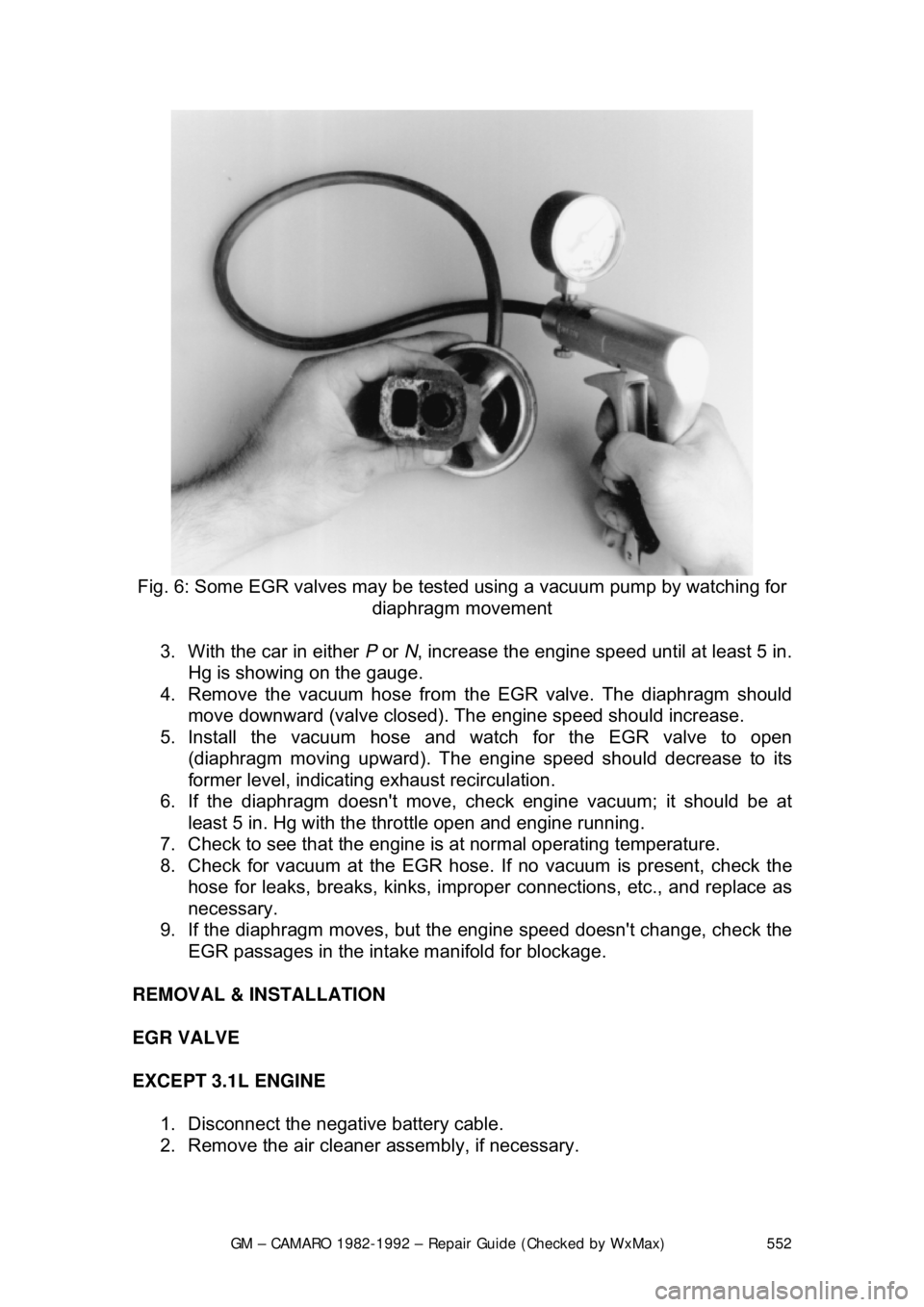
Fig. 6: Some EGR valves may be test ed using a vacuum pump by watching for
diaphragm movement
3. With the car in either P or N, increase the engine speed until at least 5 in.
Hg is showing on the gauge.
4. Remove the vacuum hose from t he EGR valve. The diaphragm should
move downward (valve closed). The engine speed should increase.
5. Install the vacuum hose and watch for the EGR valve to open (diaphragm moving upward). The engine speed should decrease to its
former level, indicating exhaust recirculation.
6. If the diaphragm doesn't move, c heck engine vacuum; it should be at
least 5 in. Hg with the throttle open and engine running.
7. Check to see that the engine is at normal operating temperature.
8. Check for vacuum at the EGR hose. If no vacuum is present, check the
hose for leaks, breaks, kinks, improper connections, etc., and replace as
necessary.
9. If the diaphragm move s, but the engine speed doesn't change, check the
EGR passages in the intake manifold for blockage.
REMOVAL & INSTALLATION
EGR VALVE
EXCEPT 3.1L ENGINE 1. Disconnect the negative battery cable.
2. Remove the air cleaner assembly, if necessary.
Page 553 of 875
GM – CAMARO 1982-1992 – Repair Guide (Checked by WxMax) 553
If equipped with the 5.0L (VIN F) and 5.7L
(VIN 8) engines with Tuned Port
Injection (TPI), it will be necessary to remove the intake plenum to gain access
to the EGR valve.
3. Tag and disconnect the necessary hos es and wiring to gain access to
the EGR valve.
4. Remove the EGR valve retaining bolts.
5. Remove the EGR valve. Discard the gasket.
6. Buff the exhaust deposits from the mounting surface and around the
valve using a wire wheel.
7. Remove deposits from the valve outlet.
8. Clean the mounting surfaces of the intake manifold and valve assembly.
To install: 9. Install a new EGR gasket.
10. Install the EGR valve to the manifold.
11. Install the retaining bolts.
12. Connect the wiring and hoses.
13. Install the air cleaner assembly.
14. Connect the negative battery cable.
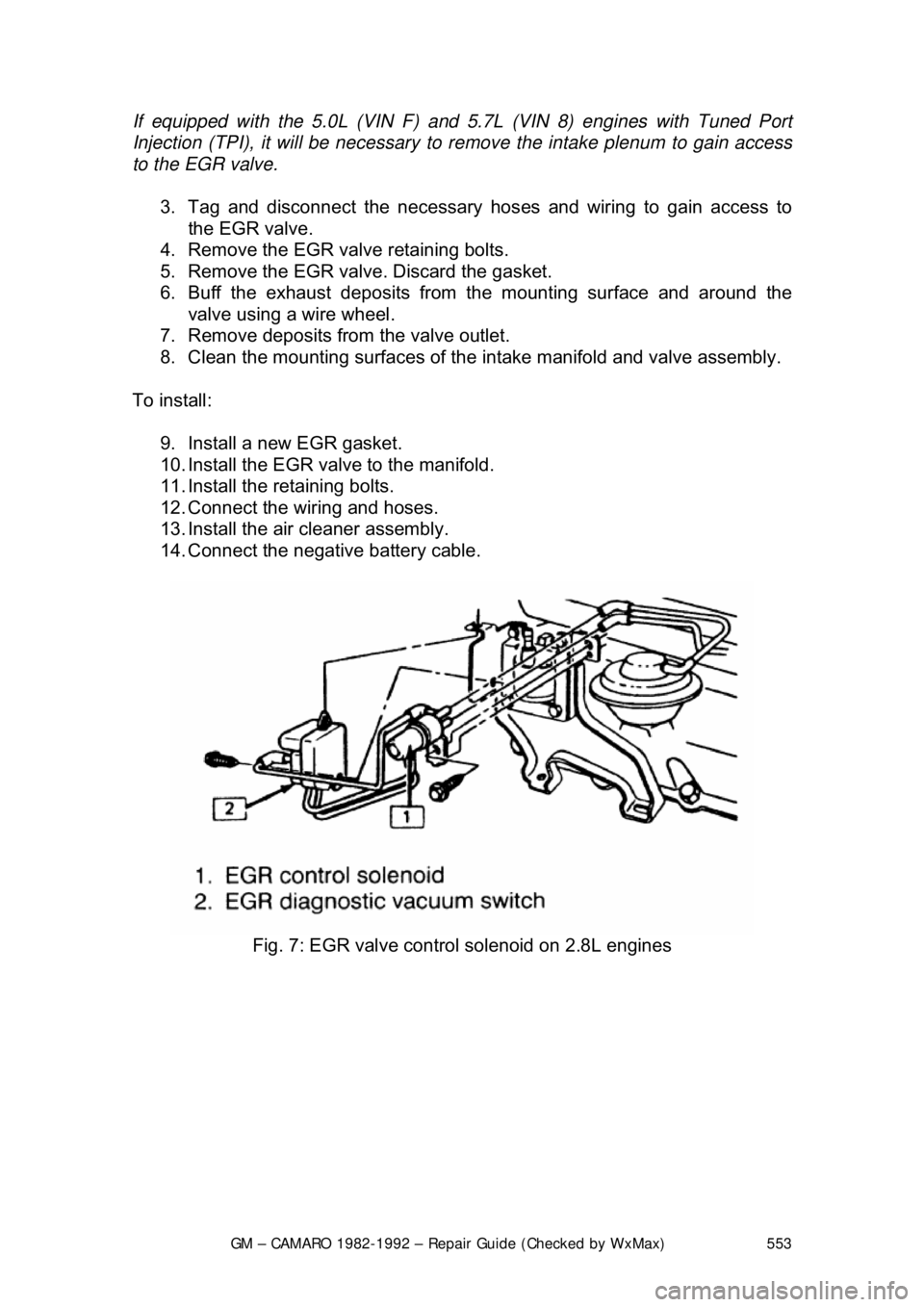
Fig. 7: EGR valve control solenoid on 2.8L engines
Page 556 of 875
GM – CAMARO 1982-1992 – Repair Guide (Checked by WxMax) 556
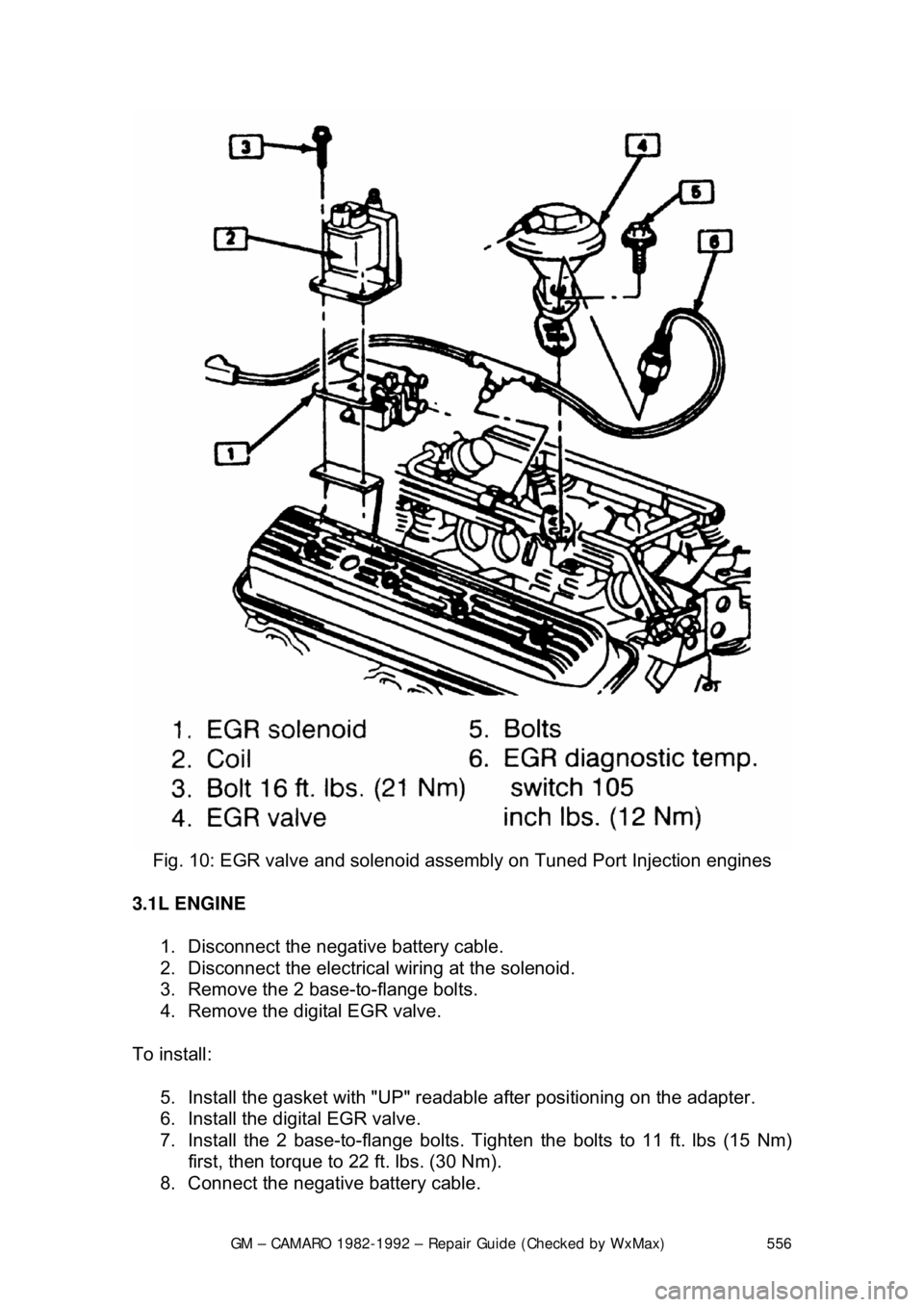
Fig. 10: EGR valve and solenoid a ssembly on Tuned Port Injection engines
3.1L ENGINE 1. Disconnect the negative battery cable.
2. Disconnect the electrical wiring at the solenoid.
3. Remove the 2 base-to-flange bolts.
4. Remove the digital EGR valve.
To install: 5. Install the gasket with "UP" readabl e after positioning on the adapter.
6. Install the digital EGR valve.
7. Install the 2 base-to-f lange bolts. Tighten the bolts to 11 ft. lbs (15 Nm)
first, then torque to 22 ft. lbs. (30 Nm).
8. Connect the negative battery cable.
Page 557 of 875
GM – CAMARO 1982-1992 – Repair Guide (Checked by WxMax) 557
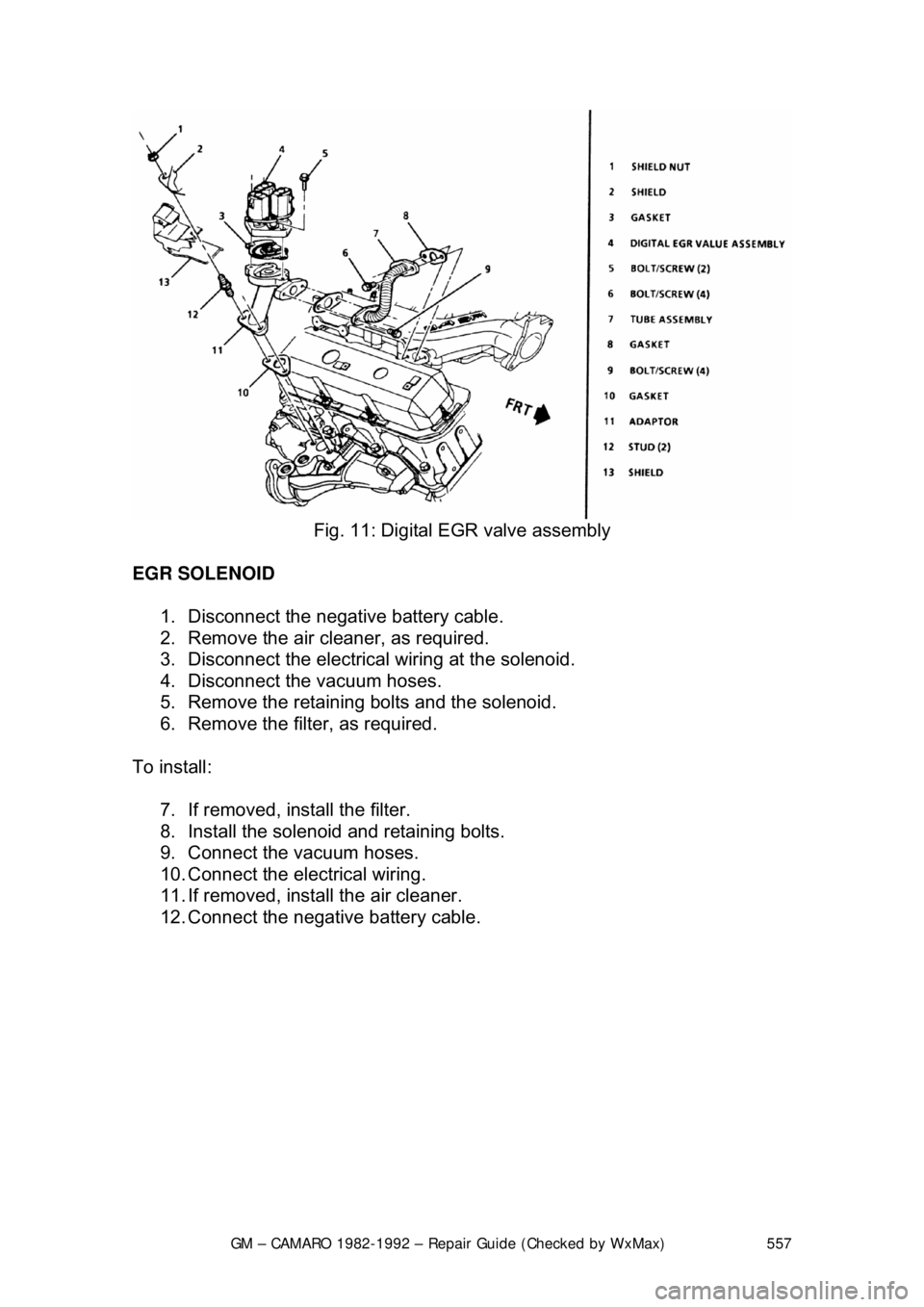
Fig. 11: Digital EGR valve assembly
EGR SOLENOID 1. Disconnect the negative battery cable.
2. Remove the air cl eaner, as required.
3. Disconnect the electrical wiring at the solenoid.
4. Disconnect the vacuum hoses.
5. Remove the retaining bolts and the solenoid.
6. Remove the filt er, as required.
To install: 7. If removed, install the filter.
8. Install the solenoid and retaining bolts.
9. Connect the vacuum hoses.
10. Connect the electrical wiring.
11. If removed, install the air cleaner.
12. Connect the negative battery cable.
Page 567 of 875
GM – CAMARO 1982-1992 – Repair Guide (Checked by WxMax) 567
3. Installation is in the reverse order of removal.
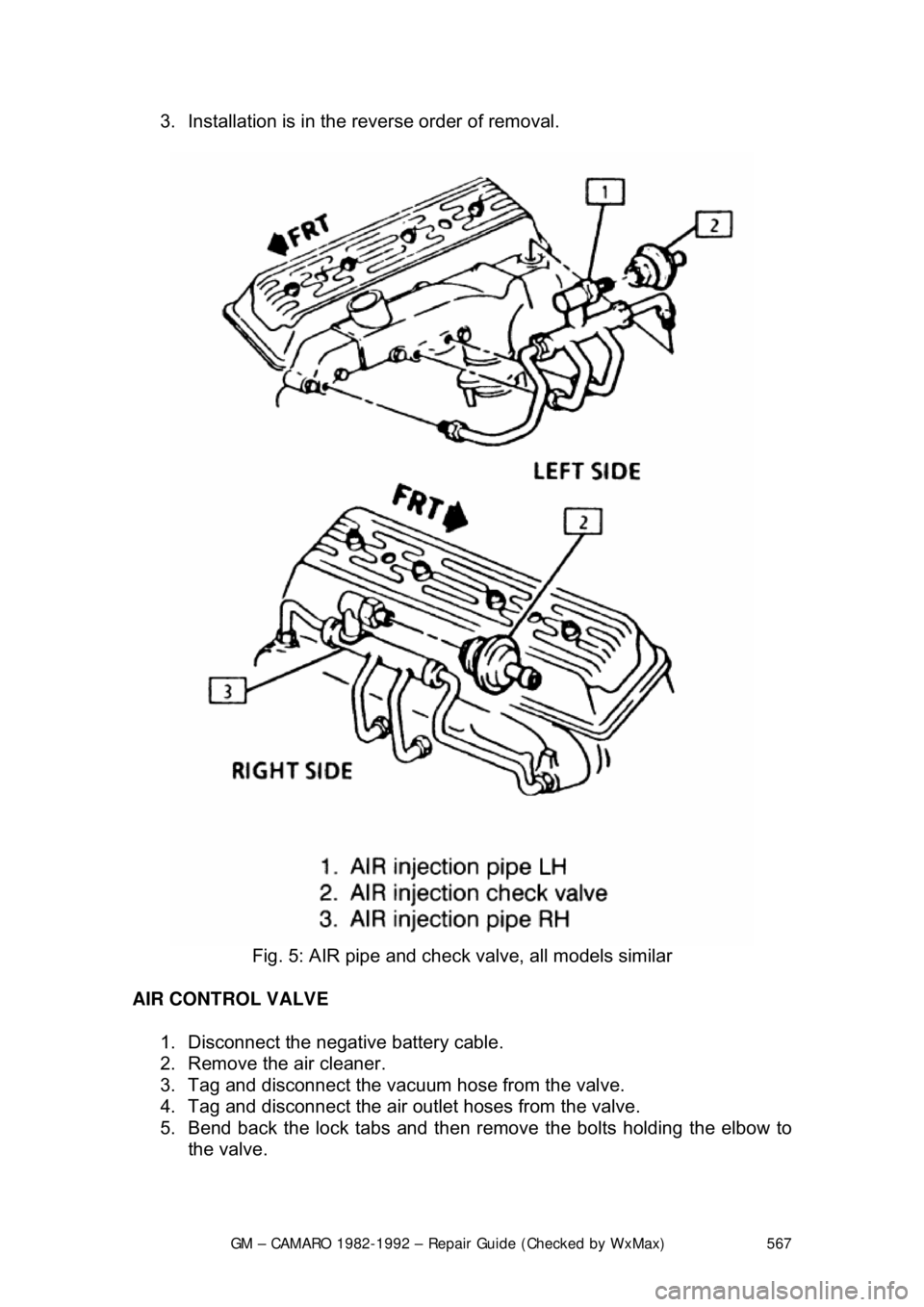
Fig. 5: AIR pipe and check valve, all models similar
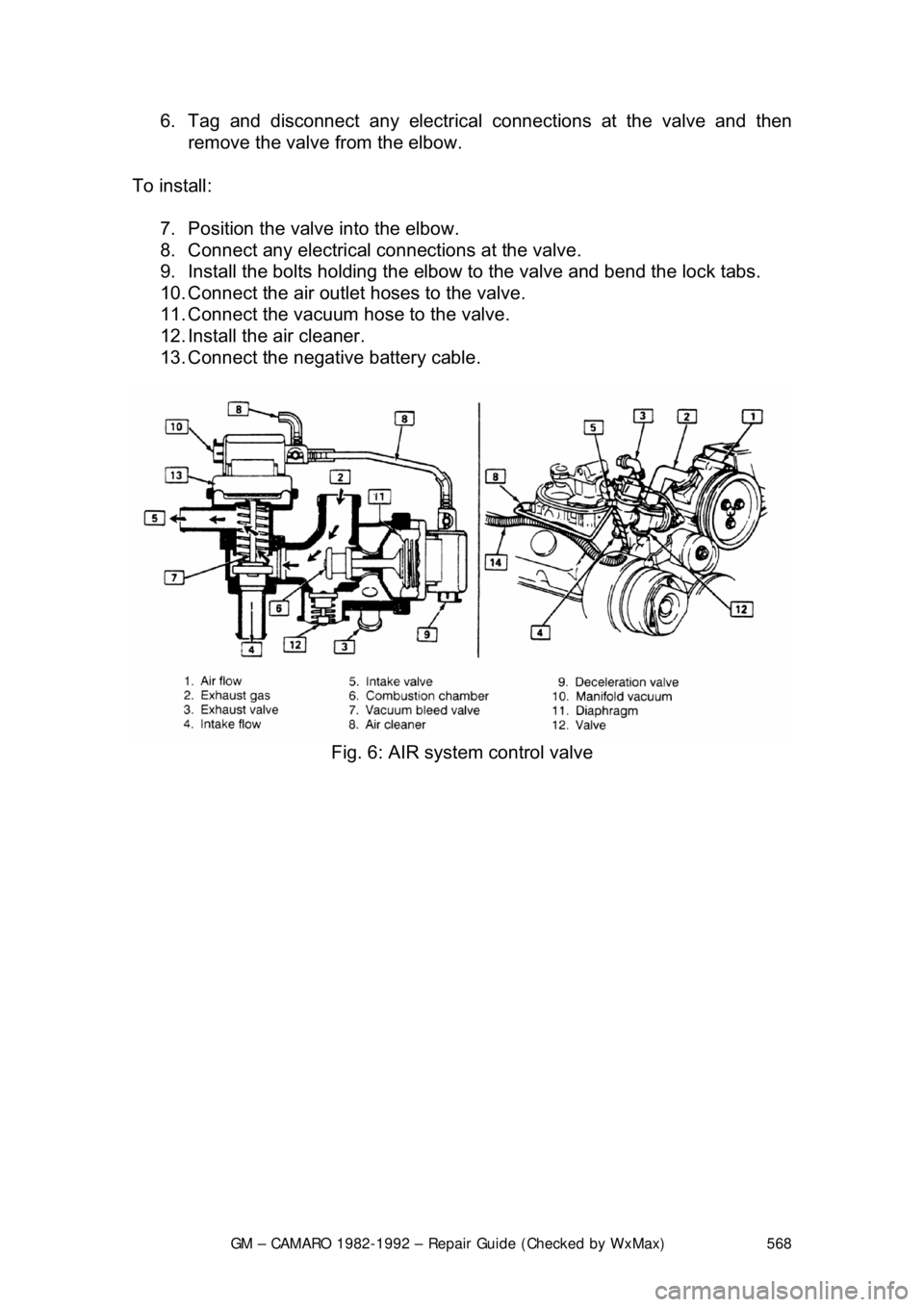
AIR CONTROL VALVE 1. Disconnect the negative battery cable.
2. Remove the air cleaner.
3. Tag and disconnect the vacuum hose from the valve.
4. Tag and disconnect the air outle t hoses from the valve.
5. Bend back the lock tabs and then remo ve the bolts holding the elbow to
the valve.
Page 568 of 875
GM – CAMARO 1982-1992 – Repair Guide (Checked by WxMax) 568
6. Tag and disconnect any electrical
connections at the valve and then
remove the valve from the elbow.
To install: 7. Position the valve into the elbow.
8. Connect any electrical c onnections at the valve.
9. Install the bolts holding the elbow to the valve and bend the lock tabs.
10. Connect the air outlet hoses to the valve.
11. Connect the vacuum hose to the valve.
12. Install the air cleaner.
13. Connect the negative battery cable.
Fig. 6: AIR system control valve
Page 571 of 875
GM – CAMARO 1982-1992 – Repair Guide (Checked by WxMax) 571
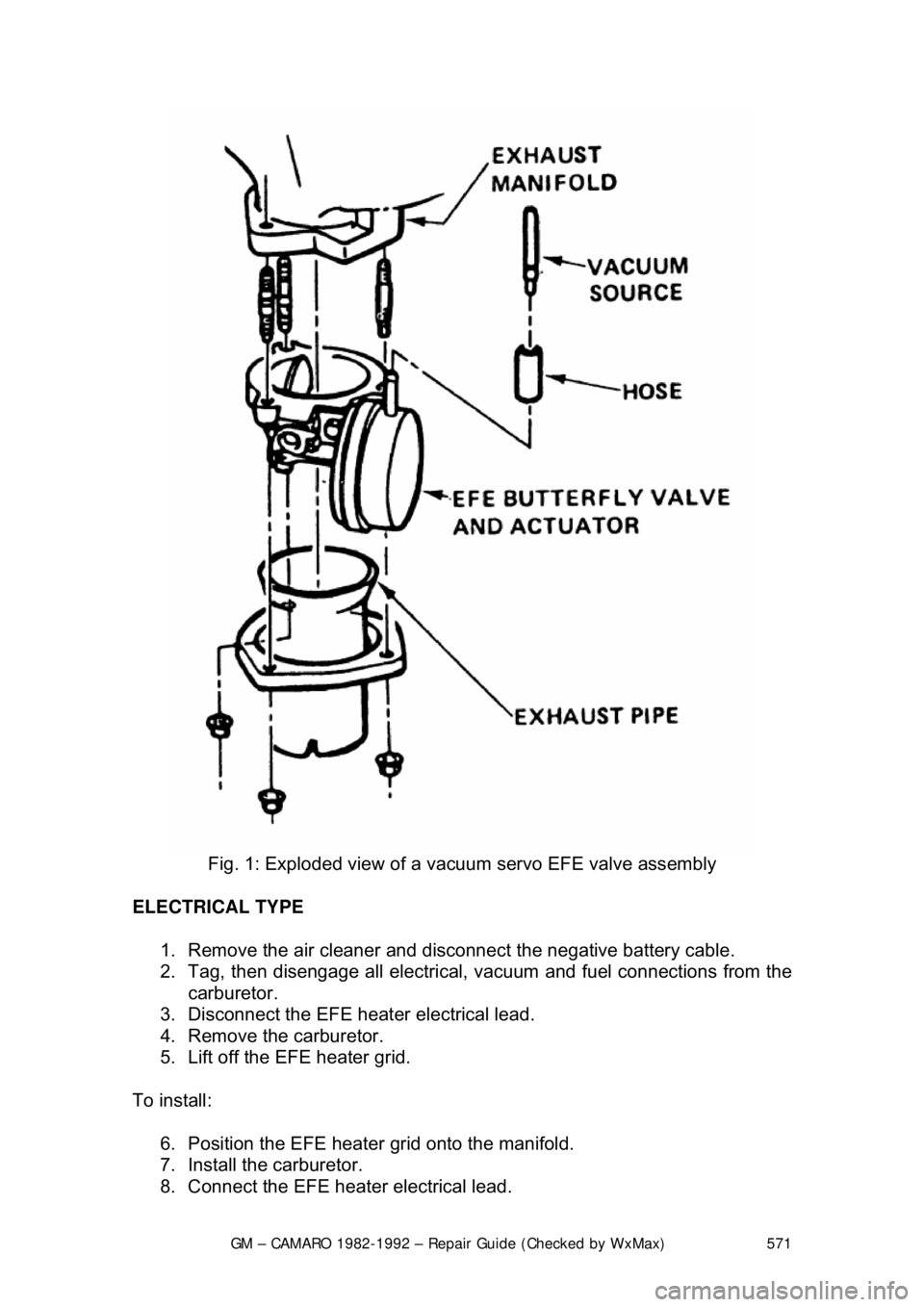
Fig. 1: Exploded view of a vacuum servo EFE valve assembly
ELECTRICAL TYPE 1. Remove the air cleaner and disconnect the negative battery cable.
2. Tag, then disengage all electrical, vacuum and fuel connections from the
carburetor.
3. Disconnect the EFE heat er electrical lead.
4. Remove the carburetor.
5. Lift off the EFE heater grid.
To install: 6. Position the EFE heater grid onto the manifold.
7. Install the carburetor.
8. Connect the EFE heater electrical lead.
Page 572 of 875
GM – CAMARO 1982-1992 – Repair Guide (Checked by WxMax) 572
9. Connect all electrical, vacuum and f
uel connection to the carburetor.
10. Install the air cleaner and connec t the negative battery cable.
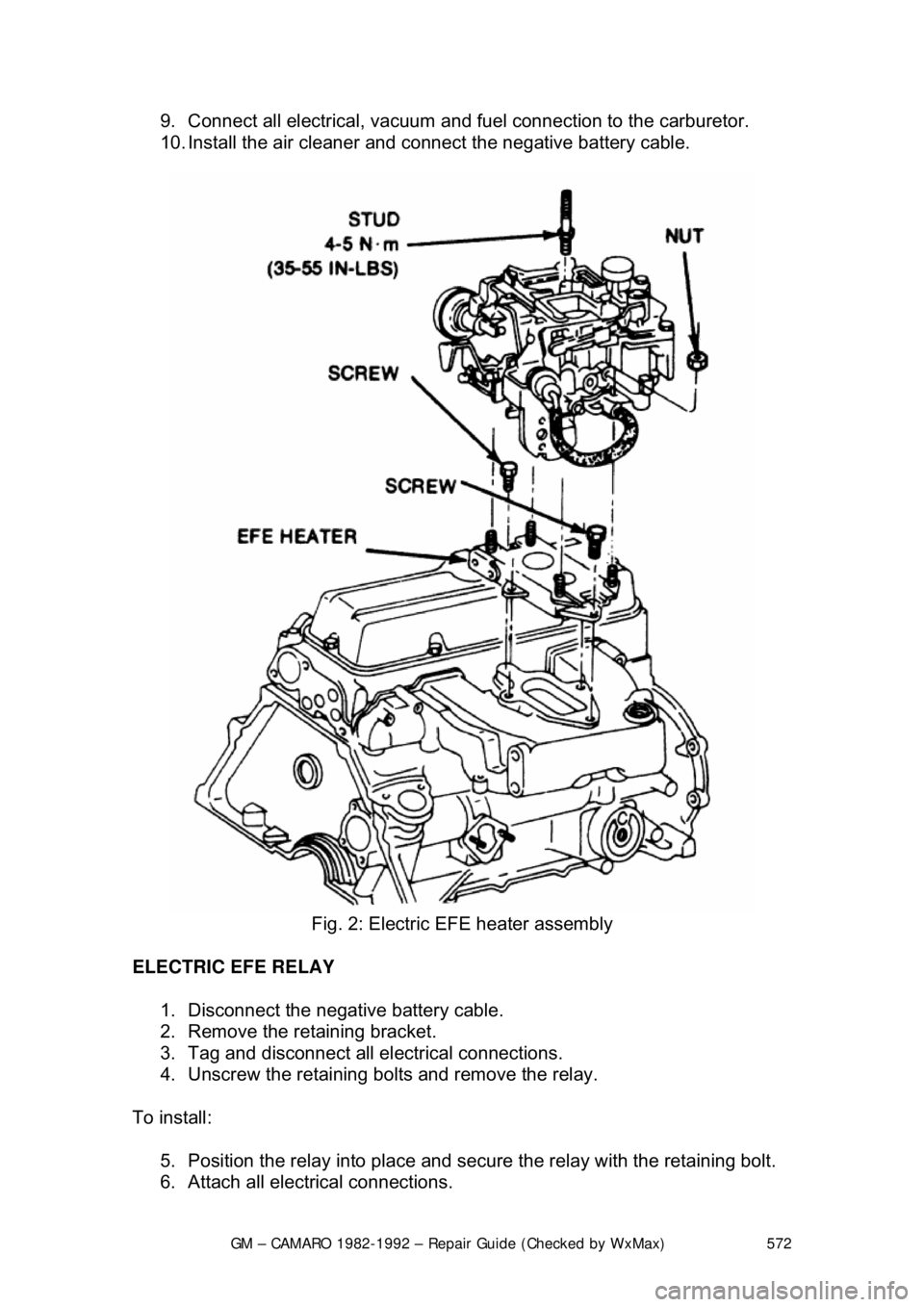
Fig. 2: Electric EFE heater assembly
ELECTRIC EFE RELAY 1. Disconnect the negative battery cable.
2. Remove the retaining bracket.
3. Tag and disconnect all el ectrical connections.
4. Unscrew the retaining bolts and remove the relay.
To install: 5. Position the relay into place and secu re the relay with the retaining bolt.
6. Attach all electrical connections.
Page 573 of 875

GM – CAMARO 1982-1992 – Repair Guide (Checked by WxMax) 573
7. Install the retaining bracket.
8. Connect the negative battery cable.
ELECTRONIC ENGINE CONTROLS
COMPUTER COMMAND CO NTROL (CCC) SYSTEM
The Computer Command Control (CCC) Sy stem is an electronically controlled
exhaust emission system that can m onitor and control a large number of
interrelated emission cont rol systems. It can monitor various engine/vehicle
operating conditions and then use this in formation to control multiple engine
related systems. The CCC syst em is thereby making constant adjustments to
maintain optimum vehicle performance und er all normal driving conditions while
at the same time allowing the catalyti c converter to effectively control the
emissions of HC, CO and NO
x.
OPERATION
The Electronic Control Module (ECM) is required to maintain the exhaust
emissions at acceptable le vels. The module is a sma ll, solid state computer
which receives signals from many source s and sensors; it uses these data to
make judgements about operating conditions and then control output signals to
the fuel and emission systems to ma tch the current requirements.
Inputs are received from m any sources to form a complete picture of engine
operating conditions. Some inputs are simp ly Yes or No messages, such as that
from the Park/Neutral switch; the vehicle is either in gear or in Park/Neutral;
there are no other choices. Other data is sent in quantitative input, such as
engine rpm or coolant temperature. T he ECM is pre-programmed to recognize
acceptable ranges or combinations of si gnals and control the outputs to control
emissions while providing good driv eability and economy. The ECM also
monitors some output circuits, making sure that the components function as
commanded. For proper engine oper ation, it is essential that all input and output
components function properly and comm unicate properly with the ECM.
Since the control module is programmed to recognize the presence and value
of electrical inputs, it will also note the lack of a signal or a radical change in
values. It will, for example, react to the loss of signal from the vehicle speed
sensor or note that engine coolant temperature has risen beyond acceptable
(programmed) limits. Once a fault is recognized, a numeric code is assigned
and held in memory. The SERVICE ENGIN E SOON Malfunction Indicator Lamp
(MIL), will illuminate to advise the operator that the system has detected a fault.
More than one code may be stored. Although not every engine uses every
code, possible codes range from 12-999. Additionally, the same code may carry
different meanings relative to each engine or engine family. For example, on the
3.3L (VIN N) engine, code 46 indicates a fault found in the power steering
pressure switch circuit. The same code on the 5.7L (VIN F) engine indicates a
fault in the VATS anti-theft system.
Page 576 of 875
GM – CAMARO 1982-1992 – Repair Guide (Checked by WxMax) 576
The temporary nature
of the integrator's control is expanded by the block learn
function. The name is derived from the fact that the entire engine operating
range (load vs. rpm) is divided into sect ions or blocks. Within each memory
block is stored the correct fuel delivery value for that combination of load and
engine speed. Once the operating range enters a certain block, that stored
value controls the fuel delivery unless th e integrator steps in to change it. If
changes are made by the integrator, t he new value is memorized and stored
within the block. As the block learn makes the correction, the integrator
correction will be reduced until the integrator returns to 128; the block learn then
controls the fuel delivery with the new value.
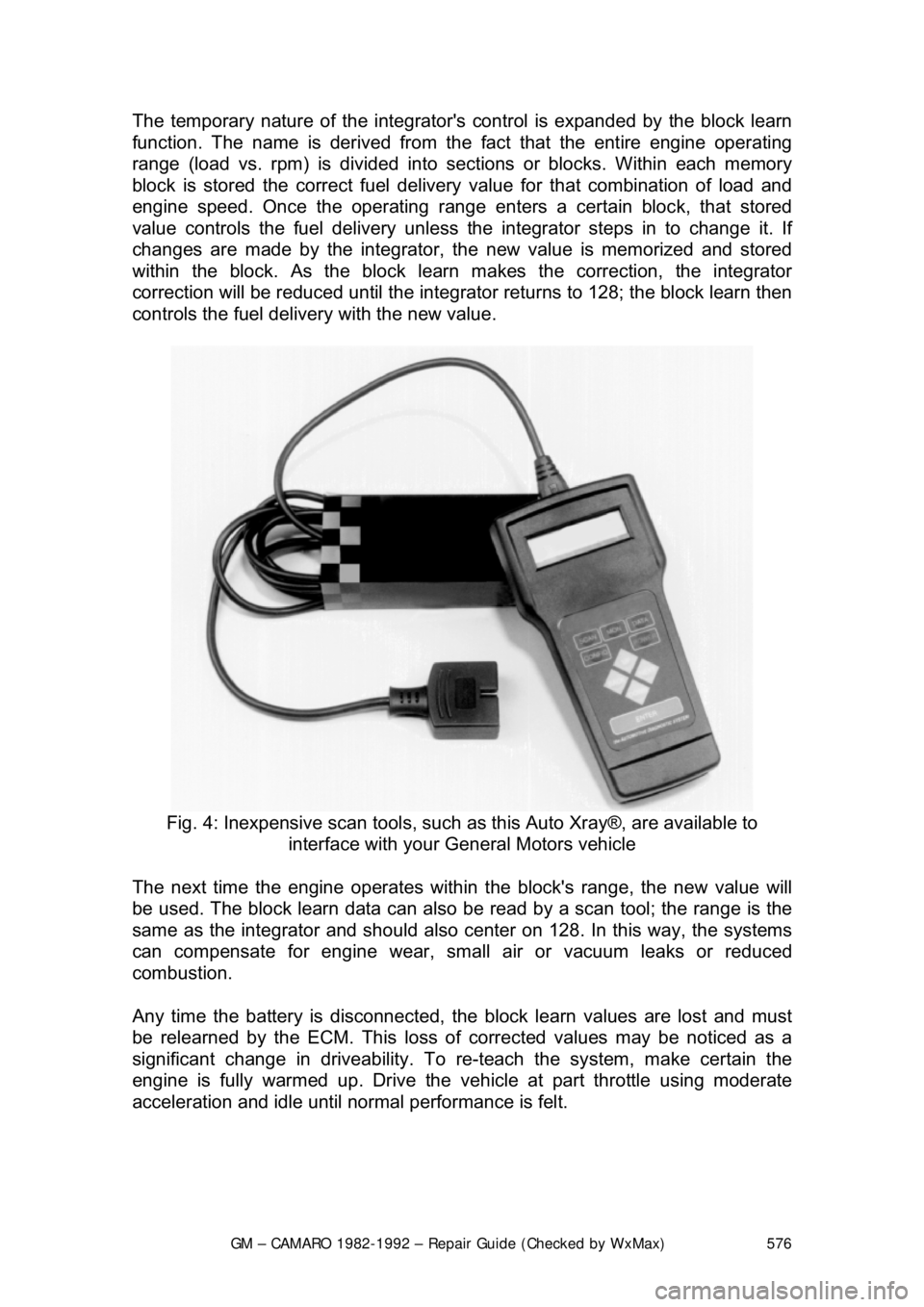
Fig. 4: Inexpensive scan tools, such as this Auto Xray®, are available to
interface with your General Motors vehicle
The next time the engine operates within the block's range, the new value will
be used. The block learn data can also be read by a scan tool; the range is the
same as the integrator and should also center on 128. In this way, the systems
can compensate for engine wear, small air or vacuum leaks or reduced
combustion.
Any time the battery is disconnected, the block learn values are lost and must
be relearned by the ECM. This loss of corrected values may be noticed as a
significant change in driveab ility. To re-teach the system, make certain the
engine is fully warmed up. Drive the v ehicle at part throttle using moderate
acceleration and idle until normal performance is felt.