battery CHEVROLET CAMARO 1982 Repair Guide
[x] Cancel search | Manufacturer: CHEVROLET, Model Year: 1982, Model line: CAMARO, Model: CHEVROLET CAMARO 1982Pages: 875, PDF Size: 88.64 MB
Page 33 of 875
GM – CAMARO 1982-1992 – Repair Guide (Checked by WxMax) 33
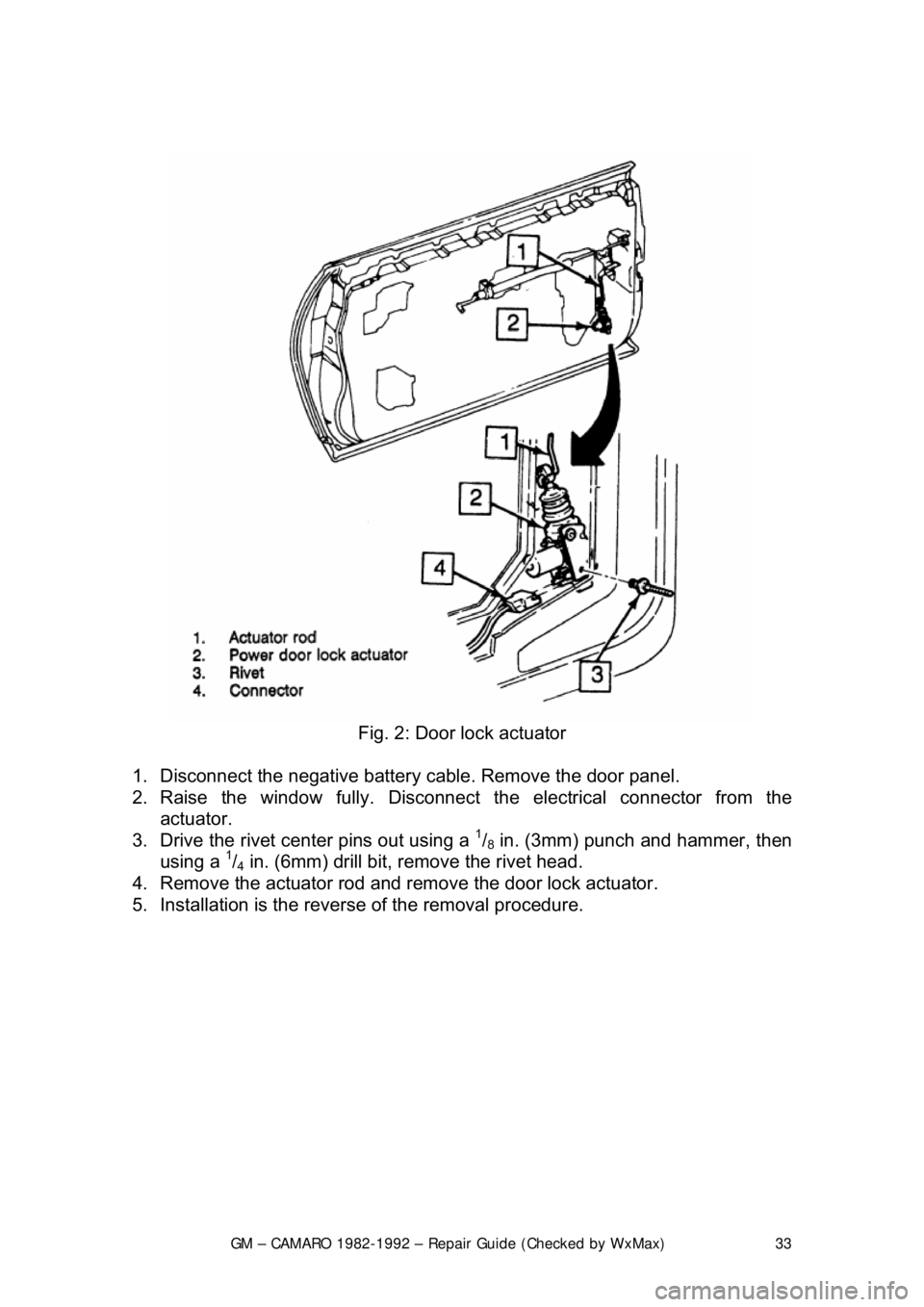
Fig. 2: Door lock actuator
1. Disconnect the negative battery c able. Remove the door panel.
2. Raise the window fully. Disconnect t he electrical connector from the
actuator.
3. Drive the rivet cent er pins out using a
1/8 in. (3mm) punch and hammer, then
using a 1/4 in. (6mm) drill bit, remove the rivet head.
4. Remove the actuator rod and remove the door lock actuator.
5. Installation is the revers e of the removal procedure.
Page 34 of 875
GM – CAMARO 1982-1992 – Repair Guide (Checked by WxMax) 34
REAR LIFTGATE PULL-DOWN UNIT
REMOVAL & INSTALLATION
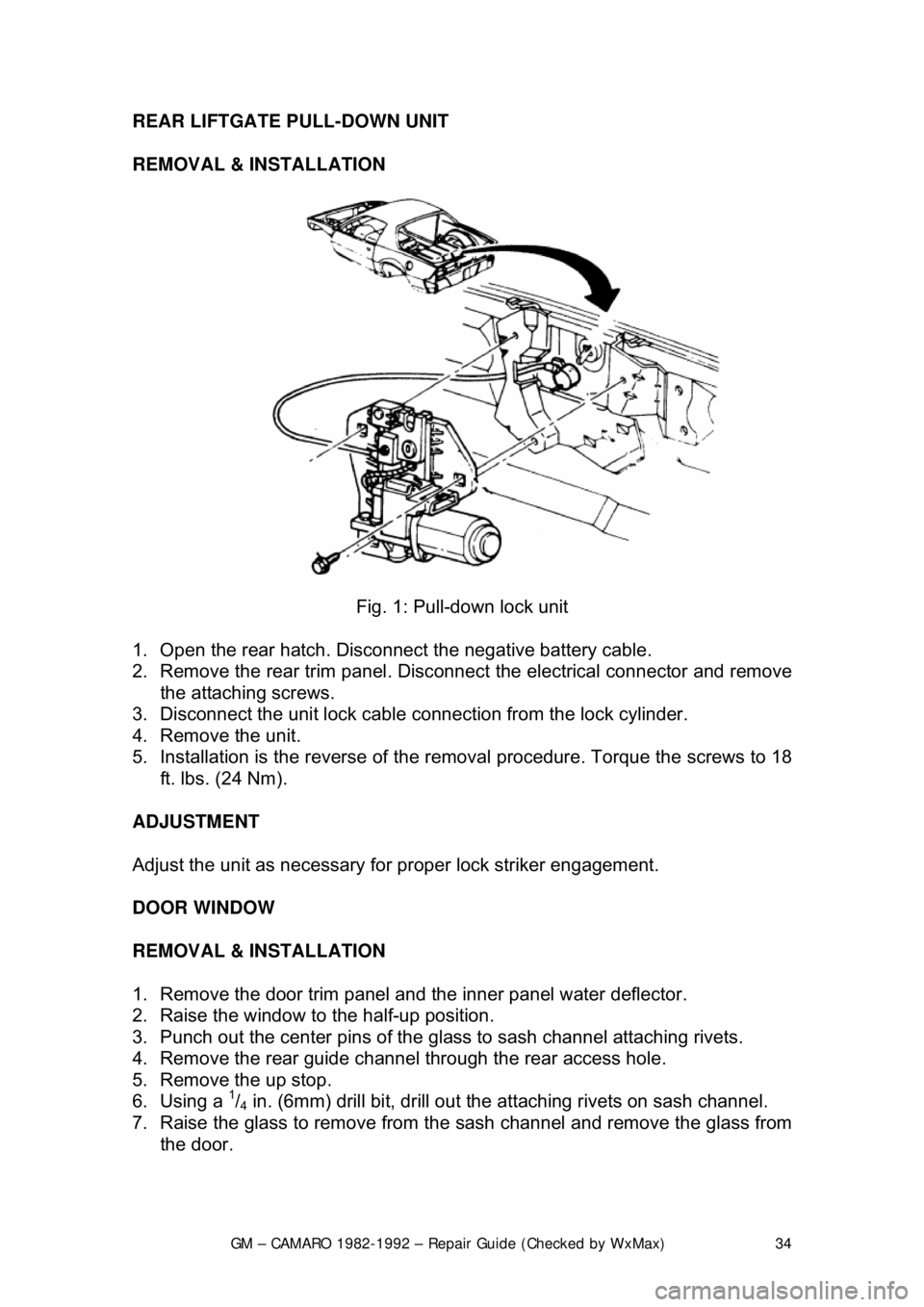
Fig. 1: Pull-down lock unit
1. Open the rear hatch. Disconnec t the negative battery cable.
2. Remove the rear trim panel. Disconnec t the electrical connector and remove
the attaching screws.
3. Disconnect the unit lock cable co nnection from the lock cylinder.
4. Remove the unit.
5. Installation is the reverse of the re moval procedure. Torque the screws to 18
ft. lbs. (24 Nm).
ADJUSTMENT
Adjust the unit as necessary fo r proper lock striker engagement.
DOOR WINDOW
REMOVAL & INSTALLATION
1. Remove the door trim panel and the inner panel water deflector.
2. Raise the window to the half-up position.
3. Punch out the center pins of the gl ass to sash channel attaching rivets.
4. Remove the rear guide channel through the rear access hole.
5. Remove the up stop.
6. Using a
1/4 in. (6mm) drill bit, drill out the atta ching rivets on sash channel.
7. Raise the glass to remove from the sash channel and remove the glass from
the door.
Page 69 of 875
GM – CAMARO 1982-1992 – Repair Guide (Checked by WxMax) 69
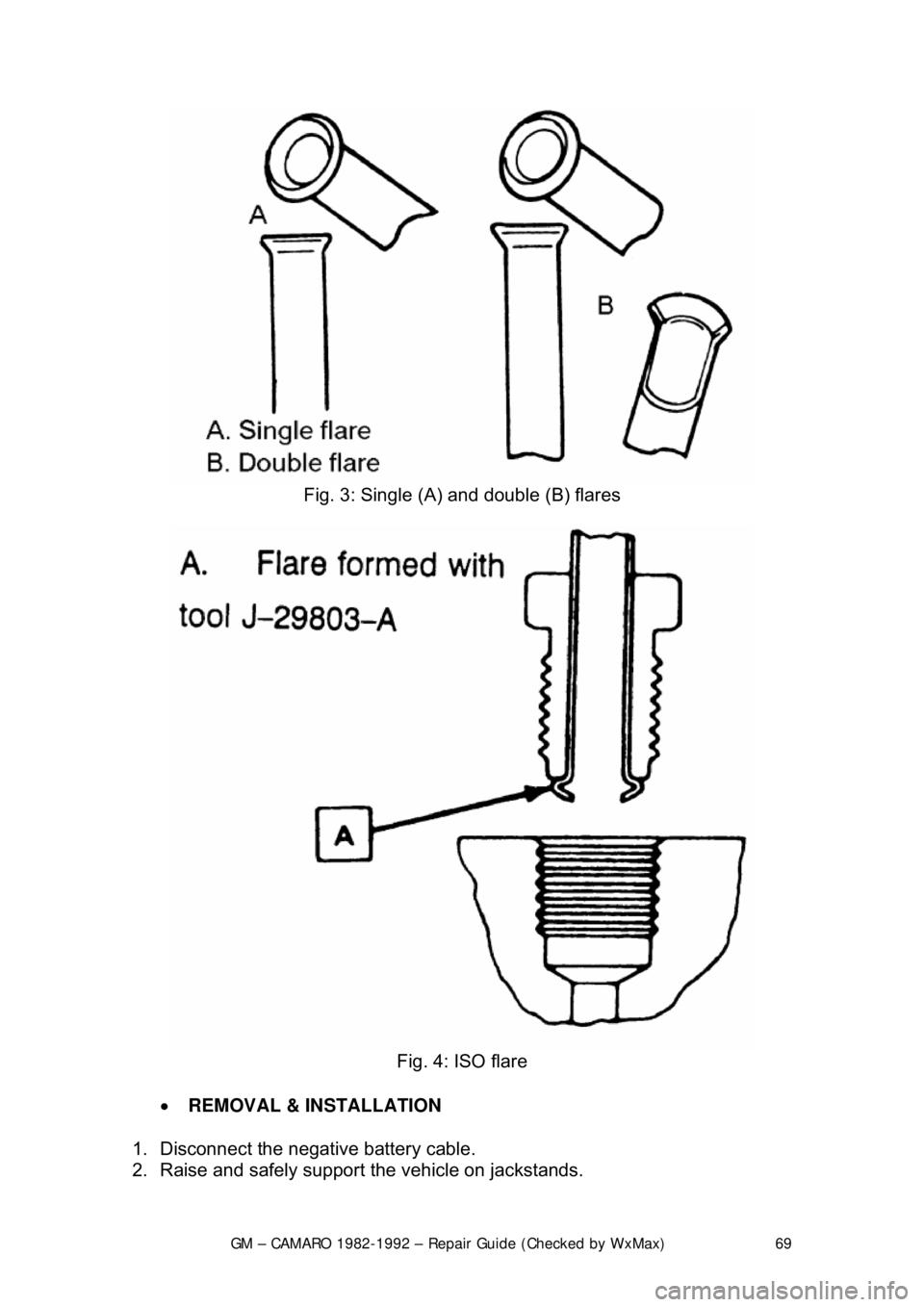
Fig. 3: Single (A) and double (B) flares
Fig. 4: ISO flare
• REMOVAL & INSTALLATION
1. Disconnect the negative battery cable.
2. Raise and safely support the vehicle on jackstands.
Page 73 of 875
GM – CAMARO 1982-1992 – Repair Guide (Checked by WxMax) 73
To install:
9. Install the new line or hose, starti
ng with the end farthest from the master
cylinder. Connect the other end, then confirm that both fittings are correctly
threaded and turn smoothly using finger pressure. Make sure the new line
will not rub against any ot her part. Brake lines must be at least 1/2 in.
(13mm) from the steering column and other moving parts. Any protective
shielding or insulators must be rein stalled in the original location.
WARNING - Make sure the hose is NO T kinked or touching any part of the
frame or suspension after installation. These conditions may cause the hose to
fail prematurely.
10. Using two wrenches as bef ore, tighten each fitting.
11. Install any retaining clips or brackets on the lines.
12. If removed, install the wheel and tire assemblies, then carefully lower the
vehicle to the ground.
13. Refill the brake master cylinder re servoir with clean, fresh brake fluid,
meeting DOT 3 specifications. Pr operly bleed the brake system.
14. Connect the negative battery cable.
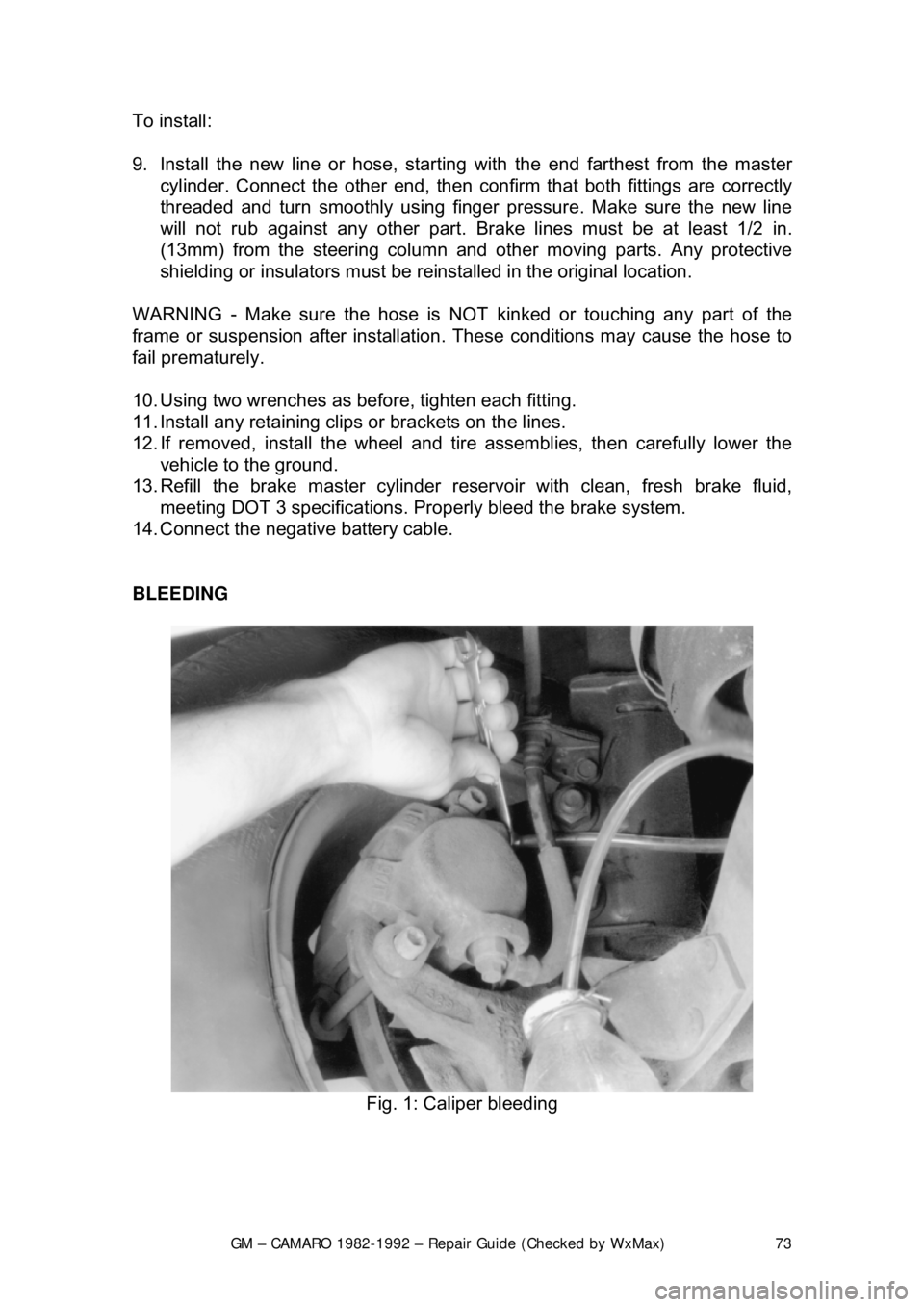
BLEEDING
Fig. 1: Caliper bleeding
Page 126 of 875
GM – CAMARO 1982-1992 – Repair Guide (Checked by WxMax) 126
CHASSIS ELECTRICAL
UNDERSTANDING AND TROUBLESHOOTING ELECTRICAL SYSTEMS
BASIC ELECTRICAL THEORY
For any 12 volt, negative ground, electrical system to operate, the electricity
must travel in a complete circuit. This simply means that current (power) from
the positive (+) terminal of the battery must eventually return to the negative (—
) terminal of the battery. Along the way, this current will travel through wires,
fuses, switches and components. If, for any reason, the flow of current through
the circuit is interrupted, the component f ed by that circuit will cease to function
properly.
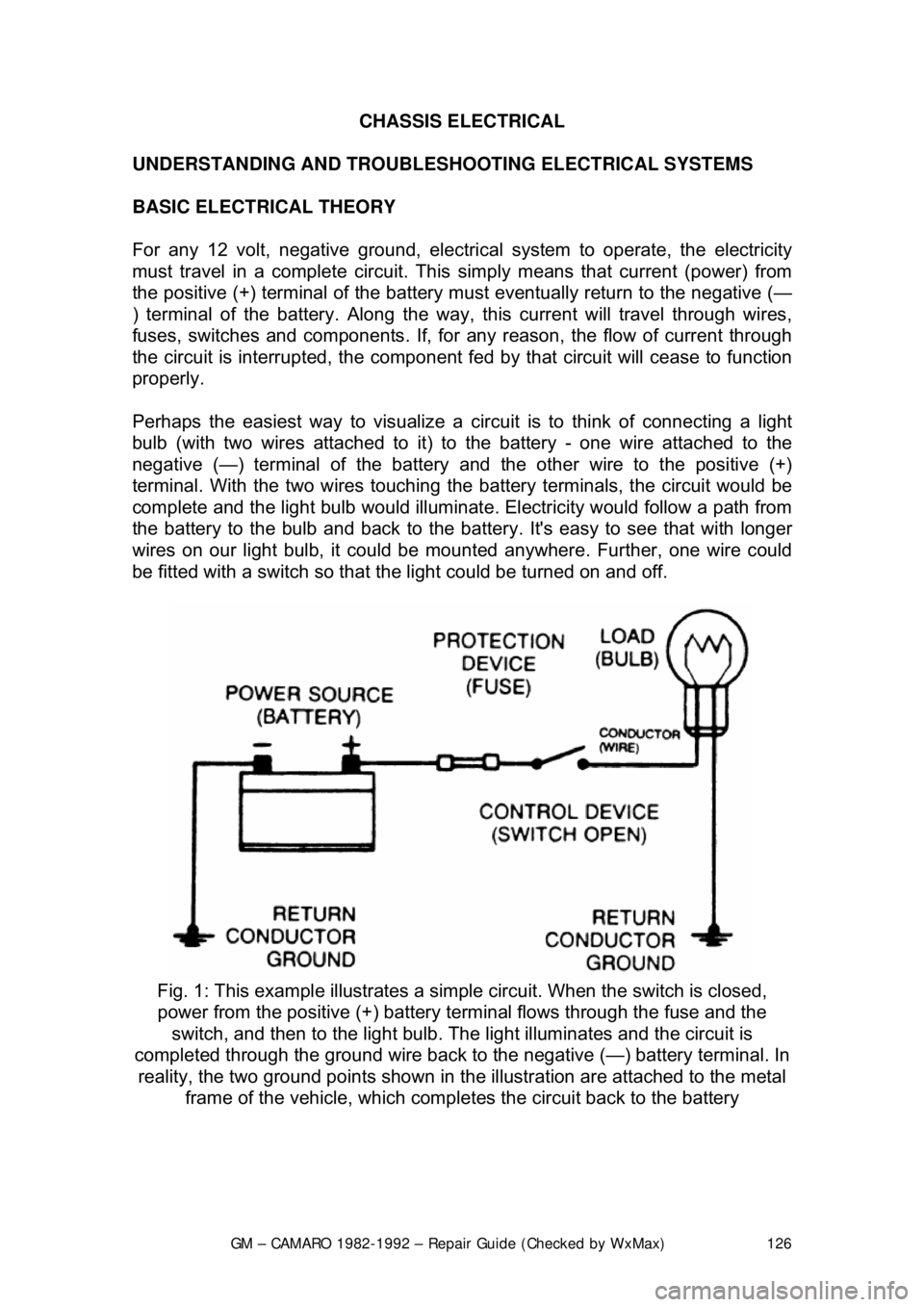
Perhaps the easiest way to visualize a circ uit is to think of connecting a light
bulb (with two wires attac hed to it) to the battery - one wire attached to the
negative (—) terminal of the battery and the other wire to the positive (+)
terminal. With the two wires touching the battery terminals, the circuit would be
complete and the light bulb would illuminat e. Electricity would follow a path from
the battery to the bulb and back to the bat tery. It's easy to see that with longer
wires on our light bulb, it could be mounted anywhere. Further, one wire could
be fitted with a switch so that t he light could be turned on and off.
Fig. 1: This example illu strates a simple circuit. Wh en the switch is closed,
power from the positive (+) battery te rminal flows through the fuse and the
switch, and then to the light bulb. The light illuminates and the circuit is
completed through the ground wire back to the negative (—) battery terminal. In
reality, the two ground point s shown in the illustration are attached to the metal
frame of the vehicle, which comple tes the circuit back to the battery
Page 127 of 875

GM – CAMARO 1982-1992 – Repair Guide (Checked by WxMax) 127
The normal automotive circuit differs from
this simple example in two ways.
First, instead of having a return wire from the bulb to the battery, the current
travels through the frame of the vehicle. Since the negative (—) battery cable is
attached to the frame (made of electrically conductive metal), the frame of the
vehicle can serve as a ground wire to complete the circuit. Secondly, mo\
st
automotive circuits contain multiple components which receive power from a
single circuit. This lessens the amount of wire needed to power components on
the vehicle.
HOW DOES ELECTRICITY WORK: THE WATER ANALOGY
Electricity is the flow of electrons - t he subatomic particles that constitute the
outer shell of an atom. Elec trons spin in an orbit around the center core of an
atom. The center core is comprised of protons (positive charge) and neutrons
(neutral charge). Electrons have a negativ e charge and balance out the positive
charge of the protons. When an outside forc e causes the number of electrons to
unbalance the charge of the protons, the electrons will split off the atom and
look for another atom to balance out. If th is imbalance is kept up, electrons will
continue to move and an elec trical flow will exist.
Many people have been taught electrical th eory using an analogy with water. In
a comparison with water flowing through a pipe, the electrons would be the
water and the wire is the pipe.
The flow of electricity can be measur ed much like the flow of water through a
pipe. The unit of measur ement used is amperes, frequently abbreviated as
amps (a). You can compare amperage to th e volume of water flowing through a
pipe. When connected to a circuit, an ammeter will measure the actual amount
of current flowing through the circuit. W hen relatively few electrons flow through
a circuit, the amperage is low. When many electrons flow, the amperage is high.
Water pressure is measured in units su ch as pounds per square inch (psi); The
electrical pressure is m easured in units called volts (v). When a voltmeter is
connected to a circuit, it is meas uring the electrical pressure.
The actual flow of electricity depends not only on voltage and amperage, but
also on the resistance of the circuit. T he higher the resistance, the higher the
force necessary to push the current through the circuit. The standard unit for
measuring resistance is an ohm. Resistance in a circuit varies depending on the
amount and type of components used in t he circuit. The main factors which
determine resistance are:
• Material - some materials have more resistance than others. Those with
high resistance are said to be insulato rs. Rubber materials (or rubber-like
plastics) are some of the most common insulators used in vehicles as
they have a very high resistance to electricity. Very low resistance
materials are said to be conductors. Copper wire is among the best
conductors. Silver is actually a super ior conductor to copper and is used
in some relay contacts, but its hi gh cost prohibits its use as common
wiring. Most automotive wir ing is made of copper.
Page 128 of 875

GM – CAMARO 1982-1992 – Repair Guide (Checked by WxMax) 128
•
Size - the larger the wire size being used, the less resistance the wire will
have. This is why components which use large amounts of electricity
usually have large wires suppl ying current to them.
• Length - for a given thickness of wire, the longer the wire, the greater the
resistance. The shorter the wire, the less the resistance. When
determining the proper wire for a circ uit, both size and length must be
considered to design a circuit that can handle the current needs of the
component.
• Temperature - with many materials, the higher the temperature, the
greater the resistance (positive temper ature coefficient). Some materials
exhibit the opposite trait of lower re sistance with higher temperatures
(negative temperature coefficient). Thes e principles are used in many of
the sensors on the engine.
OHM'S LAW
There is a direct relationship between current, voltage and resistance. The
relationship between current, voltage and resistance can be summed up by a
statement known as Ohm's law.
Voltage (E) is equal to amper age (I) times resistance (R): E=I x ROther forms of
the formula are R=E/I and I=E/R
In each of these formulas, E is the voltage in volts, I is the current in amps and
R is the resistance in ohms. The basic point to remember is that as the
resistance of a circuit goes up, the amount of current that flows in the circuit will
go down, if voltage remains the same.
The amount of work that the electricity can perform is expressed as power. The
unit of power is the watt (w). The re lationship between power, voltage and
current is expressed as:
Power (w) is equal to amperage (I) times voltage (E): W=I x EThis is only true
for direct current (DC) circuits; The alte rnating current formula is a tad different,
but since the electrical circuits in mo st vehicles are DC type, we need not get
into AC circuit theory.
ELECTRICAL COMPONENTS
POWER SOURCE
Power is supplied to the vehicle by tw o devices: The battery and the alternator.
The battery supplies electrical power dur ing starting or during periods when the
current demand of the vehicle's electrical system exceeds the output capacity of
the alternator. The alternator supplies electrical current when the engine is
running. Just not does the al ternator supply the current needs of the vehicle, but
it recharges the battery.
Page 129 of 875

GM – CAMARO 1982-1992 – Repair Guide (Checked by WxMax) 129
THE BATTERY
In most modern vehicles, the battery is
a lead/acid electrochemical device
consisting of six 2 volt subs ections (cells) connected in se ries, so that the unit is
capable of producing approximately 12 volt s of electrical pressure. Each
subsection consists of a series of positive and negative plates held a short
distance apart in a solution of sulfuric acid and water.
The two types of plates are of dissim ilar metals. This sets up a chemical
reaction, and it is this r eaction which produces current flow from the battery
when its positive and negative terminals are connected to an electrical \
load .
The power removed from the battery is r eplaced by the alternator, restoring the
battery to its original chemical state.
THE ALTERNATOR
On some vehicles there isn't an alter nator, but a generator. The difference is
that an alternator supplies alternating current which is then changed to direct
current for use on the vehicle, while a generator produces direct current.
Alternators tend to be more efficient and that is why they are used.
Alternators and generators are devices t hat consist of coils of wires wound
together making big electrom agnets. One group of coils spins within another set
and the interaction of the magnetic fields causes a current to flow. This current
is then drawn off the coils and fed into the vehicles electrical system.
GROUND
Two types of grounds are used in automot ive electric circuits. Direct ground
components are grounded to the frame thr ough their mounting points. All other
components use some sort of ground wire which is attached to the frame or
chassis of the vehicle. The electrical current runs through the chassis of the
vehicle and returns to the battery thr ough the ground (—) cable; if you look,
you'll see that the battery ground cabl e connects between the battery and the
frame or chassis of the vehicle.
It should be noted that a good percentage of electrical problems can be traced
to bad grounds.
PROTECTIVE DEVICES
It is possible for large surges of current to pass through the electrical system of
your vehicle. If this surge of current we re to reach the load in the circuit, the
surge could burn it out or severely dam age it. It can also overload the wiring,
causing the harness to get hot and melt t he insulation. To prevent this, fuses,
circuit breakers and/or fusible links are connected into the supply wires of the
electrical system. These items are nothing more than a built-in weak spot in the
system. When an abnormal amount of curr ent flows through the system, these
protective devices work as fo llows to protect the circuit:
Page 131 of 875
GM – CAMARO 1982-1992 – Repair Guide (Checked by WxMax) 131
•
Circuit Breaker - a circuit breaker is basically a self-repairing fuse. It will
open the circuit in the same fashio n as a fuse, but when the surge
subsides, the circuit breaker can be reset and does not need
replacement.
• Fusible Link - a fusible link (fuse link or main link) is a short length of
special, high temperatur e insulated wire that acts as a fuse. When an
excessive electrical current passes th rough a fusible link, the thin gauge
wire inside the link melt s, creating an intentional open to protect the
circuit. To repair the circuit, the link must be replaced. Some newer type
fusible links are housed in plug-in modules, which are simply replaced
like a fuse, while older type fusible lin ks must be cut and spliced if they
melt. Since this link is very early in the electrical path, it's the first place to
look if nothing on the vehicle works, yet the battery seems to be charged
and is properly connected.
CAUTION - Always replace fuses, circ uit breakers and fusible links with
identically rated component s. Under no circumstances should a component of
higher or lower amperage rating be substituted.
SWITCHES & RELAYS
Switches are used in electrical circuits to control the passage of current. The
most common use is to open and close circuits between the battery and the
various electric devices in the system. Switches are rated according to the
amount of amperage they c an handle. If a sufficient amperage rated switch is
not used in a circuit, the switch could overload and cause damage.
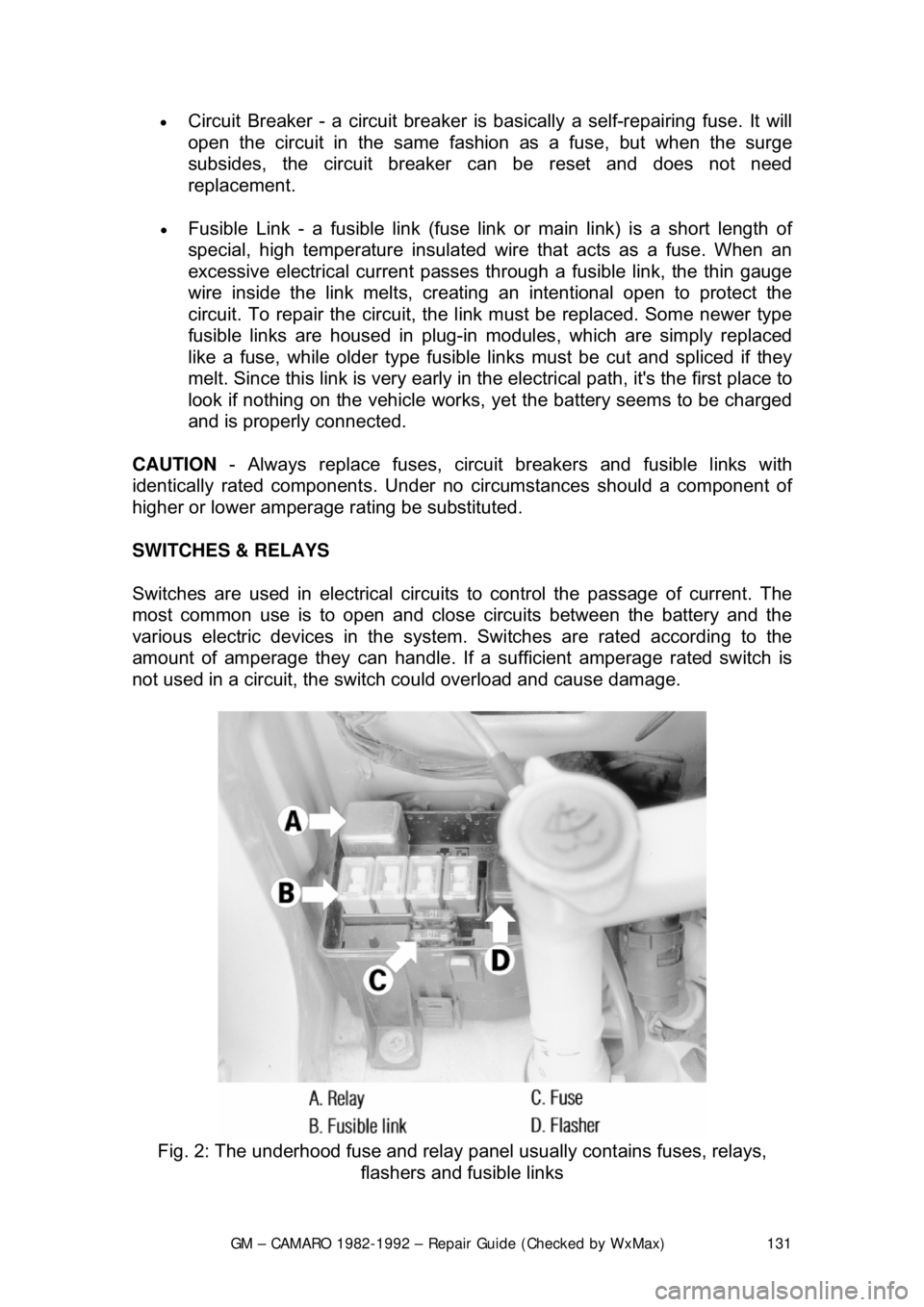
Fig. 2: The underhood fuse and relay panel usually contains fuses, relays,
flashers and fusible links
Page 132 of 875
GM – CAMARO 1982-1992 – Repair Guide (Checked by WxMax) 132
Some electrical components which require
a large amount of current to operate
use a special switch called a relay. Sinc e these circuits carry a large amount of
current, the thickness of the wire in the ci rcuit is also greater. If this large wire
were connected from the load to the c ontrol switch, the switch would have to
carry the high amperage load and the fair ing or dash would be twice as large to
accommodate the increased size of t he wiring harness. To prevent these
problems, a relay is used.
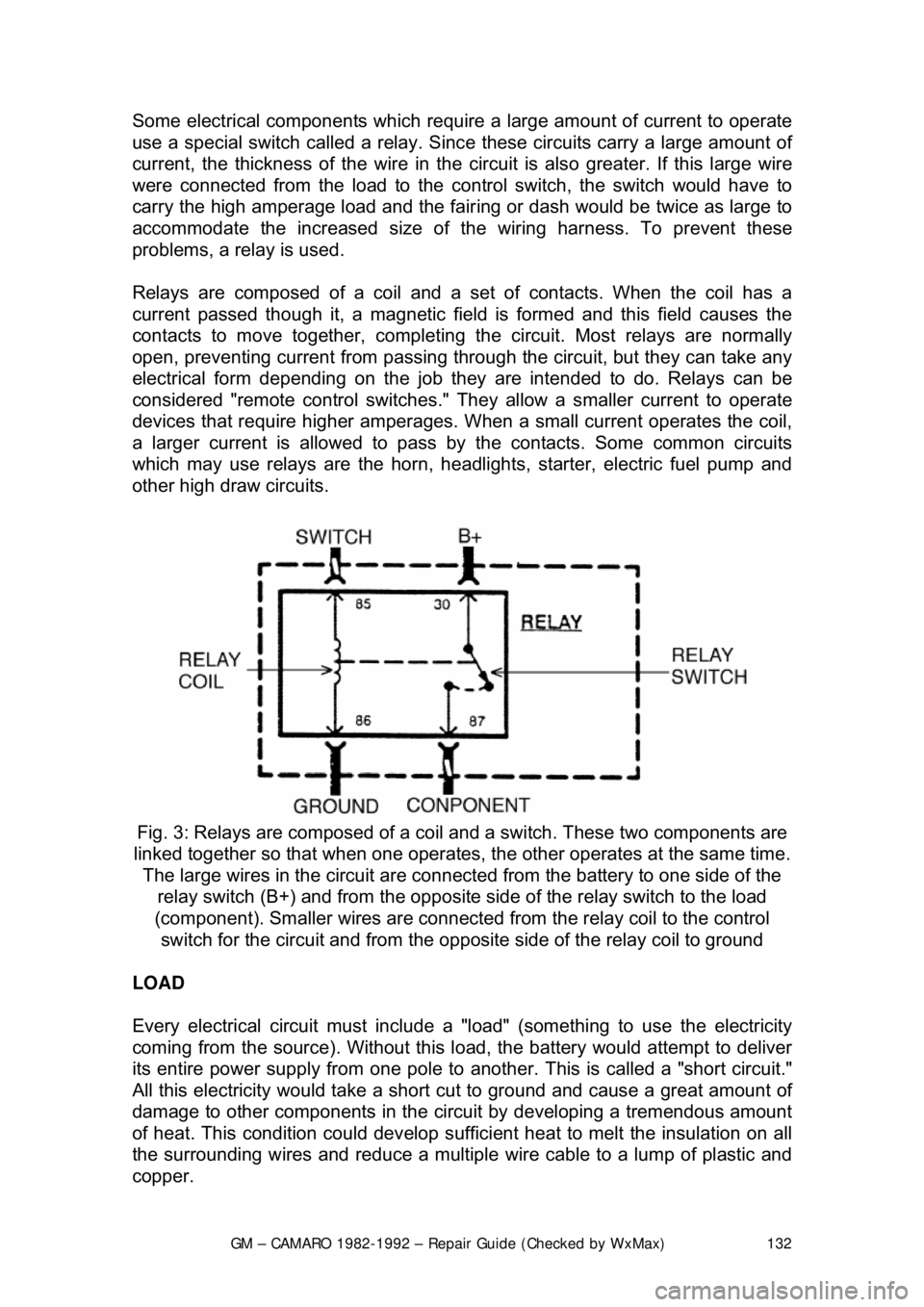
Relays are composed of a coil and a se t of contacts. When the coil has a
current passed though it, a magnetic fiel d is formed and this field causes the
contacts to move together, completing the circuit. Most relays are normally
open, preventing current from passing thr ough the circuit, but they can take any
electrical form depending on th e job they are intended to do. Relays can be
considered "remote control switches." They allow a smaller current to operate
devices that require higher amperages. W hen a small current operates the coil,
a larger current is allo wed to pass by the contacts. Some common circuits
which may use relays are the horn, headlight s, starter, electric fuel pump and
other high draw circuits.
Fig. 3: Relays are composed of a coil and a switch. These two components are
linked together so that w hen one operates, the other operat es at the same time.
The large wires in the circuit are connect ed from the battery to one side of the
relay switch (B+) and from the opposite side of the re lay switch to the load
(component). Smaller wires are connected from the relay coil to the control
switch for the circuit and from the opposite side of the relay coil to ground
LOAD
Every electrical circuit must include a "load" (something to use the electricity
coming from the source). Without this l oad, the battery would attempt to deliver
its entire power supply from one pole to another. This is called a "short circuit."
All this electricity would take a short cut to ground and cause a great amount of
damage to other components in the circui t by developing a tremendous amount
of heat. This condition could develop suffici ent heat to melt the insulation on all
the surrounding wires and reduce a multiple wire cable to a lump of plastic and
copper.