intake CHEVROLET CAMARO 1982 Repair Guide
[x] Cancel search | Manufacturer: CHEVROLET, Model Year: 1982, Model line: CAMARO, Model: CHEVROLET CAMARO 1982Pages: 875, PDF Size: 88.64 MB
Page 410 of 875
GM – CAMARO 1982-1992 – Repair Guide (Checked by WxMax) 410
11. Disconnect all electrical connecti
ons from the intake manifold and
cylinder head.
12. If the vehicle has air conditioning, remove the compressor and position it
out of the way. Do not disc onnect the refrigerant lines.
13. Remove the alternator and lay the unit aside. If necessary, remove the
alternator brackets.
14. Remove any other brackets or components mounted on the cylinder
head.
15. Remove the upper radiator hose.
16. Remove the rocker arm cover and back off the rocker arm nuts/bolts and
pivot the rocker arms out of the way so that the pushrods can be
removed. Identify the pushrods so that they can be reinstalled in their
original locations.
17. Remove the cylinder head bolts and cylinder head. Remove the intake
and exhaust manifolds, as required.
To install: 18. Thoroughly clean all mating surfaces of oil, grease and old gasket material. Clean the head bo lts and cylinder block threads, otherwise an
accurate torque specificat ion will not be attained.
19. Install a new gasket on the block mating surface. Position the cylinder
head on the block.
Clean the bolt threads, apply sealing comp ound and install the bolts finger-tight.
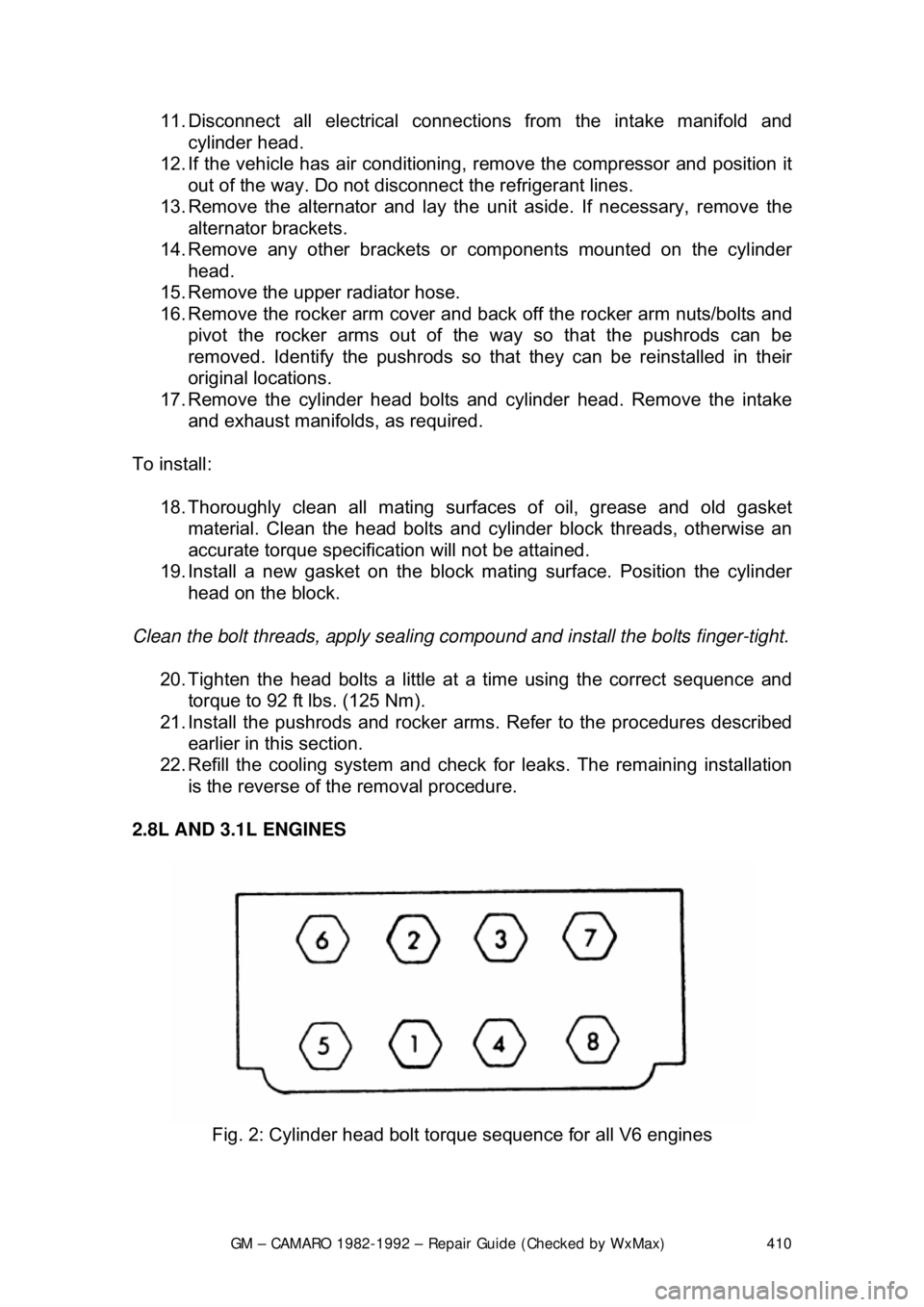
20. Tighten the head bolts a little at a time using the correct sequence and
torque to 92 ft lbs. (125 Nm).
21. Install the pushrods and rocker arms . Refer to the procedures described
earlier in this section.
22. Refill the cooling system and check for leaks. The remaining installation
is the reverse of the removal procedure.
2.8L AND 3.1L ENGINES
Fig. 2: Cylinder head bolt torque sequence for all V6 engines
Page 411 of 875

GM – CAMARO 1982-1992 – Repair Guide (Checked by WxMax) 411
1. Disconnect the negative battery cable.
2. Relieve the fuel system pressure
and drain the engine coolant from the
radiator into a suitable container.
3. Remove the intake manifold and the spark plugs.
4. Remove the dipstick tube and bra cket. Raise and support the vehicle
safely. Drain the oil and remove the oil filter. Lower the vehicle.
5. Remove the exhaust manifolds.
6. Remove the drive belt(s).
7. Remove the air conditioning compresso r and bracket, reposition it aside.
Do not disconnect the lines.
8. Remove the power steering pump and bracket, reposition it aside.
9. Remove the alternator and br acket, reposition it aside.
10. Remove the ground cable from the rear of the cylinder head and remove
the engine lift bracket.
11. Remove the rocker arm covers.
12. Loosen the rocker arms until the pushrods can be removed.
13. Remove the cylinder head bolts and remove the cylinder heads.
To install: 14. Clean the gasket mating surfaces of all components. Be careful not to
nick or scratch any surfaces as this will allow leak paths. Clean the bolt
threads in the cylinder bl ock and on the head bolts. Dirt will affect bolt
torque.
15. Place the head gaskets in pos ition over the dowel pins.
16. Install the cylinder heads.
17. Coat the cylinder head bolts th reads with GM sealer 1052080 or
equivalent, and install the bolts. Tight en the bolts in the proper sequence
to:
• 1982-1987 engines: 70 ft lbs. (90 Nm)
• 1988-1992 engines: 1st step: 40 ft lbs. (55 Nm); 2nd step: tighten
an additional 1/4 (90 degree) turn
18. Install the pushrods a nd loosely retain them wit h the rocker arms. Make
sure the lower ends of the pushrods ar e in the lifter seats. Refer to the
rocker arm procedures outlined ea rlier in this section.
19. Install the power steering pump br acket and pump. Do the same for the
air conditioning compressor bracket and compressor.
20. Install the ground cable to t he rear of the cylinder head.
21. Install the exhaust manifolds.
22. Install the dipstick tube and bracket.
23. Install the intake manifold.
24. Install the alternator bracket and alternator.
25. Install the drive belt(s).
26. Install the spark plugs.
27. Fill the cooling system with the proper type and quantity of coolant. Install
a new oil filter and fill the crankca se with the proper type and quantity of
oil.
28. Connect the negative battery cable, star t the vehicle and check for leaks.
Page 416 of 875
GM – CAMARO 1982-1992 – Repair Guide (Checked by WxMax) 416
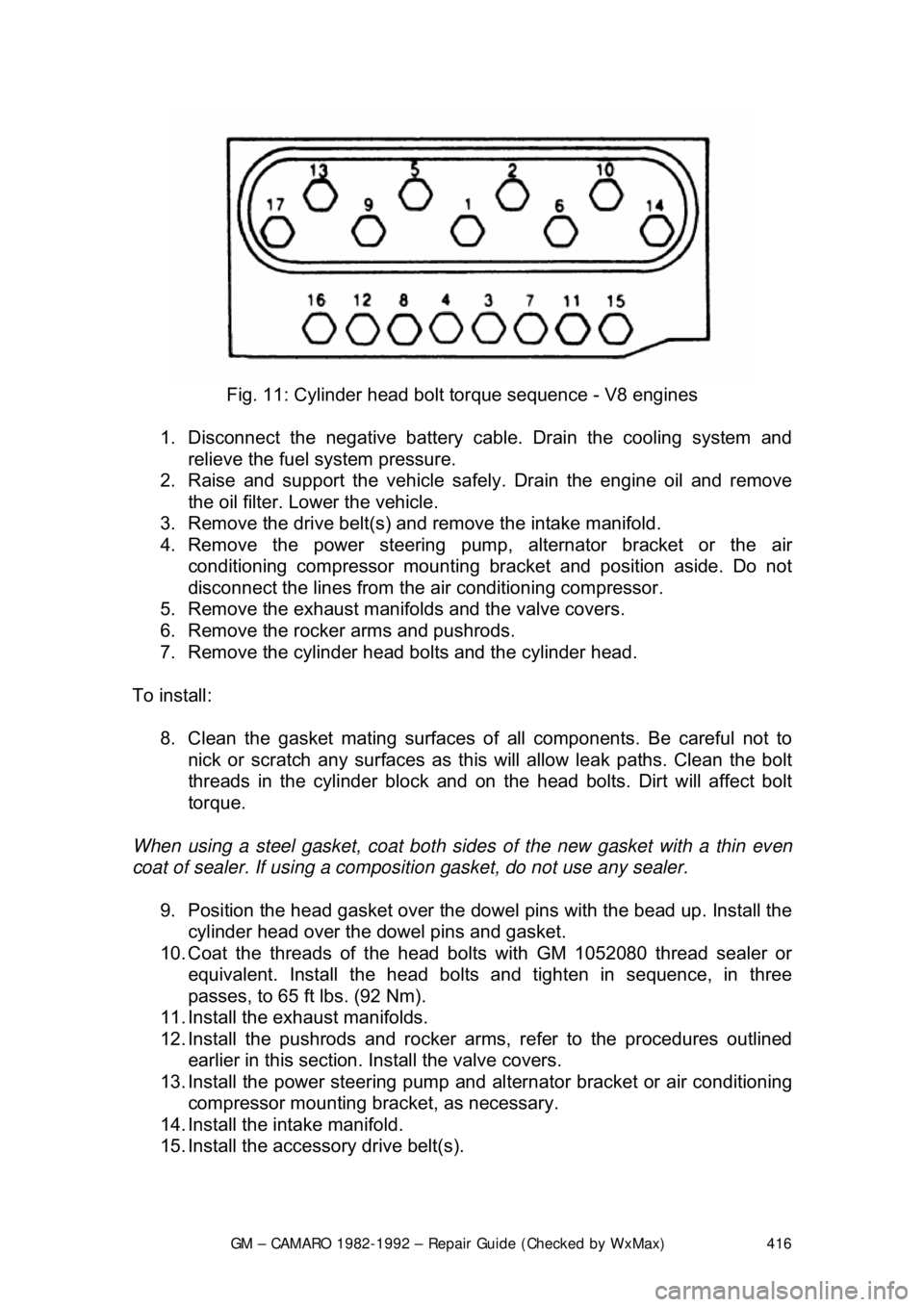
Fig. 11: Cylinder head bolt torque sequence - V8 engines
1. Disconnect the negative battery c able. Drain the cooling system and
relieve the fuel system pressure.
2. Raise and support the vehicle safe ly. Drain the engine oil and remove
the oil filter. Lower the vehicle.
3. Remove the drive belt(s) and remove the intake manifold.
4. Remove the power steering pump, alternator bracket or the air
conditioning compressor mounting br acket and position aside. Do not
disconnect the lines from the air conditioning compressor.
5. Remove the exhaust manifolds and the valve covers.
6. Remove the rocker arms and pushrods.
7. Remove the cylinder head bolts and the cylinder head.
To install: 8. Clean the gasket mating surfaces of all components. Be careful not to
nick or scratch any surfaces as this will allow leak paths. Clean the bolt
threads in the cylinder bl ock and on the head bolts. Dirt will affect bolt
torque.
When using a steel gasket, coat both sides of the new gasket with a thin even
coat of sealer. If using a compos ition gasket, do not use any sealer.
9. Position the head gasket over the dow el pins with the bead up. Install the
cylinder head over the dowel pins and gasket.
10. Coat the threads of the head bo lts with GM 1052080 thread sealer or
equivalent. Install the head bolts and tighten in sequence, in three
passes, to 65 ft lbs. (92 Nm).
11. Install the exhaust manifolds.
12. Install the pushrods and rocker arms, refer to the procedures outlined earlier in this section. Install the valve covers.
13. Install the power steering pump and al ternator bracket or air conditioning
compressor mounting bra cket, as necessary.
14. Install the intake manifold.
15. Install the accessory drive belt(s).
Page 441 of 875

GM – CAMARO 1982-1992 – Repair Guide (Checked by WxMax) 441
2. Remove the fan, driv
e belts and water pump pul ley. Remove the valve
cover. Loosen the rocker arms and pivot them, then remove the
pushrods.
3. Remove the oil pump driveshaft and gear assembly. This is located
under a small plate secured by two bol ts near the oil filter. Remove the
spark plugs.
4. Mark the position of the distribut or rotor, housing, and engine block.
Remove the distributor.
5. Remove the valve lifters. They are located behind the pushrod cover.
6. Remove the timing gear cover.
7. Insert a screwdriver through the holes in the ti ming gear and remove the
2 camshaft thrust plate screws.
8. Pull the camshaft and gear assembly out through the front of the engine
block.
When removing the camshaft, be careful not to damage the camshaft bearings.
9. If the camshaft is to be removed from the timing gear, place the assembly in an arbor press and s eparate. CAUTION When removing the
timing gear from the camshaft, the thrust plate must be positioned so that
the woodruff key does not damage it.
To install: 10. To install the timing gear to the camshaft, press the assembly together
and measure the end clearance. T here should be 0.0015-0.0050 in.
(0.038-0.127mm) between the thrust plate and the camshaft.
If the clearance is less than 0.0015 in. (0 .038mm), replace the spacer ring; if
more than 0.0050 in. (0.127mm), replace the thrust ring.
11. Lubricate the camshaft, bearings, and lifters. Slide the camshaft
assembly into the engine and align the timing marks of the camshaft gear
and crankshaft gear.
12. Complete the installation by reversing the removal procedure.
V6 AND V8 ENGINES 1. Remove the engine from the vehicl e or remove all components from the
front of the engine (radi ator, grille, etc.).
2. Remove the timing gear cover and chain.
3. Mark the distributor rotor, housi ng and engine block, then remove the
distributor. Remove the fuel pump and fuel pump pushrod on carbureted
engines.
4. Remove the intake manifold and valve covers. Loosen the rocker arms
and pivot out of way. Remove the pushrods and valve lifters.
5. Remove the oil pump drive.
6. Slide the camshaft toward the front of the engine (be careful not to
damage the camshaft bearings).
Page 442 of 875

GM – CAMARO 1982-1992 – Repair Guide (Checked by WxMax) 442
To install:
7. Lubricate all parts. Slide the ca mshaft onto the camshaft bearings.
8. Install the fuel pump and fuel pump pushrod.
9. Install the distributor and align all matchmarks.
10. Install the oil pump drive.
11. Install the valve lifters, pushrods and rocker arms.
12. Install the intake manifold and valve covers.
13. Install the timing and timing chain cover.
14. Install the radiator.
15. Fill the cooling syst em, start the engine and check for leaks.
BEARING
REMOVAL & INSTALLATION
It is recommended for a machine shop to perform these procedures.
To remove the camshaft bearings, the ca mshaft lifters, flywheel, rear camshaft
expansion plug, and cranks haft must be removed.
Camshaft bearings can be replaced wi th engine completely or partially
disassembled. To replace bearings without complete disassembly remove the
camshaft and crankshaft leaving cylinder heads attached and pistons in place.
Before removing crankshaft, tape threads of connecting rod bolts to prevent
damage to crankshaft. Fasten connecting rods against sides of engine so they
will not be in the way while replacing camshaft bearings.
If excessive wear is indicated, or if the engine is being completely rebuilt,
camshaft bearings should be replaced as follows: Drive the camshaft rear plug
from the block. Assemble the removal puller with its shoulder on the bearing to
be removed. Gradually tighten the puller nut until bearing is removed. Remove
remaining bearings, leaving the front and rear for last. To remove front and rear
bearings, reverse position of the tool, so as to pull the bearings in toward the
center of the block. Leave the tool in th is position, pilot the new front and rear
bearings on the installer, and pull them into position as follows:
• 4 cylinder engines: Ensure oil holes are properly aligned.
• V6 engines: Ensure the rear and intermediate bearing oil holes are
aligned between the 2 and 3 o'clock po sitions and the front bearing oil
holes are at 1:00 and between 2 and 3 o'clock positions.
• V8 engines: Ensure the No. 1 (f ront) camshaft bearing holes are an
equal distance from the 6 o'clock pos ition. The No. 2 through 4 inner
bearing holes must be posit ioned at the 5 o'clock position towards the left
side (drivers) of the engine, even wit h the bottom of the cylinder bore.
The No. 5 bearing oil holes must be positioned at 12 o'clock.
Return the tool to its original position and pull remaining bearings into position.
Page 444 of 875
GM – CAMARO 1982-1992 – Repair Guide (Checked by WxMax) 444
2. Zero the dial indicator. Positi
on a prybar between the camshaft gear and
the block. Pull the camshaft forwar d and release it. Compare the dial
indicator reading with the specifications.
3. If the end play is excessive, che ck the spacer for correct installation
before it is removed. If the spacer is correctly installed, replace the thrust
plate.
4. Remove the dial indicator.
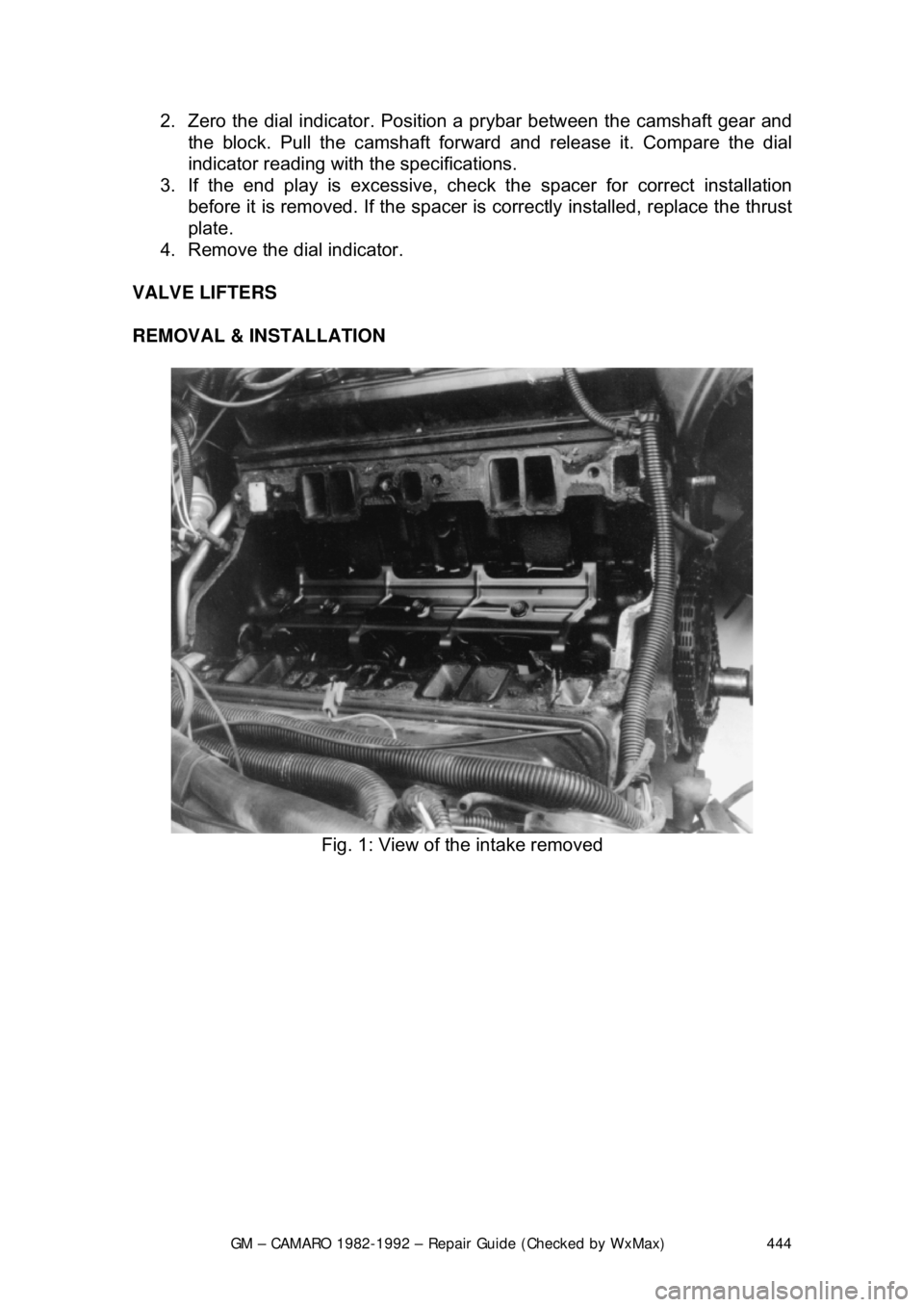
VALVE LIFTERS
REMOVAL & INSTALLATION
Fig. 1: View of the intake removed
Page 449 of 875

GM – CAMARO 1982-1992 – Repair Guide (Checked by WxMax) 449
1. Remove the intake manifold, valve
cover and pushrod cover (4-cylinder).
Disassemble the rocker arms and remove the pushrods.
2. Remove the lifters. If they are coat ed with varnish, clean with carburetor
cleaning solvent.
3. If installing new lifters or you have disassembled the lifters, they must be
primed before installation. Submer ge the lifters in SAE 10 oil and
carefully push down on the plunger with a
1/8 in. (3mm) drift. Hold the
plunger down (DO NOT pum p), then release the plunger slowly. The lifter
is now primed.
4. Coat the bottoms of the lifters wit h Molykote® before installation. Install
the lifters and pushrods into the e ngine in their original position.
5. Install the rocker arms and adjust the valves. Complete the installation by
reversing the removal procedure.
FREEZE PLUGS
REMOVAL & INSTALLATION
CAUTION - When draining the coolant, keep in mind that cats and dogs are
attracted by the ethylene gl ycol antifreeze, and are quite likely to drink any that
is left in an uncovered container or in puddles on the ground. This will prove
fatal in sufficient quantity. Always drai n the coolant into a sealable container.
Coolant should be reused unless it is contaminated or several years old.
1. Disconnect the negative battery cable.
2. Drain the cooling system.
3. Raise and support the vehicle safely.
4. Remove the coolant drain plug on t he side of the block, if equipped. If not
you can use a punch to put a small ho le in the center of the freeze plug
that is being replaced.
5. Remove all components in order to gain access to the freeze plug(s).
6. Using a punch, tap the bottom corner of the freeze plug to cock it in the
bore. Remove the plug using pliers.
7. Clean the freeze plug hole and c oat the new plug with sealer.
8. Using a suitable tool, install the freeze plug into the block.
9. Connect the negative battery cable, fill the cooling system, start the
engine and check for leaks.
REAR MAIN OIL SEAL
REMOVAL & INSTALLATION
CAUTION - The EPA warns that prol onged contact with used engine oil may
cause a number of skin disorders, incl uding cancer! You should make every
effort to minimize your exposure to used engine oil. Pr otective gloves should be
worn when changing the oil. Wash y our hands and any other exposed skin
areas as soon as possible after exposure to used engine oil. Soap and water, or
waterless hand cleaner should be used.
1-PIECE NEOPRENE SEAL
Page 465 of 875
GM – CAMARO 1982-1992 – Repair Guide (Checked by WxMax) 465
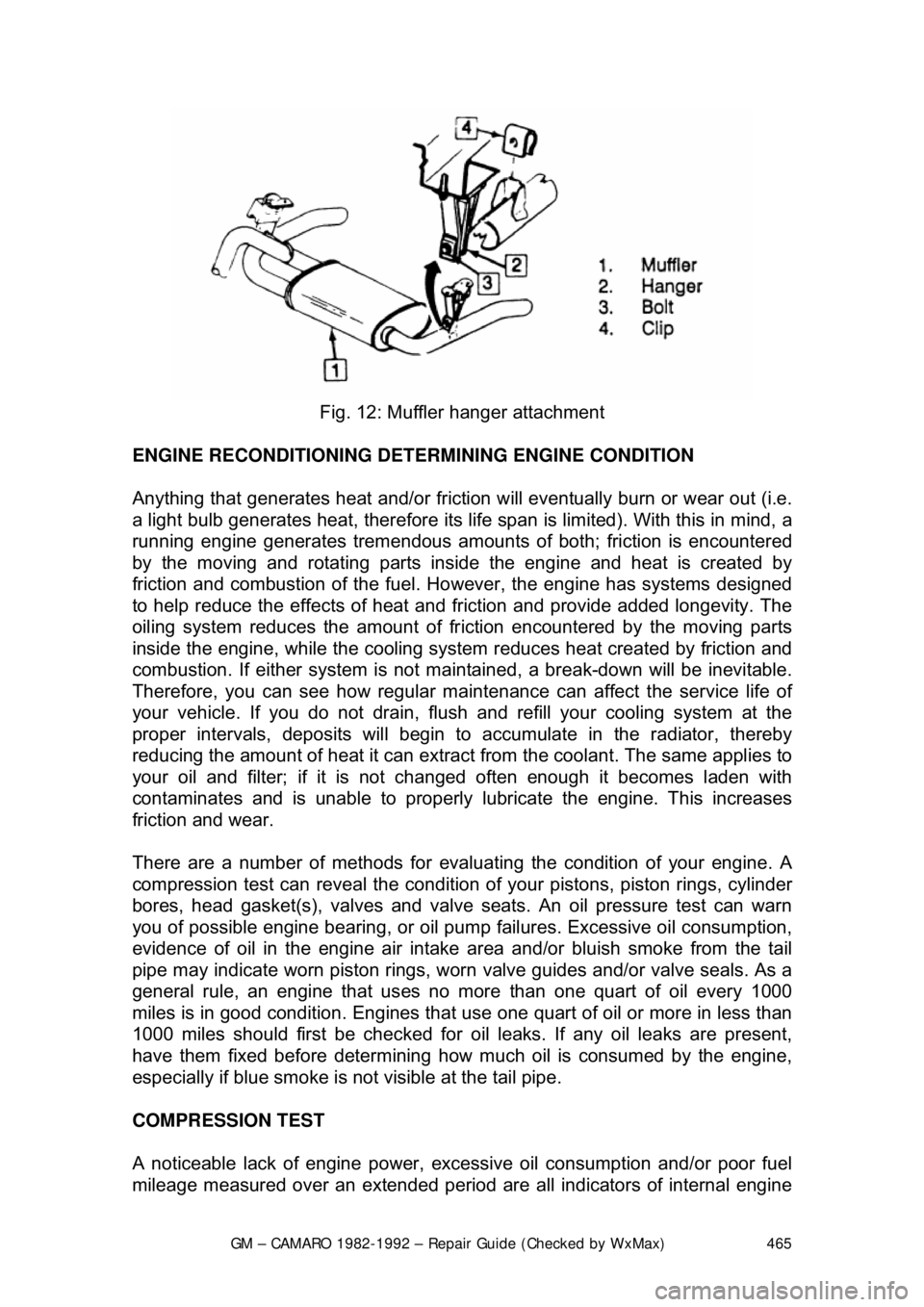
Fig. 12: Muffler hanger attachment
ENGINE RECONDITIONING DETE RMINING ENGINE CONDITION
Anything that generates heat and/or friction will eventually burn or wear out (i.e.
a light bulb generates heat, therefore its life span is limited). With this in mind, a
running engine generates trem endous amounts of both; friction is encountered
by the moving and rotating parts inside the engine and heat is created b\
y
friction and combustion of the fuel. Ho wever, the engine has systems designed
to help reduce the effects of heat and fr iction and provide added longevity. The
oiling system reduces the amount of fr iction encountered by the moving parts
inside the engine, while the cooling system reduces heat created by friction and
combustion. If either system is not main tained, a break-down will be inevitable.
Therefore, you can see how regular main tenance can affect the service life of
your vehicle. If you do not drain, flush and refill your cooling system at the
proper intervals, deposits will begin to accumulate in the radiator, thereby
reducing the amount of heat it can extrac t from the coolant. The same applies to
your oil and filter; if it is not changed often enoug h it becomes laden with
contaminates and is unable to properly lubricate the engine. This increases
friction and wear.
There are a number of methods for evaluat ing the condition of your engine. A
compression test can reveal the condition of your pistons, piston rings, cylinder
bores, head gasket(s), valves and valve seat s. An oil pressure test can warn
you of possible engine bearing, or oil pump failures. Excessive oil consumption,
evidence of oil in the engine air intake area and/or bluish smoke from the tail
pipe may indicate worn piston rings, worn valve guides and/or valve seals. As a
general rule, an engine that uses no more than one quart of oil every 1000
miles is in good condi tion. Engines that use one quart of oil or more in less than
1000 miles should first be checked for oil leaks. If any oil leaks are present,
have them fixed before dete rmining how much oil is consumed by the engine,
especially if blue smoke is not visible at the tail pipe.
COMPRESSION TEST
A noticeable lack of engine power, excessive oil consumption and/or poor fuel
mileage measured over an extended period are all indicators of internal engine
Page 476 of 875

GM – CAMARO 1982-1992 – Repair Guide (Checked by WxMax) 476
Before attempting to repair a threaded
hole, remove any snapped, broken or
damaged bolts or studs. Penetrating oil ca n be used to free frozen threads. The
offending item can usually be removed with locking pliers or using a screw/stud
extractor. After the hole is clear, the thread can be repaired, as shown in the
series of accompanying illustrations and in the kit manufacturer's instructions.
ENGINE PREPARATION
To properly rebuild an engine, you must fi rst remove it from the vehicle, then
disassemble and diagnose it. Ideally you should place your engine on an engine
stand. This affords you the best access to the engine components. Follow the
manufacturer's directions for using the stand with your particular engine.
Remove the flywheel or fl explate before installing the engine to the stand.
Now that you have the engine on a stand, and assuming that you have drained
the oil and coolant from the engine, it's ti me to strip it of all but the necessary
components. Before you start disassembli ng the engine, you may want to take
a moment to draw some pictures, or fabr icate some labels or containers to mark
the locations of various components and the bolts and/or studs which fasten
them. Modern day engines use a lot of littl e brackets and clips which hold wiring
harnesses and such, and these holders are often mounted on studs and/or bolts
that can be easily mixed up. The manufacturer spent a lot of time and money
designing your vehicle, and they wouldn't have wasted any of it by haphazardly
placing brackets, clips or fasteners on t he vehicle. If it's present when you
disassemble it, put it back when you asse mble, you will regret not remembering
that little bracket which holds a wire har ness out of the path of a rotating part.
You should begin by unbolting any accessories still attached to the engine, such
as the water pump, power steering pump, alternator, etc. Then, unfasten any
manifolds (intake or exhaust) which were not removed during the engine
removal procedure. Finally, remove any covers remaining on the engine such
as the rocker arm, front or timing cove r and oil pan. Some front covers may
require the vibration dam per and/or crank pulley to be removed beforehand.
The idea is to reduce the engine to the bar e necessities (cylinder head(s), valve
train, engine block, crankshaft, pistons and connecting rods), plus any other 'in
block' components such as oil pumps, balance shafts and auxiliary shafts.
Finally, remove the cylinder head(s) from the engine block and carefully place
on a bench. Disassembly instructions fo r each component follow later in this
section.
CYLINDER HEAD
There are two basic types of cylinder heads used on today’s automobiles:
the Overhead Valve (OHV) and the Over head Camshaft (OHC). The latter can
also be broken down into two subgr oups: the Single Overhead Camshaft
(SOHC) and the Dual Overhead Camshaft (DO HC). Generally, if there is only a
single camshaft on a head, it is just referred to as an OHC head. Also, an
engine with a OHV cylinder head is also known as a pushrod engine.
Page 483 of 875
GM – CAMARO 1982-1992 – Repair Guide (Checked by WxMax) 483
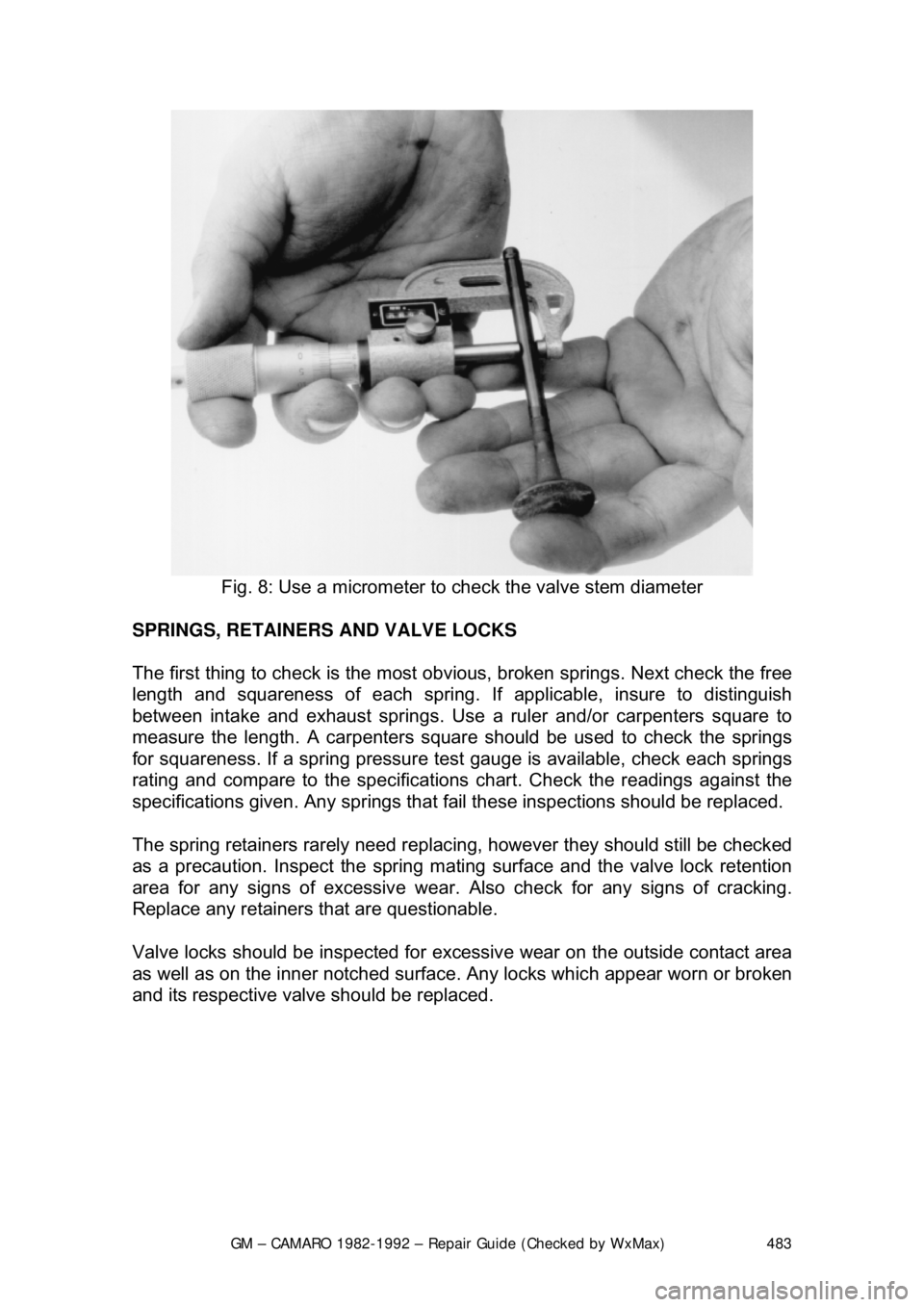
Fig. 8: Use a micrometer to check the valve stem diameter
SPRINGS, RETAINERS AND VALVE LOCKS
The first thing to check is the most obv ious, broken springs. Next check the free
length and squareness of each spring. If applicable, insure to distinguish
between intake and exhaust springs. Use a ruler and/or carpenters square to
measure the length. A car penters square should be used to check the springs
for squareness. If a spring pressure test gauge is available, check each springs
rating and compare to the specifications chart. Check the readings against the
specifications given. Any springs that fa il these inspections should be replaced.
The spring retainers rarely need replacing, however they should still be checked
as a precaution. Inspect the spring mating surface and the valve lock re\
tention
area for any signs of excessive wear. Also check for any signs of cracking.
Replace any retainers t hat are questionable.
Valve locks should be inspected for exce ssive wear on the outside contact area
as well as on the inner notched surface. Any locks which appear worn or broken
and its respective valve should be replaced.