intake CHEVROLET CAMARO 1982 Repair Guide
[x] Cancel search | Manufacturer: CHEVROLET, Model Year: 1982, Model line: CAMARO, Model: CHEVROLET CAMARO 1982Pages: 875, PDF Size: 88.64 MB
Page 692 of 875

GM – CAMARO 1982-1992 – Repair Guide (Checked by WxMax) 692
IDLE AIR VALVE
A cover is in place over t
he idle air bleed valve. Also , the access holes to the
idle mixture needles are s ealed with hardened plugs. This is done to seal the
factory settings, during original equipment production. These items are NOT to
be removed unless required for cleaning, part replacement, improper dwell
readings or if the System Performance Check indicates the carburetor is the
cause of the trouble.
ROCHESTER E4ME AND E4MC
1. With engine OFF, cover the internal bowl vents and inlet to bleed valve
and the carburetor air intakes with maski ng tape. This is done to prevent
metal chips from entering.
2. Carefully drill rivet head of idle air bleed cover, with 0.110 in. (2.8mm) drill bit.
3. Remove rivet head and all pieces of rivet.
4. Lift cover off air bleed valve and bl ow out any metal shavings, or use a
magnet to remove excess metal.
CAUTION - Always wear eye protection when using compressed air.
5. Remove masking tape.
6. Start engine and allow it to reac h normal operating temperature.
7. Disconnect the vacuum hose from t he canister purge valve and plug it.
8. While idling in D for automatic transmission or N for manual
transmission, slowly turn the valve c ounterclockwise or clockwise, until
the dwell reading varies within the 25-35 degree range, attempting to be
as close to 30 degrees as possible.
Perform this step carefully. The air bleed valve is very sensitive and should be
turned in
1/8 turn increments only.
9. If the dwell reading d oes not vary and is not within the 25-35 degree
range, it will be necessary to remove the plugs and to adjust the idle
mixture needles.
Page 711 of 875

GM – CAMARO 1982-1992 – Repair Guide (Checked by WxMax) 711
THROTTLE BODY INJECTION SYSTEM
SYSTEM DESCRIPTION
The throttle body injection (TBI) system used on 2.5L (VIN 2) and 5.0L (VIN E)
engines is centrally located
on the intake manifold. Its function is to supply the
correct air/fuel mixture to the engine, as directed by the Engine Control Module
(ECM).
The TBI unit consists of two relatively simple casting assemblies: a throttle body
and a fuel metering assembly. Components include, a pressure regulator, idle
air control valve, fuel injector(s), thro ttle position sensor, fuel inlet and a fuel
return fitting.
The Throttle Body Injection identifi cation number is stamped on the lower
mounting flange located near the TPS. Th e number is in alphabetical code and
should be noted before servicing the unit.
An oxygen sensor in the exhaust syst em functions to provide feedback
information to the ECM as to oxygen content in the exhaust. The ECM then
uses this information to modify fuel de livery to achieve as near as possible an
ideal air/fuel ratio of 14.7 :1. This ratio permits the ca talytic converter to become
more effective in reducing emissions wh ile providing acceptable driveability.
Should you encounter any type of engine performance problem, have a
complete CCC system test performed by a qualified, professional technician. If
the fault lies in the injection system, you can use the following procedures to
remove the TBI unit and replace the defective component(s).
RELIEVING FUEL SYSTEM PRESSURE
1. Disconnect the negative battery cable to prevent fuel discharge if the key
is accidentally turned to the RUN position.
2. Loosen the fuel filler cap to relieve fuel tank pressure and do not tighten
until service has been completed.
3. Fuel system pressure is automatic ally relieved when the engine is turned
OFF. No further action is necessary.
When disconnecting fuel lines, there ma y still be a small amount of fuel
released. Cover the fuel line connection wi th a shop cloth to collect the fuel,
then place the cloth in an approved container.
ELECTRIC FUEL PUMP
REMOVAL & INSTALLATION
The fuel pump is part of t he fuel sender assembly located inside the fuel tank.
1. Release the fuel syst em pressure and disconnec t the negative battery
cable.
Page 735 of 875
GM – CAMARO 1982-1992 – Repair Guide (Checked by WxMax) 735
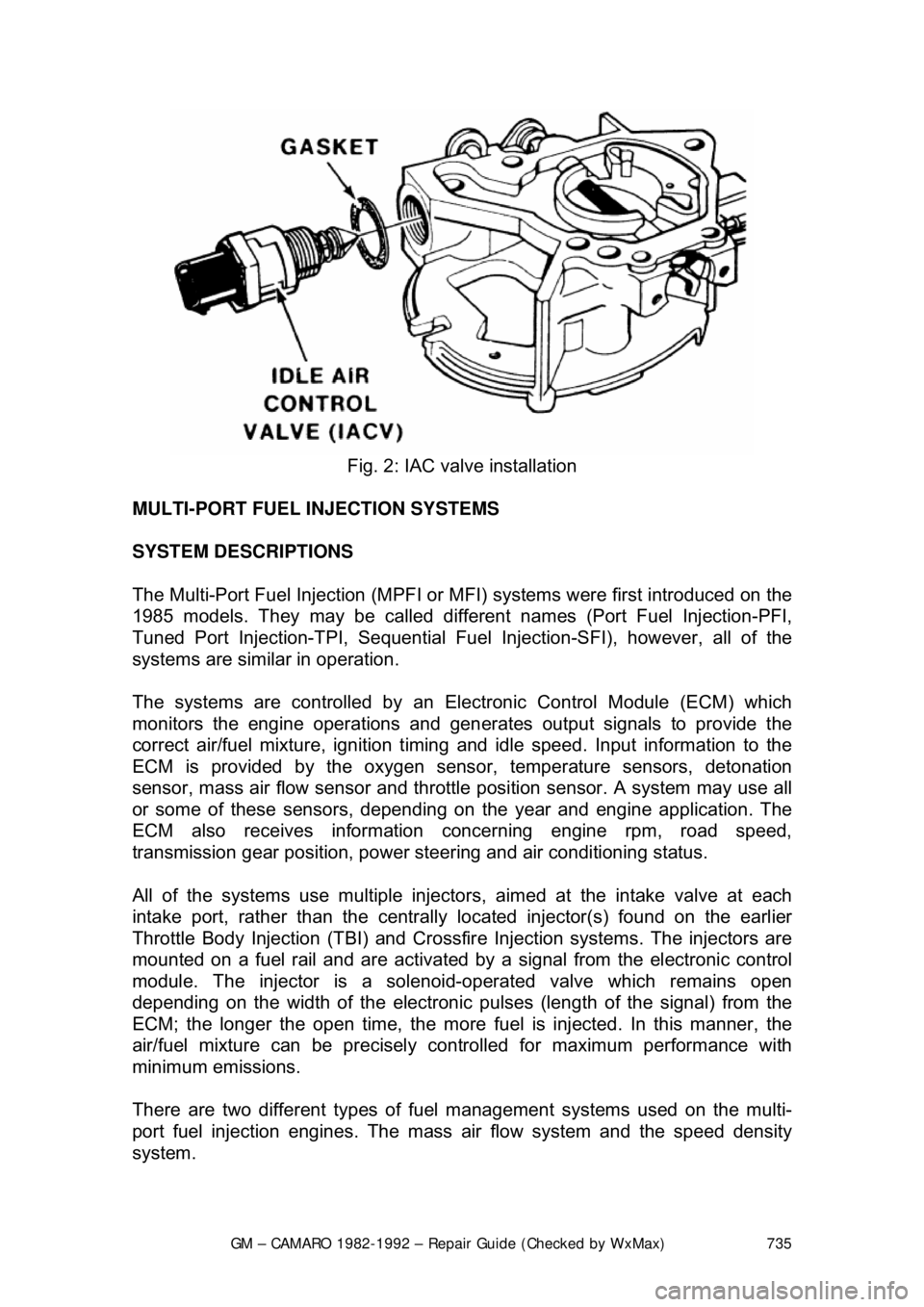
Fig. 2: IAC valve installation
MULTI-PORT FUEL INJECTION SYSTEMS
SYSTEM DESCRIPTIONS
The Multi-Port Fuel Injection (MPFI or MFI) systems were first introduced on the
1985 models. They may be called different names (Port Fuel Injection-PFI,
Tuned Port Injection-TPI, Sequential Fuel Injection-SFI), however, all of the
systems are similar in operation.
The systems are controlled by an Elec tronic Control Module (ECM) which
monitors the engine operations and gen erates output signals to provide the
correct air/fuel mixture, ignition timing and idle speed. Input information to the
ECM is provided by the oxygen sens or, temperature sensors, detonation
sensor, mass air flow sensor and throttle position sensor. A system may use all
or some of these sensors, depending on the year and engine application. The
ECM also receives information concerning engine rpm, road speed,
transmission gear position, power steer ing and air conditioning status.
All of the systems use multiple injector s, aimed at the intake valve at each
intake port, rather than the centrally lo cated injector(s) found on the earlier
Throttle Body Injection (TBI) and Crossfir e Injection systems. The injectors are
mounted on a fuel rail and ar e activated by a signal from the electronic control
module. The injector is a solenoi d-operated valve which remains open
depending on the width of t he electronic pulses (length of the signal) from the
ECM; the longer the open time, the more f uel is injected. In this manner, the
air/fuel mixture can be precisely c ontrolled for maximum performance with
minimum emissions.
There are two different types of f uel management systems used on the multi-
port fuel injection engines. The mass air flow system and the speed density
system.
Page 736 of 875

GM – CAMARO 1982-1992 – Repair Guide (Checked by WxMax) 736
The mass air flow systems measure the
mass of air that is drawn into the
engine cylinders, rather than just the vo lume. The sensor contains a hot-wire
sensing unit, which is made up of an electronic balanced bridge network.
Whenever current is suppli ed to the sensor, the bridge is energized and the
sensing hot-wire is heated. As the air enter s the mass air flow sensor, it passes
over and cools the hot wire. When the hot wire is cooled, it's resistance changes
and additional current is needed to k eep the bridge network balanced. This
increase in current is sent to the computer as a voltage signal and is used to
calculate the mass of the incoming air. The ECM uses this information to\
determine the duration of fuel injection pulse, ignition timing and EGR operation.
The speed density systems calculate the volume of air moving through the
intake. The ECM establishes the speed fact or through a signal from the ignition
module. The Manifold or Intake Air Temperature (MAT/IAT) and the Engine
Coolant Temperature (ECT) sensors work together to assure that proper
temperature information gets to the ECM wh ile the Manifold Absolute Pressure
(MAP) sensor monitors the changes in m anifold pressure which results from
changes in engine loading. These three se nsors contribute to the density factor.
Together, these inputs (engine speed, coolant temperature sensor, etc ...) are
the major determinants of the air/fuel mixture delivered by the fuel injection
system.
The following engines and fuel managem ent systems are covered in this
section:
• 1985-1989 2.8L MPFI - Mass Air Flow
• 1990-1992 3.1L MPFI - Speed Density
• 1985-1989 5.0L and 5.7L TPI - Mass Air Flow
• 1990-1992 5.0L and 5.7L TPI - Speed Density
Relieving Fuel System Pressure
1. Disconnect the negative battery cable to prevent fuel discharge if the key
is accidentally turned to the RUN position.
2. Loosen the fuel filler cap to reliev e the tank pressure and do not tighten
until service has been completed.
3. Connect J-34730-1 fuel pressure gauge or equivalent, to the fuel
pressure test valve. Wrap a shop towel around the fitting while
connecting the gauge to prevent spillage.
4. Place the end of the bleed hose into a suitable container and open the
valve to relieve the fuel system pressure.
ELECTRIC FUEL PUMP
REMOVAL & INSTALLATION
The fuel pump is part of t he fuel sender assembly located inside the fuel tank.
Page 744 of 875
GM – CAMARO 1982-1992 – Repair Guide (Checked by WxMax) 744
7. Start the engine and che
ck for proper operation.
FUEL INJECTORS
REMOVAL & INSTALLATION
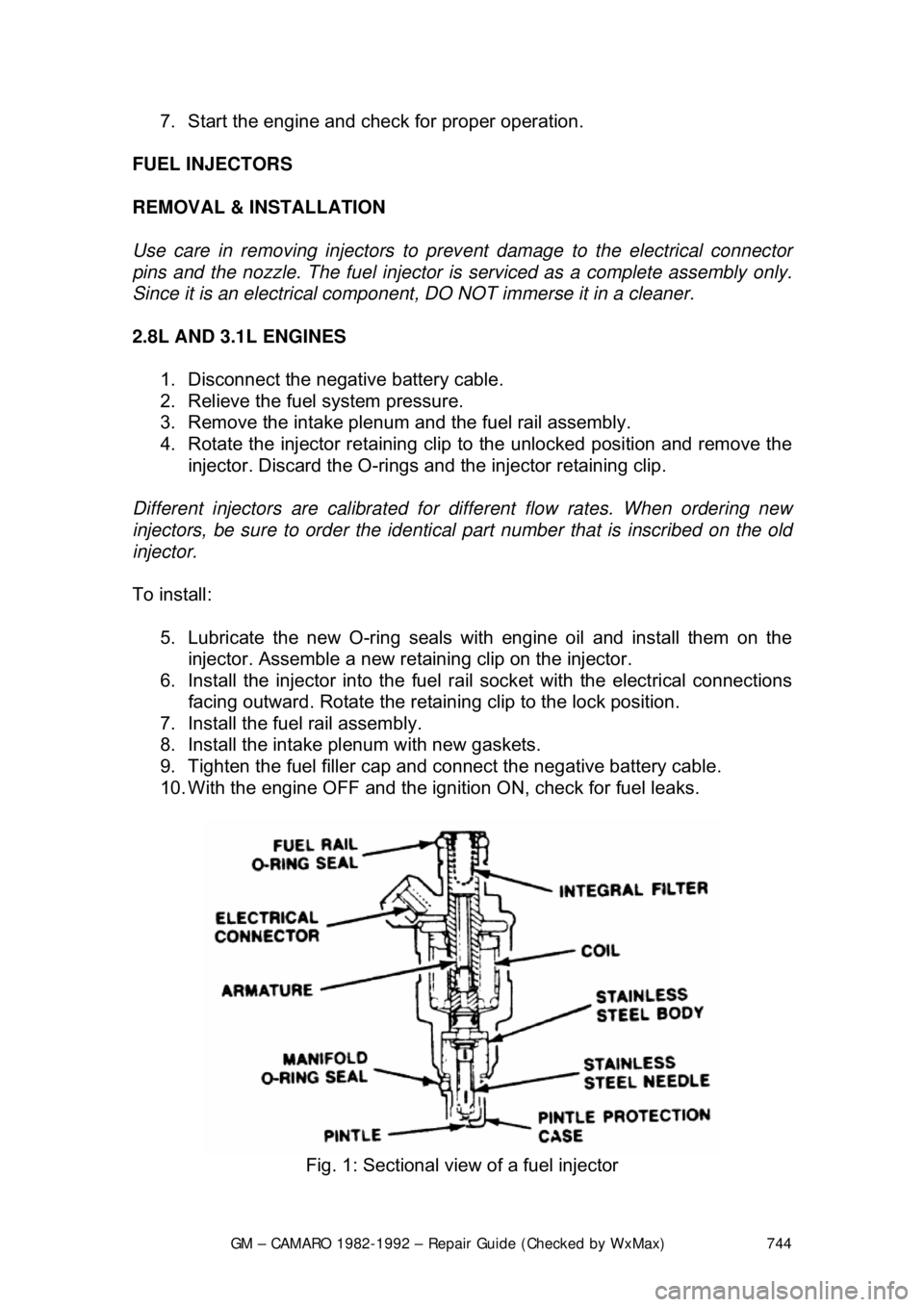
Use care in removing injectors to prev ent damage to the electrical connector
pins and the nozzle. The fuel injector is serviced as a complete assembly only.
Since it is an electrical compon ent, DO NOT immerse it in a cleaner.
2.8L AND 3.1L ENGINES 1. Disconnect the negative battery cable.
2. Relieve the fuel system pressure.
3. Remove the intake plenum and the fuel rail assembly.
4. Rotate the injector retaining clip to the unlocked position and remove the
injector. Discard the O-rings and the injector retaining clip.
Different injectors are calibrated for different flow rates. When ordering new
injectors, be sure to order the identical part number that is inscribed on the old
injector.
To install: 5. Lubricate the new O-ri ng seals with engine oil and install them on the
injector. Assemble a new reta ining clip on the injector.
6. Install the injector into the fuel ra il socket with the electrical connections
facing outward. Rotate the retaini ng clip to the lock position.
7. Install the fuel rail assembly.
8. Install the intake pl enum with new gaskets.
9. Tighten the fuel filler cap and connect the negative battery cable.
10. With the engine OFF and the igniti on ON, check for fuel leaks.
Fig. 1: Sectional view of a fuel injector
Page 746 of 875

GM – CAMARO 1982-1992 – Repair Guide (Checked by WxMax) 746
5.0L AND 5.7L TPI ENGINES
1. Disconnect the negative battery cable.
2. Relieve the fuel system pressure.
3. Remove the intake plenum and runners.
4. Remove the fuel rail assembly.
5. Rotate the injector retaining clip to the unlocked position and remove the
injector. Discard the O-rings and the injector retaining clip.
There are two different injector part numbers for the 5.0L and the 5.7L engine.
Do not intermix injectors with different part numbers, as this will result in engine
roughness and excessive emissions. When or dering new injectors, be sure to
order the identical part number that is inscribed on the old injector. However, if a
complete set of injectors is being repl aced, either part number for that engine
application may be used.
To install:
6. Lubricate the new O-ri ng seals with engine oil and install them on the
injector. Assemble a new reta ining clip on the injector.
7. Install the injector into the fuel ra il socket with the electrical connections
facing outward. Rotate the retaini ng clip to the lock position.
8. Install the fuel rail assembly.
9. Install the intake plenum and runners with new gaskets.
10. Tighten the fuel filler cap and connect the negative battery cable.
11. With the engine OFF and the igniti on ON, check for fuel leaks.
FUEL RAIL ASSEMBLY
REMOVAL & INSTALLATION
When servicing the fuel system, be sure to relieve the pressure of the system
and drain the fuel into an approved contai ner. Cap all open fuel lines and plug
any other open passages. DO NO T allow dirt or other contaminants to enter the
system.
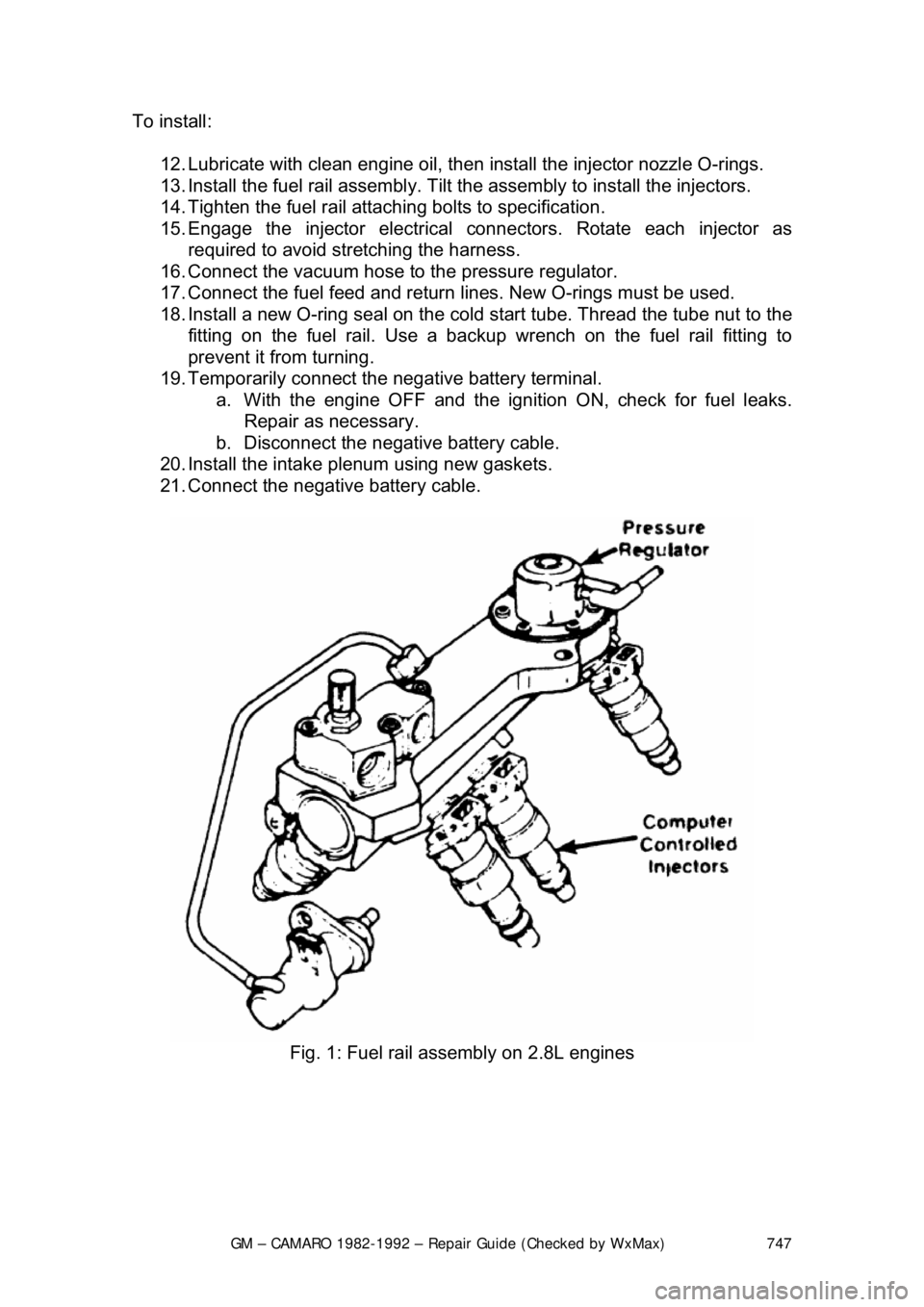
2.8L AND 3.1L ENGINES 1. Disconnect the negative battery cable.
2. Relieve the fuel system pressure.
3. Remove the intake plenum.
4. Clean the fuel rail assembly to pr event dirt from entering the system.
5. Remove the cold start tube at th e fuel rail fitting. Use a backup wrench
on the fuel rail fitting to pr event it from turning.
6. Disconnect the fuel feed and return lines at the rail.
7. Disconnect the vacuum hose at the pressure regulator.
8. Unplug the electrical connectors.
9. Loosen and remove the fuel rail attaching bolts.
10. Remove the fuel rail assembly from the intake manifold.
11. Discard all of the O-ring seals t hat are exposed during this procedure.
Page 747 of 875
GM – CAMARO 1982-1992 – Repair Guide (Checked by WxMax) 747
To install:
12. Lubricate with clean engine oil, then install the injector nozzle O-rings.
13. Install the fuel rail assembly. Tilt t he assembly to install the injectors.
14. Tighten the fuel rail attachi ng bolts to specification.
15. Engage the injector electrical connectors. Rotate each injector as
required to avoid stretching the harness.
16. Connect the vacuum hose to the pressure regulator.
17. Connect the fuel feed and return lines. New O-rings must be used.
18. Install a new O-ring seal on the cold start tube. Thread the tube nut to the
fitting on the fuel rail. Use a backup wrench on the fuel rail fitting t\
o
prevent it from turning.
19. Temporarily connect the negative battery terminal. a. With the engine OF F and the ignition ON, check for fuel leaks.
Repair as necessary.
b. Disconnect the negative battery cable.
20. Install the intake plenum using new gaskets.
21. Connect the negative battery cable.
Fig. 1: Fuel rail assembly on 2.8L engines
Page 749 of 875
GM – CAMARO 1982-1992 – Repair Guide (Checked by WxMax) 749
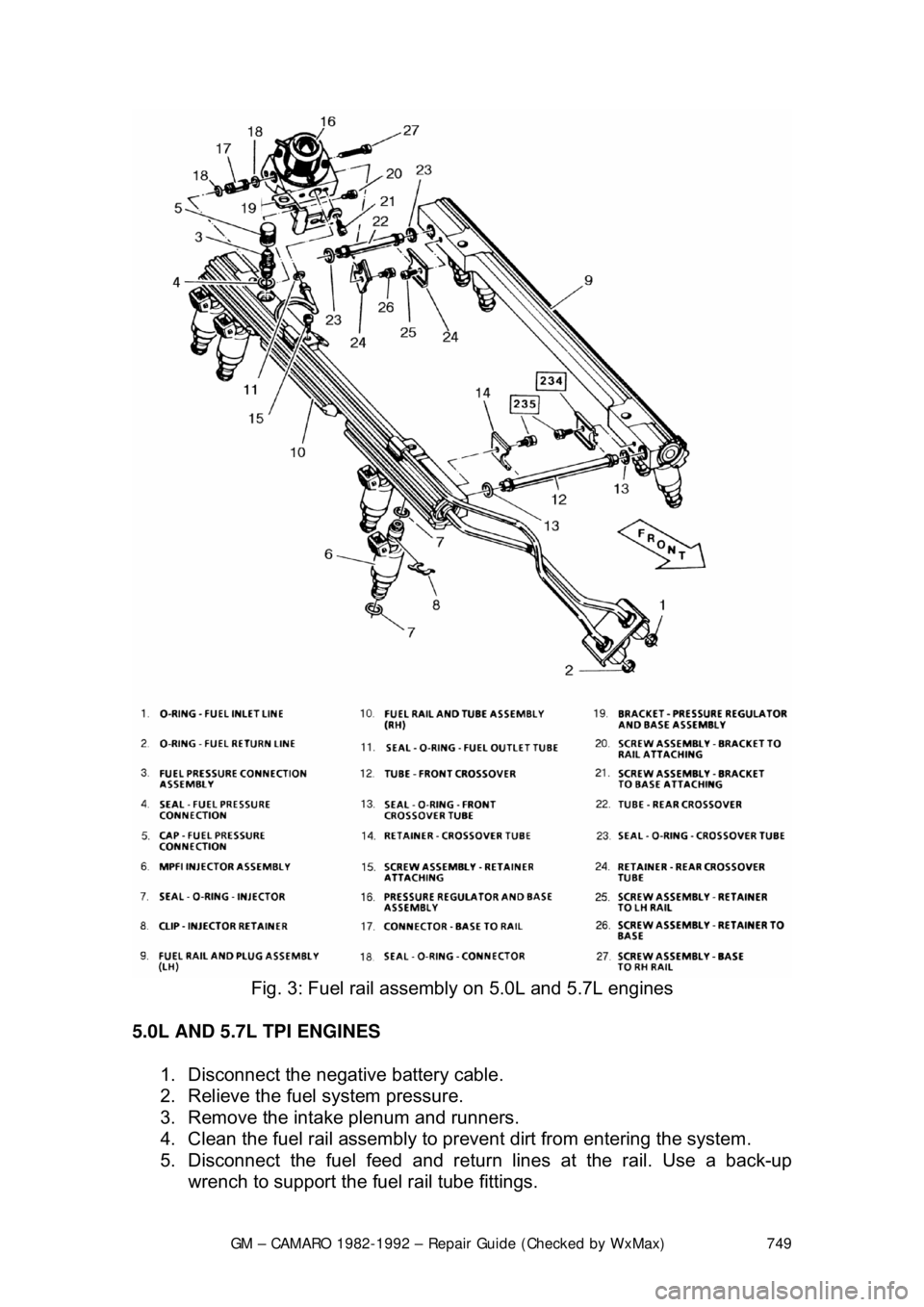
Fig. 3: Fuel rail assembly on 5.0L and 5.7L engines
5.0L AND 5.7L TPI ENGINES 1. Disconnect the negative battery cable.
2. Relieve the fuel system pressure.
3. Remove the intake plenum and runners.
4. Clean the fuel rail assembly to pr event dirt from entering the system.
5. Disconnect the fuel feed and return lines at the rail. Use a back-up
wrench to support the fuel rail tube fittings.
Page 750 of 875

GM – CAMARO 1982-1992 – Repair Guide (Checked by WxMax) 750
6. Disconnect the vacuum hose
at the pressure regulator.
7. Unplug the electrical connectors.
8. Loosen and remove the fuel rail attaching bolts.
9. Remove the fuel rail assembly from the intake manifold.
10. Discard all of the O-ring seals t hat are exposed during this procedure.
To install: 11. Lubricate with clean engine oil, then install the injector nozzle O-rings.
12. Install the fuel rail assembly in the intake manifold.
13. Tighten the fuel rail attachi ng bolts to specification.
14. Engage the injector electrical connectors. Rotate each injector as
required to avoid stretching the harness.
15. Connect the vacuum hose to the pressure regulator.
16. Connect the fuel feed and return lines. New O-rings must be used.
17. Temporarily connect the negative battery terminal. a. With the engine OF F and the ignition ON, check for fuel leaks.
Repair as necessary.
b. Disconnect the negative battery cable.
18. Install the intake plenum and runners. Use new gaskets.
19. Connect the negative battery cable.
FUEL PRESSURE REGULATOR
REMOVAL & INSTALLATION
2.8L AND 3.1L ENGINES
The pressure regulator and the fuel rail are serviced as a complete assembly
only. DO NOT attempt to remove the regulator cove r from the fuel rail.
5.0L AND 5.7L TPI ENGINES 1. Disconnect the negative battery cable.
2. Relieve the fuel system pressure.
3. Remove the intake plenum and runners.
4. Remove the fuel rail assembly.
5. Remove the rear crossover re tainer and base attaching screw.
6. Remove the rear crossover tube and O-ring from the regulator base.
Discard the O-ring.
7. Remove the pressure regulator bracket.
8. Remove the pressure r egulator base-to-rail screw.
9. Separate the regulator base from the fuel rail, then disconnect from the
fuel outlet tube.
10. Remove the fuel outle t tube O-ring and discard.
11. Remove the regulator bas e-to-fuel rail connector.
To install: 12. Lubricate and install new regul ator base-to-fuel rail O-rings.
Page 751 of 875

GM – CAMARO 1982-1992 – Repair Guide (Checked by WxMax) 751
13. Lubricate a new outlet tube 0-ring and in
stall it on the end of the tube.
14. Connect the regulator base to the fuel outlet tube, then to the fuel rail.
15. Finger-tighten the base-to-rail screw.
16. Install the pressure regulator br acket. Finger-tighten the screws only.
17. Lubricate a new rear crossover tube O-ring and install it on the end of the
tube.
18. Install the rear crossover tube to the regulator base.
19. Install the crossover tube reta iner and finger-tighten the screw.
20. Tighten all attaching screws to 44 inch lbs. (5 Nm).
21. Install the fuel rail assembly.
22. Temporarily connect the negative battery cable. a. With the engine OFF and the igniti on ON, check for fuel leaks.
b. Disconnect the negative battery cable.
23. Install the intake plenum and runners.
24. Connect the negative battery cable.
IDLE AIR CONTROL VALVE
REMOVAL & INSTALLATION 1. Unplug the electrical connector from idle air control valve.
2. Remove the idle air control valve.
To install: 3. Before installing the idle air contro l valve, measure the distance that the
valve is extended. Measurement s hould be made from the motor housing
to the end of the cone. It should not exceed 28.5mm (1
1/8 in.), or damage
to the valve may occur when installed.
4. On 1985-1992 models, identify the replacement IAC valve as being
either Type 1 (with collar at electric terminal end) or Type 2 (without
collar). If measuring distance is great er than specified above, proceed as
follows:
• Type 1: Use finger pressure to slowly retract the pintle.
• Type 2: Compress retaining spring from valve while turning valve
in with a clockwise motion. Return spring to original position with
straight portion of spring end aligned with flat surface of valve.
On IAC valves that have already been in service, do not push or pull on the
valve pintle. The force required to move the pintle may damage the threads on
the worm drive.
5. Use a new gasket or O-ring and install the IAC valve into the throttle body.
6. Allow the ECM to reset the idle air control valve using the procedure
described earlier in this section.