intake CHEVROLET CAMARO 1982 Repair Guide
[x] Cancel search | Manufacturer: CHEVROLET, Model Year: 1982, Model line: CAMARO, Model: CHEVROLET CAMARO 1982Pages: 875, PDF Size: 88.64 MB
Page 563 of 875
GM – CAMARO 1982-1992 – Repair Guide (Checked by WxMax) 563
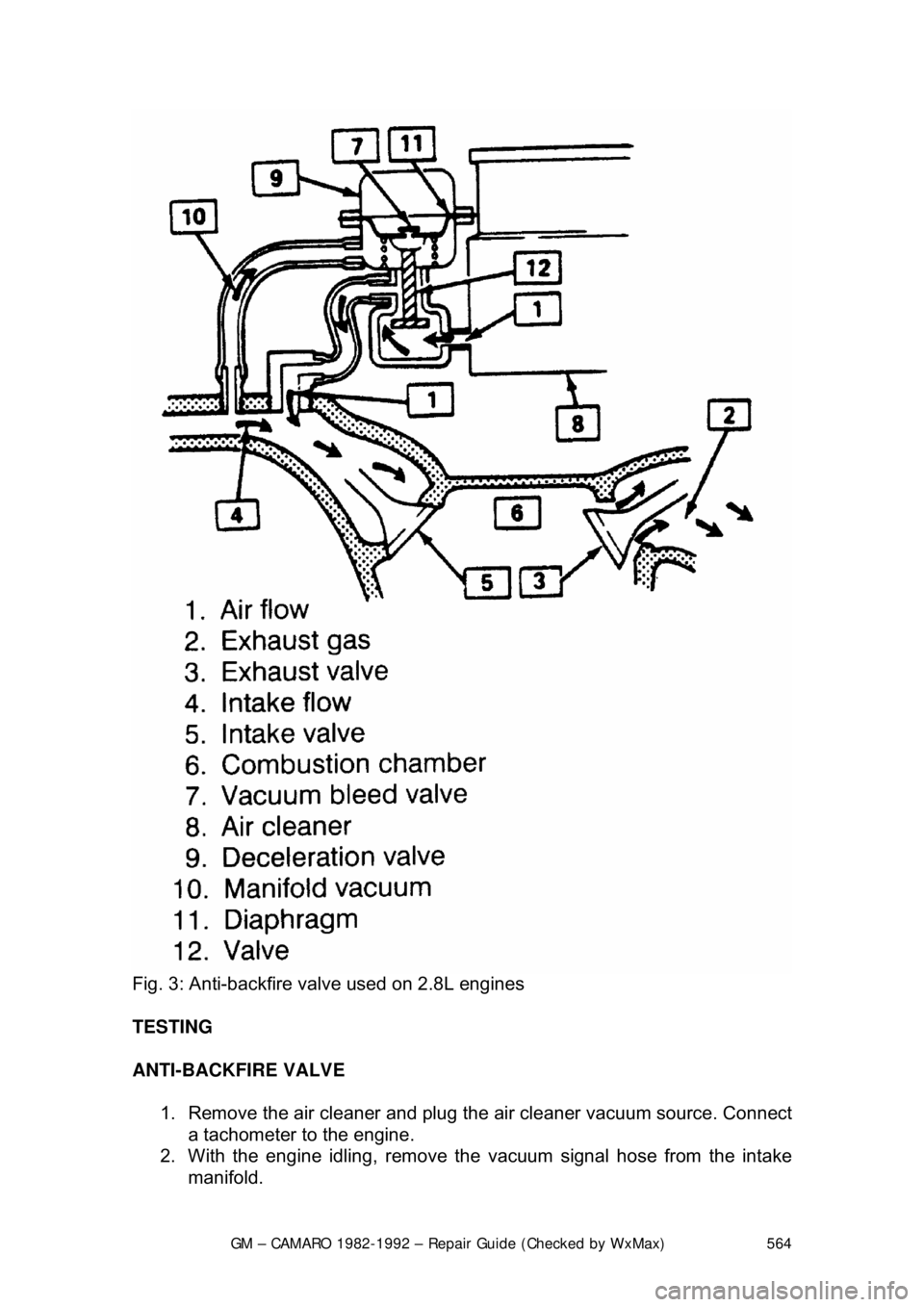
On the 2.8L engine only, an anti-backfire (g
ulp) valve is used to allow air flow
into the intake manifold. This is us ed to help prevent backfire during high
vacuum deceleration conditions. The extra air enters the intake system to lean
the rich air/fuel mixture. The valve is o perated by the intake manifold vacuum to
allow air from the air filter to flow into the intake manifold.
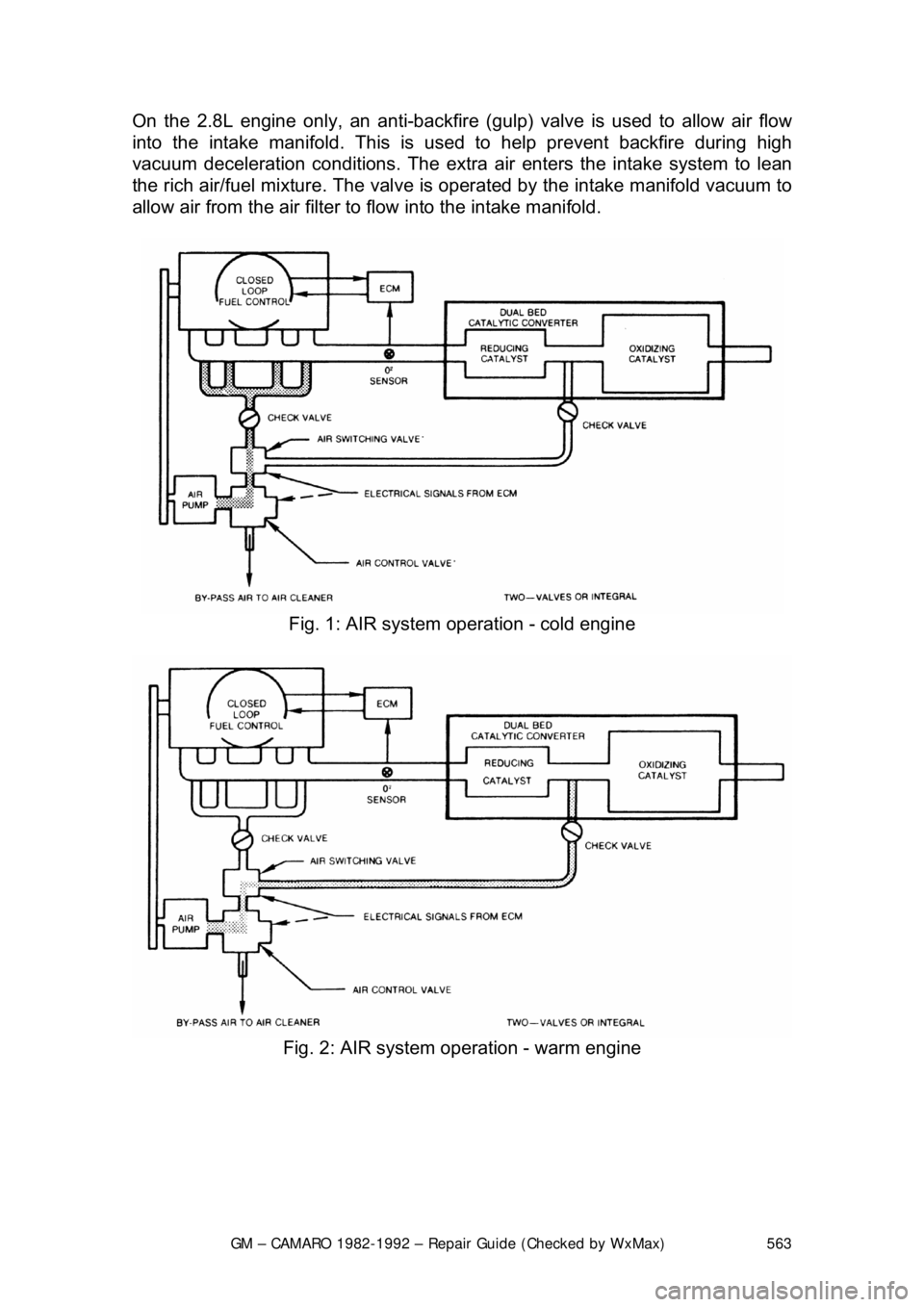
Fig. 1: AIR system operation - cold engine
Fig. 2: AIR system operation - warm engine
Page 564 of 875
GM – CAMARO 1982-1992 – Repair Guide (Checked by WxMax) 564
Fig. 3: Anti-backfire valve used on 2.8L engines
TESTING
ANTI-BACKFIRE VALVE
1. Remove the air cleaner and plug t he air cleaner vacuum source. Connect
a tachometer to the engine.
2. With the engine idling, remove the vacuum signal hose from the intake
manifold.
Page 585 of 875
GM – CAMARO 1982-1992 – Repair Guide (Checked by WxMax) 585
MANIFOLD ABSOLUTE PRESSURE SENSOR
OPERATION
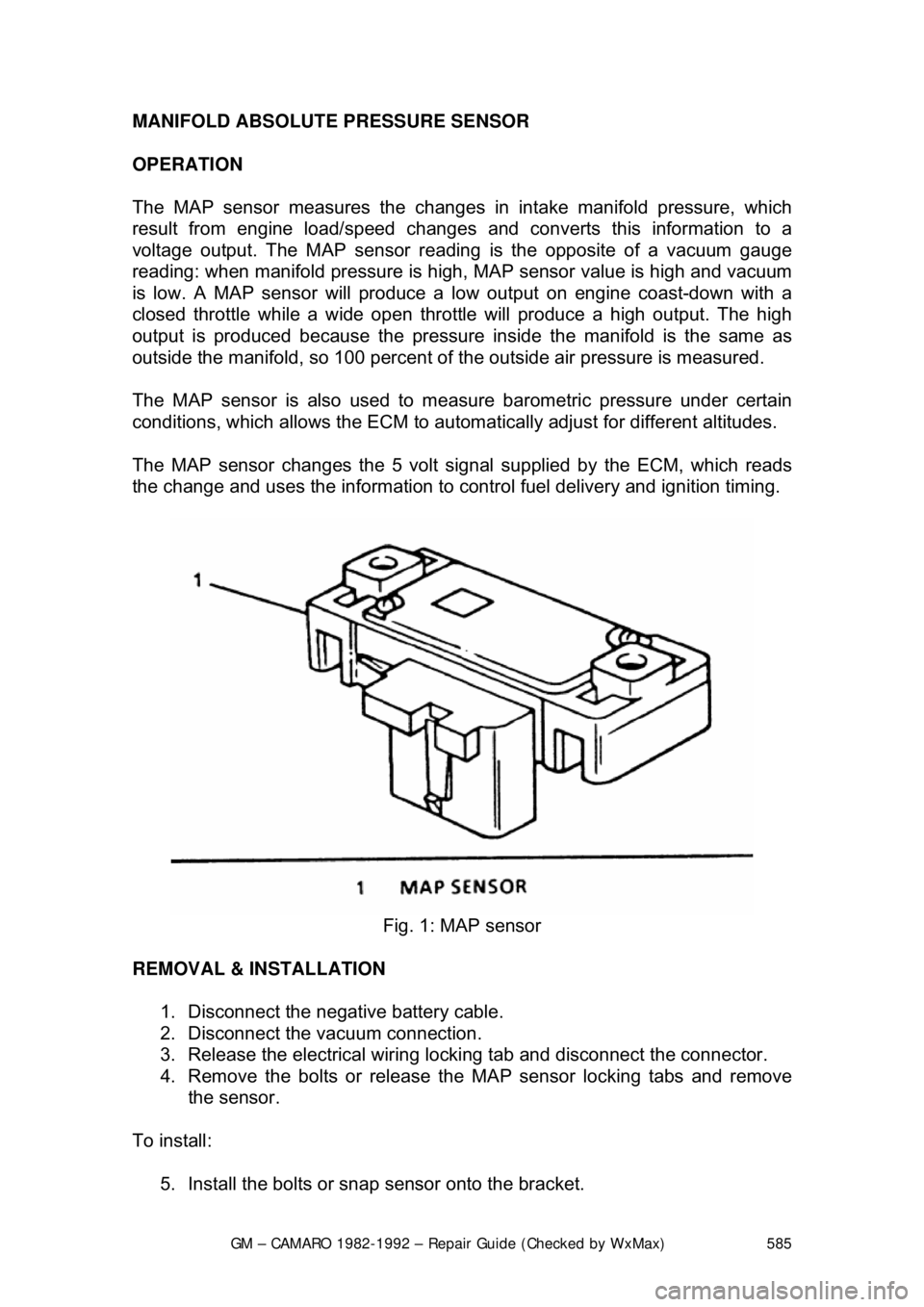
The MAP sensor measures the changes in
intake manifold pressure, which
result from engine load/ speed changes and converts this information to a
voltage output. The MAP sensor reading is the opposite of a vacuum gauge
reading: when manifold pressu re is high, MAP sensor value is high and vacuum
is low. A MAP sensor will produce a low output on engine coast-down with a
closed throttle while a wide open throttle will produce a high output. The high
output is produced because the pressure inside the manifold is the same as
outside the manifold, so 100 percent of t he outside air pressure is measured.
The MAP sensor is also used to meas ure barometric pressure under certain
conditions, which allows the ECM to autom atically adjust for different altitudes.
The MAP sensor changes the 5 volt signal supplied by the ECM, which reads
the change and uses the information to cont rol fuel delivery and ignition timing.
Fig. 1: MAP sensor
REMOVAL & INSTALLATION 1. Disconnect the negative battery cable.
2. Disconnect the vacuum connection.
3. Release the electrical wiring lo cking tab and disconnect the connector.
4. Remove the bolts or release the MAP sensor locking tabs and remove
the sensor.
To install: 5. Install the bolts or snap sensor onto the bracket.
Page 586 of 875
GM – CAMARO 1982-1992 – Repair Guide (Checked by WxMax) 586
6. Connect the MAP sensor
electrical wiring.
7. Connect the MAP sensor vacuum harness connector.
8. Connect the negative battery cable.
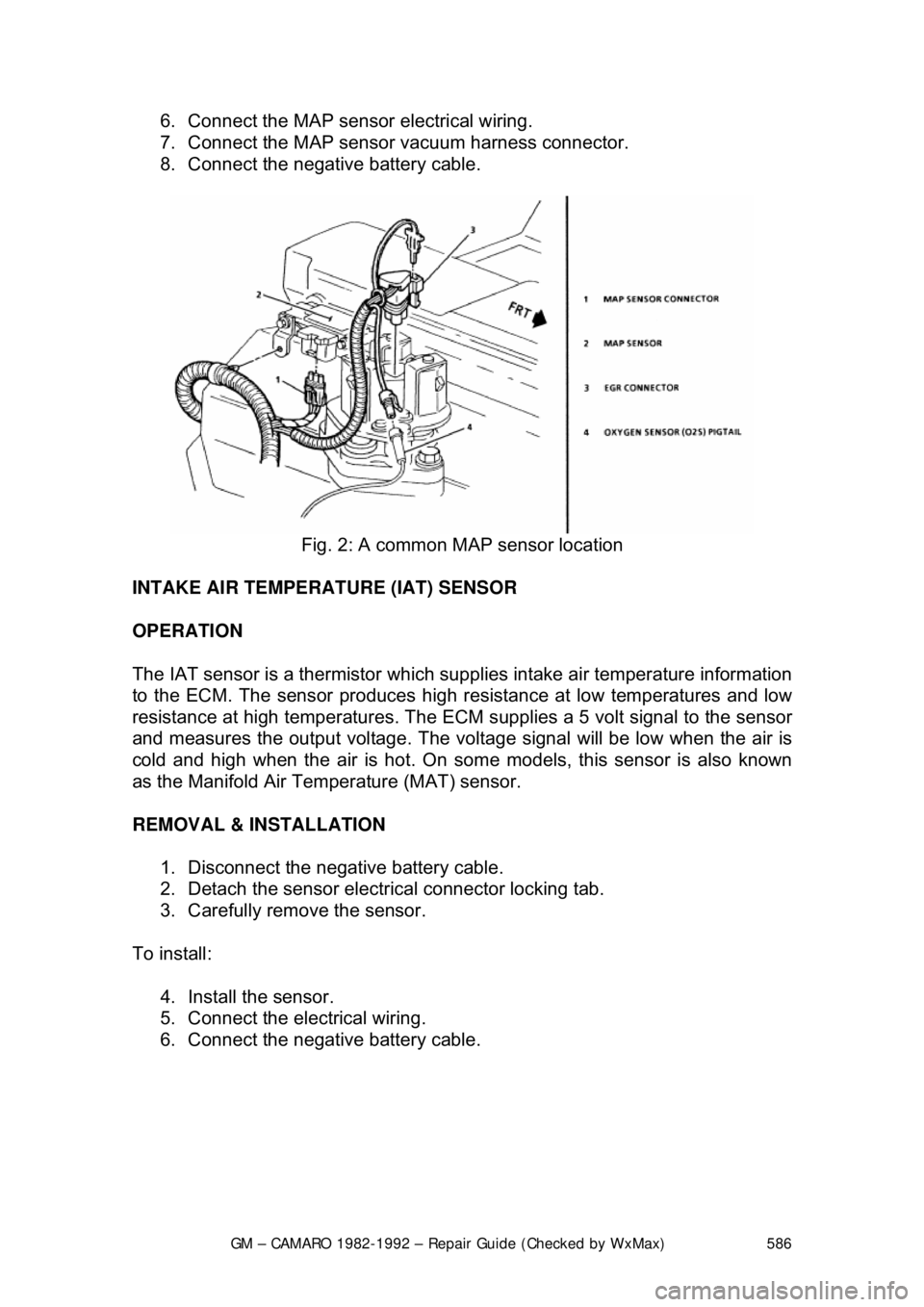
Fig. 2: A common MAP sensor location
INTAKE AIR TEMPERATURE (IAT) SENSOR
OPERATION
The IAT sensor is a thermistor which su pplies intake air temperature information
to the ECM. The sensor produces high re sistance at low temperatures and low
resistance at high temperatures. The ECM supplies a 5 volt signal to the sensor
and measures the output voltage. The vo ltage signal will be low when the air is
cold and high when the air is hot. On so me models, this sensor is also known
as the Manifold Air Tem perature (MAT) sensor.
REMOVAL & INSTALLATION 1. Disconnect the negative battery cable.
2. Detach the sensor electr ical connector locking tab.
3. Carefully remove the sensor.
To install: 4. Install the sensor.
5. Connect the electrical wiring.
6. Connect the negative battery cable.
Page 587 of 875
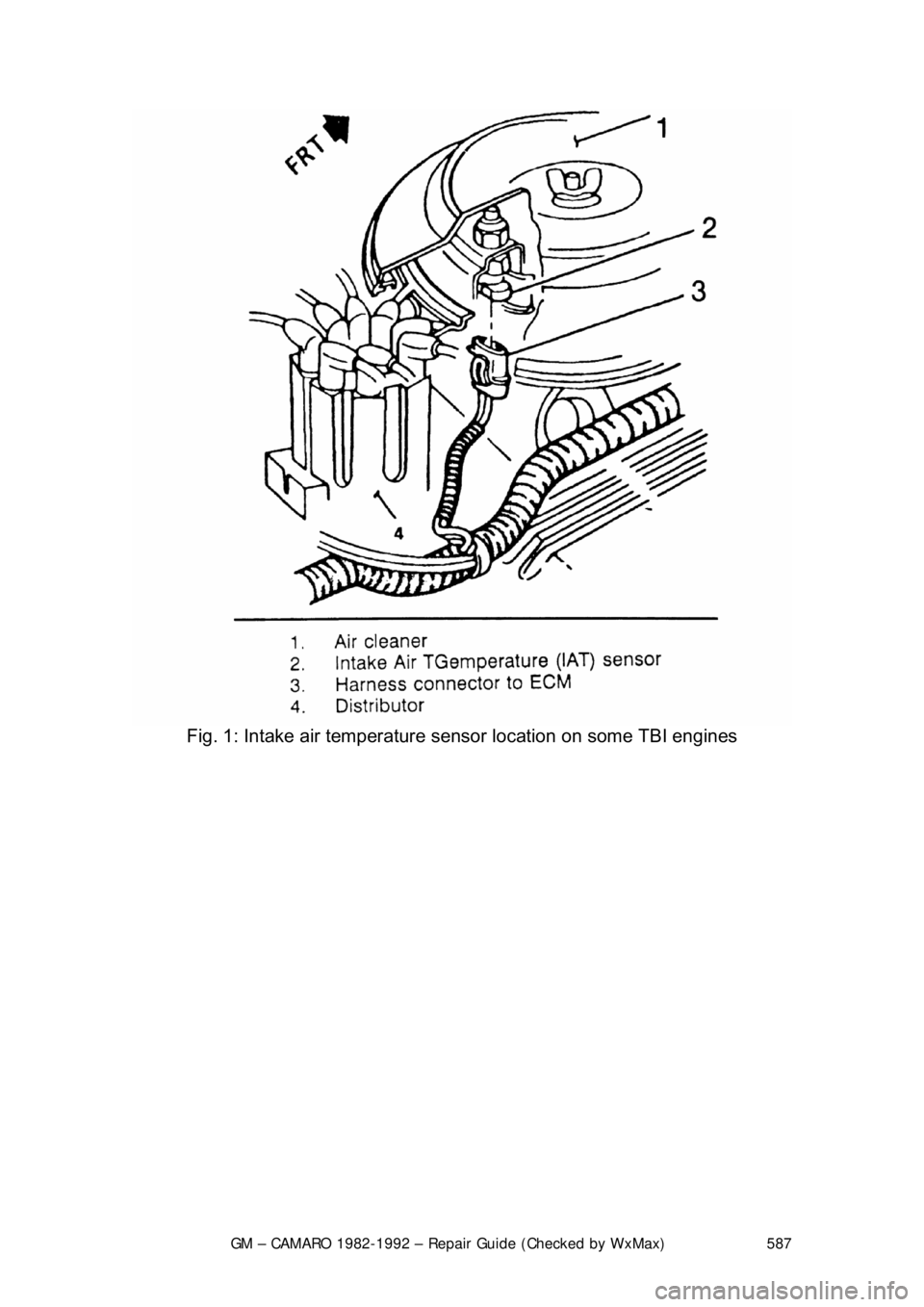
GM – CAMARO 1982-1992 – Repair Guide (Checked by WxMax) 587
Fig. 1: Intake air te mperature sensor location on some TBI engines
Page 588 of 875
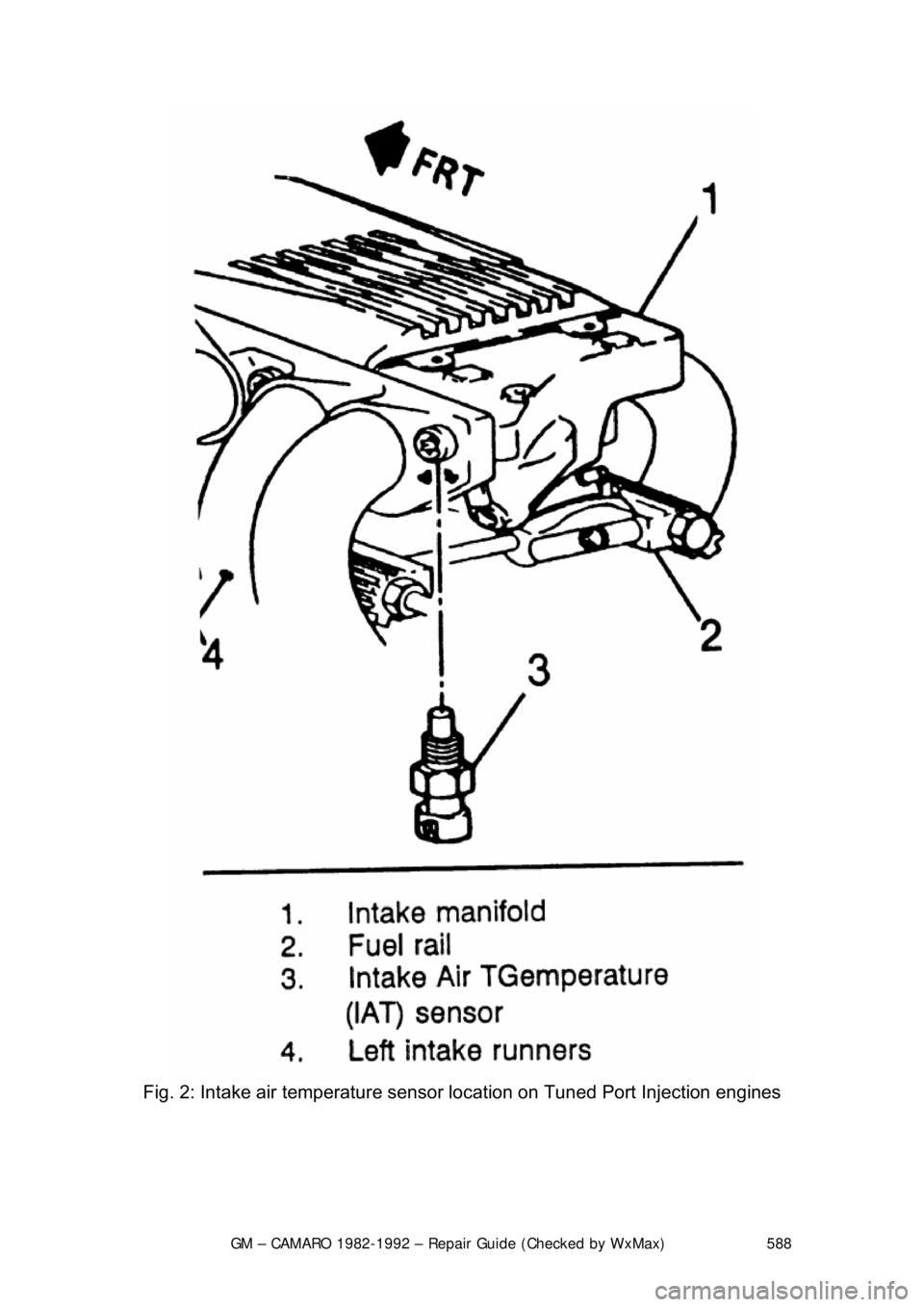
GM – CAMARO 1982-1992 – Repair Guide (Checked by WxMax) 588
Fig. 2: Intake air temperature sensor location on Tuned Port Injection engines
Page 589 of 875
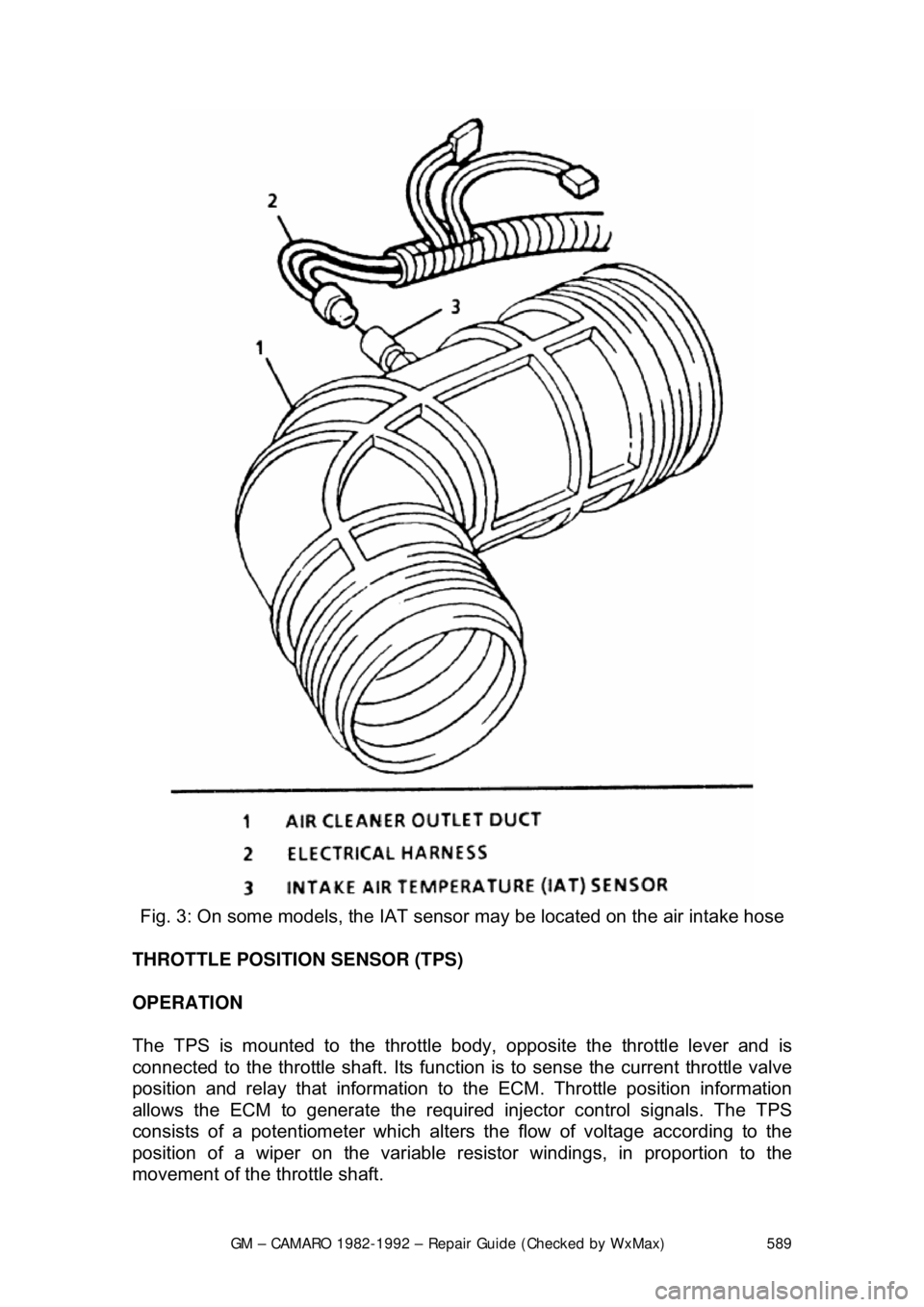
GM – CAMARO 1982-1992 – Repair Guide (Checked by WxMax) 589
Fig. 3: On some models, the IAT sens or may be located on the air intake hose
THROTTLE POSITION SENSOR (TPS)
OPERATION
The TPS is mounted to the throttle body, opposite the throttle lever and is
connected to the throttle shaft. Its functi on is to sense the current throttle valve
position and relay that information to the ECM. Throttle position information
allows the ECM to generate the required injector control signals. The TPS
consists of a potentiometer which alters the flow of voltage according to the
position of a wiper on the variable resi stor windings, in proportion to the
movement of the throttle shaft.
Page 591 of 875
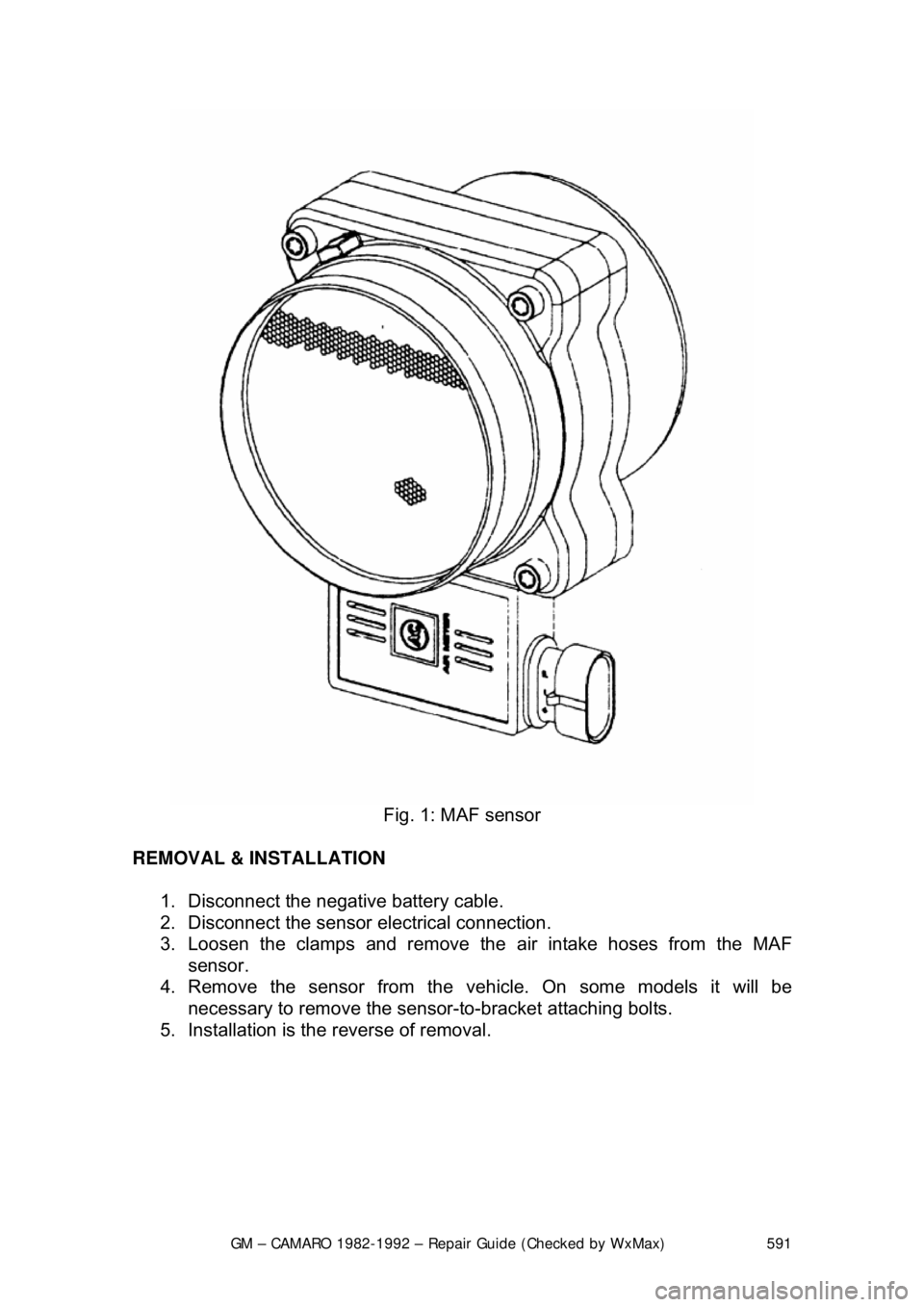
GM – CAMARO 1982-1992 – Repair Guide (Checked by WxMax) 591
Fig. 1: MAF sensor
REMOVAL & INSTALLATION 1. Disconnect the negative battery cable.
2. Disconnect the sensor electrical connection.
3. Loosen the clamps and remove the air intake hoses from the MAF
sensor.
4. Remove the sensor from the v ehicle. On some models it will be
necessary to remove the senso r-to-bracket attaching bolts.
5. Installation is the reverse of removal.
Page 666 of 875

GM – CAMARO 1982-1992 – Repair Guide (Checked by WxMax) 666
FUEL SYSTEM
BASIC FUEL SYSTEM DIAGNOSIS
When there is a problem star ting or driving a vehicle, two of the most important
checks involve the ignition and the fuel systems. The questions most mechanics
attempt to answer first, "is there spark?" an d "is there fuel?" will often lead to
solving most basic problems. For igni tion system diagnosis and testing, please
refer to the information on engine electr ical components and ignition systems
found earlier in this repair guide. If the ignition system checks out (there is
spark), then you must determine if the f uel system is operating properly (is there
fuel?).
CARBURETED FUEL SYSTEM
MECHANICAL FUEL PUMP
All fuel pumps used on carbureted V6 and V8 engines are of the diaphragm
type and are serviced by replacement onl y. No adjustments or repairs are
possible. The fuel pump is mounted on th e left front (V6) and right front (V8) of
the engine.
The fuel pumps are also equipped with vapor return lines for purposes of
emission control and to reduce vapor lock. All pumps are operated by an
eccentric on the camshaft. On V6 an d V8 engines, a pushrod between the
camshaft eccentric and the fuel pump operates the pump.
REMOVAL & INSTALLATION
When disconnecting the fuel pump outlet fitting, always use two wrenches to
avoid twisting the line.
1. Disconnect the fuel in take and outlet lines at the pump, then plug the
pump intake line.
2. Remove the two pump mounting bol ts and lockwashers; remove the
pump and its gasket.
3. If the pump pushrod is to be remo ved from the V8, remove the two
adapter bolts and lockwashers, then re move the adapter and its gasket.
4. Install the fuel pump with a new gasket reversing the removal procedure.
Coat the mating surfaces with sealer.
5. Connect the fuel lines and check for leaks.
Page 669 of 875

GM – CAMARO 1982-1992 – Repair Guide (Checked by WxMax) 669
1. Disconnect the pressure gauge. R
un the fuel line into a graduated
container.
2. Run the engine at idle until one pint of gasoline has been pumped. One
pint should be delivered in 30 seconds or less. There is normally enough
fuel in the carburetor float bowl to perform this test, but refill it if
necessary.
3. If the delivery rate is below the mini mum, check the lines for restrictions
or leaks, then r eplace the pump.
CARBURETORS
The V6 engine is equipped with the Ro chester E2SE carburetor, V8 engines
use the E4ME and E4MC. These carburet ors are of the downdraft design and
are used in conjunction with the CCC system for fuel cont rol. They have special
design features for optimum air/fuel mixt ure control during all ranges of engine
operation.
An electric solenoid in the carburetor controls the air/fu el ratio. The solenoid is
connected to an Electronic Control Module (ECM) which is an on-board
computer. The ECM provides a controllin g signal to the solenoid. The solenoid
controls the metering rod(s) and an id le air bleed valve, thereby closely
controlling the air/fuel ratio throughout the operating range of the engine.
MODEL IDENTIFICATION
General Motors Rochester carburetors ar e identified by their model code. The
first number indicates the number of ba rrels, while one of the last letters
indicates the type of choke used. These are V for the manifold mounted choke
coil, C for the choke coil mounted in the carburetor body, and E for electric
choke, also mounted on the carburetor. Model codes ending in A indicate an
altitude-compensatin g carburetor.
Because of their intricate nature and co mputer controls, the E2SE, E4ME and
E4MC carburetors should only be se rviced by a qualified technician.
PRELIMINARY CHECKS
The following should be observed befor e attempting any adjustments.
1. Thoroughly warm the engine. If the engine is cold, be sure that it reaches
operating temperature.
2. Check the torque of all carburet or mounting nuts and assembly screws.
Also check the intake manifold-to-cyli nder head bolts. If air is leaking at
any of these points, any attempts at adjustment will inevitably lead to
frustration.
3. Check the manifold heat control valve (if used) to be sure that it is free.
4. Check and adjust the choke as necessary.
5. Adjust the idle speed and mixture. If the mixture screws are capped,
don't adjust them unless all other c auses of rough idle have been
eliminated. If any adjustments are per formed that might possibly change