air condition CHEVROLET CAMARO 1982 Repair Guide
[x] Cancel search | Manufacturer: CHEVROLET, Model Year: 1982, Model line: CAMARO, Model: CHEVROLET CAMARO 1982Pages: 875, PDF Size: 88.64 MB
Page 565 of 875

GM – CAMARO 1982-1992 – Repair Guide (Checked by WxMax) 565
3. Reconnect the signal
hose and listen for air flow through the ventilation
tube into the anti-backfire valve. A speed drop should be noticed when
the hose is reconnected.
4. If these conditions are not found, check hoses for restrictions or leaks. If
hoses are OK, replace the anti-backfire valve.
AIR PUMP 1. Check the drive belt tension.
2. Increase the engine speed and observe an increase in air flow. If air flow
does not increase, replace the air pump.
CONTROL VALVE 1. Remove the hoses. Blow through t he valve (toward the cylinder head).
2. Then, suck through the valve (or blow through the other side). If air flows
in one direction, the valve is operative. If not, replace the control valve.
REMOVAL & INSTALLATION
AIR PUMP 1. Remove the AIR control valves and/or adapter at the pump.
2. Loosen the air pump adjustment bolt and remove the drive belt.
3. Unscrew the pump mounting bolts and then remove the pump pulley.
4. Unscrew the pump mounting bol ts and then remove the pump.
To install: 5. Position the pump into place and secure it with the mounting bolts.
6. Install the pump pulley.
7. Install the air pump drive belt and adjust pump belt with the pump
adjustment bolt.
8. Install the AIR contro l valves and/or adapter.
Page 573 of 875

GM – CAMARO 1982-1992 – Repair Guide (Checked by WxMax) 573
7. Install the retaining bracket.
8. Connect the negative battery cable.
ELECTRONIC ENGINE CONTROLS
COMPUTER COMMAND CO NTROL (CCC) SYSTEM
The Computer Command Control (CCC) Sy stem is an electronically controlled
exhaust emission system that can m onitor and control a large number of
interrelated emission cont rol systems. It can monitor various engine/vehicle
operating conditions and then use this in formation to control multiple engine
related systems. The CCC syst em is thereby making constant adjustments to
maintain optimum vehicle performance und er all normal driving conditions while
at the same time allowing the catalyti c converter to effectively control the
emissions of HC, CO and NO
x.
OPERATION
The Electronic Control Module (ECM) is required to maintain the exhaust
emissions at acceptable le vels. The module is a sma ll, solid state computer
which receives signals from many source s and sensors; it uses these data to
make judgements about operating conditions and then control output signals to
the fuel and emission systems to ma tch the current requirements.
Inputs are received from m any sources to form a complete picture of engine
operating conditions. Some inputs are simp ly Yes or No messages, such as that
from the Park/Neutral switch; the vehicle is either in gear or in Park/Neutral;
there are no other choices. Other data is sent in quantitative input, such as
engine rpm or coolant temperature. T he ECM is pre-programmed to recognize
acceptable ranges or combinations of si gnals and control the outputs to control
emissions while providing good driv eability and economy. The ECM also
monitors some output circuits, making sure that the components function as
commanded. For proper engine oper ation, it is essential that all input and output
components function properly and comm unicate properly with the ECM.
Since the control module is programmed to recognize the presence and value
of electrical inputs, it will also note the lack of a signal or a radical change in
values. It will, for example, react to the loss of signal from the vehicle speed
sensor or note that engine coolant temperature has risen beyond acceptable
(programmed) limits. Once a fault is recognized, a numeric code is assigned
and held in memory. The SERVICE ENGIN E SOON Malfunction Indicator Lamp
(MIL), will illuminate to advise the operator that the system has detected a fault.
More than one code may be stored. Although not every engine uses every
code, possible codes range from 12-999. Additionally, the same code may carry
different meanings relative to each engine or engine family. For example, on the
3.3L (VIN N) engine, code 46 indicates a fault found in the power steering
pressure switch circuit. The same code on the 5.7L (VIN F) engine indicates a
fault in the VATS anti-theft system.
Page 577 of 875

GM – CAMARO 1982-1992 – Repair Guide (Checked by WxMax) 577
MALFUNCTION INDICATOR LAMP
The primary function of the MIL is to adv
ise the operator and the technician that
a fault is detected, and, in most cases, a code is stored. Under normal
conditions, the malfunction indicator la mp will illuminate when the ignition is
turned ON. Once the engine is started and running, the ECM will perform a
system check and extinguish the lamp if no fault is found.
Additionally, the lamp can be used to retrieve stored codes after the system is
placed in the Diagnostic Mode. Codes ar e transmitted as a series of flashes
with short or long pauses. When the syst em is placed in the Field Service
Mode, the dash lamp will indicate open loop or closed loop function to the
technician.
INTERMITTENTS
If a fault occurs intermittently, such as a loose connector pin breaking contact
as the vehicle hits a bump, the ECM will note the fault as it occurs and energize
the dash warning lamp. If the problem se lf-corrects, as with the terminal pin
again making contact, the dash lamp will extinguish after 10 seconds but\
a code
will remain stored in the ECM memory.
When an unexpected code appe ars during diagnostics, it may have been set
during an intermittent failure that self-c orrected; the codes are still useful in
diagnosis and should not be discounted.
OXYGEN SENSOR
OPERATION
An oxygen sensor is used on all models. The sensor protrudes into the exhaust
stream and monitors the oxygen content of the exhaust gases. The difference
between the oxygen content of the exhaust gases and that of the outside air
generates a voltage si gnal to the ECM. The ECM monitors this voltage and,
depending upon the value of the signal rece ived, issues a command to adjust
for a rich or a lean condition.
No attempt should ever be made to meas ure the voltage output of the sensor.
The current drain of any conventional vo ltmeter would be such that it would
permanently damage the sensor.
Page 581 of 875
GM – CAMARO 1982-1992 – Repair Guide (Checked by WxMax) 581
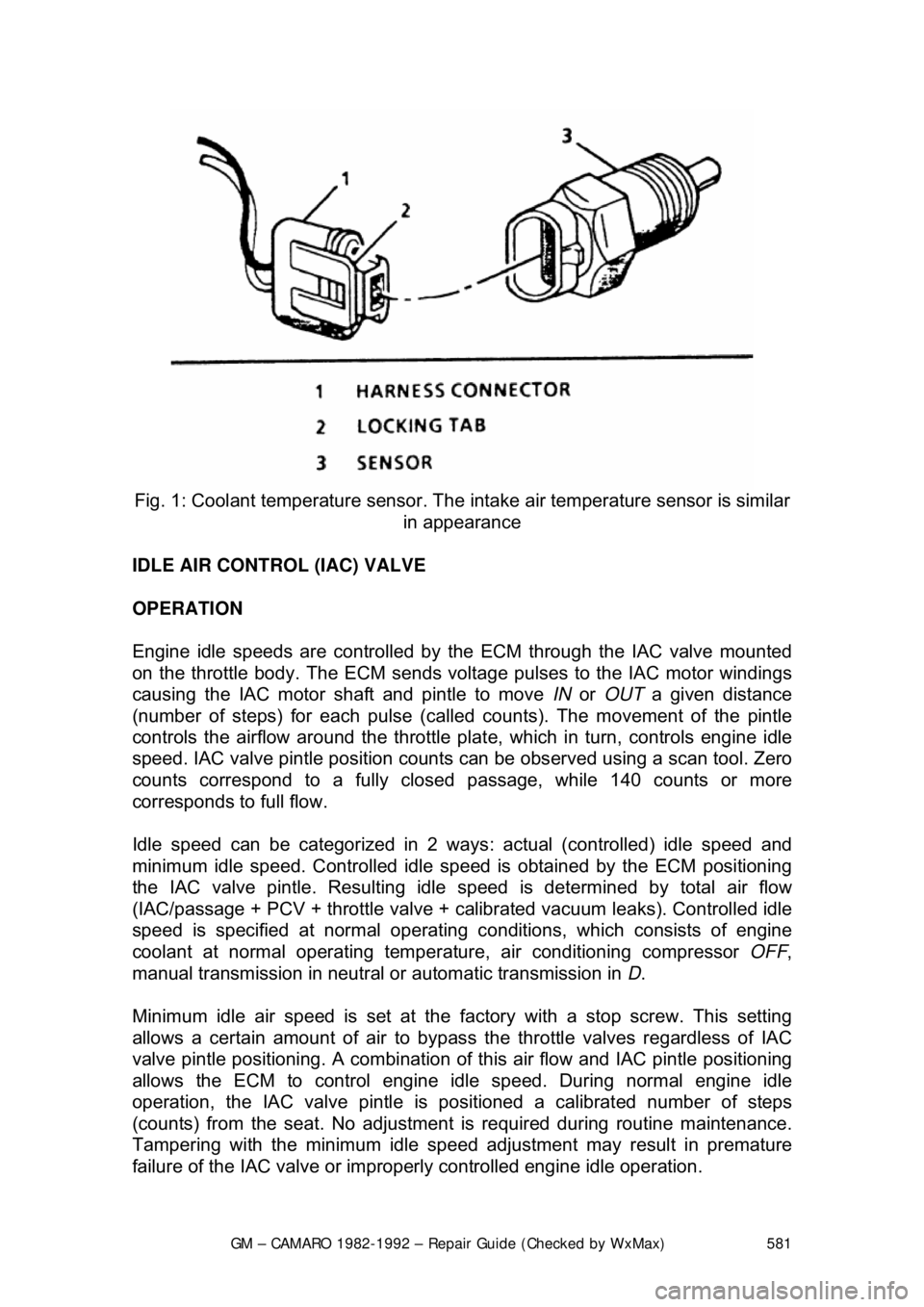
Fig. 1: Coolant temperature sensor. The in take air temperature sensor is similar
in appearance
IDLE AIR CONTROL (IAC) VALVE
OPERATION
Engine idle speeds are controlled by the ECM through the IAC valve mounted
on the throttle body. The ECM sends volt age pulses to the IAC motor windings
causing the IAC motor shaft and pintle to move IN or OUT a given distance
(number of steps) for each pulse (called counts). The movement of the pintle
controls the airflow around the throttle plat e, which in turn, controls engine idle
speed. IAC valve pintle position counts ca n be observed using a scan tool. Zero
counts correspond to a fully closed passage, while 140 counts or more
corresponds to full flow.
Idle speed can be categorized in 2 ways : actual (controlled) idle speed and
minimum idle speed. Contro lled idle speed is obtained by the ECM positioning
the IAC valve pintle. Resulting idle speed is determined by total air fl\
ow
(IAC/passage + PCV + throttle valve + ca librated vacuum leaks). Controlled idle
speed is specified at normal operating c onditions, which consists of engine
coolant at normal operating temper ature, air conditioning compressor OFF,
manual transmission in neutral or automatic transmission in D.
Minimum idle air speed is set at t he factory with a stop screw. This setting
allows a certain amount of air to bypas s the throttle valves regardless of IAC
valve pintle positioning. A co mbination of this air flow and IAC pintle positioning
allows the ECM to control engine idle speed. During normal engine idle
operation, the IAC valve pintle is positioned a calibrated number of steps
(counts) from the seat. No adjustment is required during routine maintenance.
Tampering with the minimum idle speed adjustment may result in premature
failure of the IAC valve or imprope rly controlled engine idle operation.
Page 585 of 875
GM – CAMARO 1982-1992 – Repair Guide (Checked by WxMax) 585
MANIFOLD ABSOLUTE PRESSURE SENSOR
OPERATION
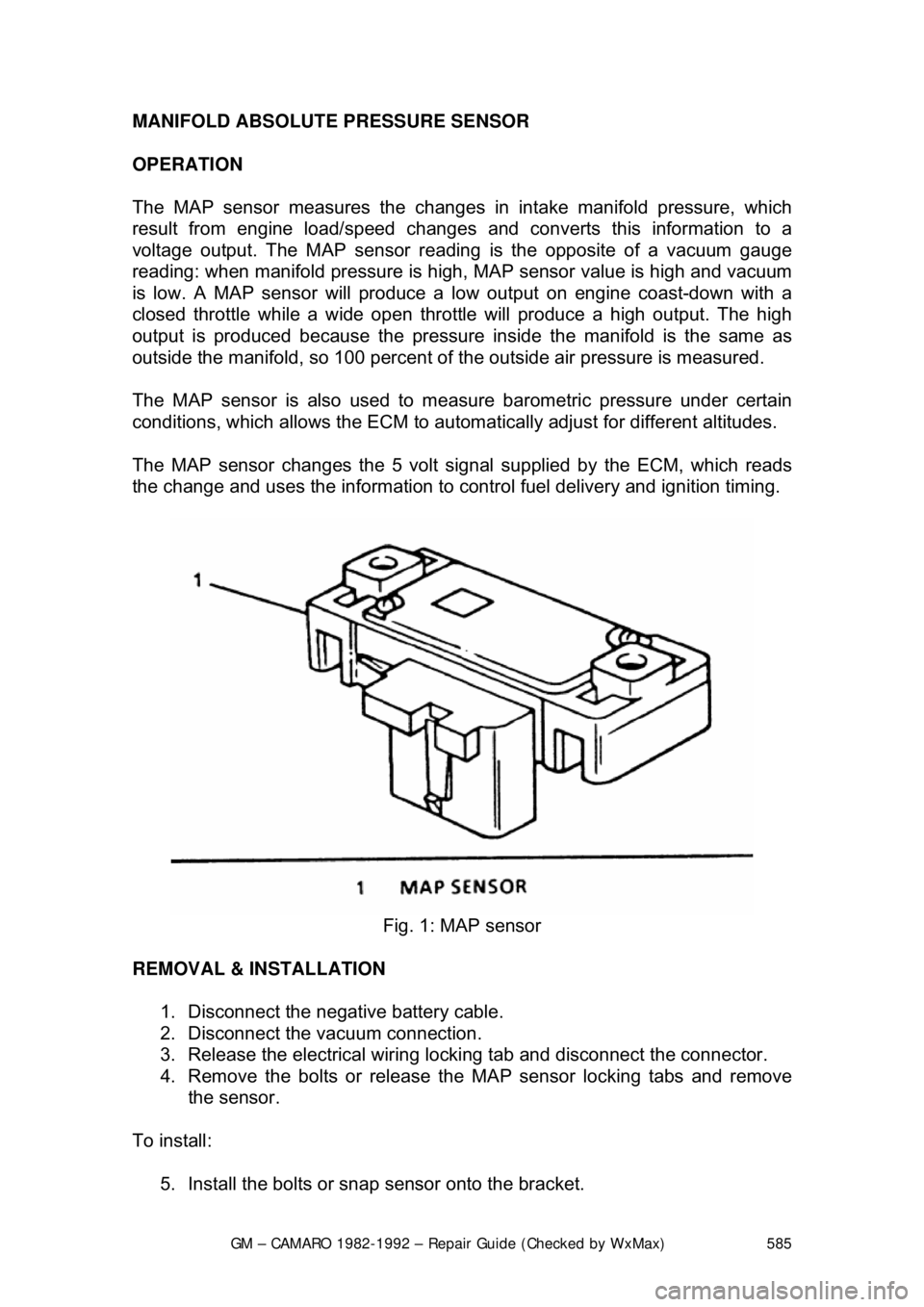
The MAP sensor measures the changes in
intake manifold pressure, which
result from engine load/ speed changes and converts this information to a
voltage output. The MAP sensor reading is the opposite of a vacuum gauge
reading: when manifold pressu re is high, MAP sensor value is high and vacuum
is low. A MAP sensor will produce a low output on engine coast-down with a
closed throttle while a wide open throttle will produce a high output. The high
output is produced because the pressure inside the manifold is the same as
outside the manifold, so 100 percent of t he outside air pressure is measured.
The MAP sensor is also used to meas ure barometric pressure under certain
conditions, which allows the ECM to autom atically adjust for different altitudes.
The MAP sensor changes the 5 volt signal supplied by the ECM, which reads
the change and uses the information to cont rol fuel delivery and ignition timing.
Fig. 1: MAP sensor
REMOVAL & INSTALLATION 1. Disconnect the negative battery cable.
2. Disconnect the vacuum connection.
3. Release the electrical wiring lo cking tab and disconnect the connector.
4. Remove the bolts or release the MAP sensor locking tabs and remove
the sensor.
To install: 5. Install the bolts or snap sensor onto the bracket.
Page 596 of 875

GM – CAMARO 1982-1992 – Repair Guide (Checked by WxMax) 596
recommended to have a qualified technici
an perform any further testing, if
needed.
FIELD SERVICE MODE
On fuel injected models, if the ALDL terminal B is grounded to terminal A with
the engine running, the system enters the Field Service Mode. In this mode, the
MIL will indicate whether the system is operating in open loop or closed loop.
If working in open loop, t he MIL will flash rapidly 2
1/2 times per second. In
closed loop, the flash rate slows to once per second. Additionally, if the system
is running lean in closed loop, the lamp will be off most of the cycle. A rich
condition in closed loop will cause the lamp to remain lit for most of the one
second cycle.
When operating in the Field Service M ode, additional codes cannot be stored
by the ECM. The closed loop timer is bypassed in this mode.
CLEARING CODES
Stored fault codes may be erased from me mory at any time by removing power
from the ECM for at least 30 seconds. It may be necessary to clear stored
codes during diagnosis to check for any re currence during a test drive, but the
stored should be written dow n when retrieved. The codes may still be required
for subsequent troubleshooting. Whenever a repair is complete, the stored
codes must be erased and the vehicle te st driven to confirm correct operation
and repair.
The ignition switch must be OFF any ti me power is disconnected or restored to
the ECM. Severe damage may result if this precaution is not observed.
Depending on the electric di stribution of the particular vehicle, power to the
ECM may be disconnected by removing the ECM fuse in the fusebox or
disconnecting the inline EC M power lead at the positive battery terminal.
Disconnecting the negative battery cable to clear codes will achieve the desired
result, but this will also clear other me mory data in the vehicle such as radio
presets or seat memory.
Page 626 of 875

GM – CAMARO 1982-1992 – Repair Guide (Checked by WxMax) 626
ENGINE PERFORMANCE AND TUNE-UP
TUNE-UP PROCEDURES
In order to extract the full measure of performance and economy from your
engine it is essential that it is properly tuned at regul ar intervals. A regular tune-
up will keep your Camaro's engine running smoothly and will prevent the
annoying breakdowns and poor perform ance associated with an untuned
engine.
A complete tune-up should be performed every 30,000 miles (48,000 km). This
interval should be halved if the car is operated under severe conditions such as
trailer towing, prolonged idling, start-and- stop driving, or if starting or running
problems are noticed. It is assumed that the routine maintenance described in
General Information & Maintenance has been kept up, as this will have a
decided effect on the result s of a tune-up. All of the applicable steps of a tune-
up should be followed in order, as the result is a cumulative one.
If the specifications on the underhoo d tune-up sticker in the engine
compartment of your car disagree with th e "Tune-Up Specifications" chart in this
Section, the figures on the sticker must be used. The sticker often reflects
changes made during t he production run.
SPARK PLUGS
A typical spark plug consists of a metal shell surrounding a ceramic insulator. A
metal electrode extends downward through the center of the insulator and
protrudes a small distance. Located at the end of the plug and attached to the
side of the outer metal shell is the side el ectrode. The side electrode bends in at
a 90 angle so that its tip is just pas t and parallel to the tip of the center
electrode. The distance between these two electrodes (measured in
thousandths of an inch or hundredths of a millimeter) is called the spark plug
gap.
The spark plug does not pr oduce a spark, but instead provides a gap across
which the current can arc. The coil produces anywhere from 20,000 to 50,000
volts (depending on the type and application) which travels through the wires to
the spark plugs. The current passes along the center electrode and jumps the
gap to the side electrode, and in doing so, ignites the air/fuel mixture in the
combustion chamber.
Page 633 of 875
GM – CAMARO 1982-1992 – Repair Guide (Checked by WxMax) 633
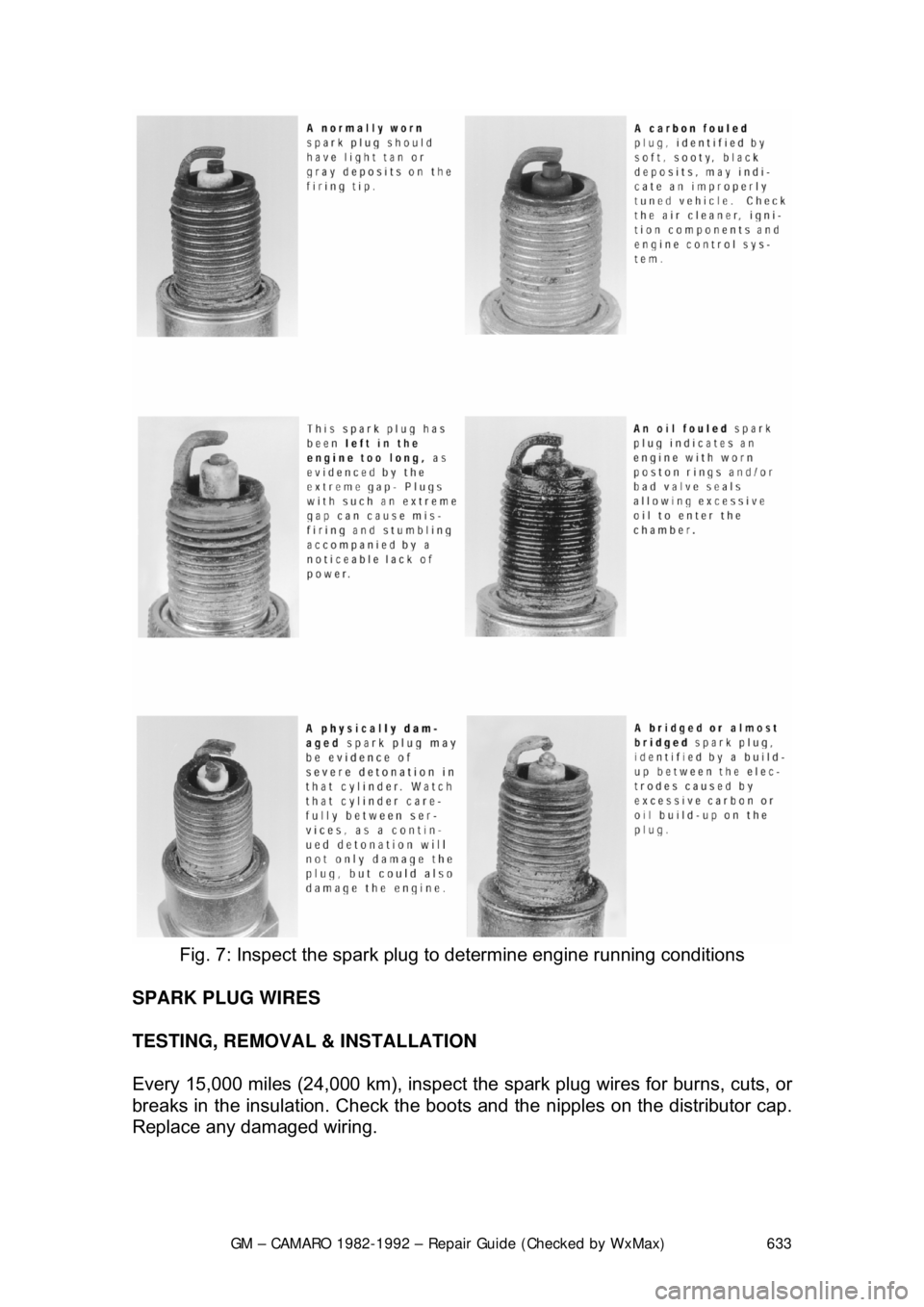
Fig. 7: Inspect the spark plug to determine engine running conditions
SPARK PLUG WIRES
TESTING, REMOVAL & INSTALLATION
Every 15,000 miles (24,000 km), inspect the spark plug wires for burns, cuts, or
breaks in the insulation. Check the boots and the nipples on the distributor cap.
Replace any damaged wiring.
Page 640 of 875

GM – CAMARO 1982-1992 – Repair Guide (Checked by WxMax) 640
The tachometer terminal should never
be allowed to touch ground, as damage
to the computer control module and/or ignition coil assembly can result.
CONNECTORS
When disengaging connectors, do not use a screw driver or other tool to release
the locking tab, as this mi ght break the connector.
SYSTEM TESTERS
Instruments designed specific ally for testing HEI or C
3I systems are available
from several tool manufactur ers. Some of these will even test the module itself.
However, the tests given in the followin g section will require only an ohmmeter
and a voltmeter.
TESTING
The symptoms of a defective component within the HEI or C
3I system are
exactly the same as those you woul d encounter in a conventional system.
Some of these symptoms are:
• Hard or no starting
• Rough Idle
• Poor fuel economy
• Engine misses under load or while accelerating
PRELIMINARY CHECKS
If you suspect a problem in your igniti on system, there are certain preliminary
checks which you should carry out befor e you begin to check the electronic
portions of the system. First, it is extrem ely important to make sure the vehicle
battery is in a good state of charge. A defective or poorly charged battery will
cause the various components of the ignition system to read incorrectly when
they are being tested. Second, make su re all wiring connections are clean and
tight, not only at the battery, but also at the distributor cap (if so equipped),
ignition coil, camshaft and/or crankshaft sensors (if so equipped) and at the
control module.
Since the only difference between these ignition systems lies before the spark
plug wiring, it is important to check the secondary ig nition circuit first. If the
secondary circuit checks out properly (ther e is spark), then the engine condition
is probably not the fault of the ignition system. To check the secondary ignition
system, perform a simple spark test. Remove one of the plug wires and insert
some sort of extension in the plug socket. An old spark plug with the ground
electrode removed makes a good extension. Hold the wire and extension using
an insulated tool (NOT BY HAND) about
1/4 in. (6mm) away from the block and
crank the engine. If a normal spark occurs, then the problem is most likely not in
the ignition system. Check for fuel system problems, or fouled spark plugs.
Page 643 of 875
GM – CAMARO 1982-1992 – Repair Guide (Checked by WxMax) 643
7. If any results of the 3 tests lis
ted above do not agree with the desired
readings, replace the ignition coil.
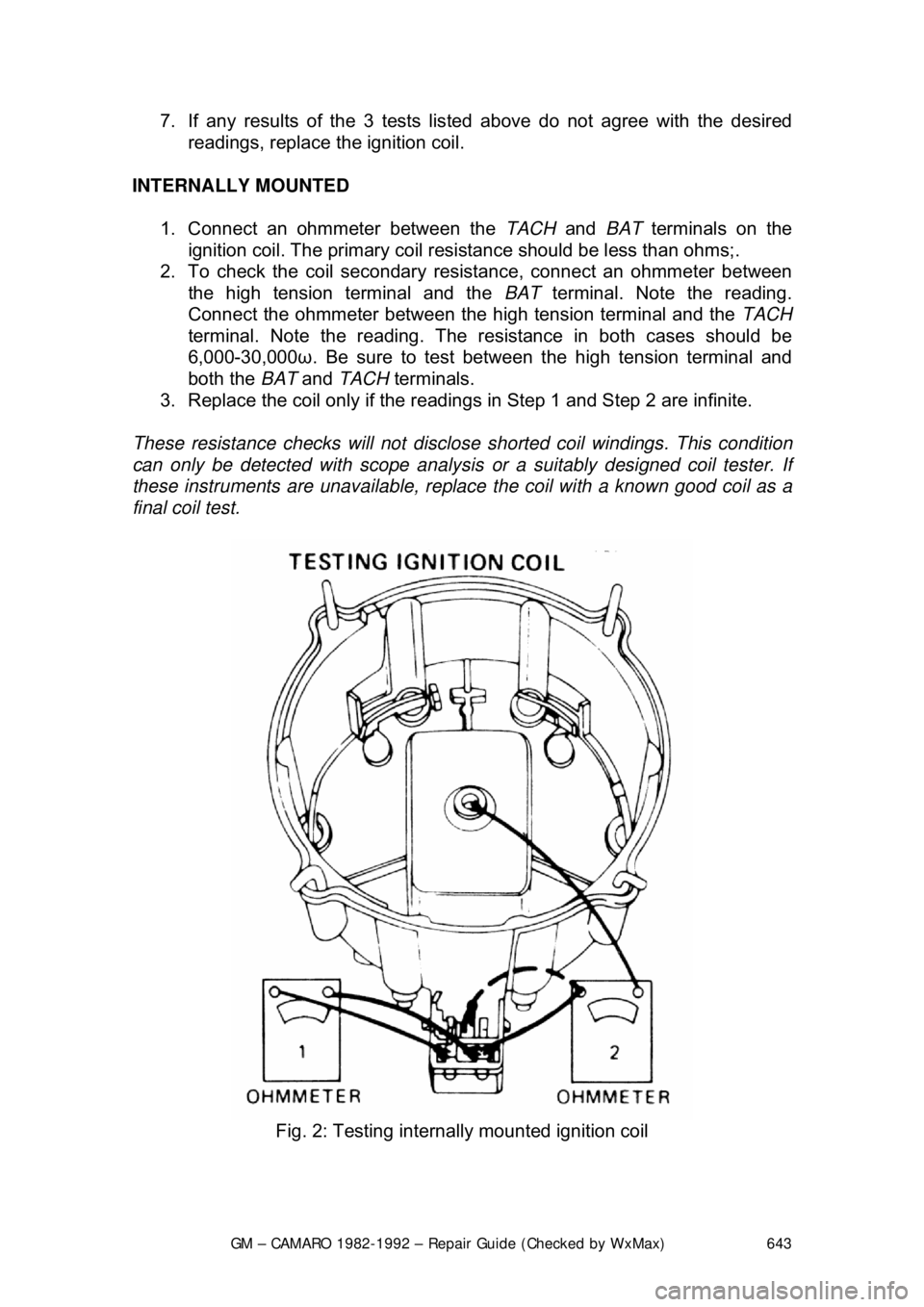
INTERNALLY MOUNTED 1. Connect an ohmmeter between the TACH and BAT terminals on the
ignition coil. The primary coil resi stance should be less than ohms;.
2. To check the coil secondary resistance, connect an ohmmeter between the high tension terminal and the BAT terminal. Note the reading.
Connect the ohmmeter between the high tension terminal and the TACH
terminal. Note the reading. The resi stance in both cases should be
6,000-30,000 ω. Be sure to test between the high tension terminal and
both the BAT and TACH terminals.
3. Replace the coil only if the reading s in Step 1 and Step 2 are infinite.
These resistance checks will not disclose shorted coil windings. This condition
can only be detected with scope analysis or a suitably designed coil tester. If
these instruments are unavaila ble, replace the coil with a known good coil as a
final coil test.
Fig. 2: Testing interna lly mounted ignition coil