light CHEVROLET CAMARO 1982 Repair Guide
[x] Cancel search | Manufacturer: CHEVROLET, Model Year: 1982, Model line: CAMARO, Model: CHEVROLET CAMARO 1982Pages: 875, PDF Size: 88.64 MB
Page 345 of 875

GM – CAMARO 1982-1992 – Repair Guide (Checked by WxMax) 345
operation is required of it. Thus, little a
llowance for air circulation is required,
and the windings can be built into a very small space.
The starter solenoid is a magnetic dev ice which employs the small current
supplied by the starting switch circuit of the ignition switch. This magnetic action
moves a plunger which mechanically engages the starter and electrically closes
the heavy switch which connects it to t he battery. The starting switch circuit
consists of the starting switch cont ained within the ignition switch, a
transmission neutral safety switch or clutch pedal switch, and the wiring
necessary to connect these with the starter solenoid or relay.
A pinion, which is a small gear, is m ounted to a one-way drive clutch. This
clutch is splined to the starter armature shaft. When the ignition switch is moved
to the start position, the solenoid plunger slides the pinion toward the flywheel
ring gear via a collar and spring. If t he teeth on the pinion and flywheel match
properly, the pinion will engage the flywheel immediately. If the gear teeth butt
one another, the spring will be compressed and will force the gears to mesh as
soon as the starter turns far enough to a llow them to do so. As the solenoid
plunger reaches the end of it s travel, it closes the contacts that connect the
battery and starter and then the engine is cranked.
As soon as the engine star ts, the flywheel ring gear begins turning fast enough
to drive the pinion at an ex tremely high rate of speed. At this point, the one-way
clutch begins allowing the pi nion to spin faster than the starter shaft so that the
starter will not operate at excessive speed. When the i gnition switch is released
from the starter position, the solenoid is de-energized, and a spring contained
within the solenoid assembly pulls the gear out of mesh and interrupts the
current flow to the starter.
Some starters employ a separate relay, mounted away from the starter, to
switch the motor and solenoid current on and off. The relay thus replaces the
solenoid electrical switch, but does not eliminate the need for a solenoid
mounted on the starter used to mechanica lly engage the starter drive gears.
The relay is used to reduce the amount of current the starting switch must carry.
THE CHARGING SYSTEM
The automobile charging system provides electrical power for operation of the
vehicle's ignition and star ting systems and all the electrical accessories. The
battery serves as an electrical surge or storage tank, storing (in chemical form)
the energy originally pr oduced by the engine driven gen erator. The system also
provides a means of regulating alternat or output to protect the battery from
being overcharged and to avoid excess ive voltage to the accessories.
The storage battery is a chemical device in corporating parallel lead plates in a
tank containing a sulfuric acid-water solution. Adjacent plates are slightly
dissimilar, and the chemical reaction of the two dissimilar plates produces
electrical energy when the battery is connected to a load such as the starter
motor. The chemical reaction is reversible, so that when the generator i\
s
producing a voltage (electrical pressure ) greater than that produced by the
Page 346 of 875

GM – CAMARO 1982-1992 – Repair Guide (Checked by WxMax) 346
battery, electricity is forced into the battery
, and the battery is returned to its fully
charged state.
Alternators are used on the modern autom obiles for they are lighter, more
efficient, can rotate at higher speeds and have fewer brush problems. In an
alternator, the field rotates while al l the current produced passes only through
the stators windings. The brushes bear agains t continuous slip rings rather than
a commutator. This causes the current produced to periodically reverse the
direction of its flow. Diodes (electrica l one-way switches) block the flow of
current from traveling in t he wrong direction. A series of diodes is wired together
to permit the alternating flow of the st ator to be converted to a pulsating, but
unidirectional flow at the alternator out put. The alternator's field is wired in
series with the voltage regulator.
Please refer to Engine Performance & Tune-up for ignition system testing
procedures.
IGNITION COIL
REMOVAL & INSTALLATION
INTERNALLY MOUNTED COIL 1. Disconnect and label the wires from cap.
2. Remove the distributor cap from the distributor.
3. On the distributor cap, remove t he coil cover attaching screws and the
cover.
4. Remove the ignition coil attaching screws and lift the coil from the cap.
To install: 5. Position the coil and secure it with the attaching screws. Be sure to install
the carbon button and rubber disc first.
6. Install the coil cover and attaching screws.
7. Install the distributor cap.
8. Connect the wires to the cap.
EXTERNALLY MOUNTED COIL 1. Label and disconnect the wires from the coil.
2. Remove the ignition coil mounting bolts and the coil.
To install: 3. To install, position the coil into place and se cure it with the mounting
bolts.
4. Connect the wires to the coil.
IGNITION MODULE
Page 351 of 875

GM – CAMARO 1982-1992 – Repair Guide (Checked by WxMax) 351
alternating current developed
within the stator windings to a direct (DC) current
at the output (BAT) terminal. Three of these diodes are negative and are
mounted flush with the end frame while t he other three are positive and are
mounted into a strip called a heat sink. The positive diodes are easily identified
as the ones within small cavities or depressions.
The alternator charging system is a negative (-) ground system which consists
of an alternator, a regulat or, a charge indicator, a storage battery and wiring
connecting the components, and fuse link wire.
The alternator is belt-driven from t he engine. Energy is supplied from the
alternator/regulator system to the rotati ng field through two brushes to two slip-
rings. The slip-rings are mounted on the rotor shaft and are connected t\
o the
field coil. This energy supplied to the ro tating field from the battery is called
excitation current and is used to init ially energize the field to begin the
generation of electricity. Once the alter nator starts to generate electricity, the
excitation current comes from its ow n output rather than the battery.
The alternator produces power in the form of alternating current. The alternating
current is rectified by 6 diodes into dire ct current. The direct current is used to
charge the battery and power the rest of the electrical system.
When the ignition key is turned ON, current flows from the battery, through the
charging system indicator light on the in strument panel, to the voltage regulator,
and to the alternator. Since the alternat or is not producing any current, the
alternator warning light comes on. When the engine is started, the alternator
begins to produce current and turns the alte rnator light off. As the alternator
turns and produces current, the current is divided in two ways: part to the
battery(to charge the battery and power the electrical components of the
vehicle), and part is returned to the alte rnator (to enable it to increase its
output). In this situation, the alternator is receiving current from the battery and
from itself. A voltage regulat or is wired into the current supply to the alternator
to prevent it from receiving too much cu rrent which would cause it to put out too
much current. Conversely, if the voltage regulator does not allow the alternator
to receive enough current, the battery will not be fully charged and will
eventually go dead.
The battery is connected to the alternator at all times, whether the ignition key is
turned ON or not. If the battery were shorted to ground, the alternator would
also be shorted. This woul d damage the alternator. To prevent this, a fuse link
is installed in the wiring between the battery and the alternator. If the battery is
shorted, the fuse link melts, protecting the alternator.
An alternator is better that a convent ional, DC shunt generator because it is
lighter and more compact, because it is designed to supply the battery and
accessory circuits through a wide range of engine speeds, and because it
eliminates the necessary maintenance of replacing brushes and servicing
commutators.
PRECAUTIONS
Page 352 of 875

GM – CAMARO 1982-1992 – Repair Guide (Checked by WxMax) 352
To prevent serious damage to the alte
rnator and the rest of the charging
system, the following precauti ons must be observed:
• Never reverse the battery connections.
• Booster batteries for starting must be connected properly: positive-to-
positive and negative-to-ground.
• Disconnect the battery cables before using a fast charger; the charger
has a tendency to force current through the diodes in the opposite
direction for which they were designed. This burns out the diodes.
• Never use a fast charger as a booster for starting the vehicle.
• Never disconnect the voltage regulator while the engine is running.
• Avoid long soldering times when replacing diodes or transistors.
Prolonged heat is damaging to AC alternators.
• Do not use test lamps of more t han 12 volts (V) for checking diode
continuity.
• Do not short across or ground any of the terminals on the AC alternator.
• The polarity of the battery, alter nator, and regulator must be matched
and considered before making any elec trical connections within the
system.
• Never operate the alternator on an open circuit. make sure that all
connections within the circ uit are clean and tight.
• Disconnect the battery terminals when performing any service on the
electrical system. This wil l eliminate the possibility of accidental reversal
of polarity.
• Disconnect the battery ground cable if arc welding is to be done on any
part of the car.
CHARGING SYSTEM TROUBLESHOOTING
There are many possible ways in whic h the charging system can malfunction.
Often the source of a problem is diffi cult to diagnose, requiring special
equipment and a good deal of experience. However, when the charging system
fails completely and causes the dash boar d warning light to come on or the
battery to become dead the following items may be checked:
1. The battery is known to be good and fully charged.
2. The alternator belt is in good condition and adjusted to the proper
tension.
3. All connections in t he system are clean and tight.
REMOVAL & INSTALLATION
Page 431 of 875
GM – CAMARO 1982-1992 – Repair Guide (Checked by WxMax) 431
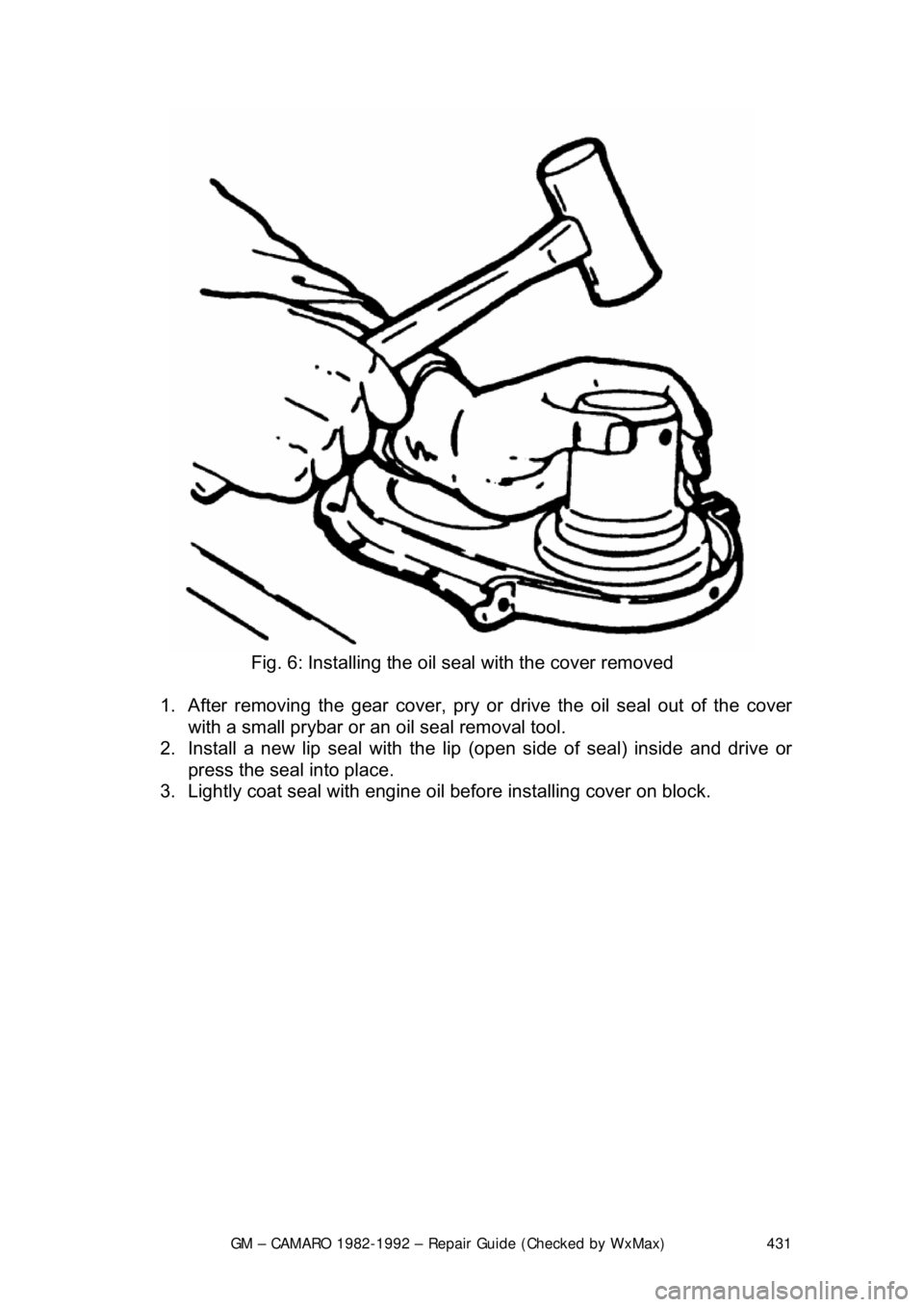
Fig. 6: Installing the oil seal with the cover removed
1. After removing the gear cover, pry or drive the oil seal out of the cover
with a small prybar or an oil seal removal tool.
2. Install a new lip seal with the lip (open side of seal) inside and drive or
press the seal into place.
3. Lightly coat seal with engine oil before installing cover on block.
Page 433 of 875
GM – CAMARO 1982-1992 – Repair Guide (Checked by WxMax) 433
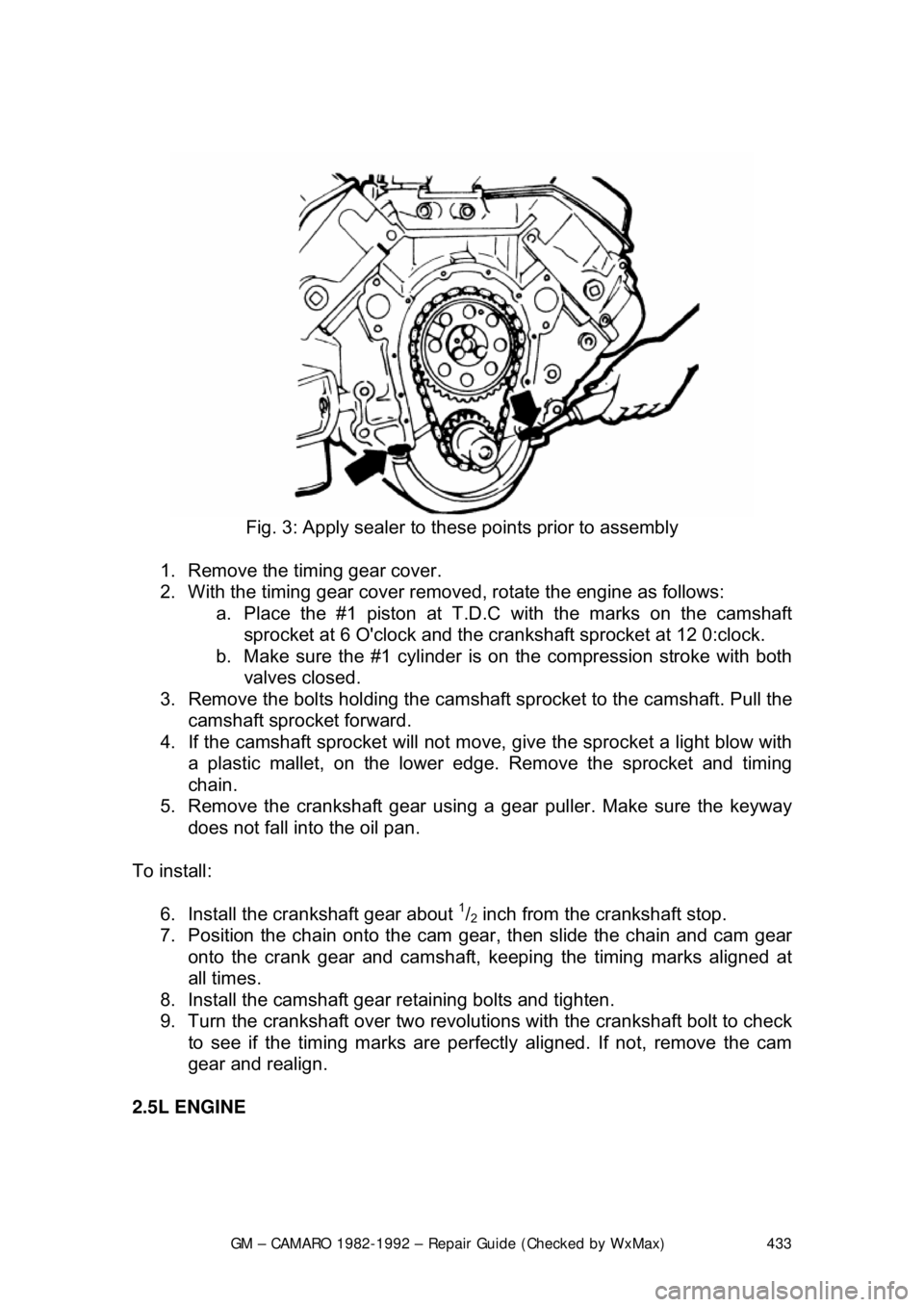
Fig. 3: Apply sealer to t hese points prior to assembly
1. Remove the timing gear cover.
2. With the timing gear cover remov ed, rotate the engine as follows:
a. Place the #1 piston at T.D. C with the marks on the camshaft
sprocket at 6 O'clock and the cranks haft sprocket at 12 0:clock.
b. Make sure the #1 cylinder is on the compression stroke with both
valves closed.
3. Remove the bolts holding the cams haft sprocket to the camshaft. Pull the
camshaft sprocket forward.
4. If the camshaft sprocket will not move, give the sprocket a light blow with
a plastic mallet, on the lower edge. Remove the sprocket and timing
chain.
5. Remove the crankshaft gear using a gear puller. Make sure the keyway
does not fall into the oil pan.
To install: 6. Install the crankshaft gear about
1/2 inch from the crankshaft stop.
7. Position the chain onto the cam gear, then slide the chain and cam gear
onto the crank gear and camshaft, keepi ng the timing marks aligned at
all times.
8. Install the camshaft gear retaining bolts and tighten.
9. Turn the crankshaft over two revolutions with the crankshaft bolt to check to see if the timing marks are perfectly aligned. If not, remove the cam
gear and realign.
2.5L ENGINE
Page 453 of 875
GM – CAMARO 1982-1992 – Repair Guide (Checked by WxMax) 453
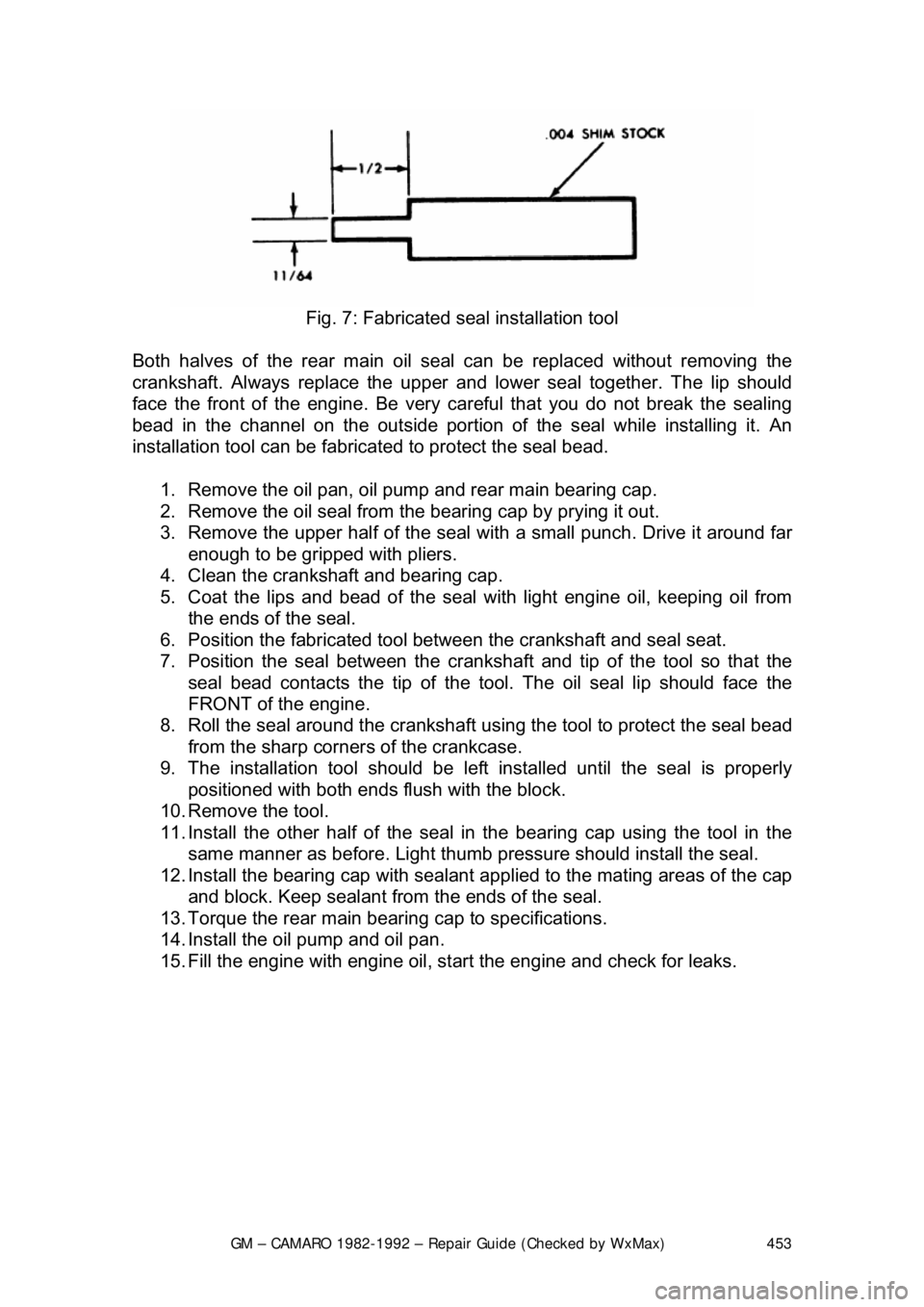
Fig. 7: Fabricated s eal installation tool
Both halves of the rear main oil s eal can be replaced without removing the
crankshaft. Always replace the upper and lower seal together. The lip should
face the front of the engine. Be very ca reful that you do not break the sealing
bead in the channel on the out side portion of the seal while installing it. An
installation tool can be fabricat ed to protect the seal bead.
1. Remove the oil pan, oil pump and rear main bearing cap.
2. Remove the oil seal from the bearing cap by prying it out.
3. Remove the upper half of the seal wit h a small punch. Drive it around far
enough to be gripped with pliers.
4. Clean the crankshaft and bearing cap.
5. Coat the lips and bead of the seal with light engine oil, keeping oil from
the ends of the seal.
6. Position the fabricated tool bet ween the crankshaft and seal seat.
7. Position the seal between the cranks haft and tip of the tool so that the
seal bead contacts the ti p of the tool. The oil seal lip should face the
FRONT of the engine.
8. Roll the seal around the crankshaft us ing the tool to protect the seal bead
from the sharp corner s of the crankcase.
9. The installation tool should be le ft installed until the seal is properly
positioned with both ends fl ush with the block.
10. Remove the tool.
11. Install the other half of the seal in the bearing cap using the tool in the
same manner as before. Light thumb pressure should install the seal.
12. Install the bearing cap with sealant applied to the mating areas of the cap
and block. Keep sealant from the ends of the seal.
13. Torque the rear main bear ing cap to specifications.
14. Install the oil pump and oil pan.
15. Fill the engine with engine oil, st art the engine and check for leaks.
Page 463 of 875
GM – CAMARO 1982-1992 – Repair Guide (Checked by WxMax) 463
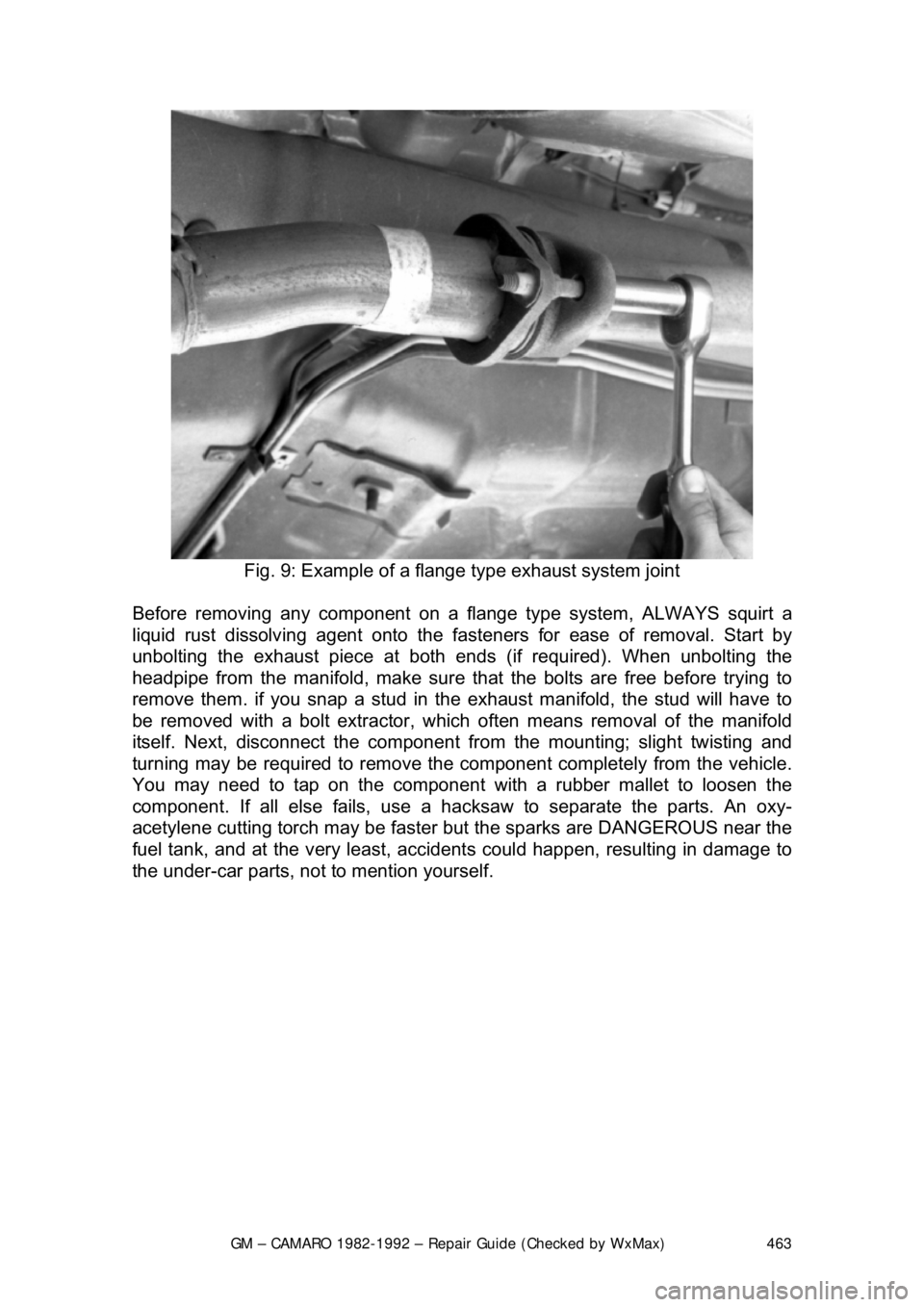
Fig. 9: Example of a fl ange type exhaust system joint
Before removing any component on a fl ange type system, ALWAYS squirt a
liquid rust dissolving agent onto the fast eners for ease of removal. Start by
unbolting the exhaust piece at both ends (if required). When unbolting the
headpipe from the manifold, make sure that the bolts are free before trying to
remove them. if you snap a stud in t he exhaust manifold, the stud will have to
be removed with a bolt extractor, which often means removal of the manifold
itself. Next, disconnect the component fr om the mounting; slight twisting and
turning may be required to remove the co mponent completely from the vehicle.
You may need to tap on the component wit h a rubber mallet to loosen the
component. If all else fails, use a hacksaw to separate the parts. An oxy-
acetylene cutting torch may be faster but the sparks are DANGEROUS near the
fuel tank, and at the very least, accident s could happen, resulting in damage to
the under-car parts, not to mention yourself.
Page 465 of 875
GM – CAMARO 1982-1992 – Repair Guide (Checked by WxMax) 465
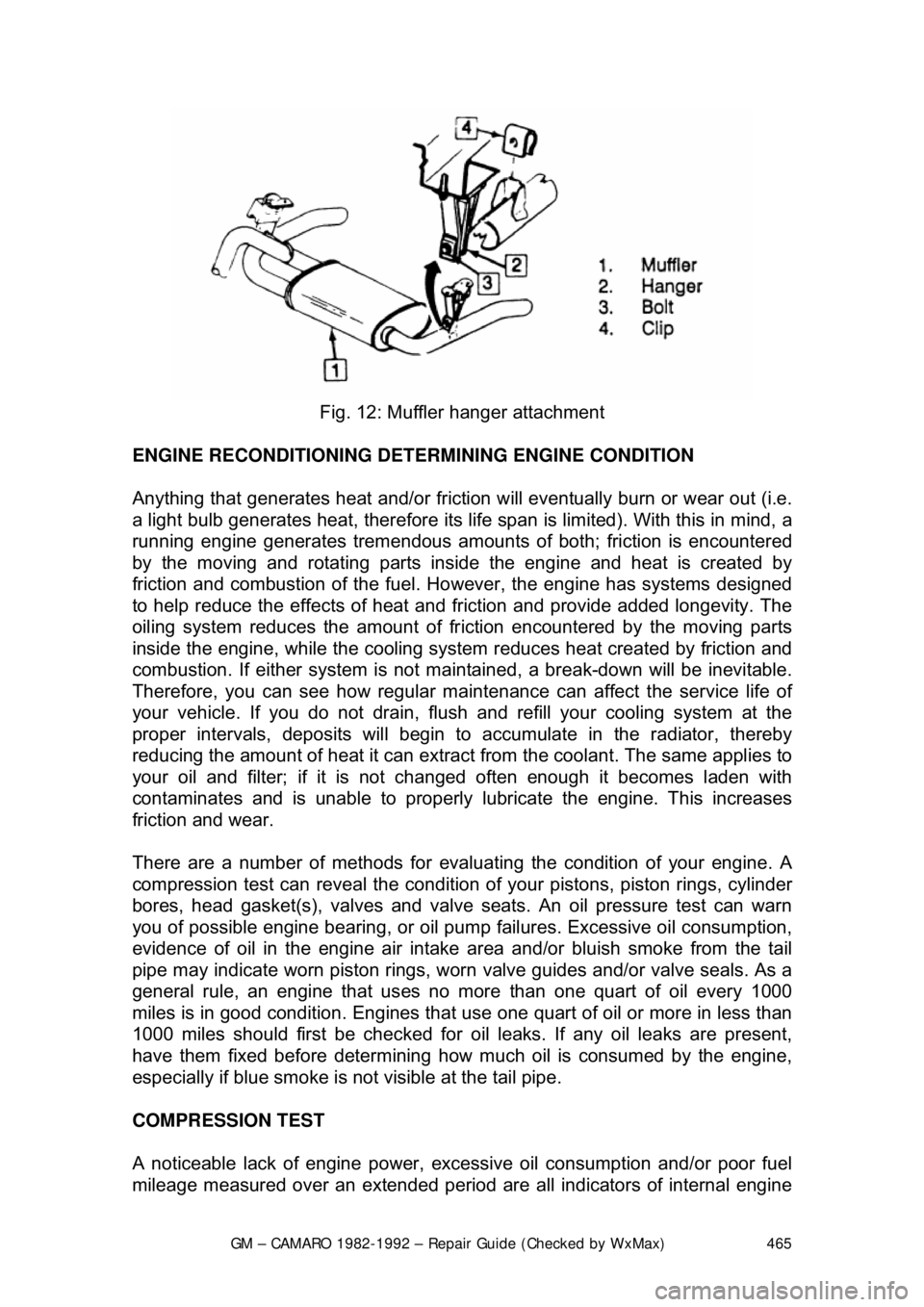
Fig. 12: Muffler hanger attachment
ENGINE RECONDITIONING DETE RMINING ENGINE CONDITION
Anything that generates heat and/or friction will eventually burn or wear out (i.e.
a light bulb generates heat, therefore its life span is limited). With this in mind, a
running engine generates trem endous amounts of both; friction is encountered
by the moving and rotating parts inside the engine and heat is created b\
y
friction and combustion of the fuel. Ho wever, the engine has systems designed
to help reduce the effects of heat and fr iction and provide added longevity. The
oiling system reduces the amount of fr iction encountered by the moving parts
inside the engine, while the cooling system reduces heat created by friction and
combustion. If either system is not main tained, a break-down will be inevitable.
Therefore, you can see how regular main tenance can affect the service life of
your vehicle. If you do not drain, flush and refill your cooling system at the
proper intervals, deposits will begin to accumulate in the radiator, thereby
reducing the amount of heat it can extrac t from the coolant. The same applies to
your oil and filter; if it is not changed often enoug h it becomes laden with
contaminates and is unable to properly lubricate the engine. This increases
friction and wear.
There are a number of methods for evaluat ing the condition of your engine. A
compression test can reveal the condition of your pistons, piston rings, cylinder
bores, head gasket(s), valves and valve seat s. An oil pressure test can warn
you of possible engine bearing, or oil pump failures. Excessive oil consumption,
evidence of oil in the engine air intake area and/or bluish smoke from the tail
pipe may indicate worn piston rings, worn valve guides and/or valve seals. As a
general rule, an engine that uses no more than one quart of oil every 1000
miles is in good condi tion. Engines that use one quart of oil or more in less than
1000 miles should first be checked for oil leaks. If any oil leaks are present,
have them fixed before dete rmining how much oil is consumed by the engine,
especially if blue smoke is not visible at the tail pipe.
COMPRESSION TEST
A noticeable lack of engine power, excessive oil consumption and/or poor fuel
mileage measured over an extended period are all indicators of internal engine
Page 466 of 875
GM – CAMARO 1982-1992 – Repair Guide (Checked by WxMax) 466
wear. Worn piston rings, scored or wo
rn cylinder bores, blown head gaskets,
sticking or burnt valves, and worn valve seats are all possible culprits. A check
of each cylinder's compression will help locate the problem.
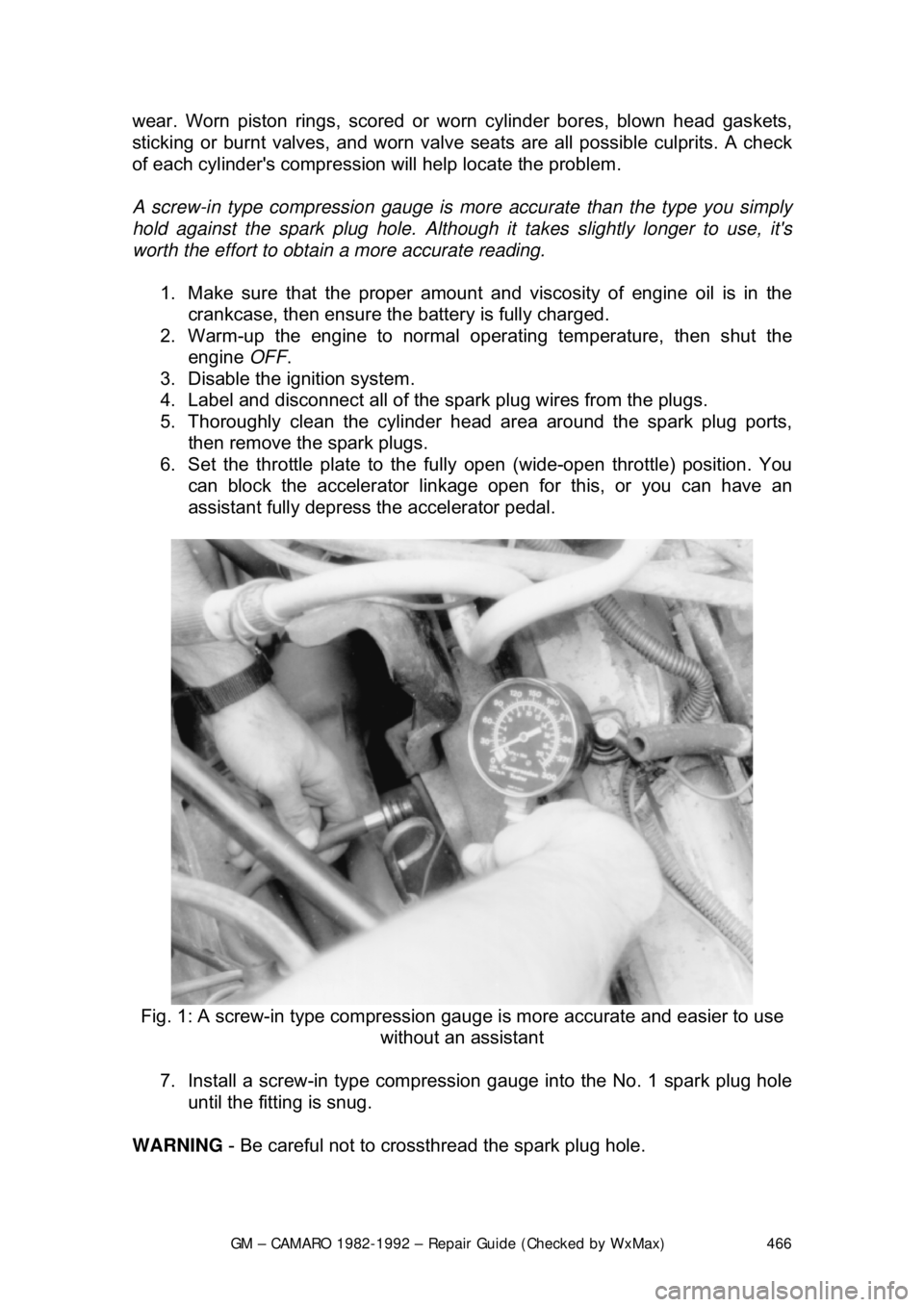
A screw-in type compression gauge is more accurate than the type you simply
hold against the spark plug hole. Although it takes slightly longer to use, it's
worth the effort to obtain a more accurate reading.
1. Make sure that the proper amount and viscosity of engine oil is in the
crankcase, then ensure the battery is fully charged.
2. Warm-up the engine to normal operat ing temperature, then shut the
engine OFF.
3. Disable the ignition system.
4. Label and disconnect all of the spark plug wires from the plugs.
5. Thoroughly clean the cylinder h ead area around the spark plug ports,
then remove the spark plugs.
6. Set the throttle plate to the fully open (wide-open throttle) position. You
can block the accelerator linkage open for this, or you can have an
assistant fully depress the accelerator pedal.
Fig. 1: A screw-in type compression gauge is more accurate and easier to use
without an assistant
7. Install a screw-in type compression gauge into the No. 1 spark plug hole
until the fitting is snug.
WARNING - Be careful not to crossthread the spark plug hole.