light CHEVROLET CAMARO 1982 Repair Guide
[x] Cancel search | Manufacturer: CHEVROLET, Model Year: 1982, Model line: CAMARO, Model: CHEVROLET CAMARO 1982Pages: 875, PDF Size: 88.64 MB
Page 86 of 875
GM – CAMARO 1982-1992 – Repair Guide (Checked by WxMax) 86
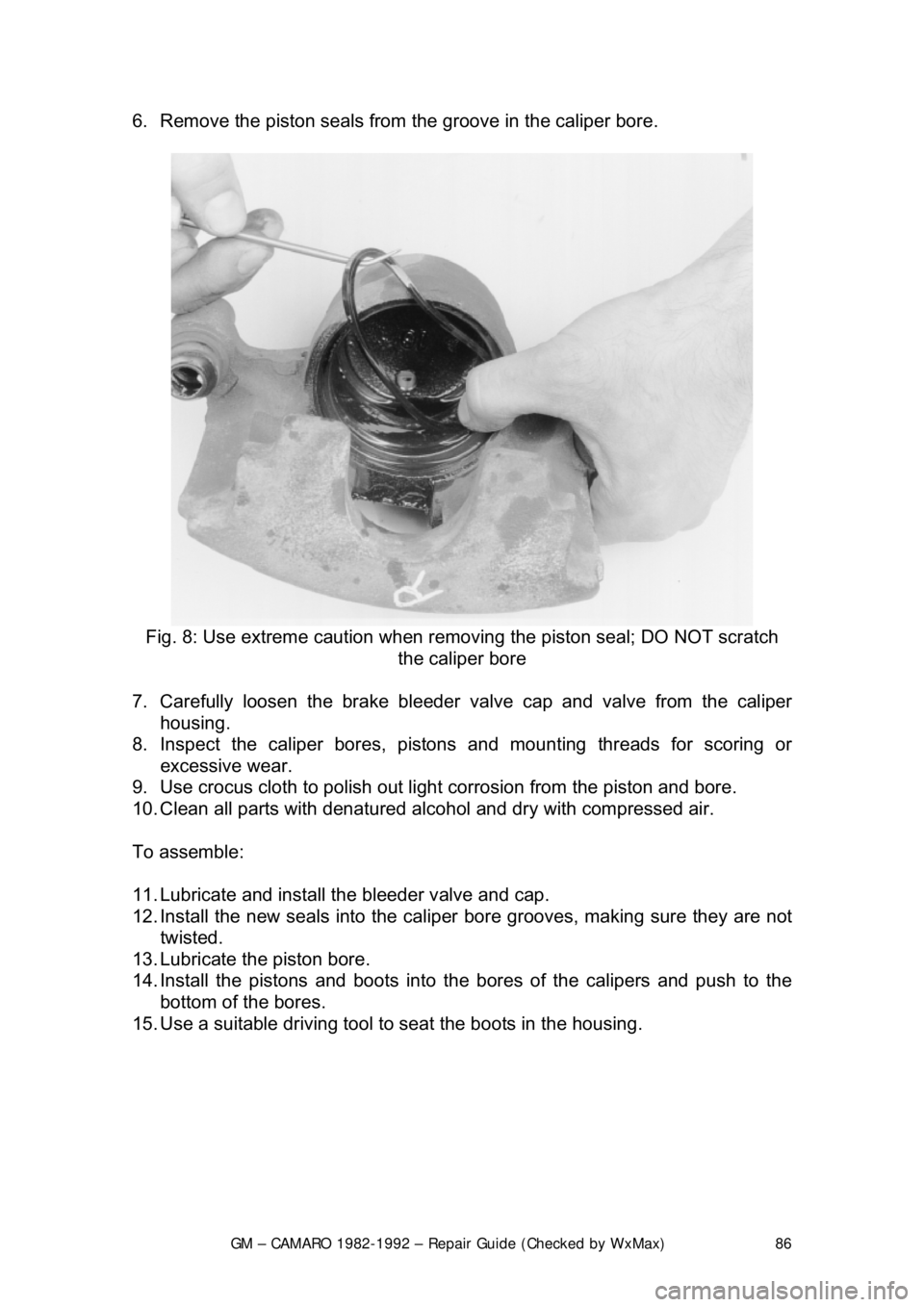
6. Remove the piston seals from
the groove in the caliper bore.
Fig. 8: Use extreme caution when remo ving the piston seal; DO NOT scratch
the caliper bore
7. Carefully loosen the br ake bleeder valve cap and valve from the caliper
housing.
8. Inspect the caliper bores, pistons and mounting threads for scoring or excessive wear.
9. Use crocus cloth to polish out light corrosion from the piston and bore.
10. Clean all parts with denatured alcohol and dry with compressed air.
To assemble:
11. Lubricate and install th e bleeder valve and cap.
12. Install the new seals into the caliper bore grooves, making sure they are not
twisted.
13. Lubricate the piston bore.
14. Install the pistons and boots into the bores of the calipers and push to the
bottom of the bores.
15. Use a suitable driving tool to seat the boots in the housing.
Page 93 of 875
GM – CAMARO 1982-1992 – Repair Guide (Checked by WxMax) 93
2. Remove the wheel or wheels.
3. Pull the brake drum off. It may be nec
essary to gently tap the rear edges of
the drum to start it off the studs.
4. If extreme resistance to removal is encountered, it will be necessary to
retract the adjusting screw. Knock out the access hole in the backing plate
and turn the adjuster to retract th e linings away from the drum.
5. Install a replacement hole co ver before reinstalling drum.
6. Install the drums in the same position on the hub as removed.
DRUM INSPECTION
1. Check the drums for any cracks, scores, grooves, or an out-of-round
condition. Replace if cracked. Slight scores can be removed with fine emery
cloth while extensive scoring requires turning the drum on a lathe.
2. Never have a drum turned mo re than 0.060 in. (1.524mm).
BRAKE SHOES
ADJUSTMENT
Rotate the star wheel adjuster until a sl ight drag is felt between the shoes and
drum, then back off 12 clicks on the adjusting wheel. Put the car in reverse and,
while backing up, apply the brakes seve ral times. This will allow the self-
adjusters to complete the adjustment.
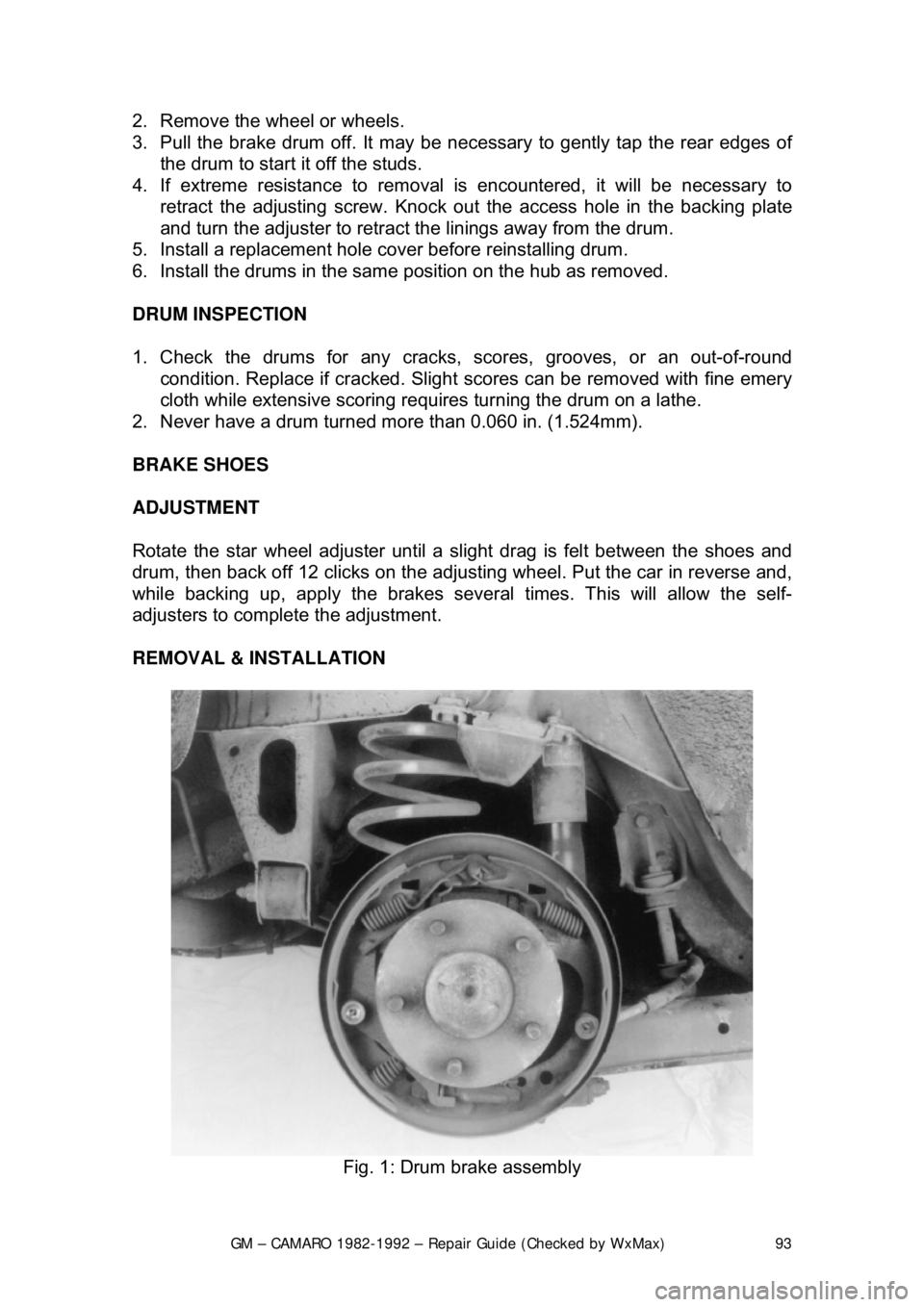
REMOVAL & INSTALLATION
Fig. 1: Drum brake assembly
Page 107 of 875
GM – CAMARO 1982-1992 – Repair Guide (Checked by WxMax) 107
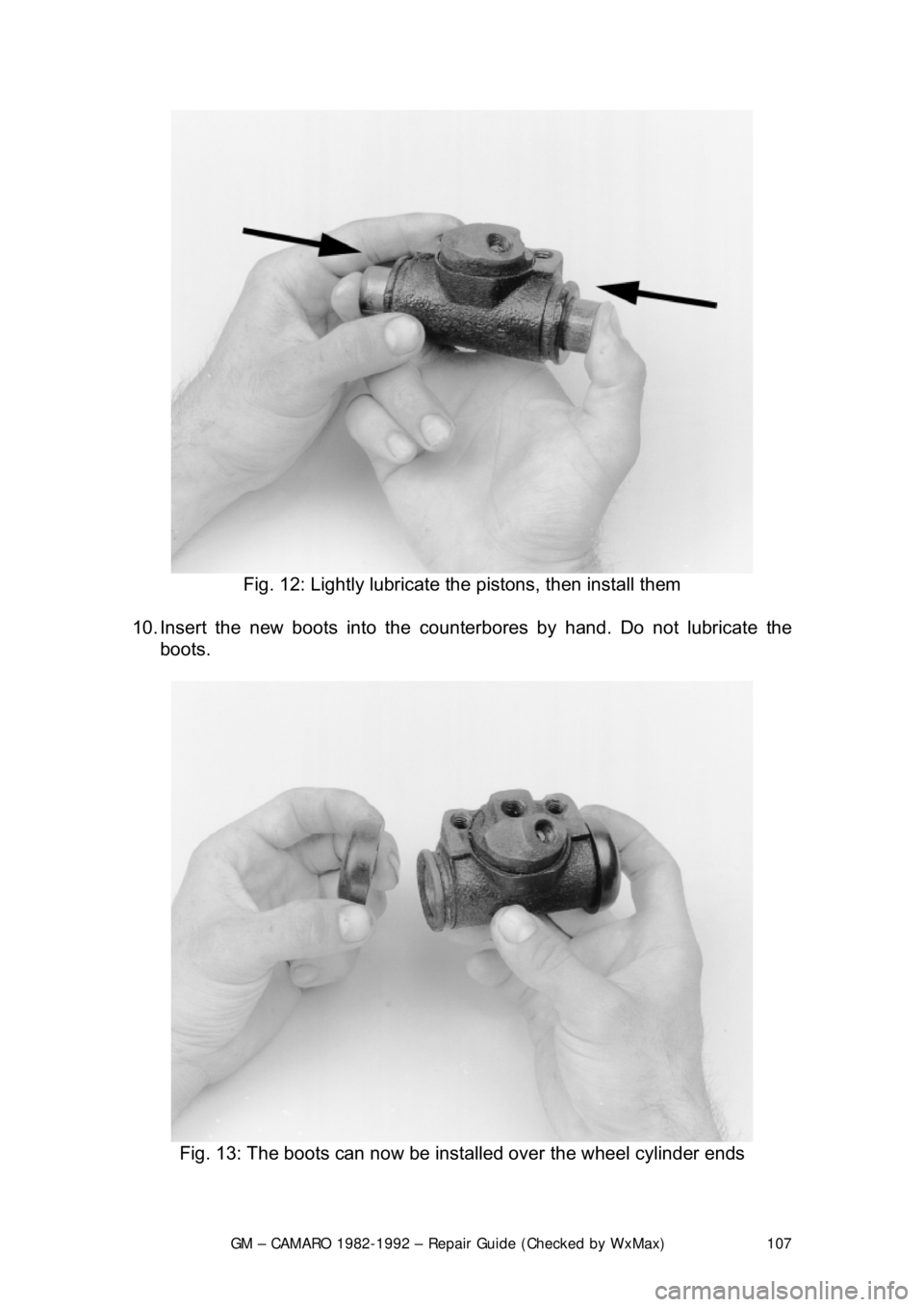
Fig. 12: Lightly lubricate t he pistons, then install them
10. Insert the new boots in to the counterbores by hand. Do not lubricate the
boots.
Fig. 13: The boots can now be installed over the wheel cylinder ends
Page 117 of 875

GM – CAMARO 1982-1992 – Repair Guide (Checked by WxMax) 117
5. Remove the shaft seal and washer.
6. Remove the dust boot. Be careful not to scratch the housing bore.
7. Remove the locator retainer if so
equipped. Remove the piston locator if so
equipped.
8. Remove the piston seal usi ng a wooden or plastic tool.
9. Remove the bleeder screw, bolt, fi tting, and copper washer. Remove the
bracket only if it is damaged.
10. Inspect caliper bore for scoring, nicks, corrosion, and wear. Use crocus cloth
for light corrosion. Replace caliper if bore will not clean up.
To install:
11. Replace the bleeder screw, bolt, fitting, and copper washer.
12. Install the piston. Lubricate seal s and piston with brake fluid prior to
reinstallation.
13. Install the locator retainer if so equi pped. Install the piston locator if so
equipped.
14. Install the dust boot.
15. Install the shaft seal and washer.
16. Install actuator scr ew to the housing.
17. Install the nut, lever, lever seal, and anti-friction washer. It may be necessary
to rotate the parking brake lever away from the stop to install the nut. Torque
the nut 30-40 ft. lbs. (41-54 Nm) and ro tate the lever back to the stop.
18. Install the shoe dampening spri ng to the end of the piston.
It may be necessary to move the parking brake lever off the stop, extending the
piston slightly, making the dampening spring groove acce ssible. If the piston is
extended, push it back into the caliper before installing the caliper on the car.
1989-92 MODELS
1. Remove the caliper assembly. Remove the 2 collar return springs from the
actuating collar. Remove the actuator collar assembly with parts attached
out of the housing.
2. Remove the clamp rod and compliance bushing.
3. Remove the boot retainers, 2 boots and pushrod from the compliance
bushing. Discard the retainers and boots.
4. Remove the preload spring from the retainer.
5. Using compressed air directed into the brake hose port, carefully extract
piston.
CAUTION - Do not place fingers between piston and brake shoe flange, or
personal injury may occur when piston breaks free from bore. Cover caliper
assembly with a rag to prevent brake fluid from spraying when piston is
extracted
6. Inspect and clean piston and bore a ssembly for cracks or scoring.
7. Remove the piston seal.
8. Remove the bleeder valve.
Page 118 of 875

GM – CAMARO 1982-1992 – Repair Guide (Checked by WxMax) 118
9. Remove the caliper lever pivot pin s
eal, sprag clip, spring and lever. Discard
the clip.
10. Inspect the caliper lever for worn spots, replace as necessary.
11. Remove the 2 guide pins from the mounting bracket.
12. Clean all parts not included in the r ebuild kit in denatured alcohol. Use only
dry filtered compressed air to dry parts . Replace the caliper housing if badly
scored or corroded.
To install:
13. Lubricate the new piston s eal with clean brake fluid. Place the seal into the
caliper groove, making sure t he seal is not twisted.
14. Install the piston. Lubricate seal s and piston with brake fluid prior to
reinstallation.
15. Assemble the pushrod, 2 new boots and new retainers to the actuating
collar.
16. Lightly coat the actuat ing collar with the lubricant provided in the rebuild kit.
Do not use any other type of lubricant.
17. Install the clamp retainers firmly agains t the actuating collar. Bend the tabs
on the retainer to hold the assembly together.
18. Install the preload spring into the boot retainers.
19. Install the clamp rod to the actuati ng collar and boot. Lubricate the clamp rod
with the lubricant supplied in the kit.
20. Slide the clamp rod th rough the holes in the boot and actuating collar. The
boot must be against the reacti on plate on the clamp rod.
21. Lubricate and install t he new compliance bushing with the lubricant supplied
in the kit.
22. Install the clamp rod with assembled parts into the connecting hole in the
caliper piston.
23. Install a new bleeder valve.
24. Install the pivot pin and new nut into the housing, if removed.
25. Install the caliper pivot pin seal, parking brake lever, new sprag clip and
spring, in that order. The teeth of the sprag clip mu st face away from the
lever.
26. Install the 2 collar return springs to the retainer. The retainer must enter the
return springs at the end of the second coil.
27. Install the adjuster screw into the cali per housing until the actuating collar is
parallel to the piston bore face of the caliper housing.
28. Lubricate and then install the guide pi ns and boots. Install the pads and
caliper assembly.
29. Bleed the brake system.
BRAKE DISC (ROTOR)
REMOVAL & INSTALLATION
CAUTION - Brake pads contain asbestos, which has been determined to be a
cancer causing agent. Never clean the brake surfaces with compressed air!
Avoid inhaling any dust from any brake surface! When cleaning brake surfaces,
use a commercially available brake cleaning fluid.
Page 122 of 875
GM – CAMARO 1982-1992 – Repair Guide (Checked by WxMax) 122
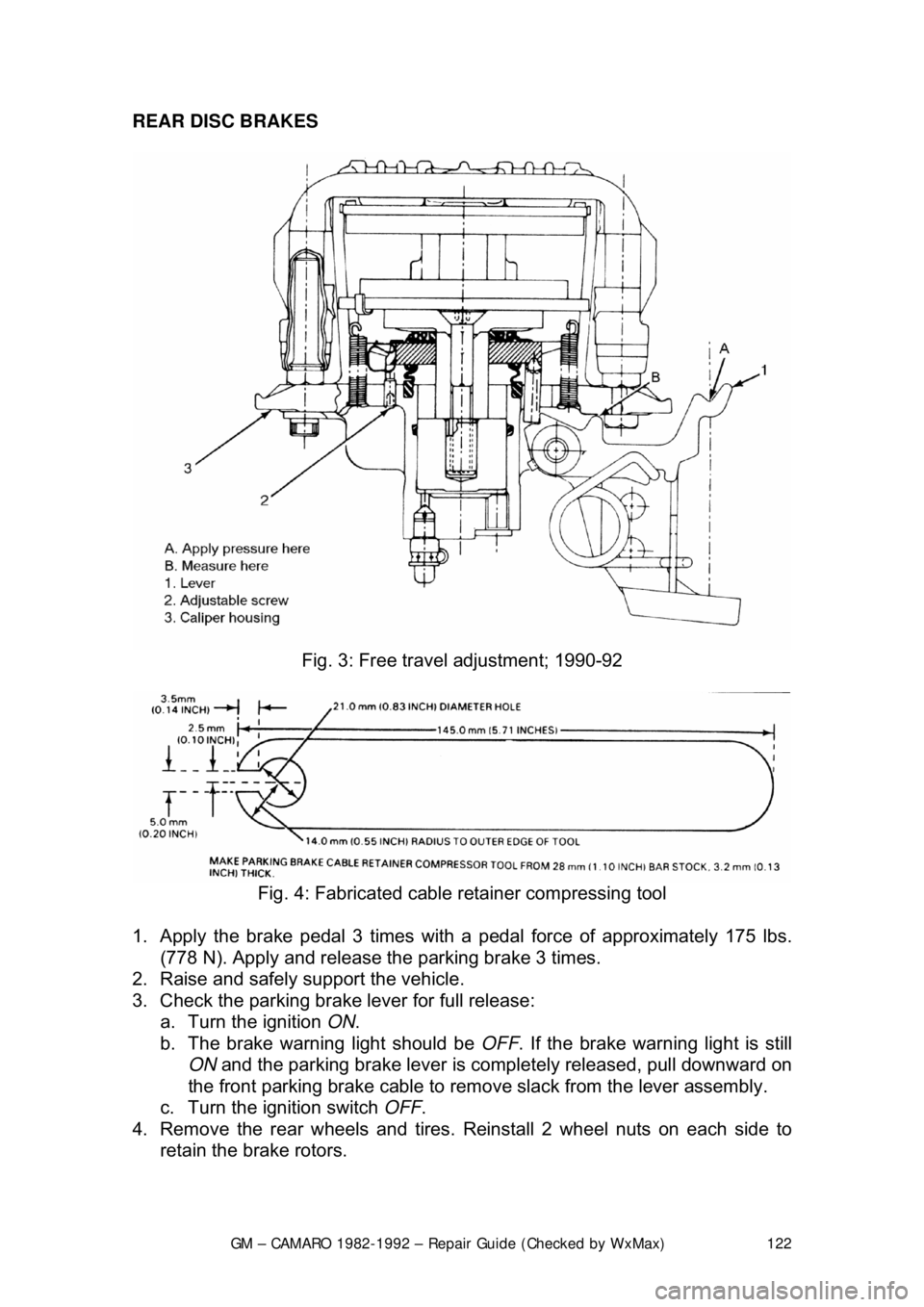
REAR DISC BRAKES
Fig. 3: Free trav el adjustment; 1990-92
Fig. 4: Fabricated cable retainer compressing tool
1. Apply the brake pedal 3 times with a pedal force of approximately 175 lbs.
(778 N). Apply and release t he parking brake 3 times.
2. Raise and safely support the vehicle.
3. Check the parking brake lever for full release: a. Turn the ignition ON.
b. The brake warning light should be OFF. If the brake warning light is still
ON and the parking brake lever is comple tely released, pull downward on
the front parking brake cable to remove slack from the lever assembly.
c. Turn the ignition switch OFF.
4. Remove the rear wheels and tires. Reinstall 2 wheel nuts on each side to
retain the brake rotors.
Page 123 of 875

GM – CAMARO 1982-1992 – Repair Guide (Checked by WxMax) 123
5. Pull the parking lever 4 clicks. T
he parking brake levers on both calipers
should be against the lever stops on the caliper housings. If the levers are
not against the stops, check for binding in the rear cables and/or loosen the
cables at the equalizer nut until both left and right levers are against their
stops.
6. Adjust the equalizer adjusting nut unt il the parking brake levers on both
calipers just begin to mo ve off their stops.
7. Back off the adjuster nut until the le vers move back, barely touching their
stops.
8. Operate the parking brak e lever several times to check adjustment. After
cable adjustment, the parking brake le ver should travel no more than 14
ratchet clicks. The rear wheels shoul d not turn forward when the parking
brake lever is applied 8-16 ratchet clicks.
9. Release the parking brake lever. Both rear whee ls must turn freely in both
directions. The parking brake levers on both calipers should be resting on
their stops.
10. Remove the wheel nuts retaining t he rotors. Install the wheel and tire
assemblies.
11. Lower the vehicle.
PARKING BRAKE FREE-TRAVEL
ADJUSTMENT
1989-92 MODELS
REAR DISC BRAKES
Disc brake pads must be new or parallel to within 0.006 in. (0.15mm). Parking
brake adjustment is not valid wit h heavily tapered pads and may cause
caliper/parking brake binding. Replace tapered brak e pads. Parking brake free-
travel should only be made if the caliper has been taken apart. This adjustment
will not correct a condition where the caliper levers will not return to their stops.
1. Have an assistant apply a light brake pedal load, enough to stop the rotor
from turning by hand. This takes up all clearances and ensures that
components are correctly aligned.
2. Apply light pressure to the caliper lever.
3. Measure the free-travel between t he caliper lever and the caliper housing.
The free-travel must be 0.0024-0.028 in. (0.6-0.7mm).
4. If the free-travel is incorrect, do the following: a. Remove the adjuster screw.
b. Clean the thread adhesive re sidue from the threads.
c. Coat the threads with adhesive.
d. Screw in the adjuster screw far enough to obtain 0.024-0.028 in. (0.6-
0.7mm) free-travel between the caliper lever and the caliper housing.
5. Have an assistant release the brak e pedal, then apply the brake pedal firmly
3 times. Recheck the free-travel and adjust as necessary.
Page 126 of 875
GM – CAMARO 1982-1992 – Repair Guide (Checked by WxMax) 126
CHASSIS ELECTRICAL
UNDERSTANDING AND TROUBLESHOOTING ELECTRICAL SYSTEMS
BASIC ELECTRICAL THEORY
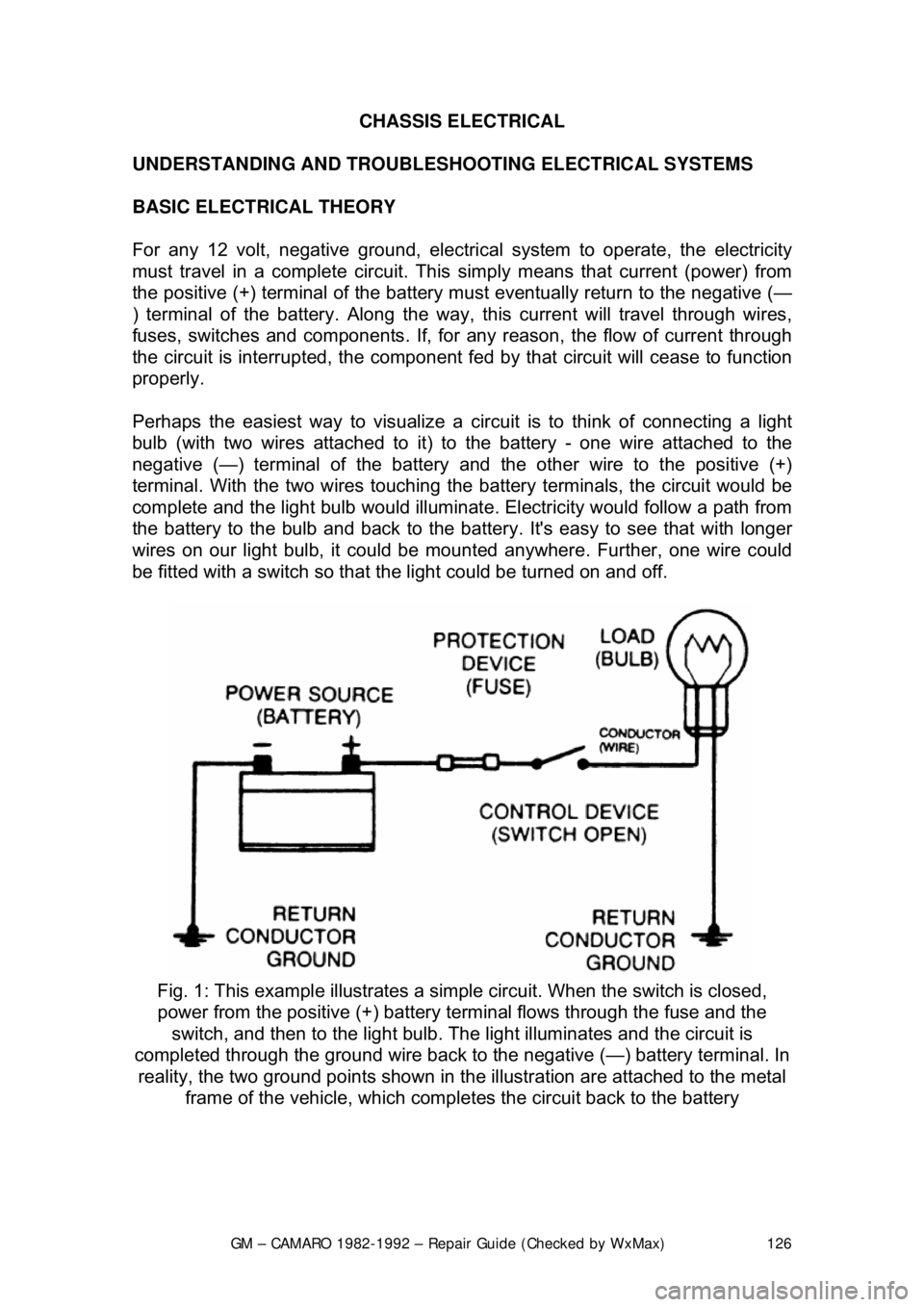
For any 12 volt, negative ground, electrical system to operate, the electricity
must travel in a complete circuit. This simply means that current (power) from
the positive (+) terminal of the battery must eventually return to the negative (—
) terminal of the battery. Along the way, this current will travel through wires,
fuses, switches and components. If, for any reason, the flow of current through
the circuit is interrupted, the component f ed by that circuit will cease to function
properly.
Perhaps the easiest way to visualize a circ uit is to think of connecting a light
bulb (with two wires attac hed to it) to the battery - one wire attached to the
negative (—) terminal of the battery and the other wire to the positive (+)
terminal. With the two wires touching the battery terminals, the circuit would be
complete and the light bulb would illuminat e. Electricity would follow a path from
the battery to the bulb and back to the bat tery. It's easy to see that with longer
wires on our light bulb, it could be mounted anywhere. Further, one wire could
be fitted with a switch so that t he light could be turned on and off.
Fig. 1: This example illu strates a simple circuit. Wh en the switch is closed,
power from the positive (+) battery te rminal flows through the fuse and the
switch, and then to the light bulb. The light illuminates and the circuit is
completed through the ground wire back to the negative (—) battery terminal. In
reality, the two ground point s shown in the illustration are attached to the metal
frame of the vehicle, which comple tes the circuit back to the battery
Page 132 of 875
GM – CAMARO 1982-1992 – Repair Guide (Checked by WxMax) 132
Some electrical components which require
a large amount of current to operate
use a special switch called a relay. Sinc e these circuits carry a large amount of
current, the thickness of the wire in the ci rcuit is also greater. If this large wire
were connected from the load to the c ontrol switch, the switch would have to
carry the high amperage load and the fair ing or dash would be twice as large to
accommodate the increased size of t he wiring harness. To prevent these
problems, a relay is used.
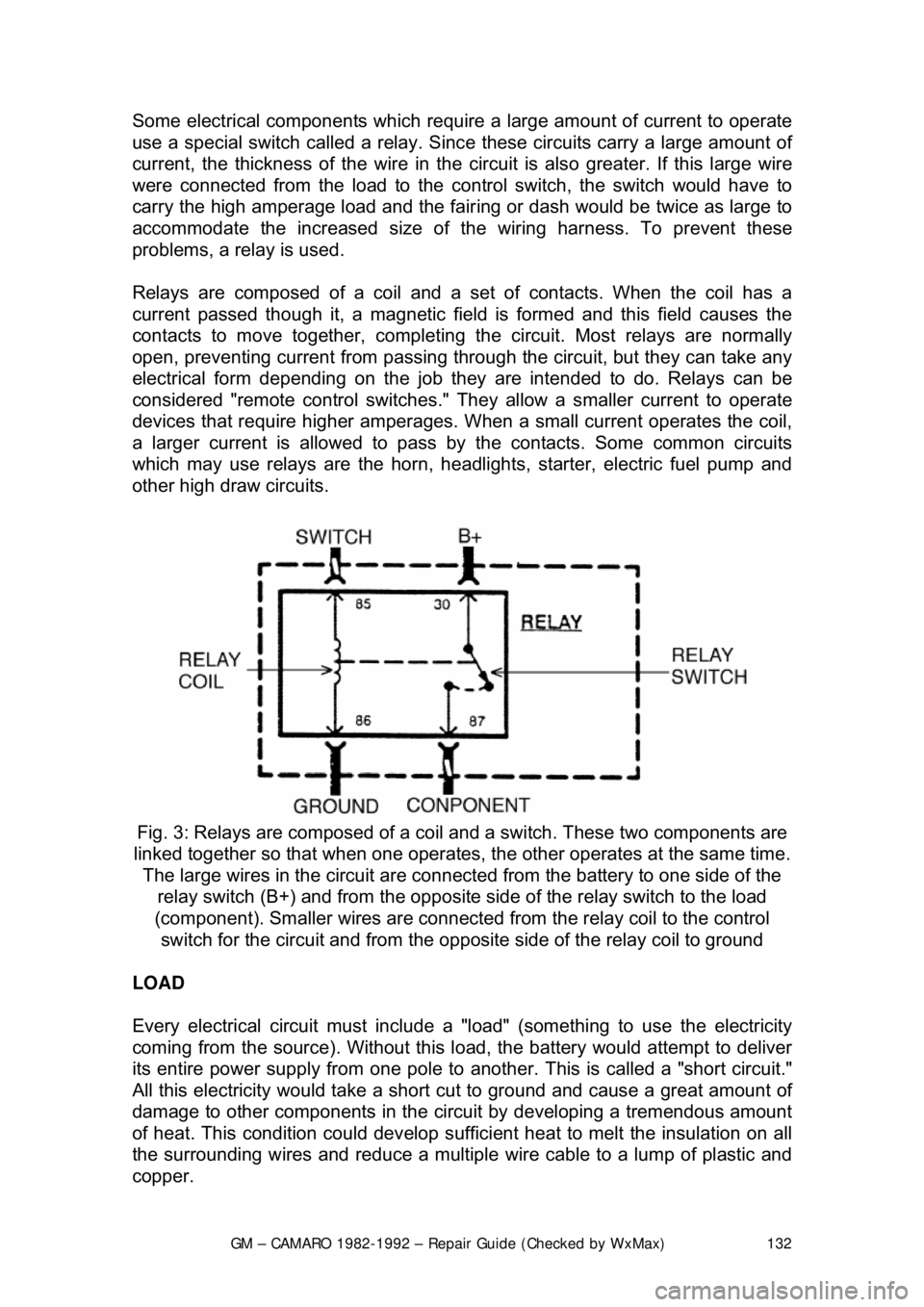
Relays are composed of a coil and a se t of contacts. When the coil has a
current passed though it, a magnetic fiel d is formed and this field causes the
contacts to move together, completing the circuit. Most relays are normally
open, preventing current from passing thr ough the circuit, but they can take any
electrical form depending on th e job they are intended to do. Relays can be
considered "remote control switches." They allow a smaller current to operate
devices that require higher amperages. W hen a small current operates the coil,
a larger current is allo wed to pass by the contacts. Some common circuits
which may use relays are the horn, headlight s, starter, electric fuel pump and
other high draw circuits.
Fig. 3: Relays are composed of a coil and a switch. These two components are
linked together so that w hen one operates, the other operat es at the same time.
The large wires in the circuit are connect ed from the battery to one side of the
relay switch (B+) and from the opposite side of the re lay switch to the load
(component). Smaller wires are connected from the relay coil to the control
switch for the circuit and from the opposite side of the relay coil to ground
LOAD
Every electrical circuit must include a "load" (something to use the electricity
coming from the source). Without this l oad, the battery would attempt to deliver
its entire power supply from one pole to another. This is called a "short circuit."
All this electricity would take a short cut to ground and cause a great amount of
damage to other components in the circui t by developing a tremendous amount
of heat. This condition could develop suffici ent heat to melt the insulation on all
the surrounding wires and reduce a multiple wire cable to a lump of plastic and
copper.
Page 136 of 875
GM – CAMARO 1982-1992 – Repair Guide (Checked by WxMax) 136
accidental grounding. It is al
so advisable to include a standard automotive fuse
in any jumper wire. This is commonly referred to as a "fused jumper". By
inserting an in-line fuse holder between a set of test leads, a fused jumper wire
can be used for bypassing open circuits. Use a 5 amp fuse to provide protection
against voltage spikes.
Jumper wires are used primarily to locate open electrical circuits, on either the
ground (—) side of the circuit or on the power (+) side. If an electrical
component fails to operate, connect t he jumper wire between the component
and a good ground. If the component operates only with the jumper installed,
the ground circuit is open. If the ground circuit is good, but the component does
not operate, the circuit between the power feed and component may be open.
By moving the jumper wire successively back from the component toward the
power source, you can isolate the area of the circuit where the open is located.
When the component stops func tioning, or the power is cut off, the open is in
the segment of wire between the jumper and the point previously tested.
You can sometimes connect the jumper wir e directly from the battery to the
"hot" terminal of the component, but firs t make sure the component uses 12
volts in operation. Some electrical components, such as fuel injectors or
sensors, are designed to operate on about 4 to 5 volts, and running 12 volts
directly to these components will cause damage.
TEST LIGHTS
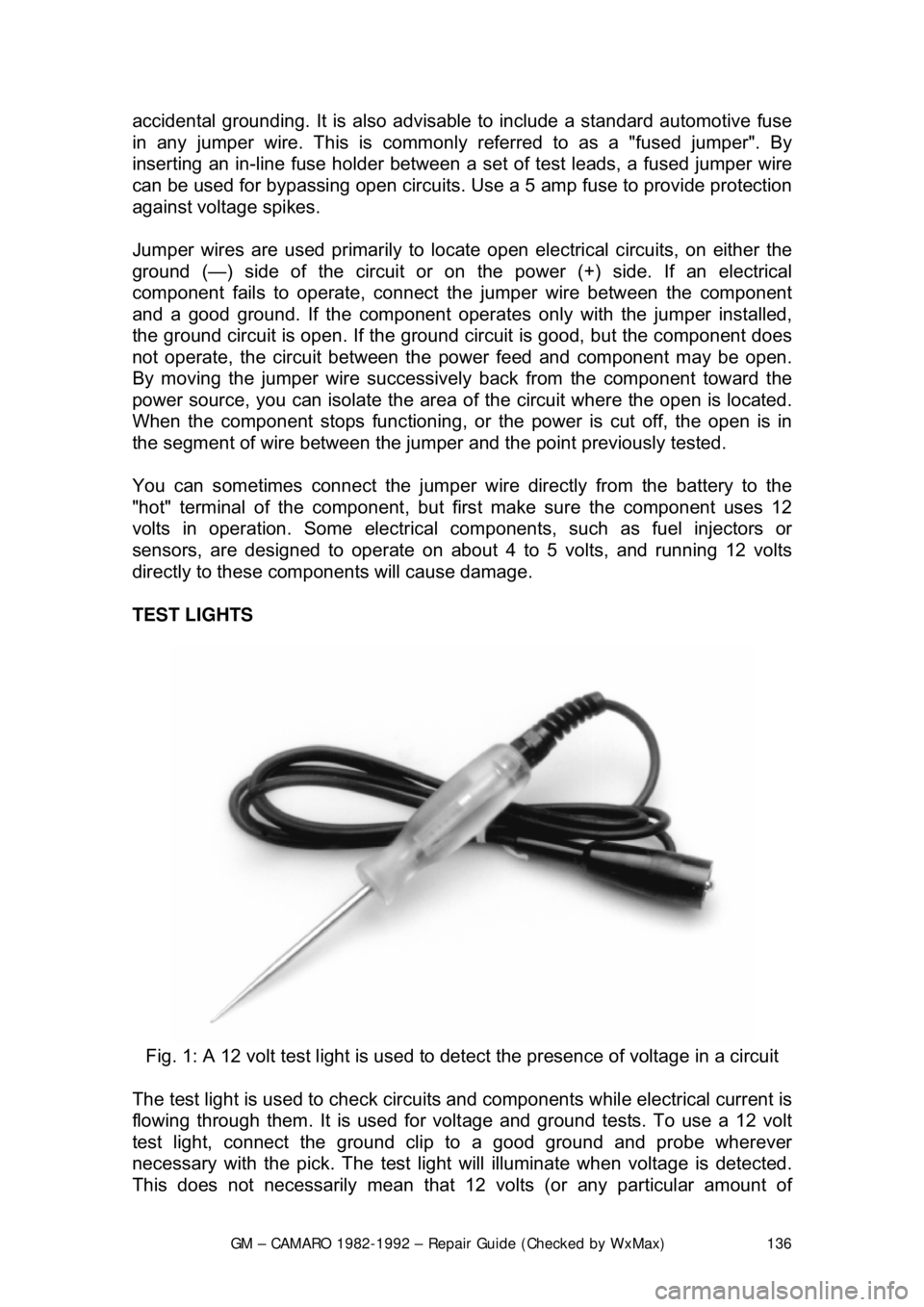
Fig. 1: A 12 volt test light is used to detect the presence of voltage in a circuit
The test light is used to check circuits and components while electrical current is
flowing through them. It is used for volt age and ground tests. To use a 12 volt
test light, connect the ground clip to a good ground and probe wherever
necessary with the pick. The test light will illuminate when voltage is detected.
This does not necessarily mean that 12 volts (or any particular amount of