light CHEVROLET CAMARO 1982 Repair Guide
[x] Cancel search | Manufacturer: CHEVROLET, Model Year: 1982, Model line: CAMARO, Model: CHEVROLET CAMARO 1982Pages: 875, PDF Size: 88.64 MB
Page 137 of 875

GM – CAMARO 1982-1992 – Repair Guide (Checked by WxMax) 137
voltage) is present; it only means that so
me voltage is present. It is advisable
before using the test light to touch its ground clip and probe across the battery
posts or terminals to make sure the light is operating properly.
WARNING - Do not use a test light to probe electronic ignition, spark plug or
coil wires. Never use a pick-type test light to probe wiring on computer
controlled systems unless spec ifically instructed to do so. Any wire insulation
that is pierced by the test light pr obe should be taped and sealed with silicone
after testing
Like the jumper wire, the 12 volt test li ght is used to isolate opens in circuits.
But, whereas the jumper wire is used to bypass the open to operate the load,
the 12 volt test light is us ed to locate the presence of voltage in a circuit. If the
test light illuminates, there is power up to t hat point in the circuit; if the test light
does not illuminate, there is an open circui t (no power). Move the test light in
successive steps back toward the power source until the light in the handle
illuminates. The open is between the pr obe and a point which was previously
probed.
The self-powered test light is similar in design to the 12 volt test light, but
contains a 1.5 volt penlight battery in the handle. It is most often used in place
of a multimeter to check for open or shor t circuits when power is isolated from
the circuit (continuity test).
The battery in a self-powered test light does not provide much current. A weak
battery may not provide enough power to illuminate the test light even when a
complete circuit is made (especially if there is high resistance in the circuit).
Always make sure that the test battery is strong. To check the battery, briefly
touch the ground clip to the pr obe; if the light glows brightly, the battery is strong
enough for testing.
A self-powered test light should not be used on any co mputer controlled system
or component. The small amount of electr icity transmitted by the test light is
enough to damage many electr onic automotive components.
MULTIMETERS
Multimeters are an extremely useful tool for troubleshooting electrical problems.
They can be purchased in either analog or digital form and have a price range
to suit any budget. A multimeter is a voltmeter, ammeter and ohmmeter (along
with other features) combined into one instrument. It is often used when testing
solid state circuits because of its hi gh input impedance (usually 10 megaohms
or more). A brief description of the mult imeter main test functions follows:
• Voltmeter - the voltmeter is used to measure voltage at any point in a
circuit, or to measure the voltage drop across any part of a circuit.
Voltmeters usually have various scales and a selector switch to allow the
reading of different volt age ranges. The voltmeter has a positive and a
negative lead. To avoid damage to the meter, always connect the
negative lead to the negative (—) side of the circ uit (to ground or nearest
Page 138 of 875

GM – CAMARO 1982-1992 – Repair Guide (Checked by WxMax) 138
the ground side of the circuit) and
connect the positive lead to the
positive (+) side of the circuit (to t he power source or the nearest power
source). Note that the negative voltme ter lead will always be black and
that the positive voltmeter will alwa ys be some color other than black
(usually red).
• Ohmmeter - the ohmmeter is designed to read resistance (measured in
ohms) in a circuit or component. Mo st ohmmeters will have a selector
switch which permits the measurement of different ranges of resistance
(usually the selector swit ch allows the multiplication of the meter reading
by 10, 100, 1,000 and 10,000). Some ohmmeters are "auto-ranging"
which means the meter itself will dete rmine which scale to use. Since the
meters are powered by an internal battery, the ohmmeter can be used
like a self-powered test light. When the ohmmeter is connected, current
from the ohmmeter flows through the ci rcuit or component being tested.
Since the ohmmeter's internal resi stance and voltage are known values,
the amount of current flow throug h the meter depends on the resistance
of the circuit or component being test ed. The ohmmeter can also be used
to perform a continuity test for suspected open circuits. In using the
meter for making continuity checks, do not be concerned with the actual
resistance readings. Zero resistance, or any ohm reading, indicates
continuity in the circui t. Infinite resistance indi cates an opening in the
circuit. A high resistance reading w here there should be none indicates a
problem in the circuit. Checks for s hort circuits are made in the same
manner as checks for open circuits, ex cept that the circuit must be
isolated from both power and normal gr ound. Infinite resistance indicates
no continuity, while zero resi stance indicates a dead short.
WARNING - Never use an ohmmeter to check the resistance of a component or
wire while there is volt age applied to the circuit
• Ammeter - an ammeter measures the am ount of current flowing through
a circuit in units called amperes or amps. At normal operating voltage,
most circuits have a characteristic amount of amperes, called "current
draw" which can be measured usi ng an ammeter. By referring to a
specified current draw rating, then measuring the amperes and
comparing the two values, one can det ermine what is happening within
the circuit to aid in diagnosis. An open circuit, for example, will not allow
any current to flow, so the amme ter reading will be zero. A damaged
component or circuit will have an incr eased current draw, so the reading
will be high. The ammeter is always connected in series with the circuit\
being tested. All of the current that normally flows through the circuit
must also flow through the ammeter; if there is any other path for the
current to follow, the ammeter readi ng will not be accurate. The ammeter
itself has very little resistance to curr ent flow and, therefore, will not affect
the circuit, but it will measure current draw only when the circuit is closed
and electricity is flowing. Excessive current draw can blow fuses and
drain the battery, while a reduced current draw can cause motors to run \
slowly, lights to dim and other components to not operate properly.
Page 140 of 875
GM – CAMARO 1982-1992 – Repair Guide (Checked by WxMax) 140
TESTING
OPEN CIRCUITS
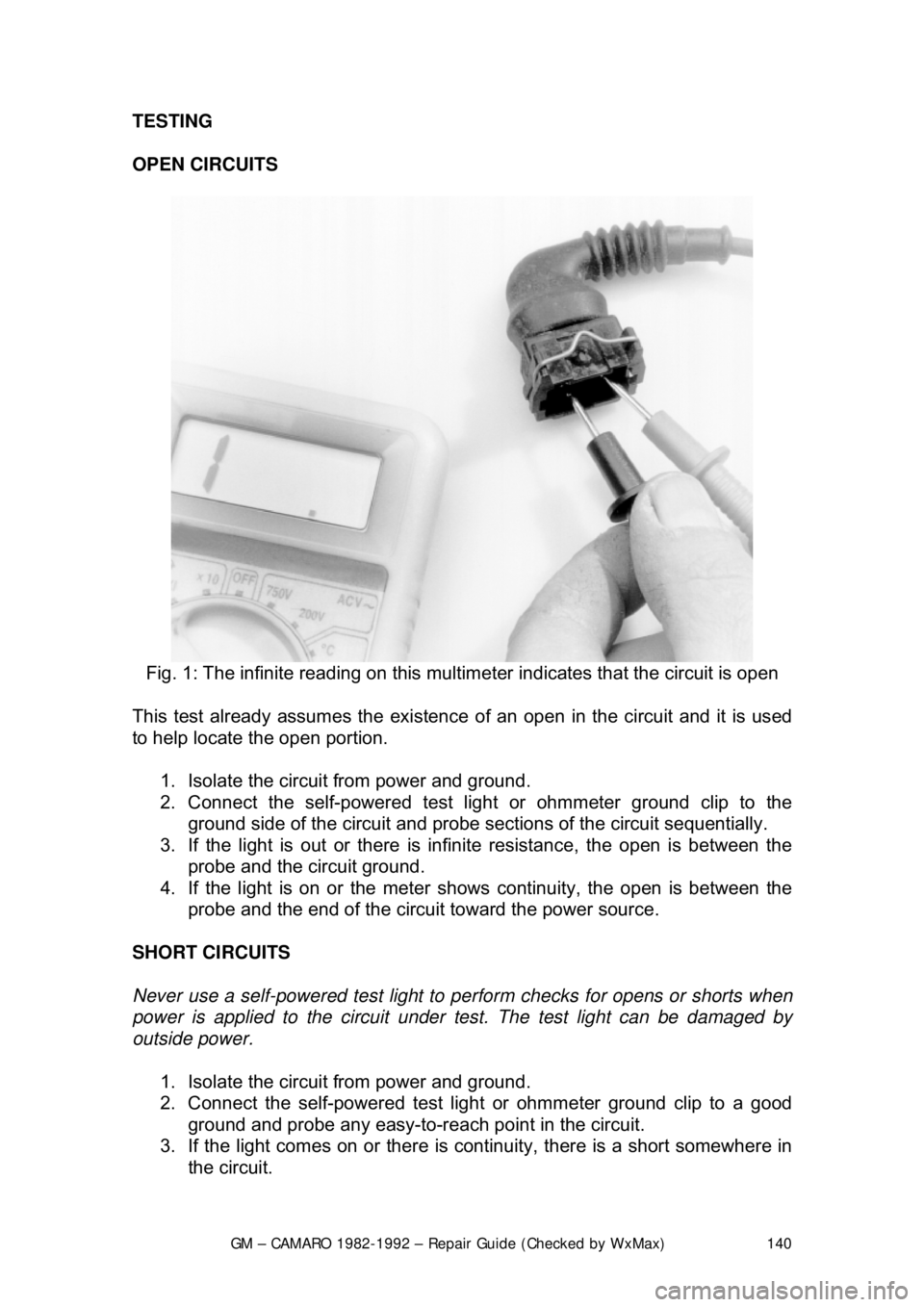
Fig. 1: The infinite reading on this mult imeter indicates that the circuit is open
This test already assumes the existence of an open in the circuit and it is used
to help locate the open portion.
1. Isolate the circuit from power and ground.
2. Connect the self-powered test light or ohmmeter ground clip to the
ground side of the circuit and probe sect ions of the circuit sequentially.
3. If the light is out or there is infinite resistanc e, the open is between the
probe and the circuit ground.
4. If the light is on or the meter s hows continuity, the open is between the
probe and the end of the circuit toward the power source.
SHORT CIRCUITS
Never use a self-powered test light to per form checks for opens or shorts when
power is applied to the circuit under te st. The test light can be damaged by
outside power.
1. Isolate the circuit from power and ground.
2. Connect the self-powered test light or ohmmeter ground clip to a good
ground and probe any easy-to-reach point in the circuit.
3. If the light comes on or there is cont inuity, there is a short somewhere in
the circuit.
Page 141 of 875
GM – CAMARO 1982-1992 – Repair Guide (Checked by WxMax) 141
4. To isolate the short, probe a test point
at either end of the isolated circuit
(the light should be on or the mete r should indicate continuity).
5. Leave the test light probe engaged and sequentiall y open connectors or
switches, remove parts, etc. until t he light goes out or continuity is
broken.
6. When the light goes out, the shor t is between the last two circuit
components which were opened.
VOLTAGE
This test determines voltage available fr om the battery and should be the first
step in any electrical troubleshooting pr ocedure after visual inspection. Many
electrical problems, especially on co mputer controlled systems, can be caused
by a low state of charge in the battery. Excessive corrosion at the battery cable
terminals can cause poor contact that will prevent proper charging and f\
ull
battery current flow.
1. Set the voltmeter selector switch to the 20V position.
2. Connect the multimeter negative lead to the battery's negative (-) post or
terminal and the positive lead to t he battery's positive (+) post or
terminal.
3. Turn the ignition switch ON to provide a load.
4. A well charged battery should register over 12 volts. If the meter reads
below 11.5 volts, the battery power may be insufficient to operate the
electrical system properly.
VOLTAGE DROP
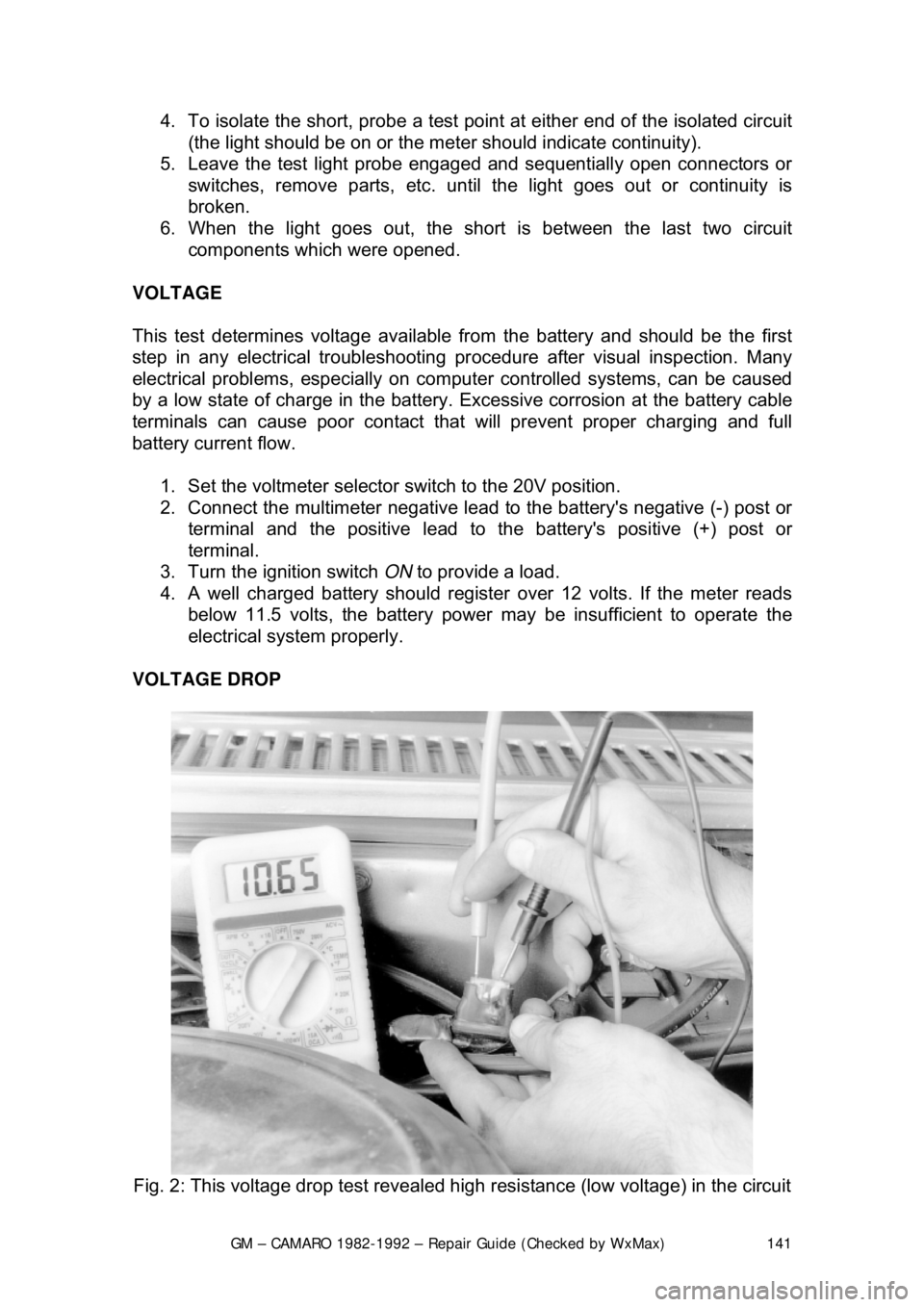
Fig. 2: This voltage drop test revealed high resistance (low voltage) in the circuit
Page 145 of 875

GM – CAMARO 1982-1992 – Repair Guide (Checked by WxMax) 145
When the battery cable(s) are reconnecte
d (negative cable last), be sure to
check that your lights, windshield wipers and other electrically operated safety
components are all working correctly. If your vehicle contains an Electronically
Tuned Radio (ETR), don't forget to also reset your radio stations. Ditto for the
clock.
Page 200 of 875

GM – CAMARO 1982-1992 – Repair Guide (Checked by WxMax) 200
9. Lubricate the speedometer cable
with an appropriate lubricant, being
sure to cover the lower thirds of the cable.
10. Insert the cable into the casi ng, then connect the cable and casing
assembly to the speedometer.
11. Install the instrument cluster, then install the cluster attaching screws.
12. Install the instrument cluster trim plate.
13. On models without cruise control, connect the speedometer cable strap
at the power brake booste r. On models with cruise control, connect the
speedometer cable at the cr uise control transducer.
14. Connect the negative battery cable at the battery.
WIPER SWITCH
REMOVAL & INSTALLATION
The wiper switch is part of the multi-function lever, located on the steering
wheel column.
1. Disconnect the electrical connector of the multi-function lever, located
under the instrument panel.
2. Remove the protective cover from the wire.
3. Grasp the lever firmly, twist and pull (the tang on the lever must align
with the socket) the lever straight out.
4. Pull the wire through the steering column.
To install: 5. Slide a music wire tool through the steering column and connect the
lever wire to the tool wire; pull t he wire through the steering column.
6. Push the control lever into the sp ring loaded socket (be sure to align the
tang).
7. Install the protective cover to the wire.
8. Connect the electrical connector of the multi-function lever.
HEADLIGHT SWITCH
REMOVAL & INSTALLATION 1. Disconnect the negative batte ry cable at the battery.
2. Remove the four screws from insi de the defroster duct (instrument panel
pad securing screws).
3. Remove the screws which are under the lip of the instrument panel pad.
4. Remove the instrument panel pad.
5. On models equipped with air condition ing, remove the instrument panel
cluster bezel and the cluster.
6. Remove the radio speaker bracket.
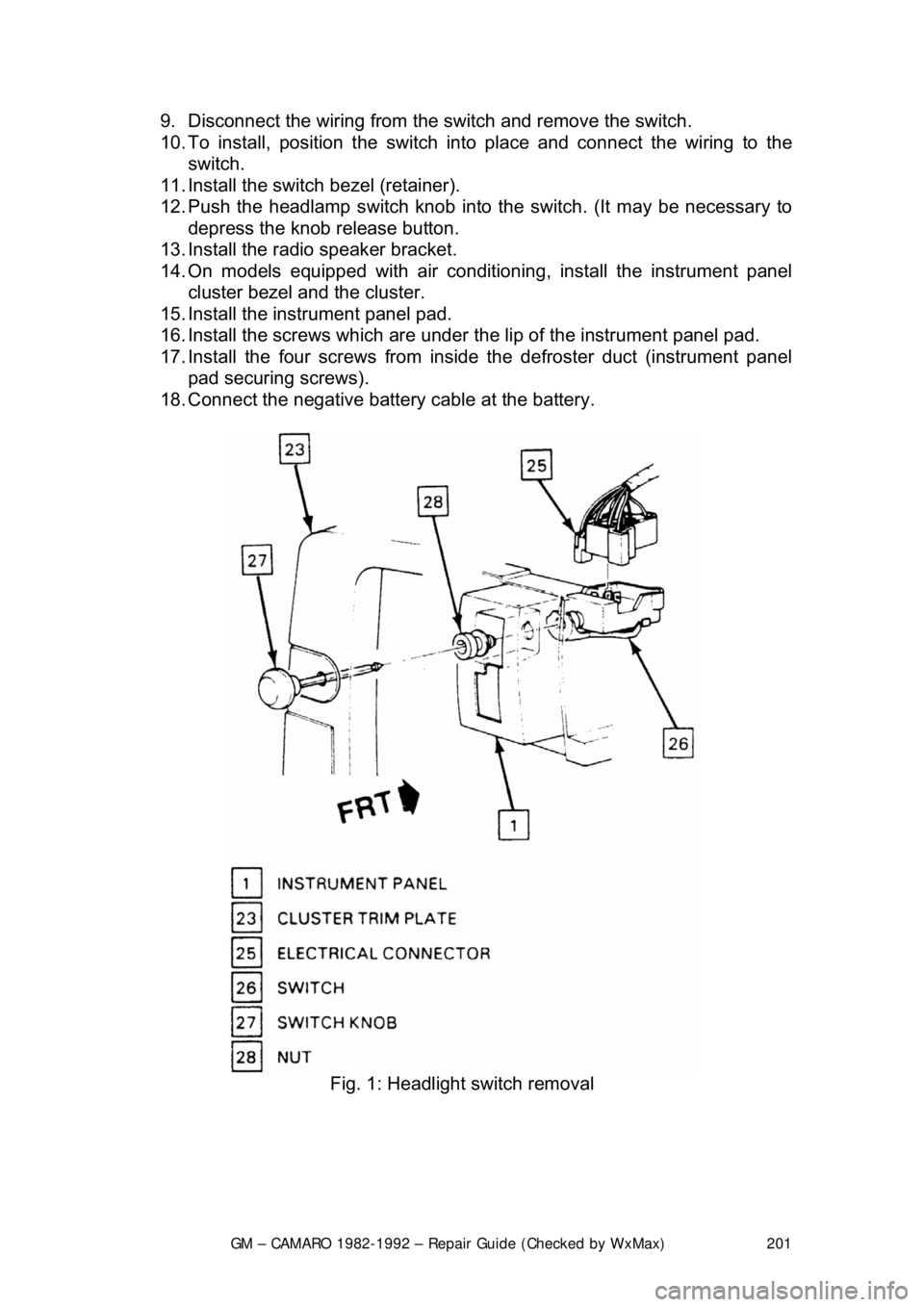
7. Pull the headlamp switch knob to the ON position, depress the locking
button for the knob and shaft (locat ed on the switch), and remove the
knob and shaft.
8. Remove the switch bezel (retainer).
Page 201 of 875
GM – CAMARO 1982-1992 – Repair Guide (Checked by WxMax) 201
9. Disconnect the wiring from the
switch and remove the switch.
10. To install, position t he switch into place and connect the wiring to the
switch.
11. Install the switch bezel (retainer).
12. Push the headlamp switch knob into the switch. (It may be necessary to
depress the knob release button.
13. Install the radio speaker bracket.
14. On models equipped with air conditioni ng, install the instrument panel
cluster bezel and the cluster.
15. Install the inst rument panel pad.
16. Install the screws which are under t he lip of the instrument panel pad.
17. Install the four screw s from inside the defroster duct (instrument panel
pad securing screws).
18. Connect the negative battery cable at the battery.
Fig. 1: Headlight switch removal
Page 203 of 875
GM – CAMARO 1982-1992 – Repair Guide (Checked by WxMax) 203
LIGHTING
HEADLIGHTS
REMOVAL & INSTALLATION
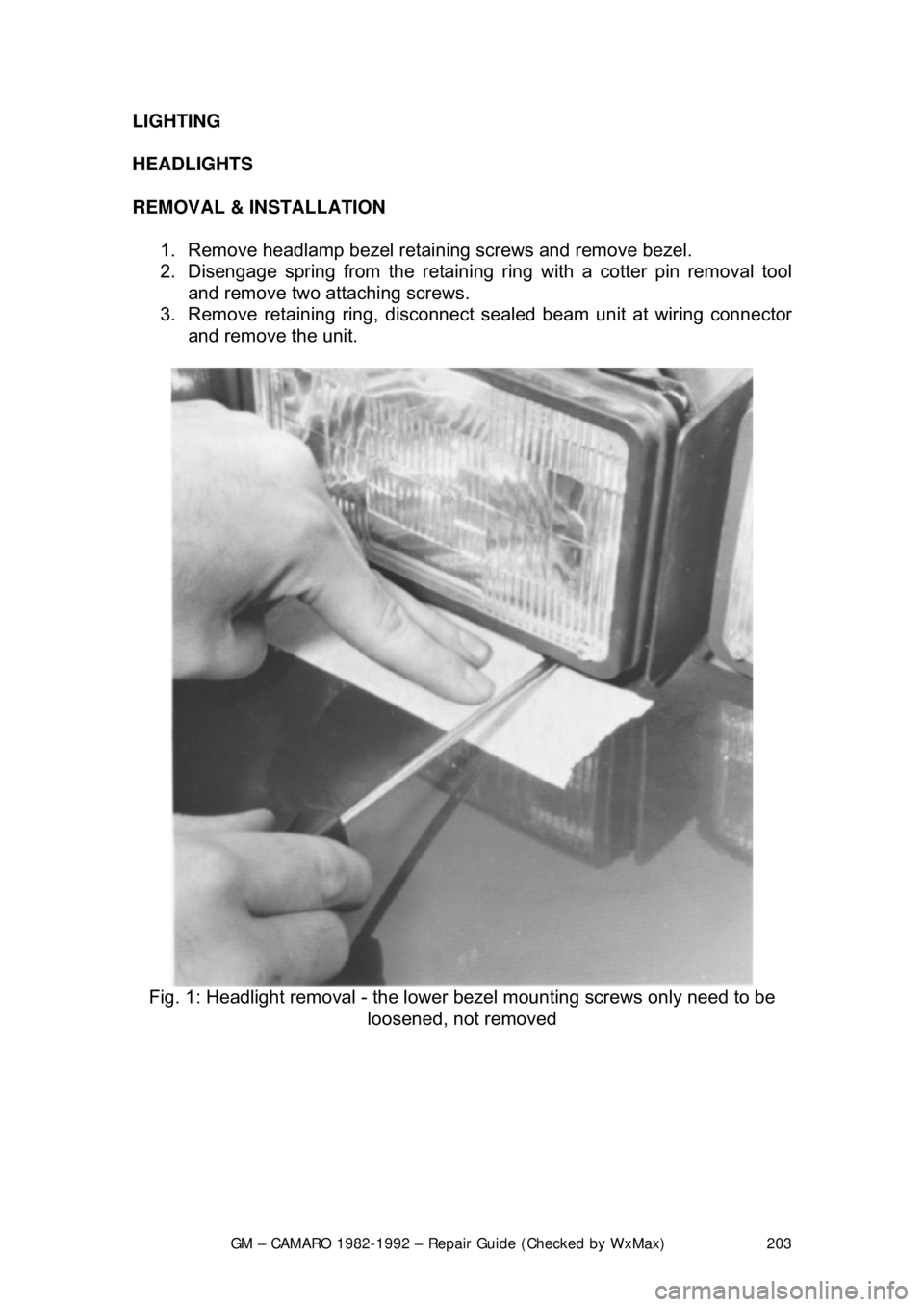
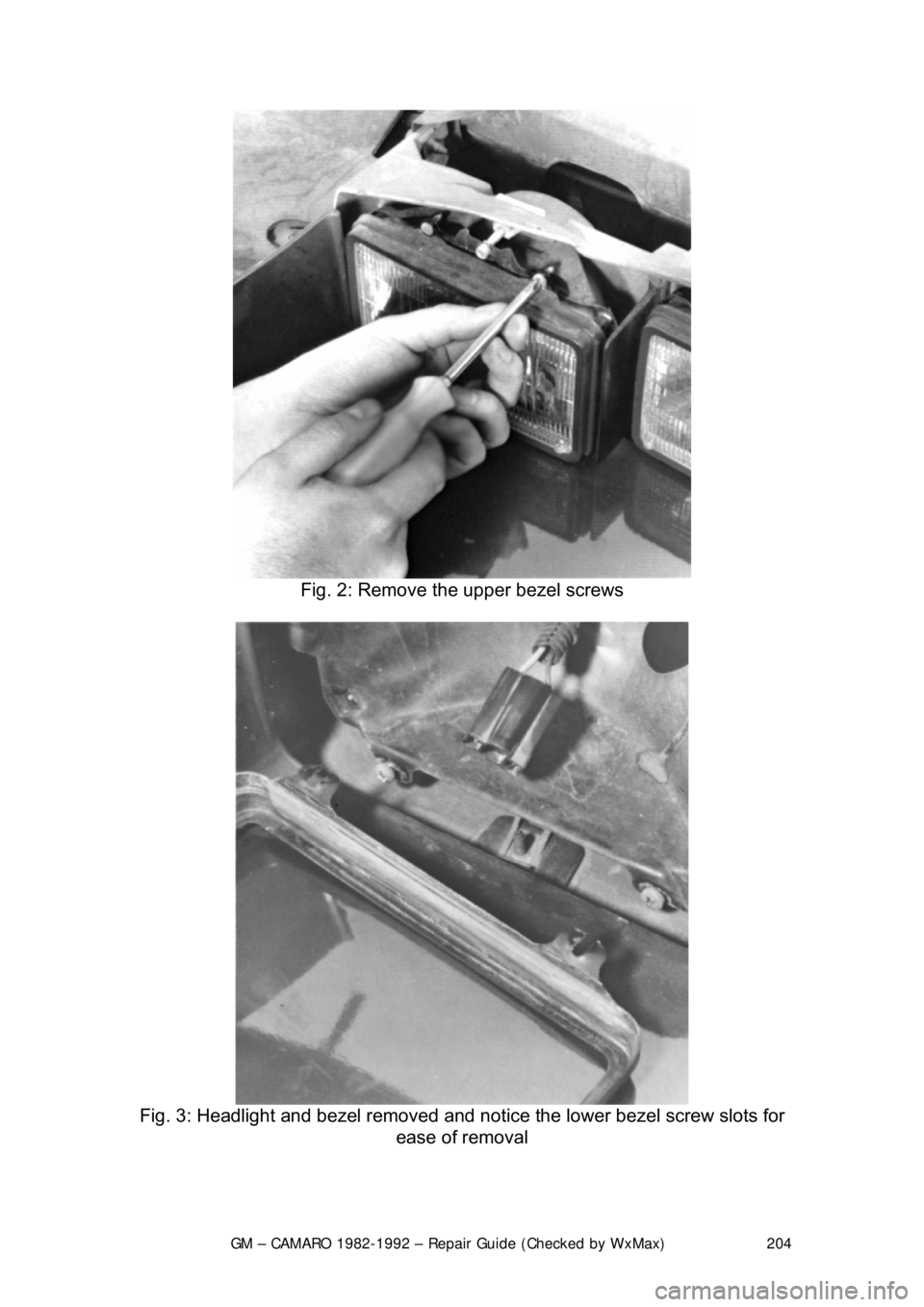
1. Remove headlamp bezel retain ing screws and remove bezel.
2. Disengage spring from the retaini ng ring with a cotter pin removal tool
and remove two attaching screws.
3. Remove retaining ring, disconnect sealed beam unit at wiring connector
and remove the unit.
Fig. 1: Headlight removal - the lowe r bezel mounting screws only need to be
loosened, not removed
Page 204 of 875
GM – CAMARO 1982-1992 – Repair Guide (Checked by WxMax) 204
Fig. 2: Remove the upper bezel screws
Fig. 3: Headlight and bezel removed and no tice the lower bezel screw slots for
ease of removal
Page 205 of 875
GM – CAMARO 1982-1992 – Repair Guide (Checked by WxMax) 205
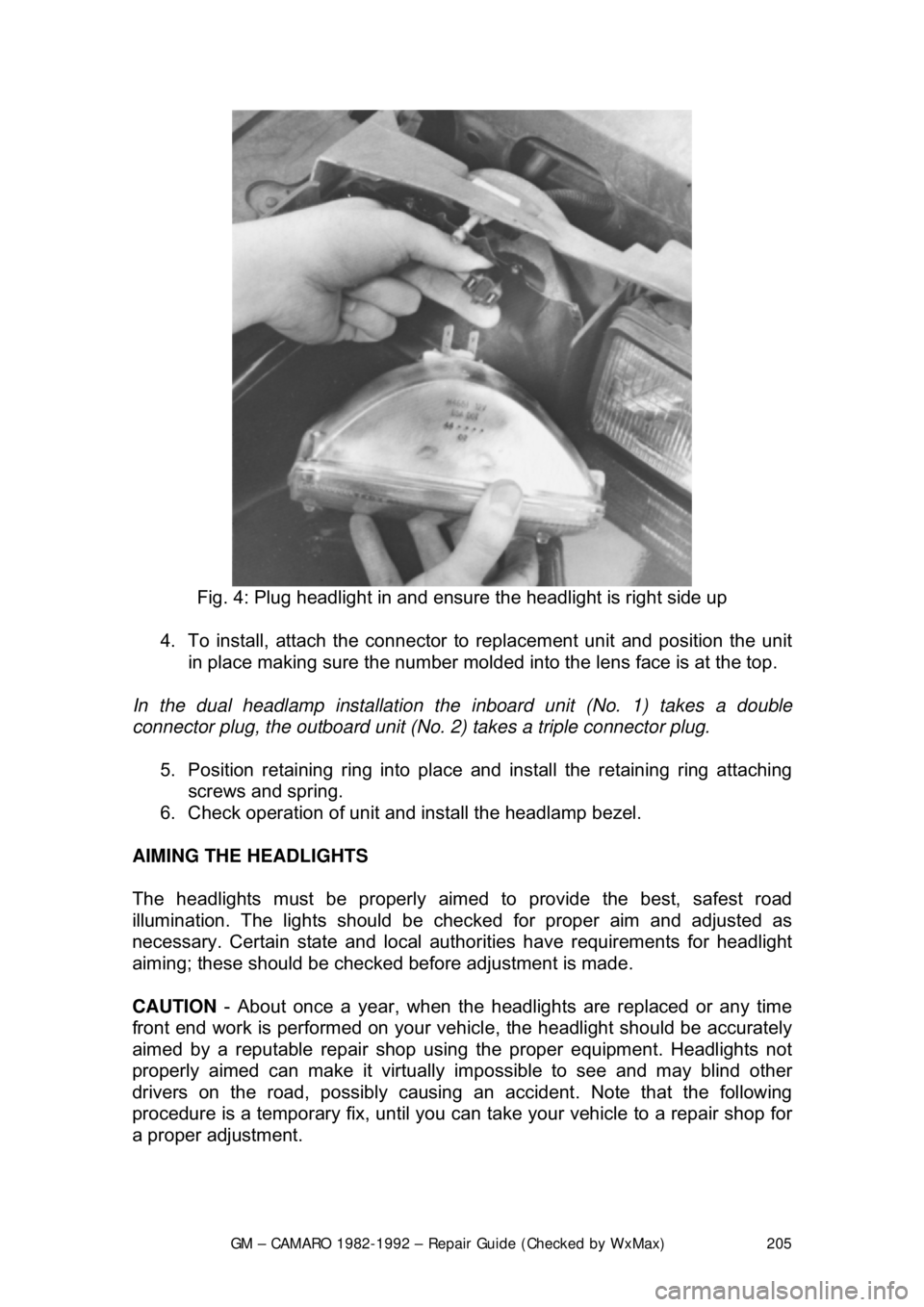
Fig. 4: Plug headlight in and ens ure the headlight is right side up
4. To install, attach the connector to replacement unit and position the unit
in place making sure the number molded in to the lens face is at the top.
In the dual headlamp installation the in board unit (No. 1) takes a double
connector plug, the outboard unit (No. 2) takes a triple connector plug.
5. Position retaining ring into place and install the retaining ring attaching
screws and spring.
6. Check operation of unit and install the headlamp bezel.
AIMING THE HEADLIGHTS
The headlights must be properly aimed to provide the best, safest road
illumination. The lights should be che cked for proper aim and adjusted as
necessary. Certain state and local author ities have requirements for headlight
aiming; these should be check ed before adjustment is made.
CAUTION - About once a year, w hen the headlights are r eplaced or any time
front end work is performed on your vehicl e, the headlight should be accurately
aimed by a reputable repai r shop using the proper equipment. Headlights not
properly aimed can make it virtually impossible to see and may blind other
drivers on the road, possibly causing an accident. Note that the following
procedure is a temporary fix, until you can take your vehicle to a repair shop for
a proper adjustment.