lock CHEVROLET CAMARO 1993 User Guide
[x] Cancel search | Manufacturer: CHEVROLET, Model Year: 1993, Model line: CAMARO, Model: CHEVROLET CAMARO 1993Pages: 358, PDF Size: 15.6 MB
Page 38 of 358
Seats & Safety Belts
r
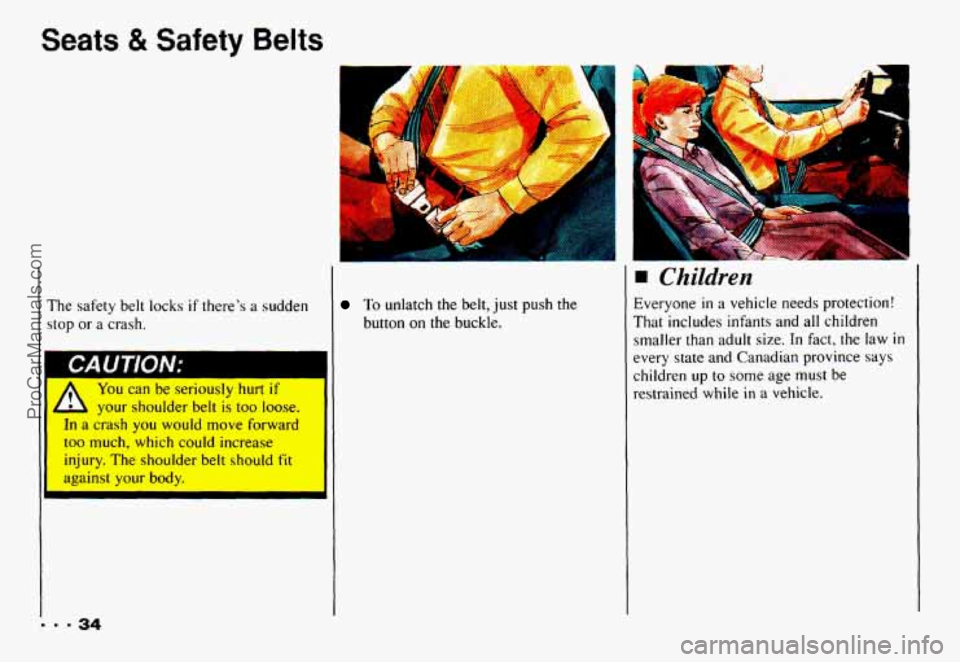
The safety belt locks if there's a sudden
stop or a crash.
You can be seriously
hurt if
1 4 your shoulder belt is too loose.
I In a crash you would move forward
3 much, which could increase
I InJury. The shoulder belt should fit
To unlatch the belt, just push the
button on the buckle.
children
Everyone in a vehicle needs protection!
That includes infants and all children
smaller than adult size. In fact, the law
in
every state and Canadian province says
children up to some age must be
restrained while
in a vehicle.
ProCarManuals.com
Page 44 of 358
Seats & Safety Belts
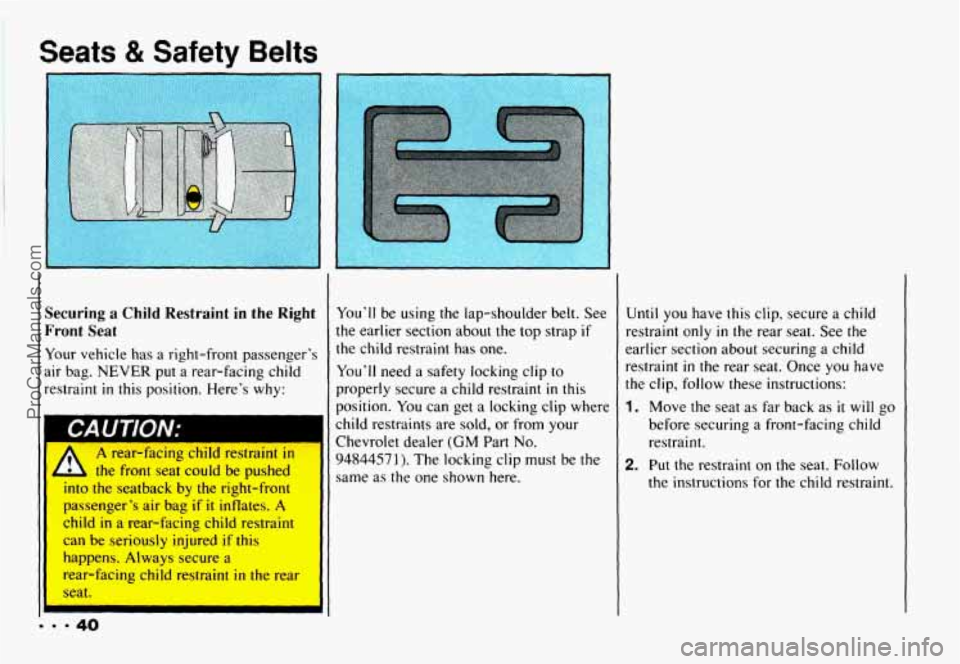
Securing a Child Restraint in the Right
Front Seat
Your vehicle has a right-front passenger’s
air bag.
NEVER put a rear-facing child
restraint
in this position. Here’s why:
* A rear-facing child restraint in
You’ll be using the lap-shoulder belt. See
the earlier section about
the top strap if
the child restraint has one.
You’ll need a safety locking clip to
properly secure a child restraint
in this
position. You can get a locking clip where
child restraints are sold, or from your
Chevrolet dealer
(GM Part No.
1 the front seat could be pushed 94844571). The locking clip must be the
same as the one shown here.
into the seatback
by the right-front I I
passenger’s air bag if it inflates. A
child in a rear-facing child restraint
can be seriously injured if this
happens. Always secure a
atat.
rr-facing child restraint in the rear
99940
Until you have this clip, secure a child
restraint only
in the rear seat. See the
earlier section about securing a child
restraint
in the rear seat. Once you have
the clip, follow these instructions:
1. Move the seat as far back as it will go
before securing a front-facing child
restraint.
2. Put the restraint on the seat. Follow
the instructions for the child restraint.
ProCarManuals.com
Page 45 of 358
3. Secure the child in the child restraint
as the instructions say.
run the lap part through or around the
restraint. The child restraint
instructions
will show you how.
See
if the shoulder belt would go in
front of the child's face or neck. If so,
put it behind the child restraint.
4. Pull out the vehicle's safety belt and
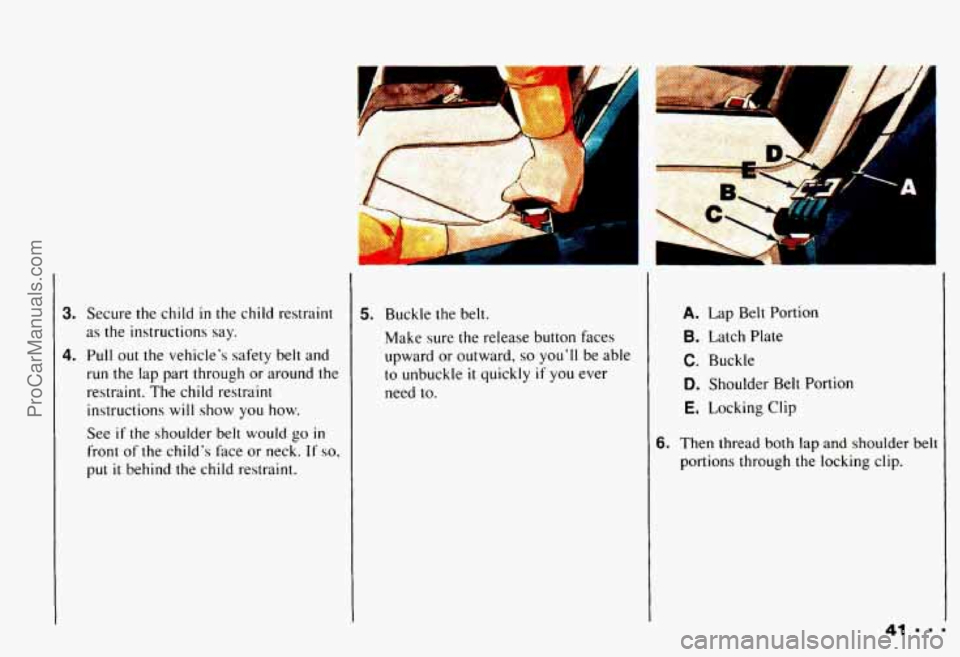
5. Buckle the belt.
Make sure the release button faces
upward or outward,
so you'll be able
to unbuckle
it quickly if you ever
need to.
A. Lap Belt Portion
B. Latch Plate
C. Buckle
D. Shoulder Belt Portion
E. Locking Clip
6. Then thread both lap and shoulder belt
portions through the locking clip.
ProCarManuals.com
Page 46 of 358
Seats & Safety Belts
L is not installed properIy, the
wlld restraint may move or tip over
when your vehicle turns or stops
quickly. The child or others could be
injured. When you secure a child
restraint with a lap-shoulder belt,
always thread both the lap and
shoulder belt portions through a
locking clip.
If a hocking clip is not used or
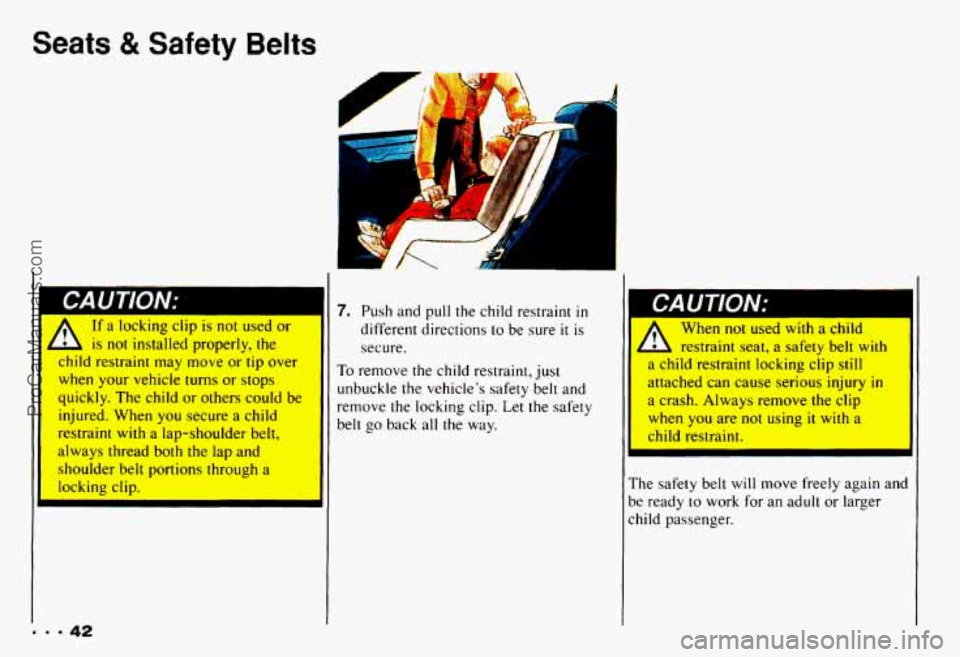
7. Push and pull the child restraint in
different directions to be sure it is
secure.
To remove the child restraint, just
unbuckle the vehicle's safety belt and
remove the locking clip. Let the safety
belt
go back all the way.
When not used with a child
L restraint seat, a safety belt with
a child restraint locking clip still
attached can cause serious injury in I a crash. AIways remove the clip
when you are not using it with a
child restraint.
The safety belt will move freely again and
be ready to work for an adult or larger
child passenger.
ProCarManuals.com
Page 51 of 358
Part 2
Features & Controls
Keys .............................................................. 48
.... DoorLocks ......................................................... 50
Theft .............................................................. 52
Here you can learn about the
many standard and optional
features on your Chevrolet. and
information
on starting. shifting
and braking
. Also explained are
the instrument panel and the
warning systems that tell you if
everything is working properly
-
and what to do if you have a
problem .
PASS-Key II@ ...................................................... 53
New Vehicle "Break-In" .............................................. 55
Ignitionswitch ...................................................... 55
Starting Your Engine ................................................. 57
Driving through Deep Standing Water
.................................... 61
Engine Block Heater
................................................. 61
Automatic Transmission .............................................. 62
ManualTransmission ................................................. 66
Limited-Slip Rear Axle
............................................... 70
Parking
............................................................ 70
EngineExhaust
..................................................... 74
Windows
.......................................................... 75
Horn
.............................................................. 76
Tiltwheel
.......................................................... 76
Operation of Lights
.................................................. 84
Interior Lights ...................................................... 86
Mirrors ............................................................ 87
Twin Lift-off Roof Panels
............................................. 88
Storage and Compartments ............................................ 92
Sunvisors
......................................................... 94
Ashtray and Lighter .................................................. 94
FloorMats ......................................................... 95
Instrument Panel and Cluster ........................................... 98
Warning Lights
. Gages and Indicators .................................... 99
47
The Turn Signal/Headlight Beam Lever .................................. 77
ProCarManuals.com
Page 52 of 358
Features & Controls
4 Keys
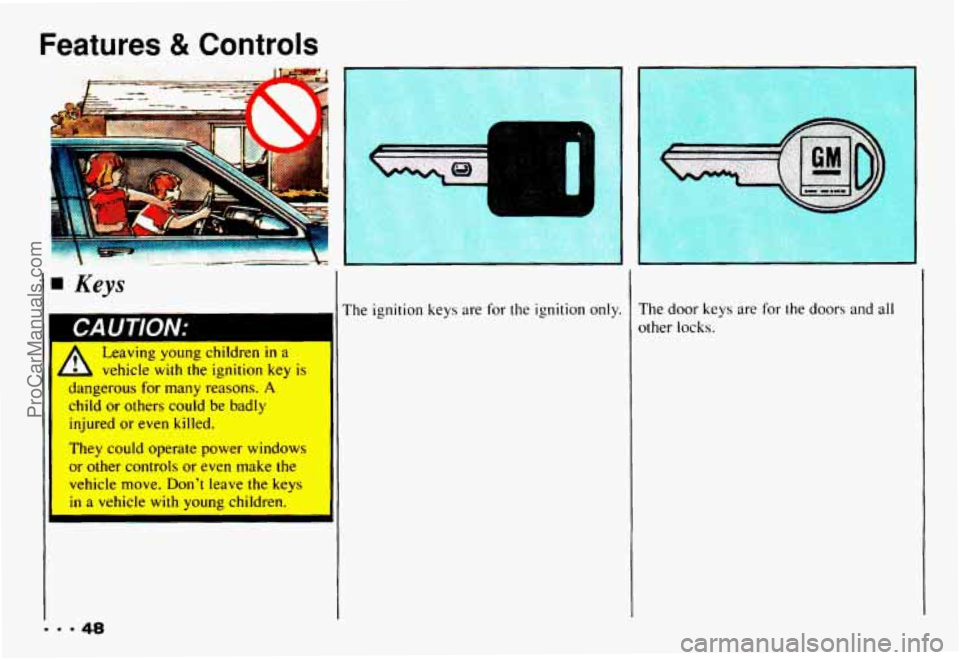
The ignition keys are for the ignition only.
Leaving young children in a
d L vehicle with the ignition key is
dangerous for many reasons. A
child or others could be badly
injured or even killed.
They could operate power windows
other controls or even make the
:hick move. Don't leave the keys
I
I or
111 a vehicle with young children.
I
The door keys are for the doors and all
other locks.
ProCarManuals.com
Page 53 of 358
I.
I
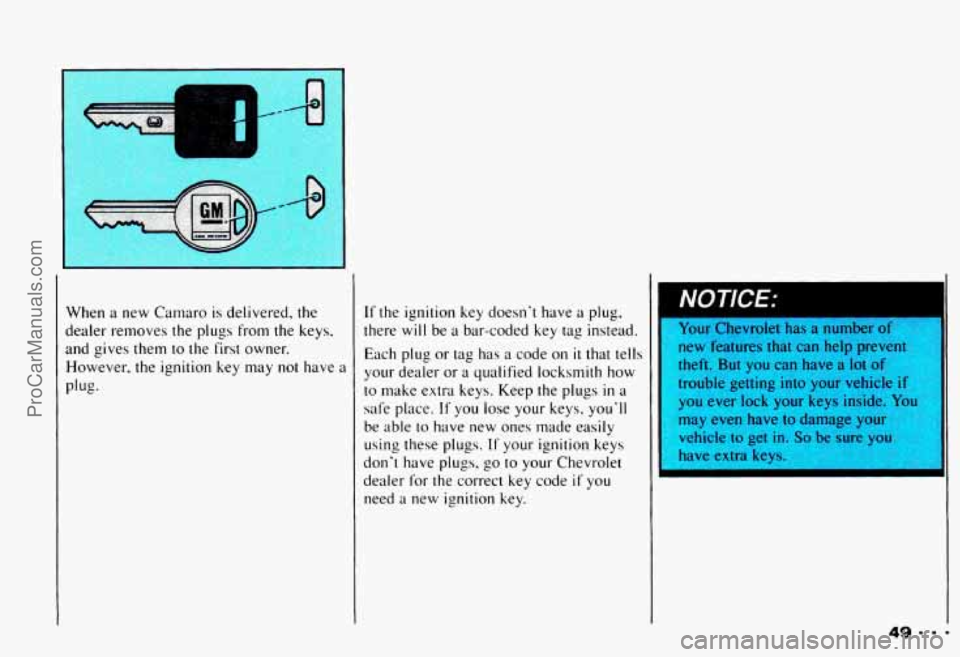
When a new Camaro is delivered, the
dealer removes the plugs from the keys,
and gives them
to the first owner.
However, the ignition key may not have a
Plug.
If the ignition key doesn't have a plug,
there
will be a bar-coded key tag instead.
Each plug or tag has
a code on it that tells
your dealer or a qualified locksmith how
to make extra keys. Keep the plugs in a
safe place.
If you lose your keys, you'll
be able to have new ones made easily
using these plugs.
If your ignition keys
don't have plugs, go to your Chevrolet
dealer for the correct key code
if you
need a new ignition key.
NOTICE:
Your Chevrolet has a number of
new features that can help prevent
theft. But you can have a
lot of
trouble getting into your vehicle if
you ever
lock your keys inside. You
may even have
to darnage \'our
vehicle
to get in. So be s YOU
have extra keys.
ProCarManuals.com
Page 54 of 358
Features & Controls
Door Locks
I CAUTION:
I ... 50
A
Unlocked doors can be
dangerous.
Passengers
- especially children
- can easily open the doors and
fall
out. When a door is locked,
the inside handle won’t open
it.
Outsiders can easily enter through
an unlocked door when you slow
down
or stop your vehicle.
This may not be
so obvious: You
increase the chance
of‘ being
thrown
out of the vehicle in a
crash if the doors aren’t locked.
Wear safety belts properly, lock
your doors, and you will be far
better
off whenever you drive your
vehicle. There
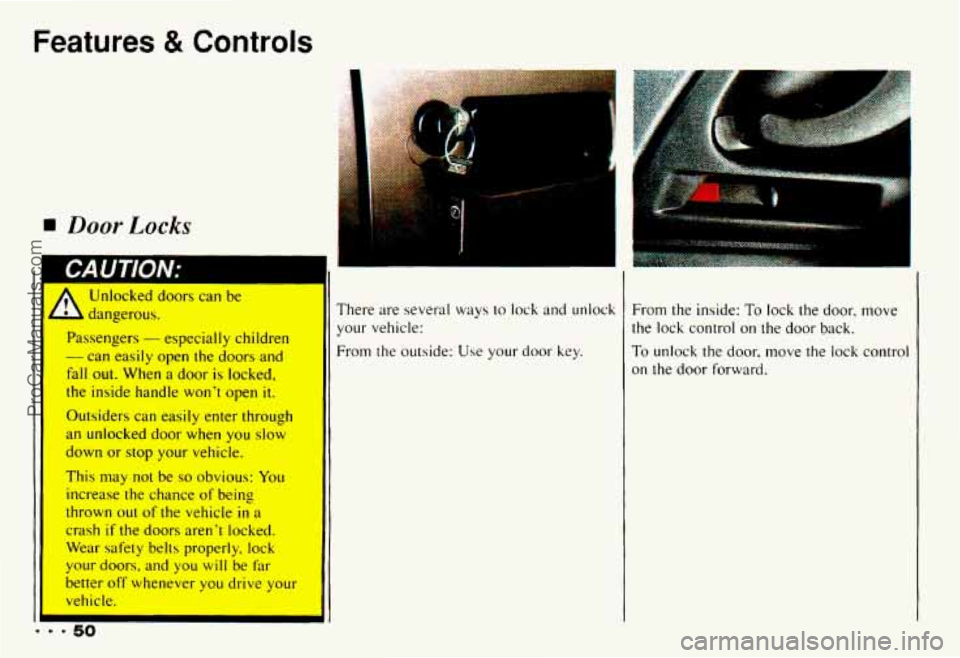
are several ways
to lock and unlock
your vehicle:
From the outside: Use your door
key.
From the inside: To lock the door, move
the
lock control on the door back.
To unlock the door. move the lock control
on
the door forward.
ProCarManuals.com
Page 55 of 358
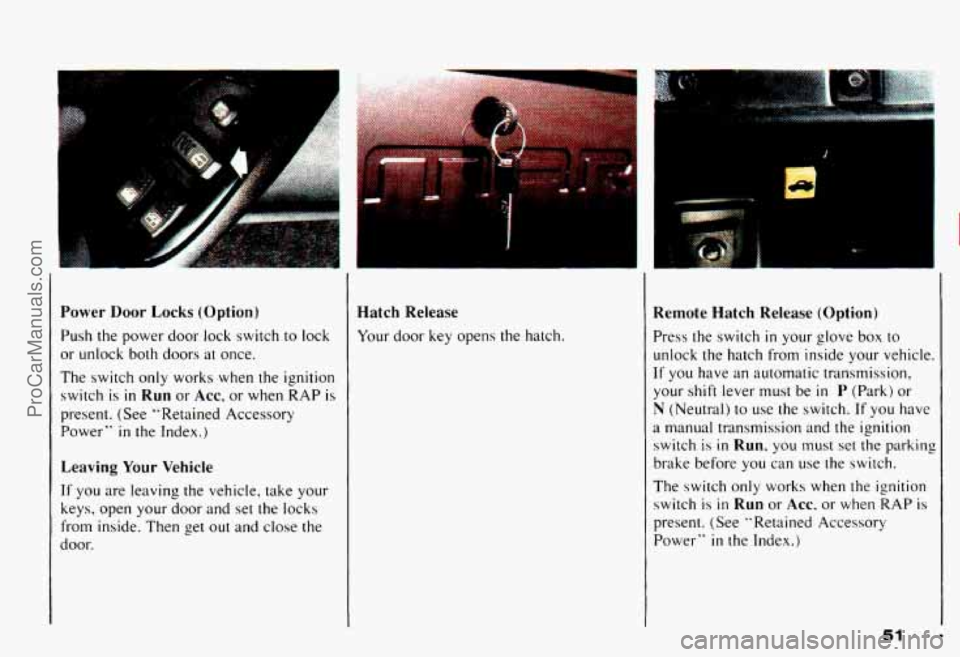
Power Door Locks (Option)
Push the power door lock switch to lock
or unlock both doors at once.
The switch only works when the ignition
switch is
in Run or Acc, or when RAP is
present. (See "Retained Accessory
Power"
in the Index.)
Leaving Your Vehicle
If you are leaving the vehicle, take your
keys, open your door and set the locks
from inside. Then get out and close the
door.
Hatch Release
Your door key opens the hatch.
Remote Hatch Release (Option)
Press the switch in your glove box to
unlock the hatch from inside your vehicle.
If you have an automatic transmission,
your shift lever must
be in P (Park) or
N (Neutral) to use the switch. If you have
a manual transmission and the ignition
switch is
in Run. you must set the parking
brake before
you can use the switch.
The switch only works when Ihe ignition
switch is
in Run or Acc. or when RAP is
present. (See "Retained Accessory
Power"
in the Index.)
ProCarManuals.com
Page 57 of 358
When you park your Chevrolet and open
the driver’s door, you’ll hear a tone
reminding you to remove your key from
the ignition and take
it with you. Always
do this. Your steering wheel
will be
locked, and
so will your ignition. If you
have an automatic transmission, taking
your key out also locks your transmission.
And remember to lock the doors.
Parking at Night: Park in a lighted spot,
close all windows and lock
your vehicle.
Remember
to keep your valuables out of
sight. Put them in a storage area, or take
them with you.
Parking Lots: If you park in a lot where
someone will be watching your vehicle,
it’s best to lock it up and take your keys.
But what if you have to leave your
ignition key? What
if you have to leave
something valuable
in your vehicle?
0 Put your valuables in a storage area,
like your glove box.
0 Lock the glove box.
0 Lock all the doors except the driver’s.
Then take the door key with you.
,I
Your vehicle is equipped with the
PASS-Key II@ (Personalized Automotive
Security System) theft-deterrent system.
PASS-Key II@ is
a passive theft-deterrent
system. This means you don’t have to do
anything different to arm or disarm the
system. It works when you insert or
remove the ke from the ignition.
PASS-Key I1 uses
a resistor pellet in
the ignition key that matches a decoder
in your vehicle.
When the PASS-Key
II@ system senses
that someone is using the wrong key,
it
shuts down the vehicle‘s starter and fuel
systems.
For about three minutes, the
starter won’t work and fuel won’t
go to
d
53-
ProCarManuals.com