lock CHEVROLET CAMARO 1993 Owner's Manual
[x] Cancel search | Manufacturer: CHEVROLET, Model Year: 1993, Model line: CAMARO, Model: CHEVROLET CAMARO 1993Pages: 358, PDF Size: 15.6 MB
Page 58 of 358
Features & Controls
the engine. If someone tries to start your
vehicle again or uses another key during
this time, the vehicle
will not start. This
discourages someone from randomly
trying different keys
with different
resistor pellets
in an attempt to make a
match.
The ignition key must be clean and dry
before it’s inserted
in the ignition or the
engine may not start. If the engine does
not start and the
SECURITY light stays
on when you try to start the vehicle, the
key may be dirty or wet. Turn the
ignition off.
Zlean and dry the key. Wait about three
ninutes and try again. The
SECURITY
ight will remain on during this time. If the
starter still won’t work, and the key
appears to be clean and dry, wait about three minutes and
try the other ignition
key.
At this time, you may also want to
check the fuses (see “Fuses and Circuit
Breakers”
in the Index). If the starter
won’t work with the other key, your
vehicle needs service. If your vehicle
does start, the first ignition key may
be faulty. See your Chevrolet dealer
or a locksmith who can service the
PASS-Key
II@.
[f you accidentally use a key that has a
lamaged or missing resistor pellet, the
;tarter won’t work and the security light
will flash. But you don’t have to wait
hree minutes before trying one of the
Ither ignition keys. See your Chevrolet
dealer or a locksmith
who can service the PASS-Key II@ to
have a new key made.
If you’re ever driving and the
SECURITY light comes on and stays on,
you
will be able to restart your en ine if
you turn it off. Your PASS-Key I1 %
;ystem, however, is not working properly
md must be serviced by your Chevrolet lealer. Your vehicle
is not protected by
:he PASS-Key 11’ system.
:f you lose or damage a PASS-Key 11’
gnition key, see your Chevrolet
lealer or a locksmith who can service
’ASS-Key 11’ to have a new key made.
ProCarManuals.com
Page 59 of 358
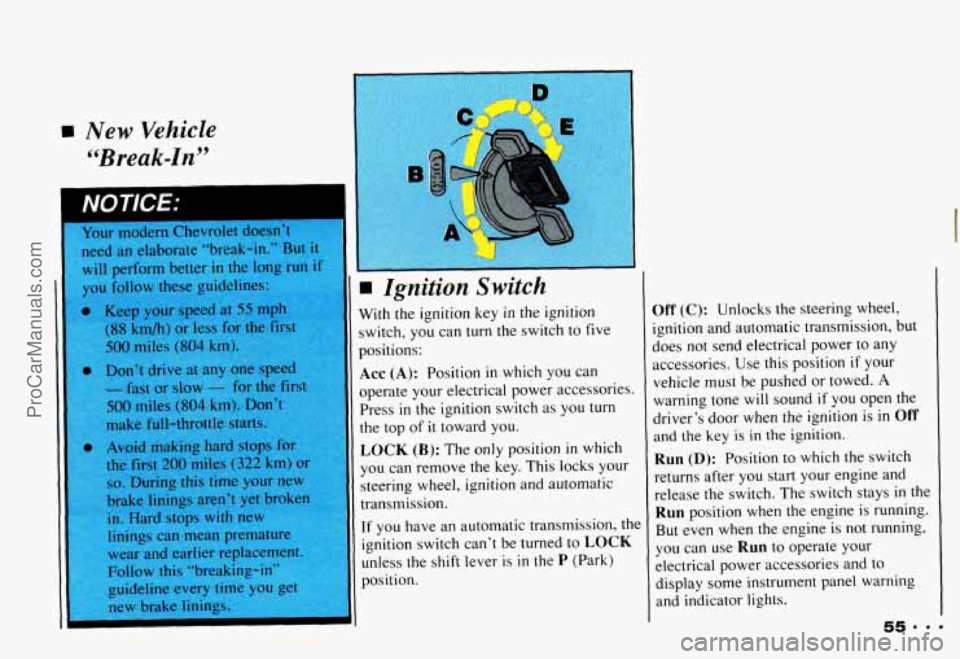
Off (C): Unlocks the steering wheel,
ignition and automatic transmission, but
does not send electrical power to any
accessories. Use this position
if your
vehicle must be pushed or towed.
A
warning tone will sound if you open the
driver’s door when the ignition is
in Off
and the key is in the ignition.
Run (D): Position to which the switch
returns after you start your engine and
release the switch. The switch stays
in the
Run position when the engine is running.
But even when the engine is not running,
you can use
Run to operate your
electrical power accessories and to
display some instrument panel warning
and indicator lights.
ProCarManuals.com
Page 60 of 358
Features & Controls
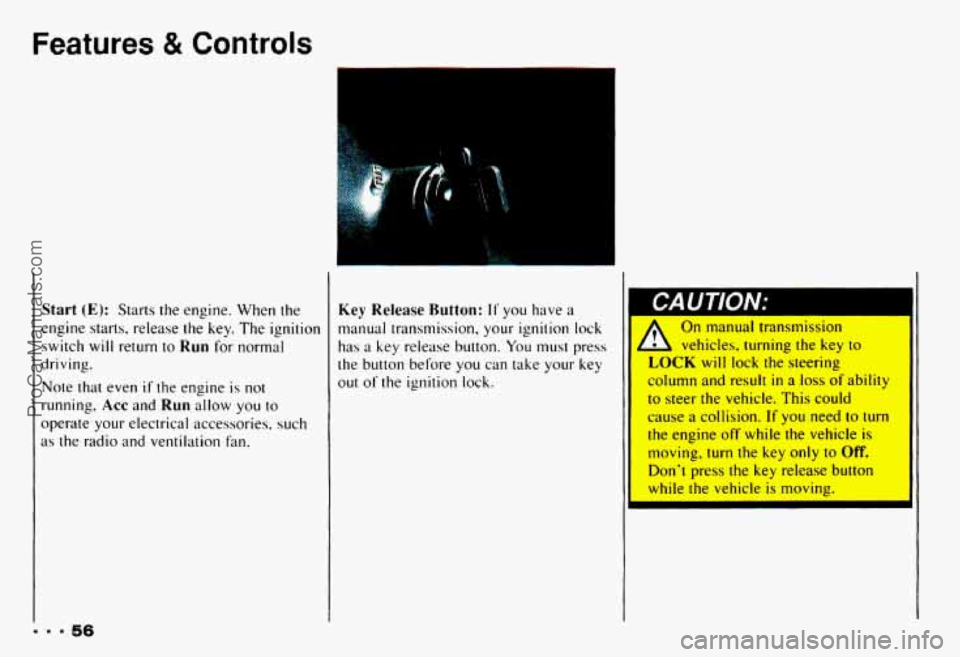
Start (E): Starts the engine. When the
engine starts, release the key. The ignition
switch will return
to Run for normal
driving.
Note that even if the engine is not
running, Acc and Run allow you to
operate your electrical accessories. such
as the radio and ventilation fan.
Key Release Button: I1 you have a
manual transmission, your ignition lock
has a key release button. You must press
the button before you can take
your key
out of the ignition lock.
On manual transmission
1 vehicles, turning the key to
LOCK will lock the steering
column and result
in a loss of ability
to steer the vehicle. This could
cause a collision.
If you need to turn
the engine
off while the vehicle is
moving,
turn the key only to Off.
Don't press the key release button
while
the vehicle is moving.
... 56
ProCarManuals.com
Page 61 of 358
I
rn
1
I
I
NOTICE:
I. If your key seems stuck in LOCK 1
and you can’t turn it, be sure it is all 5
the way in. If it is, then turn the
steering wheel left and right whil
you turn the key hard. But turn
tt
key only with your hand. Usir
tool
to force it could break the key
or
the ignition switch. If none of thi:
works,
then your vehicle nvAr
service.
T
i
ietained Accessory Power (RAP)
f you have power door locks, your
lehicle
has a feature called Retained
kcessory Power (RAP). With RAP your power
door locks, electric mirrors, power
windows, audio system and remote hatch
release will continue
to work up to 10
minutes after the ignition key is turned to
Off and neither door is opened.
If a door is opened, the audio system and
power windows will shut off. The power
door locks, electric mirrors and remote
hatch release will work
until you shut the
door. Once you have shut the
door, these
accessories
will continue to work for
approximately
35 seconds. After this
time you
will not be able to use these
accessories
until the next time you open
a
door or turn on the ignilion.
Starting Your Engine
Automatic Transmission: Move your
shift lever to P (Park) or N (Neutral).
Your engine won’t start
in any other
position
- that’s a safety feature. To
restart when you’re already moving,
use
N (Neutral) only.
NOTICE: I
Don‘t try to shilt to P (Park) if your
Chevrolet is moving.
If you do, vou
could damage the transmission,
Shift
to P (Park) o
V
ProCarManuals.com
Page 65 of 358
Driving through Deep Standing
Water
NOTiCE:
[f you drive too quickly throul
deep puddles or standing wt :r,
water can come
in through your
engine’s air intake and badly
damage your engine.
If you can’t
avoid deep puddle< nr standing
water, drive throul them very
slowly
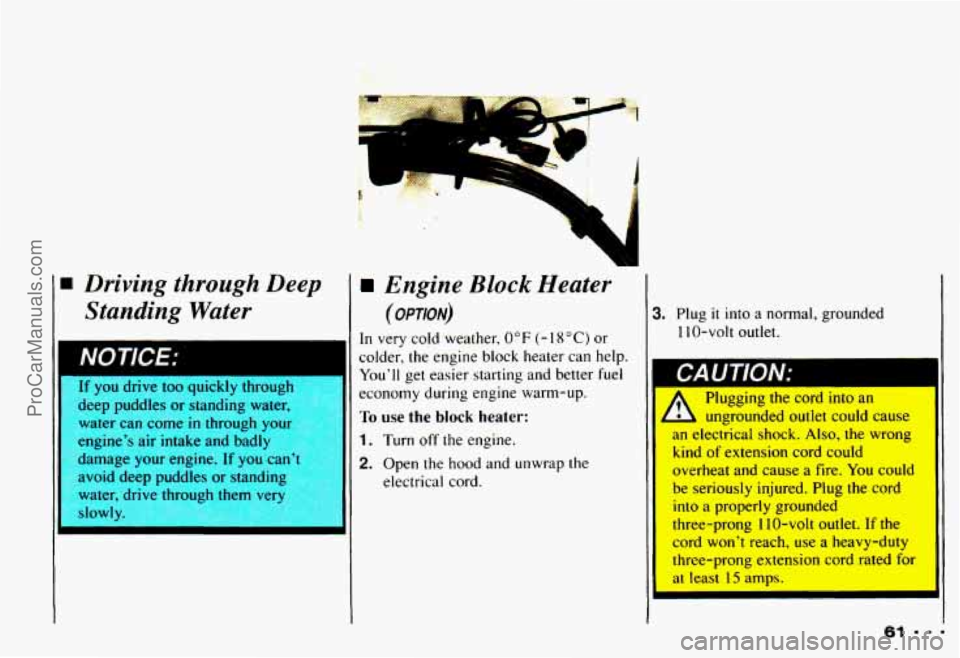
Engine Block Heater
(OPTION)
In very cold weather, 0 OF (- 1 8 “C) or
colder, the engine block heater can help.
You’ll get easier starting and better fuel
economy during engine warm-up.
To use the block heater:
1. Turn off the engine.
2. Open the hood and unwrap the
electrical cord.
3. Plug it into a normal, grounded
1 10-volt outlet.
CA UTiON:
A
Plugging the cord into an
ungrounded outlet could cause
I
an electrical shock. Also, the wrong
kind of extension cord could
overheat and cause a fire. You could
be seriously injured. Plug the cord into a properly grounded
three-prong
1 10-volt outlet. If the
cord won’t reach, use a heavy-duty
three-prong extension cord rated
for
at least 15 amps.
ProCarManuals.com
Page 66 of 358
Features & Controls
I NOTICE:
I HTI~~ you-ve usea me DIOCK neater, I- sure to store the cord as it was
,-fore, to keep
it aw-f from movin
engine parts.
If you h’t ; $&add ,$a;!$$$,.
be damaged.
I
, . ,Q i ,,<.> . , t!!! h,~
I
How long should you keep the block
heater plugged in? The answer depends
on the weather, the kind of oil you have,
and some other things. Instead of trying to
list everything here, we ask
that you
contact
a Chevrolet dealer in the area
where you’ll be parking your vehicle. The
dealer can give
you the best advice for
that particular area,
... 62
Automatic
Transmission
There are several different positions for
your shift lever.
P (Park)
This locks your rear wheels. It’s the best
position to use when you start your
engine because your vehicle can’t move
easily.
It is dangerous to get out of
your vehicle
if rhe shift lever is
not fully in P (Park) with the
parking brake
firmly set. Your
vehicle can roll.
Don’t leave your vehicle when the
engine
is running unless you have
to. If you have left the engine
running, the vehicle can move
suddenly.
You or others could be
injured. To be sure your vehicle
won’t move, when you’re on fairly
level ground, always set your
parking brake and move the shift lever to
P (Park).
See “Shifting into
P (Park)” in the
Index.
If you are parking on a hill,
or if you’re pulling a trailer, also
see “Parking on Hills” or “Towing
a Trailer” in the Index.
ProCarManuals.com
Page 67 of 358
I
Ensure the shift lever is fully in P (Park)
range before starting the engine. Your
Chevrolet has a brake-transmission shift
interlock. You have
to fully apply your
regular brakes
before you can shift from
P (Park) when the ignition key is in the
0 R (Reverse)
Use this gear to back up.
11 NOTICE:
I Shifting to K (Reverse) while your
Run position. If you cannot shift out of vehicle is moving forward could
P (Park), ease pressure on the shift lever damage your transmission. Shift to
- push the shift lever all the way into R only after your vehicle is stopped.
P (Park) and also release the shift lever
button on floor shift console models as
you maintain brake application. Then
move the shift lever into the gear you
wish. (Press the shift lever button before
moving
the shift lever on tloor shift
console models.) See "Shifting out of
P (Park)" in this part.
To rock your vehicle back and forth to
damaging your transmission, see "Stuck:
In Sand, Mud, Ice or Snow, If You're"
in the Index.
L get out of snow, ice or sand without
N (Neutral)
In this position, your engine doesn't
connect
with the wheels. To restart when
you're already moving, use
N (Neutral)
only.
Also, use N when your vehicle is
being towed.
639 9
ProCarManuals.com
Page 72 of 358
Features & Controls
0
0
0
2 (Second Gear) - Press the clutch
pedal as you let up on the accelerator
pedal and shift into
2. Then, slowly
let up on the clutch pedal as you
press the accelerator pedal.
3,4,S and 6 (Third, Fourth, Fifth
and Sixth Gears)
- Shift into 3,4,
5 and 6 the same way you do for 2.
Slowly let up on the clutch pedal as
you press the accelerator pedal.
To Stop - Let up on the accelerator
pedal and press
the brake pedal. Just
before the vehicle stops, press the
clutch pedal and the brake pedal, and
shift to
Neutral. Neutral
- Use this position when
you start or idle your
engine.
R (Reverse) - To back up, press
down the clutch pedal and shift into
R. Let up on the clutch pedal slowly
while pressing the accelerator pedal.
If
you shift from 6 into R, the shift
lever must be first placed
in the
Neutral position centered between 2
and 3 prior to shifting into R.
Your six-speed manual transmission has a
feature that allows you to safely shift into
R (Reverse) while the vehicle is rolling
(at less than
5 mph). You will be
“locked-out”
if you try to shift into R
(Reverse) while your vehicle is moving
faster than
5 mph.
If
you have turned your ignition off and
wish to park your vehicle
in Reverse, you
will have to move the shift lever quickly
to the right, “crashing” through the high
load spring and then into gear.
ProCarManuals.com
Page 75 of 358
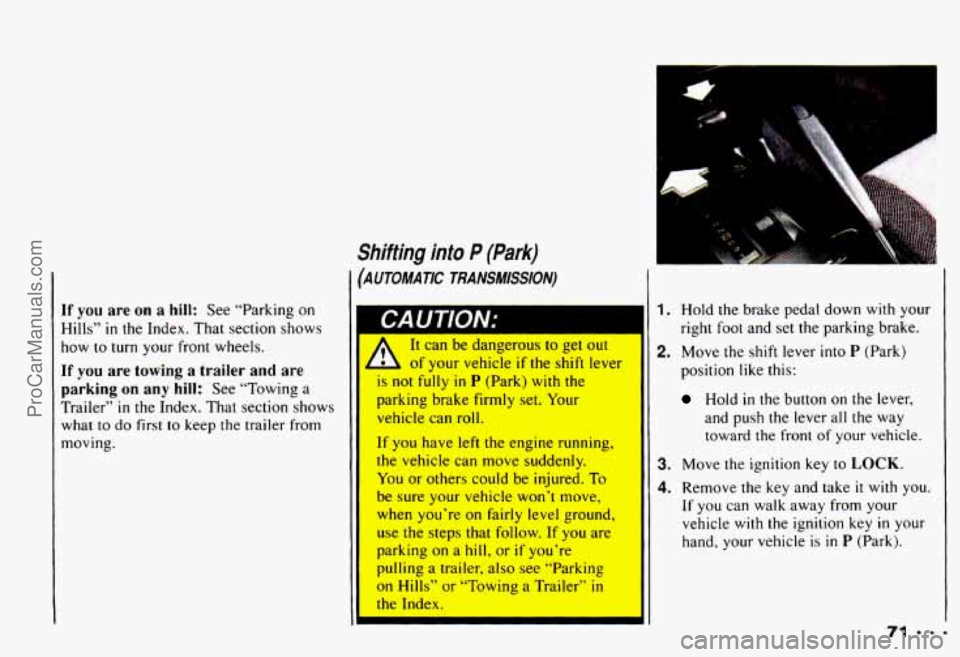
If you are on a hill: See “Parking on
Hills” in the Index. That section shows
how to turn your front wheels.
If you are towing a trailer and are
parking on any
hill: See “Towing a
Trailer”
in the Index. That section shows
what
to do first to keep the trailer from
moving.
Shifting into P (Park)
(AUTOMATIC TRANSMISSION)
It can IX aangerous to get out
- of your vehicle if the shift lever
is not fully in P (Park) with the
parking brake firmly set. Your
vehicle can roll.
If you have left the engine running,
the vehicle can move suddenly.
You
or others could be injured. To
be sure your vehicle won’t move,
when you’re on fairly level ground,
use the steps that follow. If you are
parking on a hill, or if you’re
pulling
a trailer, also see “Parking
on Hills” or “Towing a Trailer” in
the Index.
1. Hold the brake pedal down with your
2. Move the shift lever into P (Park)
right foot and set the parking brake.
position like this:
Hold in the button on the lever,
and push the lever all the way toward the front
of your vehicle.
3. Move the ignition key to LOCK.
4. Remove the key and take it with you.
If you can walk away from your
vehicle
with the ignition key in your
hand, your vehicle is
in P (Park).
ProCarManuals.com
Page 76 of 358
Features & Controls
.eaving Your Vehicle with the
rngine Running
AUTOMATIC TRANSMISSION)
A It can be dangerous to leave
,A your vehicle with the engine
running. Your vehicle could move
suddenly
if the shift lever is not
fully in P (Park) with the parking
brake firmly set. And, if you leave
the vehicle with the engine running,
it could overheat and even catch
fire. You or others could be injured.
Don’t leave your vehicle
with the
I I engine running unless you have to.
If you have to leave your vehicle with the
engine running, be sure your vehicle
is in
P (Park) and your parking brake is firmly
set before you leave it. After you’ve
moved the shift lever into the
P (Park)
position, hold the regular brake pedal
down. Then, see
if you can move the shift
lever away from
P (Park) without first
pushing the button. If you can, it means
that the shift lever wasn’t fully locked
into
P (Park).
Shifting out of P (Park)
(AUTOMATIC TRANSMISSION)
Your Chevrolet has a brake-transmission
shift interlock. You have
to fully apply
your regular brake before you can shift
from
P (Park) when the ignition is in
the Run position. See “Automatic
Transmission”
in the Index.
ProCarManuals.com