spare wheel CHEVROLET CAMARO 1996 4.G Owners Manual
[x] Cancel search | Manufacturer: CHEVROLET, Model Year: 1996, Model line: CAMARO, Model: CHEVROLET CAMARO 1996 4.GPages: 402, PDF Size: 21.38 MB
Page 68 of 402
Downloaded from www.Manualslib.com manuals search engine Vehicle and Content
Theft-DeterrenUAlr m System (Option)
If your vehicle has this option, it has a theft-deterrent
alarm system. Once armed, the system will sound the horn
and flash the parlung lamps if the vehicle is broken into.
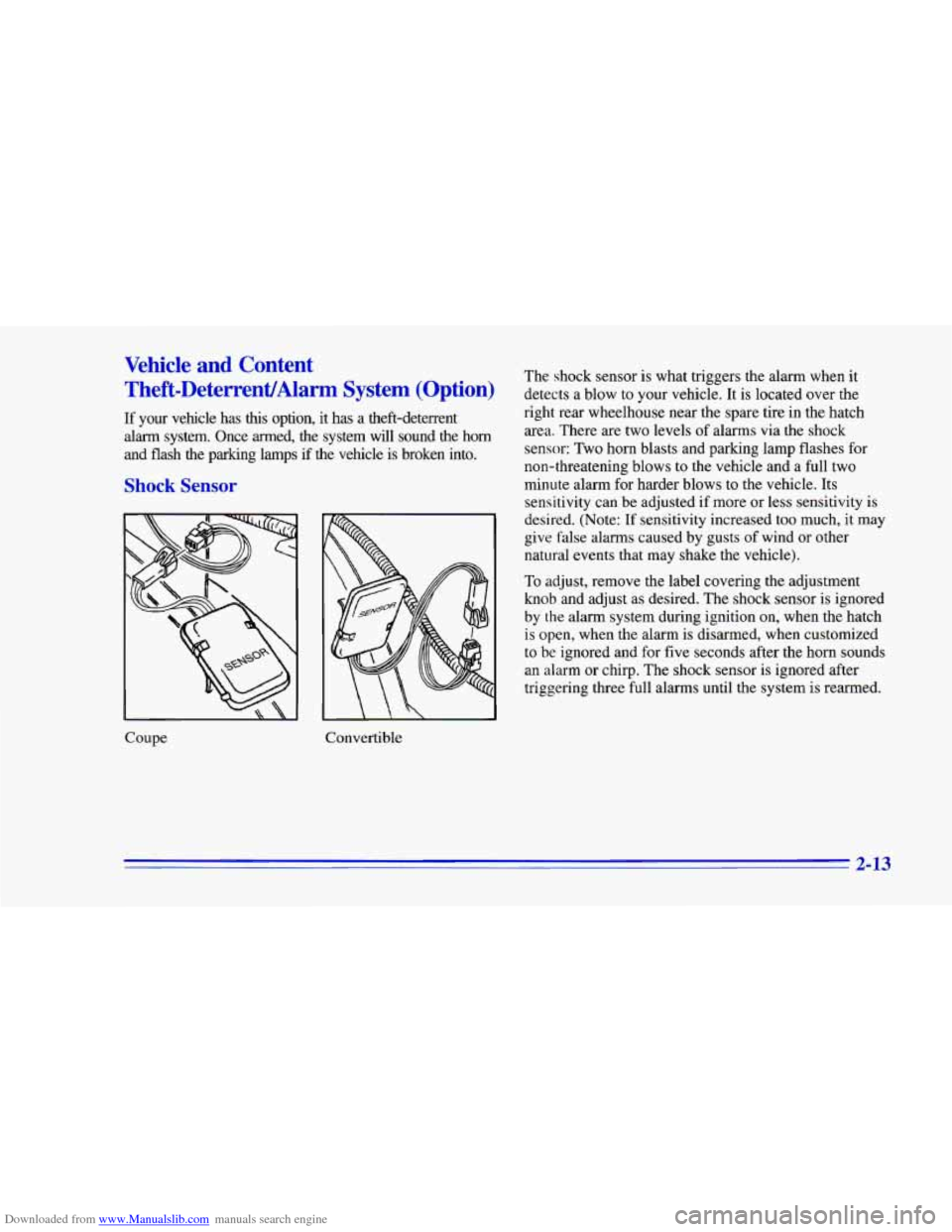
Shock Sensor
Coupe Convertible The
shock sensor is what triggers the alarm when it
detects a blow to your vehicle. It is located over the
right rear wheelhouse near the spare tire in the hatch
area. There are two levels
of alarms via the shock
sensor: Two horn blasts and parking lamp flashes for
non-threatening blows
to the vehicle and a full two
minute alarm for harder blows to the vehicle. Its
sensitivity can be adjusted if more or less sensitivity is
desired. (Note:
If sensitivity increased too much, it may
give false alarms caused by gusts of wind or other
natural events that may shake the vehicle).
To adjust, remove the label covering the adjustment
knob and adjust as desired. The shock sensor is ignored
by the alarm system during ignition on, when the hatch
is open, when the alarm is disarmed, when customized
to be ignored and for five seconds after the horn sounds
an alarm or chirp. The shock sensor is ignored after
triggering
three full alarms until the system is rearmed.
2- 13
Page 174 of 402
Downloaded from www.Manualslib.com manuals search engine Examples of these conditions include a hard acceleration
in a turn, or an abrupt upshift or downshift. Also, when
the compact spare tire is on the rear axle, the ASR
system will cycle and limit acceleration for about the
first
15 seconds of driving after each engine start.
If your vehicle is in cruise control when the ASR system
begins to limit wheel spin, the cruise control will
automatically disengage. When road conditions allow
you to safely use it again, you may re-engage the cruise
control. (See “Cruise Control” in the Index.)
ASR
OFF
The ASR system automatically comes on whenever you
start your vehicle.
To limit wheel spin, especially in
slippery road conditions, you should always leave
the
system on. But you can turn the ASR system off if you
ever need to. (You should turn the system
off if your
vehicle ever gets stuck in sand, mud, ice or snow.
See
“Rocking Your Vehicle” in the Index.)
To turn the system off, press
the button on the console
near the cigarette lighter.
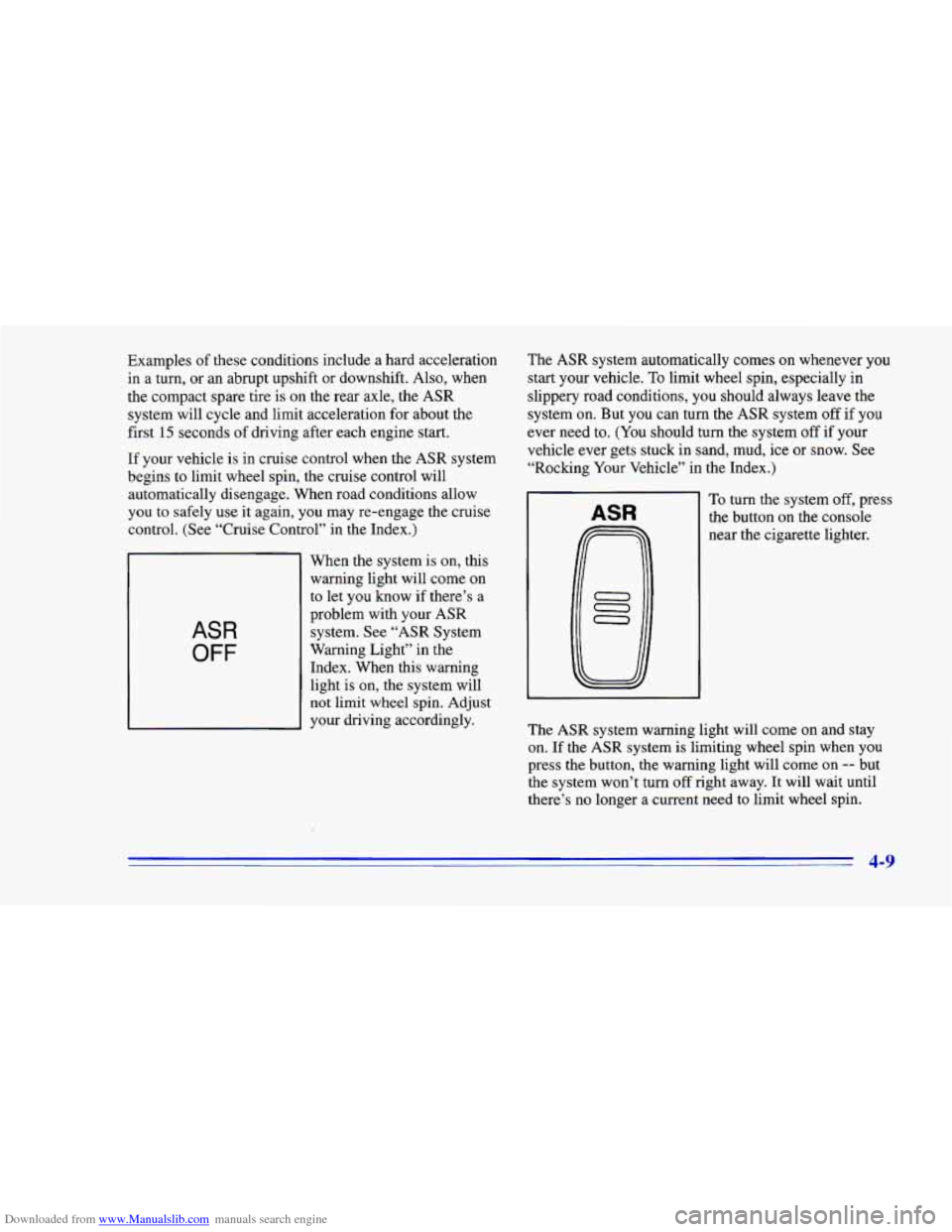
When the system is on, this
warning light will come on
to let you know if there’s a
problem with your ASR
system. See “ASR System
Warning Light” in the
Index. When this warning
light is on, the system will
not limit wheel spin. Adjust
your driving accordingly. The ASR system warning light will come on
and stay
on. If the ASR system is limiting wheel spin when you
press the button, the warning light will come on
-- but
the system won’t turn
off right away. It will wait until
there’s no longer a current need to limit wheel spin.
4-9
Page 236 of 402
Downloaded from www.Manualslib.com manuals search engine ‘)t
..
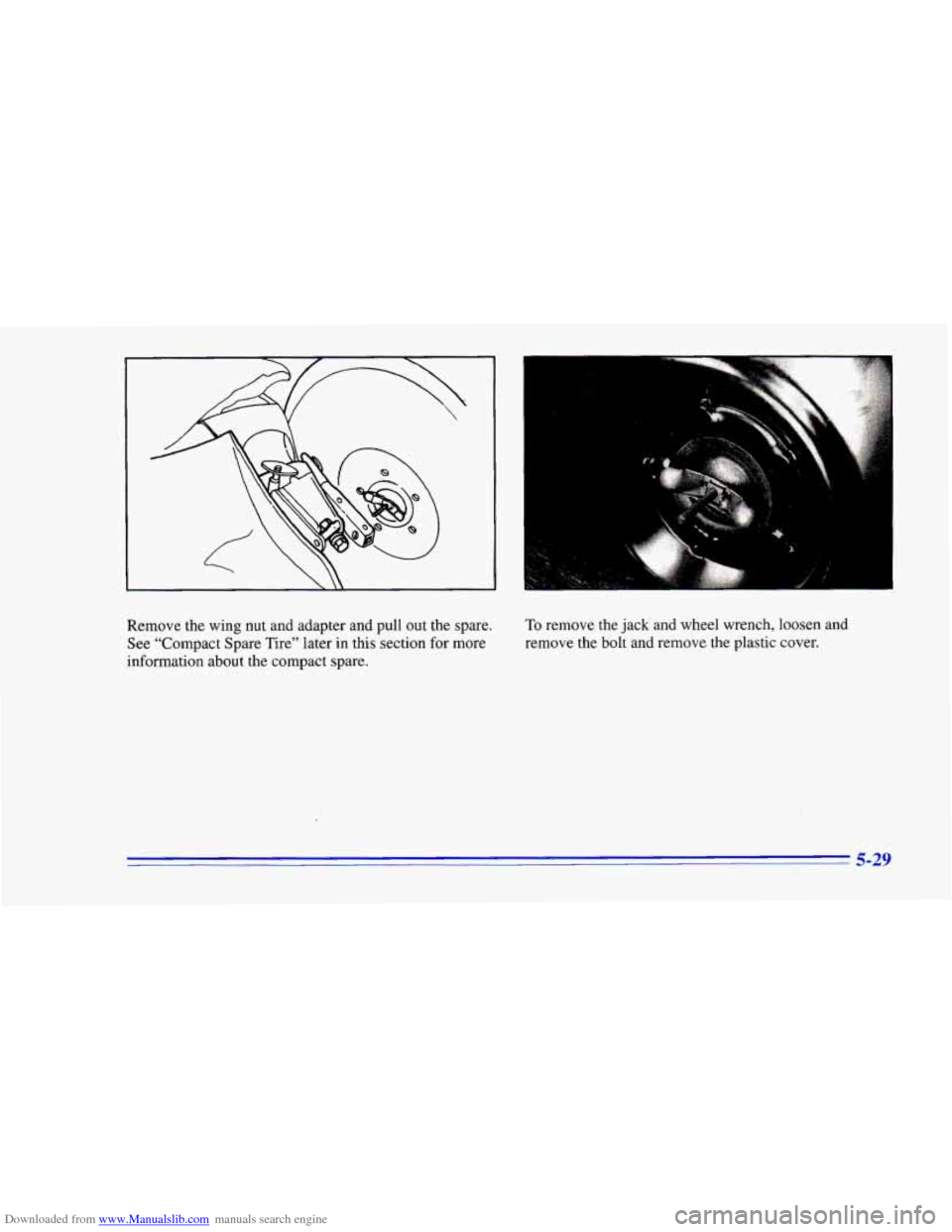
Remove the wing nut and adapter and pull out the spare.
See “Compact Spare Tire” later in this section for more
information about the compact spare. To
remove the jack and wheel wrench, loosen and
remove the bolt and remove the plastic cover.
5-29
Page 239 of 402
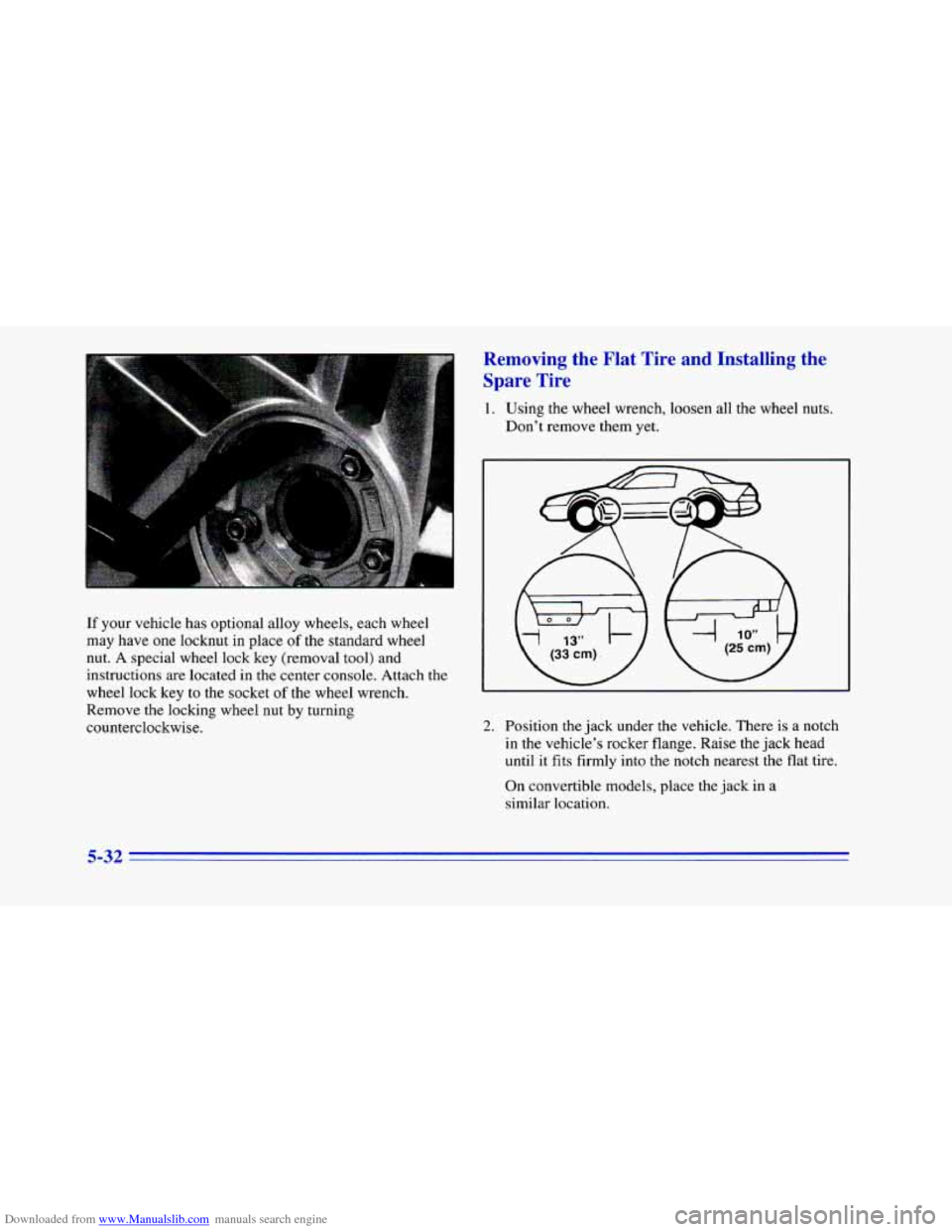
Downloaded from www.Manualslib.com manuals search engine If your vehicle has optional alloy wheels, each wheel
may have one locknut in place
of the standard wheel
nut.
A special wheel lock key (removal tool) and
instructions are located in the center console. Attach the
wheel lock key to the socket
of the wheel wrench.
Remove the locking wheel nut by turning
counterclockwise.
Removing the Flat Tire and Installing the
Spare Tire
1. Using the wheel wrench, loosen all the wheel nuts.
Don’t remove them yet.
2. Position the jack under the vehicle. There is a notch
in the vehicle’s rocker flange. Raise the jack head
until
it fits firmly into the notch nearest the flat tire.
On convertible models, place the jack in a
similar location.
5-32
Page 241 of 402
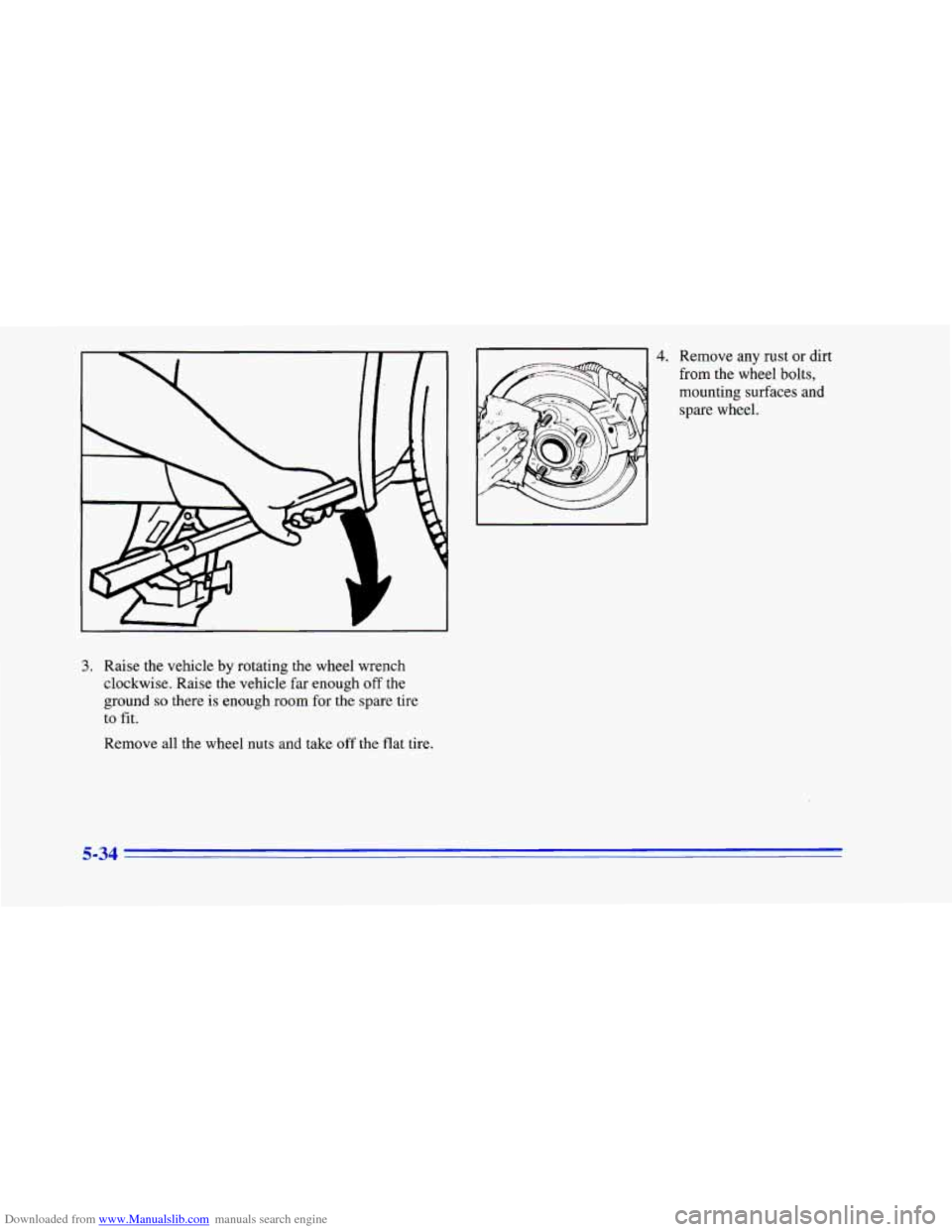
Downloaded from www.Manualslib.com manuals search engine 3. Raise the vehicle by rotating the wheel wrench
clockwise. Raise the vehicle far enough
off the
ground
so there is enough room for the spare tire
to fit.
Remove
all the wheel nuts and take off the flat tire.
4. Remove any rust or dirt
from the wheel bolts,
mounting surfaces and
spare wheel.
5-34
Page 244 of 402
Downloaded from www.Manualslib.com manuals search engine I NOTICE:’
Improperly tightened wheel nuts can lead to
brake pulsation and rotor damage.
To avoid
expensive brake repairs, evenly tighten the wheel
nuts in the proper sequence and to the proper
torque specification.
Don’t try to put a wheel cover on your compact spare
t’re. It won’t fit. Store the wheel cover in the rear area
u til you have the flat tire repaired or replaced.
F
I NOTICE:
Storing a Flat or Spare Tire and Tools
Wheel covers won’t fit on your compact spare.
If you try to put a wheel cover on your compact
spare,
you could damage the cover or the spare. Storing
a jack,
a tire or other equipment in the
passenger compartment
of the vehicle could
cause injury. In a sudden stop or collision, loose
equipment could strike someone. Store all these
in the proper place.
5-37
Page 245 of 402
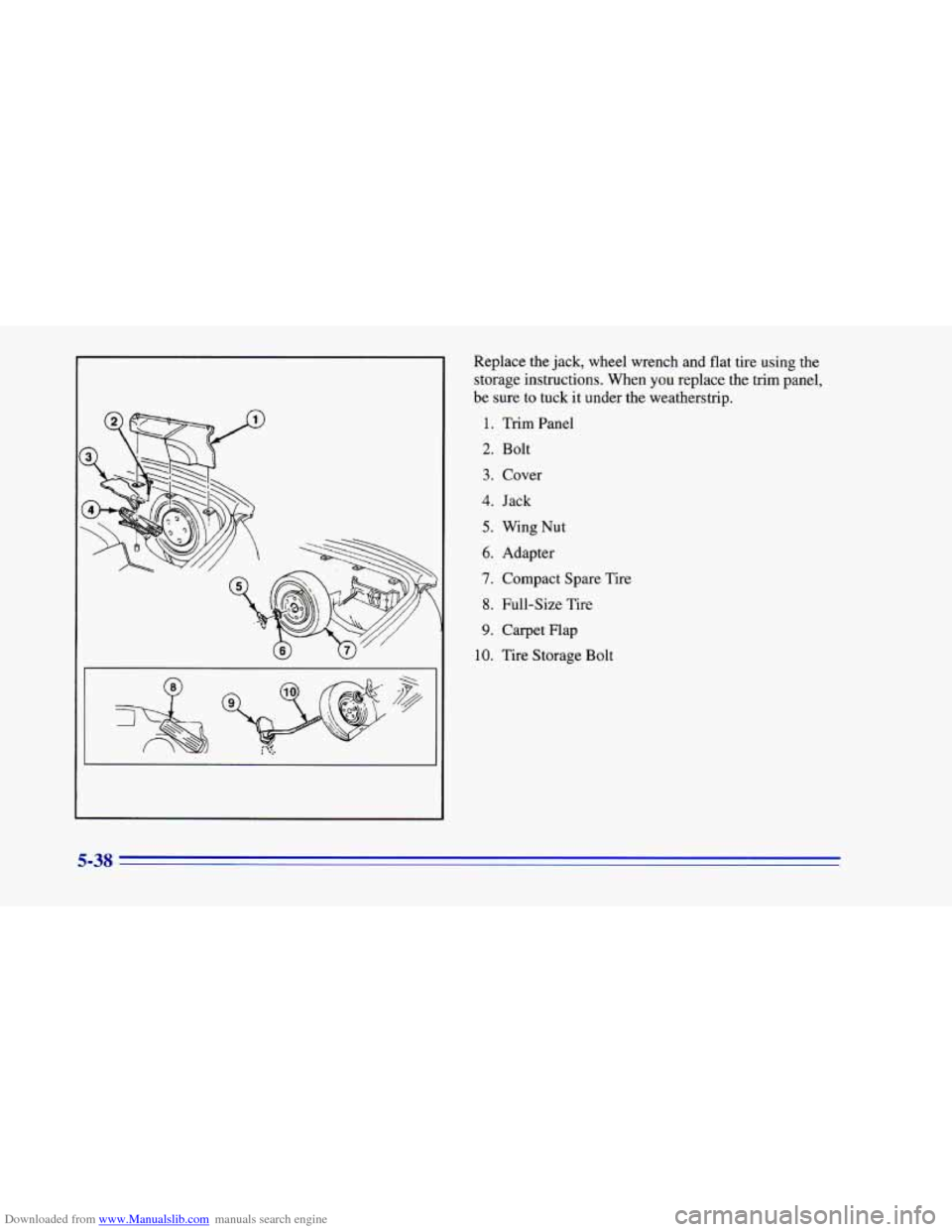
Downloaded from www.Manualslib.com manuals search engine Replace the jack, wheel wrench and flat tire using the
storage instructions. When
you replace the trim panel,
be sure to tuck it under the weatherstrip.
1.
2.
3.
4.
5.
6.
7.
8.
9.
10.
Trim Panel
Bolt
Cover
Jack
Wing Nut Adapter
Compact Spare Tire
Full-Size Tire Carpet Flap
Tire Storage Bolt
5-38
Page 246 of 402
Downloaded from www.Manualslib.com manuals search engine Compact Spare Tire
Although the compact spare tire was fully inflated
when your vehicle was new,
it can lose air after a time.
Check the inflation pressure regularly. It should be
60 psi (420 kPa).
After installing the compact spare on your vehicle, you
should stop as
soon as possible and make sure your
spare tire is correctly inflated. The compact spare is
made
to perform well at posted speed limits for
distances up to
3,000 miles (5 000 km), so you can
finish your trip and have your full-size tire repaired or
replaced where you want.
Of course, it’s best to replace
your spare with a full-size tire as soon as you can. Your
spare will last longer and be in good shape in case you
need it again.
When the compact spare is on the rear axle, the optional
ASR system will cycle and limit acceleration for about
the first
15 seconds of driving after each engine start.
I NOTICE:
~~ ~~~ ~~~
When the compact spare is installed, don’t take
your vehicle through an automatic car wash with
guide rails. The compact spare can get caught on
the rails. That can damage the tire and wheel,
and maybe other parts of your vehicle.
NOTICE:
If the compact spare is used as a rear tire, do not
drive faster than
50 mph (80 km/h). Damage to
the rear axle may occur if the compact spare is
driven faster than
50 mph (80 kmk). This speed
limitation does not apply when the compact spare
is used as a front tire.
5-39
Page 247 of 402
Downloaded from www.Manualslib.com manuals search engine Don’t use your compact spare on other vehicles.
And don’t mix
your compact spare tire or wheel with
other wheels or tires. They won’t fit. Keep your spare
tire and its wheel together.
NOTICE:
Tire chains won’t fit your compact spare. Using
them can damage
your vehicle and can damage
the chains too. Don’t use tire chains on your
compact spare.
If You’re Stuck: In Sand, Mud, Ice
or Snow
What you don’t want to do when your vehicle is stuck is
to spin your wheels too fast. The method known as
“rocking” can help you get out when you’re stuck, but
you must use caution.
A CAUTION:
If you let your tires spin at high speed, they can
explode, and
you or others could be injured. And,
the transmission or other parts
of the vehicle
can overheat. That could cause an engine
compartment fire or other damage. When you’re
stuck, spin the wheels as little as possible. Don’t
spin the wheels above
35 mph (55 km/h) as shown
on the speedometer.
5-40
Page 301 of 402
Downloaded from www.Manualslib.com manuals search engine ! I
-p
a
+C-
Y
fl-
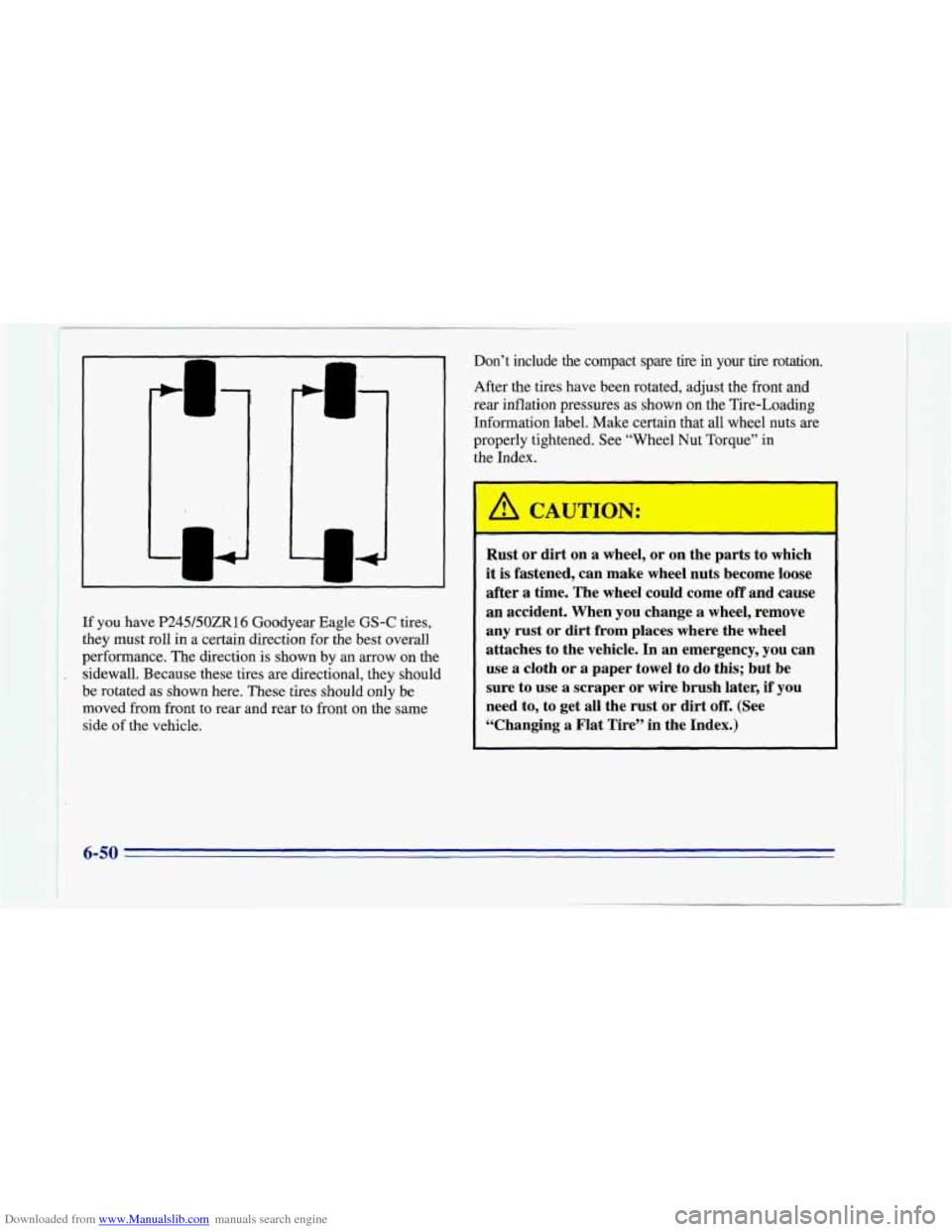
If you have P24515OZR16 Goodyear Eagle GS-C tires,
they must roll in
a certain direction for the best overall
performance. The direction
is shown by an arrow on the
sidewall. Because these tires are directional, they should
be rotated as shown here. These tires should
only be
moved from front to rear and rear to front on the same
side
of the vehicle. Don’t include the compact spare tire in
your tire rotation.
After the tires have been rotated, adjust the front and
rear inflation pressures
as shown on the Tire-Loading
Information label. Make certain that all wheel nuts are
properly tightened. See
“Wheel Nut Torque” in
the Index.
I Rust or dirt on a wheel, or on the parts to which
~ it is fastened, can make wheel nuts become loose
after a time. The wheel could come
off and cause
an accident. When you change
a wheel, remove
any rust or
dirt from places where the wheel
attaches to the vehicle.
In an emergency, you can
use a cloth
or a paper towel to do this; but be
sure to
use a scraper’or wire brush later, if you
need to, to get
all the rust or dirt off. (See
“Changing
a Flat Tire” in the Index.)