wheel CHEVROLET CAVALIER 2003 3.G Workshop Manual
[x] Cancel search | Manufacturer: CHEVROLET, Model Year: 2003, Model line: CAVALIER, Model: CHEVROLET CAVALIER 2003 3.GPages: 364, PDF Size: 2.44 MB
Page 292 of 364

Compact Spare Tire
Although the compact spare tire was fully in¯ated when
your vehicle was new, it can lose air after a time.
Check the in¯ation pressure regularly. It should be
60 psi (420 kPa).
After installing the compact spare tire on your vehicle,
you should stop as soon as possible and make sure
your compact spare tire is correctly in¯ated. The
compact spare tire is made to perform well at speeds
up to 65 mph (105 km/h) for distances up to 3,000 miles
(5 000 km), so you can ®nish your trip and have your
full-size tire repaired or replaced where you want.
Of course, it's best to replace your spare with a full-size
tire as soon as you can. Your spare will last longer
and be in good shape in case you need it again.
Notice:When the compact spare is installed, don't
take your vehicle through an automatic car wash
with guide rails. The compact spare can get caught
on the rails. That can damage the tire and wheel,
and maybe other parts of your vehicle.
Don't use your compact spare tire on other vehicles.
And don't mix your compact spare tire or wheel
with other wheels or tires. They won't ®t. Keep your
compact spare tire and its wheel together.
Notice:Tire chains won't ®t your compact spare.
Using them can damage your vehicle and can
damage the chains too. Don't use tire chains on
your compact spare.
5-70
Page 298 of 364

Cleaning Windshield and Wiper Blades
If the windshield is not clear after using the windshield
washer, or if the wiper blade chatters when running,
wax, sap or other material may be on the blade
or windshield.
Clean the outside of the windshield with a full-strength
glass cleaning liquid. The windshield is clean if beads do
not form when you rinse it with water.
Grime from the windshield will stick to the wiper blades
and affect their performance. Clean the blade by
wiping vigorously with a cloth soaked in full-strength
windshield washer solvent. Then rinse the blade
with water.
Check the wiper blades and clean them as necessary;
replace blades that look worn.
Cleaning Aluminum or Chrome-Plated
Wheels
Your vehicle may be equipped with either aluminum or
chrome-plated wheels.
Keep your wheels clean using a soft clean cloth with
mild soap and water. Rinse with clean water. After
rinsing thoroughly, dry with a soft clean towel. A wax
may then be applied.
The surface of these wheels is similar to the painted
surface of your vehicle. Don't use strong soaps,
chemicals, abrasive polishes, abrasive cleaners,
cleaners with acid, or abrasive cleaning brushes on
them because you could damage the surface. Do not
use chrome polish on aluminum wheels.
Use chrome polish only on chrome-plated wheels, but
avoid any painted surface of the wheel, and buff off
immediately after application.
Don't take your vehicle through an automatic car wash
that has silicone carbide tire cleaning brushes. These
brushes can also damage the surface of these wheels.
5-76
Page 299 of 364

Cleaning Tires
To clean your tires, use a stiff brush with tire cleaner.
Notice:When applying a tire dressing, always take
care to wipe off any overspray or splash from all
painted surfaces on the body or wheels of the
vehicle. Petroleum-based products may damage the
paint ®nish and tires.
Sheet Metal Damage
If your vehicle is damaged and requires sheet metal
repair or replacement, make sure the body repair shop
applies anti-corrosion material to parts repaired or
replaced to restore corrosion protection.
Original manufacturer replacement parts will provide the
corrosion protection while maintaining the warranty.
Finish Damage
Any stone chips, fractures or deep scratches in the
®nish should be repaired right away. Bare metal
will corrode quickly and may develop into major repair
expense.
Minor chips and scratches can be repaired with touch-up
materials avaliable from your dealer. Larger areas of
®nish damage can be corrected in your dealer's
body and paint shop.
Underbody Maintenance
Chemicals used for ice and snow removal and dust
control can collect on the underbody. If these are not
removed, accelerated corrosion (rust) can occur on
the underbody parts such as fuel lines, frame, ¯oor pan
and exhaust system even though they have corrosion
protection.
At least every spring, ¯ush these materials from the
underbody with plain water. Clean any areas where mud
and debris can collect. Dirt packed in close areas of
the frame should be loosened before being ¯ushed.
Your dealer or an underbody car washing system can
do this for you.
Chemical Paint Spotting
Some weather and atmospheric conditions can create a
chemical fallout. Airborne pollutants can fall upon and
attack painted surfaces on your vehicle. This damage
can take two forms: blotchy, ring-shaped discolorations,
and small, irregular dark spots etched into the paint
surface.
Although no defect in the paint job causes this, GM will
repair, at no charge to the owner, the surfaces of
new vehicles damaged by this fallout condition within
12 months or 12,000 miles (20 000 km) of purchase,
whichever occurs ®rst.
5-77
Page 300 of 364

Vehicle Care/Appearance Materials
See your GM dealer for more information on purchasing
the following products.
Vehicle Care/Appearance Materials
Description Usage
Polishing Cloth
Wax-TreatedInterior and exterior
polishing cloth.
Tar and Road Oil
RemoverRemoves tar, road oil and
asphalt.
Chrome Cleaner and
PolishUse on chrome or
stainless steel.
White Sidewall Tire
CleanerRemoves soil and black
marks from whitewalls.
Vinyl CleanerCleans vinyl tops,
upholstery and
convertible tops.
Glass CleanerRemoves dirt, grime,
smoke and ®ngerprints.
Vehicle Care/Appearance Materials
(cont'd)
Description Usage
Chrome and Wire Wheel
CleanerRemoves dirt and grime
from chrome wheels and
wire wheel covers.
Finish EnhancerRemoves dust,
®ngerprints, and surface
contaminants, Spray on
wipe off.
Swirl Remover PolishRemoves swirl marks,
®ne scratches and other
light surface
contamination.
Cleaner WaxRemoves light scratches
and protects ®nish.
Foaming Tire Shine Low
GlossCleans, shines and
protects in one easy step,
no wiping necessary.
5-78
Page 307 of 364
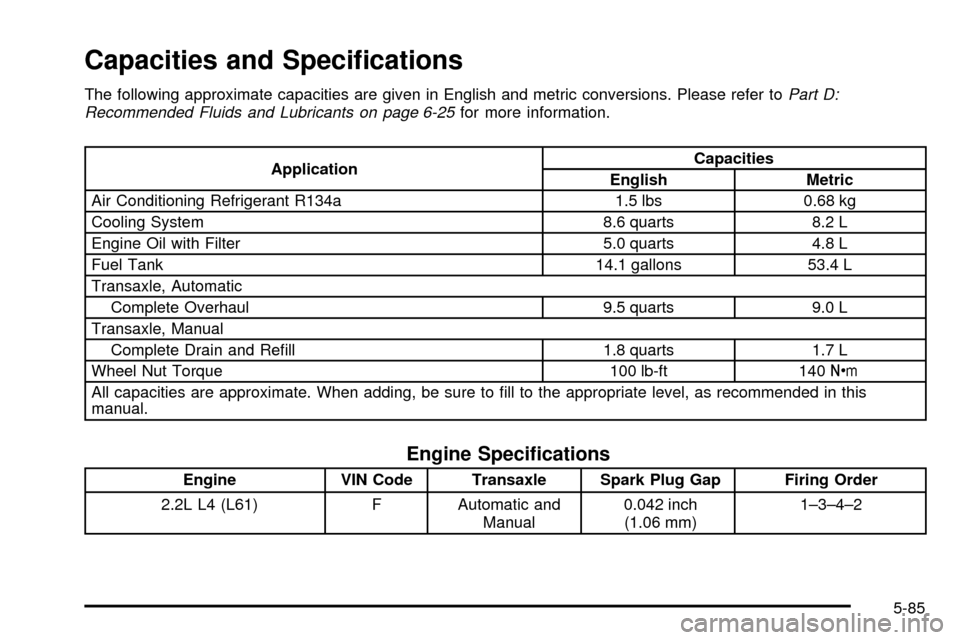
Capacities and Speci®cations
The following approximate capacities are given in English and metric conversions. Please refer toPart D:
Recommended Fluids and Lubricants on page 6-25for more information.
ApplicationCapacities
English Metric
Air Conditioning Refrigerant R134a 1.5 lbs 0.68 kg
Cooling System 8.6 quarts 8.2 L
Engine Oil with Filter 5.0 quarts 4.8 L
Fuel Tank 14.1 gallons 53.4 L
Transaxle, Automatic
Complete Overhaul 9.5 quarts 9.0 L
Transaxle, Manual
Complete Drain and Re®ll 1.8 quarts 1.7 L
Wheel Nut Torque 100 lb-ft 140Y
All capacities are approximate. When adding, be sure to ®ll to the appropriate level, as recommended in this
manual.
Engine Speci®cations
Engine VIN Code Transaxle Spark Plug Gap Firing Order
2.2L L4 (L61) F Automatic and
Manual0.042 inch
(1.06 mm)1±3±4±2
5-85
Page 330 of 364
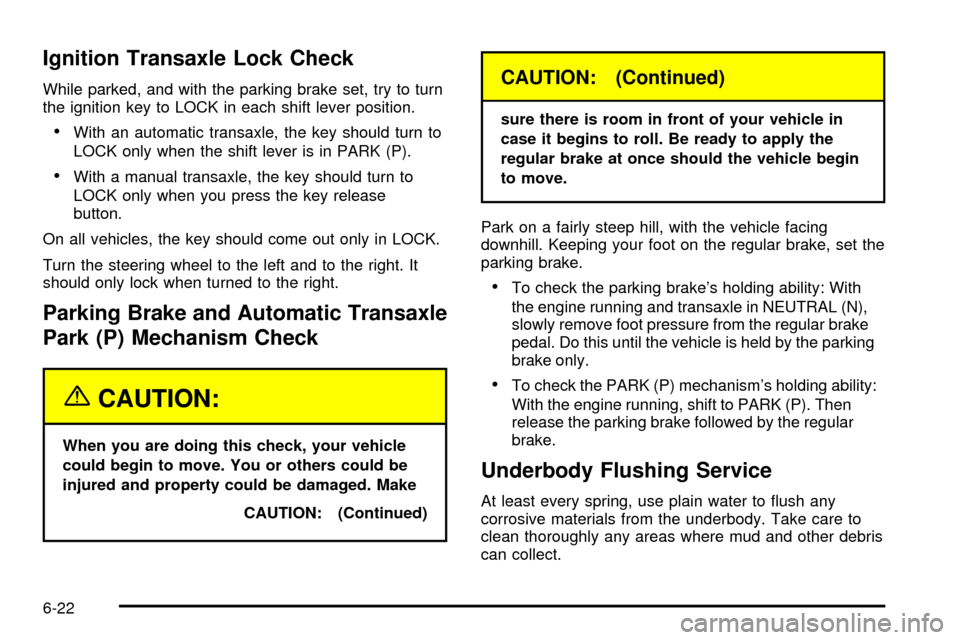
Ignition Transaxle Lock Check
While parked, and with the parking brake set, try to turn
the ignition key to LOCK in each shift lever position.
·With an automatic transaxle, the key should turn to
LOCK only when the shift lever is in PARK (P).
·With a manual transaxle, the key should turn to
LOCK only when you press the key release
button.
On all vehicles, the key should come out only in LOCK.
Turn the steering wheel to the left and to the right. It
should only lock when turned to the right.
Parking Brake and Automatic Transaxle
Park (P) Mechanism Check
{CAUTION:
When you are doing this check, your vehicle
could begin to move. You or others could be
injured and property could be damaged. Make
CAUTION: (Continued)
CAUTION: (Continued)
sure there is room in front of your vehicle in
case it begins to roll. Be ready to apply the
regular brake at once should the vehicle begin
to move.
Park on a fairly steep hill, with the vehicle facing
downhill. Keeping your foot on the regular brake, set the
parking brake.
·To check the parking brake's holding ability: With
the engine running and transaxle in NEUTRAL (N),
slowly remove foot pressure from the regular brake
pedal. Do this until the vehicle is held by the parking
brake only.
·To check the PARK (P) mechanism's holding ability:
With the engine running, shift to PARK (P). Then
release the parking brake followed by the regular
brake.
Underbody Flushing Service
At least every spring, use plain water to ¯ush any
corrosive materials from the underbody. Take care to
clean thoroughly any areas where mud and other debris
can collect.
6-22
Page 332 of 364

Brake System Inspection
Inspect the complete system. Inspect brake lines and
hoses for proper hook-up, binding, leaks, cracks,
cha®ng, etc. Inspect disc brake pads for wear and rotors
for surface condition. Also inspect drum brake linings
for wear and cracks. Inspect other brake parts, including
drums, wheel cylinders, calipers, parking brake, etc.
Check parking brake adjustment. You may need to have
your brakes inspected more often if your driving
habits or conditions result in frequent braking.
Caliper/Knuckle
MaintenanceInspection
If you operate your vehicle in a highly corrosive
environment, as indicated by the shaded areas on the
map following this text, your vehicle may require
additional brake service. Refer to the appropriate GM
service bulletin for the proper caliper inspection
procedure. As necessary, caliper pins and knuckle
brake pad abutments should be lubricated at every other
tire rotation. Also, see your GM dealer's service
department or quali®ed service center for additional
information.
6-24
Page 341 of 364

Overseas ± Customer Assistance
Please contact the local General Motors Business Unit.
Mexico, Central America and
Caribbean Islands/Countries (Except
Puerto Rico and U.S. Virgin Islands) ±
Customer Assistance
General Motors de Mexico, S. de R.L. de C.V.
Customer Assistance Center
Paseo de la Reforma # 2740
Col. Lomas de Bezares
C.P. 11910, Mexico, D.F.
01-800-508-0000
Long Distance: 011-52-53 29 0 800
GM Mobility Program for Persons
with Disabilities
This program, available to
quali®ed applicants, can
reimburse you up to
$1,000 toward aftermarket
driver or passenger
adaptive equipment you
may require for your
vehicle (hand controls,
wheelchair/scooter
lifts, etc.).
This program can also provide you with free resource
information, such as area driver assessment centers and
mobility equipment installers. The program is available
for a limited period of time from the date of vehicle
purchase/lease. See your dealer for more details or call
the GM Mobility Assistance Center at 1-800-323-9935.
Text telephone (TTY) users, call 1-800-833-9935.
GM of Canada also has a Mobility Program. Call
1-800-GM-DRIVE (463-7483) for details. All TTY users
call 1-800-263-3830.
7-5
Page 351 of 364

Checking Coolant............................................5-23
Checking Engine Oil........................................5-14
Checking Things Under the Hood......................5-10
Checking Your Restraint Systems......................1-58
Check...........................................................3-30
Engine Light...............................................3-30
Gages Warning Light...................................3-34
Chemical Paint Spotting...................................5-77
Child Restraints..............................................1-35
Child Restraint Systems...............................1-35
Infants and Young Children...........................1-32
Lower Anchorages and Top Tethers for
Children (LATCH System)..........................1-41
Older Children.............................................1-29
Securing a Child Restraint Designed for
the LATCH System...................................1-43
Securing a Child Restraint in a Rear
Seat Position...........................................1-43
Securing a Child Restraint in the Right
Front Seat Position...................................1-46
Top Strap Anchor Location............................1-40
Top Strap...................................................1-39
Where to Put the Restraint...........................1-38
Chime Level Adjustment..................................3-79
Cigarette Lighter.............................................3-16
Cleaning Aluminum or Chrome-Plated Wheels.....5-76
Cleaning Exterior Lamps/Lenses.......................5-75
Cleaning Fabric/Carpet....................................5-71
Cleaning Glass Surfaces..................................5-73Cleaning Interior Plastic Components.................5-73
Cleaning the Top of the
Instrument Panel.........................................5-73
Cleaning Tires................................................5-77
Cleaning Vinyl................................................5-73
Cleaning Windshield and Wiper Blades..............5-76
Cleaning........................................................5-71
Inside of Your Vehicle..................................5-71
Outside of Your Vehicle................................5-74
Underbody Maintenance...............................5-77
Weatherstrips..............................................5-74
Climate Control System...................................3-17
Outlet Adjustment........................................3-20
Clutch, Hydraulic.............................................5-21
Compact Disc Messages.................3-48, 3-63, 3-75
Compact Spare Tire........................................5-70
Content Theft-Deferrent....................................2-15
Control of a Vehicle.......................................... 4-5
Convenience Net............................................2-36
Coolant.........................................................3-29
Engine Temperature Gage............................3-29
Heater, Engine............................................2-21
Low Warning Light.......................................3-30
Surge Tank Pressure Cap.............................5-24
Cooling System..............................................5-27
Cruise Control.................................................. 3-8
Cupholder(s)..................................................2-35
Current and Past Model Order Forms................7-11
3
Page 361 of 364

Shoulder Belt Height Adjuster
(Four Door Models).....................................1-17
Skidding........................................................4-14
Some Other Rainy Weather Tips.......................4-18
Special Fabric Cleaning Problems.....................5-72
Speci®cations, Capacities.................................5-85
Speedometer..................................................3-23
Starter Switch Check.......................................6-21
Starting Your Engine...............................2-19, 2-20
Steering in Emergencies..................................4-11
Steering, Suspension and Front Drive
Axle Boot and Seal Inspection.......................6-23
Steering Tips..................................................4-10
Steering........................................................4-10
Storage Areas................................................2-35
Center Console Storage Area........................2-35
Convenience Net.........................................2-36
Cupholder(s)...............................................2-35
Storing the Flat Tire and Tools..........................5-68
Storing the Spare Tire and Tools.......................5-69
Stuck in Sand, Mud, Ice or Snow......................4-29
Sun Visors.....................................................2-14
Sunroof.........................................................2-36T
Tachometer....................................................3-23
Taillamps.......................................................5-48
Turn Signal Lamps......................................5-48
Theft-Deterrent, Radio.....................................3-76
Theft-Deterrent Systems...................................2-15
Content Theft-Deterrent................................2-15
Passlock
ž...................................................2-16
Throttle System Inspection...............................6-23
Tilt Wheel........................................................ 3-5
Tire In¯ation Check.........................................6-19
Tires.............................................................5-51
Buying New Tires........................................5-55
Chains.......................................................5-59
Changing a Flat Tire....................................5-61
Compact Spare Tire.....................................5-70
If a Tire Goes Flat.......................................5-60
In¯ation -- Tire Pressure...............................5-52
Inspection and Rotation................................5-53
Uniform Tire Quality Grading.........................5-56
Wheel Alignment and Tire Balance.................5-57
Wheel Replacement.....................................5-57
When It Is Time for New Tires......................5-54
13