wiring CHEVROLET DYNASTY 1993 User Guide
[x] Cancel search | Manufacturer: CHEVROLET, Model Year: 1993, Model line: DYNASTY, Model: CHEVROLET DYNASTY 1993Pages: 2438, PDF Size: 74.98 MB
Page 30 of 2438
GROUP TAB LOCATOR
GENERAL INFORMATION
FUSE CHARTS AND RELAY BANKS
WIRING AND COMPONENT
IDENTIFICATION
SPLICE LOCATIONS
AA-C, D, P WIRING DIAGRAMS
AC-C, D/AY-C WIRING DIAGRAMS
AG-D, AJ-C WIRING DIAGRAMS
AP-P, D WIRING DIAGRAMS
Service Manual Comment Forms (Rear of Manual)
Page 36 of 2438

BLEEDING BENDIX ANTILOCK 4 BRAKE SYSTEM......5-3
BASE BRAKE SYSTEM BLEEDING PROCEDURE.........5-3
MASTER CYLINDER FLUID LEVEL................5-3
TESTING FOR FLUID CONTAMINATION.............5-4 WIRING DIAGRAMS AA-BODY
..................8W-1
INDEX...............................8W-1
WIRING DIAGRAMS AJ BODY ..................8W-8
ALPHABETICAL INDEX.....................8W-8
Page 117 of 2438
AUTOMATIC AIR LOAD LEVELING SYSTEM INDEX
page page
Compressor Performance Test .............. 61
Compressor Relay ........................ 72
Control Module .......................... 72
General Information ....................... 59
Major Components ....................... 59 Rear Leveling Diagnostic Procedures
......... 65
Right Shock Absorber (With Height Sensor) .... 72
Service Procedures ....................... 62
System Operation ........................ 61
GENERAL INFORMATION
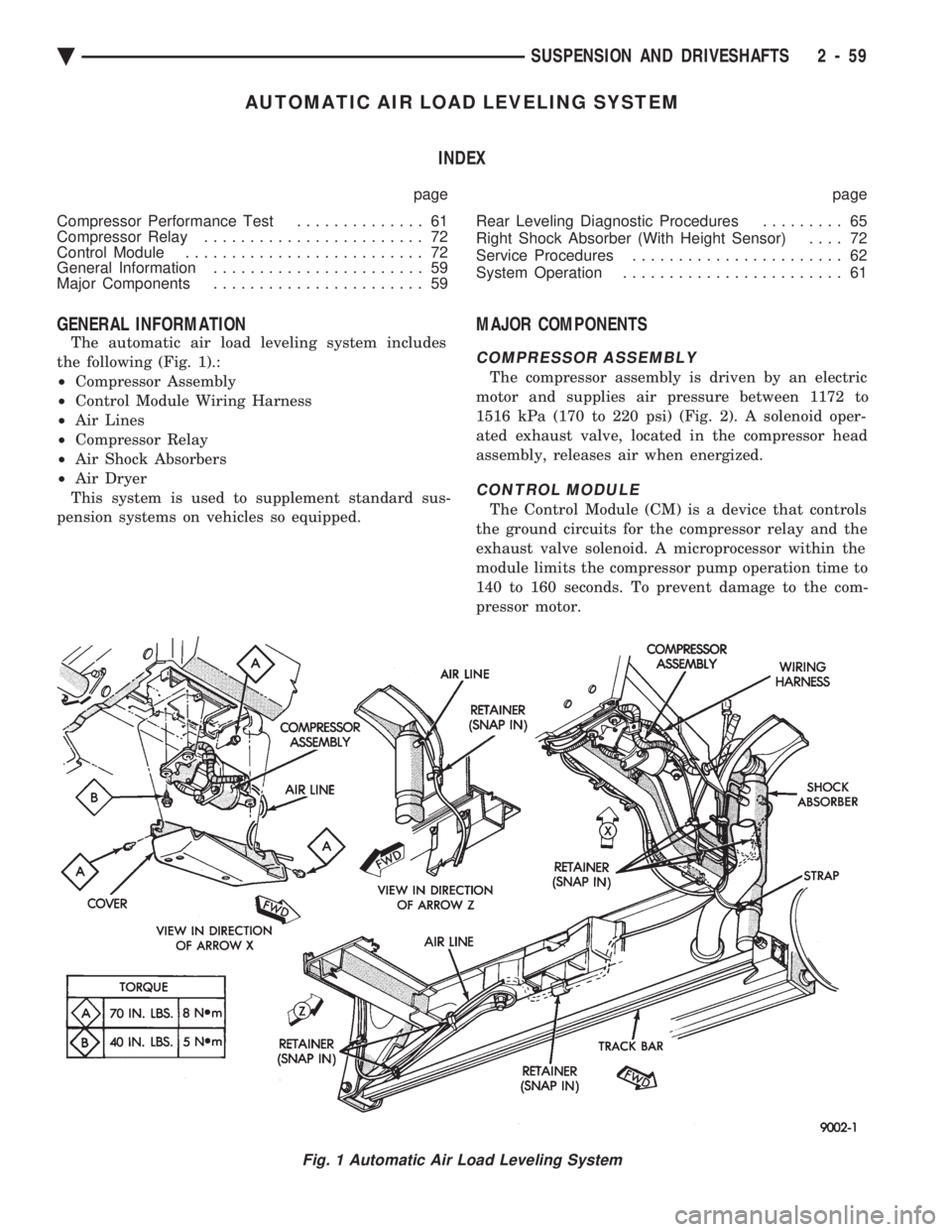
The automatic air load leveling system includes
the following (Fig. 1).:
² Compressor Assembly
² Control Module Wiring Harness
² Air Lines
² Compressor Relay
² Air Shock Absorbers
² Air Dryer
This system is used to supplement standard sus-
pension systems on vehicles so equipped.
MAJOR COMPONENTS
COMPRESSOR ASSEMBLY
The compressor assembly is driven by an electric
motor and supplies air pressure between 1172 to
1516 kPa (170 to 220 psi) (Fig. 2). A solenoid oper-
ated exhaust valve, located in the compressor head
assembly, releases air when energized.
CONTROL MODULE
The Control Module (CM) is a device that controls
the ground circuits for the compressor relay and the
exhaust valve solenoid. A microprocessor within the
module limits the compressor pump operation time to
140 to 160 seconds. To prevent damage to the com-
pressor motor.
Fig. 1 Automatic Air Load Leveling System
Ä SUSPENSION AND DRIVESHAFTS 2 - 59
Page 119 of 2438
A compression ball sleeve nut and sleeve for 3/16
inch tubing with ball sleeve connector and an inter-
nal pipe T-fitting. Can be used to attach the tubing
to the pressure gauge. (3) Cycle ignition from OFF to ON.
(4) Apply a load to the rear of the vehicle (two as-
sistants or approximately 300-325 lbs.) to run com-
pressor and raise the vehicle. (5) Remove the load applied in Step 4. Allow the
system to exhaust and lower the vehicle. (6) When no more air can be exhausted, the gauge
should indicate 69 to 152 kPa (10 to 22 psi). (7) Remove the pressure gauge and nylon tubing.
Attach the air line between the dryer and shock ab-
sorber. Repeat Steps 3, 4, and 5 to ensure system air
pressure is in the shocks.
LEAK CHECKS
(1) Repeat Residual Air Check Steps 1, 2, 3, and 4.
Allow the system to fill until gauge reads 483 to 621
kPa (70 to 90 psi). If compressor is permitted to run until it reaches
its maximum output pressure, the vent solenoid
valve will function as a relief valve. The resulting
leak down, when compressor shuts off, will indicate a
false air leak. (2) With load still applied, disconnect wire harness
connector from the control module, then remove ap-
plied load. Vehicle should rise. Cycle ignition switch
to OFF. (3) Observe if pressure leaks down or holds steady
(wait approximately 15 minutes). (A) If system will not inflate beyond 345 kPa (50
psi). A severe leak may be indicated. Check for a
pinched pressure line between compressor and
shocks. (B) The standard soap solution check procedure is
acceptable. (C) If pressure holds steady, perform the diagnosis
procedures.
SYSTEM OPERATION
RAISING VEHICLE HEIGHT
When weight is added to the rear suspension. The
body of the vehicle is lowered, moving the height
sensor down. This action will activate the internal time delay
circuit. After a time delay of 12 to 18 seconds. The
control module (CM) activates the ground circuit to
the compressor relay. With the relay energized, the compressor motor
runs and air is sent through the system. As the
shock absorbers inflate, the body moves upward to a
corrected position. When the body reaches the correct
height, the control module (CM) stops the compressor
operation.
LOWERING VEHICLE HEIGHT
When the weight is removed from the vehicle. The
body moves upward, which allows the height sensor
to move upward and activate the internal time delay
circuit. After a time delay of 12 to 18 seconds. The (CM)
activates the exhaust solenoid circuit. Air is ex-
hausted from the shock absorbers through the air
dryer and exhaust solenoid to the atmosphere. As the body lowers, the height sensor is lowered to-
ward its original position. When the body reaches the
original vehicle height, the (CM) opens the exhaust
solenoid valve circuit.
COMPRESSOR PERFORMANCE TEST
This test can be performed on the vehicle. It is
used to evaluate compressor current draw, pressure
output, and leak down. (1) Disconnect the compressor motor wiring har-
ness connector. (2) Disconnect air line between dryer and right
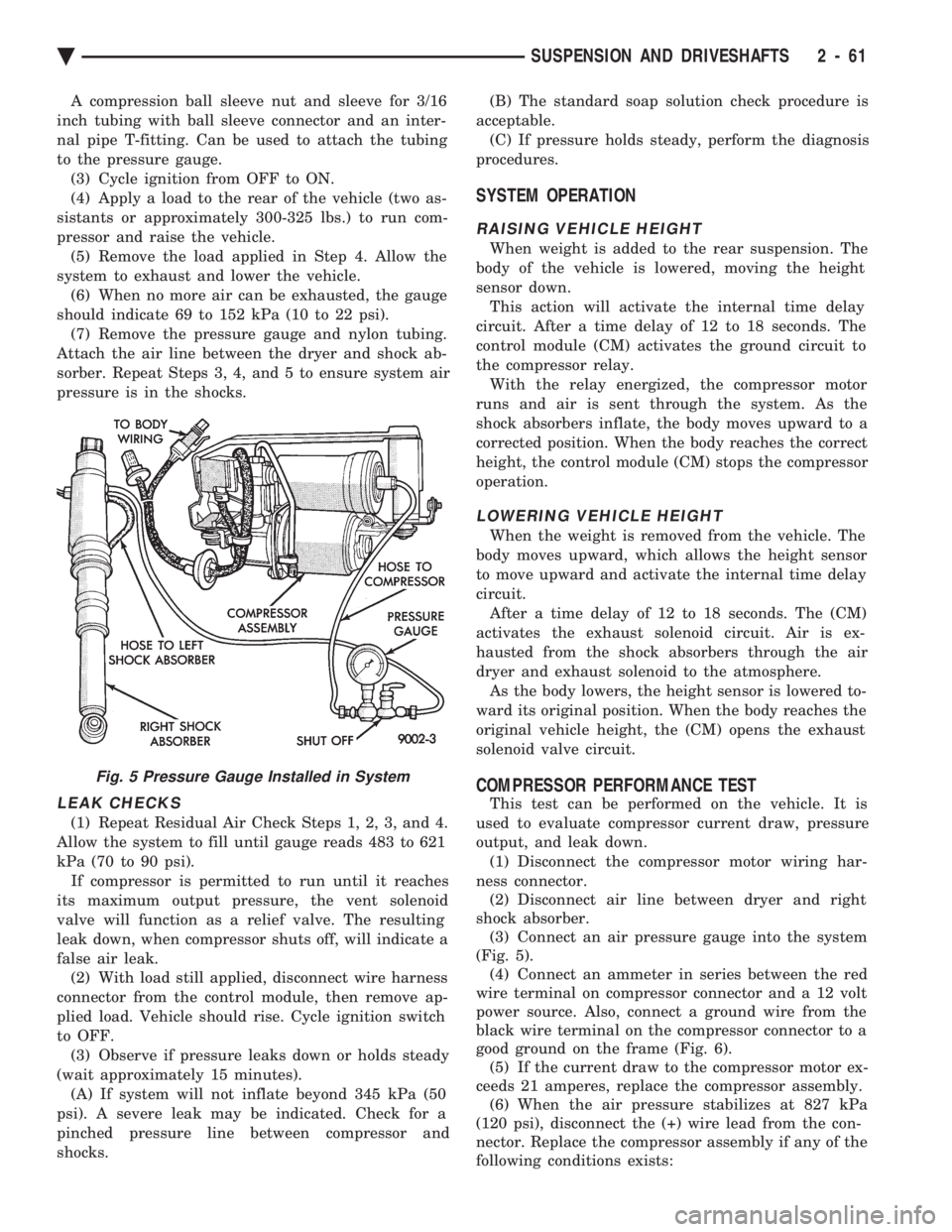
shock absorber. (3) Connect an air pressure gauge into the system
(Fig. 5). (4) Connect an ammeter in series between the red
wire terminal on compressor connector and a 12 volt
power source. Also, connect a ground wire from the
black wire terminal on the compressor connector to a
good ground on the frame (Fig. 6). (5) If the current draw to the compressor motor ex-
ceeds 21 amperes, replace the compressor assembly. (6) When the air pressure stabilizes at 827 kPa
(120 psi), disconnect the (+) wire lead from the con-
nector. Replace the compressor assembly if any of the
following conditions exists:
Fig. 5 Pressure Gauge Installed in System
Ä SUSPENSION AND DRIVESHAFTS 2 - 61
Page 121 of 2438
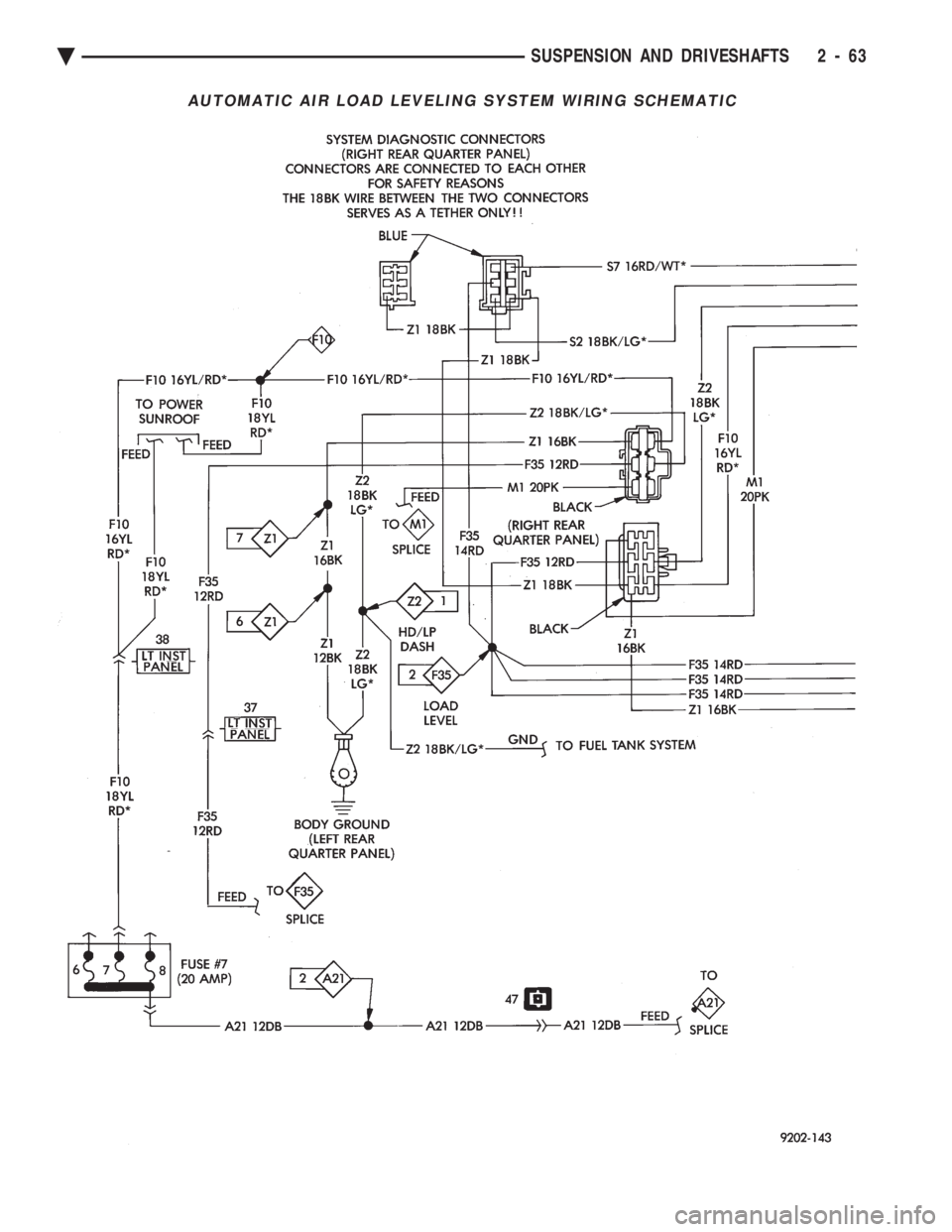
AUTOMATIC AIR LOAD LEVELING SYSTEM WIRING SCHEMATIC
Ä SUSPENSION AND DRIVESHAFTS 2 - 63
Page 122 of 2438
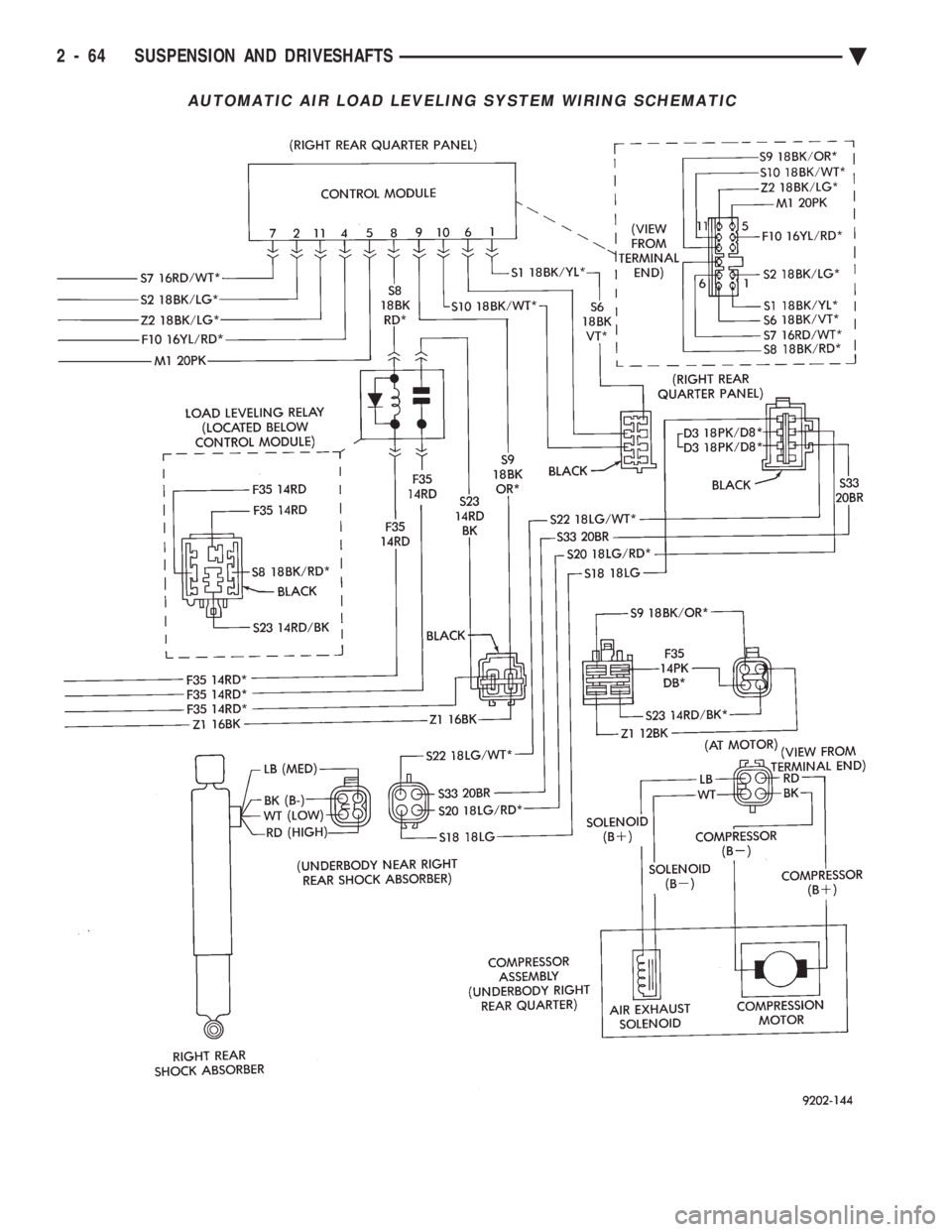
AUTOMATIC AIR LOAD LEVELING SYSTEM WIRING SCHEMATIC
2 - 64 SUSPENSION AND DRIVESHAFTS Ä
Page 123 of 2438
REAR LEVELING DIAGNOSTIC PROCEDURES
SELF-DIAGNOSTICS
A self-diagnostic procedure is available for the ser-
vice technician to use to detect system malfunctions.
BEFORE DIAGNOSTICS TEST
Check the 20 amp fuse (position W40) and the 30
amp circuit breaker (position W5) to be assured they
are functional components. Check all connectors that link the system into the
main body wiring harness. These include compressor,
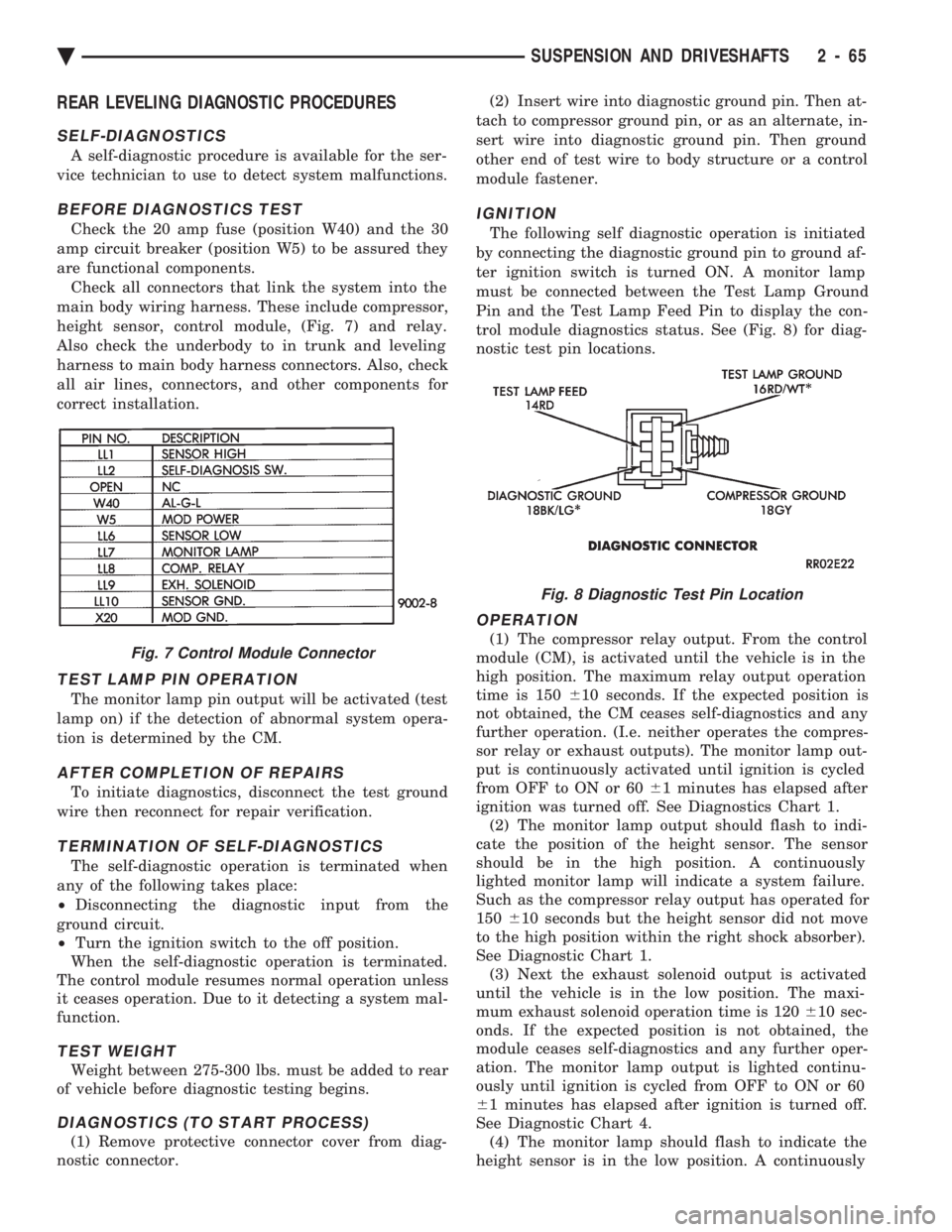
height sensor, control module, (Fig. 7) and relay.
Also check the underbody to in trunk and leveling
harness to main body harness connectors. Also, check
all air lines, connectors, and other components for
correct installation.
TEST LAMP PIN OPERATION
The monitor lamp pin output will be activated (test
lamp on) if the detection of abnormal system opera-
tion is determined by the CM.
AFTER COMPLETION OF REPAIRS
To initiate diagnostics, disconnect the test ground
wire then reconnect for repair verification.
TERMINATION OF SELF-DIAGNOSTICS
The self-diagnostic operation is terminated when
any of the following takes place:
² Disconnecting the diagnostic input from the
ground circuit.
² Turn the ignition switch to the off position.
When the self-diagnostic operation is terminated.
The control module resumes normal operation unless
it ceases operation. Due to it detecting a system mal-
function.
TEST WEIGHT
Weight between 275-300 lbs. must be added to rear
of vehicle before diagnostic testing begins.
DIAGNOSTICS (TO START PROCESS)
(1) Remove protective connector cover from diag-
nostic connector. (2) Insert wire into diagnostic ground pin. Then at-
tach to compressor ground pin, or as an alternate, in-
sert wire into diagnostic ground pin. Then ground
other end of test wire to body structure or a control
module fastener.
IGNITION
The following self diagnostic operation is initiated
by connecting the diagnostic ground pin to ground af-
ter ignition switch is turned ON. A monitor lamp
must be connected between the Test Lamp Ground
Pin and the Test Lamp Feed Pin to display the con-
trol module diagnostics status. See (Fig. 8) for diag-
nostic test pin locations.
OPERATION
(1) The compressor relay output. From the control
module (CM), is activated until the vehicle is in the
high position. The maximum relay output operation
time is 150 610 seconds. If the expected position is
not obtained, the CM ceases self-diagnostics and any
further operation. (I.e. neither operates the compres-
sor relay or exhaust outputs). The monitor lamp out-
put is continuously activated until ignition is cycled
from OFF to ON or 60 61 minutes has elapsed after
ignition was turned off. See Diagnostics Chart 1. (2) The monitor lamp output should flash to indi-
cate the position of the height sensor. The sensor
should be in the high position. A continuously
lighted monitor lamp will indicate a system failure.
Such as the compressor relay output has operated for
150 610 seconds but the height sensor did not move
to the high position within the right shock absorber).
See Diagnostic Chart 1. (3) Next the exhaust solenoid output is activated
until the vehicle is in the low position. The maxi-
mum exhaust solenoid operation time is 120 610 sec-
onds. If the expected position is not obtained, the
module ceases self-diagnostics and any further oper-
ation. The monitor lamp output is lighted continu-
ously until ignition is cycled from OFF to ON or 60
6 1 minutes has elapsed after ignition is turned off.
See Diagnostic Chart 4. (4) The monitor lamp should flash to indicate the
height sensor is in the low position. A continuouslyFig. 7 Control Module Connector
Fig. 8 Diagnostic Test Pin Location
Ä SUSPENSION AND DRIVESHAFTS 2 - 65
Page 130 of 2438
CONTROL MODULE
REMOVAL
(1) Disconnect negative battery cable.
(2) Remove right side trunk trim panel.
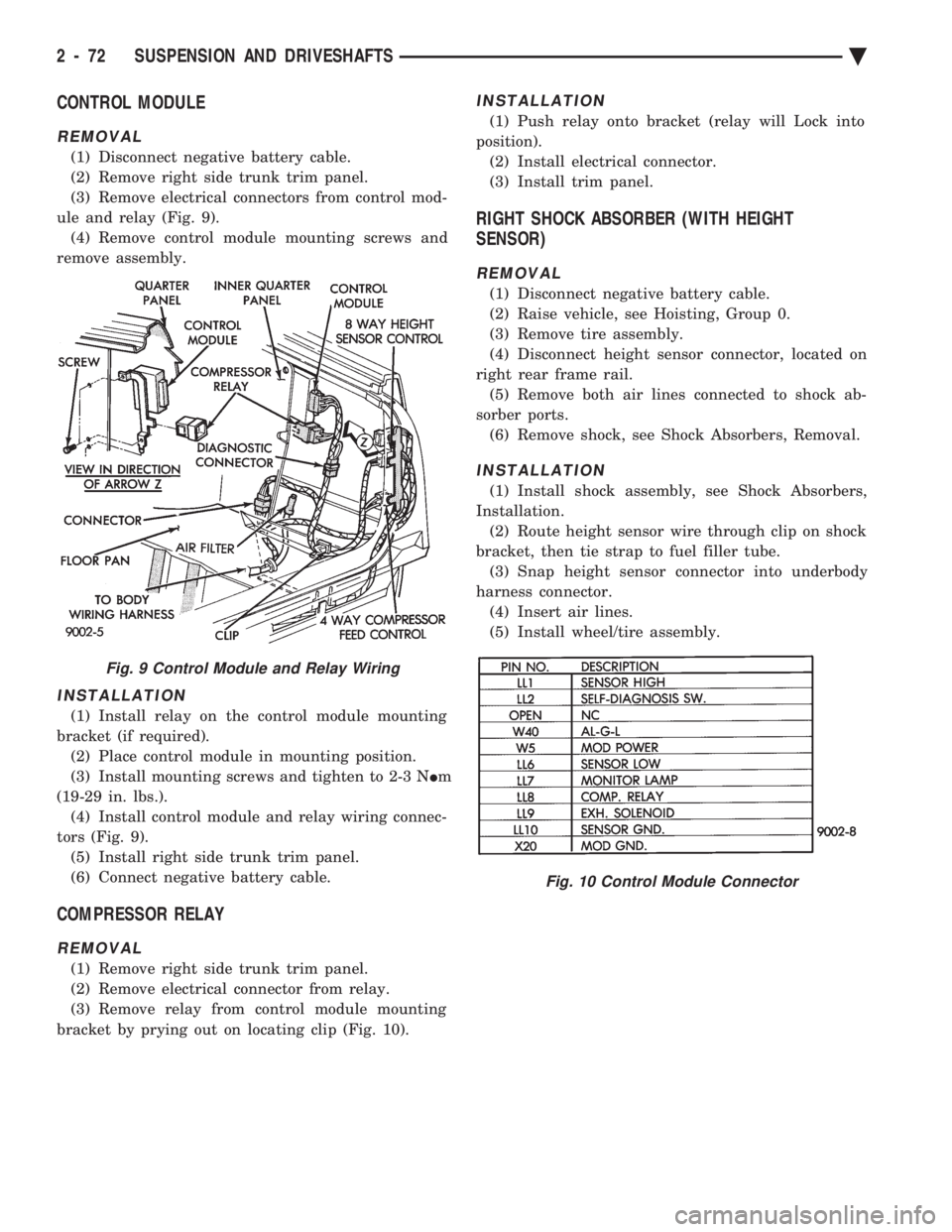
(3) Remove electrical connectors from control mod-
ule and relay (Fig. 9). (4) Remove control module mounting screws and
remove assembly.
INSTALLATION
(1) Install relay on the control module mounting
bracket (if required). (2) Place control module in mounting position.
(3) Install mounting screws and tighten to 2-3 N Im
(19-29 in. lbs.). (4) Install control module and relay wiring connec-
tors (Fig. 9). (5) Install right side trunk trim panel.
(6) Connect negative battery cable.
COMPRESSOR RELAY
REMOVAL
(1) Remove right side trunk trim panel.
(2) Remove electrical connector from relay.
(3) Remove relay from control module mounting
bracket by prying out on locating clip (Fig. 10).
INSTALLATION
(1) Push relay onto bracket (relay will Lock into
position). (2) Install electrical connector.
(3) Install trim panel.
RIGHT SHOCK ABSORBER (WITH HEIGHT
SENSOR)
REMOVAL
(1) Disconnect negative battery cable.
(2) Raise vehicle, see Hoisting, Group 0.
(3) Remove tire assembly.
(4) Disconnect height sensor connector, located on
right rear frame rail. (5) Remove both air lines connected to shock ab-
sorber ports. (6) Remove shock, see Shock Absorbers, Removal.
INSTALLATION
(1) Install shock assembly, see Shock Absorbers,
Installation. (2) Route height sensor wire through clip on shock
bracket, then tie strap to fuel filler tube. (3) Snap height sensor connector into underbody
harness connector. (4) Insert air lines.
(5) Install wheel/tire assembly.
Fig. 9 Control Module and Relay Wiring
Fig. 10 Control Module Connector
2 - 72 SUSPENSION AND DRIVESHAFTS Ä
Page 131 of 2438
AUTOMATIC AIR SUSPENSION INDEX
page page
Air Lines ............................... 75
Air Springs Rear ......................... 87
Compressor Performance Test .............. 77
Diagnosis .............................. 78
General Information ....................... 73
Recharge Air Spring ...................... 87 Right Shock Absorber (With Height Sensor)
.... 88
Safety Concerns ......................... 78
Service Procedures ....................... 85
Shipping Mode .......................... 78
Solenoids (Struts and Air Springs) ............ 86
System Operation ........................ 78
GENERAL INFORMATION
This system provides automatic height control and
low spring rates to improve suspension characteristics
of the vehicle. And it will automatically level the front
and rear of the vehicle. It will also maintain the opti-
mum vehicle attitude from one passenger through full
vehicle load.
The automatic air suspension system includes the
following components:
² Compressor/air dryer assembly
² Compressor relay
² Front struts
² Rear springs
² Rear shocks
² Control module
² Air lines ²
Compressor
² Rear height sensor
² Wiring harness assembly
² Compressor cover
Front springs (and height sensors) are integral with
the shock absorber strut assemblies. While rear air
springs replace conventional steel units. Rear height is
controlled via a height sensor contained within the
right rear shock absorber. Solenoids (integral with each
air spring) control air volume/pressure requirements.
Pressurized air is distributed from the air compressor/
dryer assembly and routed to each air spring by four
separate air lines. The air lines start at the dryer and
terminate at the individual air springs. The system is
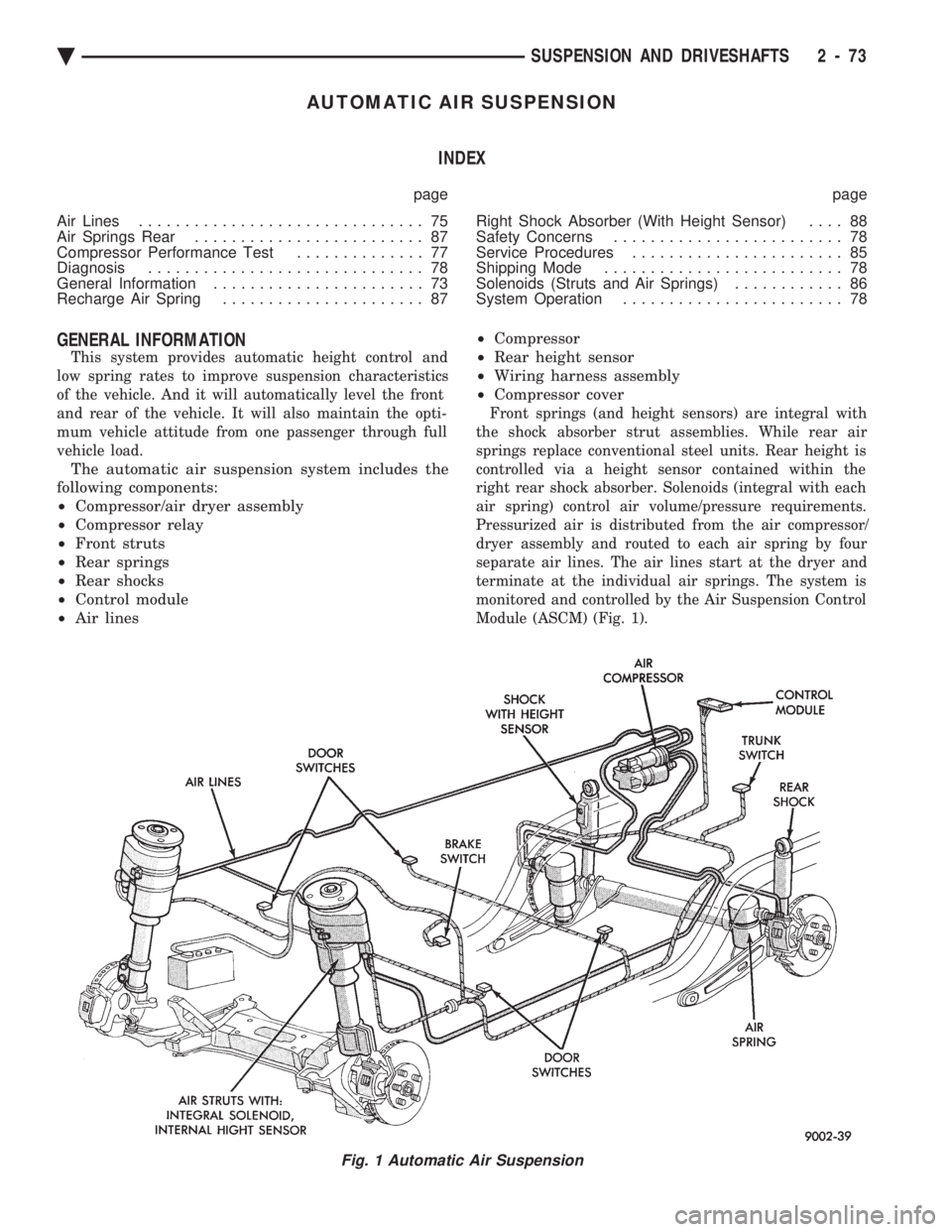
monitored and controlled by the Air Suspension Control
Module (ASCM) (Fig. 1).
Fig. 1 Automatic Air Suspension
Ä SUSPENSION AND DRIVESHAFTS 2 - 73
Page 135 of 2438
AIR LINE FITTINGS
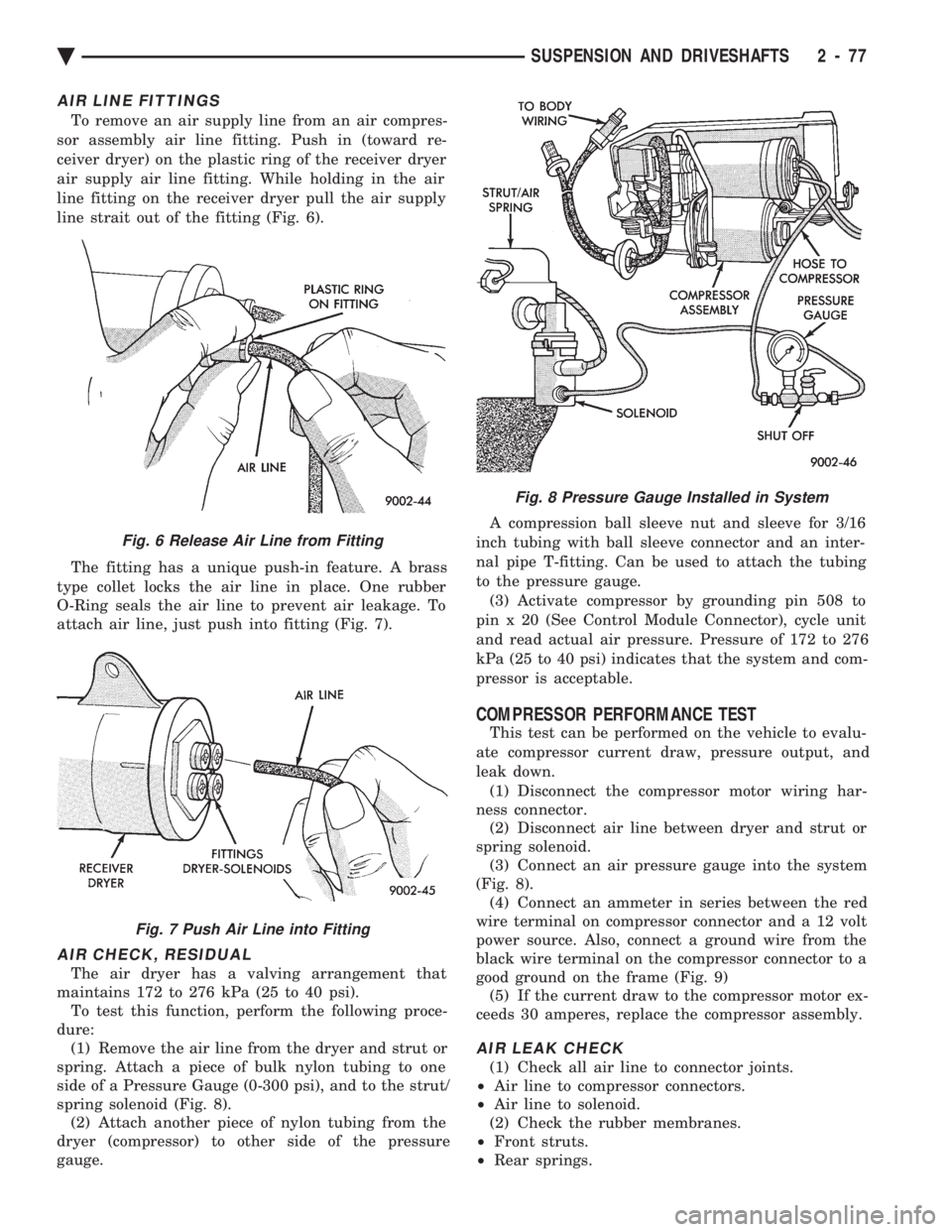
To remove an air supply line from an air compres-
sor assembly air line fitting. Push in (toward re-
ceiver dryer) on the plastic ring of the receiver dryer
air supply air line fitting. While holding in the air
line fitting on the receiver dryer pull the air supply
line strait out of the fitting (Fig. 6).
The fitting has a unique push-in feature. A brass
type collet locks the air line in place. One rubber
O-Ring seals the air line to prevent air leakage. To
attach air line, just push into fitting (Fig. 7).
AIR CHECK, RESIDUAL
The air dryer has a valving arrangement that
maintains 172 to 276 kPa (25 to 40 psi). To test this function, perform the following proce-
dure: (1) Remove the air line from the dryer and strut or
spring. Attach a piece of bulk nylon tubing to one
side of a Pressure Gauge (0-300 psi), and to the strut/
spring solenoid (Fig. 8). (2) Attach another piece of nylon tubing from the
dryer (compressor) to other side of the pressure
gauge. A compression ball sleeve nut and sleeve for 3/16
inch tubing with ball sleeve connector and an inter-
nal pipe T-fitting. Can be used to attach the tubing
to the pressure gauge. (3) Activate compressor by grounding pin 508 to
pin x 20 (See Control Module Connector), cycle unit
and read actual air pressure. Pressure of 172 to 276
kPa (25 to 40 psi) indicates that the system and com-
pressor is acceptable.
COMPRESSOR PERFORMANCE TEST
This test can be performed on the vehicle to evalu-
ate compressor current draw, pressure output, and
leak down. (1) Disconnect the compressor motor wiring har-
ness connector. (2) Disconnect air line between dryer and strut or
spring solenoid. (3) Connect an air pressure gauge into the system
(Fig. 8). (4) Connect an ammeter in series between the red
wire terminal on compressor connector and a 12 volt
power source. Also, connect a ground wire from the
black wire terminal on the compressor connector to a
good ground on the frame (Fig. 9) (5) If the current draw to the compressor motor ex-
ceeds 30 amperes, replace the compressor assembly.
AIR LEAK CHECK
(1) Check all air line to connector joints.
² Air line to compressor connectors.
² Air line to solenoid.
(2) Check the rubber membranes.
² Front struts.
² Rear springs.
Fig. 6 Release Air Line from Fitting
Fig. 7 Push Air Line into Fitting
Fig. 8 Pressure Gauge Installed in System
Ä SUSPENSION AND DRIVESHAFTS 2 - 77