torque CHEVROLET DYNASTY 1993 Service Manual
[x] Cancel search | Manufacturer: CHEVROLET, Model Year: 1993, Model line: DYNASTY, Model: CHEVROLET DYNASTY 1993Pages: 2438, PDF Size: 74.98 MB
Page 2009 of 2438
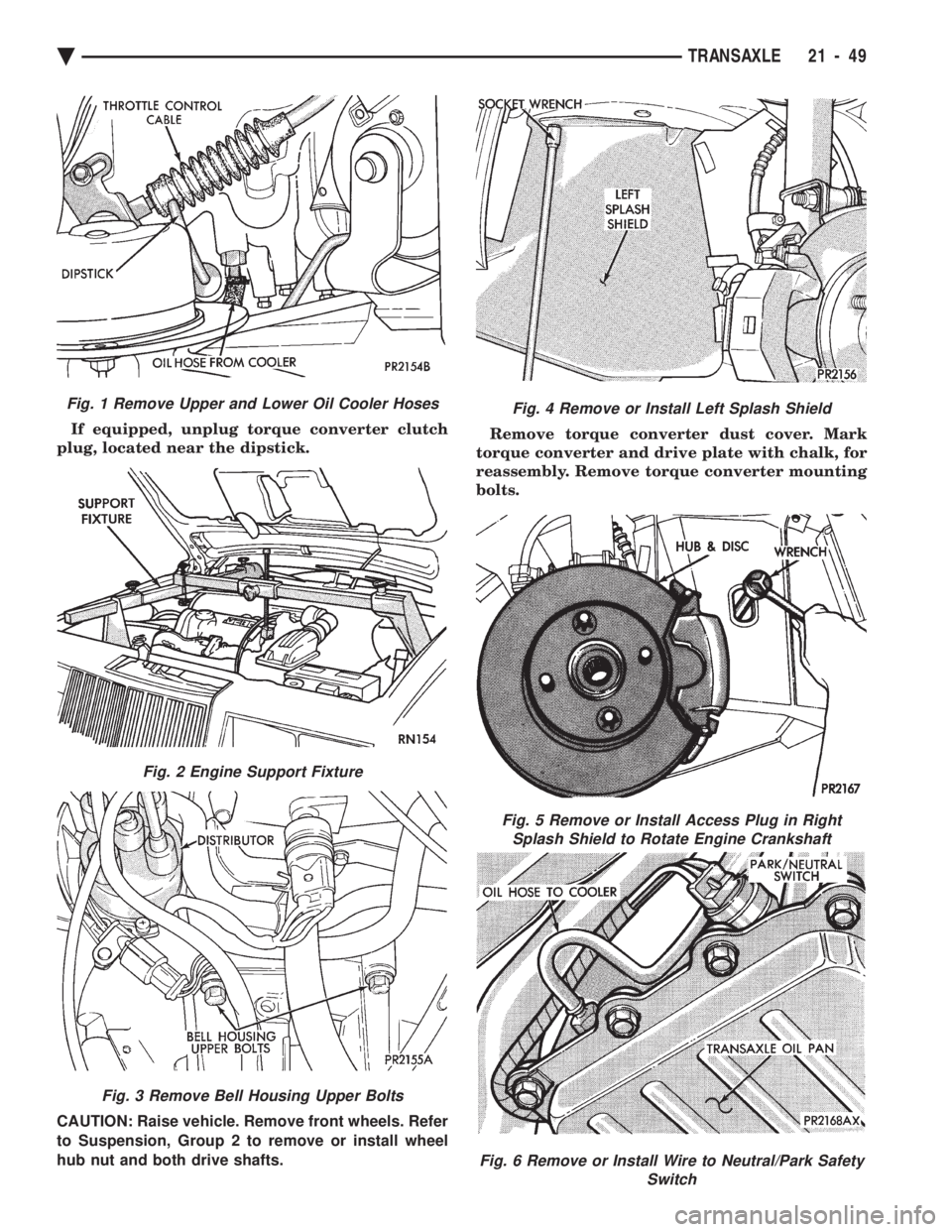
If equipped, unplug torque converter clutch
plug, located near the dipstick.
CAUTION: Raise vehicle. Remove front wheels. Refer
to Suspension, Group 2 to remove or install wheel
hub nut and both drive shafts. Remove torque converter dust cover. Mark
torque converter and drive plate with chalk, for
reassembly. Remove torque converter mounting
bolts.
Fig. 1 Remove Upper and Lower Oil Cooler Hoses
Fig. 2 Engine Support Fixture
Fig. 3 Remove Bell Housing Upper Bolts
Fig. 4 Remove or Install Left Splash Shield
Fig. 5 Remove or Install Access Plug in Right Splash Shield to Rotate Engine Crankshaft
Fig. 6 Remove or Install Wire to Neutral/Park Safety Switch
Ä TRANSAXLE 21 - 49
Page 2010 of 2438
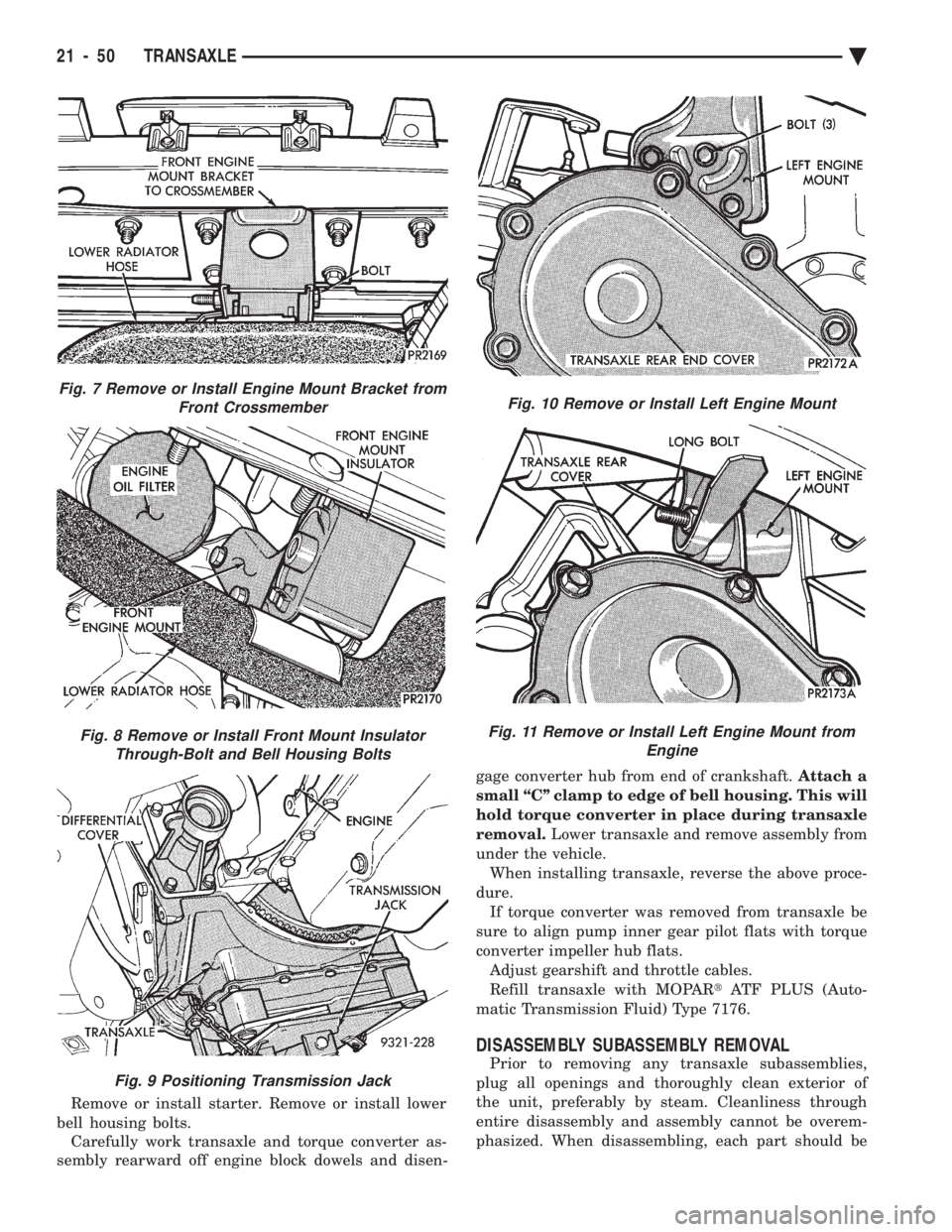
Remove or install starter. Remove or install lower
bell housing bolts. Carefully work transaxle and torque converter as-
sembly rearward off engine block dowels and disen- gage converter hub from end of crankshaft.
Attach a
small ``C'' clamp to edge of bell housing. This will
hold torque converter in place during transaxle
removal. Lower transaxle and remove assembly from
under the vehicle. When installing transaxle, reverse the above proce-
dure. If torque converter was removed from transaxle be
sure to align pump inner gear pilot flats with torque
converter impeller hub flats. Adjust gearshift and throttle cables.
Refill transaxle with MOPAR tATF PLUS (Auto-
matic Transmission Fluid) Type 7176.
DISASSEMBLY SUBASSEMBLY REMOVAL
Prior to removing any transaxle subassemblies,
plug all openings and thoroughly clean exterior of
the unit, preferably by steam. Cleanliness through
entire disassembly and assembly cannot be overem-
phasized. When disassembling, each part should be
Fig. 7 Remove or Install Engine Mount Bracket from Front Crossmember
Fig. 8 Remove or Install Front Mount InsulatorThrough-Bolt and Bell Housing Bolts
Fig. 9 Positioning Transmission Jack
Fig. 10 Remove or Install Left Engine Mount
Fig. 11 Remove or Install Left Engine Mount from Engine
21 - 50 TRANSAXLE Ä
Page 2014 of 2438
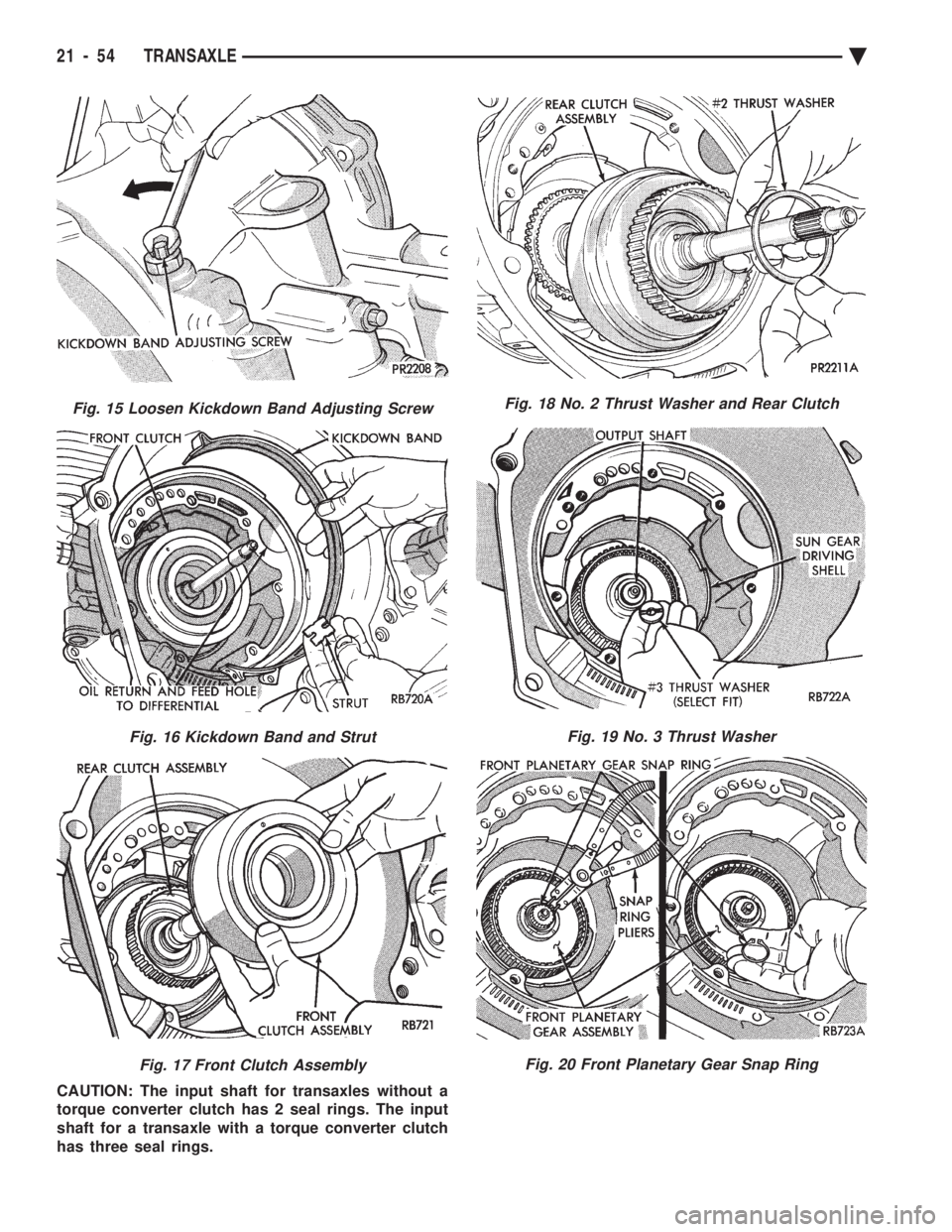
CAUTION: The input shaft for transaxles without a
torque converter clutch has 2 seal rings. The input
shaft for a transaxle with a torque converter clutch
has three seal rings.
Fig. 15 Loosen Kickdown Band Adjusting Screw
Fig. 16 Kickdown Band and Strut
Fig. 17 Front Clutch Assembly
Fig. 18 No. 2 Thrust Washer and Rear Clutch
Fig. 19 No. 3 Thrust Washer
Fig. 20 Front Planetary Gear Snap Ring
21 - 54 TRANSAXLE Ä
Page 2033 of 2438
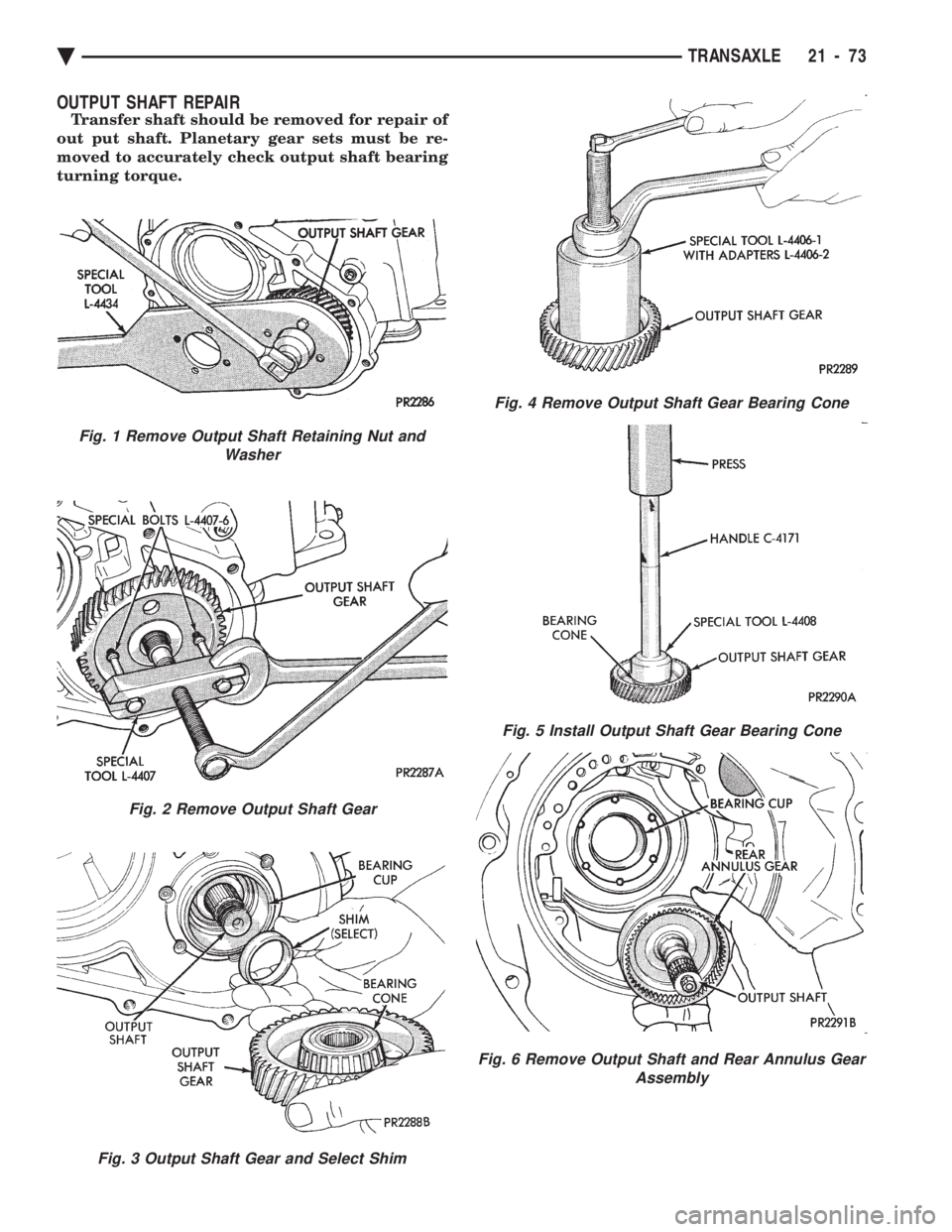
OUTPUT SHAFT REPAIR
Transfer shaft should be removed for repair of
out put shaft. Planetary gear sets must be re-
moved to accurately check output shaft bearing
turning torque.
Fig. 1 Remove Output Shaft Retaining Nut and Washer
Fig. 2 Remove Output Shaft Gear
Fig. 3 Output Shaft Gear and Select Shim
Fig. 4 Remove Output Shaft Gear Bearing Cone
Fig. 5 Install Output Shaft Gear Bearing Cone
Fig. 6 Remove Output Shaft and Rear Annulus Gear Assembly
Ä TRANSAXLE 21 - 73
Page 2035 of 2438
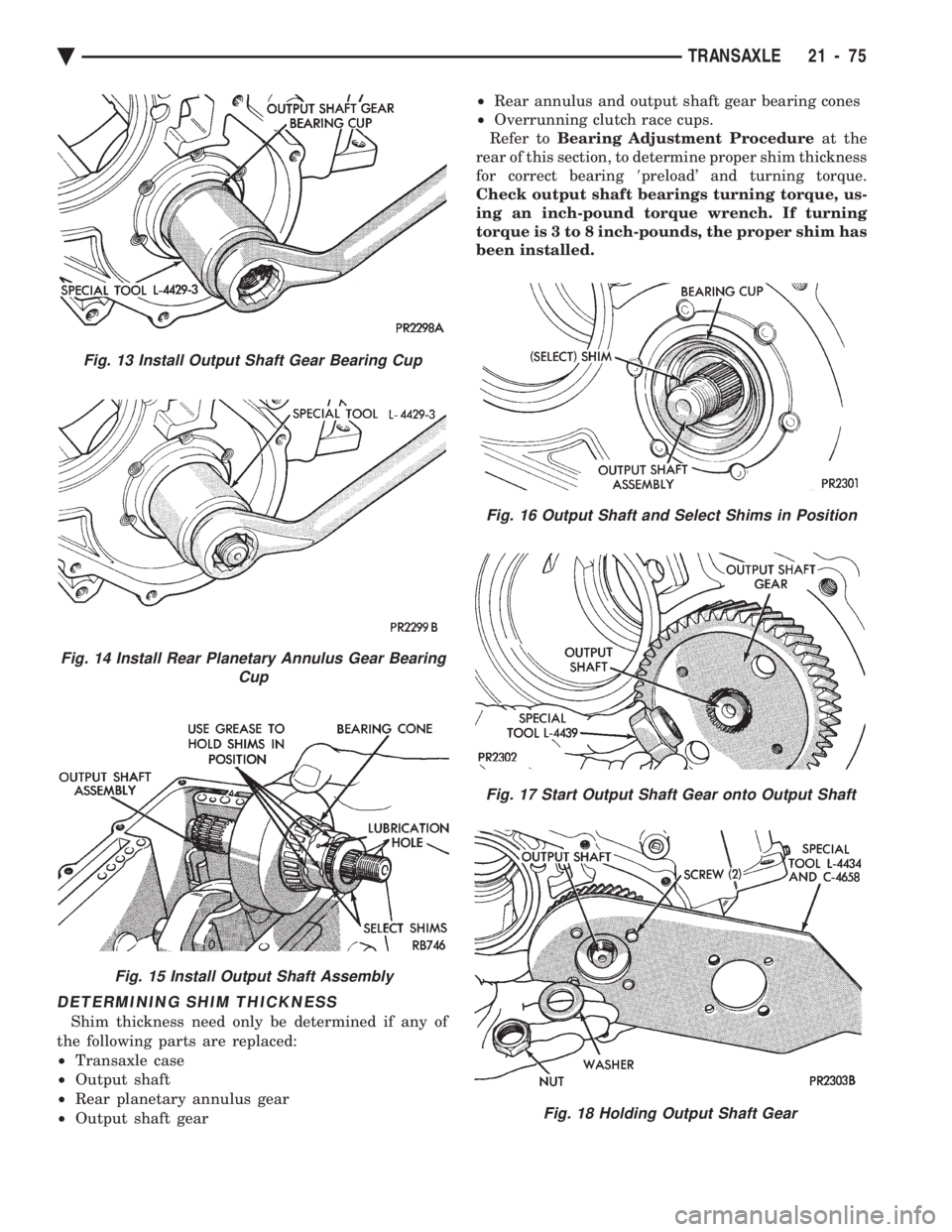
DETERMINING SHIM THICKNESS
Shim thickness need only be determined if any of
the following parts are replaced:
² Transaxle case
² Output shaft
² Rear planetary annulus gear
² Output shaft gear ²
Rear annulus and output shaft gear bearing cones
² Overrunning clutch race cups.
Refer to Bearing Adjustment Procedure at the
rear of this section, to determine proper shim thickness
for correct bearing 8preload' and turning torque.
Check output shaft bearings turning torque, us-
ing an inch-pound torque wrench. If turning
torque is 3 to 8 inch-pounds, the proper shim has
been installed.
Fig. 15 Install Output Shaft Assembly
Fig. 16 Output Shaft and Select Shims in Position
Fig. 17 Start Output Shaft Gear onto Output Shaft
Fig. 18 Holding Output Shaft Gear
Fig. 14 Install Rear Planetary Annulus Gear Bearing Cup
Fig. 13 Install Output Shaft Gear Bearing Cup
Ä TRANSAXLE 21 - 75
Page 2036 of 2438
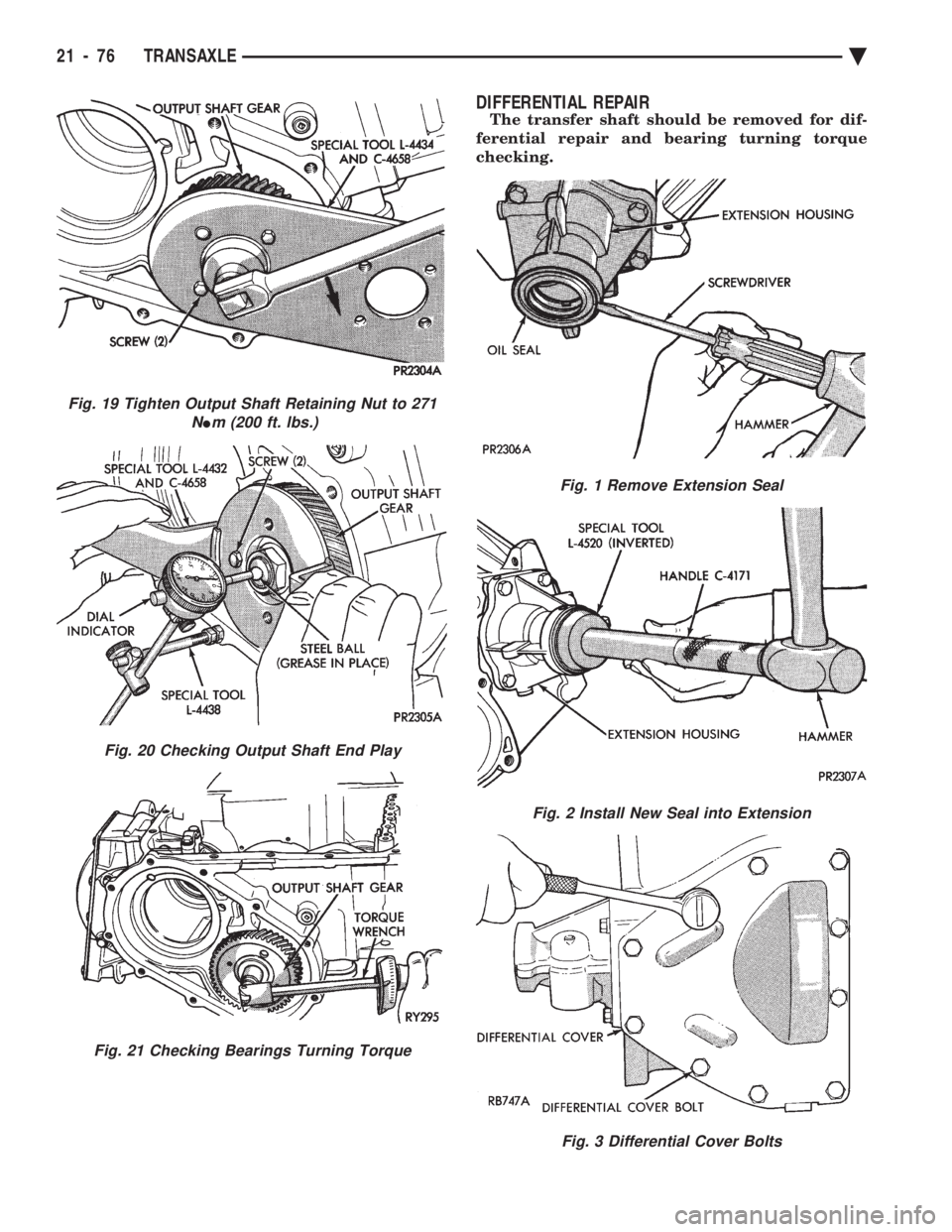
DIFFERENTIAL REPAIR
The transfer shaft should be removed for dif-
ferential repair and bearing turning torque
checking.
Fig. 19 Tighten Output Shaft Retaining Nut to 271 N
Im (200 ft. lbs.)
Fig. 20 Checking Output Shaft End Play
Fig. 21 Checking Bearings Turning Torque
Fig. 1 Remove Extension Seal
Fig. 2 Install New Seal into Extension
Fig. 3 Differential Cover Bolts
21 - 76 TRANSAXLE Ä
Page 2039 of 2438
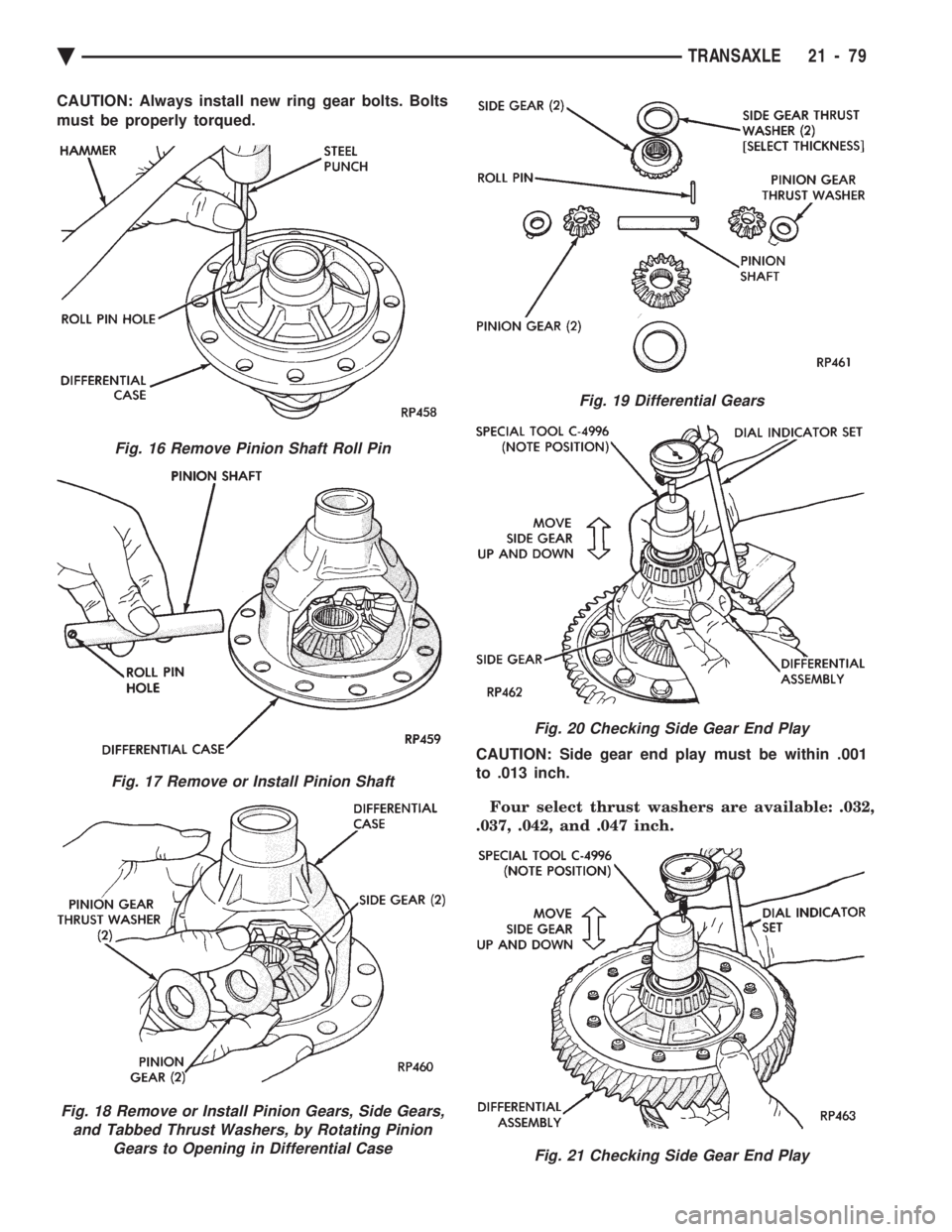
CAUTION: Always install new ring gear bolts. Bolts
must be properly torqued. CAUTION: Side gear end play must be within .001
to .013 inch.
Four select thrust washers are available: .032,
.037, .042, and .047 inch.
Fig. 16 Remove Pinion Shaft Roll Pin
Fig. 17 Remove or Install Pinion Shaft
Fig. 18 Remove or Install Pinion Gears, Side Gears, and Tabbed Thrust Washers, by Rotating Pinion Gears to Opening in Differential Case
Fig. 19 Differential Gears
Fig. 20 Checking Side Gear End Play
Fig. 21 Checking Side Gear End Play
Ä TRANSAXLE 21 - 79
Page 2040 of 2438
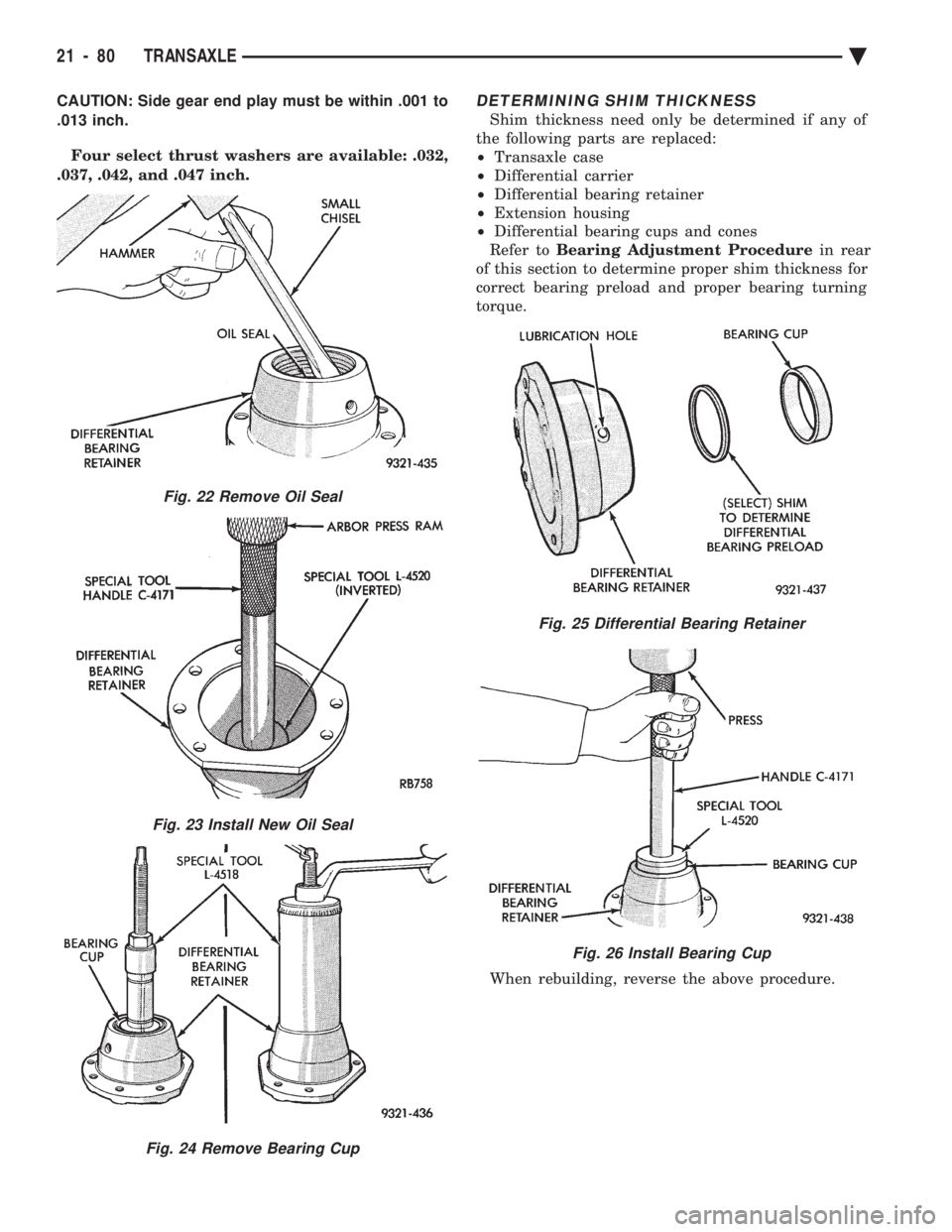
CAUTION: Side gear end play must be within .001 to
.013 inch. Four select thrust washers are available: .032,
.037, .042, and .047 inch.DETERMINING SHIM THICKNESS
Shim thickness need only be determined if any of
the following parts are replaced:
² Transaxle case
² Differential carrier
² Differential bearing retainer
² Extension housing
² Differential bearing cups and cones
Refer to Bearing Adjustment Procedure in rear
of this section to determine proper shim thickness for
correct bearing preload and proper bearing turning
torque.
When rebuilding, reverse the above procedure.
Fig. 25 Differential Bearing Retainer
Fig. 26 Install Bearing Cup
Fig. 22 Remove Oil Seal
Fig. 23 Install New Oil Seal
Fig. 24 Remove Bearing Cup
21 - 80 TRANSAXLE Ä
Page 2041 of 2438
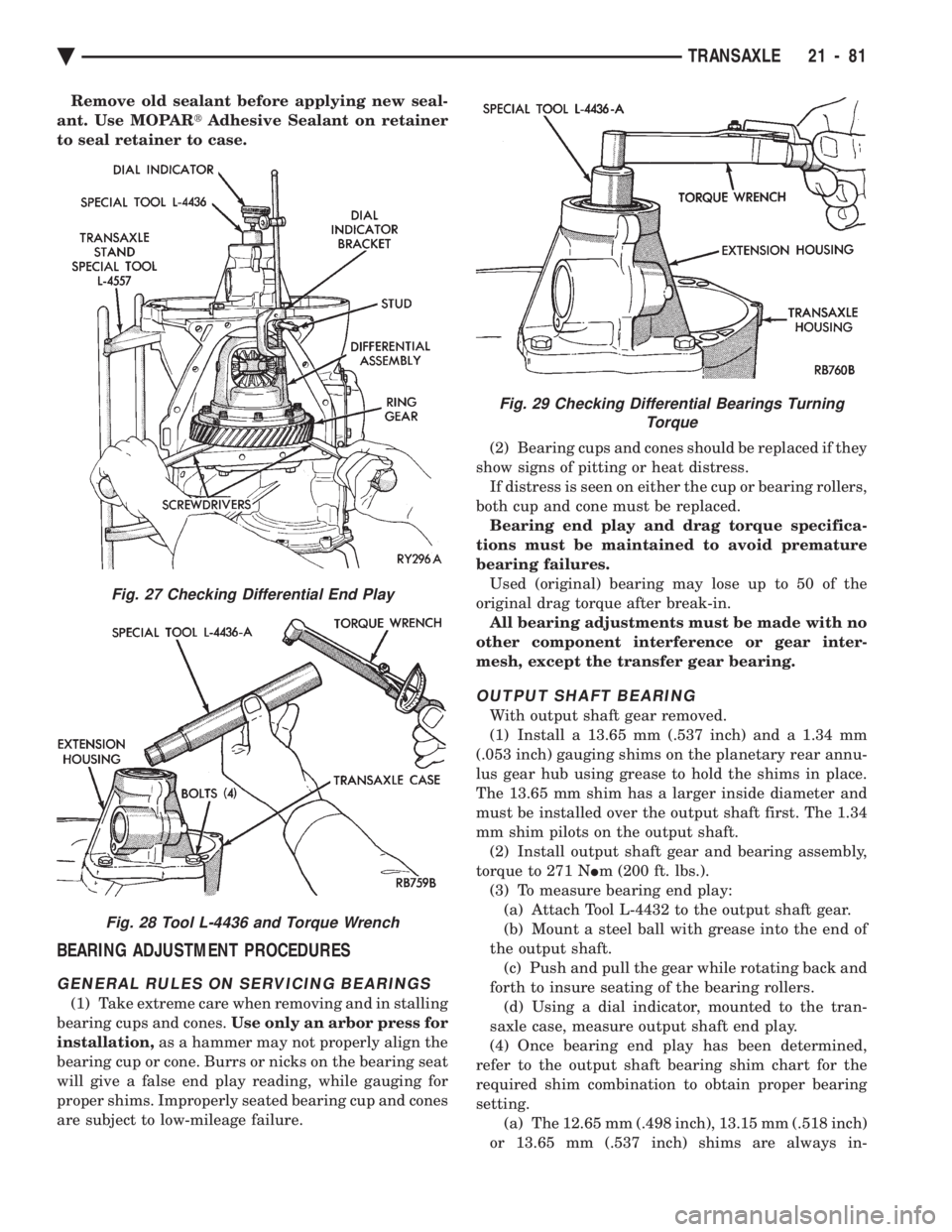
Remove old sealant before applying new seal-
ant. Use MOPAR tAdhesive Sealant on retainer
to seal retainer to case.
BEARING ADJUSTMENT PROCEDURES
GENERAL RULES ON SERVICING BEARINGS
(1) Take extreme care when removing and in stalling
bearing cups and cones. Use only an arbor press for
installation, as a hammer may not properly align the
bearing cup or cone. Burrs or nicks on the bearing seat
will give a false end play reading, while gauging for
proper shims. Improperly seated bearing cup and cones
are subject to low-mileage failure. (2) Bearing cups and cones should be replaced if they
show signs of pitting or heat distress. If distress is seen on either the cup or bearing rollers,
both cup and cone must be replaced. Bearing end play and drag torque specifica-
tions must be maintained to avoid premature
bearing failures. Used (original) bearing may lose up to 50 of the
original drag torque after break-in. All bearing adjustments must be made with no
other component interference or gear inter-
mesh, except the transfer gear bearing.
OUTPUT SHAFT BEARING
With output shaft gear removed.
(1) Install a 13.65 mm (.537 inch) and a 1.34 mm
(.053 inch) gauging shims on the planetary rear annu-
lus gear hub using grease to hold the shims in place.
The 13.65 mm shim has a larger inside diameter and
must be installed over the output shaft first. The 1.34
mm shim pilots on the output shaft. (2) Install output shaft gear and bearing assembly,
torque to 271 N Im (200 ft. lbs.).
(3) To measure bearing end play: (a) Attach Tool L-4432 to the output shaft gear.
(b) Mount a steel ball with grease into the end of
the output shaft. (c) Push and pull the gear while rotating back and
forth to insure seating of the bearing rollers. (d) Using a dial indicator, mounted to the tran-
saxle case, measure output shaft end play.
(4) Once bearing end play has been determined,
refer to the output shaft bearing shim chart for the
required shim combination to obtain proper bearing
setting. (a) The 12.65 mm (.498 inch), 13.15 mm (.518 inch)
or 13.65 mm (.537 inch) shims are always in-
Fig. 27 Checking Differential End Play
Fig. 28 Tool L-4436 and Torque Wrench
Fig. 29 Checking Differential Bearings Turning Torque
Ä TRANSAXLE 21 - 81
Page 2042 of 2438
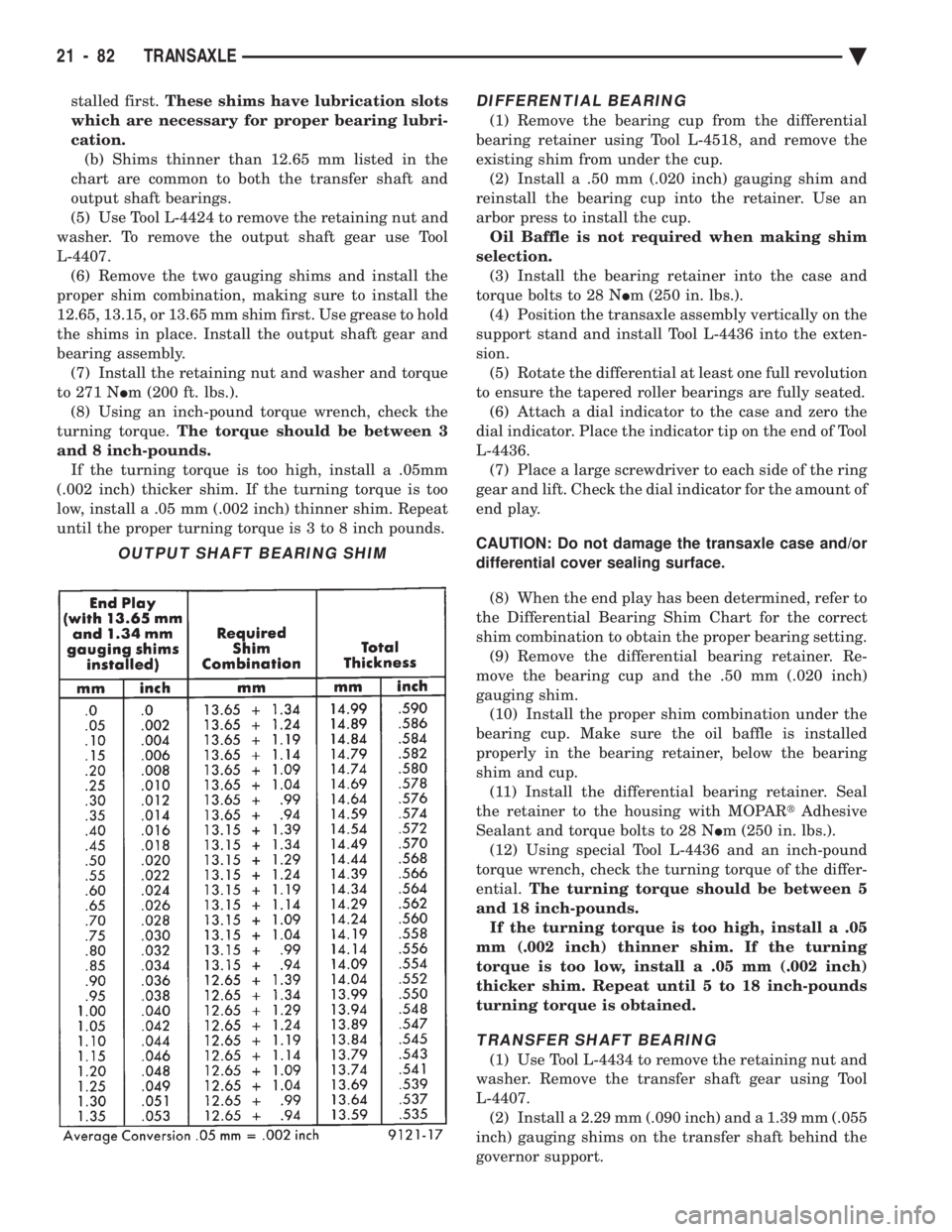
stalled first. These shims have lubrication slots
which are necessary for proper bearing lubri-
cation. (b) Shims thinner than 12.65 mm listed in the
chart are common to both the transfer shaft and
output shaft bearings.
(5) Use Tool L-4424 to remove the retaining nut and
washer. To remove the output shaft gear use Tool
L-4407. (6) Remove the two gauging shims and install the
proper shim combination, making sure to install the
12.65, 13.15, or 13.65 mm shim first. Use grease to hold
the shims in place. Install the output shaft gear and
bearing assembly. (7) Install the retaining nut and washer and torque
to 271 N Im (200 ft. lbs.).
(8) Using an inch-pound torque wrench, check the
turning torque. The torque should be between 3
and 8 inch-pounds. If the turning torque is too high, install a .05mm
(.002 inch) thicker shim. If the turning torque is too
low, install a .05 mm (.002 inch) thinner shim. Repeat
until the proper turning torque is 3 to 8 inch pounds.DIFFERENTIAL BEARING
(1) Remove the bearing cup from the differential
bearing retainer using Tool L-4518, and remove the
existing shim from under the cup. (2) Install a .50 mm (.020 inch) gauging shim and
reinstall the bearing cup into the retainer. Use an
arbor press to install the cup. Oil Baffle is not required when making shim
selection. (3) Install the bearing retainer into the case and
torque bolts to 28 N Im (250 in. lbs.).
(4) Position the transaxle assembly vertically on the
support stand and install Tool L-4436 into the exten-
sion. (5) Rotate the differential at least one full revolution
to ensure the tapered roller bearings are fully seated. (6) Attach a dial indicator to the case and zero the
dial indicator. Place the indicator tip on the end of Tool
L-4436. (7) Place a large screwdriver to each side of the ring
gear and lift. Check the dial indicator for the amount of
end play.
CAUTION: Do not damage the transaxle case and/or
differential cover sealing surface.
(8) When the end play has been determined, refer to
the Differential Bearing Shim Chart for the correct
shim combination to obtain the proper bearing setting. (9) Remove the differential bearing retainer. Re-
move the bearing cup and the .50 mm (.020 inch)
gauging shim. (10) Install the proper shim combination under the
bearing cup. Make sure the oil baffle is installed
properly in the bearing retainer, below the bearing
shim and cup. (11) Install the differential bearing retainer. Seal
the retainer to the housing with MOPAR tAdhesive
Sealant and torque bolts to 28 N Im (250 in. lbs.).
(12) Using special Tool L-4436 and an inch-pound
torque wrench, check the turning torque of the differ-
ential. The turning torque should be between 5
and 18 inch-pounds. If the turning torque is too high, install a .05
mm (.002 inch) thinner shim. If the turning
torque is too low, install a .05 mm (.002 inch)
thicker shim. Repeat until 5 to 18 inch-pounds
turning torque is obtained.
TRANSFER SHAFT BEARING
(1) Use Tool L-4434 to remove the retaining nut and
washer. Remove the transfer shaft gear using Tool
L-4407. (2) Install a 2.29 mm (.090 inch) and a 1.39 mm (.055
inch) gauging shims on the transfer shaft behind the
governor support.
OUTPUT SHAFT BEARING SHIM
21 - 82 TRANSAXLE Ä