torque CHEVROLET DYNASTY 1993 Service Manual
[x] Cancel search | Manufacturer: CHEVROLET, Model Year: 1993, Model line: DYNASTY, Model: CHEVROLET DYNASTY 1993Pages: 2438, PDF Size: 74.98 MB
Page 2345 of 2438
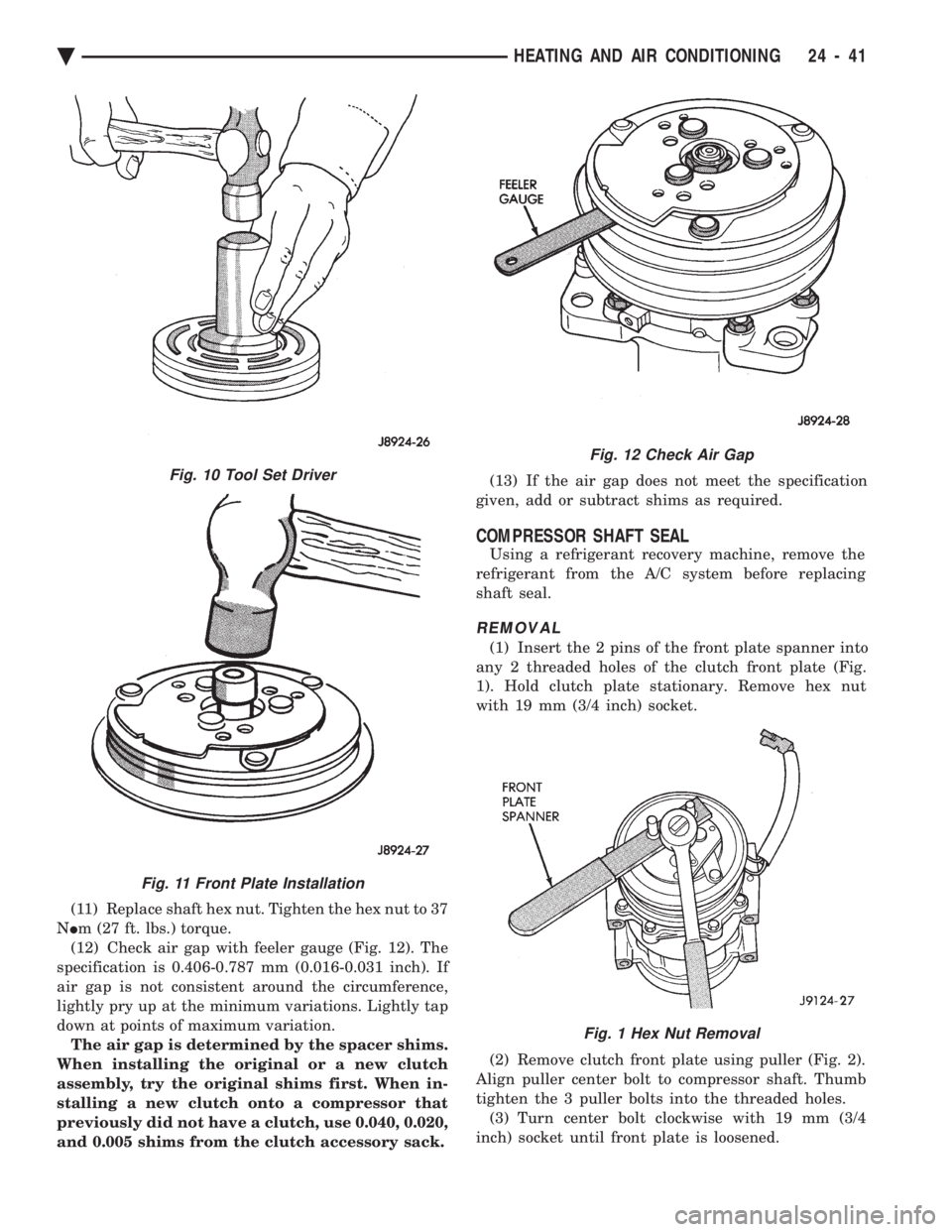
(11) Replace shaft hex nut. Tighten the hex nut to 37
N Im (27 ft. lbs.) torque.
(12) Check air gap with feeler gauge (Fig. 12). The
specification is 0.406-0.787 mm (0.016-0.031 inch). If
air gap is not consistent around the circumference,
lightly pry up at the minimum variations. Lightly tap
down at points of maximum variation. The air gap is determined by the spacer shims.
When installing the original or a new clutch
assembly, try the original shims first. When in-
stalling a new clutch onto a compressor that
previously did not have a clutch, use 0.040, 0.020,
and 0.005 shims from the clutch accessory sack. (13) If the air gap does not meet the specification
given, add or subtract shims as required.
COMPRESSOR SHAFT SEAL
Using a refrigerant recovery machine, remove the
refrigerant from the A/C system before replacing
shaft seal.
REMOVAL
(1) Insert the 2 pins of the front plate spanner into
any 2 threaded holes of the clutch front plate (Fig.
1). Hold clutch plate stationary. Remove hex nut
with 19 mm (3/4 inch) socket.
(2) Remove clutch front plate using puller (Fig. 2).
Align puller center bolt to compressor shaft. Thumb
tighten the 3 puller bolts into the threaded holes. (3) Turn center bolt clockwise with 19 mm (3/4
inch) socket until front plate is loosened.
Fig. 12 Check Air Gap
Fig. 1 Hex Nut Removal
Fig. 10 Tool Set Driver
Fig. 11 Front Plate Installation
Ä HEATING AND AIR CONDITIONING 24 - 41
Page 2347 of 2438
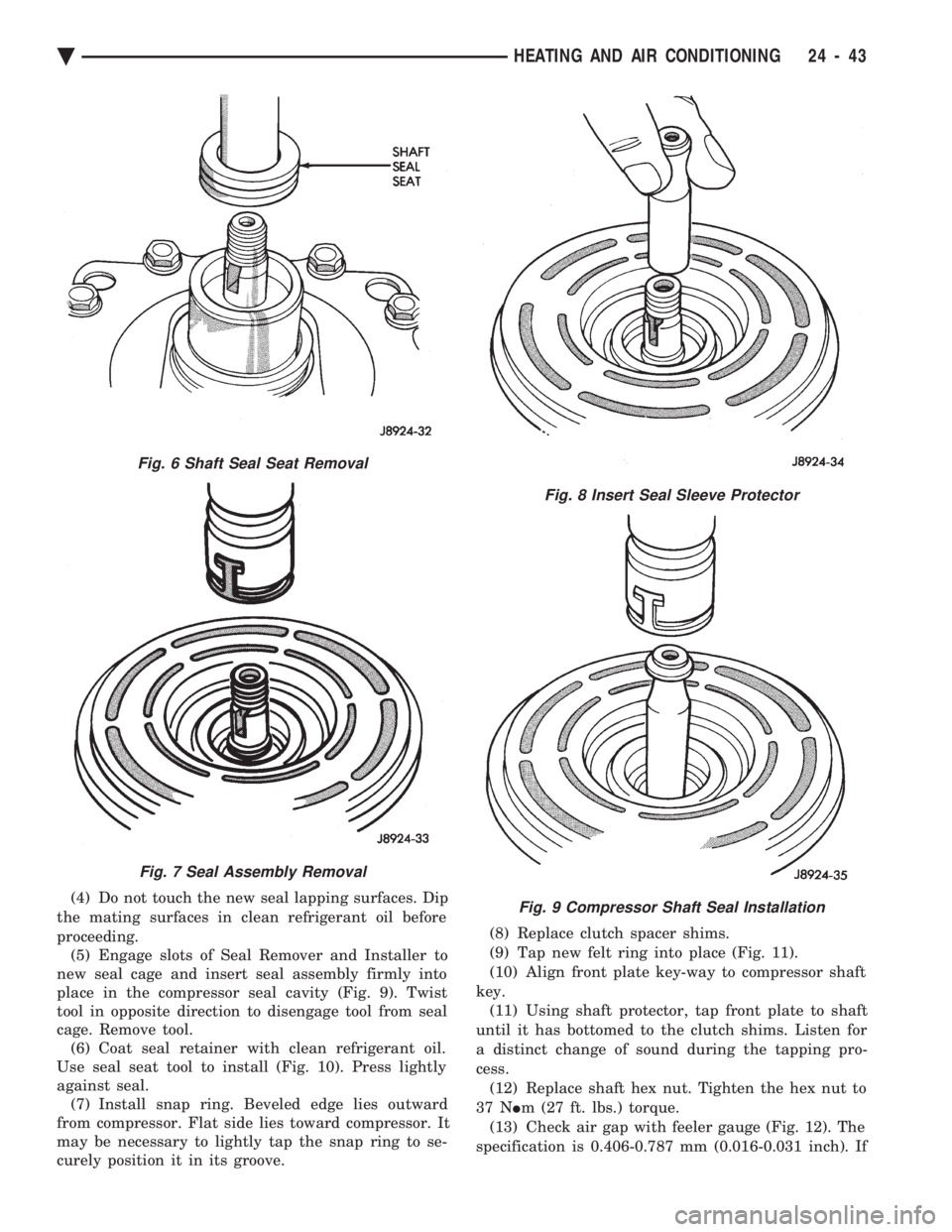
(4) Do not touch the new seal lapping surfaces. Dip
the mating surfaces in clean refrigerant oil before
proceeding. (5) Engage slots of Seal Remover and Installer to
new seal cage and insert seal assembly firmly into
place in the compressor seal cavity (Fig. 9). Twist
tool in opposite direction to disengage tool from seal
cage. Remove tool. (6) Coat seal retainer with clean refrigerant oil.
Use seal seat tool to install (Fig. 10). Press lightly
against seal. (7) Install snap ring. Beveled edge lies outward
from compressor. Flat side lies toward compressor. It
may be necessary to lightly tap the snap ring to se-
curely position it in its groove. (8) Replace clutch spacer shims.
(9) Tap new felt ring into place (Fig. 11).
(10) Align front plate key-way to compressor shaft
key. (11) Using shaft protector, tap front plate to shaft
until it has bottomed to the clutch shims. Listen for
a distinct change of sound during the tapping pro-
cess. (12) Replace shaft hex nut. Tighten the hex nut to
37 N Im (27 ft. lbs.) torque.
(13) Check air gap with feeler gauge (Fig. 12). The
specification is 0.406-0.787 mm (0.016-0.031 inch). If
Fig. 6 Shaft Seal Seat Removal
Fig. 7 Seal Assembly Removal
Fig. 8 Insert Seal Sleeve Protector
Fig. 9 Compressor Shaft Seal Installation
Ä HEATING AND AIR CONDITIONING 24 - 43
Page 2349 of 2438
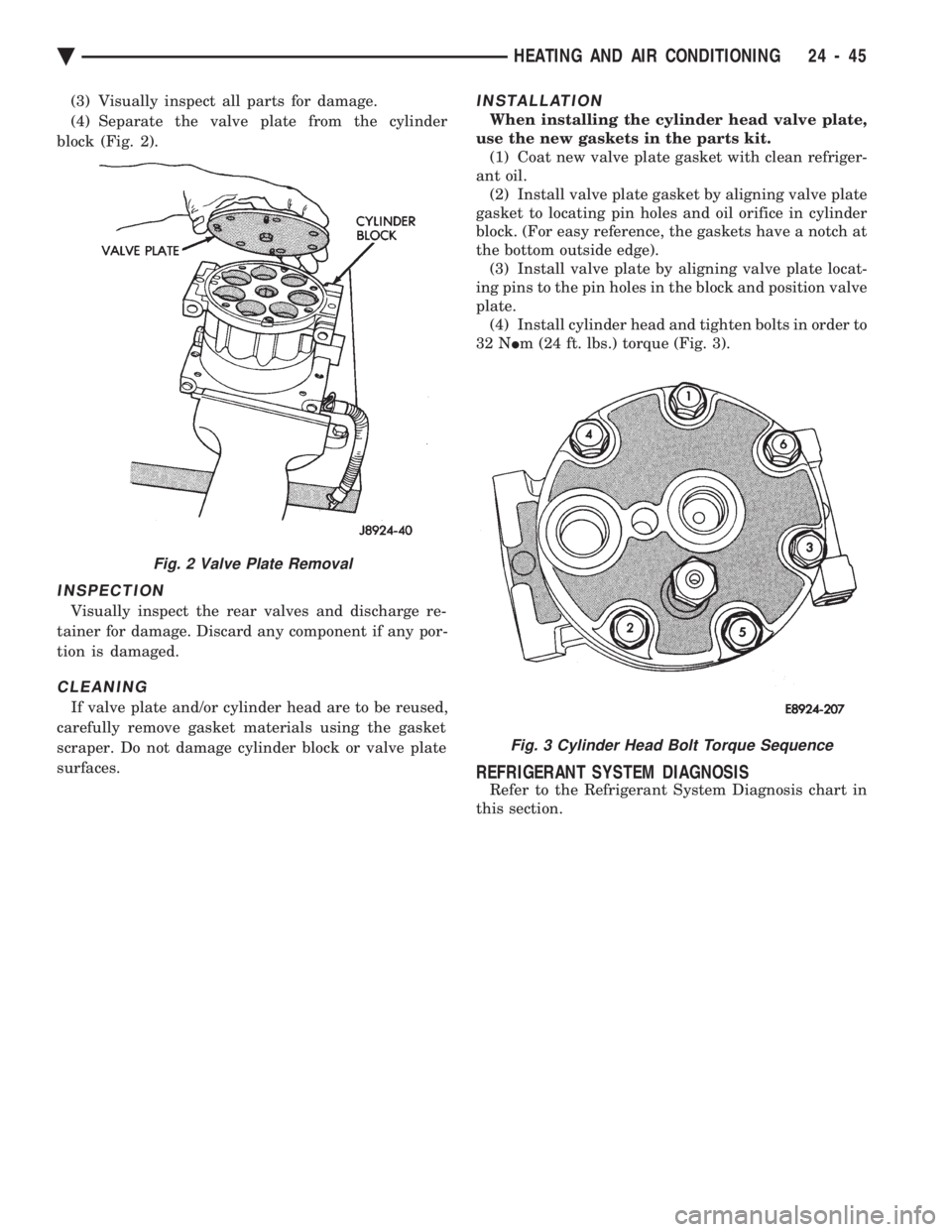
(3) Visually inspect all parts for damage.
(4) Separate the valve plate from the cylinder
block (Fig. 2).
INSPECTION
Visually inspect the rear valves and discharge re-
tainer for damage. Discard any component if any por-
tion is damaged.
CLEANING
If valve plate and/or cylinder head are to be reused,
carefully remove gasket materials using the gasket
scraper. Do not damage cylinder block or valve plate
surfaces.
INSTALLATION
When installing the cylinder head valve plate,
use the new gaskets in the parts kit. (1) Coat new valve plate gasket with clean refriger-
ant oil. (2) Install valve plate gasket by aligning valve plate
gasket to locating pin holes and oil orifice in cylinder
block. (For easy reference, the gaskets have a notch at
the bottom outside edge). (3) Install valve plate by aligning valve plate locat-
ing pins to the pin holes in the block and position valve
plate. (4) Install cylinder head and tighten bolts in order to
32 N Im (24 ft. lbs.) torque (Fig. 3).
REFRIGERANT SYSTEM DIAGNOSIS
Refer to the Refrigerant System Diagnosis chart in
this section.
Fig. 2 Valve Plate Removal
Fig. 3 Cylinder Head Bolt Torque Sequence
Ä HEATING AND AIR CONDITIONING 24 - 45
Page 2408 of 2438
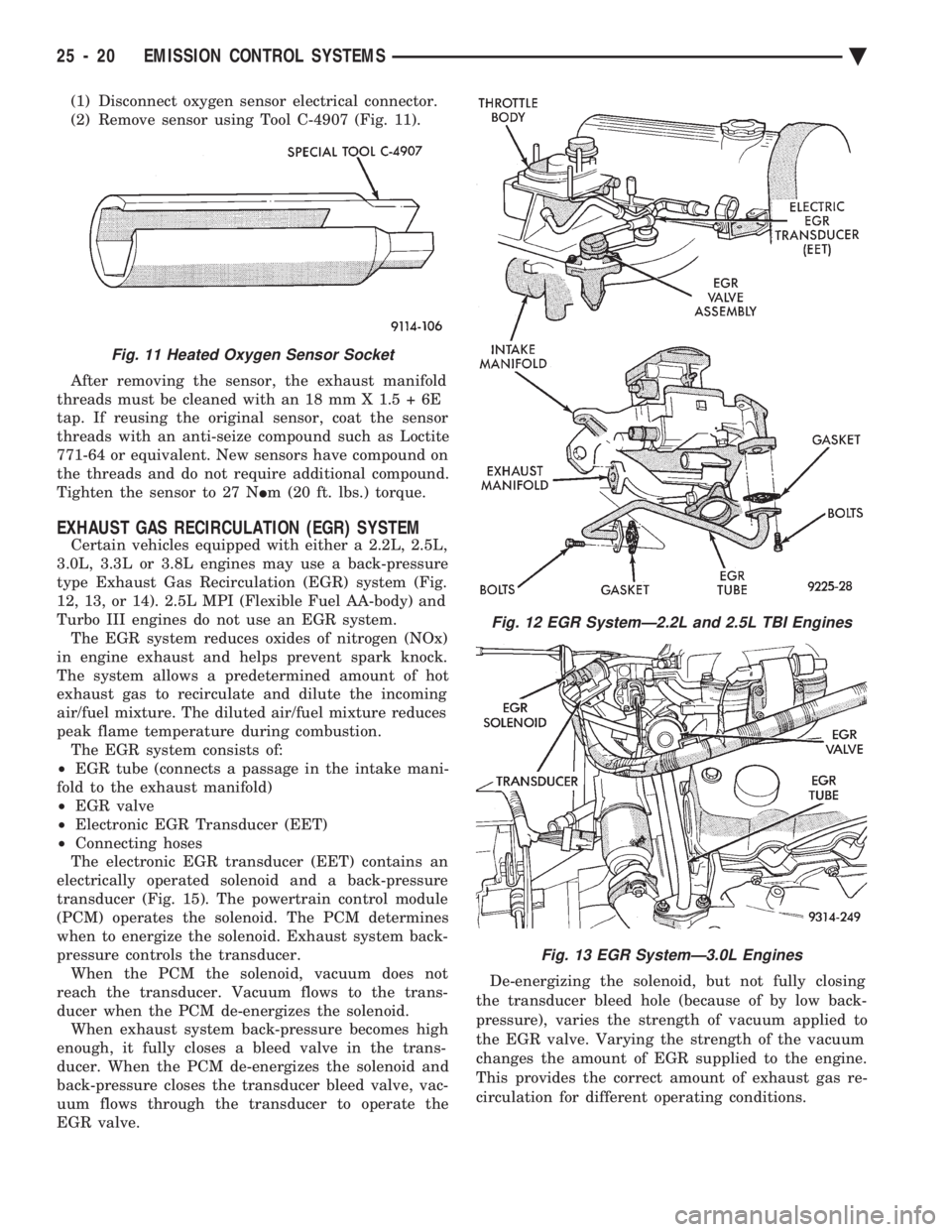
(1) Disconnect oxygen sensor electrical connector.
(2) Remove sensor using Tool C-4907 (Fig. 11).
After removing the sensor, the exhaust manifold
threads must be cleaned with an 18 mm X 1.5 + 6E
tap. If reusing the original sensor, coat the sensor
threads with an anti-seize compound such as Loctite
771-64 or equivalent. New sensors have compound on
the threads and do not require additional compound.
Tighten the sensor to 27 N Im (20 ft. lbs.) torque.
EXHAUST GAS RECIRCULATION (EGR) SYSTEM
Certain vehicles equipped with either a 2.2L, 2.5L,
3.0L, 3.3L or 3.8L engines may use a back-pressure
type Exhaust Gas Recirculation (EGR) system (Fig.
12, 13, or 14). 2.5L MPI (Flexible Fuel AA-body) and
Turbo III engines do not use an EGR system. The EGR system reduces oxides of nitrogen (NOx)
in engine exhaust and helps prevent spark knock.
The system allows a predetermined amount of hot
exhaust gas to recirculate and dilute the incoming
air/fuel mixture. The diluted air/fuel mixture reduces
peak flame temperature during combustion. The EGR system consists of:
² EGR tube (connects a passage in the intake mani-
fold to the exhaust manifold)
² EGR valve
² Electronic EGR Transducer (EET)
² Connecting hoses
The electronic EGR transducer (EET) contains an
electrically operated solenoid and a back-pressure
transducer (Fig. 15). The powertrain control module
(PCM) operates the solenoid. The PCM determines
when to energize the solenoid. Exhaust system back-
pressure controls the transducer. When the PCM the solenoid, vacuum does not
reach the transducer. Vacuum flows to the trans-
ducer when the PCM de-energizes the solenoid. When exhaust system back-pressure becomes high
enough, it fully closes a bleed valve in the trans-
ducer. When the PCM de-energizes the solenoid and
back-pressure closes the transducer bleed valve, vac-
uum flows through the transducer to operate the
EGR valve. De-energizing the solenoid, but not fully closing
the transducer bleed hole (because of by low back-
pressure), varies the strength of vacuum applied to
the EGR valve. Varying the strength of the vacuum
changes the amount of EGR supplied to the engine.
This provides the correct amount of exhaust gas re-
circulation for different operating conditions.
Fig. 11 Heated Oxygen Sensor Socket
Fig. 12 EGR SystemÐ2.2L and 2.5L TBI Engines
Fig. 13 EGR SystemÐ3.0L Engines
25 - 20 EMISSION CONTROL SYSTEMS Ä
Page 2410 of 2438
Engine speed may drop quickly or engine may even
stall. This indicates that EGR gas is flowing through
the system.If both the EGR Gas Flow Check, System Check
and Diagnosis Chart are completed satisfactorily,
then the EGR system functions normally. If engine speed does not drop off when performing
the test, remove both the EGR valve and EGR tube
and check for plugged passages. Also, check the in-
take manifold inlet passage. Clean or replace these
components for restoration of proper flow.
EGR VALVE SERVICEÐ2.2L AND 2.5L TBI
ENGINES
REMOVAL
(1) Disconnect electrical connector and vacuum
line from the electric EGR transducer (Fig. 12). (2) Remove EGR valve bolts from intake manifold.
(3) Remove EGR valve from intake manifold.
(4) Clean gasket surface and discard old gasket.
Check for any signs of leakage or cracked surfaces.
INSTALLATION
(1) Assemble EGR valve with new gasket onto the
intake manifold. (2) Install EGR valve mounting bolts. Tighten to
22 N Im (200 in. lbs.) torque.
(3) Reconnect vacuum line and electrical connector
to Electric EGR Transducer.
EGR TUBE SERVICEÐ2.2L AND 2.5L TBI ENGINES
REMOVAL
(1) Remove EGR tube attaching bolts from intake
and exhaust manifolds. (2) Remove EGR tube.
(3) Clean intake and exhaust manifold gasket sur-
faces and EGR tube flange gasket surfaces. Discard
old gaskets. (4) Check for signs of leakage or cracked surfaces
on either manifolds or tube. Replace as necessary.
INSTALLATION
(1) Loosely position EGR tube and new gaskets in
place on intake and exhaust manifolds. Install
mounting bolts. (2) Tighten attaching bolts to 22 N Im (200 in. lbs.)
torque.
EGR VALVE SERVICEÐ3.0L ENGINES
REMOVAL
(1) Disconnect the electric and vacuum connectors
from the electric EGR transducer (EET) (Fig. 16). (2) Remove EGR valve mounting bolts.
(3) Clean all gasket surfaces and discard old gas-
kets. Check for any signs of leakage or cracked sur-
faces. Repair or replace as necessary.
INSTALLATION
(1) Install EGR valve and new gasket on intake
manifold. Tighten mounting bolts to 22 N Im (200 in.
lbs.) torque. (2) Connect the electrical and vacuum connectors
to the electric EGR transducer.
EGR TUBE SERVICEÐ3.0L ENGINES
REMOVAL
(1) Remove EGR tube flange nuts from exhaust
manifold (Fig. 16). (2) Remove EGR valve nuts at intake manifold
(Fig. 16). Remove EGR tube. (3) Clean all gasket surfaces and discard old gas-
kets. Check for any signs of leakage or cracked sur-
faces. Repair or replace as necessary.
INSTALLATION
(1) Loosely install the EGR tube on the intake and
exhaust manifolds with new gaskets. (2) Tighten EGR tube flange bolts at the intake
manifold to 22 N Im (200 in. lbs.) torque.
(3) Tighten EGR tube to exhaust manifold nuts to
22 N Im (200 in. lbs.) torque.
EGR VALVE SERVICEÐ3.3L AND 3.8L ENGINES
REMOVAL
(1) Disconnect vacuum tube from electric EGR
transducer (EET). Inspect vacuum tube for damage
(Fig. 17). (2) Remove electrical connector from EET.
(3) Remove EGR valve bolts from intake manifold.
(4) Open EGR transducer clip and remove electric
EGR transducer. (5) Remove EGR valve from intake manifold.
(6) Clean gasket surface and discard old gasket.
Check for any signs of leakage or cracked surfaces.
Repair or replace as necessary.
INSTALLATION
(1) Assemble EGR valve with new gasket onto the
intake manifold. (2) Install mounting bolts. Tighten bolts to 22 N Im
(200 in. lbs.) torque. (3) Install electric EGR transducer in clip with ori-
entation tab in slot and snap closed. (4) Reconnect vacuum hose and electrical connec-
tor to EET.
EGR TUBE SERVICEÐ3.3L AND 3.8L ENGINES
REMOVAL
(1) Remove EGR tube attaching bolts from intake
and exhaust manifolds. (2) Clean intake and exhaust manifold gasket sur-
faces. Discard old gasket.
25 - 22 EMISSION CONTROL SYSTEMS Ä
Page 2412 of 2438
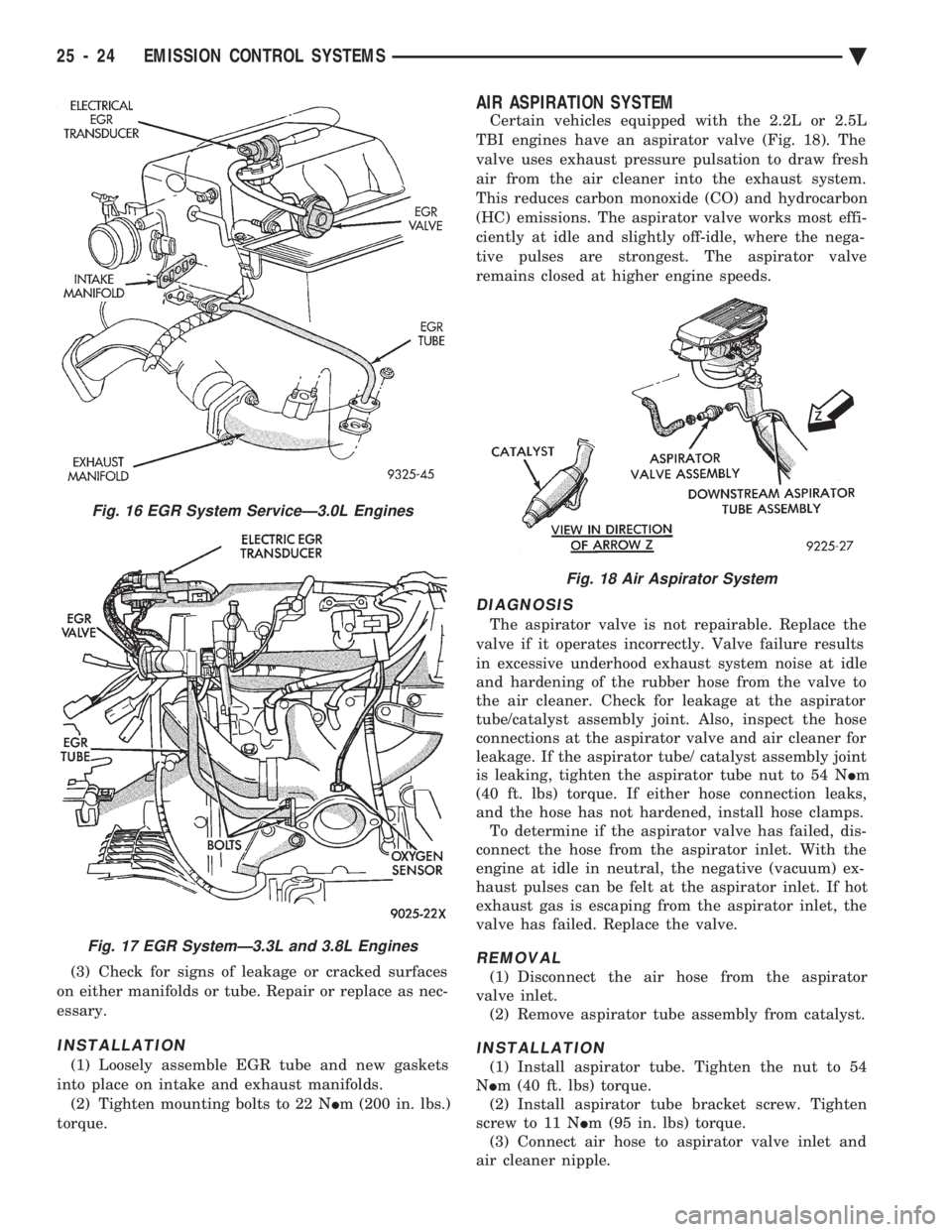
(3) Check for signs of leakage or cracked surfaces
on either manifolds or tube. Repair or replace as nec-
essary.
INSTALLATION
(1) Loosely assemble EGR tube and new gaskets
into place on intake and exhaust manifolds. (2) Tighten mounting bolts to 22 N Im (200 in. lbs.)
torque.
AIR ASPIRATION SYSTEM
Certain vehicles equipped with the 2.2L or 2.5L
TBI engines have an aspirator valve (Fig. 18). The
valve uses exhaust pressure pulsation to draw fresh
air from the air cleaner into the exhaust system.
This reduces carbon monoxide (CO) and hydrocarbon
(HC) emissions. The aspirator valve works most effi-
ciently at idle and slightly off-idle, where the nega-
tive pulses are strongest. The aspirator valve
remains closed at higher engine speeds.
DIAGNOSIS
The aspirator valve is not repairable. Replace the
valve if it operates incorrectly. Valve failure results
in excessive underhood exhaust system noise at idle
and hardening of the rubber hose from the valve to
the air cleaner. Check for leakage at the aspirator
tube/catalyst assembly joint. Also, inspect the hose
connections at the aspirator valve and air cleaner for
leakage. If the aspirator tube/ catalyst assembly joint
is leaking, tighten the aspirator tube nut to 54 N Im
(40 ft. lbs) torque. If either hose connection leaks,
and the hose has not hardened, install hose clamps. To determine if the aspirator valve has failed, dis-
connect the hose from the aspirator inlet. With the
engine at idle in neutral, the negative (vacuum) ex-
haust pulses can be felt at the aspirator inlet. If hot
exhaust gas is escaping from the aspirator inlet, the
valve has failed. Replace the valve.
REMOVAL
(1) Disconnect the air hose from the aspirator
valve inlet. (2) Remove aspirator tube assembly from catalyst.
INSTALLATION
(1) Install aspirator tube. Tighten the nut to 54
N Im (40 ft. lbs) torque.
(2) Install aspirator tube bracket screw. Tighten
screw to 11 N Im (95 in. lbs) torque.
(3) Connect air hose to aspirator valve inlet and
air cleaner nipple.
Fig. 16 EGR System ServiceÐ3.0L Engines
Fig. 17 EGR SystemÐ3.3L and 3.8L Engines
Fig. 18 Air Aspirator System
25 - 24 EMISSION CONTROL SYSTEMS Ä
Page 2416 of 2438
INTRODUCTION
CONTENTS
page page
BODY CODE PLATE LOCATION AND DECODING INFORMATION ........................ 2
INTERNATIONAL SYMBOLS ................ 9
METRIC SYSTEM ........................ 6
METRIC THREAD AND GRADE IDENTIFICATION ....................... 6 TORQUE REFERENCES
.................... 6
VEHICLE FAMILY IDENTIFICATION ........... 1
VEHICLE IDENTIFICATION NUMBER ......... 1
VEHICLE SAFETY CERTIFICATION LABEL ..... 1
VEHICLE FAMILY IDENTIFICATION
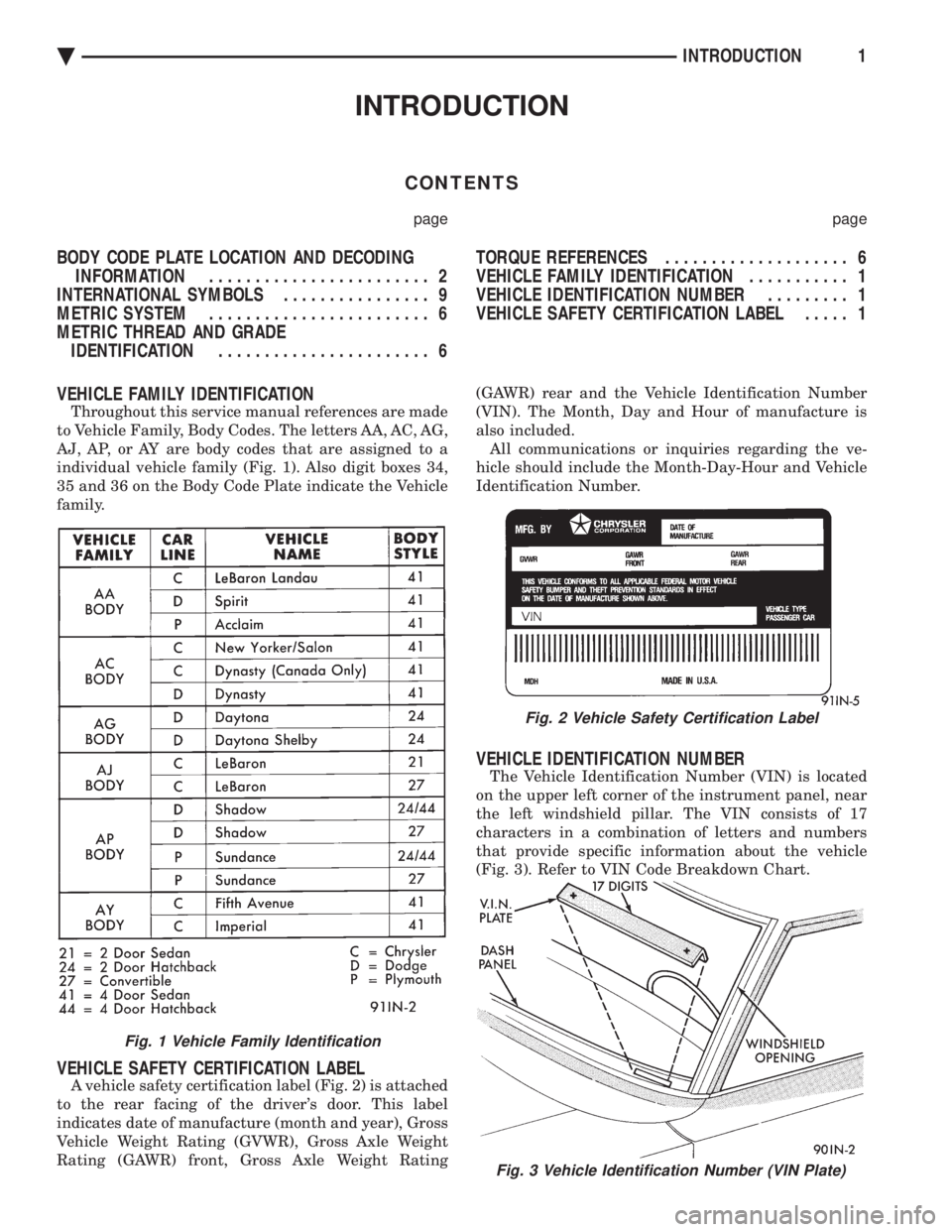
Throughout this service manual references are made
to Vehicle Family, Body Codes. The letters AA, AC, AG,
AJ, AP, or AY are body codes that are assigned to a
individual vehicle family (Fig. 1). Also digit boxes 34,
35 and 36 on the Body Code Plate indicate the Vehicle
family.
VEHICLE SAFETY CERTIFICATION LABEL
A vehicle safety certification label (Fig. 2) is attached
to the rear facing of the driver's door. This label
indicates date of manufacture (month and year), Gross
Vehicle Weight Rating (GVWR), Gross Axle Weight
Rating (GAWR) front, Gross Axle Weight Rating (GAWR) rear and the Vehicle Identification Number
(VIN). The Month, Day and Hour of manufacture is
also included. All communications or inquiries regarding the ve-
hicle should include the Month-Day-Hour and Vehicle
Identification Number.
VEHICLE IDENTIFICATION NUMBER
The Vehicle Identification Number (VIN) is located
on the upper left corner of the instrument panel, near
the left windshield pillar. The VIN consists of 17
characters in a combination of letters and numbers
that provide specific information about the vehicle
(Fig. 3). Refer to VIN Code Breakdown Chart.
Fig. 3 Vehicle Identification Number (VIN Plate)
Fig. 1 Vehicle Family Identification
Fig. 2 Vehicle Safety Certification Label
Ä INTRODUCTION1
Page 2421 of 2438
TORQUE REFERENCES
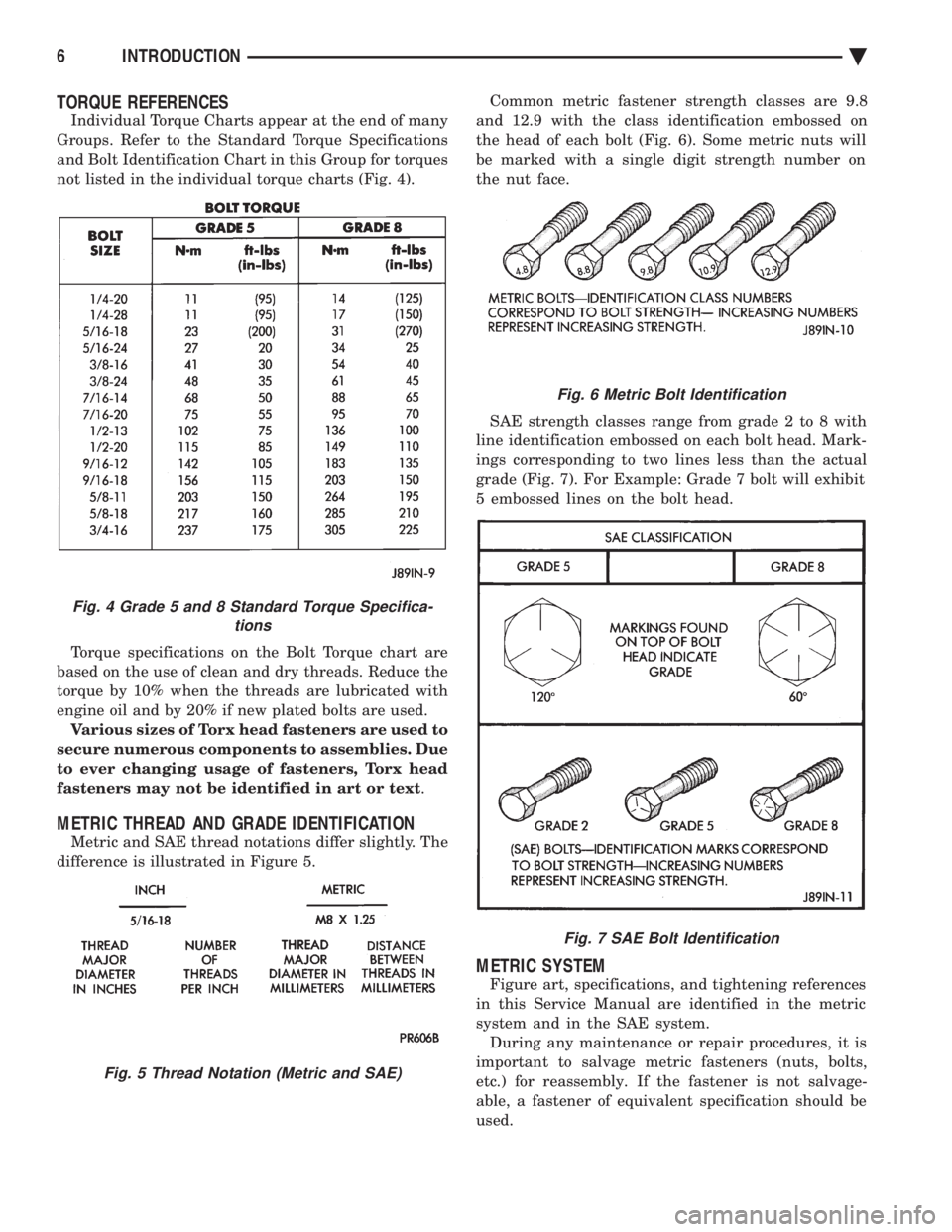
Individual Torque Charts appear at the end of many
Groups. Refer to the Standard Torque Specifications
and Bolt Identification Chart in this Group for torques
not listed in the individual torque charts (Fig. 4).
Torque specifications on the Bolt Torque chart are
based on the use of clean and dry threads. Reduce the
torque by 10% when the threads are lubricated with
engine oil and by 20% if new plated bolts are used. Various sizes of Torx head fasteners are used to
secure numerous components to assemblies. Due
to ever changing usage of fasteners, Torx head
fasteners may not be identified in art or text .
METRIC THREAD AND GRADE IDENTIFICATION
Metric and SAE thread notations differ slightly. The
difference is illustrated in Figure 5. Common metric fastener strength classes are 9.8
and 12.9 with the class identification embossed on
the head of each bolt (Fig. 6). Some metric nuts will
be marked with a single digit strength number on
the nut face.
SAE strength classes range from grade 2 to 8 with
line identification embossed on each bolt head. Mark-
ings corresponding to two lines less than the actual
grade (Fig. 7). For Example: Grade 7 bolt will exhibit
5 embossed lines on the bolt head.
METRIC SYSTEM
Figure art, specifications, and tightening references
in this Service Manual are identified in the metric
system and in the SAE system. During any maintenance or repair procedures, it is
important to salvage metric fasteners (nuts, bolts,
etc.) for reassembly. If the fastener is not salvage-
able, a fastener of equivalent specification should be
used.
Fig. 6 Metric Bolt Identification
Fig. 7 SAE Bolt Identification
Fig. 4 Grade 5 and 8 Standard Torque Specifica- tions
Fig. 5 Thread Notation (Metric and SAE)
6 INTRODUCTION Ä