abs CHEVROLET DYNASTY 1993 Repair Manual
[x] Cancel search | Manufacturer: CHEVROLET, Model Year: 1993, Model line: DYNASTY, Model: CHEVROLET DYNASTY 1993Pages: 2438, PDF Size: 74.98 MB
Page 244 of 2438
pressurized. When a definite increase in pedal effort
is felt, pump pedal a few additional times. This will
insure removal of all hydraulic pressure from the
brake system.(2) Thoroughly clean both reservoir caps and sur-
rounding area of reservoir before cap removal. This
will avoid getting dirt into the reservoir and brake
fluid. (3) Inspect the fluid level, see instructions on top
of reservoir (Fill To Top Of The White Screen In
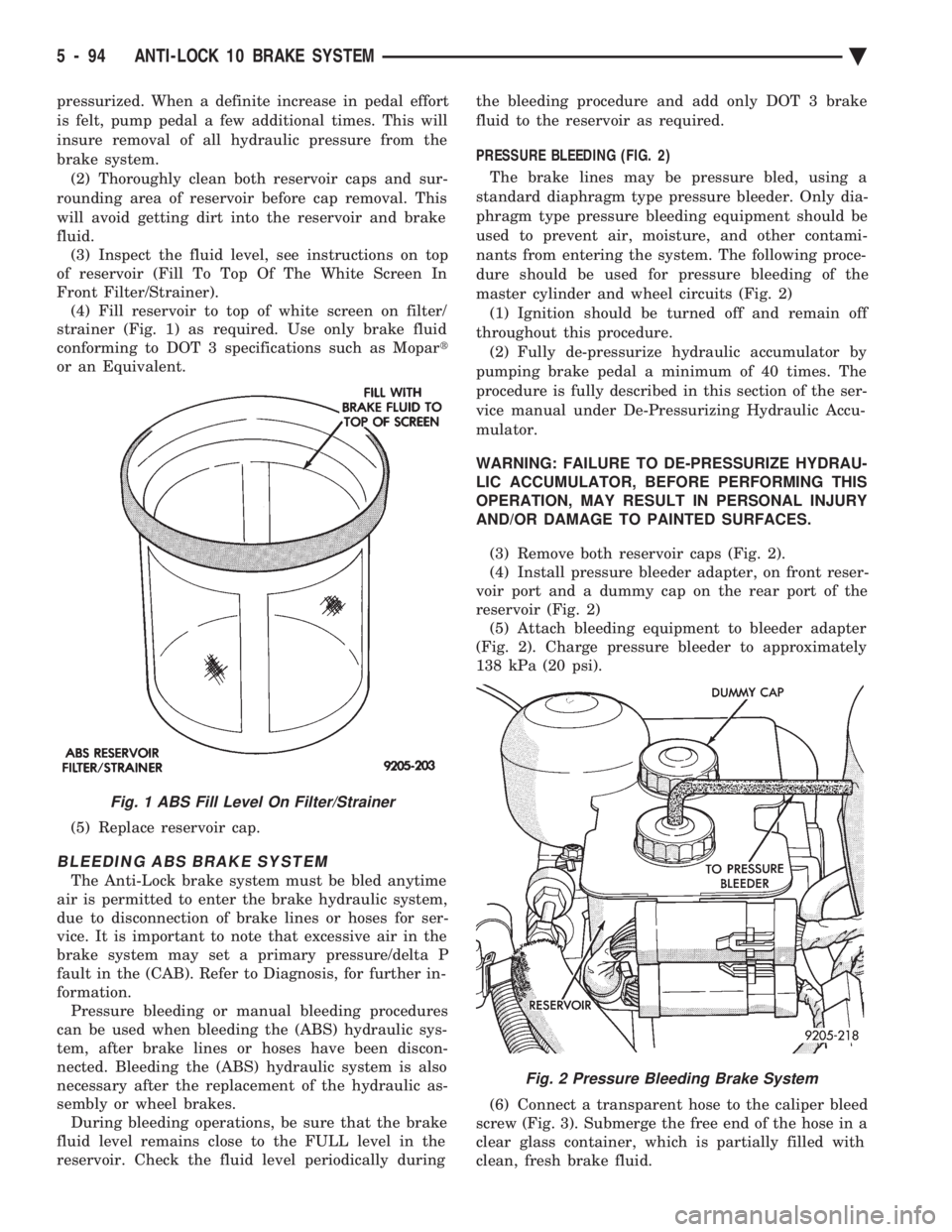
Front Filter/Strainer). (4) Fill reservoir to top of white screen on filter/
strainer (Fig. 1) as required. Use only brake fluid
conforming to DOT 3 specifications such as Mopar t
or an Equivalent.
(5) Replace reservoir cap.
BLEEDING ABS BRAKE SYSTEM
The Anti-Lock brake system must be bled anytime
air is permitted to enter the brake hydraulic system,
due to disconnection of brake lines or hoses for ser-
vice. It is important to note that excessive air in the
brake system may set a primary pressure/delta P
fault in the (CAB). Refer to Diagnosis, for further in-
formation. Pressure bleeding or manual bleeding procedures
can be used when bleeding the (ABS) hydraulic sys-
tem, after brake lines or hoses have been discon-
nected. Bleeding the (ABS) hydraulic system is also
necessary after the replacement of the hydraulic as-
sembly or wheel brakes. During bleeding operations, be sure that the brake
fluid level remains close to the FULL level in the
reservoir. Check the fluid level periodically during the bleeding procedure and add only DOT 3 brake
fluid to the reservoir as required.
PRESSURE BLEEDING (FIG. 2)
The brake lines may be pressure bled, using a
standard diaphragm type pressure bleeder. Only dia-
phragm type pressure bleeding equipment should be
used to prevent air, moisture, and other contami-
nants from entering the system. The following proce-
dure should be used for pressure bleeding of the
master cylinder and wheel circuits (Fig. 2) (1) Ignition should be turned off and remain off
throughout this procedure. (2) Fully de-pressurize hydraulic accumulator by
pumping brake pedal a minimum of 40 times. The
procedure is fully described in this section of the ser-
vice manual under De-Pressurizing Hydraulic Accu-
mulator.
WARNING: FAILURE TO DE-PRESSURIZE HYDRAU-
LIC ACCUMULATOR, BEFORE PERFORMING THIS
OPERATION, MAY RESULT IN PERSONAL INJURY
AND/OR DAMAGE TO PAINTED SURFACES.
(3) Remove both reservoir caps (Fig. 2).
(4) Install pressure bleeder adapter, on front reser-
voir port and a dummy cap on the rear port of the
reservoir (Fig. 2) (5) Attach bleeding equipment to bleeder adapter
(Fig. 2). Charge pressure bleeder to approximately
138 kPa (20 psi).
(6) Connect a transparent hose to the caliper bleed
screw (Fig. 3). Submerge the free end of the hose in a
clear glass container, which is partially filled with
clean, fresh brake fluid.
Fig. 1 ABS Fill Level On Filter/Strainer
Fig. 2 Pressure Bleeding Brake System
5 - 94 ANTI-LOCK 10 BRAKE SYSTEM Ä
Page 245 of 2438
(7) With the pressure bleeder turned on, open the
caliper bleed screw 3/4 to one full turn allowing brake
fluid to flow into the container. Leave bleed screw open
until a clear, bubble-free flow of brake fluid is coming
from the hose in the container. If the reservoir has been
drained or the hydraulic assembly removed from the
car before the bleeding operation. Slowly pump the
brake pedal one or two times while the bleed screw is
open and fluid is flowing. This will help purge any
trapped air from the hydraulic assembly. Tighten
bleeder screw to 10 N Im (7.5 ft. lbs.) torque.
(8) Step 7 above should be done at all wheel brakes,
following the order wheel by wheel as listed below. a) Left rear.
b) Right rear.
c) Left front.
d) Right front.
(9) After bleeding is completed at all four wheel
brakes. Remove pressure bleeding equipment and
adapter by closing pressure bleeder valve and slowly
unscrewing bleeder adapter from hydraulic assembly
reservoir. Failure to release pressure in the reser-
voir will cause spillage of brake fluid, and could
result in personal injury or damage to painted
surfaces. (10) Using a syringe or equivalent method, remove
excess fluid from the reservoir to bring the brake fluid
to the required fill level (Fig. 1). If brake fluid is below
the proper level add Mopar tbrake fluid or equivalent
conforming to DOT 3, requirements. (11) Install the reservoir caps and turn on the igni-
tion to allow the (ABS) pump to charge the accumula-
tor.
MANUAL BLEEDING
Brake lines can be bled, using the manual bleeding
method. Manual bleeding is a two person operation,
one to pump the brake pedal and the other to bleed
each wheel brake. The following procedure should be
used: De-pressurizing the hydraulic accumulator is done
by following the steps described below. (1) Verify that the ignition switch is in the off posi-
tion. (2) Fully de-pressurize the hydraulic accumulator by
pumping brake pedal a minimum of 40 times. Use the
procedure as described in De-Pressurizing Hydraulic
Accumulator listed earlier in this section.
WARNING: FAILURE TO DE-PRESSURIZE HYDRAU-
LIC ACCUMULATOR, PRIOR TO PERFORMING THIS
OPERATION, MAY RESULT IN PERSONAL INJURY
AND/OR DAMAGE TO PAINTED SURFACES.
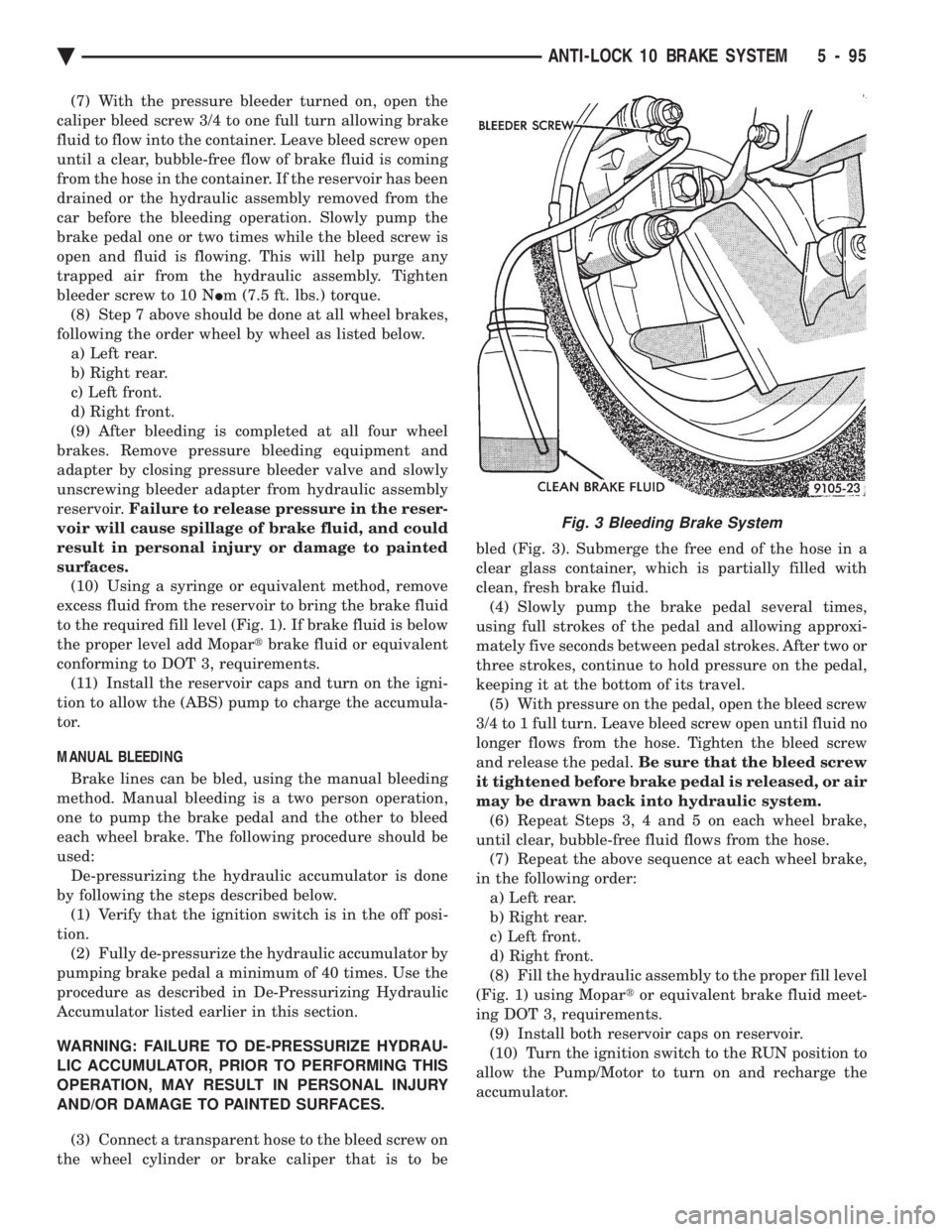
(3) Connect a transparent hose to the bleed screw on
the wheel cylinder or brake caliper that is to be bled (Fig. 3). Submerge the free end of the hose in a
clear glass container, which is partially filled with
clean, fresh brake fluid.
(4) Slowly pump the brake pedal several times,
using full strokes of the pedal and allowing approxi-
mately five seconds between pedal strokes. After two or
three strokes, continue to hold pressure on the pedal,
keeping it at the bottom of its travel. (5) With pressure on the pedal, open the bleed screw
3/4 to 1 full turn. Leave bleed screw open until fluid no
longer flows from the hose. Tighten the bleed screw
and release the pedal. Be sure that the bleed screw
it tightened before brake pedal is released, or air
may be drawn back into hydraulic system. (6) Repeat Steps 3, 4 and 5 on each wheel brake,
until clear, bubble-free fluid flows from the hose. (7) Repeat the above sequence at each wheel brake,
in the following order: a) Left rear.
b) Right rear.
c) Left front.
d) Right front.
(8) Fill the hydraulic assembly to the proper fill level
(Fig. 1) using Mopar tor equivalent brake fluid meet-
ing DOT 3, requirements. (9) Install both reservoir caps on reservoir.
(10) Turn the ignition switch to the RUN position to
allow the Pump/Motor to turn on and recharge the
accumulator.
Fig. 3 Bleeding Brake System
Ä ANTI-LOCK 10 BRAKE SYSTEM 5 - 95
Page 249 of 2438
(7) Install high pressure hose to hydraulic assem-
bly (Fig. 7). Tighten the hose, to hydraulic assembly
fitting to 16 N Im (145 in. lbs)
(8) Fill hydraulic assembly brake fluid reservoir to
top of screen on the reservoir filter/strainer Fig. 9.
(9) Connect all electrical connectors to the hydrau-
lic assembly. (10) Bleed the entire brake system, see Bleeding
Brake System in this section of the Service Manual. (11) Replace all fresh air intake ducts, air cleaner
and washer bottle. (12) Check that the brake fluid in the hydraulic
assembly is at the correct level before moving vehicle
(Fig. 9). (See Checking Brake Fluid Level in this sec-
tion of the service manual).
BRAKE FLUID RESERVOIR
REMOVE
(1) Fully de-pressurize the hydraulic accumulator
by pumping brake pedal a minimum of 40 times. Use
procedure described in De-Pressurizing Hydraulic Ac-
cumulator listed earlier in this section.
WARNING: FAILURE TO DE-PRESSURIZE HYDRAU-
LIC ACCUMULATOR, BEFORE PERFORMING THIS
OPERATION, MAY RESULT IN PERSONAL INJURY
AND/OR DAMAGE TO PAINTED SURFACES.
(2) Remove as much brake fluid as possible from
the fluid reservoir, using a syringe or equivalent
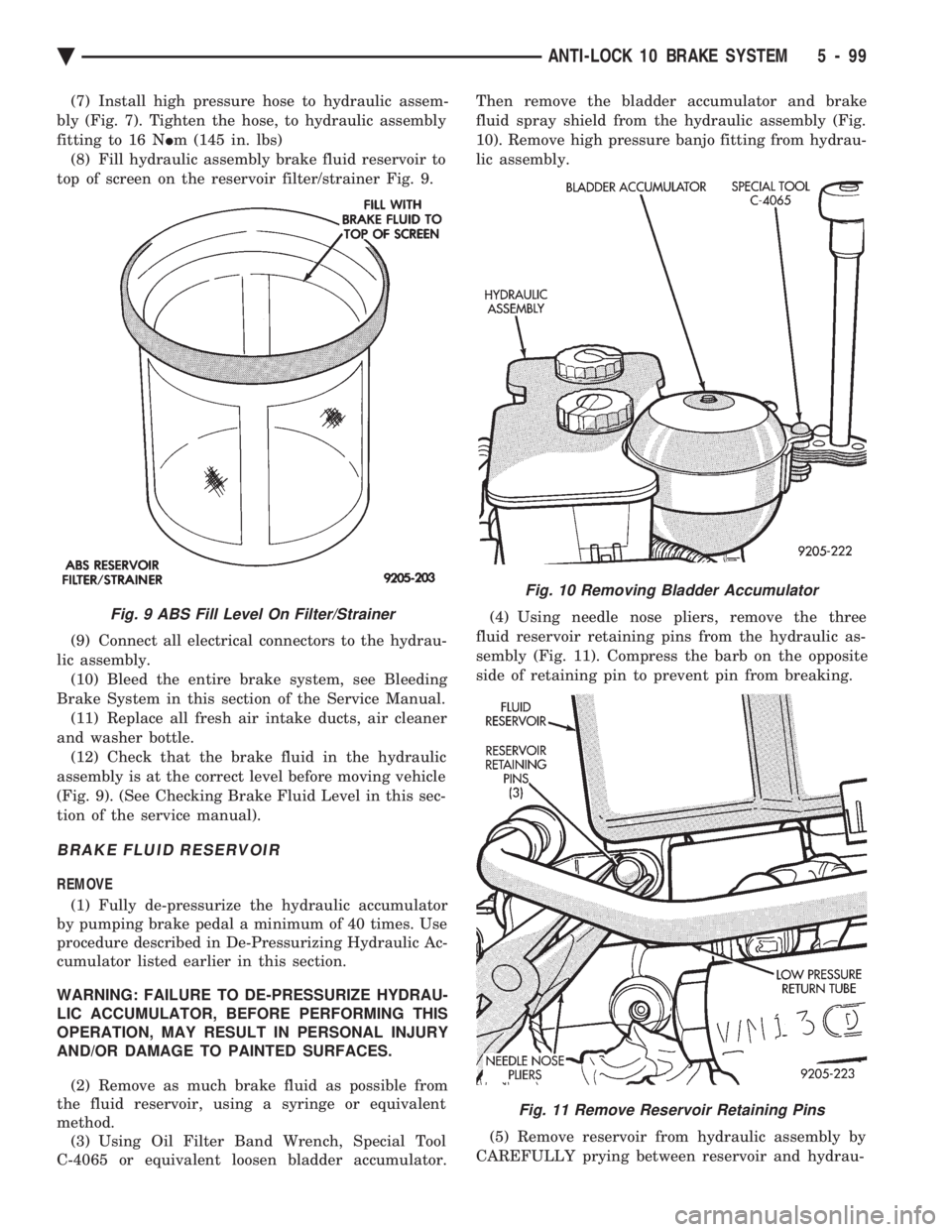
method. (3) Using Oil Filter Band Wrench, Special Tool
C-4065 or equivalent loosen bladder accumulator. Then remove the bladder accumulator and brake
fluid spray shield from the hydraulic assembly (Fig.
10). Remove high pressure banjo fitting from hydrau-
lic assembly.
(4) Using needle nose pliers, remove the three
fluid reservoir retaining pins from the hydraulic as-
sembly (Fig. 11). Compress the barb on the opposite
side of retaining pin to prevent pin from breaking.
(5) Remove reservoir from hydraulic assembly by
CAREFULLY prying between reservoir and hydrau-
Fig. 9 ABS Fill Level On Filter/Strainer
Fig. 10 Removing Bladder Accumulator
Fig. 11 Remove Reservoir Retaining Pins
Ä ANTI-LOCK 10 BRAKE SYSTEM 5 - 99
Page 251 of 2438
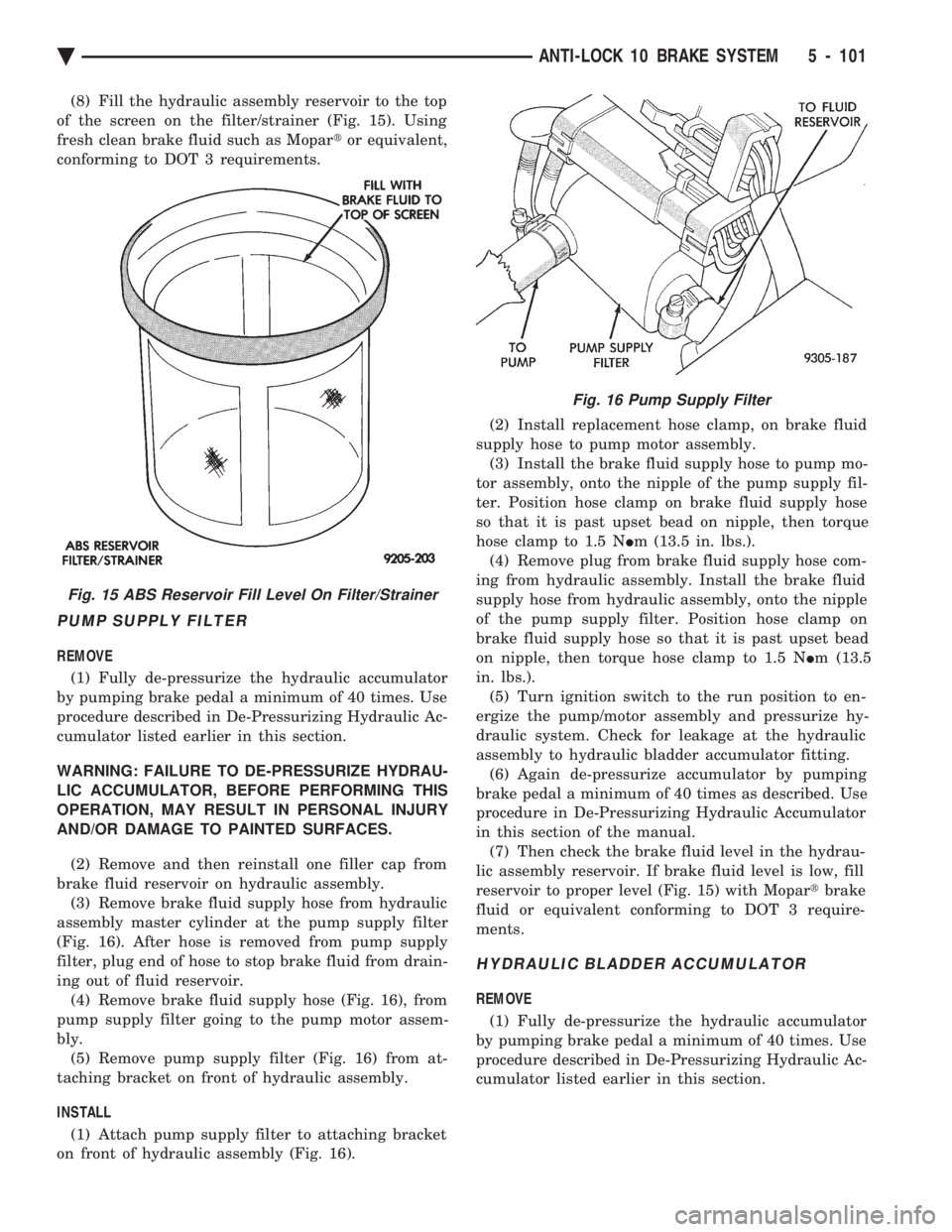
(8) Fill the hydraulic assembly reservoir to the top
of the screen on the filter/strainer (Fig. 15). Using
fresh clean brake fluid such as Mopar tor equivalent,
conforming to DOT 3 requirements.
PUMP SUPPLY FILTER
REMOVE
(1) Fully de-pressurize the hydraulic accumulator
by pumping brake pedal a minimum of 40 times. Use
procedure described in De-Pressurizing Hydraulic Ac-
cumulator listed earlier in this section.
WARNING: FAILURE TO DE-PRESSURIZE HYDRAU-
LIC ACCUMULATOR, BEFORE PERFORMING THIS
OPERATION, MAY RESULT IN PERSONAL INJURY
AND/OR DAMAGE TO PAINTED SURFACES.
(2) Remove and then reinstall one filler cap from
brake fluid reservoir on hydraulic assembly. (3) Remove brake fluid supply hose from hydraulic
assembly master cylinder at the pump supply filter
(Fig. 16). After hose is removed from pump supply
filter, plug end of hose to stop brake fluid from drain-
ing out of fluid reservoir. (4) Remove brake fluid supply hose (Fig. 16), from
pump supply filter going to the pump motor assem-
bly. (5) Remove pump supply filter (Fig. 16) from at-
taching bracket on front of hydraulic assembly.
INSTALL (1) Attach pump supply filter to attaching bracket
on front of hydraulic assembly (Fig. 16). (2) Install replacement hose clamp, on brake fluid
supply hose to pump motor assembly. (3) Install the brake fluid supply hose to pump mo-
tor assembly, onto the nipple of the pump supply fil-
ter. Position hose clamp on brake fluid supply hose
so that it is past upset bead on nipple, then torque
hose clamp to 1.5 N Im (13.5 in. lbs.).
(4) Remove plug from brake fluid supply hose com-
ing from hydraulic assembly. Install the brake fluid
supply hose from hydraulic assembly, onto the nipple
of the pump supply filter. Position hose clamp on
brake fluid supply hose so that it is past upset bead
on nipple, then torque hose clamp to 1.5 N Im (13.5
in. lbs.). (5) Turn ignition switch to the run position to en-
ergize the pump/motor assembly and pressurize hy-
draulic system. Check for leakage at the hydraulic
assembly to hydraulic bladder accumulator fitting. (6) Again de-pressurize accumulator by pumping
brake pedal a minimum of 40 times as described. Use
procedure in De-Pressurizing Hydraulic Accumulator
in this section of the manual. (7) Then check the brake fluid level in the hydrau-
lic assembly reservoir. If brake fluid level is low, fill
reservoir to proper level (Fig. 15) with Mopar tbrake
fluid or equivalent conforming to DOT 3 require-
ments.
HYDRAULIC BLADDER ACCUMULATOR
REMOVE
(1) Fully de-pressurize the hydraulic accumulator
by pumping brake pedal a minimum of 40 times. Use
procedure described in De-Pressurizing Hydraulic Ac-
cumulator listed earlier in this section.
Fig. 15 ABS Reservoir Fill Level On Filter/Strainer
Fig. 16 Pump Supply Filter
Ä ANTI-LOCK 10 BRAKE SYSTEM 5 - 101
Page 252 of 2438
WARNING: FAILURE TO DE-PRESSURIZE HYDRAU-
LIC ASSEMBLY/ACCUMULATOR PRIOR PERFORM-
ING THIS OPERATION. MAY RESULT IN PERSONAL
INJURY AND/OR DAMAGE TO PAINTED SURFACES
OF THE VEHICLE.
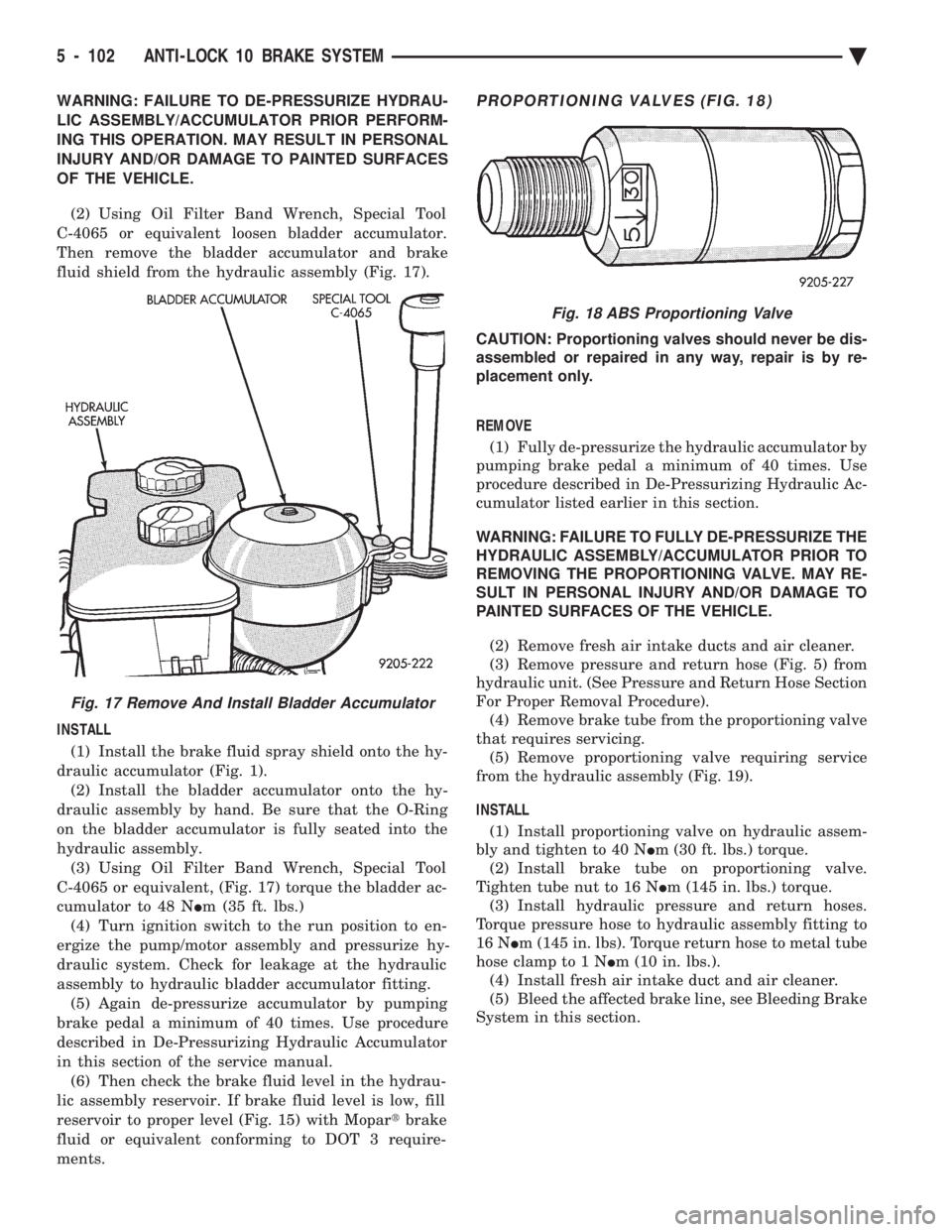
(2) Using Oil Filter Band Wrench, Special Tool
C-4065 or equivalent loosen bladder accumulator.
Then remove the bladder accumulator and brake
fluid shield from the hydraulic assembly (Fig. 17).
INSTALL
(1) Install the brake fluid spray shield onto the hy-
draulic accumulator (Fig. 1). (2) Install the bladder accumulator onto the hy-
draulic assembly by hand. Be sure that the O-Ring
on the bladder accumulator is fully seated into the
hydraulic assembly. (3) Using Oil Filter Band Wrench, Special Tool
C-4065 or equivalent, (Fig. 17) torque the bladder ac-
cumulator to 48 N Im (35 ft. lbs.)
(4) Turn ignition switch to the run position to en-
ergize the pump/motor assembly and pressurize hy-
draulic system. Check for leakage at the hydraulic
assembly to hydraulic bladder accumulator fitting. (5) Again de-pressurize accumulator by pumping
brake pedal a minimum of 40 times. Use procedure
described in De-Pressurizing Hydraulic Accumulator
in this section of the service manual. (6) Then check the brake fluid level in the hydrau-
lic assembly reservoir. If brake fluid level is low, fill
reservoir to proper level (Fig. 15) with Mopar tbrake
fluid or equivalent conforming to DOT 3 require-
ments.PROPORTIONING VALVES (FIG. 18)
CAUTION: Proportioning valves should never be dis-
assembled or repaired in any way, repair is by re-
placement only.
REMOVE (1) Fully de-pressurize the hydraulic accumulator by
pumping brake pedal a minimum of 40 times. Use
procedure described in De-Pressurizing Hydraulic Ac-
cumulator listed earlier in this section.
WARNING: FAILURE TO FULLY DE-PRESSURIZE THE
HYDRAULIC ASSEMBLY/ACCUMULATOR PRIOR TO
REMOVING THE PROPORTIONING VALVE. MAY RE-
SULT IN PERSONAL INJURY AND/OR DAMAGE TO
PAINTED SURFACES OF THE VEHICLE.
(2) Remove fresh air intake ducts and air cleaner.
(3) Remove pressure and return hose (Fig. 5) from
hydraulic unit. (See Pressure and Return Hose Section
For Proper Removal Procedure). (4) Remove brake tube from the proportioning valve
that requires servicing. (5) Remove proportioning valve requiring service
from the hydraulic assembly (Fig. 19).
INSTALL (1) Install proportioning valve on hydraulic assem-
bly and tighten to 40 N Im (30 ft. lbs.) torque.
(2) Install brake tube on proportioning valve.
Tighten tube nut to 16 N Im (145 in. lbs.) torque.
(3) Install hydraulic pressure and return hoses.
Torque pressure hose to hydraulic assembly fitting to
16 N Im (145 in. lbs). Torque return hose to metal tube
hose clamp to 1 N Im (10 in. lbs.).
(4) Install fresh air intake duct and air cleaner.
(5) Bleed the affected brake line, see Bleeding Brake
System in this section.
Fig. 17 Remove And Install Bladder Accumulator
Fig. 18 ABS Proportioning Valve
5 - 102 ANTI-LOCK 10 BRAKE SYSTEM Ä
Page 254 of 2438
SYSTEM RELAY, ANTI-LOCK WARNING LAMP RELAY AND PUMP/MOTOR RELAYS (FIG. 2)
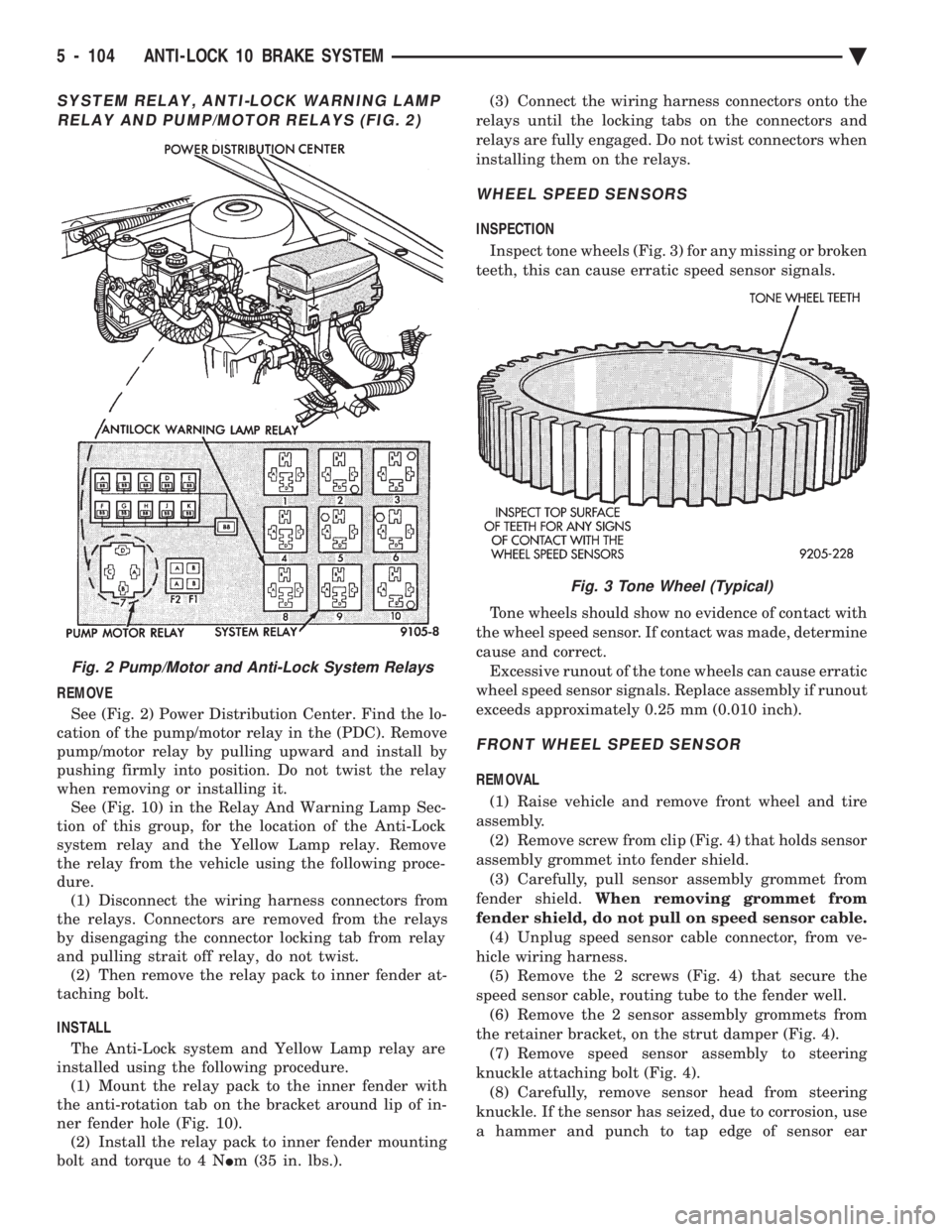
REMOVE
See (Fig. 2) Power Distribution Center. Find the lo-
cation of the pump/motor relay in the (PDC). Remove
pump/motor relay by pulling upward and install by
pushing firmly into position. Do not twist the relay
when removing or installing it. See (Fig. 10) in the Relay And Warning Lamp Sec-
tion of this group, for the location of the Anti-Lock
system relay and the Yellow Lamp relay. Remove
the relay from the vehicle using the following proce-
dure. (1) Disconnect the wiring harness connectors from
the relays. Connectors are removed from the relays
by disengaging the connector locking tab from relay
and pulling strait off relay, do not twist. (2) Then remove the relay pack to inner fender at-
taching bolt.
INSTALL The Anti-Lock system and Yellow Lamp relay are
installed using the following procedure. (1) Mount the relay pack to the inner fender with
the anti-rotation tab on the bracket around lip of in-
ner fender hole (Fig. 10). (2) Install the relay pack to inner fender mounting
bolt and torque to 4 N Im (35 in. lbs.). (3) Connect the wiring harness connectors onto the
relays until the locking tabs on the connectors and
relays are fully engaged. Do not twist connectors when
installing them on the relays.
WHEEL SPEED SENSORS
INSPECTION
Inspect tone wheels (Fig. 3) for any missing or broken
teeth, this can cause erratic speed sensor signals.
Tone wheels should show no evidence of contact with
the wheel speed sensor. If contact was made, determine
cause and correct. Excessive runout of the tone wheels can cause erratic
wheel speed sensor signals. Replace assembly if runout
exceeds approximately 0.25 mm (0.010 inch).
FRONT WHEEL SPEED SENSOR
REMOVAL
(1) Raise vehicle and remove front wheel and tire
assembly. (2) Remove screw from clip (Fig. 4) that holds sensor
assembly grommet into fender shield. (3) Carefully, pull sensor assembly grommet from
fender shield. When removing grommet from
fender shield, do not pull on speed sensor cable. (4) Unplug speed sensor cable connector, from ve-
hicle wiring harness. (5) Remove the 2 screws (Fig. 4) that secure the
speed sensor cable, routing tube to the fender well. (6) Remove the 2 sensor assembly grommets from
the retainer bracket, on the strut damper (Fig. 4). (7) Remove speed sensor assembly to steering
knuckle attaching bolt (Fig. 4). (8) Carefully, remove sensor head from steering
knuckle. If the sensor has seized, due to corrosion, use
a hammer and punch to tap edge of sensor ear
Fig. 2 Pump/Motor and Anti-Lock System Relays
Fig. 3 Tone Wheel (Typical)
5 - 104 ANTI-LOCK 10 BRAKE SYSTEM Ä
Page 258 of 2438
CAUTION: Do not insert dual function pressure
switch into hydraulic assembly using the socket
and ratchet. Cross threading of the switch may oc-
cur. (1) Install the dual function pressure switch into
the hydraulic assembly by hand until the O-ring
seals are seated. (2) Using Socket, Special Tool 6607, (Fig. 10)
torque the dual function pressure switch into the hy-
draulic assembly to 12 N Im (9 ft. lbs.).
(3) Connect the wiring harness connectors (Fig. 9)
onto the dual function pressure switch and the boost
pressure transducer. Be sure the locking tabs on the
connectors are fully engaged on the switches. (4) Lower the vehicle.
(5) Turn the ignition switch to the on position and
let the system pressurize. Check for any leaks at the
dual function pressure switch. (6) Fully de-pressurize the hydraulic assembly a
second time. This will purge any air out that may
have entered hydraulic assembly when the switch
was removed. Turn the ignition switch to the on po-
sition and let the system pressurize again. (7) Road test vehicle to insure that the brake sys-
tem is performing correctly.
PRIMARY PRESSURE TRANSDUCER
REMOVE
WARNING: FAILURE TO FULLY DE-PRESSURIZE
THE HYDRAULIC BLADDER ACCUMULATOR PRIOR
TO REMOVING PRIMARY PRESSURE TRANS-
DUCER. WILL RESULT IN PERSONAL INJURY
AND/OR DAMAGE TO PAINTED SURFACES OF THE
VEHICLE.
To remove primary pressure transducer (Fig. 11),
from hydraulic assembly, removal of hydraulic as-
sembly from vehicle is notrequired.
(1) Fully de-pressurize the hydraulic accumulator
by pumping brake pedal a minimum of 40 times. Use
procedure described in De-Pressurizing Hydraulic Ac-
cumulator listed earlier in this section. (2) Remove as much brake fluid as possible from
the brake fluid reservoir, using a syringe or equiva-
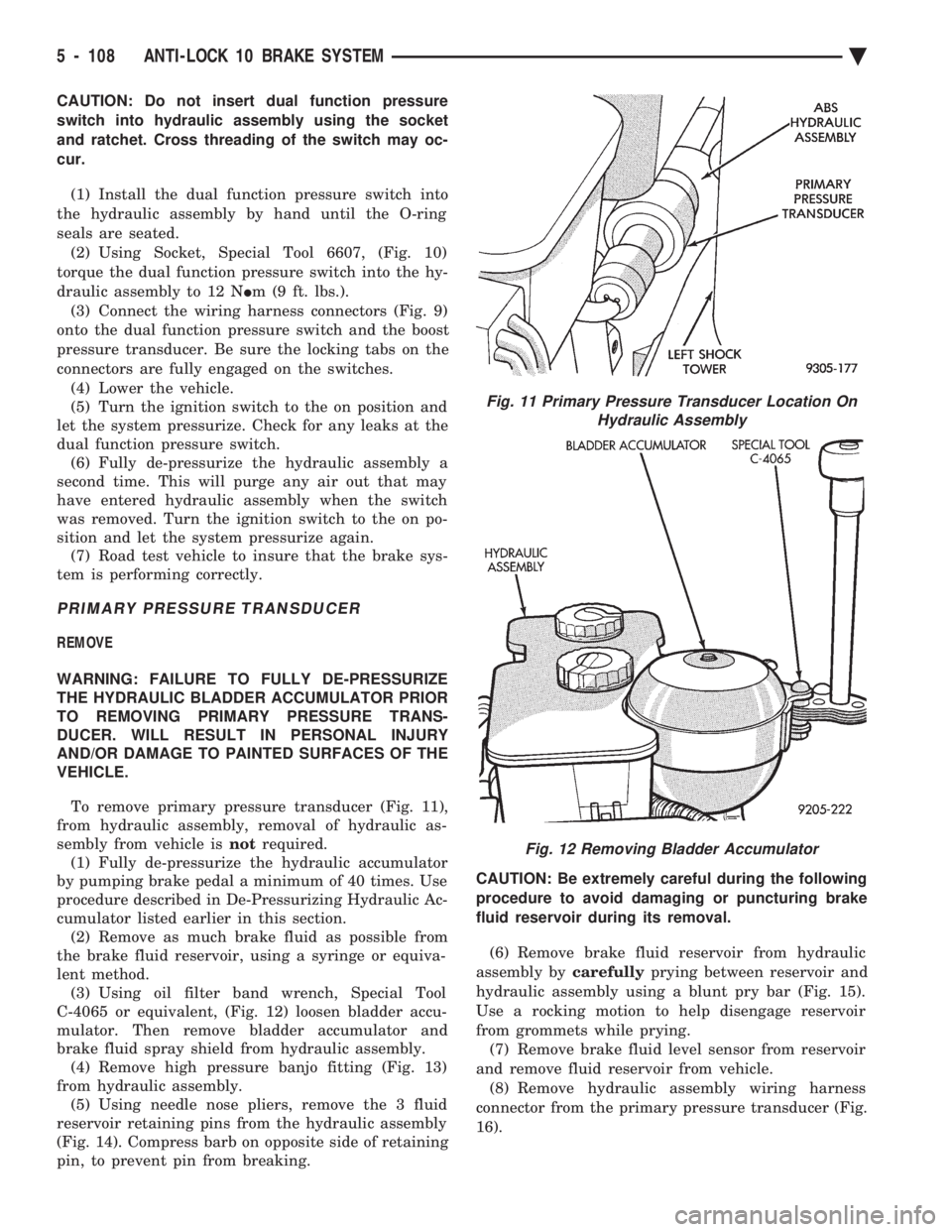
lent method. (3) Using oil filter band wrench, Special Tool
C-4065 or equivalent, (Fig. 12) loosen bladder accu-
mulator. Then remove bladder accumulator and
brake fluid spray shield from hydraulic assembly. (4) Remove high pressure banjo fitting (Fig. 13)
from hydraulic assembly. (5) Using needle nose pliers, remove the 3 fluid
reservoir retaining pins from the hydraulic assembly
(Fig. 14). Compress barb on opposite side of retaining
pin, to prevent pin from breaking. CAUTION: Be extremely careful during the following
procedure to avoid damaging or puncturing brake
fluid reservoir during its removal.
(6) Remove brake fluid reservoir from hydraulic
assembly by carefullyprying between reservoir and
hydraulic assembly using a blunt pry bar (Fig. 15).
Use a rocking motion to help disengage reservoir
from grommets while prying. (7) Remove brake fluid level sensor from reservoir
and remove fluid reservoir from vehicle. (8) Remove hydraulic assembly wiring harness
connector from the primary pressure transducer (Fig.
16).
Fig. 11 Primary Pressure Transducer Location On Hydraulic Assembly
Fig. 12 Removing Bladder Accumulator
5 - 108 ANTI-LOCK 10 BRAKE SYSTEM Ä
Page 263 of 2438
ANTI-LOCK BRAKE SYSTEMÐBENDIX ANTI-LOCK 6 AA,AG,AJ,AP BODY INDEX
page page
ABS Brake System Diagnosis .............. 123
ABS Brake System Diagnostic Features ...... 125
ABS Computer System Service Precautions . . . 124
ABS General Service Precautions ........... 124
Anti-Lock Brake System Components ........ 116
Anti-Lock Brake System Definitions .......... 113
Anti-Lock Brakes Operation and Performance . . 115
Anti-Lock System Relays and Warning Lamps . . 120
Controller Anti-Lock Brake (CAB) ............ 119
Diagnostic Connector ..................... 120
Electronic Components ................... 130 General Information
...................... 113
Hydraulic Circuits and Valve Operation ....... 121
Major Components ...................... 114
Mechanical Diagnostics and Service Procedures . 125
Normal Braking System Function ............ 114
On-Car ABS Brake System Service .......... 126
Specifications .......................... 135
System Self-Diagnostics .................. 115
Vehicle Performance ..................... 115
Warning Systems Operation ............... 116
GENERAL INFORMATION
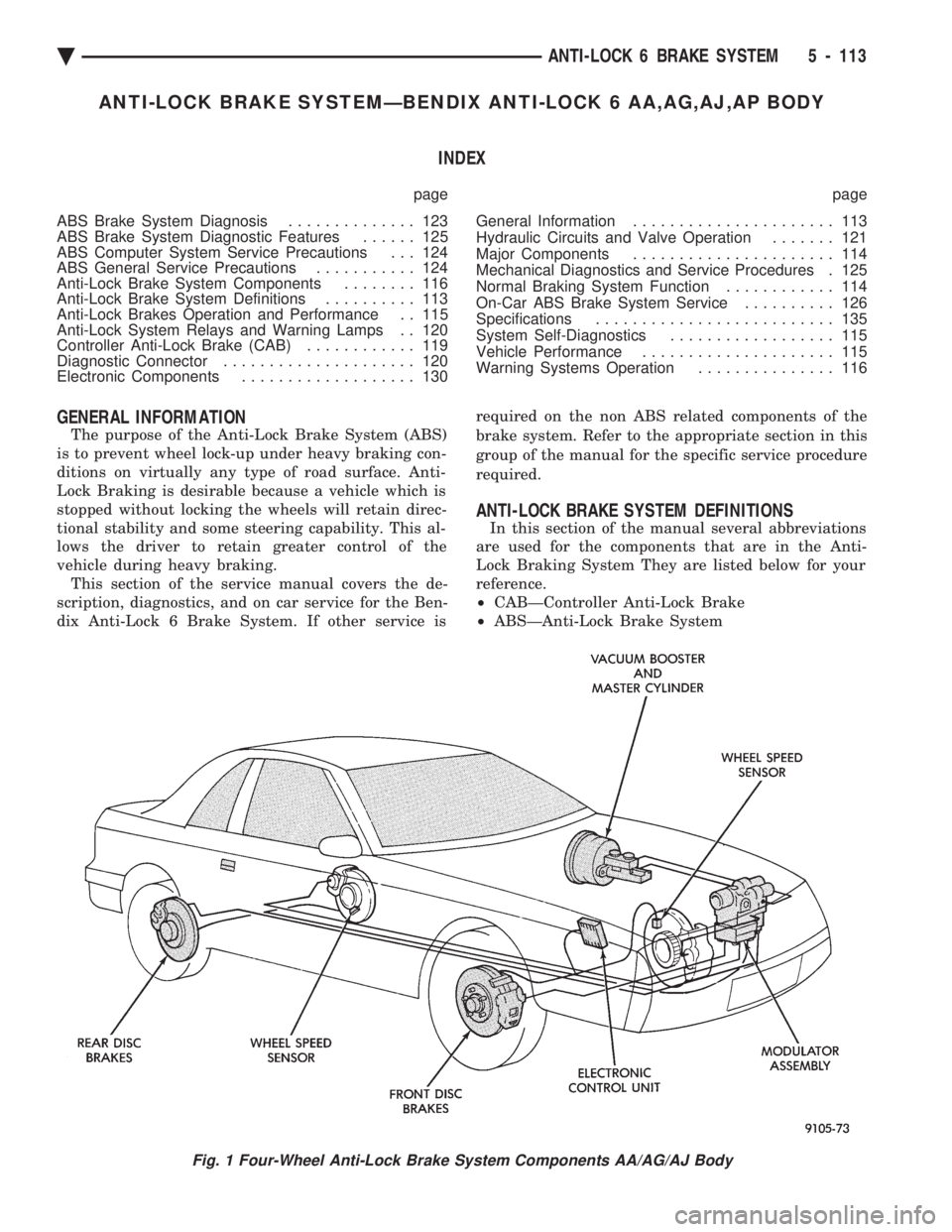
The purpose of the Anti-Lock Brake System (ABS)
is to prevent wheel lock-up under heavy braking con-
ditions on virtually any type of road surface. Anti-
Lock Braking is desirable because a vehicle which is
stopped without locking the wheels will retain direc-
tional stability and some steering capability. This al-
lows the driver to retain greater control of the
vehicle during heavy braking. This section of the service manual covers the de-
scription, diagnostics, and on car service for the Ben-
dix Anti-Lock 6 Brake System. If other service is required on the non ABS related components of the
brake system. Refer to the appropriate section in this
group of the manual for the specific service procedure
required.
ANTI-LOCK BRAKE SYSTEM DEFINITIONS
In this section of the manual several abbreviations
are used for the components that are in the Anti-
Lock Braking System They are listed below for your
reference.
² CABÐController Anti-Lock Brake
² ABSÐAnti-Lock Brake System
Fig. 1 Four-Wheel Anti-Lock Brake System Components AA/AG/AJ Body
Ä ANTI-LOCK 6 BRAKE SYSTEM 5 - 113
Page 264 of 2438
² PSIÐPounds per Square Inch (pressure)
² WSSÐWheel Speed Sensor
NORMAL BRAKING SYSTEM FUNCTION
Under normal braking conditions, the ABS System
functions the same as a standard brake system with
a diagonally split master cylinder and conventional
vacuum assist. If a wheel locking tendency is detected during a
brake application, the system will enter Anti-Lock
mode. During Anti-Lock Braking, hydraulic pressure
in the four wheel circuits is modulated to prevent
any wheel from locking. Each wheel circuit is de-
signed with a set of electrical valves and hydraulic
line to provide modulation, although for vehicle sta-
bility, both rear wheel valves receive the same elec-
trical signal. The system can build or reduce
pressure at each wheel, depending on signals gener-
ated by the wheel speed sensors (WSS) at each wheel
and received at the Controller Anti-Lock Brake
(CAB).
MAJOR COMPONENTS
The following is a list of major system components.
Details of all components can be found later in this
section. See (Fig. 1) for the general location of the
components in the vehicle.
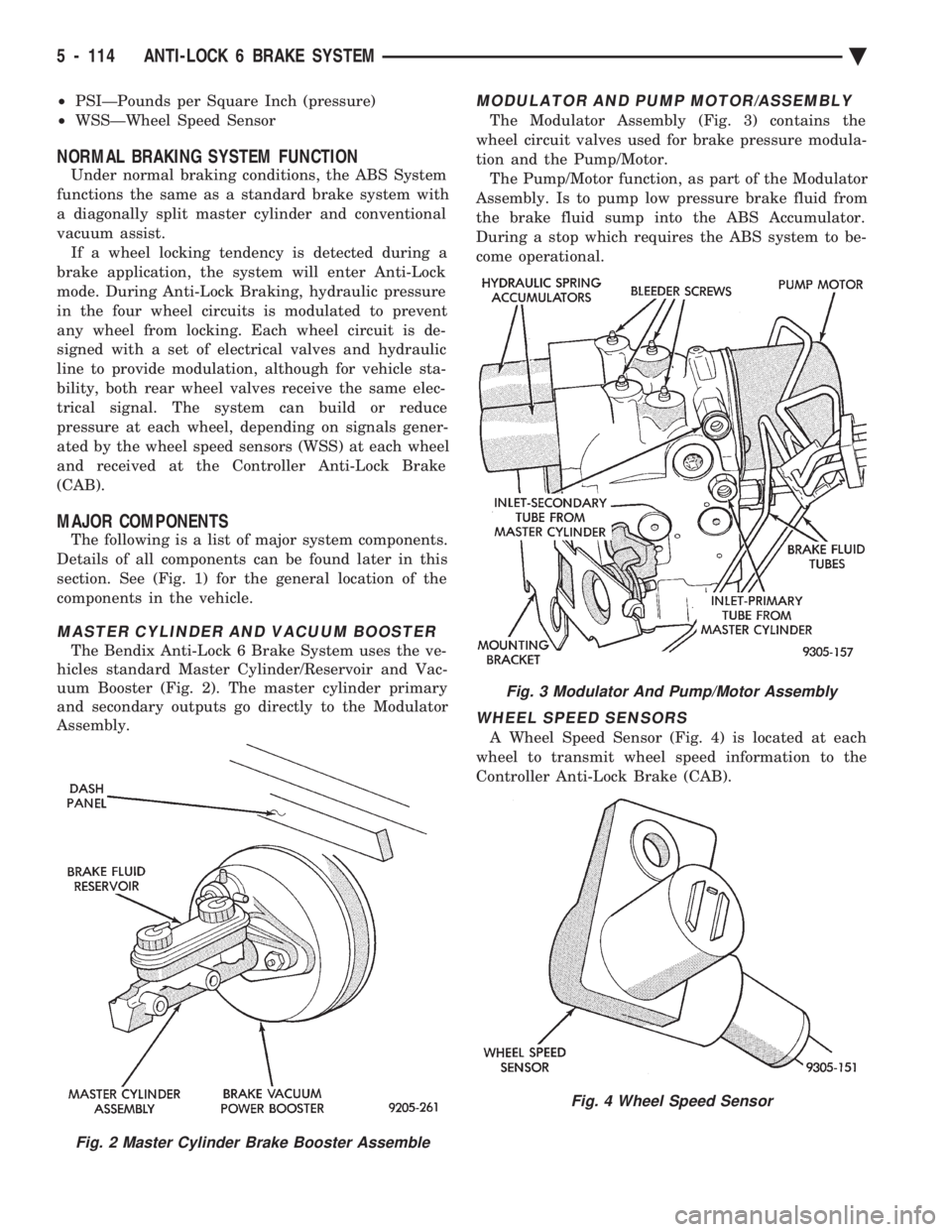
MASTER CYLINDER AND VACUUM BOOSTER
The Bendix Anti-Lock 6 Brake System uses the ve-
hicles standard Master Cylinder/Reservoir and Vac-
uum Booster (Fig. 2). The master cylinder primary
and secondary outputs go directly to the Modulator
Assembly.
MODULATOR AND PUMP MOTOR/ASSEMBLY
The Modulator Assembly (Fig. 3) contains the
wheel circuit valves used for brake pressure modula-
tion and the Pump/Motor. The Pump/Motor function, as part of the Modulator
Assembly. Is to pump low pressure brake fluid from
the brake fluid sump into the ABS Accumulator.
During a stop which requires the ABS system to be-
come operational.
WHEEL SPEED SENSORS
A Wheel Speed Sensor (Fig. 4) is located at each
wheel to transmit wheel speed information to the
Controller Anti-Lock Brake (CAB).
Fig. 2 Master Cylinder Brake Booster Assemble
Fig. 3 Modulator And Pump/Motor Assembly
Fig. 4 Wheel Speed Sensor
5 - 114 ANTI-LOCK 6 BRAKE SYSTEM Ä
Page 265 of 2438
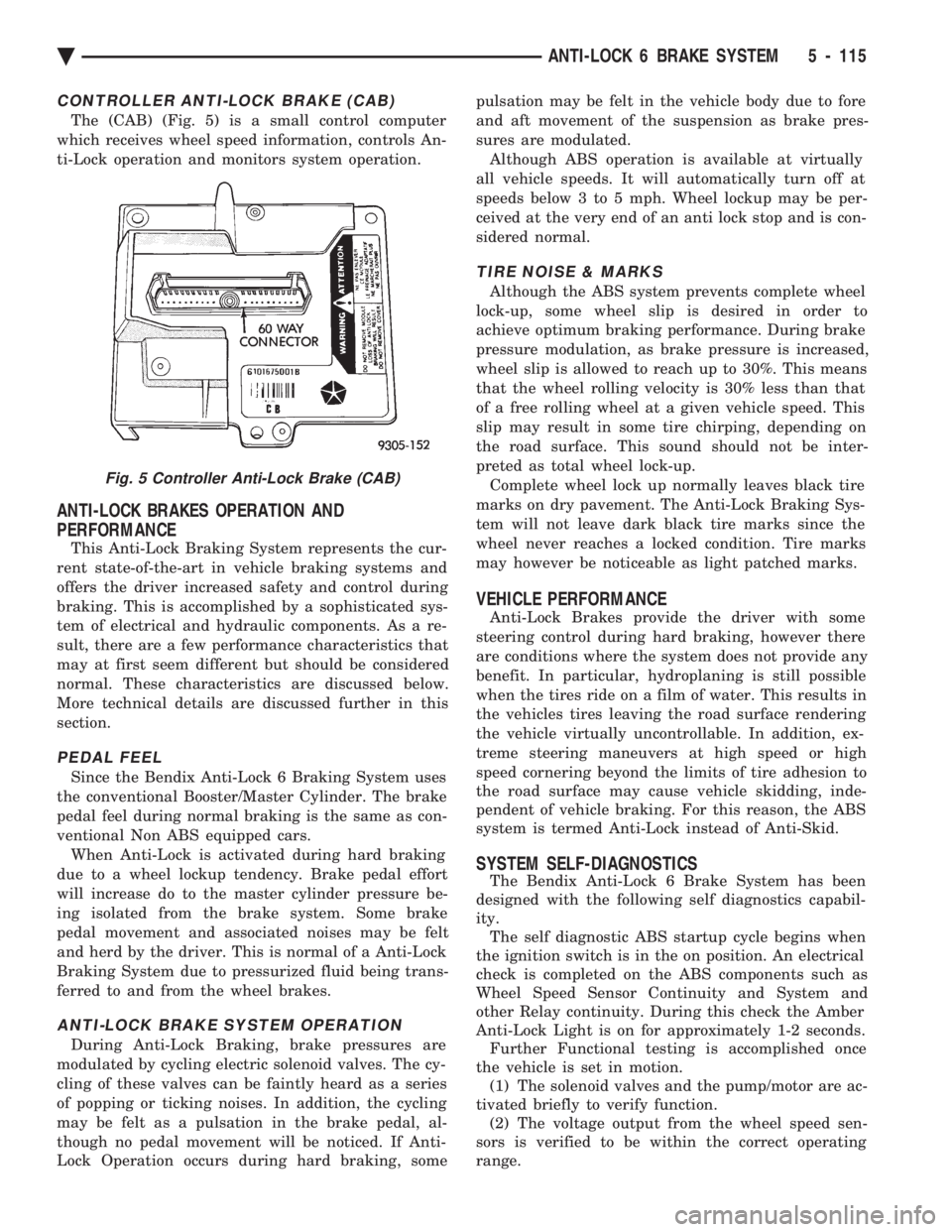
CONTROLLER ANTI-LOCK BRAKE (CAB)
The (CAB) (Fig. 5) is a small control computer
which receives wheel speed information, controls An-
ti-Lock operation and monitors system operation.
ANTI-LOCK BRAKES OPERATION AND
PERFORMANCE
This Anti-Lock Braking System represents the cur-
rent state-of-the-art in vehicle braking systems and
offers the driver increased safety and control during
braking. This is accomplished by a sophisticated sys-
tem of electrical and hydraulic components. As a re-
sult, there are a few performance characteristics that
may at first seem different but should be considered
normal. These characteristics are discussed below.
More technical details are discussed further in this
section.
PEDAL FEEL
Since the Bendix Anti-Lock 6 Braking System uses
the conventional Booster/Master Cylinder. The brake
pedal feel during normal braking is the same as con-
ventional Non ABS equipped cars. When Anti-Lock is activated during hard braking
due to a wheel lockup tendency. Brake pedal effort
will increase do to the master cylinder pressure be-
ing isolated from the brake system. Some brake
pedal movement and associated noises may be felt
and herd by the driver. This is normal of a Anti-Lock
Braking System due to pressurized fluid being trans-
ferred to and from the wheel brakes.
ANTI-LOCK BRAKE SYSTEM OPERATION
During Anti-Lock Braking, brake pressures are
modulated by cycling electric solenoid valves. The cy-
cling of these valves can be faintly heard as a series
of popping or ticking noises. In addition, the cycling
may be felt as a pulsation in the brake pedal, al-
though no pedal movement will be noticed. If Anti-
Lock Operation occurs during hard braking, some pulsation may be felt in the vehicle body due to fore
and aft movement of the suspension as brake pres-
sures are modulated.
Although ABS operation is available at virtually
all vehicle speeds. It will automatically turn off at
speeds below 3 to 5 mph. Wheel lockup may be per-
ceived at the very end of an anti lock stop and is con-
sidered normal.
TIRE NOISE & MARKS
Although the ABS system prevents complete wheel
lock-up, some wheel slip is desired in order to
achieve optimum braking performance. During brake
pressure modulation, as brake pressure is increased,
wheel slip is allowed to reach up to 30%. This means
that the wheel rolling velocity is 30% less than that
of a free rolling wheel at a given vehicle speed. This
slip may result in some tire chirping, depending on
the road surface. This sound should not be inter-
preted as total wheel lock-up. Complete wheel lock up normally leaves black tire
marks on dry pavement. The Anti-Lock Braking Sys-
tem will not leave dark black tire marks since the
wheel never reaches a locked condition. Tire marks
may however be noticeable as light patched marks.
VEHICLE PERFORMANCE
Anti-Lock Brakes provide the driver with some
steering control during hard braking, however there
are conditions where the system does not provide any
benefit. In particular, hydroplaning is still possible
when the tires ride on a film of water. This results in
the vehicles tires leaving the road surface rendering
the vehicle virtually uncontrollable. In addition, ex-
treme steering maneuvers at high speed or high
speed cornering beyond the limits of tire adhesion to
the road surface may cause vehicle skidding, inde-
pendent of vehicle braking. For this reason, the ABS
system is termed Anti-Lock instead of Anti-Skid.
SYSTEM SELF-DIAGNOSTICS
The Bendix Anti-Lock 6 Brake System has been
designed with the following self diagnostics capabil-
ity. The self diagnostic ABS startup cycle begins when
the ignition switch is in the on position. An electrical
check is completed on the ABS components such as
Wheel Speed Sensor Continuity and System and
other Relay continuity. During this check the Amber
Anti-Lock Light is on for approximately 1-2 seconds. Further Functional testing is accomplished once
the vehicle is set in motion. (1) The solenoid valves and the pump/motor are ac-
tivated briefly to verify function. (2) The voltage output from the wheel speed sen-
sors is verified to be within the correct operating
range.
Fig. 5 Controller Anti-Lock Brake (CAB)
Ä ANTI-LOCK 6 BRAKE SYSTEM 5 - 115