light CHEVROLET HHR 2009 1.G Owners Manual
[x] Cancel search | Manufacturer: CHEVROLET, Model Year: 2009, Model line: HHR, Model: CHEVROLET HHR 2009 1.GPages: 450, PDF Size: 2.49 MB
Page 261 of 450
Rocking Your Vehicle to Get It Out
Turn the steering wheel left and right to clear the area
around the front wheels. Turn off any traction system.
Shift back and forth between R (Reverse) and a forward
gear, or with a manual transmission, between 1 (First) or
2 (Second) and R (Reverse), spinning the wheels as little
as possible. To prevent transmission wear, wait until the
wheels stop spinning before shifting gears. Release the
accelerator pedal while shifting, and press lightly on the
accelerator pedal when the transmission is in gear.
Slowly spinning the wheels in the forward and reverse
directions causes a rocking motion that could free the
vehicle. If that does not get the vehicle out after a few
tries, it might need to be towed out. If the vehicle does
need to be towed out, seeTowing Your Vehicle on
page 4-31.
Loading the Vehicle
It is very important to know how much weight your
vehicle can carry. Two labels on your vehicle show
how much weight it may properly carry, the Tire
and Loading Information label and the Vehicle
Certication label.
{CAUTION:
Do not load the vehicle any heavier than the
Gross Vehicle Weight Rating (GVWR), or
either the maximum front or rear Gross Axle
Weight Rating (GAWR). If you do, parts on the
vehicle can break, and it can change the way
your vehicle handles. These could cause you
to lose control and crash. Also, overloading
can shorten the life of the vehicle.
4-25
Page 283 of 450
Keep a record with all parts receipts and list the
mileage and the date of any service work performed.
SeeMaintenance Record on page 6-18.
Adding Equipment to the Outside of
the Vehicle
Things added to the outside of the vehicle can affect the
airow around it. This can cause wind noise and can
affect fuel economy and windshield washer performance.
Check with your dealer/retailer before adding equipment
to the outside of the vehicle.
Fuel
Use of the recommended fuel is an important part
of the proper maintenance of this vehicle. To help
keep the engine clean and maintain optimum vehicle
performance, we recommend the use of gasoline
advertised as TOP TIER Detergent Gasoline.
The 8th digit of the Vehicle Identication Number (VIN)
shows the code letter or number that identies the
vehicle’s engine. The VIN is at the top left of the
instrument panel. SeeVehicle Identification Number
(VIN) on page 5-107.
If the vehicle has the 2.2L L4 engine (VIN Code B)
or the 2.4L L4 engine (VIN Code V), you can use either
unleaded gasoline or ethanol fuel containing up to85% ethanol (E85). SeeFuel E85 (85% Ethanol) on
page 5-7. If the vehicle has the 2.0L L4 engine
(VIN Code X), use only unleaded gasoline.
SeeGasoline Octane on page 5-5.
Gasoline Octane
If the vehicle has the 2.2L L4 engine (VIN Code B), use
regular unleaded gasoline with a posted octane rating
of 87 or higher. If the octane rating is less than 87, you
might notice an audible knocking noise when you
drive, commonly referred to as spark knock. If this
occurs, use a gasoline rated at 87 octane or higher as
soon as possible. If you are using gasoline rated at
87 octane or higher and you hear heavy knocking, the
engine needs service.
If the vehicle has the 2.4L L4 engine (VIN Code V) or
the 2.0L L4 engine (VIN Code X), use premium unleaded
gasoline with a posted octane rating of 91 or higher.
You can also use regular unleaded gasoline rated at
87 octane or higher, but the vehicle’s acceleration could
be slightly reduced, and you might notice a slight audible
knocking noise, commonly referred to as spark knock.
If the octane is less than 87, you might notice a heavy
knocking noise when you drive. If this occurs, use a
gasoline rated at 87 octane or higher as soon as possible.
Otherwise, you could damage the engine. If you are using
gasoline rated at 87 octane or higher and you hear heavy
knocking, the engine needs service.
5-5
Page 289 of 450
When replacing the fuel cap, turn it clockwise
until it clicks. Make sure the cap is fully installed.
The diagnostic system can determine if the fuel cap
has been left off or improperly installed. This would
allow fuel to evaporate into the atmosphere.
SeeMalfunction Indicator Lamp on page 3-37.
The CHECK GAS CAP message displays on the Driver
Information Center (DIC) if the fuel cap is not properly
installed. SeeDIC Warnings and Messages on
page 3-50for more information.
To close the fuel door securely, push the door to the
closed position.
{CAUTION:
If a re starts while you are refueling, do not
remove the nozzle. Shut off the ow of fuel by
shutting off the pump or by notifying the station
attendant. Leave the area immediately.
Notice:If you need a new fuel cap, be sure to get
the right type. Your dealer/retailer can get one
for you. If you get the wrong type, it may not t
properly. This may cause the malfunction indicator
lamp to light and may damage the fuel tank and
emissions system. SeeMalfunction Indicator Lamp
on page 3-37.
5-11
Page 301 of 450
Used oil can be a threat to the environment. If you
change your own oil, be sure to drain all the oil from the
lter before disposal. Never dispose of oil by putting it
in the trash, pouring it on the ground, into sewers, or into
streams or bodies of water. Recycle it by taking it to a
place that collects used oil.
Engine Air Cleaner/Filter
When to Inspect the Engine Air
Cleaner/Filter
Inspect the air cleaner/lter at the MaintenanceII
intervals and replace it at the rst oil change after each
50,000 mile (80 000 km) interval. SeeScheduled
Maintenance on page 6-4for more information. If you
are driving in dusty/dirty conditions, inspect the lter
at each engine oil change. The 2.0L engine inspect at
each oil change. Replace lter if appears dusty or dirty.
How to Inspect the Engine Air
Cleaner/Filter (2.2L and 2.4L Engines)
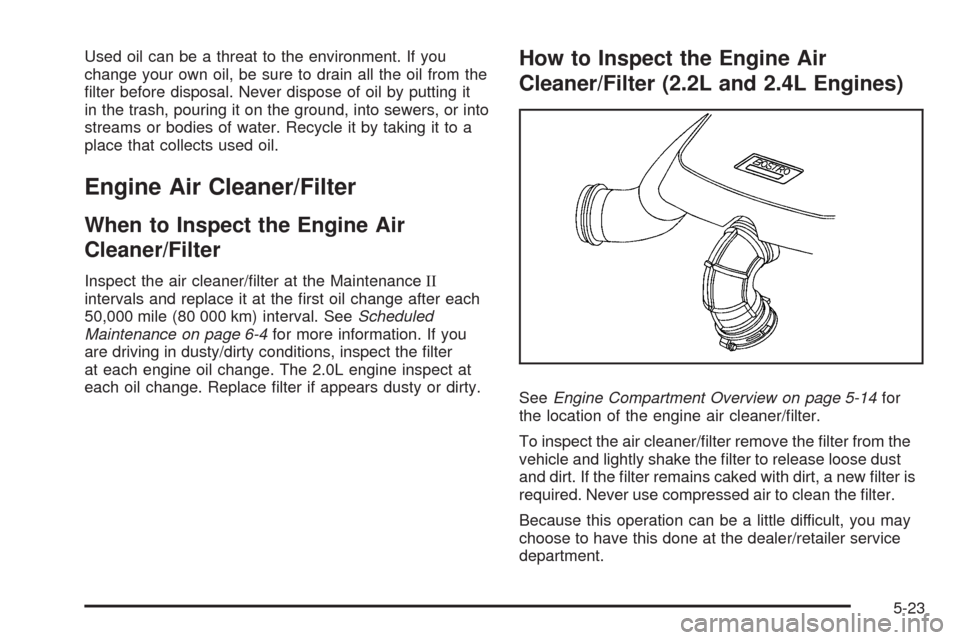
SeeEngine Compartment Overview on page 5-14for
the location of the engine air cleaner/lter.
To inspect the air cleaner/lter remove the lter from the
vehicle and lightly shake the lter to release loose dust
and dirt. If the lter remains caked with dirt, a new lter is
required. Never use compressed air to clean the lter.
Because this operation can be a little difficult, you may
choose to have this done at the dealer/retailer service
department.
5-23
Page 302 of 450
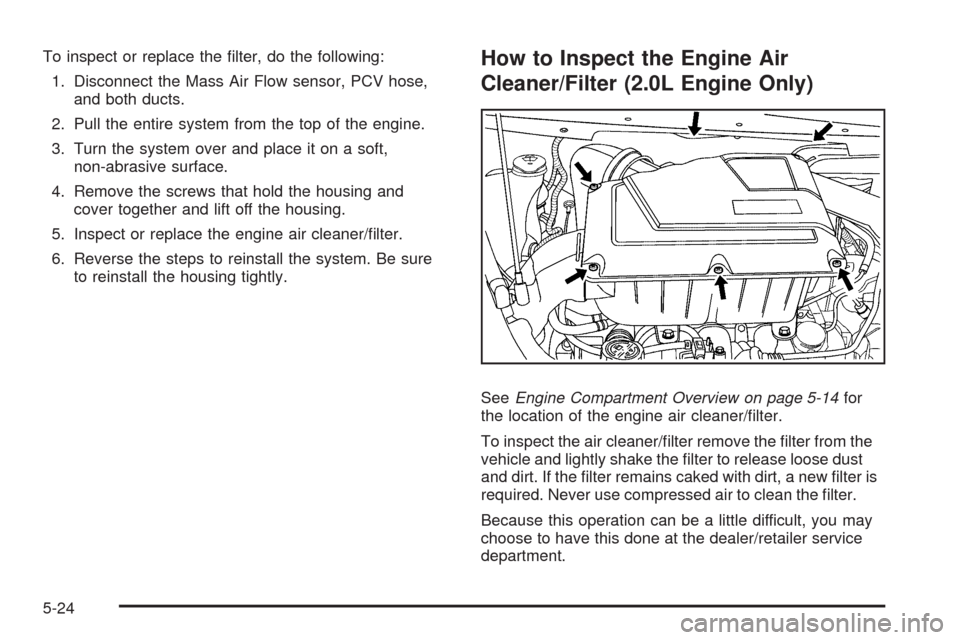
To inspect or replace the lter, do the following:
1. Disconnect the Mass Air Flow sensor, PCV hose,
and both ducts.
2. Pull the entire system from the top of the engine.
3. Turn the system over and place it on a soft,
non-abrasive surface.
4. Remove the screws that hold the housing and
cover together and lift off the housing.
5. Inspect or replace the engine air cleaner/lter.
6. Reverse the steps to reinstall the system. Be sure
to reinstall the housing tightly.How to Inspect the Engine Air
Cleaner/Filter (2.0L Engine Only)
SeeEngine Compartment Overview on page 5-14for
the location of the engine air cleaner/lter.
To inspect the air cleaner/lter remove the lter from the
vehicle and lightly shake the lter to release loose dust
and dirt. If the lter remains caked with dirt, a new lter is
required. Never use compressed air to clean the lter.
Because this operation can be a little difficult, you may
choose to have this done at the dealer/retailer service
department.
5-24
Page 310 of 450
8. By this time, the coolant level inside the radiator
ller port may be lower. If the level is lower, add
more of the proper DEX-COOL
®coolant mixture
through the ll port until the level reaches the base
of the ll port.
9. Then replace the pressure cap. At any time during
this procedure, if coolant begins to ow out of the
ll port, reinstall the pressure cap. Be sure the
pressure cap is hand-tight and fully seated.
10. When the engine has cooled, check the coolant in
the coolant recovery tank. The level in the coolant
recovery tank should be at the COLD FILL line
when the engine is cold.
Pressure Cap
Notice:If the pressure cap is not tightly installed,
coolant loss and possible engine damage may
occur. Be sure the cap is properly and tightly
secured.
SeeEngine Compartment Overview on page 5-14for
more information on location.
Engine Overheating
The vehicle has several indicators to warn of engine
overheating.
You will nd a coolant temperature warning light and a
coolant temperature gage on your vehicle’s instrument
panel. SeeEngine Coolant Temperature Warning
Light on page 3-36andEngine Coolant Temperature
Gage on page 3-36for more information.
You may decide not to lift the hood when this warning
appears, but instead get service help right away.
SeeRoadside Assistance Program on page 7-7.
If you do decide to lift the hood, make sure the vehicle
is parked on a level surface.
Then check to see if the engine cooling fans are
running. If the engine is overheating, both fans should
be running. If they are not, do not continue to run
the engine and have the vehicle serviced.
Notice:Engine damage from running the engine
without coolant is not covered by the warranty.
Notice:If the engine catches re because of being
driven with no coolant, your vehicle can be badly
damaged. The costly repairs would not be covered
by the vehicle warranty.
5-32
Page 313 of 450
Brakes
Brake Fluid
The brake master cylinder and, on manual transmission
vehicles, the clutch hydraulic system use the same
reservoir. SeeEngine Compartment Overview on
page 5-14for the location of the reservoir. The reservoir
is lled with DOT 3 brake uid.
There are only two reasons why the brake uid level in
the reservoir might go down:
The brake uid level goes down because of normal
brake lining wear. When new linings are installed,
the uid level goes back up.
A uid leak in the brake and/or clutch hydraulic
system can also cause a low uid level. Have the
brake and/or clutch hydraulic system xed, since a
leak means that sooner or later the brakes and/or
clutch will not work well.Do not top off the brake/clutch uid. Adding uid does not
correct a leak. If uid is added when the brake linings are
worn, there will be too much uid when new brake linings
are installed. Add or remove uid, as necessary, only
when work is done on the brake/clutch hydraulic system.
{CAUTION:
If too much brake uid is added, it can spill on the
engine and burn, if the engine is hot enough. You
or others could be burned, and the vehicle could
be damaged. Add brake uid only when work is
done on the brake and/or clutch hydraulic system.
When the brake uid falls to a low level, the brake
warning light comes on. SeeBrake System Warning
Light on page 3-33.
5-35
Page 315 of 450
Brake Wear
This vehicle has front disc brakes and could have rear
drum brakes or rear disc brakes.
Disc brake pads have built-in wear indicators that make
a high-pitched warning sound when the brake pads are
worn and new pads are needed. The sound can come
and go or be heard all the time the vehicle is moving,
except when applying the brake pedal rmly.
{CAUTION:
The brake wear warning sound means that soon
the brakes will not work well. That could lead to an
accident. When the brake wear warning sound is
heard, have the vehicle serviced.
Notice:Continuing to drive with worn-out brake
pads could result in costly brake repair.
Some driving conditions or climates can cause a brake
squeal when the brakes are rst applied or lightly applied.
This does not mean something is wrong with the brakes.Properly torqued wheel nuts are necessary to help
prevent brake pulsation. When tires are rotated, inspect
brake pads for wear and evenly tighten wheel nuts in
the proper sequence to torque specications in
Capacities and Specifications on page 5-114.
If the vehicle has rear drum brakes, they do not have
wear indicators, but if a rear brake rubbing noise is heard,
have the rear brake linings inspected immediately. Rear
brake drums should be removed and inspected each time
the tires are removed for rotation or changing. When the
front brake pads are replaced, have the rear brakes
inspected, too.
Brake linings should always be replaced as complete
axle sets.
Brake Pedal Travel
See your dealer/retailer if the brake pedal does not
return to normal height, or if there is a rapid increase in
pedal travel. This could be a sign that brake service
might be required.
Brake Adjustment
Every time the brakes are applied, with or without the
vehicle moving, the brakes adjust for wear.
5-37
Page 318 of 450
Notice:If you leave the radio or other accessories
on during the jump starting procedure, they could be
damaged. The repairs would not be covered by the
warranty. Always turn off the radio and other
accessories when jump starting the vehicle.
3. Turn off the ignition on both vehicles. Unplug
unnecessary accessories plugged into the cigarette
lighter or the accessory power outlet. Turn off
the radio and all lamps that are not needed.
This will avoid sparks and help save both batteries.
And it could save the radio!
4. Open the hood on the other vehicle and locate the
positive (+) and negative (−) terminal locations on
that vehicle.You will not see the battery of your vehicle under
the hood. It is located in the rear cargo area.
You will not need to access your battery for jump
starting. The vehicle has a remote positive (+) and a
remote negative (−) jump starting terminal.
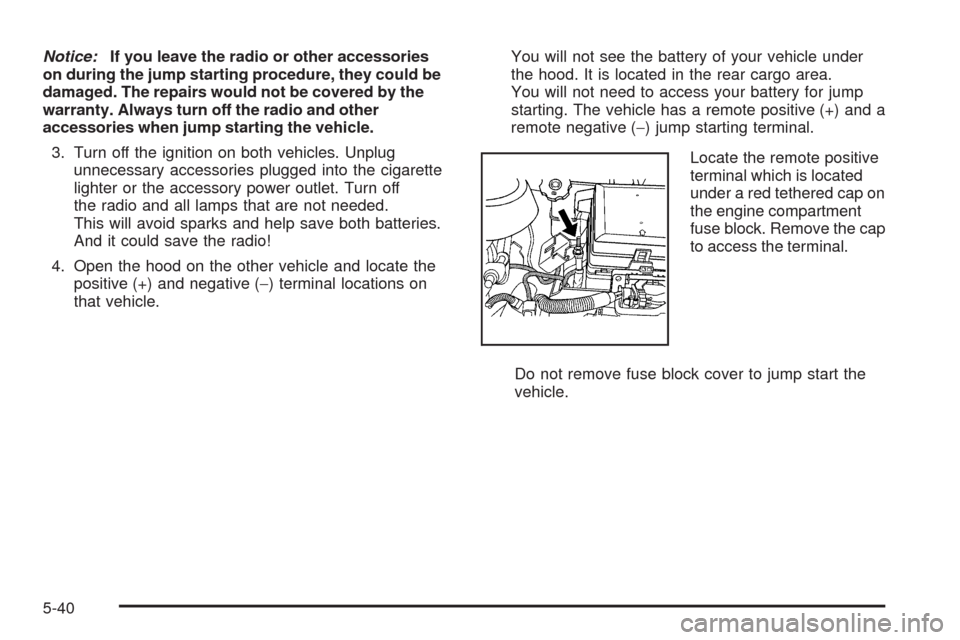
Locate the remote positive
terminal which is located
under a red tethered cap on
the engine compartment
fuse block. Remove the cap
to access the terminal.
Do not remove fuse block cover to jump start the
vehicle.
5-40
Page 319 of 450
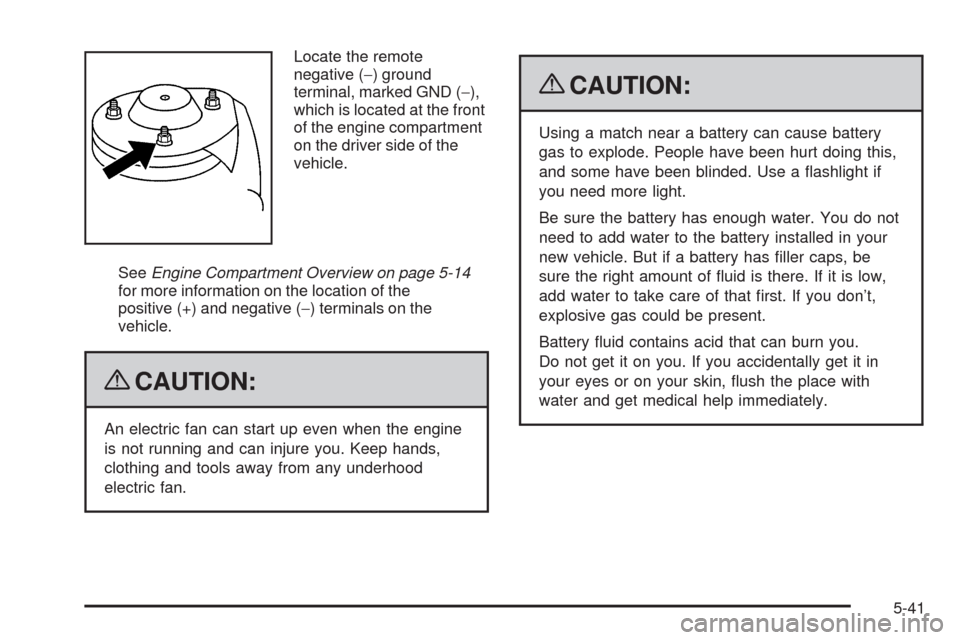
Locate the remote
negative (−) ground
terminal, marked GND (−),
which is located at the front
of the engine compartment
on the driver side of the
vehicle.
SeeEngine Compartment Overview on page 5-14
for more information on the location of the
positive (+) and negative (−) terminals on the
vehicle.
{CAUTION:
An electric fan can start up even when the engine
is not running and can injure you. Keep hands,
clothing and tools away from any underhood
electric fan.
{CAUTION:
Using a match near a battery can cause battery
gas to explode. People have been hurt doing this,
and some have been blinded. Use a ashlight if
you need more light.
Be sure the battery has enough water. You do not
need to add water to the battery installed in your
new vehicle. But if a battery has ller caps, be
sure the right amount of uid is there. If it is low,
add water to take care of that rst. If you don’t,
explosive gas could be present.
Battery uid contains acid that can burn you.
Do not get it on you. If you accidentally get it in
your eyes or on your skin, ush the place with
water and get medical help immediately.
5-41