ECO CHEVROLET KODIAK 2005 Owners Manual
[x] Cancel search | Manufacturer: CHEVROLET, Model Year: 2005, Model line: KODIAK, Model: CHEVROLET KODIAK 2005Pages: 374, PDF Size: 5.46 MB
Page 36 of 374
Infants and Young Children
Everyone in a vehicle needs protection! This includes
infants and all other children. Neither the distance
traveled nor the age and size of the traveler changes
the need, for everyone, to use safety restraints. In fact,
the law in every state in the United States and in
every Canadian province says children up to some age
must be restrained while in a vehicle.
Every time infants and young children ride in vehicles,
they should have the protection provided by appropriate
restraints. Young children should not use the vehicle’s
adult safety belts alone, unless there is no other choice.
Instead, they need to use a child restraint.
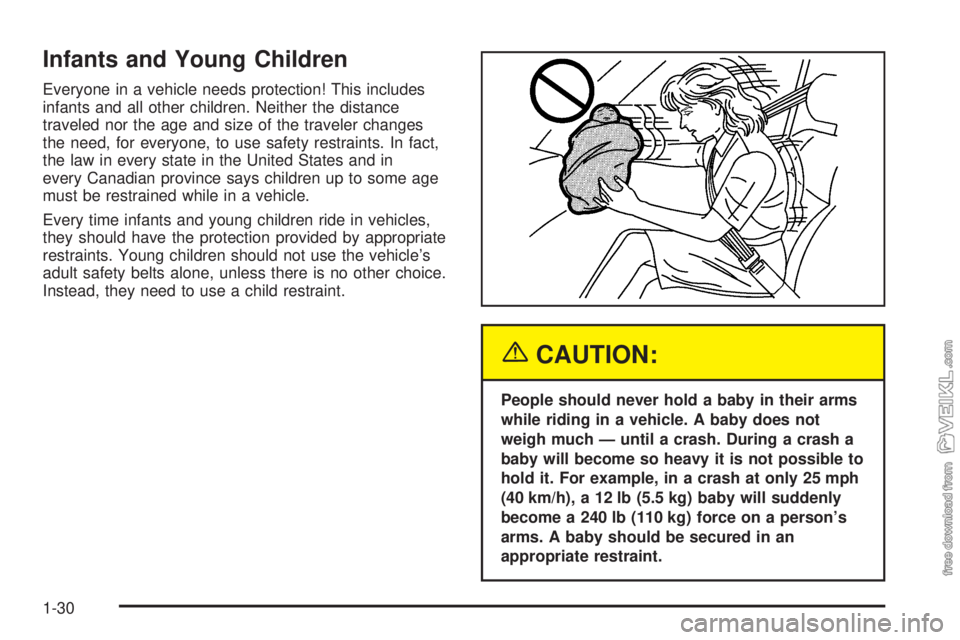
{CAUTION:
People should never hold a baby in their arms
while riding in a vehicle. A baby does not
weigh much — until a crash. During a crash a
baby will become so heavy it is not possible to
hold it. For example, in a crash at only 25 mph
(40 km/h), a 12 lb (5.5 kg) baby will suddenly
become a 240 lb (110 kg) force on a person’s
arms. A baby should be secured in an
appropriate restraint.
1-30
Page 43 of 374
Unless the passenger’s airbag has been turned off,
never put a rear-facing child restraint in this vehicle.
Here is why:
{CAUTION:
A child in a rear-facing child restraint can be
seriously injured or killed if the passenger’s
airbag inates. This is because the back of the
rear-facing child restraint would be very close
to the inating airbag. Do not use a rear-facing
child restraint in this vehicle unless the
passenger’s airbag has been turned off.
Even though the airbag off switch is designed
to turn off the passenger’s frontal airbag, no
system is fail-safe, and no one can guarantee
CAUTION: (Continued)
CAUTION: (Continued)
that an airbag will not deploy under some
unusual circumstance, even though it is turned
off. We recommend that rear-facing child
restraints be transported in vehicles with a
rear seat that will accommodate a rear-facing
child restraint, whenever possible.
If you need to secure a forward-facing child
restraint in the right front static seat or the
right front bench seat, always move the
passenger seat as far back as it will go.
Keep in mind that an unsecured child restraint can
move around in a collision or sudden stop and injure
people in the vehicle — even when no child is in it.
1-37
Page 44 of 374
Where to Put the Restraint
(Crew Cab Models)
Accident statistics show that children are safer if they
are restrained in the rear rather than the front seat.
We recommend that child restraints be secured in a rear
seat position, including an infant riding in a rear-racing
infant seat, a child riding in a forward-facing child
seat and an older child riding in a booster seat.
If your vehicle has airbags and you need to secure a
child restraint in the right front passenger’s seat, there is
a switch on the instrument panel that you can use to
turn off the passenger’s airbag. SeeAirbag Off Switch
on page 1-56andSecuring a Child Restraint in the Right
Front Seat Position on page 1-44for more on this,
including important safety information.Unless the passenger’s airbag has been turned off,
never put a rear-facing child restraint in this vehicle.
Here is why:
{CAUTION:
A child in a rear-facing child restraint can be
seriously injured or killed if the right front
passenger’s airbag inates. This is because
the back of the rear-facing child restraint
would be very close to the inating airbag.
Be sure to turn off the airbag before using a
rear-facing child restraint in the right front
seat position.
Even though the airbag off switch is designed
to turn off the passenger’s airbag, no system
is fail-safe, and no one can guarantee that an
airbag will not deploy under some unusual
circumstance, even though it is turned off.
We recommend that rear-facing child restraints
be secured in the rear seat, even if the airbag
is off.
CAUTION: (Continued)
1-38
Page 50 of 374
Securing a Child Restraint in the
Right Front Seat Position
Do not use a child restraint with an air suspension seat.
{CAUTION:
A child restraint cannot be secured properly in
an air-suspension type seat. This is because
an air-suspension seat is designed to move up
and down for an adult passenger. Do not use a
child restraint in an air-suspension seat.
There is no top strap anchor in this position. Do not
secure a child seat in this position if a national or local
law requires that the top strap be anchored, or if the
instructions that come with the child restraint say that the
top strap must be anchored. SeeTop Strap on page 1-39
if your child restraint has one.
If your vehicle has a right front passenger airbag,
there is a switch on the instrument panel that you can
use to turn off the right front passenger’s airbag
when you need to secure a child restraint in the right
front passenger’s position. SeeAirbag Off Switch
on page 1-56for more on this, including important safety
information.A rear seat is a safer place to secure a forward-facing
child restraint. Never put a rear-facing child restraint
in the right front passenger’s seat unless the airbag
is off. Here is why:
{CAUTION:
A child in a rear-facing child restraint can be
seriously injured or killed if the passenger’s
airbag inates. This is because the back of the
rear-facing child restraint would be very close
to the inating airbag. Do not use a rear-facing
child restraint in this vehicle unless the
passenger’s airbag has been turned off.
Even though the airbag off switch is designed
to turn off the passenger’s frontal airbag, no
system is fail-safe, and no one can guarantee
that an airbag will not deploy under some
unusual circumstance, even though it is
turned off. We recommend that rear-facing
child restraints be transported in vehicles with
a rear seat that will accommodate a rear-facing
child restraint, whenever possible.
CAUTION: (Continued)
1-44
Page 61 of 374
{CAUTION:
When an airbag inates, there is dust in the
air. This dust could cause breathing problems
for people with a history of asthma or other
breathing trouble. To avoid this, everyone in
the vehicle should get out as soon as it is safe
to do so. If you have breathing problems but
cannot get out of the vehicle after an airbag
inates, then get fresh air by opening a
window or a door. If you experience breathing
problems following an airbag deployment,
you should seek medical attention.In many crashes severe enough to inflate the airbag,
windshields are broken by vehicle deformation.
Additional windshield breakage may also occur from the
right front passenger airbag.•Airbags are designed to inflate only once. After they
inflate, you will need some new parts for your
airbag system. If you do not get them, the airbag
system will not be there to help protect you in
another crash. A new system will include airbag
modules and possibly other parts. The service
manual for your vehicle covers the need to replace
other parts.
•Your vehicle is equipped with a crash sensing and
diagnostic module which records information after
a crash. SeeVehicle Data Collection and Event
Data Recorders on page 7-6.
•Let only qualified technicians work on your airbag
system. Improper service can mean that an
airbag system will not work properly. See your
dealer for service.
Notice:If you damage the covering for the driver’s
or the right front passenger’s airbag, the airbag
may not work properly. You may have to replace the
airbag module in the steering wheel or both the
airbag module and the instrument panel for the right
front passenger’s airbag. Do not open or break
the airbag coverings.
1-55
Page 65 of 374
Servicing Your Airbag-Equipped
Vehicle
Airbags affect how your vehicle should be serviced.
There are parts of the airbag system in several places
around your vehicle. You do not want the system to
inflate while someone is working on your vehicle.
Your dealer and the service manual have information
about servicing your vehicle and the airbag system.
To purchase a service manual, seeService Publications
Ordering Information on page 7-8.
{CAUTION:
For up to 10 seconds after the ignition key is
turned off and the battery is disconnected, an
airbag can still inate during improper service.
You can be injured if you are close to an
airbag when it inates. Avoid yellow wires,
wires wrapped with yellow tape or yellow
connectors. They are probably part of the
airbag system. Be sure to follow proper
service procedures, and make sure the person
performing work for you is qualied to do so.
The airbag system does not need regular maintenance.
Adding Equipment to Your
Airbag-Equipped Vehicle
Q:Is there anything I might add to the front of
the vehicle that could keep the airbags from
working properly?
A:Yes. If you add things that change your vehicle’s
frame, bumper system, front end sheet metal or
height, they may keep the airbag system from
working properly. Also, the airbag system may not
work properly if you relocate any of the airbag
sensors. If you have any questions about this,
you should contact Customer Assistance before
you modify your vehicle. The phone numbers
and addresses for Customer Assistance are in
Step Two of theCustomer Satisfaction Procedure
on page 7-2.
1-59
Page 70 of 374
At times you may notice a decrease in range. This is
normal for any remote keyless entry system. If the
transmitter does not work or if you have to stand closer
to your vehicle for the transmitter to work, try this:
•Check the distance. You may be too far from your
vehicle. You may need to stand closer during
rainy or snowy weather.
•Check the location. Other vehicles or objects may
be blocking the signal. Take a few steps to the
left or right, hold the transmitter higher, and
try again.
•Check to determine if battery replacement is
necessary. See “Battery Replacement” under
Remote Keyless Entry System Operation on
page 2-4.
•If you are still having trouble, see your dealer or a
qualified technician for service.
Remote Keyless Entry System
Operation
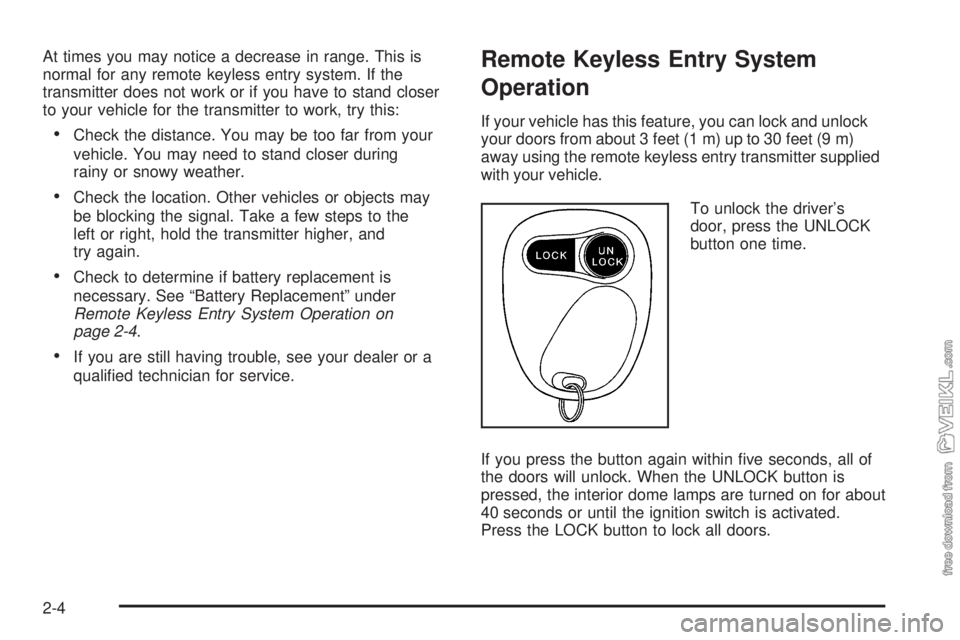
If your vehicle has this feature, you can lock and unlock
your doors from about 3 feet (1 m) up to 30 feet (9 m)
away using the remote keyless entry transmitter supplied
with your vehicle.
To unlock the driver’s
door, press the UNLOCK
button one time.
If you press the button again within five seconds, all of
the doors will unlock. When the UNLOCK button is
pressed, the interior dome lamps are turned on for about
40 seconds or until the ignition switch is activated.
Press the LOCK button to lock all doors.
2-4
Page 72 of 374
Resynchronization
Resynchronization may be necessary due to the
security method used by this system. The transmitter
does not send the same signal twice to the receiver.
The receiver will not respond to a signal it has been sent
previously. This prevents anyone from recording and
playing back the signal from the transmitter.
To resynchronize your transmitter, stand close to your
vehicle and simultaneously press and hold the LOCK
and UNLOCK buttons on the transmitter for at least
five seconds. The door locks should cycle to confirm
resynchronization. If the locks do not cycle, see
your dealer for service.
Doors and Locks
Door Locks
{CAUTION:
Unlocked doors can be dangerous.
Passengers — especially children — can
easily open the doors and fall out of a
moving vehicle. When a door is locked,
the handle will not open it. You increase
the chance of being thrown out of the
vehicle in a crash if the doors are not
locked. So, wear safety belts properly and
lock the doors whenever you drive.
Young children who get into unlocked
vehicles may be unable to get out. A child
can be overcome by extreme heat and can
suffer permanent injuries or even death
from heat stroke. Always lock your vehicle
whenever you leave it.
Outsiders can easily enter through an
unlocked door when you slow down or
stop your vehicle. Locking your doors can
help prevent this from happening.
2-6
Page 76 of 374
Express-Down Feature
The driver’s window also has an express-down feature
that allows the window to be lowered without holding
down the switch. Press and hold the rear of the window
switch labeled AUTO for one second to activate the
express-down mode.
The express-down mode can be cancelled at any time
by pressing the front of the switch. To open the
window part way, lightly tap the switch until the window
is at the desired position.
Lockout Feature
o
(Lockout):If you have a crew cab model with
power windows, the driver’s door will have a window
lockout feature. When engaged, this feature will prevent
all window switches, except the driver’s window
switches, from operating. This switch is located above
the four window switches on the driver’s door. When the
switch is not engaged, all windows will return to
normal operation.
Sliding Rear Window
To open the sliding rear window, pull the latch toward
the driver’s side of the vehicle.
To close the window, slide the window toward the
passenger’s side of the vehicle. The latch will
automatically lock into place. Try to open the window
without releasing the latch to be sure the window is in the
locked position.
Sun Visors
To block out glare, you can swing down the visors.
You can also swing them out to block glare from the side.
2-10
Page 79 of 374
Automatic Transmission
Set the parking brake and move your shift lever to
NEUTRAL (N) or PARK (P), if so equipped. Your engine
will not start in any other position — that is a safety
feature.
Manual Transmission
Set the parking brake, shift to neutral NEUTRAL (N)
and hold the clutch pedal to the floor while starting
the engine.
Starter Motor Operation
•The starter motor will disengage if you release
the key or the engine reaches a predetermined
engine speed.
•To prevent overheating, the starter motor will
disengage after continuously operating for
15 seconds. You must release the key from the
start position to re-engage the starter.
•The starter motor will not engage if the engine
is already running.
•The starter motor will disengage if, after
two seconds, the starter pinion gear does not
engage the flywheel or there is no engine
rpm signal from the engine speed sensor.
Starting Your Engine
1. Without pushing the accelerator pedal, turn your
ignition key to START. When the engine starts,
let go of the key. The idle speed will go down as
your engine gets warm.
2. If the engine does not start in 10 seconds, push the
accelerator pedal all the way down and crank the
engine for five more seconds, unless it starts sooner.
3. If your engine still will not start, or starts but then
stops, it could be flooded with too much gasoline.
Wait 15 seconds to let the starter motor cool down.
Do Steps 1 through 3 again.
When the engine starts, let go of the key and the
accelerator pedal.
Notice:Your engine is designed to work with the
electronics in your vehicle. If you add electrical
parts or accessories, you could change the way the
engine operates. Before adding electrical equipment,
check with your dealer. If you do not, your engine
might not perform properly. Any resulting damage
would not be covered by your vehicle’s warranty.
If you ever need to have your vehicle towed,
seeTowing Your Vehicle on page 4-35.
2-13