tow CHEVROLET KODIAK 2007 User Guide
[x] Cancel search | Manufacturer: CHEVROLET, Model Year: 2007, Model line: KODIAK, Model: CHEVROLET KODIAK 2007Pages: 430, PDF Size: 6.06 MB
Page 120 of 430
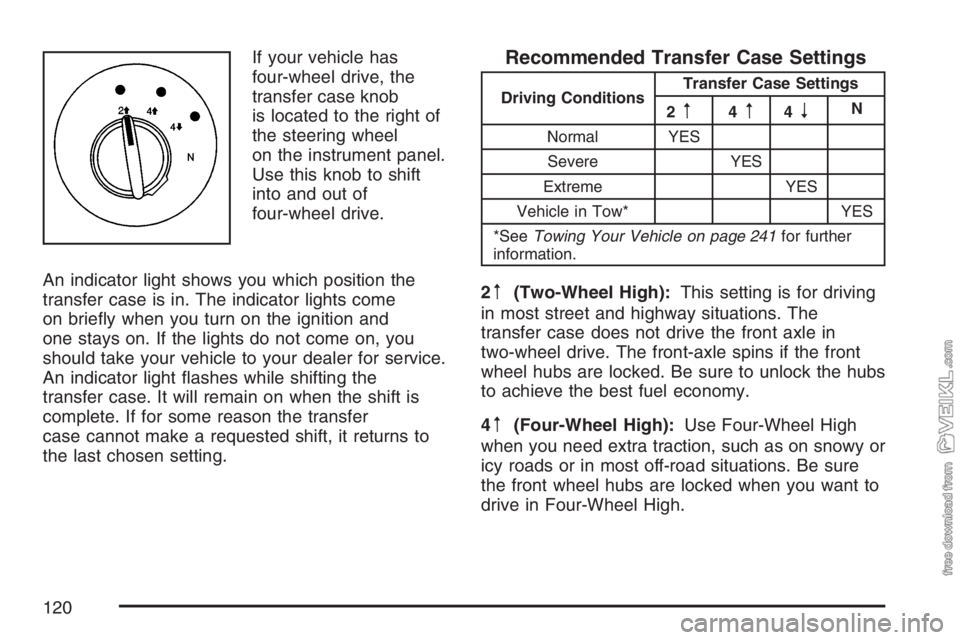
If your vehicle has
four-wheel drive, the
transfer case knob
is located to the right of
the steering wheel
on the instrument panel.
Use this knob to shift
into and out of
four-wheel drive.
An indicator light shows you which position the
transfer case is in. The indicator lights come
on briefly when you turn on the ignition and
one stays on. If the lights do not come on, you
should take your vehicle to your dealer for service.
An indicator light flashes while shifting the
transfer case. It will remain on when the shift is
complete. If for some reason the transfer
case cannot make a requested shift, it returns to
the last chosen setting.Recommended Transfer Case Settings
Driving ConditionsTransfer Case Settings
2m4m4nN
Normal YES
Severe YES
Extreme YES
Vehicle in Tow* YES
*SeeTowing Your Vehicle on page 241for further
information.
2m(Two-Wheel High):This setting is for driving
in most street and highway situations. The
transfer case does not drive the front axle in
two-wheel drive. The front-axle spins if the front
wheel hubs are locked. Be sure to unlock the hubs
to achieve the best fuel economy.
4
m(Four-Wheel High):Use Four-Wheel High
when you need extra traction, such as on snowy or
icy roads or in most off-road situations. Be sure
the front wheel hubs are locked when you want to
drive in Four-Wheel High.
120
Page 121 of 430
4n(Four-Wheel Low):This setting sends
maximum power to all four wheels. You might
choose Four-Wheel Low if you are driving off-road
in deep sand, deep mud, and climbing or
descending steep hills. Be sure the front wheel
hubs are locked when you want to drive in
Four-Wheel Low.
{CAUTION:
Shifting the transfer case to NEUTRAL
can cause your vehicle to roll even if the
transmission is in PARK (P). You or
someone else could be injured. If you are
going to leave your vehicle, set the
parking brake and shift the transmission
to PARK (P) and make sure the transfer
case is in a drive gear.Notice:If your vehicle has an Allison
®
transmission and you try to put the
transmission in PARK (P) while the transfer
case is in Four-Wheel Low, the transmission
might not go into PARK (P) and could damage
your vehicle. When parking your vehicle,
make sure the transfer case is in Two-Wheel
High or Four-Wheel High.
NEUTRAL:Shift the vehicle’s transfer case to
NEUTRAL only when towing your vehicle.
Shifting Into Four-Wheel High
Turn the knob to four-wheel high. This can be
done at 3 mph or less, while you are shifting out
of Four-Wheel Low. The indicator light flashes
while shifting. It remains on after the shift is
complete. Be sure to lock your front hubs.
121
Page 127 of 430
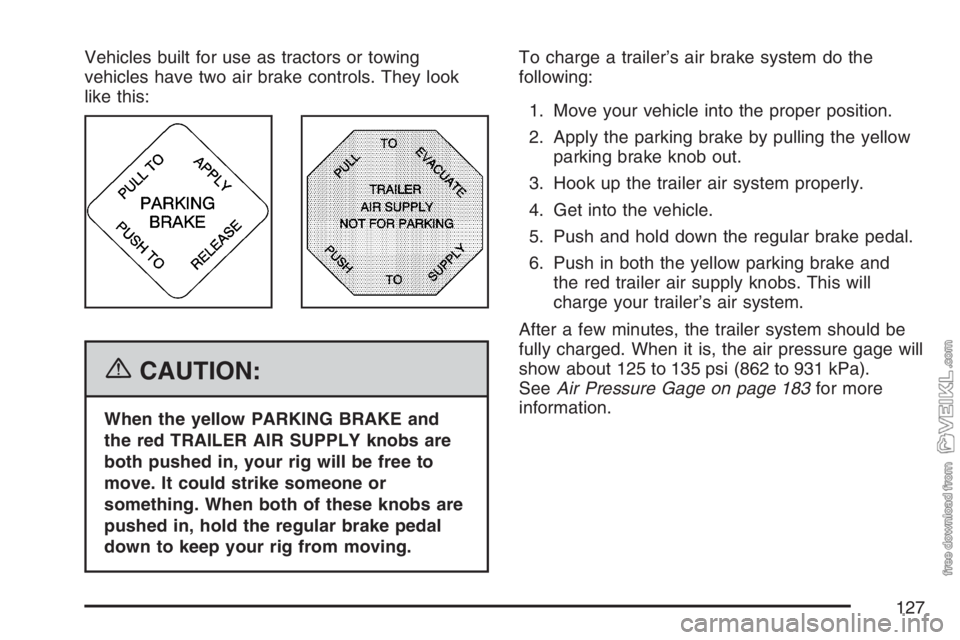
Vehicles built for use as tractors or towing
vehicles have two air brake controls. They look
like this:
{CAUTION:
When the yellow PARKING BRAKE and
the red TRAILER AIR SUPPLY knobs are
both pushed in, your rig will be free to
move. It could strike someone or
something. When both of these knobs are
pushed in, hold the regular brake pedal
down to keep your rig from moving.To charge a trailer’s air brake system do the
following:
1. Move your vehicle into the proper position.
2. Apply the parking brake by pulling the yellow
parking brake knob out.
3. Hook up the trailer air system properly.
4. Get into the vehicle.
5. Push and hold down the regular brake pedal.
6. Push in both the yellow parking brake and
the red trailer air supply knobs. This will
charge your trailer’s air system.
After a few minutes, the trailer system should be
fully charged. When it is, the air pressure gage will
show about 125 to 135 psi (862 to 931 kPa).
SeeAir Pressure Gage on page 183for more
information.
127
Page 128 of 430
For driving with a trailer, the yellow and red, if
equipped, knobs must be pushed in. When you are
not pulling a trailer, the red trailer air supply
knob must be pulled out.
{CAUTION:
If you apply any one of the air brake
parking controls while the vehicle is
moving, your rig will stop suddenly. If you
are not ready for this, you or others could
be injured. Do not apply any one of these
controls while you are driving, unless you
have to make an emergency stop.
If the air pressure drops below 60 to 70 psi
(413 to 482 kPa), the primary brake light and
warning buzzer will come on. If the air pressure
drops to 35 to 45 psi (241 to 310 kPa), the
red trailer air supply knob will automatically pop
out and apply the spring brakes on the trailer.If the air pressure drops to 35 to 45 psi
(241 to 310 kPa), the yellow park brake knob will
automatically pop out and apply the spring
brakes on the truck or tractor.
If you ever have a complete loss of air so that
your air brakes automatically apply, there is a way
that the tow operator can release the parking
brakes to tow the vehicle. SeeTowing Your
Vehicle on page 241.
Parking Brake Burnish Procedure
All vehicles which have hydraulic brakes will have
a parking brake. It is recommended that the
parking brake be burnished as part of the new
vehicle break-in. The parking brake will work best
after it has been burnished following these
instructions:
1. Making sure that there is no other traffic
around, get the vehicle speed up to
20 mph (32 km/h) and pull up to apply the
parking brake. Let the vehicle come to
a complete stop. Apply the base brakes and
disengage the parking brake.
128
Page 133 of 430
Mirrors
Manual Rearview Mirror
If your vehicle has this feature, pull the tab under
the mirror toward you to reduce glare from
headlamps behind you after dark. Push the tab
away from you to restore the mirror to the daytime
position.
Outside Manual Mirrors
Adjust the outside rearview mirrors so you can
see a little of the side of your vehicle, and the area
beside your vehicle from a comfortable driving
position. All mirrors can be folded in to enter
narrow passageways.
Outside Power Mirrors
If you have outside power mirrors, they can be
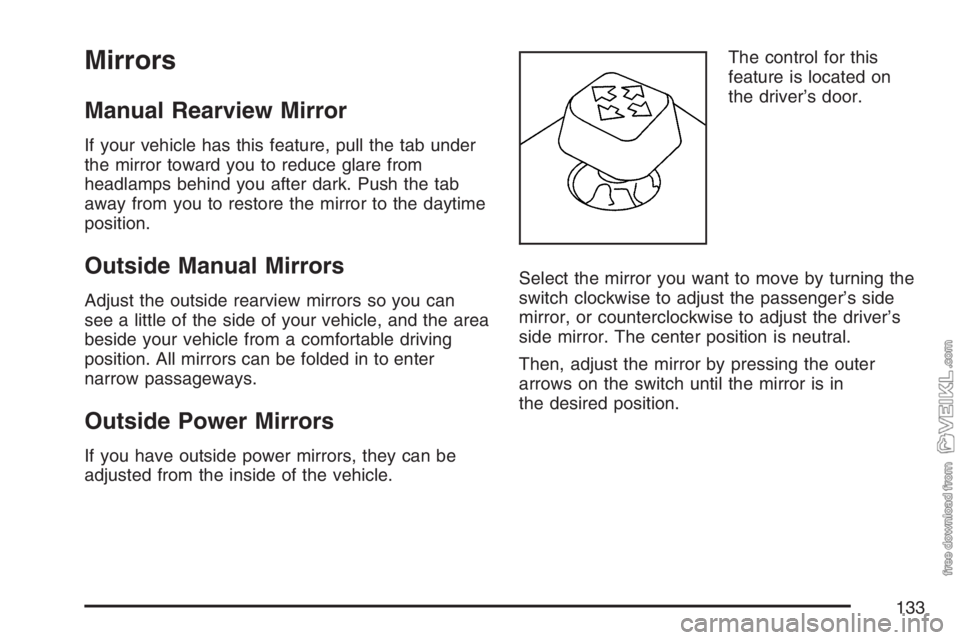
adjusted from the inside of the vehicle.The control for this
feature is located on
the driver’s door.
Select the mirror you want to move by turning the
switch clockwise to adjust the passenger’s side
mirror, or counterclockwise to adjust the driver’s
side mirror. The center position is neutral.
Then, adjust the mirror by pressing the outer
arrows on the switch until the mirror is in
the desired position.
133
Page 144 of 430
Turn and Lane-Change Signals
The turn signal has two upward (for right) and
two downward (for left) positions. These positions
allow you to signal a turn or a lane change.
To signal a turn, move the lever all the way up or
down. When the turn is finished, the lever will
return automatically.
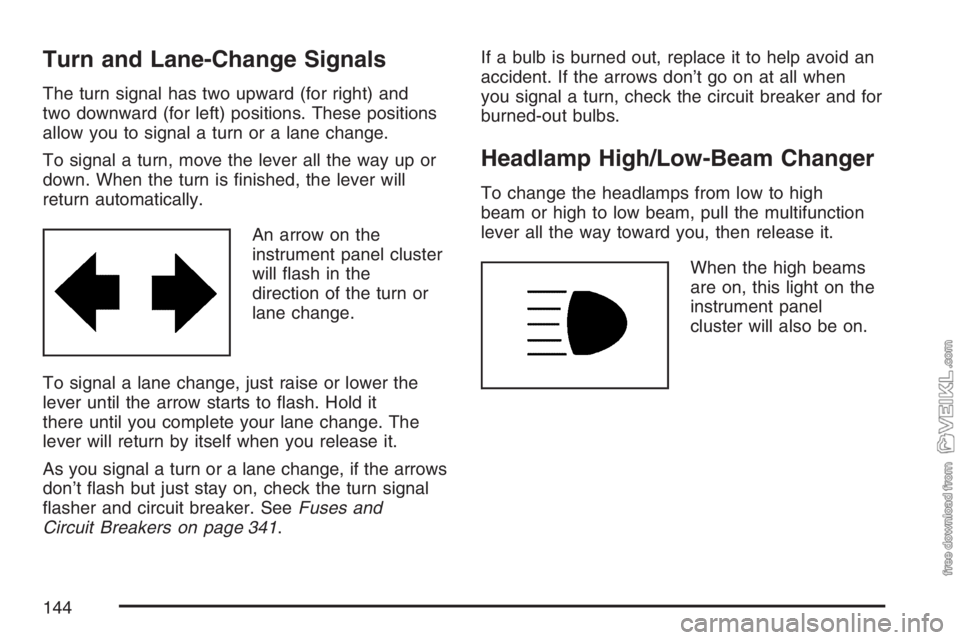
An arrow on the
instrument panel cluster
will flash in the
direction of the turn or
lane change.
To signal a lane change, just raise or lower the
lever until the arrow starts to flash. Hold it
there until you complete your lane change. The
lever will return by itself when you release it.
As you signal a turn or a lane change, if the arrows
don’t flash but just stay on, check the turn signal
flasher and circuit breaker. SeeFuses and
Circuit Breakers on page 341.If a bulb is burned out, replace it to help avoid an
accident. If the arrows don’t go on at all when
you signal a turn, check the circuit breaker and for
burned-out bulbs.
Headlamp High/Low-Beam Changer
To change the headlamps from low to high
beam or high to low beam, pull the multifunction
lever all the way toward you, then release it.
When the high beams
are on, this light on the
instrument panel
cluster will also be on.
144
Page 145 of 430
Windshield Wipers
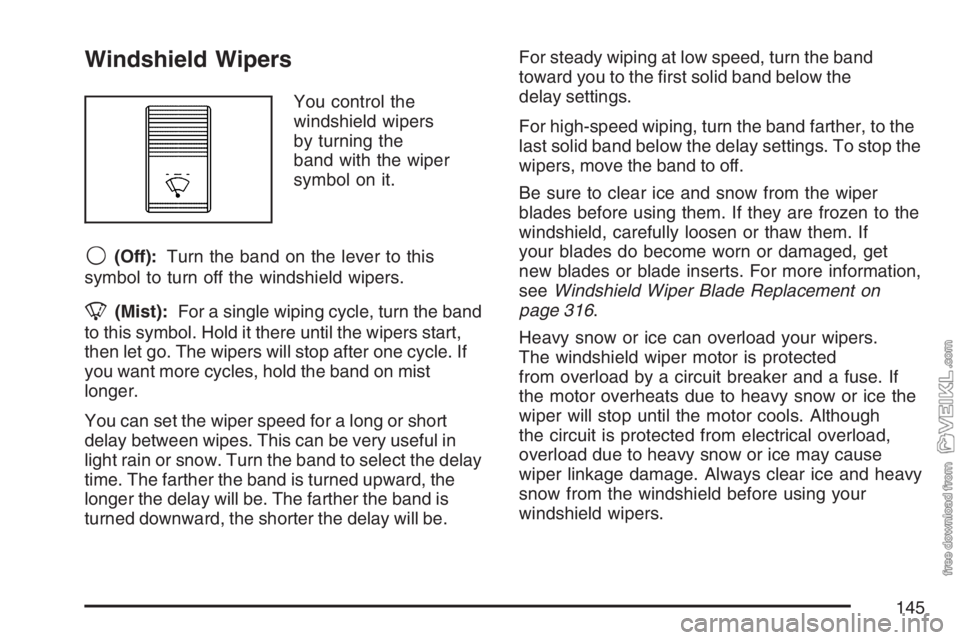
You control the
windshield wipers
by turning the
band with the wiper
symbol on it.
9(Off):Turn the band on the lever to this
symbol to turn off the windshield wipers.
8(Mist):For a single wiping cycle, turn the band
to this symbol. Hold it there until the wipers start,
then let go. The wipers will stop after one cycle. If
you want more cycles, hold the band on mist
longer.
You can set the wiper speed for a long or short
delay between wipes. This can be very useful in
light rain or snow. Turn the band to select the delay
time. The farther the band is turned upward, the
longer the delay will be. The farther the band is
turned downward, the shorter the delay will be.For steady wiping at low speed, turn the band
toward you to the first solid band below the
delay settings.
For high-speed wiping, turn the band farther, to the
last solid band below the delay settings. To stop the
wipers, move the band to off.
Be sure to clear ice and snow from the wiper
blades before using them. If they are frozen to the
windshield, carefully loosen or thaw them. If
your blades do become worn or damaged, get
new blades or blade inserts. For more information,
seeWindshield Wiper Blade Replacement on
page 316.
Heavy snow or ice can overload your wipers.
The windshield wiper motor is protected
from overload by a circuit breaker and a fuse. If
the motor overheats due to heavy snow or ice the
wiper will stop until the motor cools. Although
the circuit is protected from electrical overload,
overload due to heavy snow or ice may cause
wiper linkage damage. Always clear ice and heavy
snow from the windshield before using your
windshield wipers.
145
Page 150 of 430
Exterior Lamps
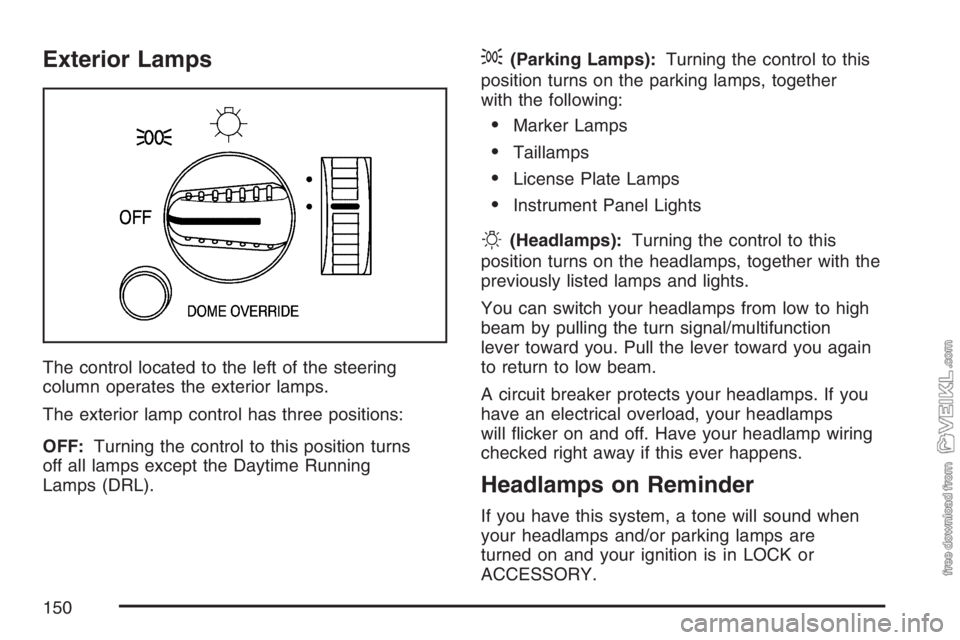
The control located to the left of the steering
column operates the exterior lamps.
The exterior lamp control has three positions:
OFF:Turning the control to this position turns
off all lamps except the Daytime Running
Lamps (DRL).
;(Parking Lamps):Turning the control to this
position turns on the parking lamps, together
with the following:
•Marker Lamps
•Taillamps
•License Plate Lamps
•Instrument Panel Lights
O(Headlamps):Turning the control to this
position turns on the headlamps, together with the
previously listed lamps and lights.
You can switch your headlamps from low to high
beam by pulling the turn signal/multifunction
lever toward you. Pull the lever toward you again
to return to low beam.
A circuit breaker protects your headlamps. If you
have an electrical overload, your headlamps
will flicker on and off. Have your headlamp wiring
checked right away if this ever happens.
Headlamps on Reminder
If you have this system, a tone will sound when
your headlamps and/or parking lamps are
turned on and your ignition is in LOCK or
ACCESSORY.
150
Page 158 of 430
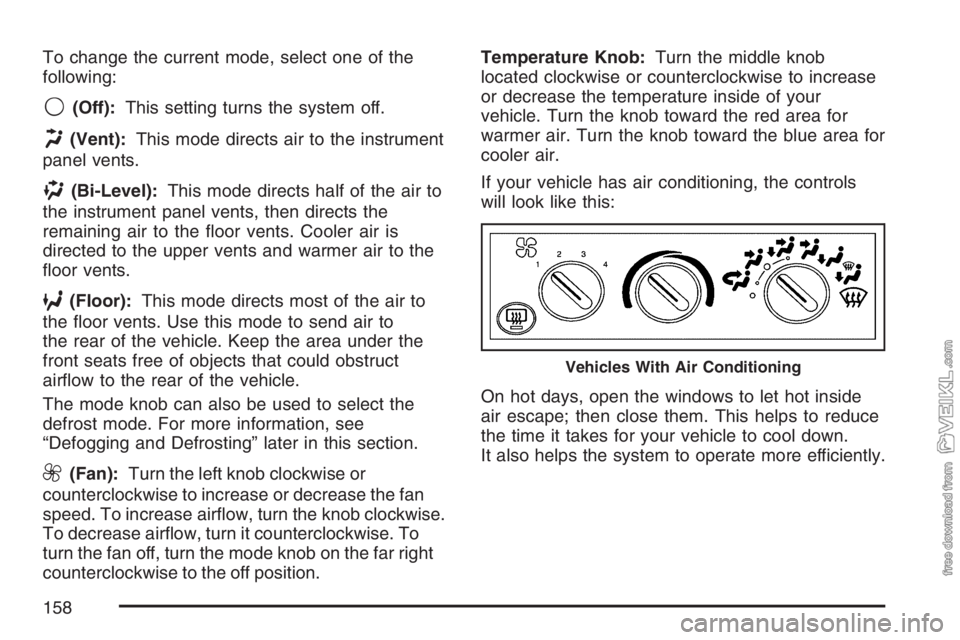
To change the current mode, select one of the
following:
9(Off):This setting turns the system off.
H(Vent):This mode directs air to the instrument
panel vents.
)(Bi-Level):This mode directs half of the air to
the instrument panel vents, then directs the
remaining air to the floor vents. Cooler air is
directed to the upper vents and warmer air to the
floor vents.
6(Floor):This mode directs most of the air to
the floor vents. Use this mode to send air to
the rear of the vehicle. Keep the area under the
front seats free of objects that could obstruct
airflow to the rear of the vehicle.
The mode knob can also be used to select the
defrost mode. For more information, see
“Defogging and Defrosting” later in this section.
9(Fan):Turn the left knob clockwise or
counterclockwise to increase or decrease the fan
speed. To increase airflow, turn the knob clockwise.
To decrease airflow, turn it counterclockwise. To
turn the fan off, turn the mode knob on the far right
counterclockwise to the off position.Temperature Knob:Turn the middle knob
located clockwise or counterclockwise to increase
or decrease the temperature inside of your
vehicle. Turn the knob toward the red area for
warmer air. Turn the knob toward the blue area for
cooler air.
If your vehicle has air conditioning, the controls
will look like this:
On hot days, open the windows to let hot inside
air escape; then close them. This helps to reduce
the time it takes for your vehicle to cool down.
It also helps the system to operate more efficiently.
Vehicles With Air Conditioning
158
Page 159 of 430
<(Maximum Air Conditioning):Turn the right
knob to this setting for maximum cooling. This
setting puts the system in recirculation mode and
helps to maximize your air conditioner’s
performance and your vehicle’s fuel economy.
This setting also cools the air the fastest.
Y(Air Conditioning):This setting is used for
normal cooling on hot days. It cools outside air and
directs it through the instrument panel vents.
)(Bi-Level Air Conditioning):This setting
divides airflow between the floor vents and
instrument panel vents. The air conditioning
compressor will cycle continuously in this setting
as long as the outside temperature is warm
enough to activate the compressor.
Defogging and Defrosting
Fog on the inside of windows is a result of high
humidity (moisture) condensing on the cool window
glass. This can be minimized if the climate
control is used properly. There are two modes to
clear fog or frost from your windshield and
side windows.Use the defog mode to clear the windows of fog or
moisture and warm the passengers. Use the defrost
mode to remove fog or frost from the windshield
more quickly. For best results, clear all snow and
ice from the windshield before defrosting.
Turn the mode knob on the right of the climate
control panel to select the defog or defrost mode.
-(Defog):With this setting, the outside air
comes out of both the floor and defroster outlets.
Adjust the temperature knob for warmer or
cooler air. The air conditioning compressor may
operate in this setting to dehumidify the air.
0(Defrost):This setting operates the defroster.
Most of the air comes out near the windshield,
with some going to the floor outlets and front side
windows. The air conditioning compressor may
operate in this setting to dehumidify the air.
The defog setting is useful for cold weather with a
large number of passengers or very humid
conditions to help keep the windshield clear. Use
defrost to remove fog or ice from the windshield
quickly in extremely cold conditions. The
temperature knob should be in the red area and
the fan control toward high. Do not drive the
vehicle until all the windows are clear.
159