tow CHEVROLET KODIAK 2007 Owner's Manual
[x] Cancel search | Manufacturer: CHEVROLET, Model Year: 2007, Model line: KODIAK, Model: CHEVROLET KODIAK 2007Pages: 430, PDF Size: 6.06 MB
Page 169 of 430
Notice:If you continue driving your vehicle
after the transmission warning light comes on,
you could damage the transmission. While
this light is on, the transmission cannot
operate in all gears. If you attempt to shift
gears, the vehicle may not continue to move.
Do not attempt to shift gears while the
transmission warning light is on. Instead, drive
directly to an authorized dealer for service. If
you cannot drive to a dealer immediately, have
the vehicle towed.
Range Inhibit Warning Indicator
If your vehicle has an Allison 1000/2200/2300/
2500 series automatic transmission, a lighted bar
under the current gear selected will flash.
If your vehicle has an Allison 3000/3500
series automatic transmission, the current gear
selected on the pushbutton display will flash.
The flashing bar or gear selection indicates that
transmission range shifts may not occur.
For detailed information on shift inhibit limitations,
see the Allison Automatic Transmission
Operator’s Manual in your vehicle for further
information.
Brake System Warning Light
Your vehicle has either hydraulic or air brakes.
Each system has different warning lights.
Hydraulic Brake System
Warning Lights
Vehicles with hydraulic brake systems
have two brake system warning lights on the
instrument panel.
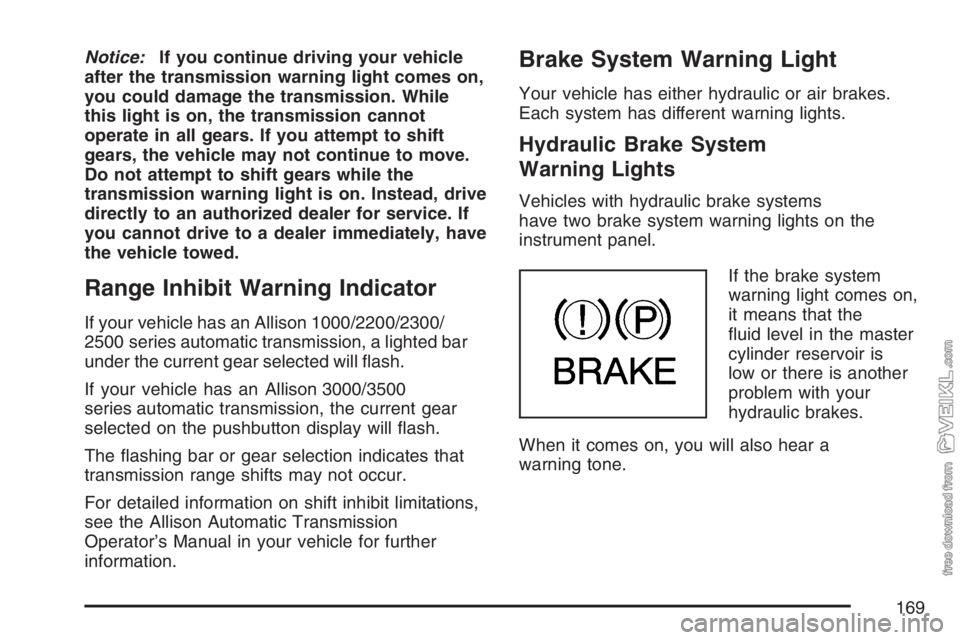
If the brake system
warning light comes on,
it means that the
fluid level in the master
cylinder reservoir is
low or there is another
problem with your
hydraulic brakes.
When it comes on, you will also hear a
warning tone.
169
Page 170 of 430
The brake system warning light may come on, and
the warning tone may sound, when you are
turning and braking at the same time. This is
normal. See “Hydraulic Brake Systems” under
Braking on page 210.
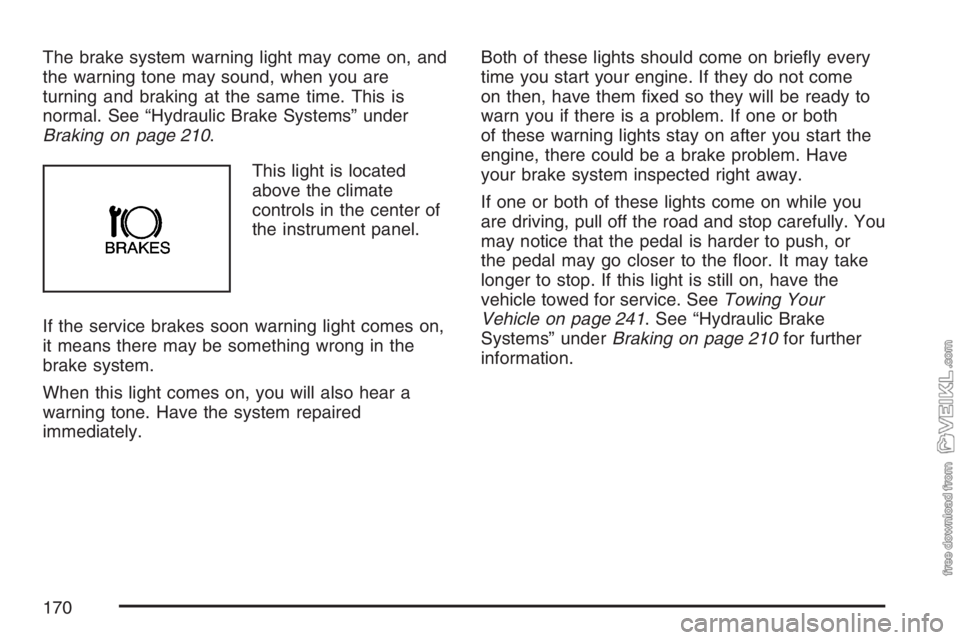
This light is located
above the climate
controls in the center of
the instrument panel.
If the service brakes soon warning light comes on,
it means there may be something wrong in the
brake system.
When this light comes on, you will also hear a
warning tone. Have the system repaired
immediately.Both of these lights should come on briefly every
time you start your engine. If they do not come
on then, have them fixed so they will be ready to
warn you if there is a problem. If one or both
of these warning lights stay on after you start the
engine, there could be a brake problem. Have
your brake system inspected right away.
If one or both of these lights come on while you
are driving, pull off the road and stop carefully. You
may notice that the pedal is harder to push, or
the pedal may go closer to the floor. It may take
longer to stop. If this light is still on, have the
vehicle towed for service. SeeTowing Your
Vehicle on page 241. See “Hydraulic Brake
Systems” underBraking on page 210for further
information.
170
Page 174 of 430
Wait to Start Indicator
If your vehicle has the DURAMAX®6.6L diesel
engine, it will have glow plugs and an air
intake heater. If your vehicle has the Isuzu 6H
diesel engine, it will have glow plugs and an inlet
heater. If your vehicle has a Caterpillar
®engine,
it will have an inlet heater.
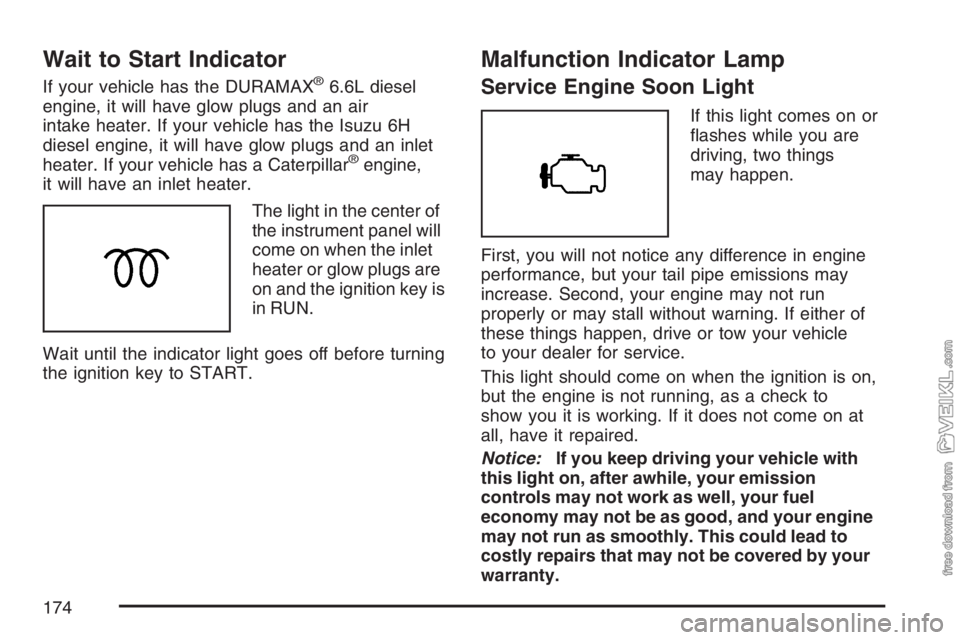
The light in the center of
the instrument panel will
come on when the inlet
heater or glow plugs are
on and the ignition key is
in RUN.
Wait until the indicator light goes off before turning
the ignition key to START.
Malfunction Indicator Lamp
Service Engine Soon Light
If this light comes on or
flashes while you are
driving, two things
may happen.
First, you will not notice any difference in engine
performance, but your tail pipe emissions may
increase. Second, your engine may not run
properly or may stall without warning. If either of
these things happen, drive or tow your vehicle
to your dealer for service.
This light should come on when the ignition is on,
but the engine is not running, as a check to
show you it is working. If it does not come on at
all, have it repaired.
Notice:If you keep driving your vehicle with
this light on, after awhile, your emission
controls may not work as well, your fuel
economy may not be as good, and your engine
may not run as smoothly. This could lead to
costly repairs that may not be covered by your
warranty.
174
Page 188 of 430
Adjusting the Speakers (Balance/Fade)
AUDIO:To adjust the balance between the
right and the left speakers, press and release
AUDIO until BAL (balance) displays. Then press
and hold the up or the down arrow to move
the sound toward the right or the left speakers.
To adjust the fade between the front and the rear
speakers, press and release AUDIO until FAD
(fade) displays. Then press and hold the up or the
down arrow to move the sound toward the front
or the rear speakers.
To adjust balance or fade to the middle position,
select BAL or FAD. Then press and hold
AUDIO for more than two seconds until a beep
sounds. B (balance) and a zero or F (fade) and a
zero displays.
To adjust both tone controls and both speaker
controls to the middle position, first exit out of audio
mode by pressing another button, causing the radio
to perform that function or wait five seconds for the
display to return to time of day. Then press and hold
AUDIO for more than two seconds until a beep
sounds. CEN (center) displays.
Fade might not be available if the vehicle is a
regular cab model.
Radio Messages
CAL (Calibrated):The audio system has been
calibrated for your vehicle from the factory. If CAL
displays it means that the radio has not been
configured properly for your vehicle and must be
returned to your dealer for service.
LOC (Locked):This message is displayed when
the THEFTLOCK
®system has locked up. Take
the vehicle to your dealer for service.
If any error occurs repeatedly or if an error cannot
be corrected, contact your dealer.
188
Page 191 of 430
Adjusting the Speakers (Balance/Fade)
AUDIO:To adjust the balance between the right
and the left speakers, press and release AUDIO
until BAL (balance) appears on the display. Then
press and hold the up or the down arrow to move
the sound toward the right or the left speakers.
To adjust the fade between the front and the rear
speakers, press and release AUDIO until FAD
(fade) appears on the display. Then press and hold
the up or the down arrow to move the sound toward
the front or the rear speakers.
To adjust balance or fade to the middle position,
select BAL or FAD. Then press and hold AUDIO for
more than two seconds until you hear a beep.
L (balance) and a zero or F and a zero appears on
the display.
To adjust both tone controls and both speaker
controls to the middle position, end out of audio by
waiting for the display to change to the time display.
Then press and hold AUDIO for more than
two seconds until you hear a beep. CEN (center)
appears on the display.
Fade may not be available if the vehicle is a regular
cab model.
Radio Messages
CAL (Calibration):The audio system has been
calibrated for your vehicle from the factory. If
CAL appears on the display it means that the radio
has not been configured properly for your vehicle
and must be returned to your dealer for service.
LOC (Locked):This message is displayed when
the THEFTLOCK
®system has locked up. Take
the vehicle to your dealer for service.
If any error occurs repeatedly or if an error cannot
be corrected, contact your dealer.
Playing a Cassette Tape
The tape player is built to work best with tapes
that are up to 30 to 45 minutes long on each side.
Tapes longer than that are so thin they may not
work well in this player. The longer side with
the tape visible should face to the right. If you hear
nothing or hear a garbled sound, the tape may
not be in squarely. Press the eject button to
remove the tape and start over.
191
Page 197 of 430
Adjusting the Speakers (Balance/Fade)
AUDIO:To adjust the balance between the
right and the left speakers, press and release the
AUDIO button until BAL (balance) appears on
the display. Then press and hold the up or
the down arrow to move the sound toward the
right or the left speakers.
To adjust the fade between the front and the rear
speakers, press and release the AUDIO button
until FAD (fade) appears on the display. Then
press and hold the up or the down arrow to move
the sound toward the front or the rear speakers.
To adjust balance or fade to the middle position,
select BAL or FAD. Then press and hold
AUDIO for more than two seconds until you hear
a beep. L (balance) and a zero or F and a
zero appears on the display.To adjust both tone controls and both speaker
controls to the middle position, first end out
of audio mode by pressing another button, causing
the radio to perform that function, or by waiting
five seconds for the display to return to the time of
day. Then press and hold the AUDIO button for
more than two seconds until you hear a beep.
CEN appears on the display.
Fade may not be available if the vehicle is a
regular cab model.
Radio Messages
CAL (Calibration):The audio system has been
calibrated for your vehicle from the factory. If
CAL appears on the display it means that the radio
has not been configured properly for your vehicle
and must be returned to your dealer for service.
LOC (Locked):This message is displayed when
the THEFTLOCK
®system has locked up. Take
the vehicle to your dealer for service.
If any error occurs repeatedly or cannot be
corrected, contact your dealer.
197
Page 205 of 430
Your Driving, the Road, and Your Vehicle.... 206
Defensive Driving...................................... 206
Drunken Driving........................................ 207
Control of a Vehicle.................................. 210
Braking...................................................... 210
Hydraulic Brake Systems........................... 211
Anti-Lock Brake System (ABS).................. 212
Braking in Emergencies............................. 213
Trailer Brake Hand Control Valve.............. 214
Rear Axle Differential Lock Control............ 215
Traction Control System (TCS).................. 216
Steering.................................................... 217
Off-Road Recovery.................................... 219
Passing..................................................... 220
Loss of Control.......................................... 221
Driving at Night......................................... 223Driving in Rain and on Wet Roads............ 224
City Driving............................................... 227
Freeway Driving........................................ 228
Highway Hypnosis..................................... 229
Hill and Mountain Roads........................... 230
Winter Driving........................................... 231
If Your Vehicle is Stuck in Sand,
Mud, Ice, or Snow ................................. 236
Rocking Your Vehicle to Get It Out........... 236
Tow Hooks................................................ 237
Loading Your Vehicle................................ 238
Adding a Snow Plow or Similar
Equipment.............................................. 240
Towing........................................................ 241
Towing Your Vehicle ................................. 241
Trailer Connections................................... 243
Section 4 Driving Your Vehicle
205
Page 236 of 430
If Your Vehicle is Stuck in Sand,
Mud, Ice, or Snow
In order to free your vehicle when it is stuck,
you will need to spin the wheels, but you do not
want to spin your wheels too fast. The method
known as rocking can help you get out when you
are stuck, but you must use caution.
{CAUTION:
If you let your vehicle’s tires spin at high
speed, they can explode, and you or others
could be injured. And, the transmission or
other parts of the vehicle can overheat.
That could cause an engine compartment
re or other damage. When you are stuck,
spin the wheels as little as possible. Do not
spin the wheels above 35 mph (55 km/h)
as shown on the speedometer.
Notice:Spinning the wheels can destroy
parts of your vehicle as well as the tires. If you
spin the wheels too fast while shifting the
transmission back and forth, you can destroy
the transmission.
Rocking Your Vehicle to Get It Out
First, turn the steering wheel left and right.
That will clear the area around the front wheels.
If you have a four-wheel-drive vehicle, shift
into 4HI. SeeFour-Wheel Drive on page 119.
If your vehicle has traction control, you should turn
the traction control system off. SeeTraction
Control System (TCS) on page 216. Then shift
back and forth between REVERSE (R) and
a forward gear, or with a manual transmission,
between FIRST (1) or SECOND (2) and
REVERSE (R), spinning the wheels as little as
possible. Release the accelerator pedal while you
shift, and press lightly on the accelerator pedal
when the transmission is in gear. By slowly
spinning the wheels in the forward and reverse
directions, you will cause a rocking motion
that may free your vehicle. If that does not get
your vehicle out after a few tries, it may need to
be towed out. If your vehicle does need to be
towed out, seeTowing Your Vehicle on page 241.
236
Page 237 of 430
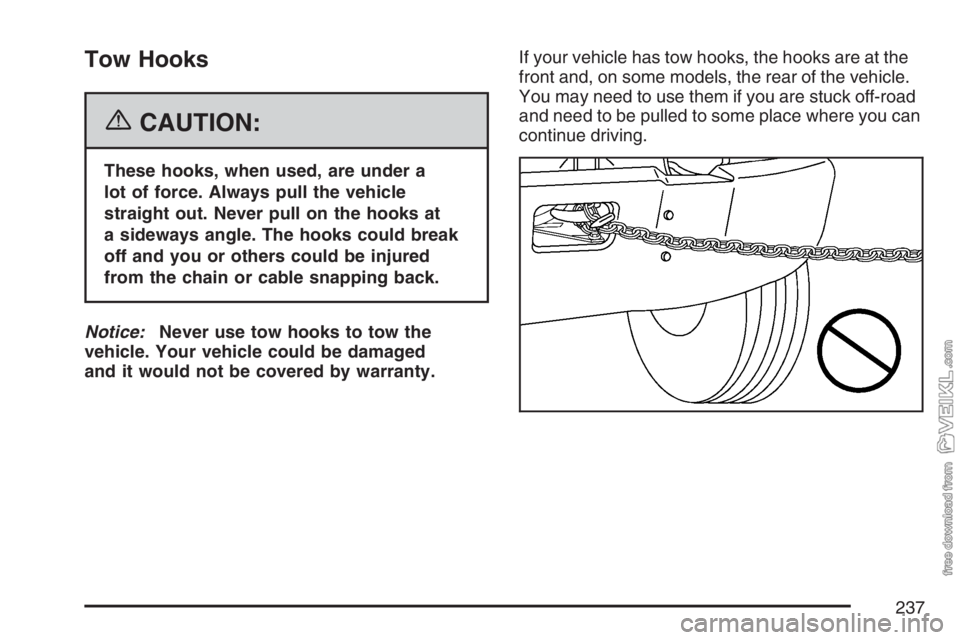
Tow Hooks
{CAUTION:
These hooks, when used, are under a
lot of force. Always pull the vehicle
straight out. Never pull on the hooks at
a sideways angle. The hooks could break
off and you or others could be injured
from the chain or cable snapping back.
Notice:Never use tow hooks to tow the
vehicle. Your vehicle could be damaged
and it would not be covered by warranty.If your vehicle has tow hooks, the hooks are at the
front and, on some models, the rear of the vehicle.
You may need to use them if you are stuck off-road
and need to be pulled to some place where you can
continue driving.
237
Page 241 of 430
Towing
Towing Your Vehicle
Consult your dealer or a professional towing service
if you need to have your disabled vehicle towed.
SeeRoadside Assistance Program on page 408.
Releasing Air-Operated Parking Brakes
If your vehicle has air brakes, you could have a
special towing problem. If your vehicle has to
be towed because of a complete loss of air
pressure from both systems, the parking brakes
will have automatically engaged. The tow operator
can release the brakes manually by using the
following steps. Then your vehicle can be towed
with all wheels or only the rear wheels on
the ground.
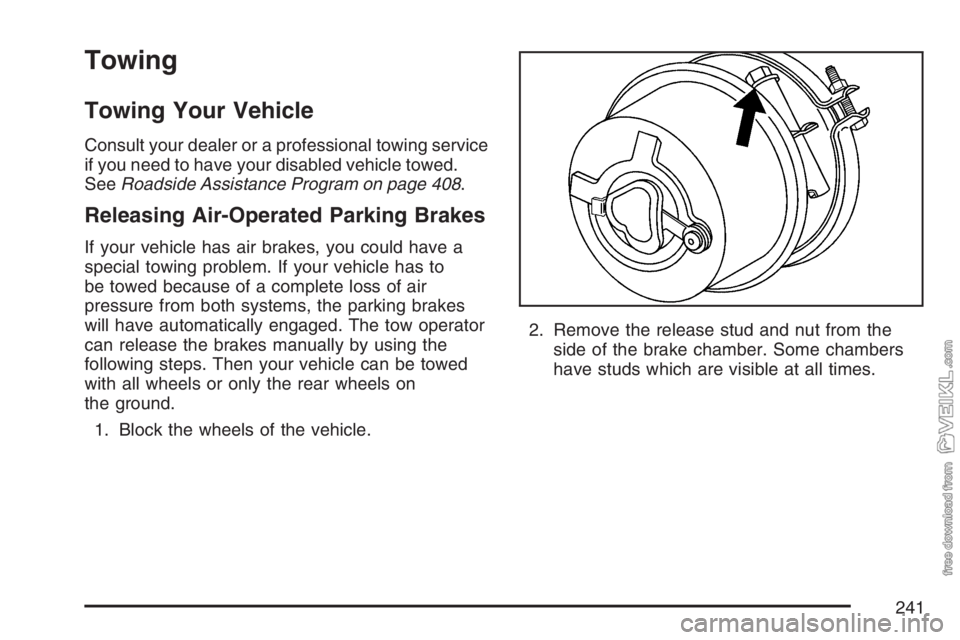
1. Block the wheels of the vehicle.2. Remove the release stud and nut from the
side of the brake chamber. Some chambers
have studs which are visible at all times.
241